
Chapter 15 Basics of Functional Dependencies and Normalization

Chapter 15 Basics of Functional Dependencies and Normalization for Relational Databases Copyright © 2011 Pearson Education, Inc. Publishing as Pearson Addison-Wesley
Introduction § Levels at which we can discuss goodness of relation schemas Logical (or conceptual) level § Implementation (or physical storage) level § § Approaches to database design: § Bottom-up or top-down Copyright © 2011 Ramez Elmasri and Shamkant Navathe
1 Informal Design Guidelines for Relational Databases (1) § What is relational database design? § The grouping of attributes to form "good" relation schemas § Two levels of relation schemas § The logical "user view" level § The storage "base relation" level § Design is concerned mainly with base relations § What are the criteria for "good" base relations? Copyright © 2011 Ramez Elmasri and Shamkant Navathe Slide 10 - 3
Informal Design Guidelines for Relational Databases (2) § We first discuss informal guidelines for good relational design § Then we discuss formal concepts of functional dependencies and normal forms § - 1 NF (First Normal Form) § - 2 NF (Second Normal Form) § - 3 NF (Third Normal Form) § - BCNF (Boyce-Codd Normal Form) § Additional types of dependencies, further normal forms, relational design algorithms by synthesis are discussed in Chapter 11 Copyright © 2011 Ramez Elmasri and Shamkant Navathe Slide 10 - 4
1. 1 Semantics of the Relation Attributes § GUIDELINE 1: Informally, each tuple in a relation should represent one entity or relationship instance. (Applies to individual relations and their attributes). § Attributes of different entities (EMPLOYEEs, DEPARTMENTs, PROJECTs) should not be mixed in the same relation § Only foreign keys should be used to refer to other entities § Entity and relationship attributes should be kept apart as much as possible. § Bottom Line: Design a schema that can be explained easily relation by relation. The semantics of attributes should be easy to interpret. Copyright © 2011 Ramez Elmasri and Shamkant Navathe Slide 10 - 5
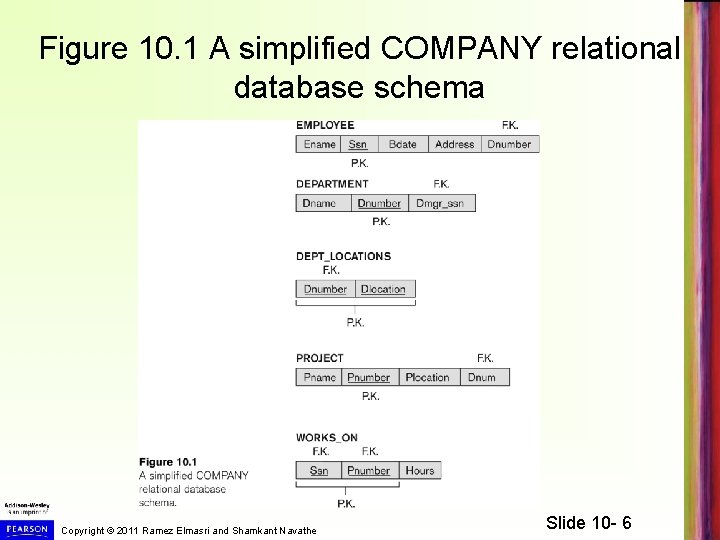
Figure 10. 1 A simplified COMPANY relational database schema Copyright © 2011 Ramez Elmasri and Shamkant Navathe Slide 10 - 6
1. 2 Redundant Information in Tuples and Update Anomalies § Information is stored redundantly Wastes storage § Causes problems with update anomalies § • Insertion anomalies • Deletion anomalies • Modification anomalies Copyright © 2011 Ramez Elmasri and Shamkant Navathe Slide 10 - 7
EXAMPLE OF AN UPDATE ANOMALY § Consider the relation: § EMP_PROJ(Emp#, Proj#, Ename, Pname, No_hours) § Update Anomaly: § Changing the name of project number P 1 from “Billing” to “Customer-Accounting” may cause this update to be made for all 100 employees working on project P 1. Copyright © 2011 Ramez Elmasri and Shamkant Navathe Slide 10 - 8
EXAMPLE OF AN INSERT ANOMALY § Consider the relation: § EMP_PROJ(Emp#, Proj#, Ename, Pname, No_hours) § Insert Anomaly: § Cannot insert a project unless an employee is assigned to it. § Conversely § Cannot insert an employee unless an he/she is assigned to a project. Copyright © 2011 Ramez Elmasri and Shamkant Navathe Slide 10 - 9
EXAMPLE OF AN DELETE ANOMALY § Consider the relation: § EMP_PROJ(Emp#, Proj#, Ename, Pname, No_hours) § Delete Anomaly: § When a project is deleted, it will result in deleting all the employees who work on that project. § Alternately, if an employee is the sole employee on a project, deleting that employee would result in deleting the corresponding project. Slide 10 - 10 Copyright © 2011 Ramez Elmasri and Shamkant Navathe
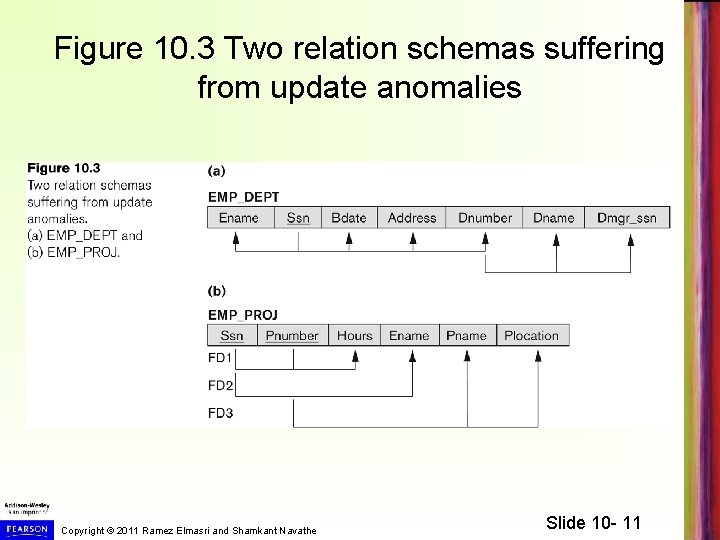
Figure 10. 3 Two relation schemas suffering from update anomalies Copyright © 2011 Ramez Elmasri and Shamkant Navathe Slide 10 - 11
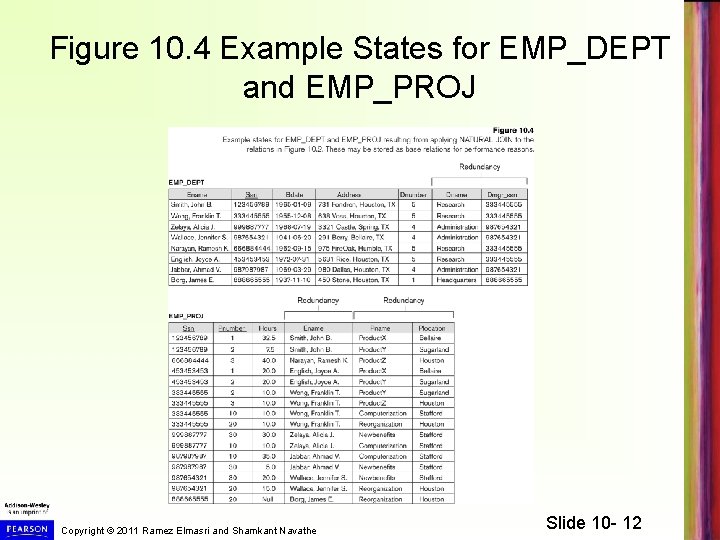
Figure 10. 4 Example States for EMP_DEPT and EMP_PROJ Copyright © 2011 Ramez Elmasri and Shamkant Navathe Slide 10 - 12
Guideline to Redundant Information in Tuples and Update Anomalies § GUIDELINE 2: Design a schema that does not suffer from the insertion, deletion and update anomalies. § If there any anomalies present, then note them so that applications can be made to take them into account. § Copyright © 2011 Ramez Elmasri and Shamkant Navathe Slide 10 - 13
1. 3 Null Values in Tuples § GUIDELINE 3: Relations should be designed such that their tuples will have as few NULL values as possible § Attributes that are NULL frequently could be placed in separate relations (with the primary key) § § Reasons for nulls: Attribute not applicable or invalid § Attribute value unknown (may exist) § Value known to exist, but unavailable § Copyright © 2011 Ramez Elmasri and Shamkant Navathe Slide 10 - 14
1. 4 Spurious Tuples § Bad designs for a relational database may result in erroneous results for certain JOIN operations § The "lossless join" property is used to guarantee meaningful results for join operations § GUIDELINE 4: The relations should be designed to satisfy the lossless join condition. § No spurious tuples should be generated by doing a natural-join of any relations. § Copyright © 2011 Ramez Elmasri and Shamkant Navathe Slide 10 - 15
2. 1 Functional Dependencies (1) § Functional dependencies (FDs) Are used to specify formal measures of the "goodness" of relational designs § And keys are used to define normal forms for relations § Are constraints that are derived from the meaning and interrelationships of the data attributes § § A set of attributes X functionally determines a set of attributes Y if the value of X determines a unique value for Y Copyright © 2011 Ramez Elmasri and Shamkant Navathe Slide 10 - 16
Functional Dependencies (2) § X -> Y holds if whenever two tuples have the same value for X, they must have the same value for Y § For any two tuples t 1 and t 2 in any relation instance r(R): If t 1[X]=t 2[X], then t 1[Y]=t 2[Y] § X -> Y in R specifies a constraint on all relation instances r(R) § Written as X -> Y; can be displayed graphically on a relation schema as in Figures. ( denoted by the arrow: ). § FDs are derived from the real-world constraints on the attributes Copyright © 2011 Ramez Elmasri and Shamkant Navathe Slide 10 - 17
Examples of FD constraints (1) § Social security number determines employee name § SSN -> ENAME § Project number determines project name and location § PNUMBER -> {PNAME, PLOCATION} § Employee ssn and project number determines the hours per week that the employee works on the project § {SSN, PNUMBER} -> HOURS Copyright © 2011 Ramez Elmasri and Shamkant Navathe Slide 10 - 18
Examples of FD constraints (2) § An FD is a property of the attributes in the schema R § The constraint must hold on every relation instance r(R) § If K is a key of R, then K functionally determines all attributes in R § (since we never have two distinct tuples with t 1[K]=t 2[K]) Copyright © 2011 Ramez Elmasri and Shamkant Navathe Slide 10 - 19
2. 2 Inference Rules for FDs (1) § Given a set of FDs F, we can infer additional FDs that hold whenever the FDs in F hold § Armstrong's inference rules: IR 1. (Reflexive) If Y subset-of X, then X -> Y § IR 2. (Augmentation) If X -> Y, then XZ -> YZ § • (Notation: XZ stands for X U Z) § IR 3. (Transitive) If X -> Y and Y -> Z, then X -> Z § IR 1, IR 2, IR 3 form a sound and complete set of inference rules § These are rules hold and all other rules that hold can be deduced from these Copyright © 2011 Ramez Elmasri and Shamkant Navathe Slide 10 - 20
3 Normal Forms Based on Primary Keys § 3. 1 Normalization of Relations § 3. 2 Practical Use of Normal Forms § 3. 3 Definitions of Keys and Attributes Participating in Keys § 3. 4 First Normal Form § 3. 5 Second Normal Form § 3. 6 Third Normal Form Copyright © 2011 Ramez Elmasri and Shamkant Navathe Slide 10 - 21
3. 1 Normalization of Relations (1) § Normalization: § The process of decomposing unsatisfactory "bad" relations by breaking up their attributes into smaller relations § Normal form: § Condition using keys and FDs of a relation to certify whether a relation schema is in a particular normal form Copyright © 2011 Ramez Elmasri and Shamkant Navathe Slide 10 - 22

Normalization of Relations (2) § 2 NF, 3 NF, BCNF § based on keys and FDs of a relation schema § 4 NF § based on keys, multi-valued dependencies : MVDs; 5 NF based on keys, join dependencies : JDs (Chapter 11) § Additional properties may be needed to ensure a good relational design (lossless join, dependency preservation; Chapter 11) Copyright © 2011 Ramez Elmasri and Shamkant Navathe Slide 10 - 23
3. 2 Practical Use of Normal Forms § Normalization is carried out in practice so that the resulting designs are of high quality and meet the desirable properties § The practical utility of these normal forms becomes questionable when the constraints on which they are based are hard to understand or to detect § The database designers need not normalize to the highest possible normal form § (usually up to 3 NF, BCNF or 4 NF) § Denormalization: § The process of storing the join of higher normal form relations as a base relation—which is in a lower normal form Copyright © 2011 Ramez Elmasri and Shamkant Navathe Slide 10 - 24
3. 3 Definitions of Keys and Attributes Participating in Keys (1) § A superkey of a relation schema R = {A 1, A 2, . . , An} is a set of attributes S subset-of R with the property that no two tuples t 1 and t 2 in any legal relation state r of R will have t 1[S] = t 2[S] § A key K is a superkey with the additional property that removal of any attribute from K will cause K not to be a superkey any more. Slide 10 - 25 Copyright © 2011 Ramez Elmasri and Shamkant Navathe
Definitions of Keys and Attributes Participating in Keys (2) § If a relation schema has more than one key, each is called a candidate key. § One of the candidate keys is arbitrarily designated to be the primary key, and the others are called secondary keys. § A Prime attribute must be a member of some candidate key § A Nonprime attribute is not a prime attribute—that is, it is not a member of any candidate key. Copyright © 2011 Ramez Elmasri and Shamkant Navathe Slide 10 - 26
3. 2 First Normal Form § Disallows composite attributes § multivalued attributes § nested relations; attributes whose values for an individual tuple are non-atomic § § Considered to be part of the definition of relation Copyright © 2011 Ramez Elmasri and Shamkant Navathe Slide 10 - 27
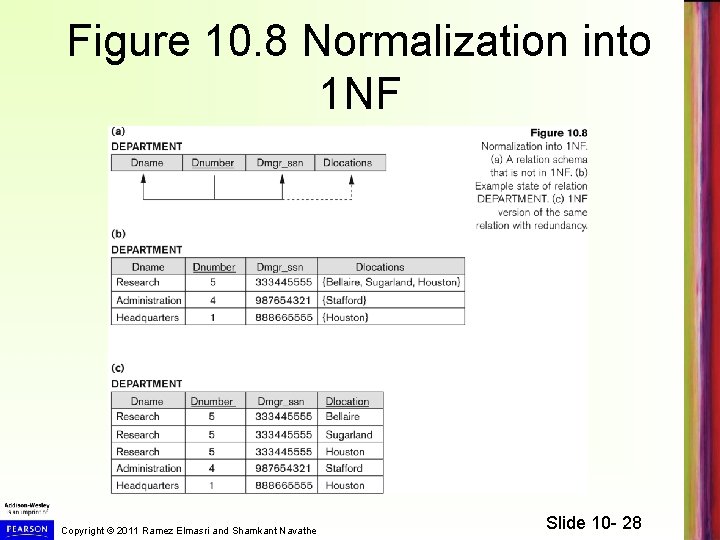
Figure 10. 8 Normalization into 1 NF Copyright © 2011 Ramez Elmasri and Shamkant Navathe Slide 10 - 28
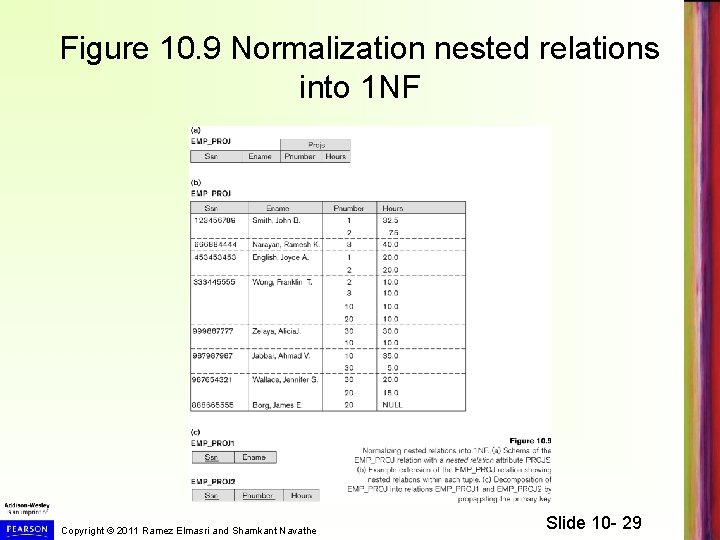
Figure 10. 9 Normalization nested relations into 1 NF Copyright © 2011 Ramez Elmasri and Shamkant Navathe Slide 10 - 29
3. 3 Second Normal Form (1) § Uses the concepts of FDs, primary key § Definitions Prime attribute: An attribute that is member of the primary key K § Full functional dependency: a FD Y -> Z where removal of any attribute from Y means the FD does not hold any more § § Examples: {SSN, PNUMBER} -> HOURS is a full FD since neither SSN -> HOURS nor PNUMBER -> HOURS hold § {SSN, PNUMBER} -> ENAME is not a full FD (it is called a partial dependency ) since SSN -> ENAME also holds § Copyright © 2011 Ramez Elmasri and Shamkant Navathe Slide 10 - 30
Second Normal Form (2) § A relation schema R is in second normal form (2 NF) if every non-prime attribute A in R is fully functionally dependent on the primary key § R can be decomposed into 2 NF relations via the process of 2 NF normalization Copyright © 2011 Ramez Elmasri and Shamkant Navathe Slide 10 - 31
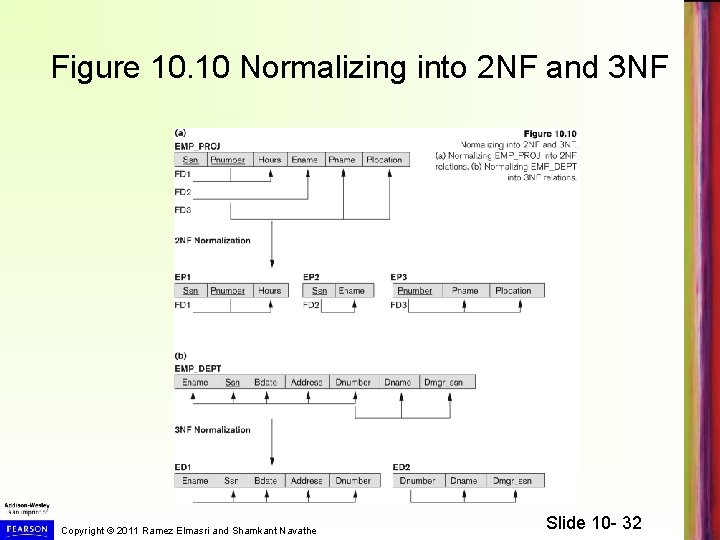
Figure 10. 10 Normalizing into 2 NF and 3 NF Copyright © 2011 Ramez Elmasri and Shamkant Navathe Slide 10 - 32

Figure 10. 11 Normalization into 2 NF and 3 NF Copyright © 2011 Ramez Elmasri and Shamkant Navathe Slide 10 - 33
- Slides: 33