
Chapter 15 Assessing Head and Neck Structure and


- Slides: 42
Chapter 15 Assessing Head and Neck
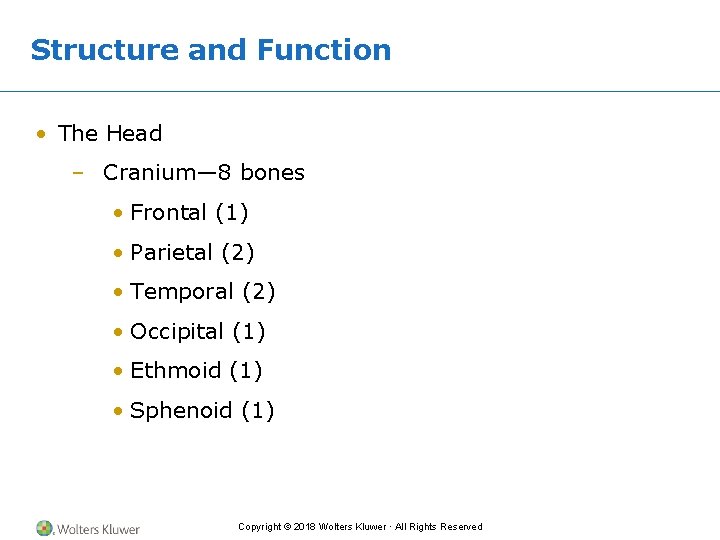
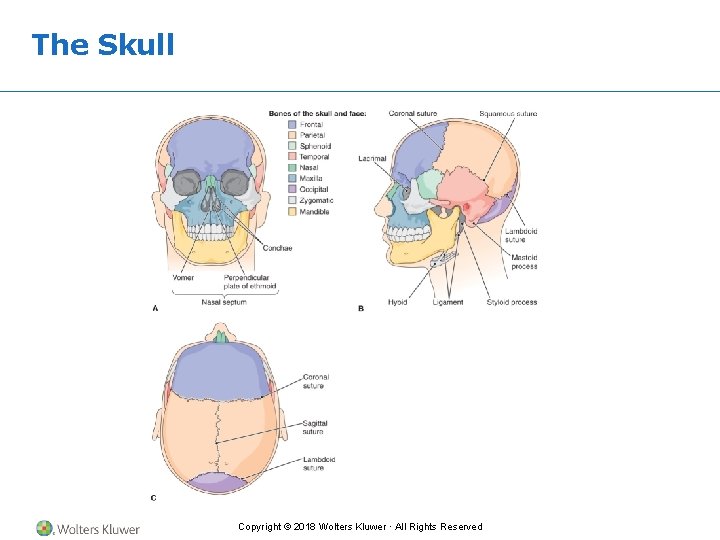
Structure and Function • The Head – Cranium— 8 bones • Frontal (1) • Parietal (2) • Temporal (2) • Occipital (1) • Ethmoid (1) • Sphenoid (1) Copyright © 2018 Wolters Kluwer · All Rights Reserved
Question Is the following statement true or false? The skull, which is the framework of a head, has two subsections: the cranium and cervical vertebrae. Copyright © 2018 Wolters Kluwer · All Rights Reserved
Answer False. The skull has two subsections: the cranium and the face. Copyright © 2018 Wolters Kluwer · All Rights Reserved
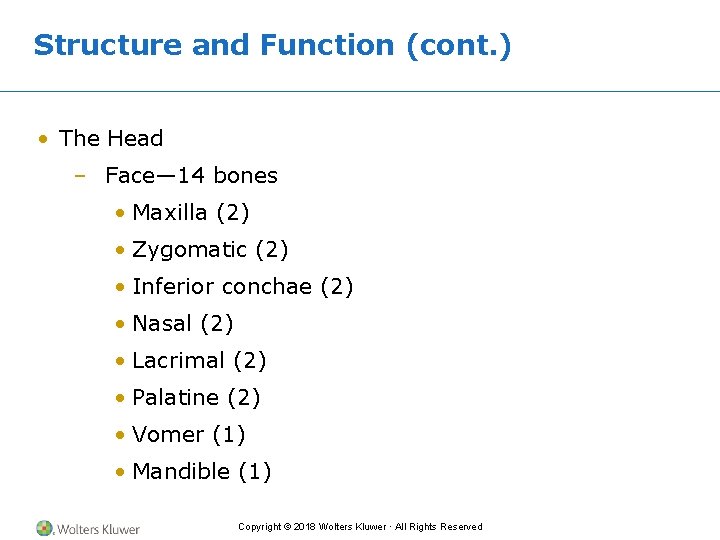
Structure and Function (cont. ) • The Head – Face— 14 bones • Maxilla (2) • Zygomatic (2) • Inferior conchae (2) • Nasal (2) • Lacrimal (2) • Palatine (2) • Vomer (1) • Mandible (1) Copyright © 2018 Wolters Kluwer · All Rights Reserved
The Skull Copyright © 2018 Wolters Kluwer · All Rights Reserved
Question Which bone belongs to the face? A. Parietal B. Temporal C. Palatine D. Mandible Copyright © 2018 Wolters Kluwer · All Rights Reserved
Answer C. Palatine is a facial bone that gives shape to the face. Parietal, temporal, and sphenoid are bones of the cranium. Copyright © 2018 Wolters Kluwer · All Rights Reserved
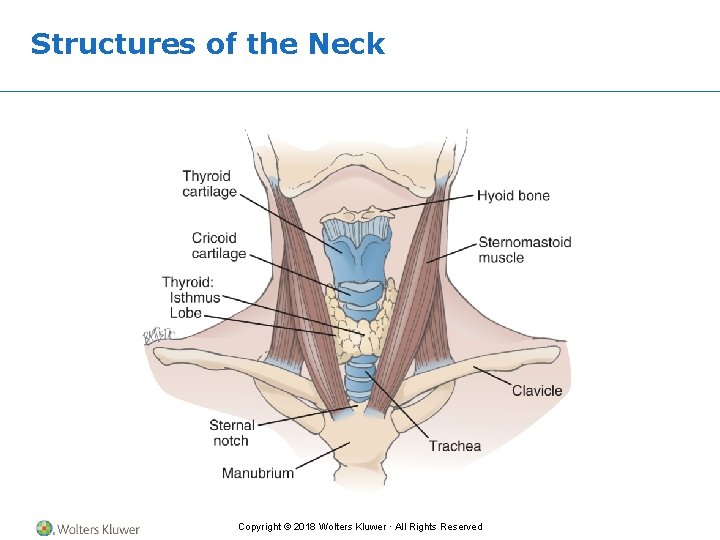
Structure and Function (cont. ) • The Neck – Hyoid bone – Several major blood vessels – Larynx – Trachea – Thyroid gland Copyright © 2018 Wolters Kluwer · All Rights Reserved
Structures of the Neck Copyright © 2018 Wolters Kluwer · All Rights Reserved
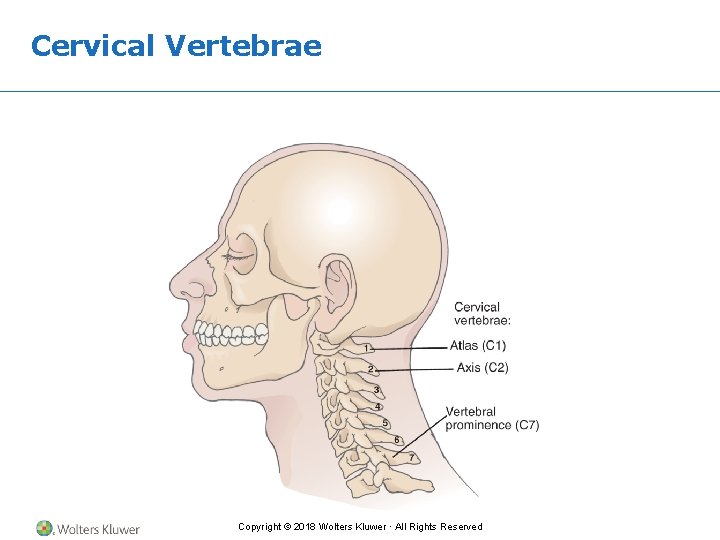
Cervical Vertebrae Copyright © 2018 Wolters Kluwer · All Rights Reserved
Question Tell whether the following statement is true or false. The axis is the first of the seven cervical vertebrae. Copyright © 2018 Wolters Kluwer · All Rights Reserved
Answer False. The axis is the second of the seven cervical vertebrae. Copyright © 2018 Wolters Kluwer · All Rights Reserved
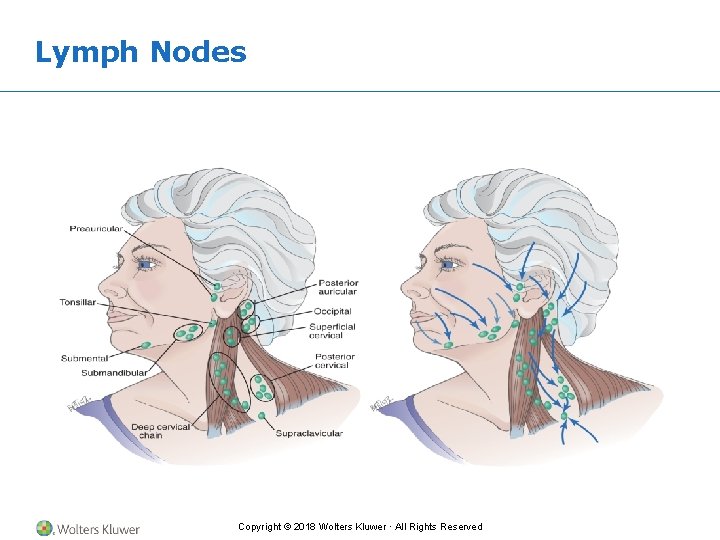
Lymph Nodes Copyright © 2018 Wolters Kluwer · All Rights Reserved
Traumatic Brain Injury • Presence of transportation accidents involving automobiles, motorcycles, bicycles, and pedestrians • Presence of violence, such as firearm assaults and child abuse or self-inflicted wounds • Falling • Excessive alcohol ingestion • Infants and elderly being cared for by caregivers Copyright © 2018 Wolters Kluwer · All Rights Reserved
Infant and Toddlers Risk Factors • Environmental risks (for falls) • Lack of parental knowledge of shaken baby syndrome • Caregivers risk of shaken baby syndrome Copyright © 2018 Wolters Kluwer · All Rights Reserved
Children and Teens Risk Factors • Knowledge and use of protective equipment in sports and bicycle use • Knowledge and use of safety practices when driving Copyright © 2018 Wolters Kluwer · All Rights Reserved
Adults and Older Adults Risk Factors • Knowledge and use of safety practices when driving • Impairment of physical or mental stability • Potential for maltreatment or domestic violence Copyright © 2018 Wolters Kluwer · All Rights Reserved
Risk Reduction • Buckling your child in the car using a child safety seat, booster seat, or seat belt (according to the child’s height, weight, and age). Know the stages: – Birth through age 2 – Between ages 2 and 4/until 40 lb – Between ages 4 and 8 or until 4’ 9” tall – After age 8 and/or 4’ 9” tall • Wearing a seat belt every time you drive or ride in a motor vehicle Copyright © 2018 Wolters Kluwer · All Rights Reserved
Risk Reduction (cont. ) • Never driving while under the influence of alcohol or drugs • Wearing a helmet and making sure your children wear helmets when: – Riding a bike, motorcycle, snowmobile, scooter, or allterrain vehicle – Playing a contact sport, such as football, ice hockey, or boxing – Using in-line skates or riding a skateboard – Batting and running bases in baseball or softball – Riding a horse – Skiing or snowboarding Copyright © 2018 Wolters Kluwer · All Rights Reserved
Risk Reduction (cont. ) • Making living areas safer for seniors, by: – Removing tripping hazards such as throw rugs and clutter in walkways – Using nonslip mats in the bathtub and on shower floors – Installing grab bars next to the toilet and in the tub or shower – Installing handrails on both sides of stairways – Improving lighting throughout the home Copyright © 2018 Wolters Kluwer · All Rights Reserved
Risk Reduction (cont. ) • Maintaining a regular physical activity program, if your doctor agrees, to improve lower body strength and balance • Making living areas safer for children, by: – Installing window guards to keep young children from falling out of open windows – Using safety gates at the top and bottom of stairs when young children are around – Making sure that the surface on your child’s playground is made of shock-absorbing material, such as hardwood mulch or sand. Copyright © 2018 Wolters Kluwer · All Rights Reserved
Health Assessment: Subjective Data • Interview Approach (COLDSPA) – History of current health problem, past health, family – Lifestyle and health practices Copyright © 2018 Wolters Kluwer · All Rights Reserved
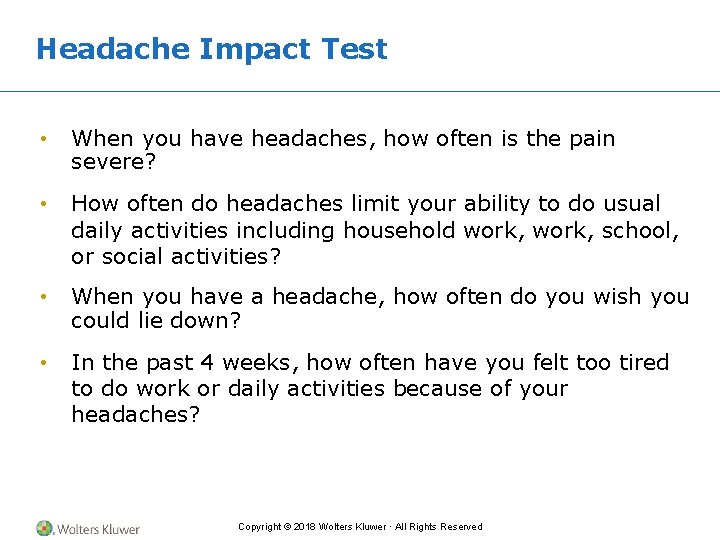
Headache Impact Test • When you have headaches, how often is the pain severe? • How often do headaches limit your ability to do usual daily activities including household work, school, or social activities? • When you have a headache, how often do you wish you could lie down? • In the past 4 weeks, how often have you felt too tired to do work or daily activities because of your headaches? Copyright © 2018 Wolters Kluwer · All Rights Reserved
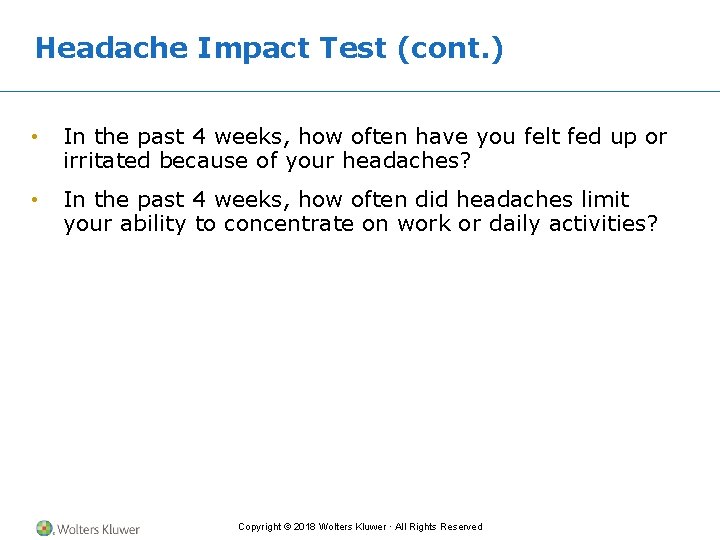
Headache Impact Test (cont. ) • In the past 4 weeks, how often have you felt fed up or irritated because of your headaches? • In the past 4 weeks, how often did headaches limit your ability to concentrate on work or daily activities? Copyright © 2018 Wolters Kluwer · All Rights Reserved
Equipment for Head and Neck Examination • Gloves • Penlight or flashlight • Small glass of water • Stethoscope Copyright © 2018 Wolters Kluwer · All Rights Reserved
Physical Assessment: Head • Inspect the size, shape, configuration • Consistency • Involuntary movement • Palpate the head Copyright © 2018 Wolters Kluwer · All Rights Reserved
Physical Assessment: Face • Inspect the face – Symmetry – Features – Movement – Expression – Skin condition Copyright © 2018 Wolters Kluwer · All Rights Reserved
Physical Assessment: Face (cont. ) • Palpate – Temporal artery: tenderness and elasticity – Temporomandibular joint (TMJ): range of motion (ROM), swelling, tenderness, crepitation Copyright © 2018 Wolters Kluwer · All Rights Reserved
Physical Assessment: Neck • Inspect movement of neck structures – Cervical vertebrae – Neck ROM Copyright © 2018 Wolters Kluwer · All Rights Reserved
Physical Assessment: Neck (cont. ) • Palpate – Trachea – Thyroid gland • Thyroid cartilage • Cricoid cartilage • Auscultate an enlarged thyroid gland Copyright © 2018 Wolters Kluwer · All Rights Reserved
Physical Assessment: Neck (cont. ) • Palpate lymph nodes of head and neck – Preauricular – Postauricular – Occipital – Tonsillar – Submandibular Copyright © 2018 Wolters Kluwer · All Rights Reserved
Physical Assessment: Neck (cont. ) • Palpate lymph nodes of head and neck (cont. ) – Submental – Superficial cervical – Posterior cervical – Deep cervical – Supraclavicular Copyright © 2018 Wolters Kluwer · All Rights Reserved
Normal and Abnormal Findings • Review and discuss findings of assessment of client’s head and neck with peers. Copyright © 2018 Wolters Kluwer · All Rights Reserved
Altered Thyroid Function • Increased sensitivity to cold • Constipation • Depression • Fatigue • Heavier menstrual periods • Pale, dry skin • Thin, brittle hair or nails • Weakness • Unintentional weight gain Copyright © 2018 Wolters Kluwer · All Rights Reserved
Hyperthyroidism • Sudden weight loss, without changes in appetite and diet • Increased appetite • Rapid heartbeat (tachycardia) greater than 100 beats a minute, irregular heartbeat (arrhythmia), or palpitations • Nervousness, anxiety, and irritability • Tremor in the hands and fingers • Sweating Copyright © 2018 Wolters Kluwer · All Rights Reserved
Hyperthyroidism (cont. ) • Changes in menstrual patterns • Increased sensitivity to heat • Changes in bowel patterns, more frequent bowel movements • Enlarged thyroid gland (goiter) • Fatigue, insomnia • Muscle weakness Copyright © 2018 Wolters Kluwer · All Rights Reserved
Types of Headaches • Sinus • Cluster • Tension • Migraine • Tumor related Copyright © 2018 Wolters Kluwer · All Rights Reserved
Abnormal Findings of the Head and Neck • Acromegaly • Cushing syndrome • Scleroderma • Hypothyroidism • Bell palsy Copyright © 2018 Wolters Kluwer · All Rights Reserved
Findings in Older Adults • Older clients who have arthritis or osteoporosis may experience neck pain and a decreased ROM. • In older clients, facial wrinkles are prominent because subcutaneous fat decreases with age. In addition, the lower face may shrink and the mouth may be drawn inward as a result of resorption of mandibular bone, also an age-related process. • The strength of the pulsation of the temporal artery may be decreased in the older client. Copyright © 2018 Wolters Kluwer · All Rights Reserved
Findings in Older Adults (cont. ) • In older clients, cervical curvature may increase because of kyphosis of the spine. Moreover, fat may accumulate around the cervical vertebrae (especially in women). This is sometimes called a “dowager’s hump. ” • Older clients usually have somewhat decreased flexion, extension, lateral bending, and rotation of the neck. This is usually due to arthritis. • If palpable, the older client’s thyroid may feel more nodular or irregular because of fibrotic changes that occur with aging; the thyroid may also be felt lower in the neck because of age-related structural changes. Copyright © 2018 Wolters Kluwer · All Rights Reserved
Validating and Documenting Findings • Health promotion diagnoses • Risk diagnoses • Actual diagnoses • Collaborative problems • Medical problems Copyright © 2018 Wolters Kluwer · All Rights Reserved