
Chapter 15 1 b Managing Organizational Structure Overview

Chapter 15 1 b Managing Organizational Structure
© Overview: We will cover… l Several § § § types of organizational structures: Functional Divisional Matrix l Mechanistic vs. Organic type of structures l Factors influencing type of structure used § § Strategy Size ▪Technology ▪Environment 15 -2
© Grouping Jobs Various Types of Organizational Structures Functional Structure § § An organizational structure composed of all the departments that an organization requires to produce its goods or services. Examples: Finance, Marketing, Logistics, Production, Sales Advantages? Disadvantages? For an optional 5 min. video about some disadvantages of Functional Structures, see https: //insights. som. yale. edu/insights/can-you-work-without-silos For a general description of Functional Structures, see the following optional 8 min. video: https: //www. youtube. com/watch? v=nf 8 Y 2 m. ZZ 0 n. I 15 -3
© Divisional Structures Divisional Structure § An organizational structure composed of separate business units within which are the functions that work together to produce a specific product for a specific customer l l Divisions create smaller, manageable parts of a firm. Divisions develop a business-level strategy to compete. Divisions have marketing, finance, and other functions. Functional managers report to divisional managers who then report to corporate management. 15 -4
© Types of Divisional Structures: • Product, • Geographic • Market 15 -5
© Types of Divisional Structures P_______ Structure § Customers are served by self-contained divisions that handle a specific type of product or service. l l Allows functional managers to specialize in one product area Division managers become experts in their area Removes need for direct supervision of division by corporate managers Divisional management improves the use of resources 15 -6
© Types of Divisional Structures G________ Structure Each region (or country) with customers with differing needs is served by a local self-contained division producing and/or selling products that best meet those needs. 15 -7
© Types of Divisional Structures Market (Customer) Structure § Each kind of customer is served by a self-contained division § Example: l l Business customers Individual customers Educational customers Nonprofit customers For optional videos reviewing divisional structures, see one or more of the following: https: //www. youtube. com/watch? v=v. Sk. BNv 2 p. V 8 Q (3 min. ) https: //www. youtube. com/watch? v=Jb. GLrem. IR 3 U (4 min. ) 15 -8
© M______ Design Structure § An organizational structure that simultaneously groups people and resources by function and product. l l l Results in a complex network of superior-subordinate reporting relationships. Advantage: The structure is very flexible and can respond rapidly to the need for change. Disadvantage: Each employee has two bosses (functional manager and product manager) and possibly cannot satisfy both. 15 -9
© Matrix Structure (See Exhibit 15 -5) Want to learn more? You might enjoy these optional videos: https: //www. youtube. com/watch? v=l. A-g 2 S 1 P 2 o 4 (5 min. ) https: //www. youtube. com/watch? v=i. KAr. Fi. Yf. XWQ (9 min. ) https: //www. youtube. com/watch? v=d. T 2 t. Xv 33 lx. Q (2 min. ) 15 -10
© Dimensions of Organizational Structure l Complexity § § Vertical: The number of different levels in the firm. Horizontal: The number of different jobs at the same level. l Centralization § of Authority S______ of C______: How many employees a manager supervises 15 -11
© Vertical Complexity: Tall and Flat Organizations l Tall structures have many levels of authority and narrow spans of control. § § As hierarchy levels increase, communication gets difficult creating delays in implementing decisions. Communications can also become garbled as it is repeated through the firm. l Flat structures have fewer levels and wide spans of control. § Structure results in quick communications but can lead to overworked managers. 15 -12
© Flat vs. Tall Organizations 15 -13

© Complex structures often require Integrating Mechanisms l Direct Contact: Two managers meet to discuss coordination l Liaison Role: Person has job of coordinating work between two depts. l Task Force/Cross-functional Team: People from multiple depts work together on temporary project. l Matrix Organization: Every person works for both functional dept and specific cross-functional projects. Simple Complex 15 -14
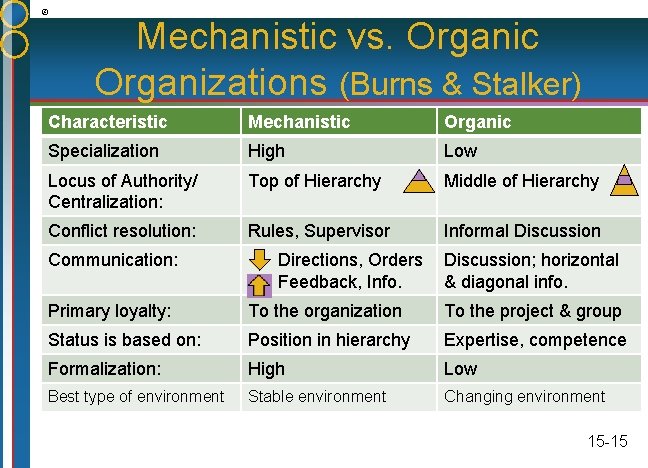
© Mechanistic vs. Organic Organizations (Burns & Stalker) Characteristic Mechanistic Organic Specialization High Low Locus of Authority/ Centralization: Top of Hierarchy Middle of Hierarchy Conflict resolution: Rules, Supervisor Informal Discussion Communication: Directions, Orders Feedback, Info. Discussion; horizontal & diagonal info. Primary loyalty: To the organization To the project & group Status is based on: Position in hierarchy Expertise, competence Formalization: High Low Best type of environment Stable environment Changing environment 15 -15

Mechanistic Firms are often Bureaucracies Max Weber’s Principles of Bureaucracy: Bureaucracy Organization has a system of written rules and Standard Operating Procedures (SOPs) that specify how workers should behave in most situations. Clear hierarchy of authority within the organization. Personnel systems (e. g. , hiring, performance appraisal, reward systems) are fair and equitable. Clear system of task and role relationships between jobs. Workers understand how their job relates to other jobs in the organization. 2 -16
© Mechanistic Firms are often Bureaucracies (text, pp. 517 -518) Strengths Weaknesses 15 -17
© l Four Factors influence Organizational design choice See Exhibit 15 -10 & pp. 526 -532 of your textbook… 15 -18
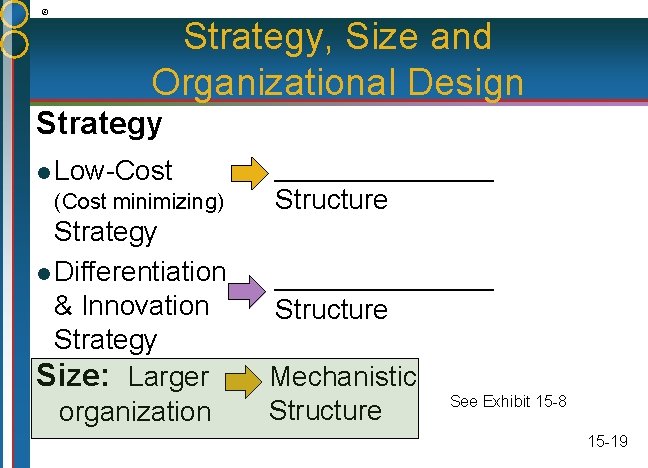
© Strategy, Size and Organizational Design Strategy l Low-Cost (Cost minimizing) Strategy l Differentiation & Innovation Strategy Size: Larger organization ______________ Structure Mechanistic Structure See Exhibit 15 -8 15 -19
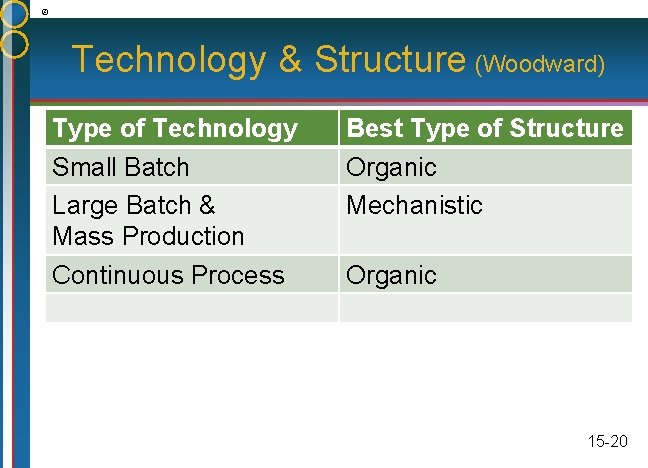
© Technology & Structure (Woodward) Type of Technology Small Batch Large Batch & Mass Production Continuous Process Best Type of Structure Organic Mechanistic Organic 15 -20
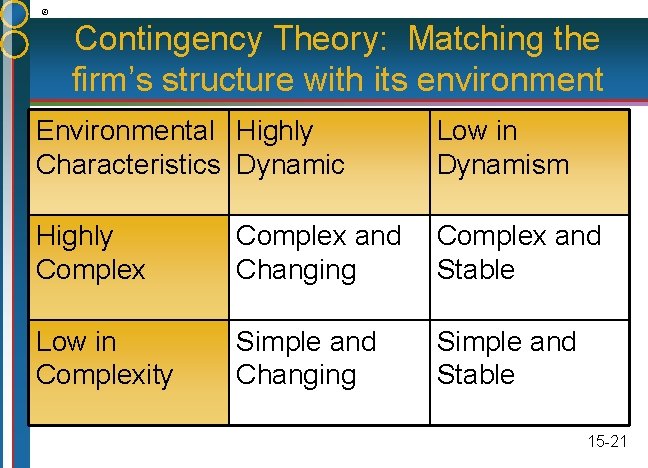
© Contingency Theory: Matching the firm’s structure with its environment Environmental Highly Characteristics Dynamic Low in Dynamism Highly Complex and Changing Complex and Stable Low in Complexity Simple and Changing Simple and Stable 15 -21
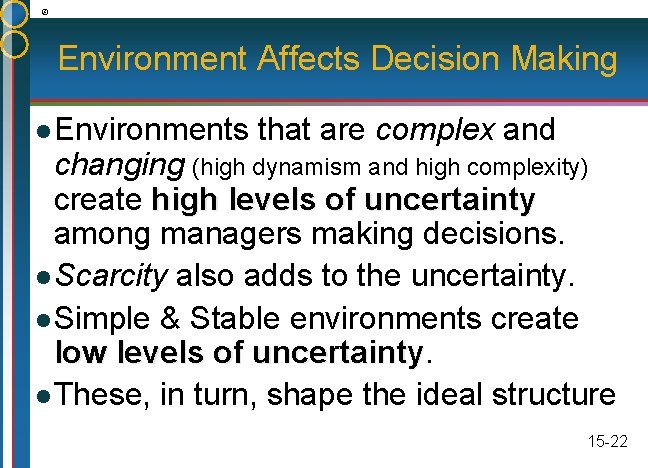
© Environment Affects Decision Making l Environments that are complex and changing (high dynamism and high complexity) create high levels of uncertainty among managers making decisions. l Scarcity also adds to the uncertainty. l Simple & Stable environments create low levels of uncertainty l These, in turn, shape the ideal structure 15 -22
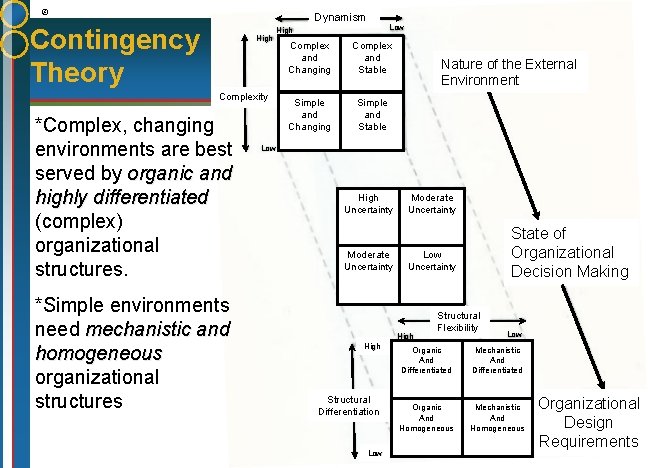
© Dynamism Contingency Theory High Complexity *Complex, changing environments are best served by organic and highly differentiated (complex) organizational structures. *Simple environments need mechanistic and homogeneous organizational structures Low High Complex and Changing Complex and Stable Simple and Changing Simple and Stable Nature of the External Environment Low High Moderate Uncertainty Moderate Low Uncertainty High Structural Differentiation Low State of Organizational Decision Making Structural Flexibility Low Organic And Differentiated Mechanistic And Differentiated Organic And Homogeneous Mechanistic And Homogeneous Organizational Design 15 -23 Requirements
© New Design Options: “Boundaryless” (Team-based) Organization Variation on Organic structure: Self-managed, empowered work teams Teams report to HQ; thus little “chain of command. ” Flat hierarchy Cross-hierarchical teams 360 -degree feedback Organized around processes, not functions, customers, or geography Requires coordinating mechanisms Examples: Semco, Oticon, Xerox 15 -24
© New Design Options: Virtual Organization § § A small, core organization that outsources major business functions Highly centralized with little departmentalization Provides maximum flexibility while focusing on what the business does best. l Reduced control over parts of the business. l E X H I B I T 15 -6 15 -25
© Summary l Managers must decide how to structure firms l Different theories help us understand different types of organization structures § Burns & Stalker’s “Mechanistic v. Organic” Model l Several factors influence type § Strategy § Size § Woodward’s Typology of Technologies § Environmental Contingencies of structure: For slide-based reviews of these topics (from different textbooks and other universities; not always identical to MGT 308) see these optional videos: • https: //slideplayer. com/slide/4255453/ (11 min. ) • https: //slideplayer. com/slide/9109889/ (11 min. ; text outline provided. ) 15 -26 • http: //drisauraflores-busi-4940 -businesspolicy. com/creating-effective-organizational-designs/
- Slides: 26