
Chapter 14 Transforming the Global Human Resource Role
Chapter 14 Transforming the Global Human Resource Role
HR at KONE Originally composed of autonomous units Increased focus on global HR integration – new values, one strategy Designing and implementing core HR processes Two strategic challenges in the future: 1. Digitalization • Collaborate with external partners 2. Move towards emerging markets • Find, develop, retain talent How should HR help the company address these & other challenges? 14 -2

Challenges Facing the Global HR Function Key Issues for transnational HR: • Adaptation of policies and practices to local markets, culture, and institutional features, but also pursuit of global integration • Coordination to meet global and local needs • Social architecture: shared values, social capital, global mindset • The core HR processes in international HRM: • • Recruitment and selection Performance management Leadership development Cross-border mobility • Access, share, and recombine knowledge for innovation • Management of large, complex processes of change • Change and learning in international M&As and alliances 14 -3
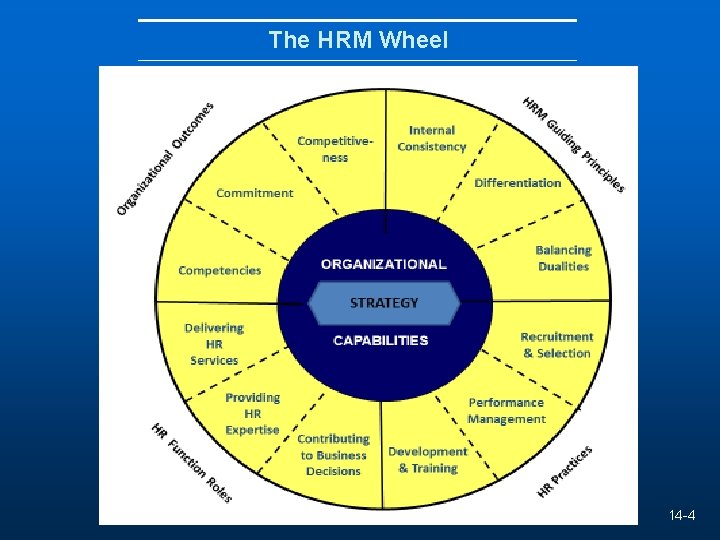
The HRM Wheel 14 -4
Providing HR Functional Expertise Tensions between local responsiveness and global integration: § Balance between standardization and sensitivity to local needs § Find and exploit HR practices successful in one part of the company § Ensure HR practices support business objectives Solutions: 1 Functional experts at headquarters • Deep specialization – too home-country centered? 2 Centers of expertise • Challenge of consistency 3 Functional committees or communities of practice 4 Cross-boundary project groups • Those in the centralized hub need expertise from subsidiaries 5 Network leadership 14 -5
Network Leadership The center needs expertise from subsidiaries • HR function and the line – both key stakeholders This requires Network Leadership skills: 1. An awareness of leading-edge trends and developments • Internal and external networking 2. The ability to mobilize the appropriate resources • Forming project groups requires credibility and stakeholder analysis 3. A sense of timing and context • Long-term corporate initiatives can distract when priority is short-term goals 14 -6
HR Service Delivery e-HR tools allow self-help • Employees can find answers to routine questions and issues • Dealing with system issues takes time; employees must adopt self-help attitude HR service centers have regional and global scope • Decreases personalization (user dissatisfaction), increases specialization Some HR tasks can be outsourced with global support • Software platforms for HR outsourcing may reduce costs • Outsourcing may free up time for strategic HRM But be careful what you outsource; some of it is better kept inside These mechanisms are complementary, often used in parallel 14 -7
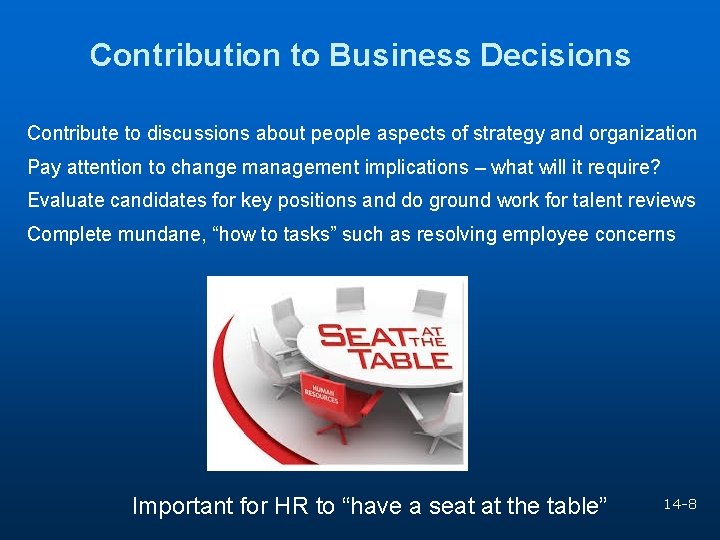
Contribution to Business Decisions Contribute to discussions about people aspects of strategy and organization Pay attention to change management implications – what will it require? Evaluate candidates for key positions and do ground work for talent reviews Complete mundane, “how to tasks” such as resolving employee concerns Important for HR to “have a seat at the table” 14 -8
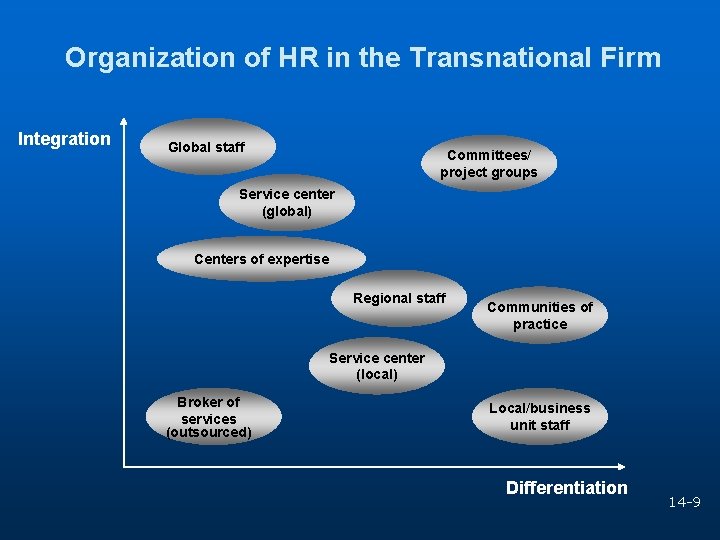
Organization of HR in the Transnational Firm Integration Global staff Committees/ project groups Service center (global) Centers of expertise Regional staff Communities of practice Service center (local) Broker of services (outsourced) Local/business unit staff Differentiation 14 -9
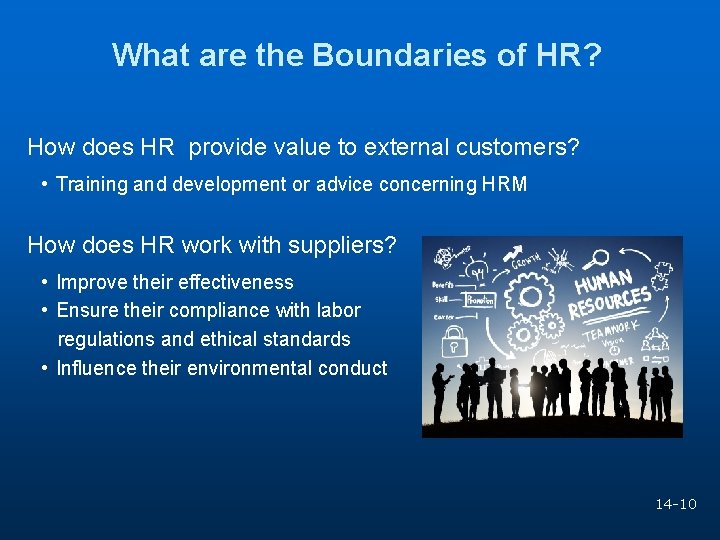
What are the Boundaries of HR? How does HR provide value to external customers? • Training and development or advice concerning HRM How does HR work with suppliers? • Improve their effectiveness • Ensure their compliance with labor regulations and ethical standards • Influence their environmental conduct 14 -10
HR versus Top and Line Management Visible management commitment is crucial for HRM to be successful. The line at all levels must be involved and feel at least joint responsibility for: • Development of HRM processes and content aligned with business strategy • Implementation of most HR practices - selection, development, performance mgmt. Devolvement of people management to line managers often challenging: • • • Line managers are not necessarily committed to people management issues Managers don’t take the necessary time to handle HRM Managers don’t have the ability and necessary functional knowledge Managers have unit’s short-term interests in mind, not broad global goals Acceptability of the people management role differs across countries 14 -11
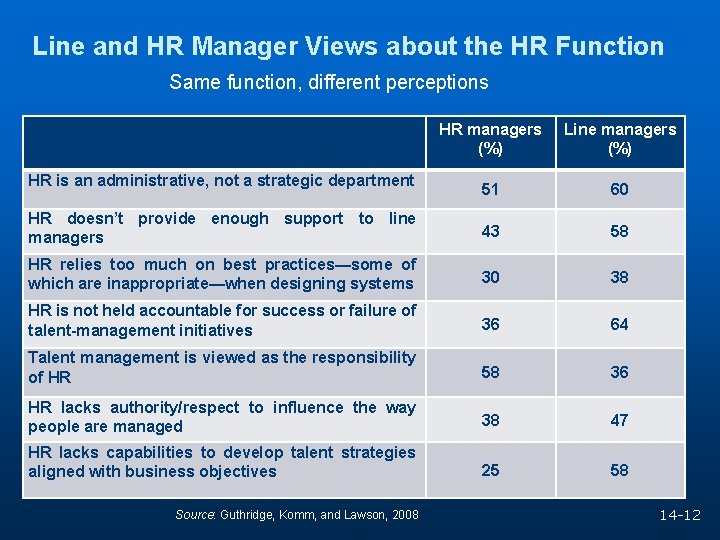
Line and HR Manager Views about the HR Function Same function, different perceptions HR managers (%) Line managers (%) 51 60 HR doesn’t provide enough support to line managers 43 58 HR relies too much on best practices—some of which are inappropriate—when designing systems 30 38 HR is not held accountable for success or failure of talent-management initiatives 36 64 Talent management is viewed as the responsibility of HR 58 36 HR lacks authority/respect to influence the way people are managed 38 47 HR lacks capabilities to develop talent strategies aligned with business objectives 25 58 HR is an administrative, not a strategic department Source: Guthridge, Komm, and Lawson, 2008 14 -12
Developing the Capabilities of the HR Function HR Competencies • • Credible activist (personal trust through business acumen) Strategic positioner (thinking and acting by mastering the business) Capacity builder (mixing individual competencies & organizational ones) Change champion (making sure things happen) HR innovator and integrator Tech proponent (using tech to deliver HR and build relationships) Ability to use business analytics 14 -13
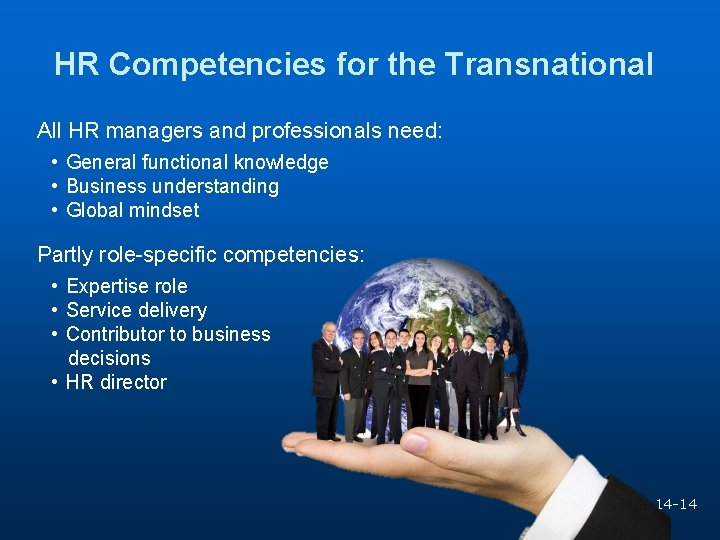
HR Competencies for the Transnational All HR managers and professionals need: • General functional knowledge • Business understanding • Global mindset Partly role-specific competencies: • Expertise role • Service delivery • Contributor to business decisions • HR director 14 -14
Developing HR Managers for Transnational Competence Development Mobility - Zigzag talent development helps build skills outside the HR function Mentors from other functions Cross-Functional Transfers Hi-Po’s should see HR as a part of career development Care must be taken of people’s development in the HR function AND their exit 14 -15
Challenges Worth Standing Up For Speaking out for organizational sustainability • Climate of openness is important – people need to be comfortable speaking up • HR will get blamed when things go wrong, even if people knew about it. Fighting for the long-term perspective • Pressures for short-term goals are common • Fight to retain necessary competency during layoffs - anticipate the future Taking into account the social implications of globalization • Remember those that fall behind - doing nothing undermines achievements • Be a catalyst in building a responsible culture 14 -16
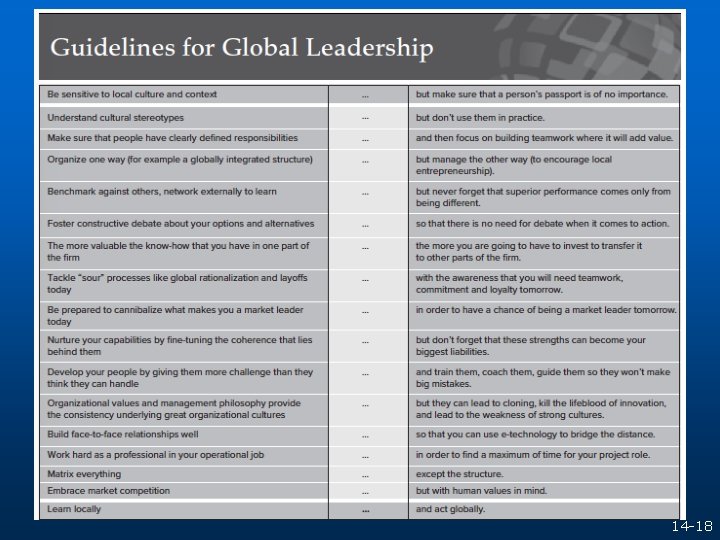
HRM as Tension Management The transnational organization is defined by contradictions Leaders must recognize and understand dualities – work in split egg ways The task of HR and line is to navigate contradictions, not resolve tensions Global seesaw doesn’t stand in balance – it moves back and forth HRM is both line responsibility and functional role “People are not resources, they are people” 14 -17
14 -18
- Slides: 18