
Chapter 14 The Phrase I can recognize the
- Slides: 16
Chapter 14: The Phrase I can recognize the following phrases: 1. Prepositional 2. Verbal 3. Appositive
To Recognize a Phrase You Must… • Know your parts of speech! • Describe the function of the following parts of speech: – Noun – Adjective – Adverb
What is a phrase? • Group of related words • Used as single part of speech • Does not contain both verb and its subject • EXAMPLES – Was walking (no subject) – With the girls (no subject or verb)
1. Prepositional Phrases • Preposition + object + modifiers • Object = noun or pronoun in phrase What are good strategies for memorizing? Look at page 400 MEMORIZE!
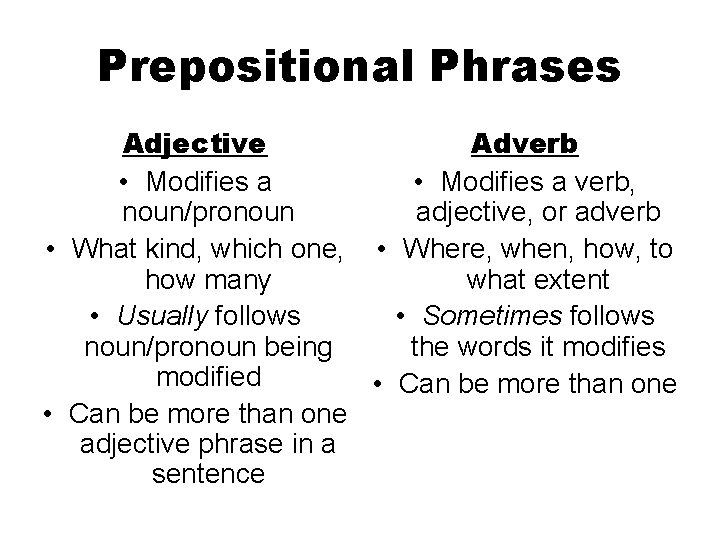
Prepositional Phrases Adjective • Modifies a noun/pronoun • What kind, which one, • how many • Usually follows noun/pronoun being modified • • Can be more than one adjective phrase in a sentence Adverb • Modifies a verb, adjective, or adverb Where, when, how, to what extent • Sometimes follows the words it modifies Can be more than one
PRACTICE 1. Page 444, exercise 2 2. Page 446, exercise 3
Prepositional Phrases • Reviews B and C on page 447 • Do only odds!
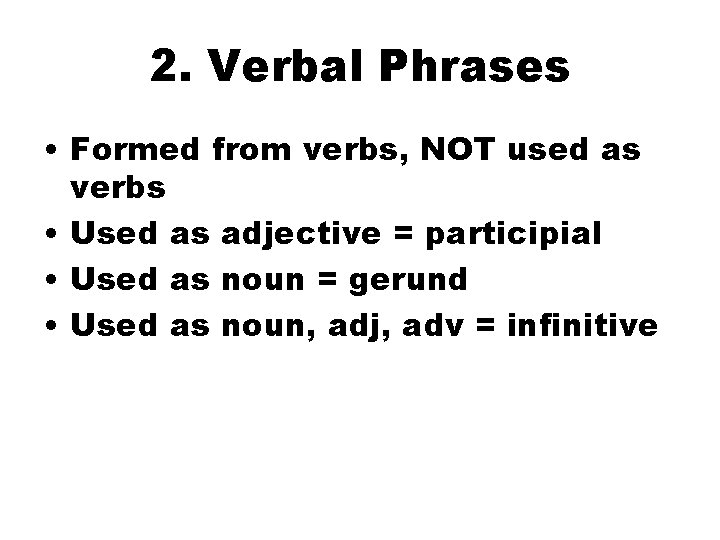
2. Verbal Phrases • Formed from verbs, NOT used as verbs • Used as adjective = participial • Used as noun = gerund • Used as noun, adj, adv = infinitive
Participial Phrases • Participle + modifiers • Participle = verb ending in –ing or –d/ed, used as an adjective Page 452: exer. 6
Gerund Phrases • Gerund + modifiers • Gerund = verb ending with –ing, used as a noun • Used as subjects, PNs, DOs, IOs, and objects of prepositions Page 455: exer. 8
Infinitive Phrases • Infinitive = to + verb, used as noun, adjective, or adverb • Infinitive + modifiers • Sometimes to is omitted (implied) Page 459: exer. 11
Verbal Phrases • Review D on page 466
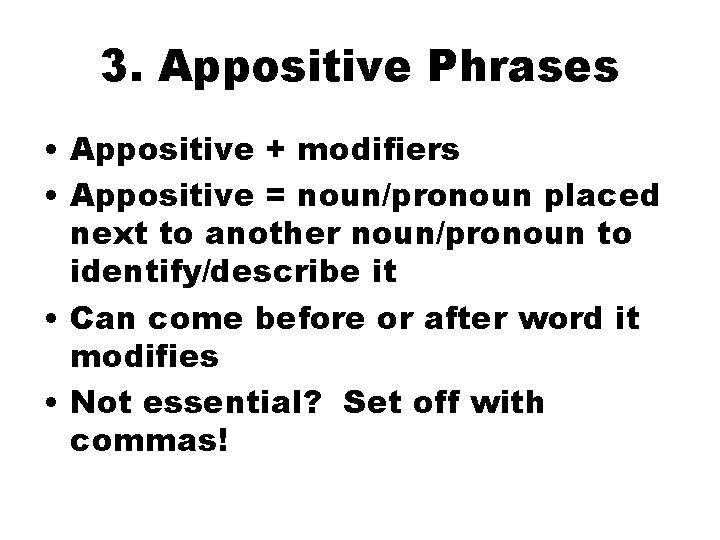
3. Appositive Phrases • Appositive + modifiers • Appositive = noun/pronoun placed next to another noun/pronoun to identify/describe it • Can come before or after word it modifies • Not essential? Set off with commas!
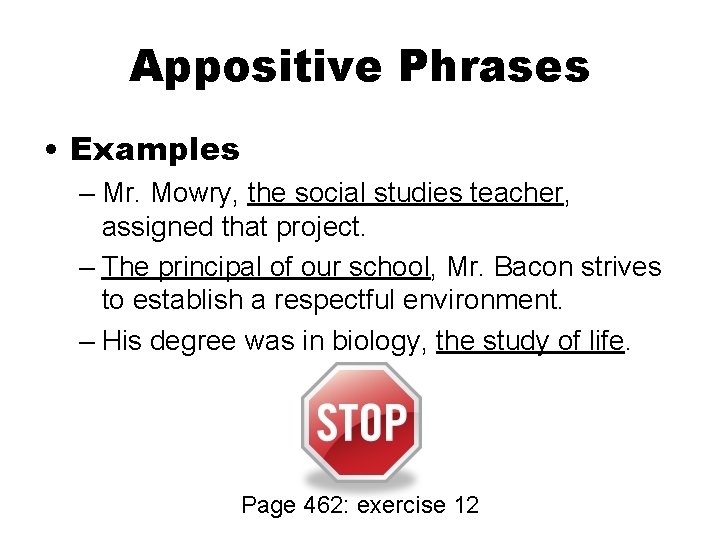
Appositive Phrases • Examples – Mr. Mowry, the social studies teacher, assigned that project. – The principal of our school, Mr. Bacon strives to establish a respectful environment. – His degree was in biology, the study of life. Page 462: exercise 12
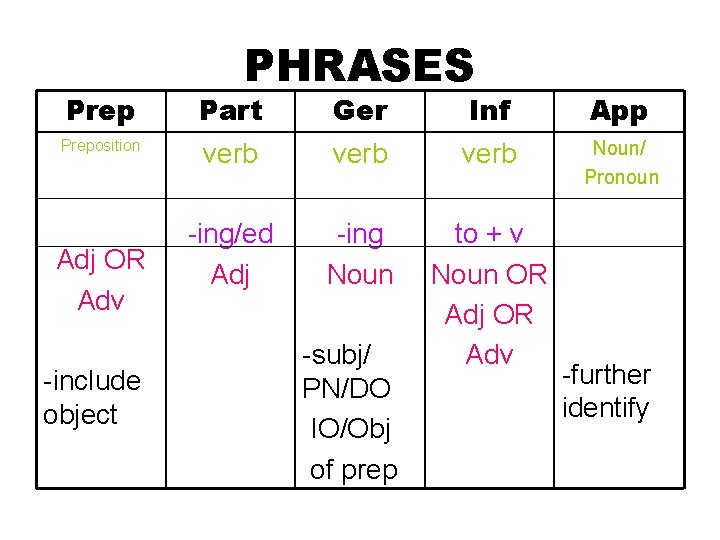
PHRASES Prep Part Ger Inf App Preposition verb Noun/ Pronoun -ing/ed Adj -ing Noun to + v Noun OR Adj OR Adv -include object -subj/ PN/DO IO/Obj of prep -further identify
Page 465: Review A