
CHAPTER 14 The Monocentric City and Urban General
CHAPTER 14 The Monocentric City and Urban General Equilibrium ©Mc. Graw-Hill Education. All rights reserved. Authorized only for instructor use in the classroom. No reproduction or further distribution permitted without the prior written consent of Mc. Graw-Hill Education.
Introduction This chapter develops a model of the urban economy based on the traditional monocentric city. The model incorporates the interactions between the urban land market and the urban labor market. • We use the model to explore the effects of changes in technology, climate, and public policy on land use, wages, and total employment. • Although modern cities are not monocentric, the model provides insights into the workings of the urban economy. ©Mc. Graw-Hill Education.
The Monocentric Model The classic model of the monocentric city is based on the transportation and communication technology available at the beginning of the 20 th century. • The four key assumptions in the monocentric model are – central export node – horse carts – hub-and-spoke streetcar – central information exchange. • These assumptions make the city center the focal point of the metropolitan area. ©Mc. Graw-Hill Education.
The Industrial Revolution and the Monocentric City (1 of 2) • In the 19 th century, the innovations of the Industrial Revolution resulted in the development of large monocentric cities. • Technological innovations in production and energy increased economies of scale in production, leading to large-scale production in factories. • The agglomeration economies in production caused factories to cluster in large industrial cities. • In addition, the Industrial Revolution generated innovations in intercity transportation that led to increased trade and larger trading cities. Why were large cities monocentric, with highly centralized employment? ©Mc. Graw-Hill Education.
The Industrial Revolution and the Monocentric City (2 of 2) • Over the course of the Industrial Revolution the efficiency of the hub-andspoke transit system increased with the development of the: – omnibus (1827) – cable car (1873) – electric trolley (1873) – subway (1890). • A series of innovations also decreased the cost of building taller buildings: – balloon-frame building (1832) – cast-iron columns (1848) – steel frame (1885). ©Mc. Graw-Hill Education.
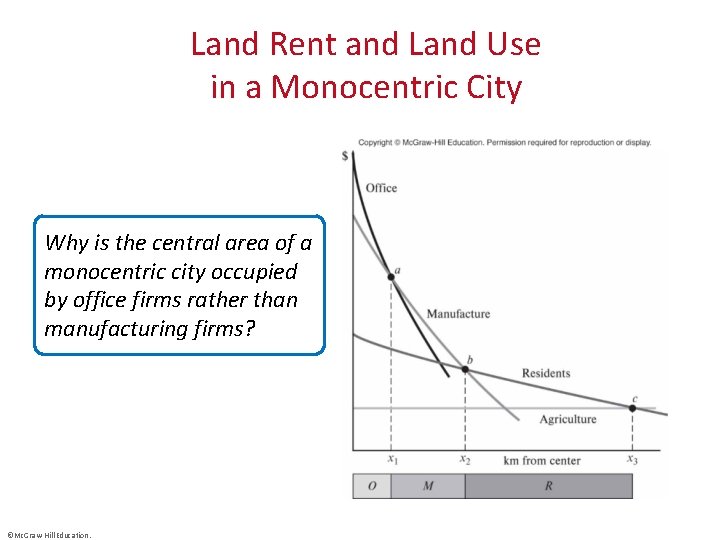
Land Rent and Land Use in a Monocentric City Why is the central area of a monocentric city occupied by office firms rather than manufacturing firms? ©Mc. Graw-Hill Education.
Centralized Employment (1 of 2) The defining characteristic of the monocentric city is that all employment is in the central area. • The alternative is to distribute jobs more evenly throughout the city, with many employment subcenters that would bring workers and employers closer together and save on commuting cost. Why do all the manufacturers and office firms locate in the central area, far from their workers in the residential district? ©Mc. Graw-Hill Education.
Centralized Employment (2 of 2) To apply the monocentric model to a manufacturing firm’s location choice within the city, we assume that there is spatial variation in freight cost and labor cost, so the firm’s objective is to minimize the sum of freight cost and labor cost. • We can characterize the transportation technology of the early 20 th century as horse carts and streetcars. • Under this transportation technology, the cost of transporting output (on horse carts) is high relative to the cost of transporting workers (in streetcars). ©Mc. Graw-Hill Education.
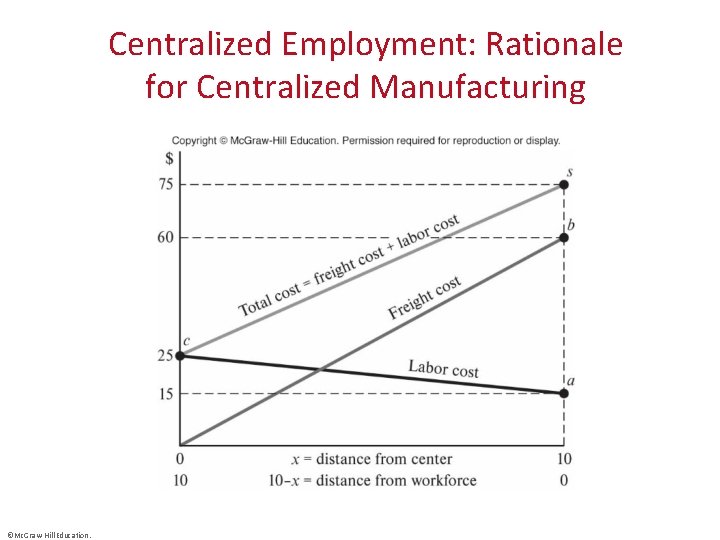
Centralized Employment: Rationale for Centralized Manufacturing ©Mc. Graw-Hill Education.
General-Equilibrium Model We can use the model of the monocentric city to explore the interactions between the urban labor market and the urban land market. • The model considers a city that is small (one of many in a nation) and open (people move costlessly between cities). • The utility level of residents is determined at the national level and is unaffected by changes in the city. In other words, the utility level of city residents is fixed, but the population of the city varies. ©Mc. Graw-Hill Education.
Interactions between the Land Labor Markets • To simplify matters, we adopt two assumptions. • First, we assume for the moment that there is no consumer substitution or input substitution. – Therefore, population density is the same at all residential locations, and employment density is the same at all business locations. • Second, we assume that the city is not circular, but rectangular, with a fixed width of 10 kilometers and a length to be determined by the bids of businesses and residents. ©Mc. Graw-Hill Education.
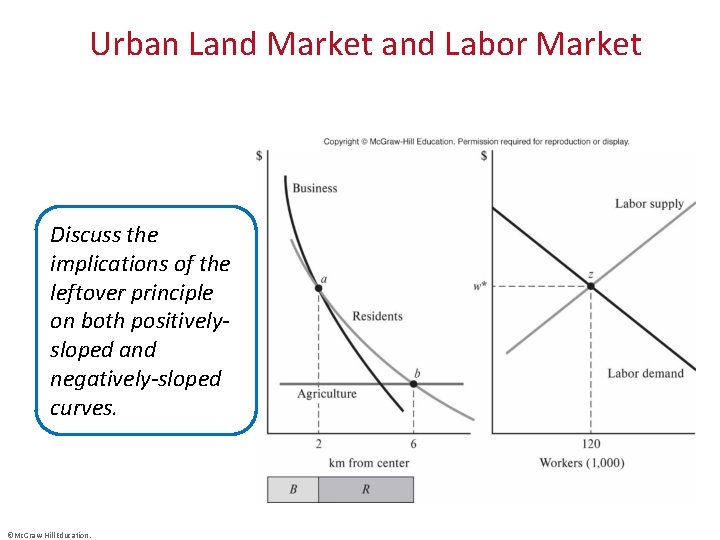
Urban Land Market and Labor Market Discuss the implications of the leftover principle on both positivelysloped and negatively-sloped curves. ©Mc. Graw-Hill Education.
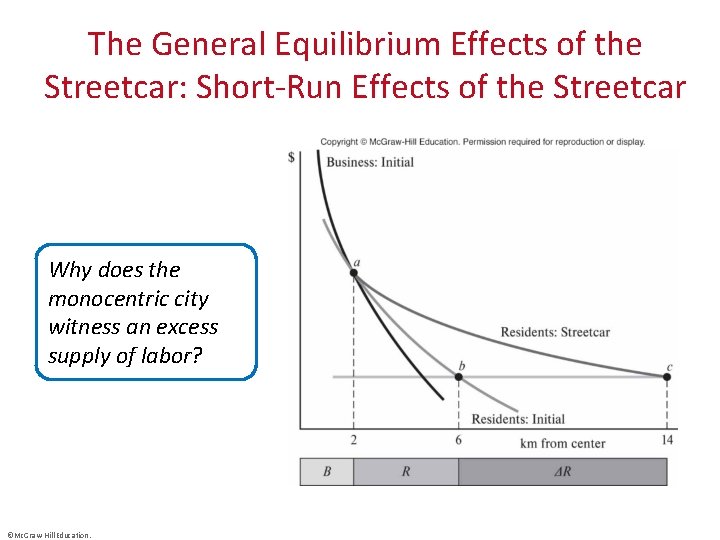
The General Equilibrium Effects of the Streetcar: Short-Run Effects of the Streetcar Why does the monocentric city witness an excess supply of labor? ©Mc. Graw-Hill Education.
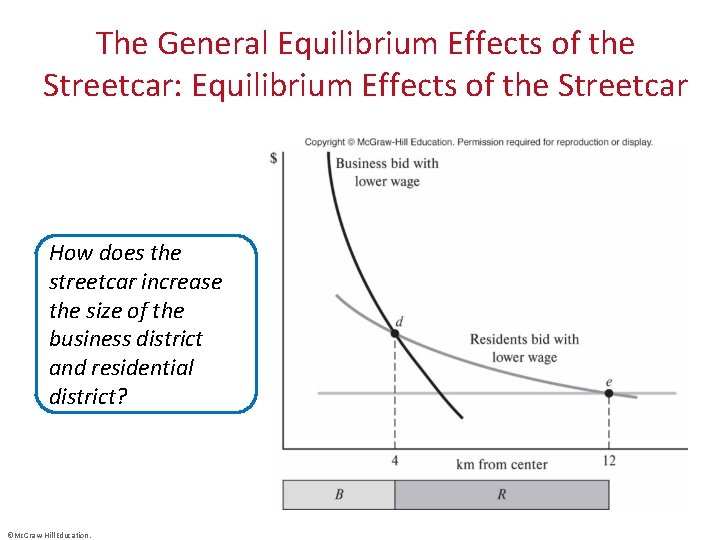
The General Equilibrium Effects of the Streetcar: Equilibrium Effects of the Streetcar How does the streetcar increase the size of the business district and residential district? ©Mc. Graw-Hill Education.
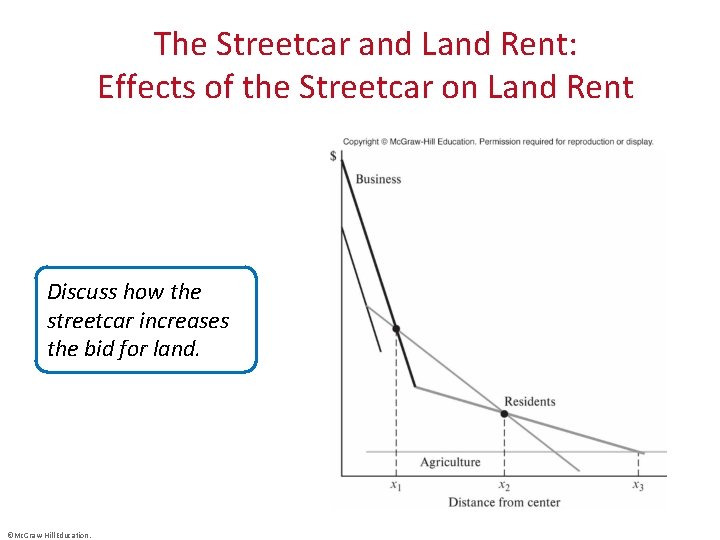
The Streetcar and Land Rent: Effects of the Streetcar on Land Rent Discuss how the streetcar increases the bid for land. ©Mc. Graw-Hill Education.
Changes in Employment and Residential Density • So far, we have assumed that both employment density and residential density are fixed. – There is no input substitution by firms, and no consumer substitution by residents. – As a result, all the changes in labor supply and labor demand are caused entirely by changes in the territories of business and residents. • Although the assumption of fixed density makes the numerical example simple and straightforward, the assumption is not realistic. What are the implications of allowing consumer substitution and input substitution? ©Mc. Graw-Hill Education.
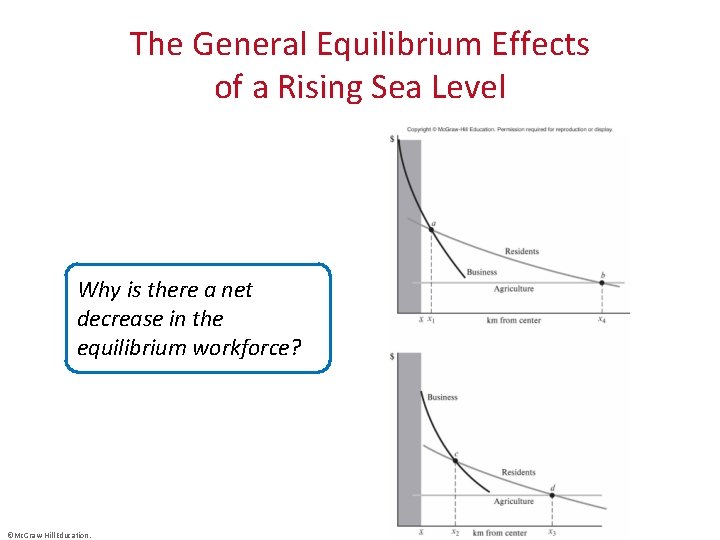
The General Equilibrium Effects of a Rising Sea Level Why is there a net decrease in the equilibrium workforce? ©Mc. Graw-Hill Education.
- Slides: 17