
Chapter 14 The Money Supply Process Three Players




- Slides: 38
Chapter 14 The Money Supply Process
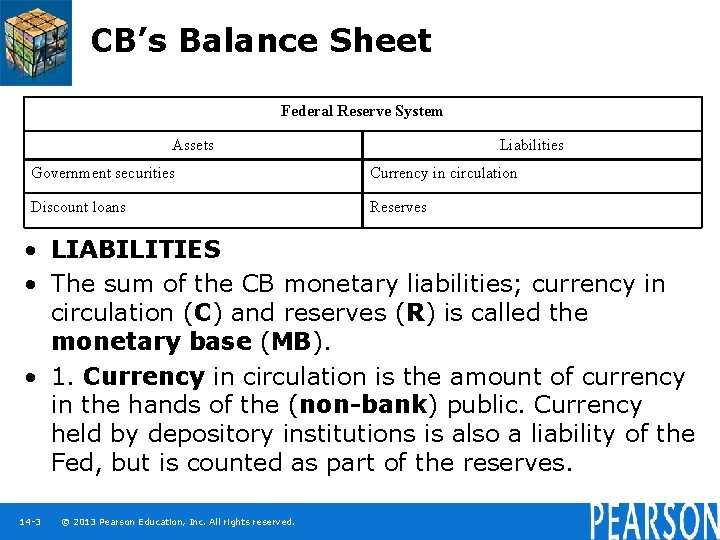
Three Players in the Money Supply Process 1. The central bank—the government agency that oversees the banking system and is responsible for the conduct of monetary policy. 2. Banks: commercial banks, savings and loan associations, mutual savings banks, and credit unions. 3. Depositors: individuals and institutions that hold deposits in banks. Of the three players, the central Bank (CB) is the most important. The CB conduct of monetary policy involves actions that affect its balance sheet (holdings of assets and liabilities). 14 -2 © 2013 Pearson Education, Inc. All rights reserved.
CB’s Balance Sheet Federal Reserve System Assets Liabilities Government securities Currency in circulation Discount loans Reserves • LIABILITIES • The sum of the CB monetary liabilities; currency in circulation (C) and reserves (R) is called the monetary base (MB). • 1. Currency in circulation is the amount of currency in the hands of the (non-bank) public. Currency held by depository institutions is also a liability of the Fed, but is counted as part of the reserves. 14 -3 © 2013 Pearson Education, Inc. All rights reserved.
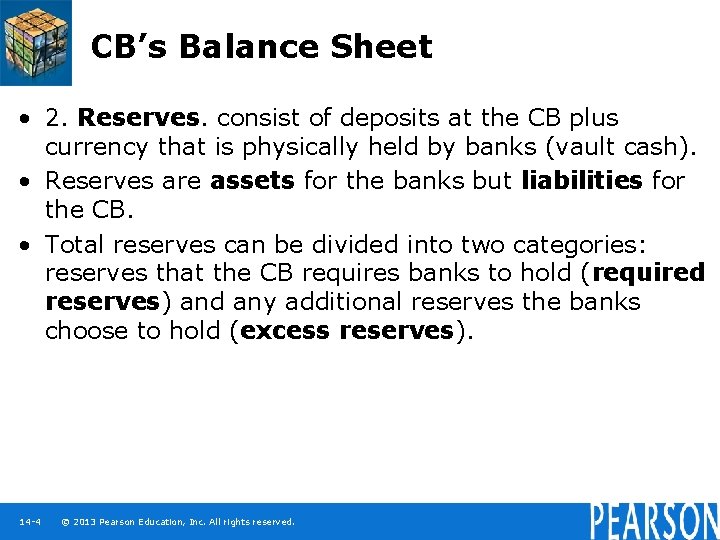
CB’s Balance Sheet • 2. Reserves. consist of deposits at the CB plus currency that is physically held by banks (vault cash). • Reserves are assets for the banks but liabilities for the CB. • Total reserves can be divided into two categories: reserves that the CB requires banks to hold (required reserves) and any additional reserves the banks choose to hold (excess reserves). 14 -4 © 2013 Pearson Education, Inc. All rights reserved.
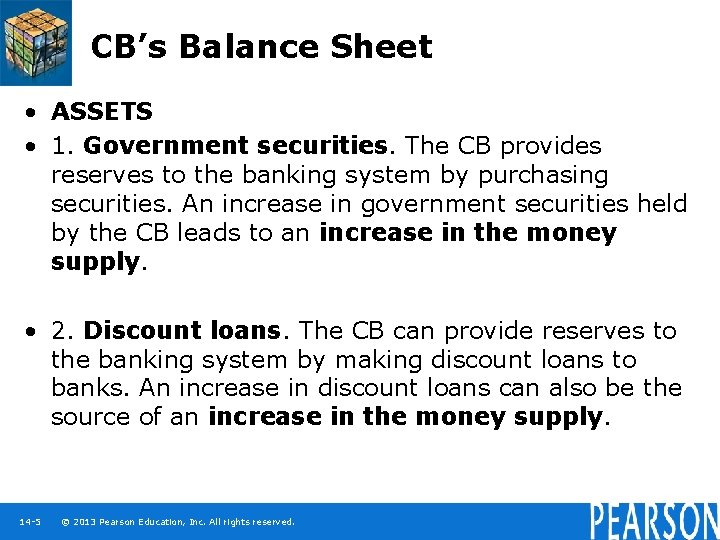
CB’s Balance Sheet • ASSETS • 1. Government securities. The CB provides reserves to the banking system by purchasing securities. An increase in government securities held by the CB leads to an increase in the money supply. • 2. Discount loans. The CB can provide reserves to the banking system by making discount loans to banks. An increase in discount loans can also be the source of an increase in the money supply. 14 -5 © 2013 Pearson Education, Inc. All rights reserved.
Control of the Monetary Base • The monetary base (high-powered money) equals currency in circulation C plus the total reserves in banking system R. The monetary base MB can be expressed as: MB = C + R • The CB exercises control over the monetary base through open market operations, and its extension of discount loans to banks. 14 -6 © 2013 Pearson Education, Inc. All rights reserved.
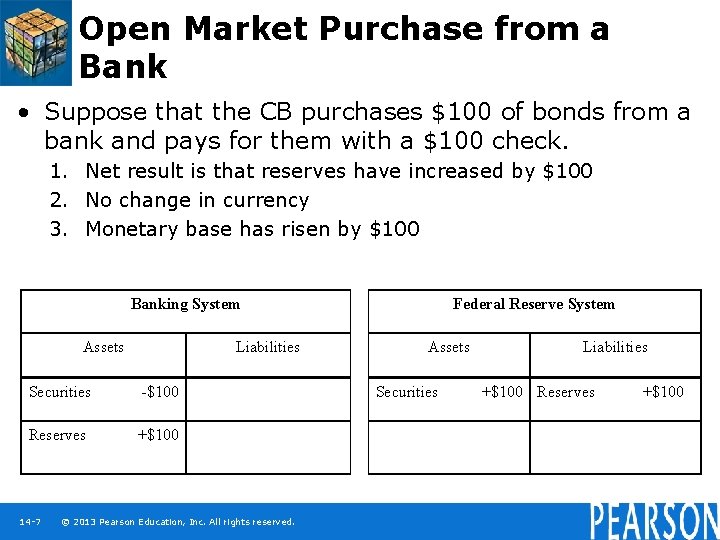
Open Market Purchase from a Bank • Suppose that the CB purchases $100 of bonds from a bank and pays for them with a $100 check. 1. Net result is that reserves have increased by $100 2. No change in currency 3. Monetary base has risen by $100 Banking System Assets Liabilities Securities -$100 Reserves +$100 14 -7 © 2013 Pearson Education, Inc. All rights reserved. Federal Reserve System Assets Securities Liabilities +$100 Reserves +$100
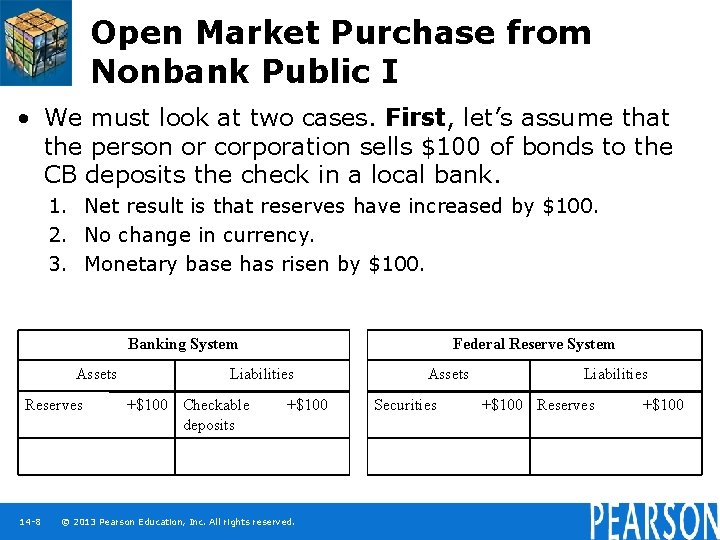
Open Market Purchase from Nonbank Public I • We must look at two cases. First, let’s assume that the person or corporation sells $100 of bonds to the CB deposits the check in a local bank. 1. Net result is that reserves have increased by $100. 2. No change in currency. 3. Monetary base has risen by $100. Banking System Assets Reserves 14 -8 Federal Reserve System Liabilities +$100 Checkable deposits +$100 © 2013 Pearson Education, Inc. All rights reserved. Assets Securities Liabilities +$100 Reserves +$100
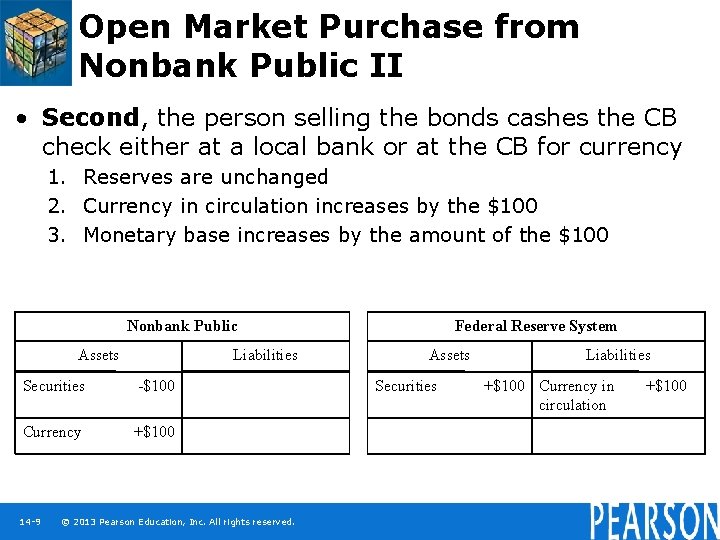
Open Market Purchase from Nonbank Public II • Second, the person selling the bonds cashes the CB check either at a local bank or at the CB for currency 1. Reserves are unchanged 2. Currency in circulation increases by the $100 3. Monetary base increases by the amount of the $100 Nonbank Public Assets Liabilities Securities -$100 Currency +$100 14 -9 © 2013 Pearson Education, Inc. All rights reserved. Federal Reserve System Assets Securities Liabilities +$100 Currency in circulation +$100
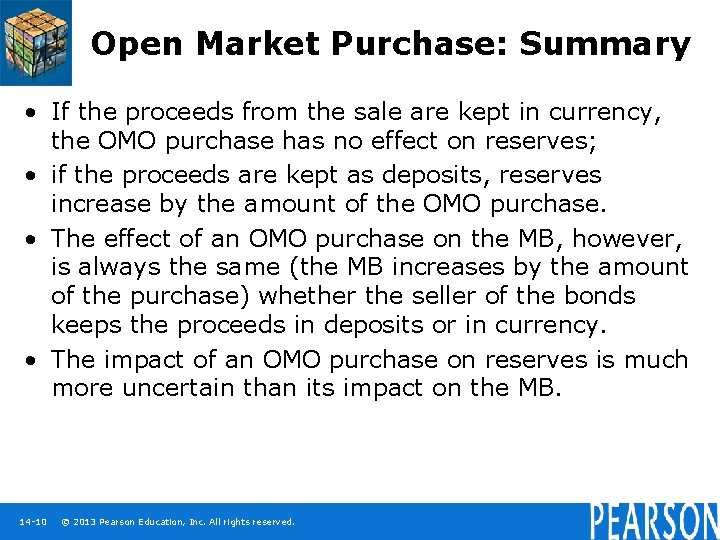
Open Market Purchase: Summary • If the proceeds from the sale are kept in currency, the OMO purchase has no effect on reserves; • if the proceeds are kept as deposits, reserves increase by the amount of the OMO purchase. • The effect of an OMO purchase on the MB, however, is always the same (the MB increases by the amount of the purchase) whether the seller of the bonds keeps the proceeds in deposits or in currency. • The impact of an OMO purchase on reserves is much more uncertain than its impact on the MB. 14 -10 © 2013 Pearson Education, Inc. All rights reserved.
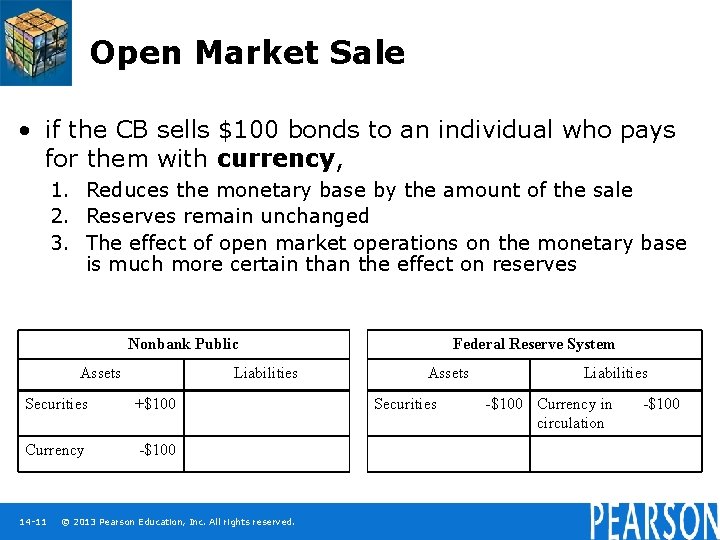
Open Market Sale • if the CB sells $100 bonds to an individual who pays for them with currency, 1. Reduces the monetary base by the amount of the sale 2. Reserves remain unchanged 3. The effect of open market operations on the monetary base is much more certain than the effect on reserves Nonbank Public Assets Liabilities Securities +$100 Currency -$100 14 -11 © 2013 Pearson Education, Inc. All rights reserved. Federal Reserve System Assets Securities Liabilities -$100 Currency in circulation -$100
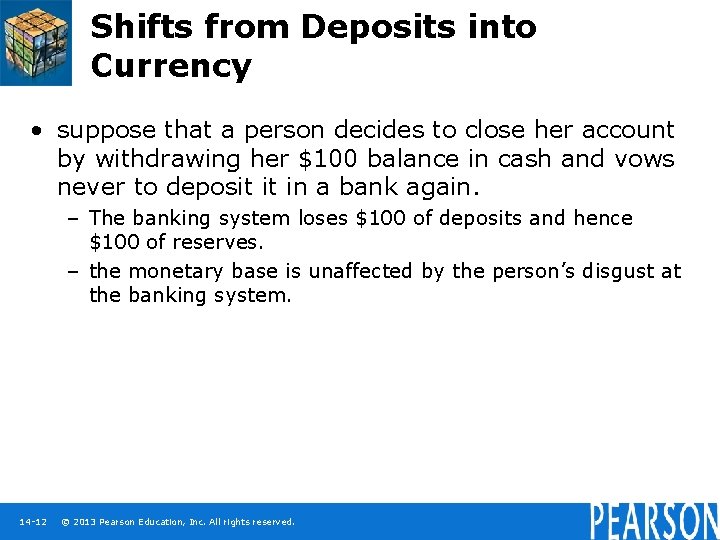
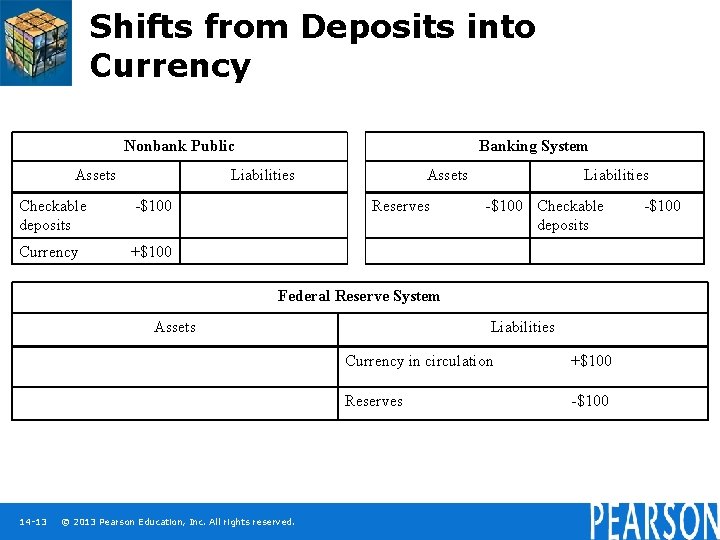
Shifts from Deposits into Currency • suppose that a person decides to close her account by withdrawing her $100 balance in cash and vows never to deposit it in a bank again. – The banking system loses $100 of deposits and hence $100 of reserves. – the monetary base is unaffected by the person’s disgust at the banking system. 14 -12 © 2013 Pearson Education, Inc. All rights reserved.
Shifts from Deposits into Currency Nonbank Public Assets Banking System Liabilities Checkable deposits -$100 Currency +$100 Assets Reserves Liabilities -$100 Checkable deposits Federal Reserve System Assets 14 -13 © 2013 Pearson Education, Inc. All rights reserved. Liabilities Currency in circulation +$100 Reserves -$100
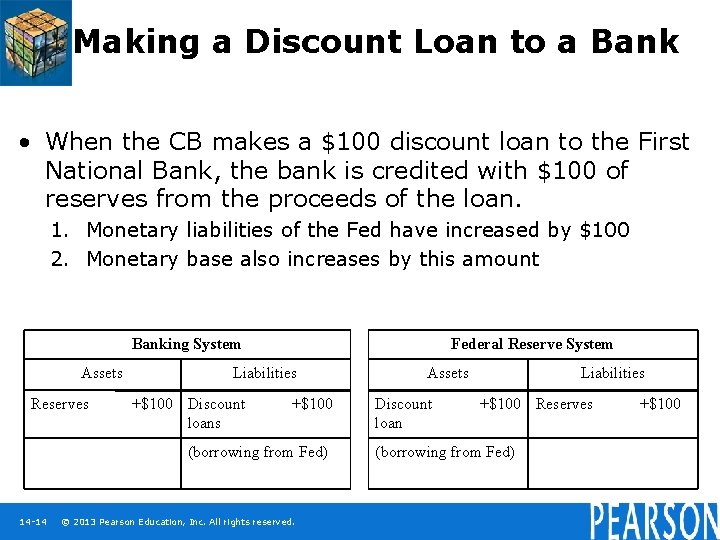
Making a Discount Loan to a Bank • When the CB makes a $100 discount loan to the First National Bank, the bank is credited with $100 of reserves from the proceeds of the loan. 1. Monetary liabilities of the Fed have increased by $100 2. Monetary base also increases by this amount Banking System Assets Reserves Federal Reserve System Liabilities +$100 Discount loans +$100 (borrowing from Fed) 14 -14 © 2013 Pearson Education, Inc. All rights reserved. Assets Discount loan Liabilities +$100 Reserves (borrowing from Fed) +$100
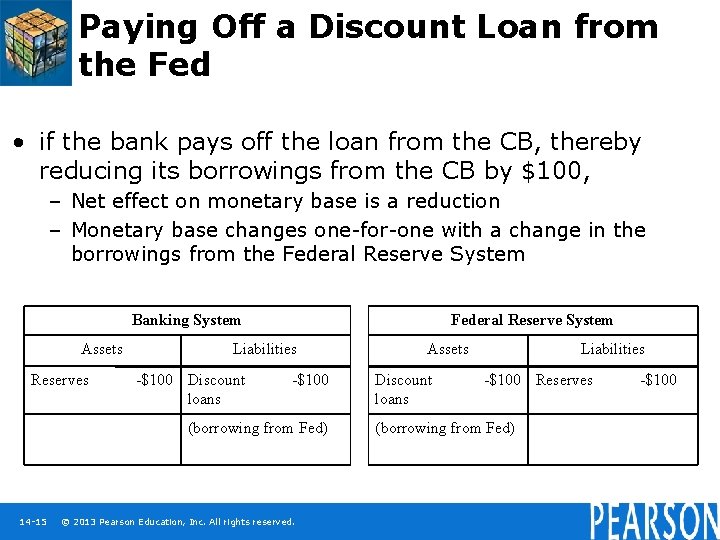
Paying Off a Discount Loan from the Fed • if the bank pays off the loan from the CB, thereby reducing its borrowings from the CB by $100, – Net effect on monetary base is a reduction – Monetary base changes one-for-one with a change in the borrowings from the Federal Reserve System Banking System Assets Reserves Federal Reserve System Liabilities -$100 Discount loans -$100 (borrowing from Fed) 14 -15 © 2013 Pearson Education, Inc. All rights reserved. Assets Discount loans Liabilities -$100 Reserves (borrowing from Fed) -$100
Other Factors Affecting the Monetary Base 1. Float. When the Fed clears checks for banks, it often credits the amount of the check to a bank that has deposited it (increases the bank’s reserves) but only later debits (decreases the reserves of) the bank on which the check is drawn. The resulting temporary net increase in the total amount of reserves in the banking system (and hence in the monetary base) occurring from the Fed’s check-clearing process is called float 14 -16 © 2013 Pearson Education, Inc. All rights reserved.
Other Factors Affecting the Monetary Base 2. Treasury deposits at the Federal Reserve. When the Treasury moves deposits from commercial banks to its account at the CB, leading to a rise in Treasury deposits at the CB, it causes a deposit outflow at these banks thus causes reserves in the banking system and the monetary base to fall. 3. Interventions in the foreign exchange market also affects the monetary base. 14 -17 © 2013 Pearson Education, Inc. All rights reserved.
Other Factors Affecting the Monetary Base 2. Treasury deposits at the Federal Reserve. When the Treasury moves deposits from commercial banks to its account at the CB, leading to a rise in Treasury deposits at the CB, it causes a deposit outflow at these banks thus causes reserves in the banking system and the monetary base to fall. 3. Interventions in the foreign exchange market also affects the monetary base. 14 -18 © 2013 Pearson Education, Inc. All rights reserved.
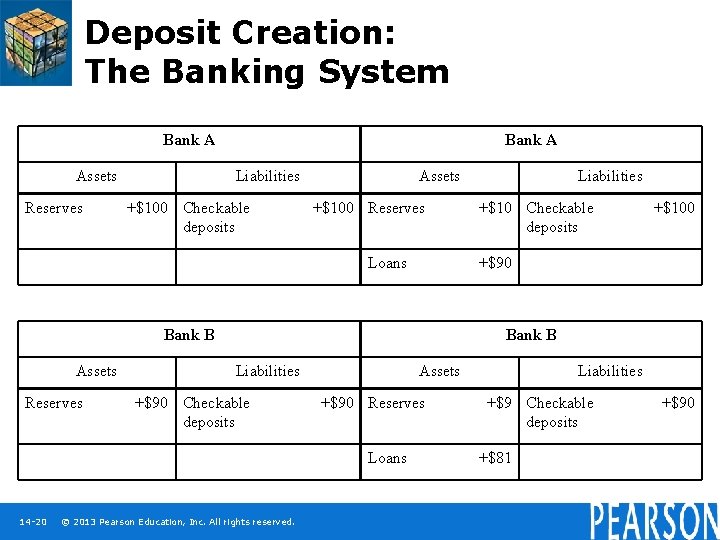
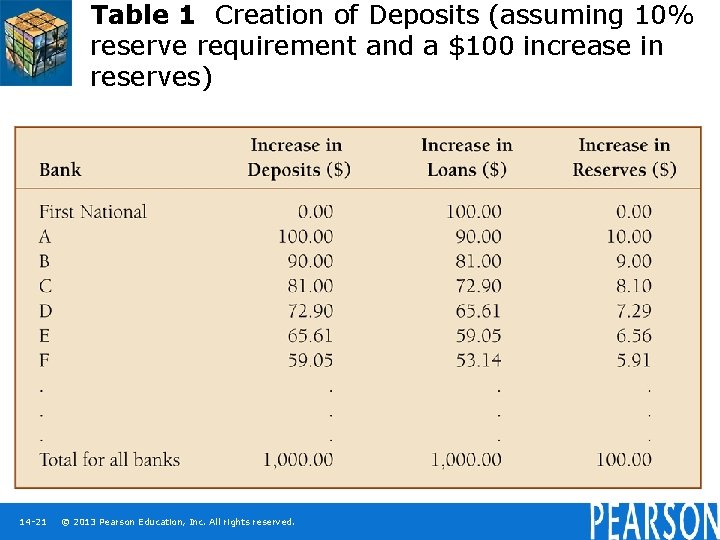
Deposit Creation: Single Bank – Suppose that the First National Banks gives a $100 loan to a borrower who deposited the loan in Bank A. – If the RRR=10, the bank can only give loans of the excess reserves $90. – If the borrower puts the loan in Bank B, this bank will only be able to give loans of the excess reserves $81, which will be deposited in another bank, and so on. – The checkable deposits would increase so far by the total amount of $271 ($100 + $90 + $81). – If all banks make loans for the full amount of their – excess reserves, further increments in checkable deposits will continue as depicted in Table. 14 -19 © 2013 Pearson Education, Inc. All rights reserved.
Deposit Creation: The Banking System Bank A Assets Reserves Bank A Liabilities +$100 Checkable deposits Assets +$100 Reserves Loans Reserves +$100 Bank B Liabilities +$90 Checkable deposits Assets +$90 Reserves Loans 14 -20 +$10 Checkable deposits +$90 Bank B Assets Liabilities © 2013 Pearson Education, Inc. All rights reserved. Liabilities +$9 Checkable deposits +$81 +$90
Table 1 Creation of Deposits (assuming 10% reserve requirement and a $100 increase in reserves) 14 -21 © 2013 Pearson Education, Inc. All rights reserved.
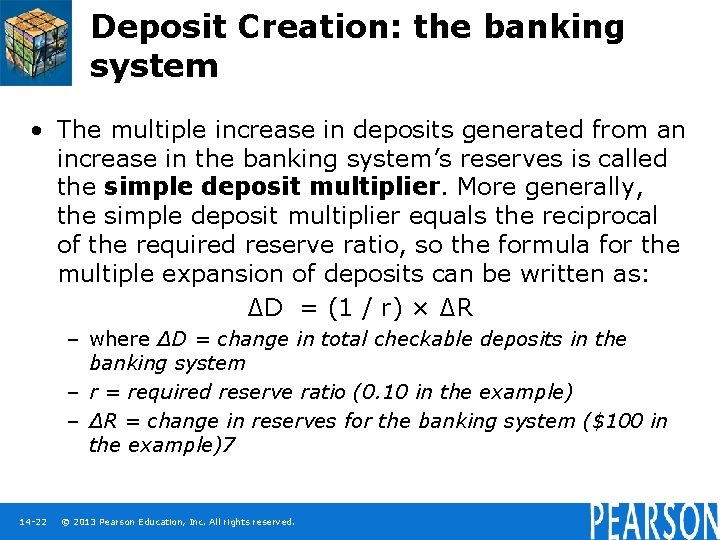
Deposit Creation: the banking system • The multiple increase in deposits generated from an increase in the banking system’s reserves is called the simple deposit multiplier. More generally, the simple deposit multiplier equals the reciprocal of the required reserve ratio, so the formula for the multiple expansion of deposits can be written as: ∆D = (1 / r) × ∆R – where ∆D = change in total checkable deposits in the banking system – r = required reserve ratio (0. 10 in the example) – ∆R = change in reserves for the banking system ($100 in the example)7 14 -22 © 2013 Pearson Education, Inc. All rights reserved.
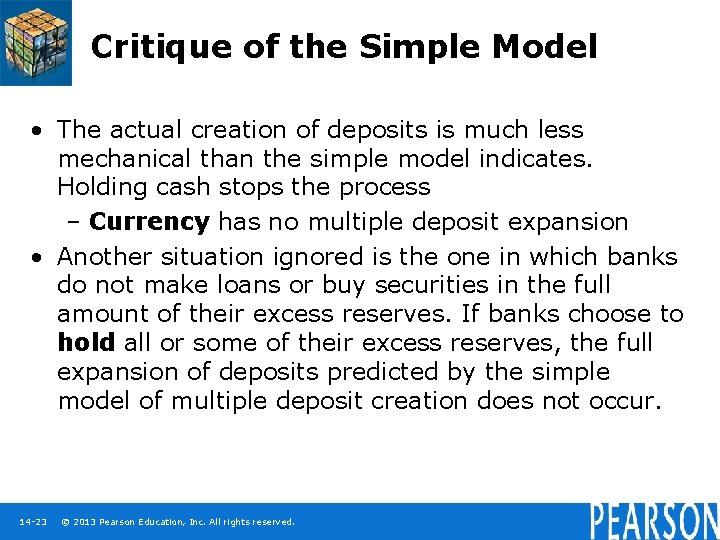
Critique of the Simple Model • The actual creation of deposits is much less mechanical than the simple model indicates. Holding cash stops the process – Currency has no multiple deposit expansion • Another situation ignored is the one in which banks do not make loans or buy securities in the full amount of their excess reserves. If banks choose to hold all or some of their excess reserves, the full expansion of deposits predicted by the simple model of multiple deposit creation does not occur. 14 -23 © 2013 Pearson Education, Inc. All rights reserved.
Critique of the Simple Model • The CB is not the only player whose behavior influences the level of deposits and therefore the money supply. Depositors’ decisions (how much currency to hold) and bank’s decisions (amount of excess reserves to hold) also cause the money supply to change. 14 -24 © 2013 Pearson Education, Inc. All rights reserved.
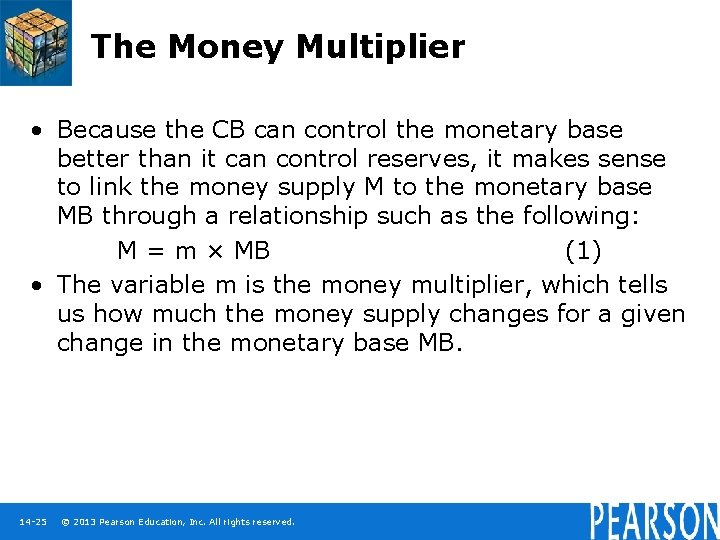
The Money Multiplier • Because the CB can control the monetary base better than it can control reserves, it makes sense to link the money supply M to the monetary base MB through a relationship such as the following: M = m × MB (1) • The variable m is the money multiplier, which tells us how much the money supply changes for a given change in the monetary base MB. 14 -25 © 2013 Pearson Education, Inc. All rights reserved.
The Money Multiplier • The money multiplier reflects the effect on the money supply of other factors besides the monetary base. • Depositors’ decisions about their holdings of currency and checkable deposits are one set of factors affecting the money multiplier. • It also involves the reserve requirements imposed by the CB on the banking system. • Banks’ decisions about excess reserves also affect the money multiplier 14 -26 © 2013 Pearson Education, Inc. All rights reserved.
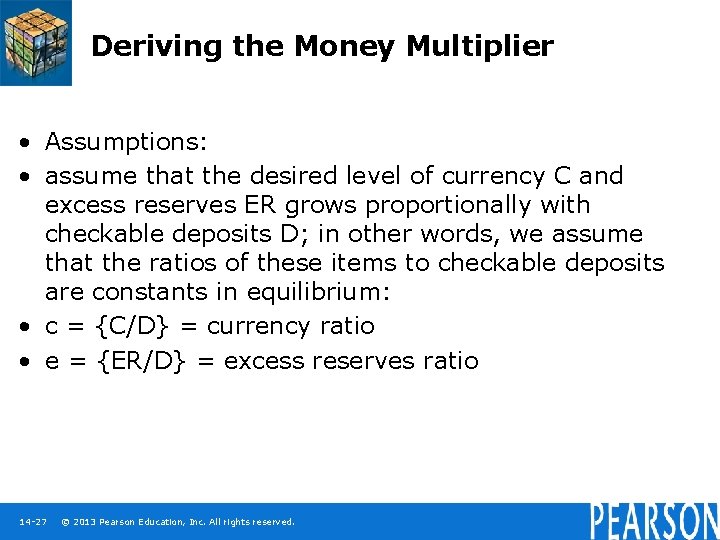
Deriving the Money Multiplier • Assumptions: • assume that the desired level of currency C and excess reserves ER grows proportionally with checkable deposits D; in other words, we assume that the ratios of these items to checkable deposits are constants in equilibrium: • c = {C/D} = currency ratio • e = {ER/D} = excess reserves ratio 14 -27 © 2013 Pearson Education, Inc. All rights reserved.
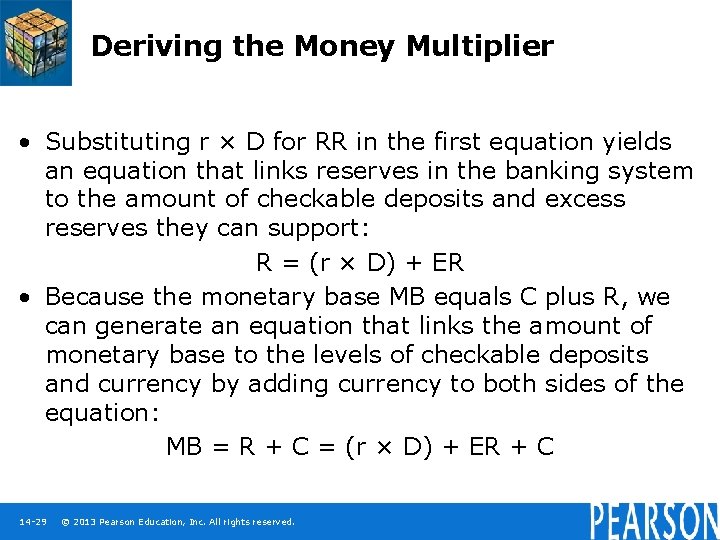
Deriving the Money Multiplier • We begin the derivation of the model of the money supply with the equation: R = RR + ER Where RR=required reserves and ER=excess reserves. • The total amount of required reserves equals the required reserve ratio r times the amount of checkable deposits D: RR = r × D 14 -28 © 2013 Pearson Education, Inc. All rights reserved.
Deriving the Money Multiplier • Substituting r × D for RR in the first equation yields an equation that links reserves in the banking system to the amount of checkable deposits and excess reserves they can support: R = (r × D) + ER • Because the monetary base MB equals C plus R, we can generate an equation that links the amount of monetary base to the levels of checkable deposits and currency by adding currency to both sides of the equation: MB = R + C = (r × D) + ER + C 14 -29 © 2013 Pearson Education, Inc. All rights reserved.
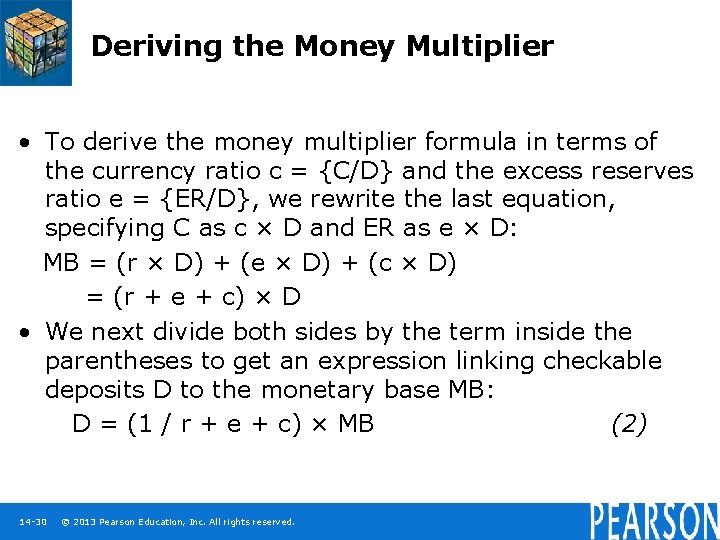
Deriving the Money Multiplier • To derive the money multiplier formula in terms of the currency ratio c = {C/D} and the excess reserves ratio e = {ER/D}, we rewrite the last equation, specifying C as c × D and ER as e × D: MB = (r × D) + (e × D) + (c × D) = (r + e + c) × D • We next divide both sides by the term inside the parentheses to get an expression linking checkable deposits D to the monetary base MB: D = (1 / r + e + c) × MB (2) 14 -30 © 2013 Pearson Education, Inc. All rights reserved.
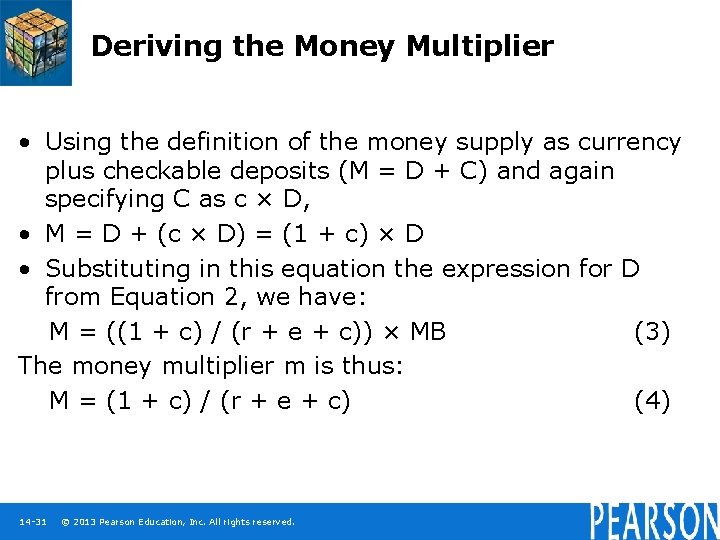
Deriving the Money Multiplier • Using the definition of the money supply as currency plus checkable deposits (M = D + C) and again specifying C as c × D, • M = D + (c × D) = (1 + c) × D • Substituting in this equation the expression for D from Equation 2, we have: M = ((1 + c) / (r + e + c)) × MB (3) The money multiplier m is thus: M = (1 + c) / (r + e + c) (4) 14 -31 © 2013 Pearson Education, Inc. All rights reserved.
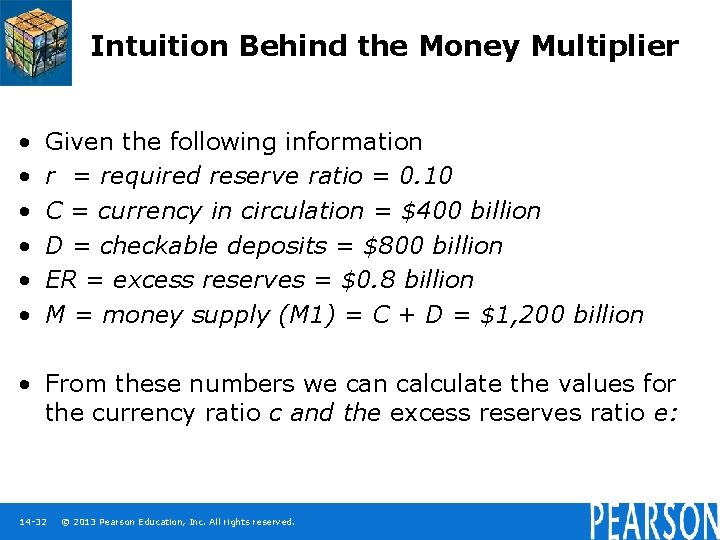
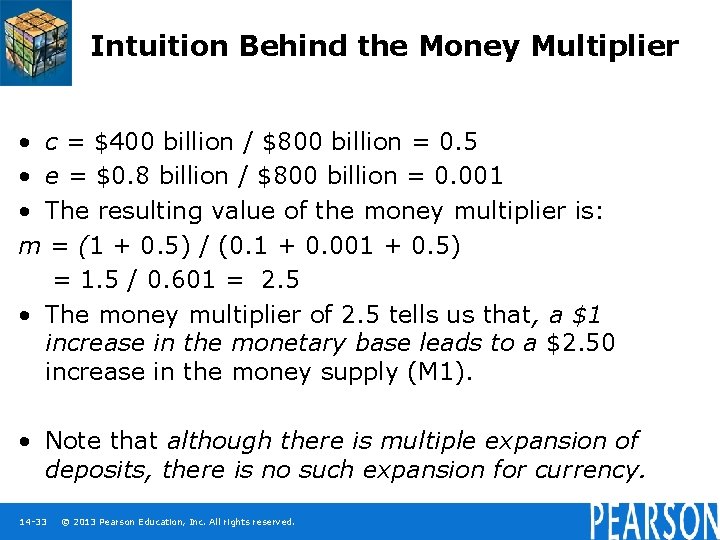
Intuition Behind the Money Multiplier • • • Given the following information r = required reserve ratio = 0. 10 C = currency in circulation = $400 billion D = checkable deposits = $800 billion ER = excess reserves = $0. 8 billion M = money supply (M 1) = C + D = $1, 200 billion • From these numbers we can calculate the values for the currency ratio c and the excess reserves ratio e: 14 -32 © 2013 Pearson Education, Inc. All rights reserved.
Intuition Behind the Money Multiplier • c = $400 billion / $800 billion = 0. 5 • e = $0. 8 billion / $800 billion = 0. 001 • The resulting value of the money multiplier is: m = (1 + 0. 5) / (0. 1 + 0. 001 + 0. 5) = 1. 5 / 0. 601 = 2. 5 • The money multiplier of 2. 5 tells us that, a $1 increase in the monetary base leads to a $2. 50 increase in the money supply (M 1). • Note that although there is multiple expansion of deposits, there is no such expansion for currency. 14 -33 © 2013 Pearson Education, Inc. All rights reserved.
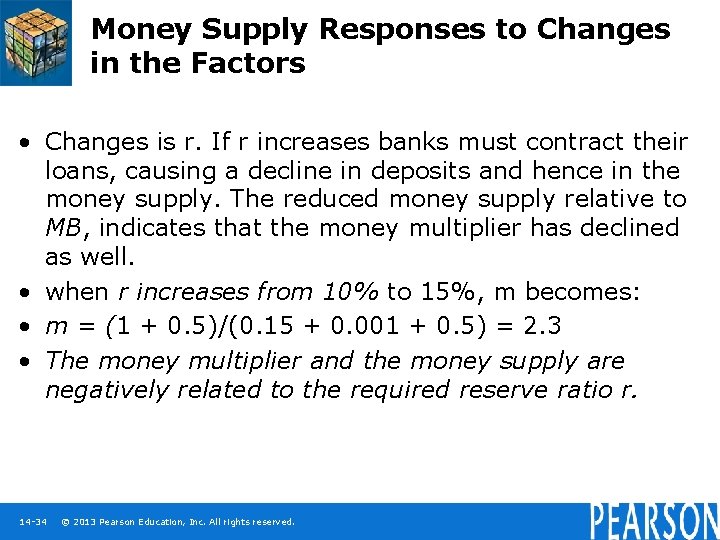
Money Supply Responses to Changes in the Factors • Changes is r. If r increases banks must contract their loans, causing a decline in deposits and hence in the money supply. The reduced money supply relative to MB, indicates that the money multiplier has declined as well. • when r increases from 10% to 15%, m becomes: • m = (1 + 0. 5)/(0. 15 + 0. 001 + 0. 5) = 2. 3 • The money multiplier and the money supply are negatively related to the required reserve ratio r. 14 -34 © 2013 Pearson Education, Inc. All rights reserved.
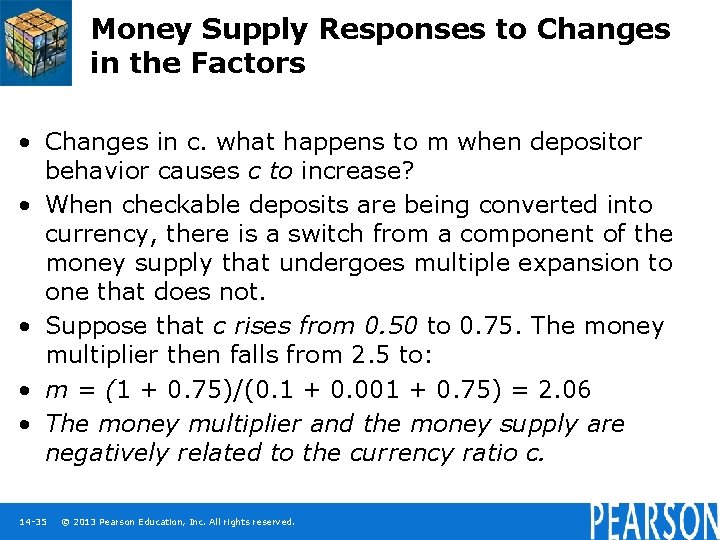
Money Supply Responses to Changes in the Factors • Changes in c. what happens to m when depositor behavior causes c to increase? • When checkable deposits are being converted into currency, there is a switch from a component of the money supply that undergoes multiple expansion to one that does not. • Suppose that c rises from 0. 50 to 0. 75. The money multiplier then falls from 2. 5 to: • m = (1 + 0. 75)/(0. 1 + 0. 001 + 0. 75) = 2. 06 • The money multiplier and the money supply are negatively related to the currency ratio c. 14 -35 © 2013 Pearson Education, Inc. All rights reserved.
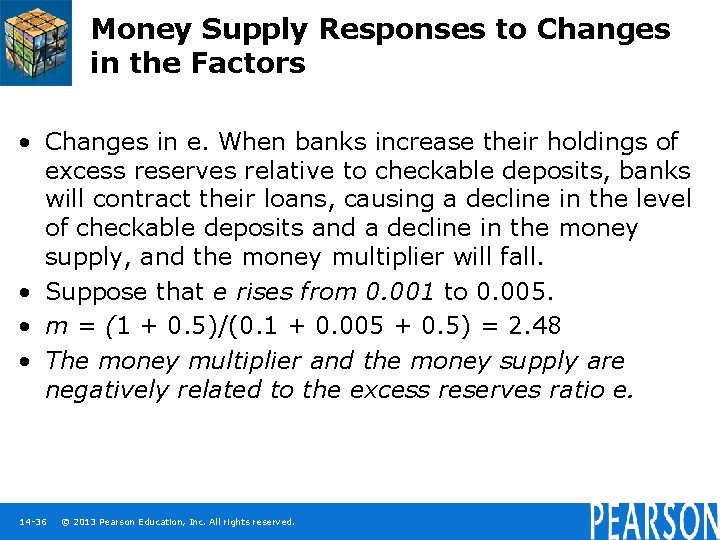
Money Supply Responses to Changes in the Factors • Changes in e. When banks increase their holdings of excess reserves relative to checkable deposits, banks will contract their loans, causing a decline in the level of checkable deposits and a decline in the money supply, and the money multiplier will fall. • Suppose that e rises from 0. 001 to 0. 005. • m = (1 + 0. 5)/(0. 1 + 0. 005 + 0. 5) = 2. 48 • The money multiplier and the money supply are negatively related to the excess reserves ratio e. 14 -36 © 2013 Pearson Education, Inc. All rights reserved.
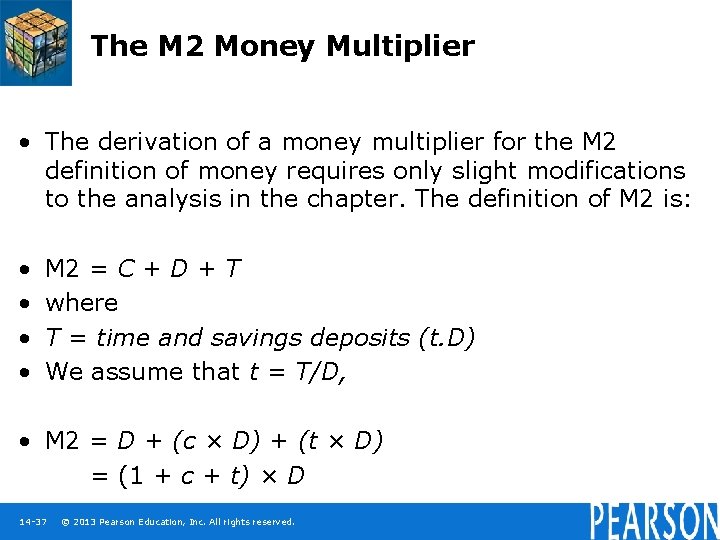
The M 2 Money Multiplier • The derivation of a money multiplier for the M 2 definition of money requires only slight modifications to the analysis in the chapter. The definition of M 2 is: • • M 2 = C + D + T where T = time and savings deposits (t. D) We assume that t = T/D, • M 2 = D + (c × D) + (t × D) = (1 + c + t) × D 14 -37 © 2013 Pearson Education, Inc. All rights reserved.
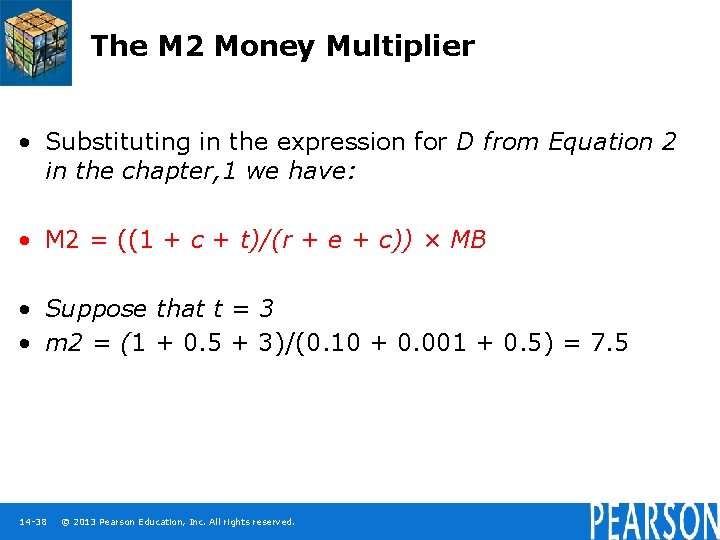
The M 2 Money Multiplier • Substituting in the expression for D from Equation 2 in the chapter, 1 we have: • M 2 = ((1 + c + t)/(r + e + c)) × MB • Suppose that t = 3 • m 2 = (1 + 0. 5 + 3)/(0. 10 + 0. 001 + 0. 5) = 7. 5 14 -38 © 2013 Pearson Education, Inc. All rights reserved.