
Chapter 14 The Effects of Time and Risk

- Slides: 47
Chapter 14: The Effects of Time and Risk on Value Mc. Graw-Hill/Irwin Copyright © 2013 by The Mc. Graw-Hill Companies, Inc. All rights reserved.
Value: The Central Idea § Investment Value: § Maximum price an investor is willing to pay for ownership interest in real property or mortgages § Real estate valuation: § Estimate all future net cash flows § Convert into estimate of present value § How are investment decisions made? § By comparing estimate of present value to required equity investment 14 -2
Value Depends on…? § Value of a property or mortgage thus depends on: § magnitude of expected cash flows § timing of expected cash flows § riskiness of expected cash flows 14 -3
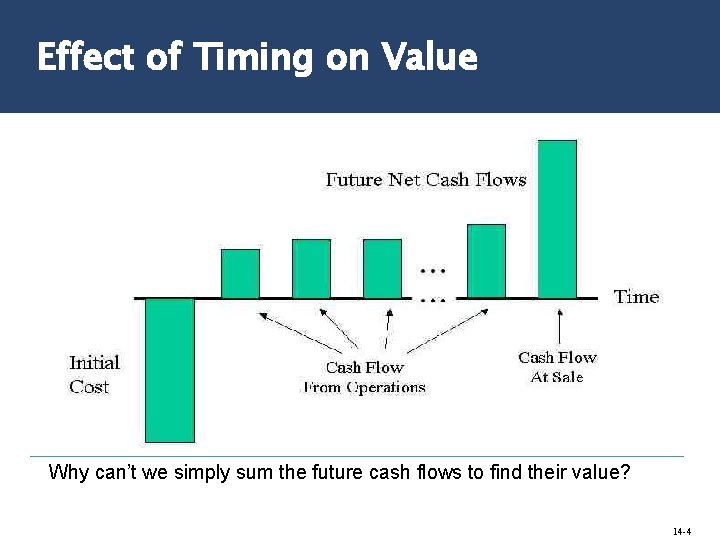
Effect of Timing on Value Why can’t we simply sum the future cash flows to find their value? 14 -4
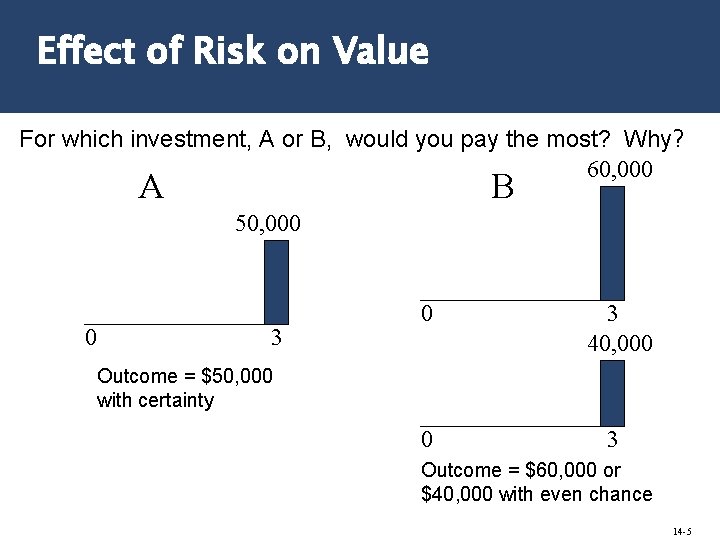
Effect of Risk on Value For which investment, A or B, would you pay the most? Why? 60, 000 A B 50, 000 0 3 40, 000 0 3 Outcome = $50, 000 with certainty Outcome = $60, 000 or $40, 000 with even chance 14 -5
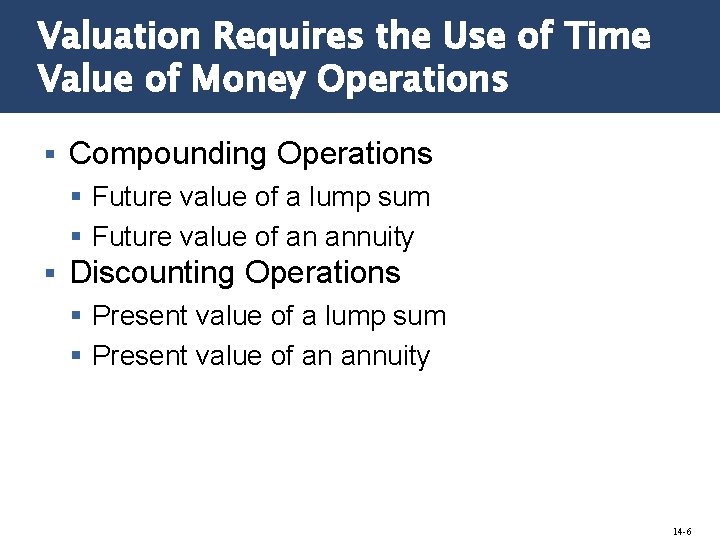
Valuation Requires the Use of Time Value of Money Operations § Compounding Operations § Future value of a lump sum § Future value of an annuity § Discounting Operations § Present value of a lump sum § Present value of an annuity 14 -6
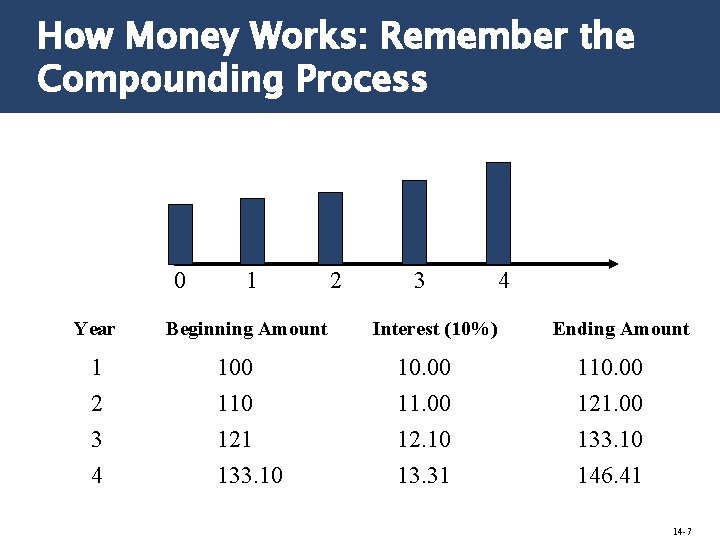
How Money Works: Remember the Compounding Process 0 1 Year Beginning Amount 1 2 3 4 100 110 121 133. 10 2 3 Interest (10%) 10. 00 11. 00 12. 10 13. 31 4 Ending Amount 110. 00 121. 00 133. 10 146. 41 14 -7
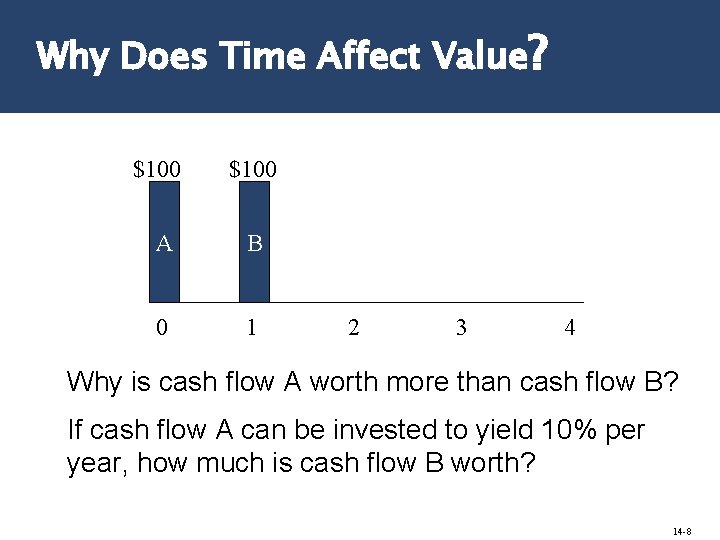
Why Does Time Affect Value? $100 A B 0 1 2 3 4 Why is cash flow A worth more than cash flow B? If cash flow A can be invested to yield 10% per year, how much is cash flow B worth? 14 -8
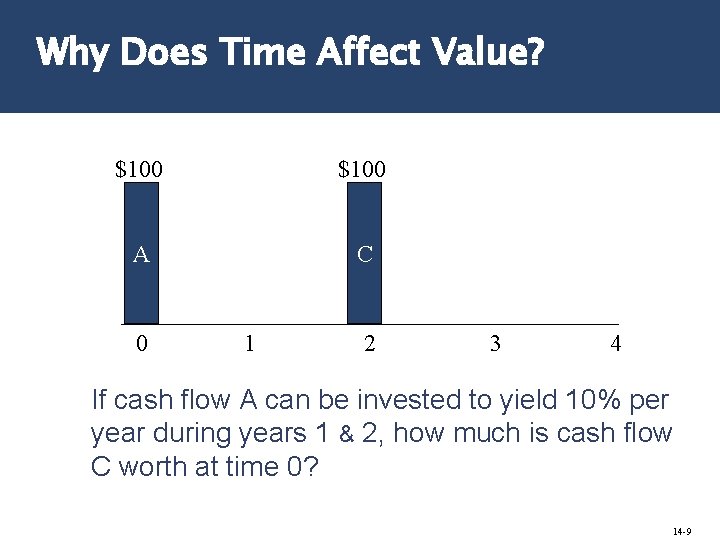
Why Does Time Affect Value? $100 A C 0 1 2 3 4 If cash flow A can be invested to yield 10% per year during years 1 & 2, how much is cash flow C worth at time 0? 14 -9
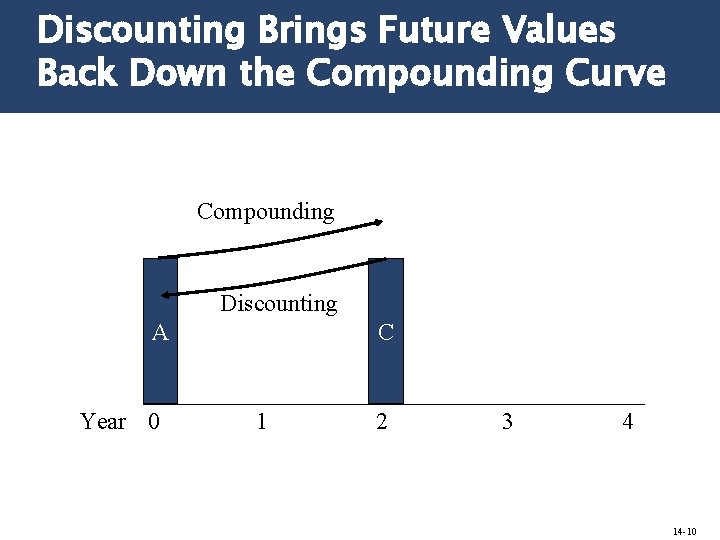
Discounting Brings Future Values Back Down the Compounding Curve Compounding Discounting A Year 0 C 1 2 3 4 14 -10
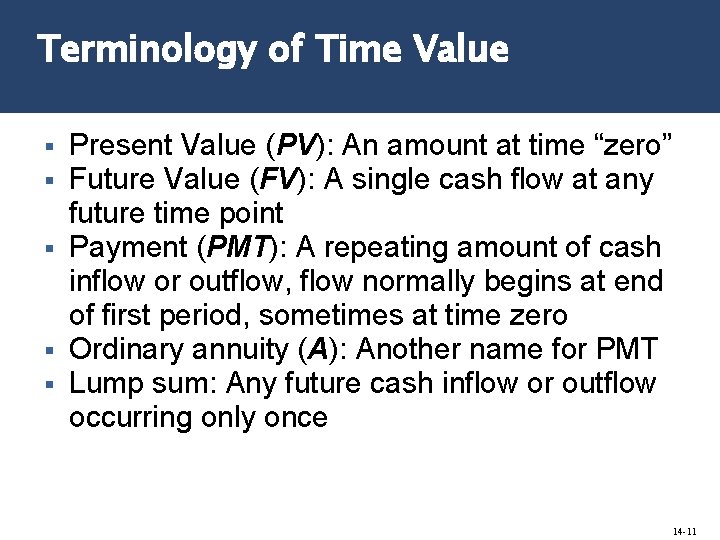
Terminology of Time Value Present Value (PV): An amount at time “zero” Future Value (FV): A single cash flow at any future time point § Payment (PMT): A repeating amount of cash inflow or outflow, flow normally begins at end of first period, sometimes at time zero § Ordinary annuity (A): Another name for PMT § Lump sum: Any future cash inflow or outflow occurring only once § § 14 -11
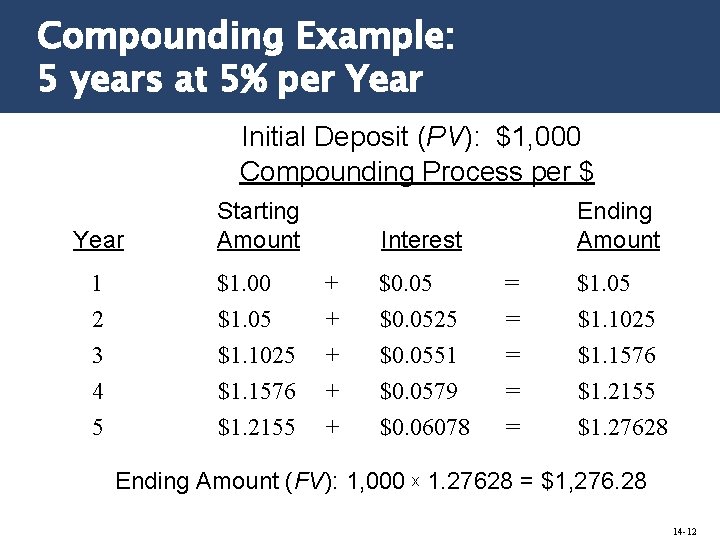
Compounding Example: 5 years at 5% per Year Initial Deposit (PV): $1, 000 Compounding Process per $ Year Starting Amount 1 2 3 4 5 $1. 00 $1. 05 $1. 1025 $1. 1576 $1. 2155 Ending Amount Interest + + + $0. 0525 $0. 0551 $0. 0579 $0. 06078 = = = $1. 05 $1. 1025 $1. 1576 $1. 2155 $1. 27628 Ending Amount (FV): 1, 000 x 1. 27628 = $1, 276. 28 14 -12
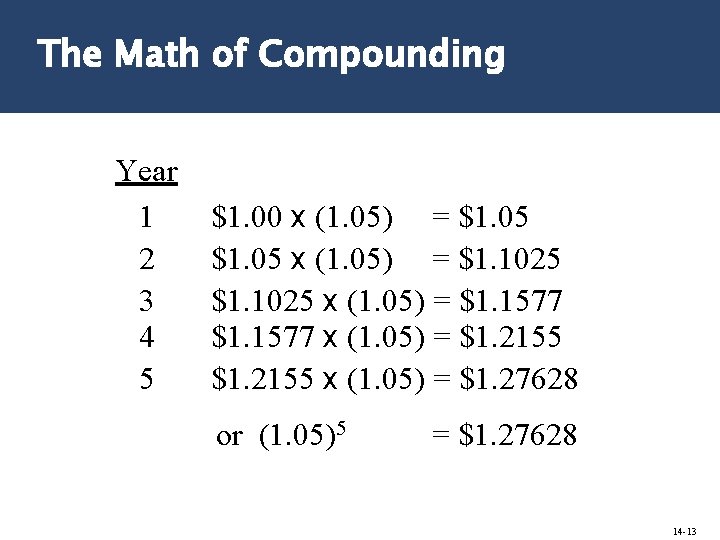
The Math of Compounding Year 1 2 3 4 5 $1. 00 x (1. 05) = $1. 05 x (1. 05) = $1. 1025 x (1. 05) = $1. 1577 x (1. 05) = $1. 2155 x (1. 05) = $1. 27628 or (1. 05)5 = $1. 27628 14 -13
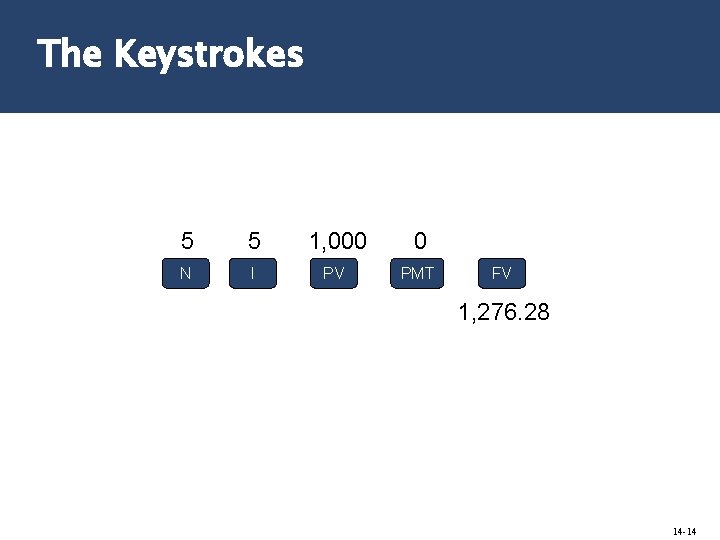
The Keystrokes 5 5 1, 000 0 N I PV PMT FV 1, 276. 28 14 -14
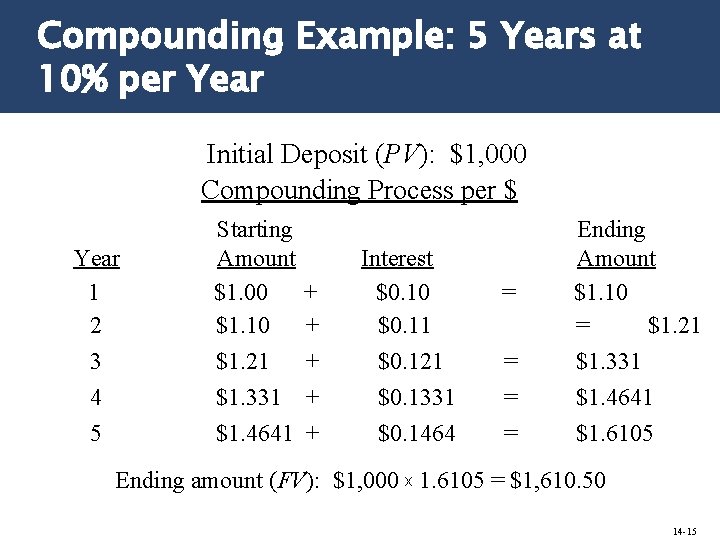
Compounding Example: 5 Years at 10% per Year Initial Deposit (PV): $1, 000 Compounding Process per $ Year 1 2 3 4 5 Starting Amount $1. 00 $1. 10 $1. 21 $1. 331 $1. 4641 + + + Interest $0. 10 $0. 11 $0. 121 $0. 1331 $0. 1464 = = Ending Amount $1. 10 = $1. 21 $1. 331 $1. 4641 $1. 6105 Ending amount (FV): $1, 000 x 1. 6105 = $1, 610. 50 14 -15
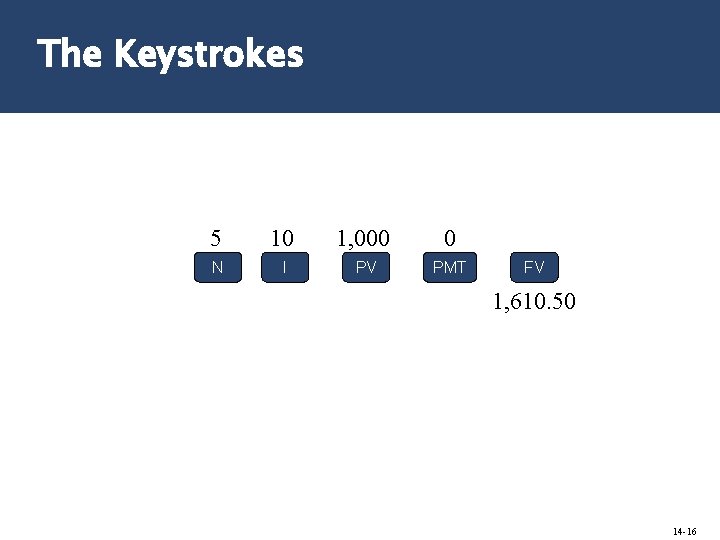
The Keystrokes 5 10 1, 000 0 N I PV PMT FV 1, 610. 50 14 -16
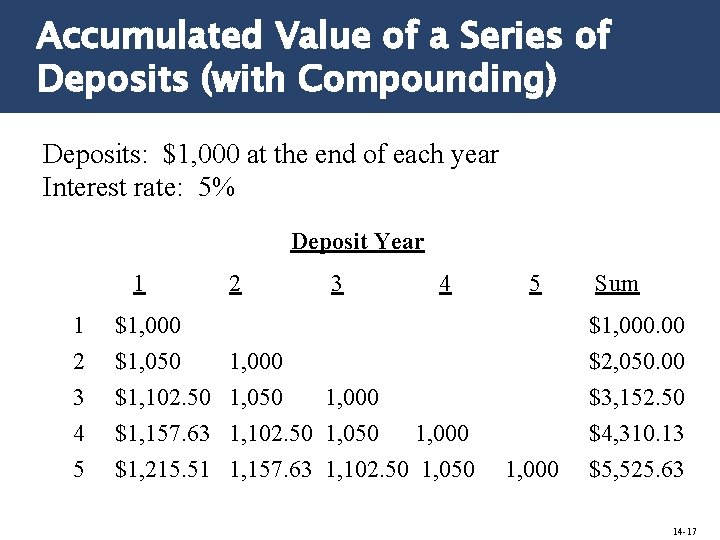
Accumulated Value of a Series of Deposits (with Compounding) Deposits: $1, 000 at the end of each year Interest rate: 5% Deposit Year 1 1 2 3 4 5 $1, 000 $1, 050 $1, 102. 50 $1, 157. 63 $1, 215. 51 2 3 4 1, 000 1, 050 1, 000 1, 102. 50 1, 000 1, 157. 63 1, 102. 50 1, 050 5 1, 000 Sum $1, 000. 00 $2, 050. 00 $3, 152. 50 $4, 310. 13 $5, 525. 63 14 -17
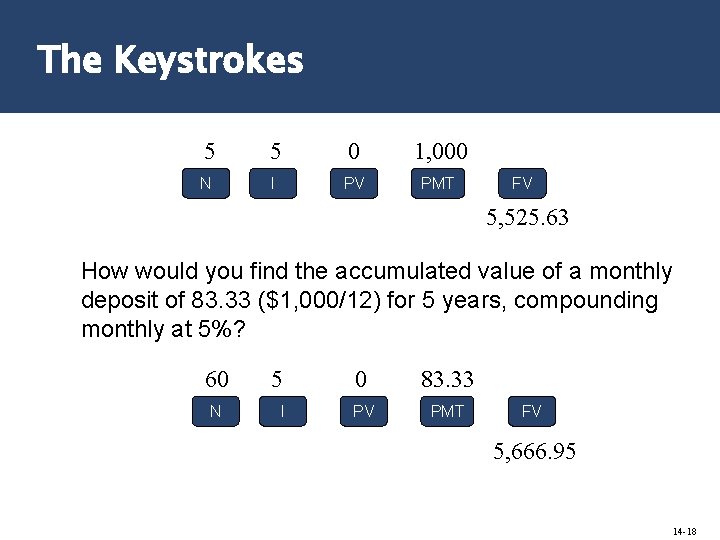
The Keystrokes 5 5 0 1, 000 N I PV PMT FV 5, 525. 63 How would you find the accumulated value of a monthly deposit of 83. 33 ($1, 000/12) for 5 years, compounding monthly at 5%? 60 N 5 I 0 83. 33 PV PMT FV 5, 666. 95 14 -18
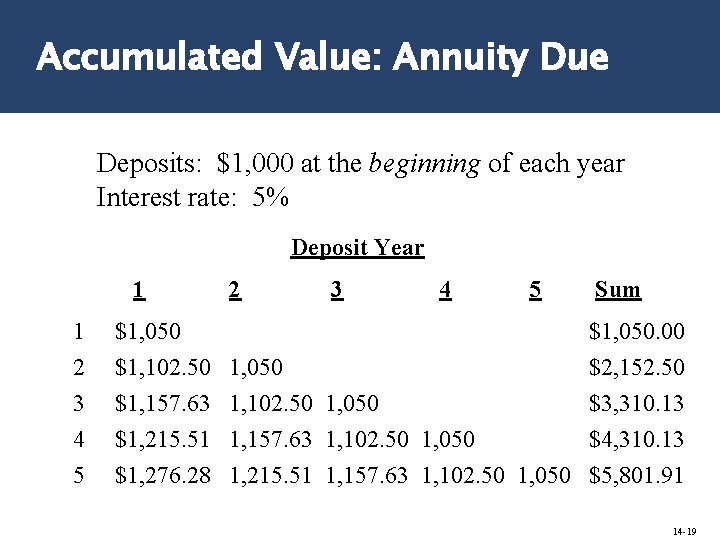
Accumulated Value: Annuity Due Deposits: $1, 000 at the beginning of each year Interest rate: 5% Deposit Year 1 1 2 3 4 5 $1, 050 $1, 102. 50 $1, 157. 63 $1, 215. 51 $1, 276. 28 2 3 4 5 Sum $1, 050. 00 1, 050 $2, 152. 50 1, 102. 50 1, 050 $3, 310. 13 1, 157. 63 1, 102. 50 1, 050 $4, 310. 13 1, 215. 51 1, 157. 63 1, 102. 50 1, 050 $5, 801. 91 14 -19
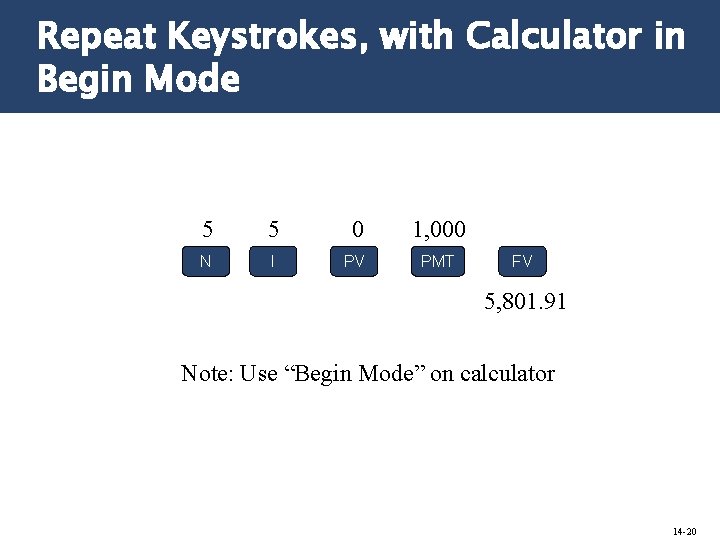
Repeat Keystrokes, with Calculator in Begin Mode 5 5 0 1, 000 N I PV PMT FV 5, 801. 91 Note: Use “Begin Mode” on calculator 14 -20
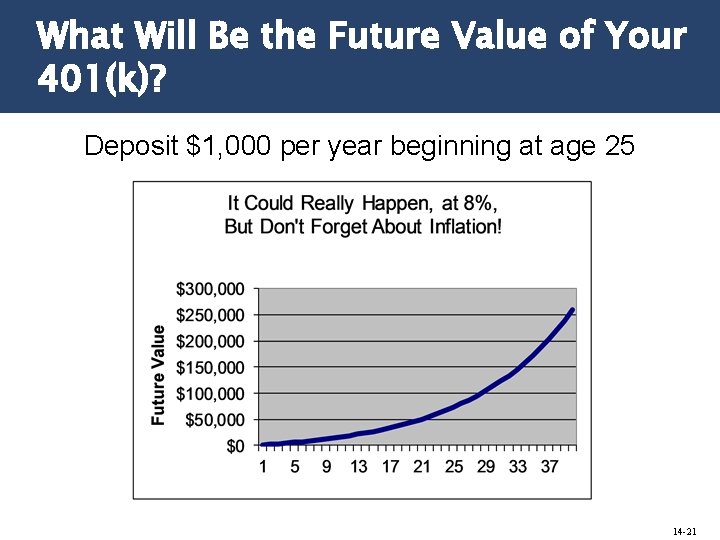
What Will Be the Future Value of Your 401(k)? Deposit $1, 000 per year beginning at age 25 14 -21
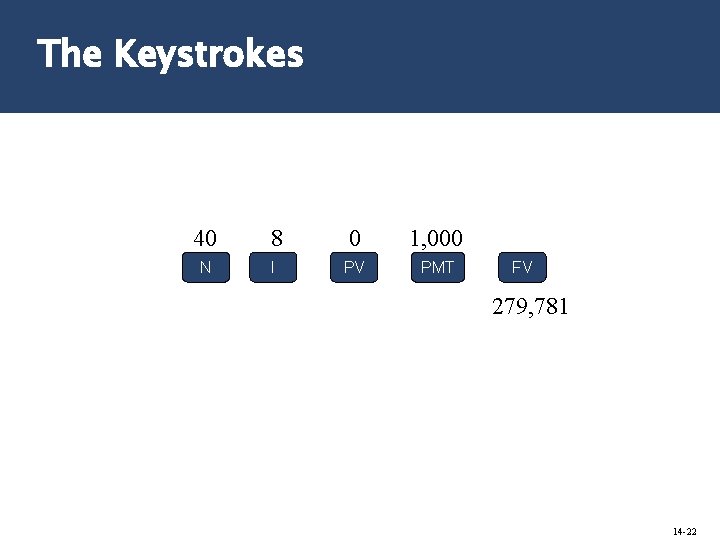
The Keystrokes 40 8 0 1, 000 N I PV PMT FV 279, 781 14 -22
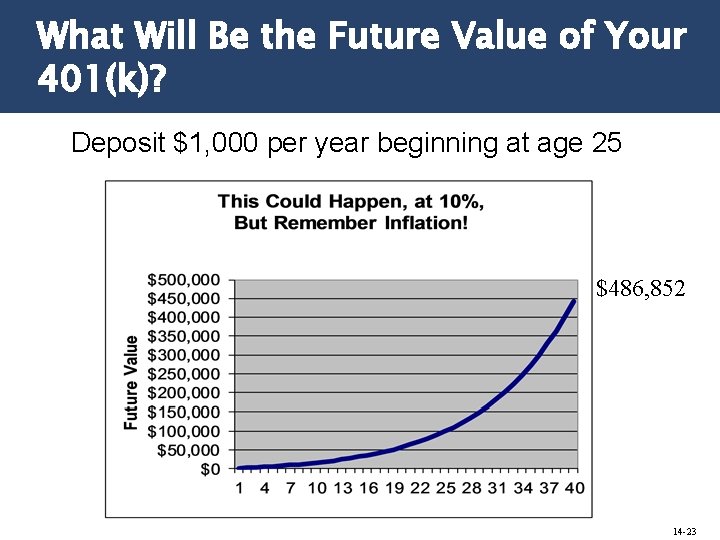
What Will Be the Future Value of Your 401(k)? Deposit $1, 000 per year beginning at age 25 $486, 852 14 -23
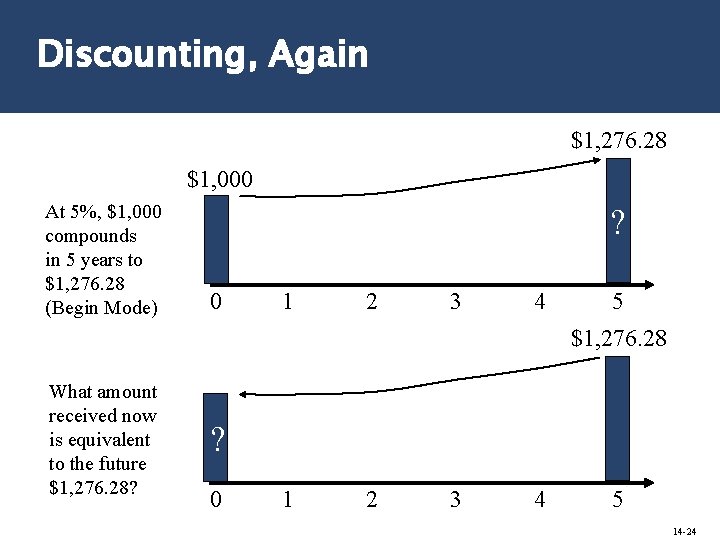
Discounting, Again $1, 276. 28 $1, 000 At 5%, $1, 000 compounds in 5 years to $1, 276. 28 (Begin Mode) ? 0 1 2 3 4 5 $1, 276. 28 What amount received now is equivalent to the future $1, 276. 28? ? 0 1 2 3 4 5 14 -24
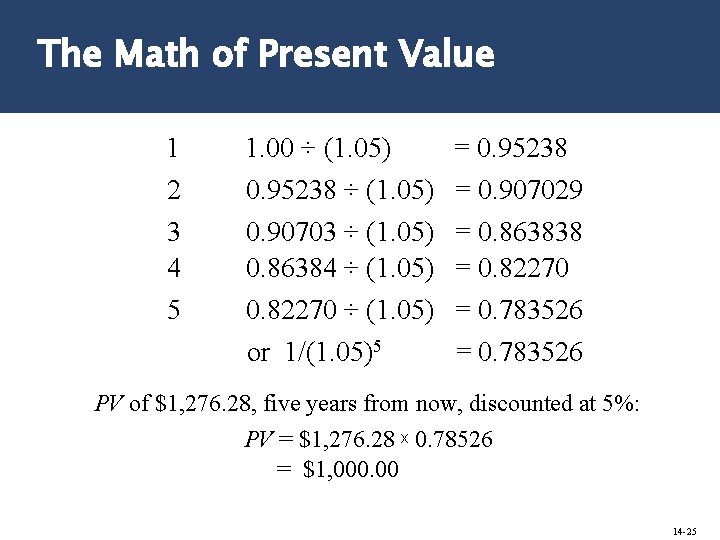
The Math of Present Value 1 2 3 4 5 1. 00 ÷ (1. 05) 0. 95238 ÷ (1. 05) 0. 90703 ÷ (1. 05) 0. 86384 ÷ (1. 05) 0. 82270 ÷ (1. 05) or 1/(1. 05)5 = 0. 95238 = 0. 907029 = 0. 863838 = 0. 82270 = 0. 783526 PV of $1, 276. 28, five years from now, discounted at 5%: PV = $1, 276. 28 x 0. 78526 = $1, 000. 00 14 -25
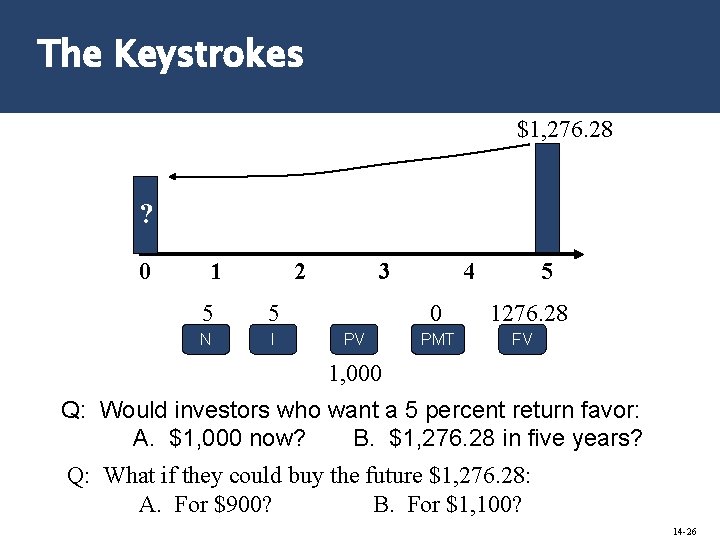
The Keystrokes $1, 276. 28 ? 0 1 2 5 5 N I 3 4 0 PV PMT 5 1276. 28 FV 1, 000 Q: Would investors who want a 5 percent return favor: A. $1, 000 now? B. $1, 276. 28 in five years? Q: What if they could buy the future $1, 276. 28: A. For $900? B. For $1, 100? 14 -26
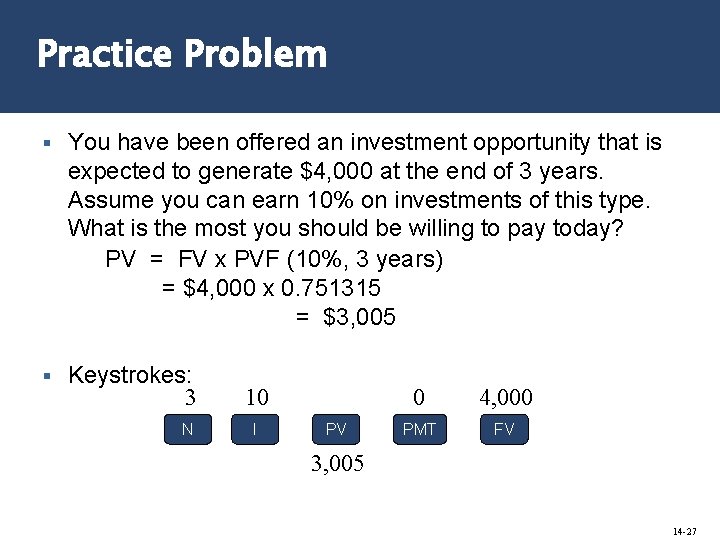
Practice Problem § You have been offered an investment opportunity that is expected to generate $4, 000 at the end of 3 years. Assume you can earn 10% on investments of this type. What is the most you should be willing to pay today? PV = FV x PVF (10%, 3 years) = $4, 000 x 0. 751315 = $3, 005 § Keystrokes: 3 N 10 I PV 0 4, 000 PMT FV 3, 005 14 -27
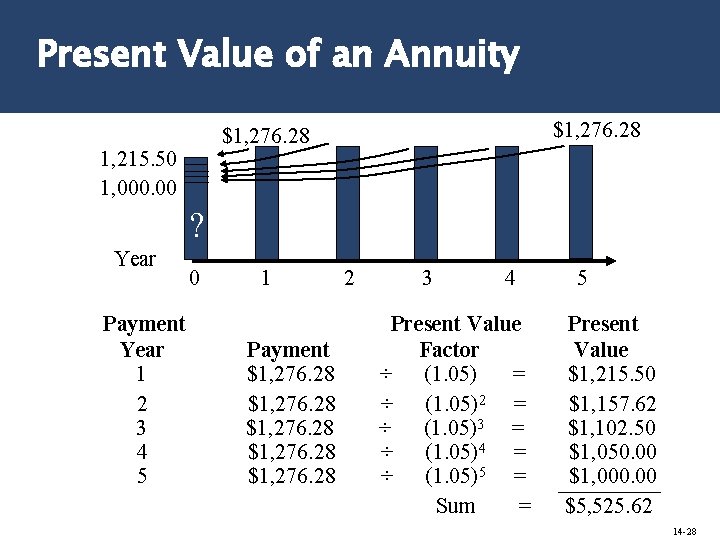
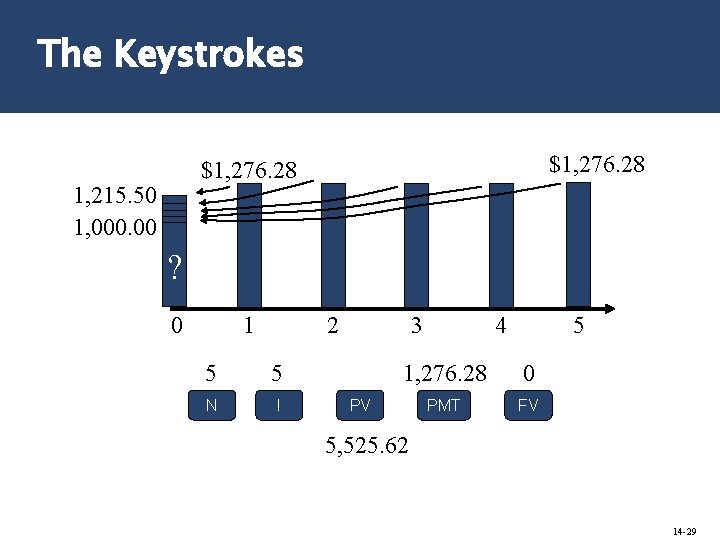
Present Value of an Annuity $1, 276. 28 1, 215. 50 1, 000. 00 ? Year Payment Year 1 2 3 4 5 0 1 Payment $1, 276. 28 2 3 4 Present Value Factor ÷ (1. 05) = ÷ (1. 05)2 = ÷ (1. 05)3 = ÷ (1. 05)4 = ÷ (1. 05)5 = Sum = 5 Present Value $1, 215. 50 $1, 157. 62 $1, 102. 50 $1, 050. 00 $1, 000. 00 $5, 525. 62 14 -28
The Keystrokes $1, 276. 28 1, 215. 50 1, 000. 00 ? 0 1 2 5 5 N I 3 4 5 1, 276. 28 0 PMT FV PV 5, 525. 62 14 -29
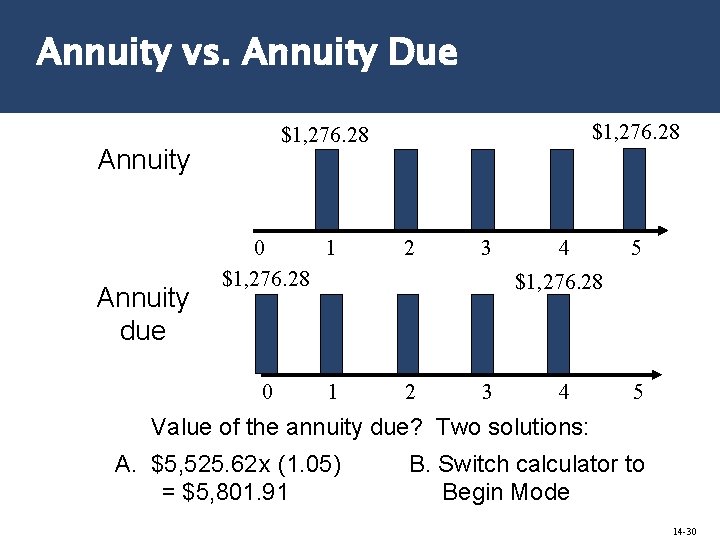
Annuity vs. Annuity Due Annuity due $1, 276. 28 0 1 2 3 4 5 $1, 276. 28 2 3 4 5 Value of the annuity due? Two solutions: A. $5, 525. 62 x (1. 05) = $5, 801. 91 B. Switch calculator to Begin Mode 14 -30
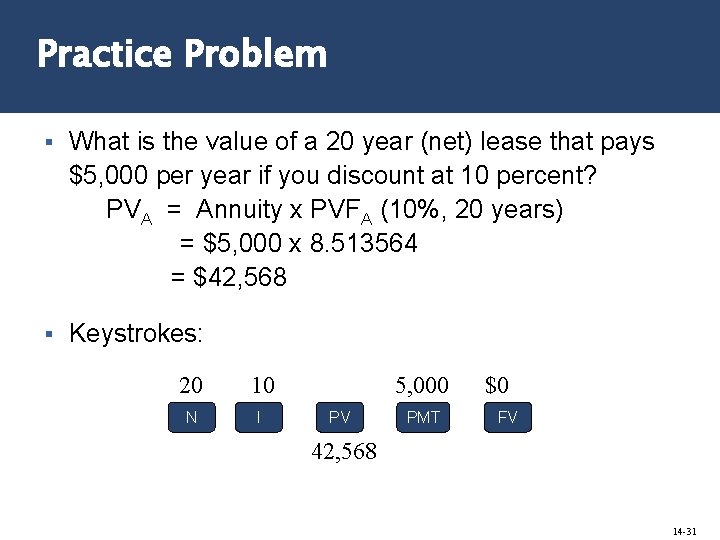
Practice Problem § What is the value of a 20 year (net) lease that pays $5, 000 per year if you discount at 10 percent? PVA = Annuity x PVFA (10%, 20 years) = $5, 000 x 8. 513564 = $42, 568 § Keystrokes: 20 10 N I 5, 000 PV PMT $0 FV 42, 568 14 -31
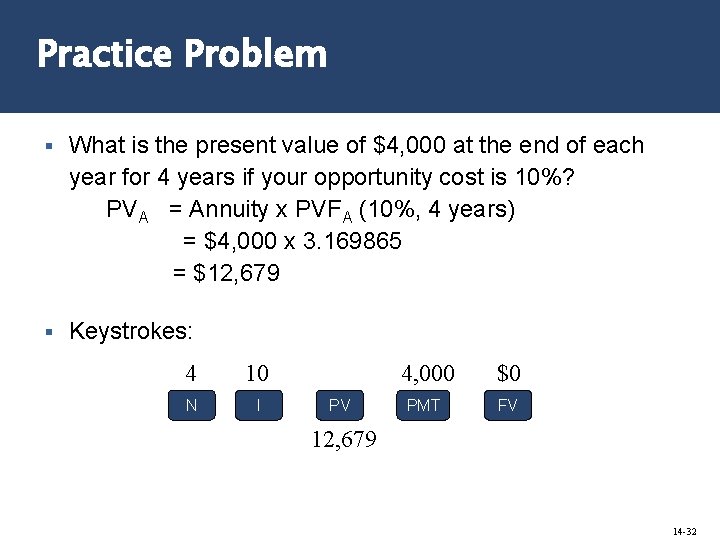
Practice Problem § What is the present value of $4, 000 at the end of each year for 4 years if your opportunity cost is 10%? PVA = Annuity x PVFA (10%, 4 years) = $4, 000 x 3. 169865 = $12, 679 § Keystrokes: 4 10 N I PV 4, 000 $0 PMT FV 12, 679 14 -32
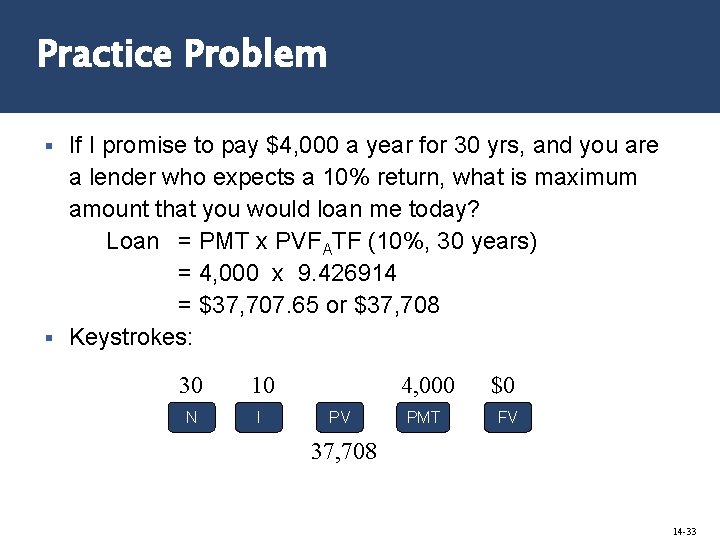
Practice Problem If I promise to pay $4, 000 a year for 30 yrs, and you are a lender who expects a 10% return, what is maximum amount that you would loan me today? Loan = PMT x PVFATF (10%, 30 years) = 4, 000 x 9. 426914 = $37, 707. 65 or $37, 708 § Keystrokes: § 30 10 N I 4, 000 PV PMT $0 FV 37, 708 14 -33
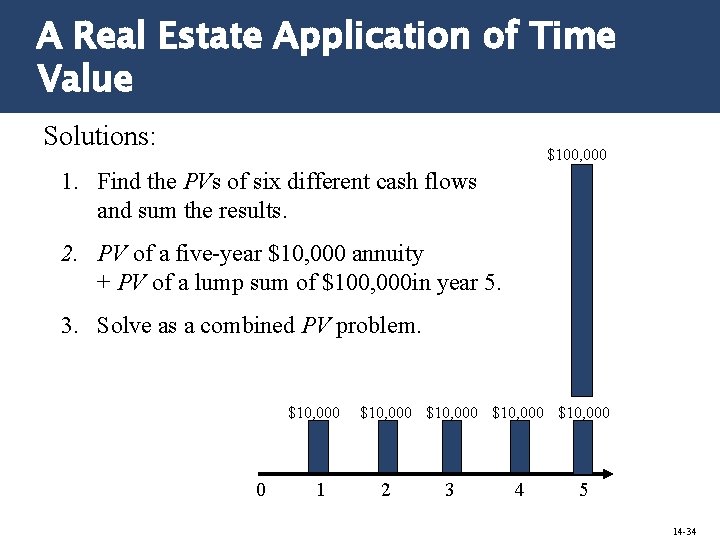
A Real Estate Application of Time Value Solutions: $100, 000 1. Find the PVs of six different cash flows and sum the results. 2. PV of a five-year $10, 000 annuity + PV of a lump sum of $100, 000 in year 5. 3. Solve as a combined PV problem. $10, 000 0 1 $10, 000 2 3 4 5 14 -34
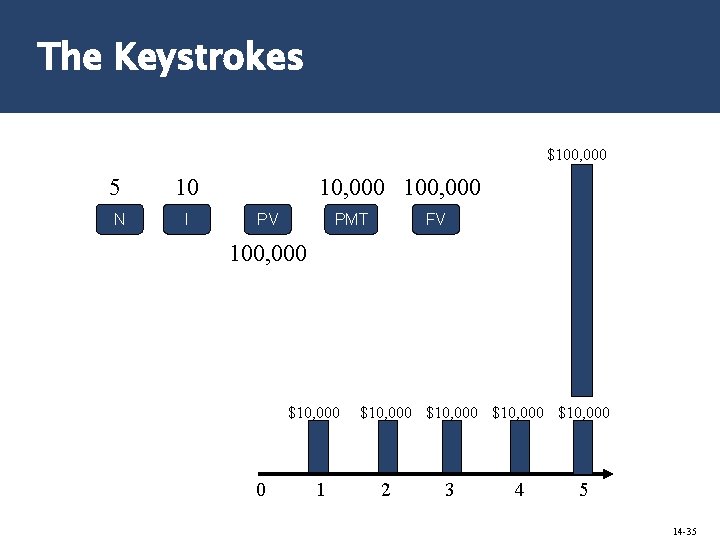
The Keystrokes $100, 000 5 10 N I 10, 000 100, 000 PV PMT FV 100, 000 $10, 000 0 1 $10, 000 2 3 4 5 14 -35
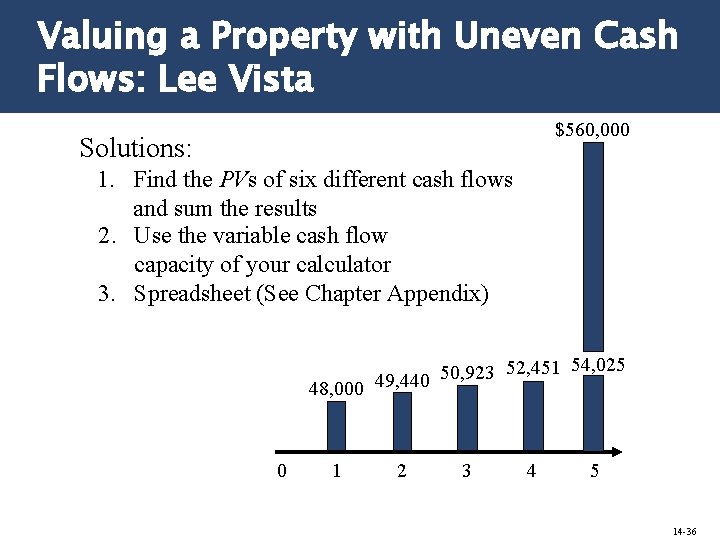
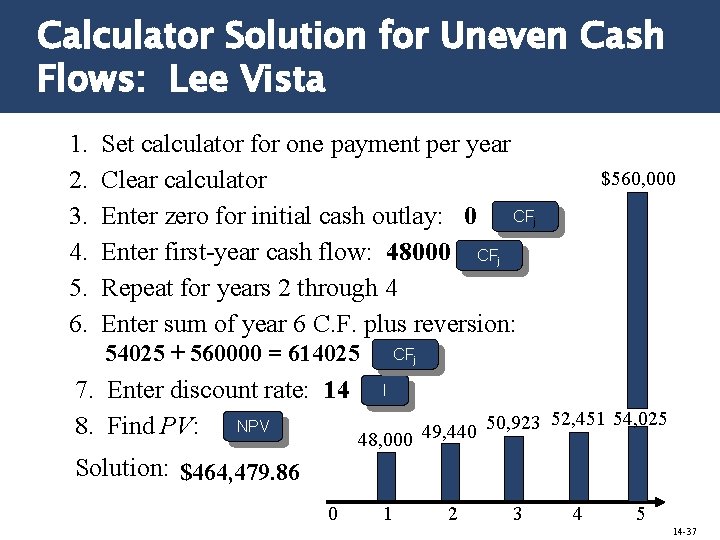
Valuing a Property with Uneven Cash Flows: Lee Vista $560, 000 Solutions: 1. Find the PVs of six different cash flows and sum the results 2. Use the variable cash flow capacity of your calculator 3. Spreadsheet (See Chapter Appendix) 52, 451 54, 025 50, 923 48, 000 49, 440 0 1 2 3 4 5 14 -36
Calculator Solution for Uneven Cash Flows: Lee Vista 1. 2. 3. 4. 5. 6. Set calculator for one payment per year Clear calculator Enter zero for initial cash outlay: 0 CFj Enter first-year cash flow: 48000 CFj Repeat for years 2 through 4 Enter sum of year 6 C. F. plus reversion: 54025 + 560000 = 614025 $560, 000 CFj 7. Enter discount rate: 14 I 8. Find PV: NPV 48, 000 52, 451 54, 025 49, 440 50, 923 Solution: $464, 479. 86 0 1 2 3 4 5 14 -37
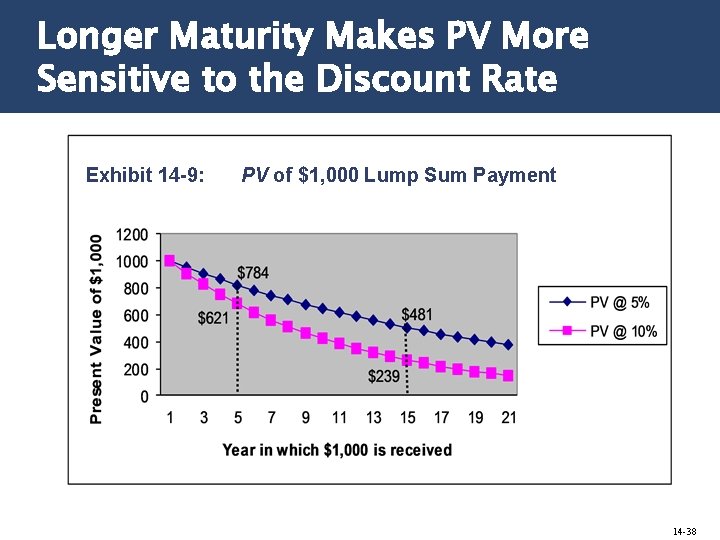
Longer Maturity Makes PV More Sensitive to the Discount Rate Exhibit 14 -9: PV of $1, 000 Lump Sum Payment 14 -38
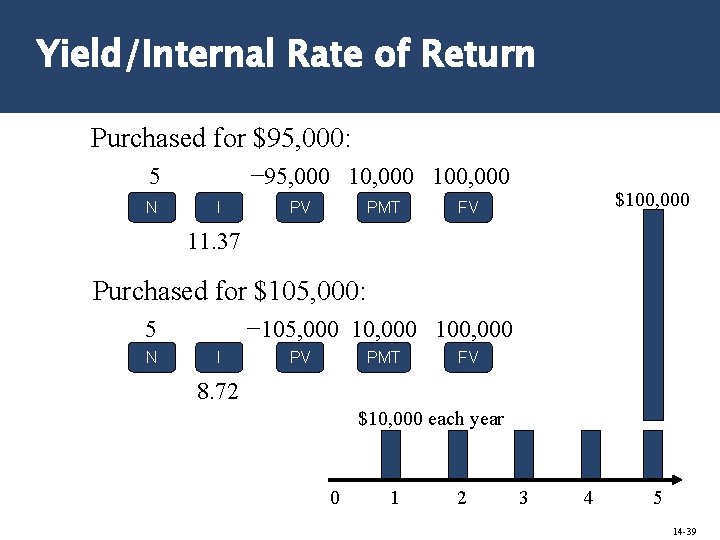
Yield/Internal Rate of Return Purchased for $95, 000: 5 N − 95, 000 100, 000 I PV PMT $100, 000 FV 11. 37 Purchased for $105, 000: 5 N − 105, 000 100, 000 I PV PMT FV 8. 72 $10, 000 each year 0 1 2 3 4 5 14 -39
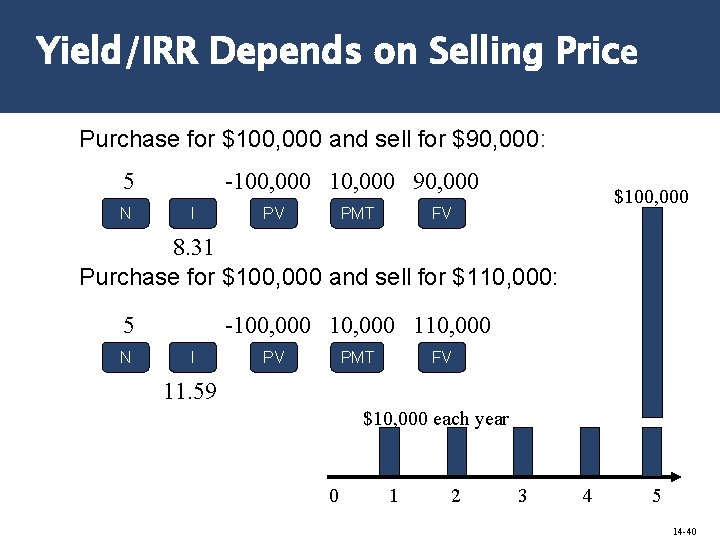
Yield/IRR Depends on Selling Price Purchase for $100, 000 and sell for $90, 000: 5 N -100, 000 10, 000 90, 000 I PV PMT $100, 000 FV 8. 31 Purchase for $100, 000 and sell for $110, 000: 5 N -100, 000 110, 000 I PV PMT FV 11. 59 $10, 000 each year 0 1 2 3 4 5 14 -40
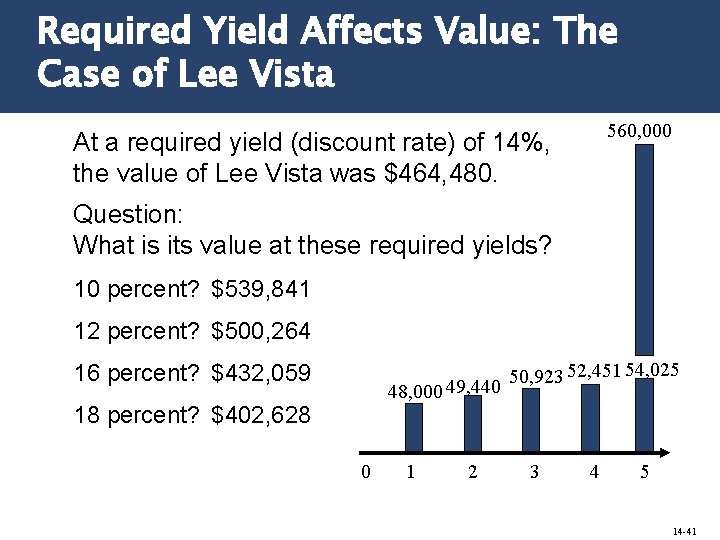
Required Yield Affects Value: The Case of Lee Vista 560, 000 At a required yield (discount rate) of 14%, the value of Lee Vista was $464, 480. Question: What is its value at these required yields? 10 percent? $539, 841 12 percent? $500, 264 16 percent? $432, 059 48, 000 49, 440 18 percent? $402, 628 0 1 2 50, 923 52, 451 54, 025 3 4 5 14 -41
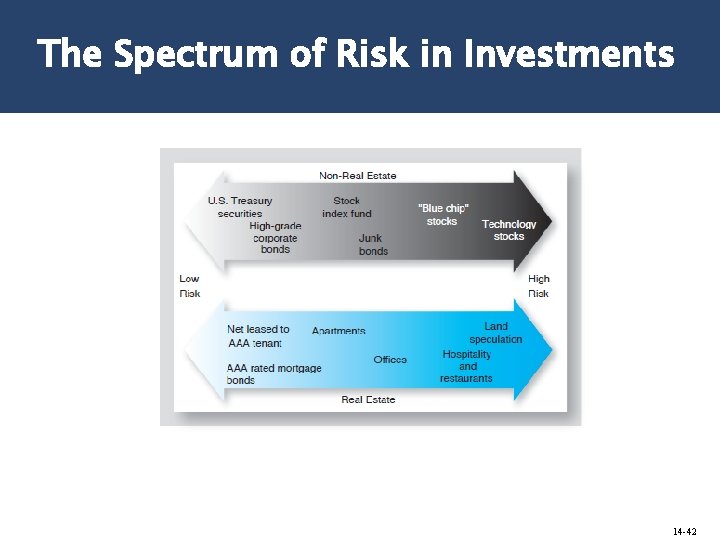
The Spectrum of Risk in Investments 14 -42
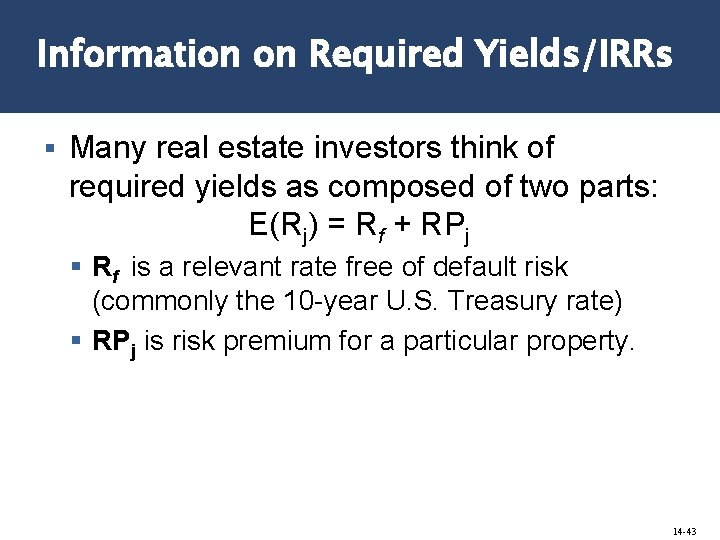
Information on Required Yields/IRRs § Many real estate investors think of required yields as composed of two parts: E(Rj) = Rf + RPj § Rf is a relevant rate free of default risk (commonly the 10 -year U. S. Treasury rate) § RPj is risk premium for a particular property. 14 -43
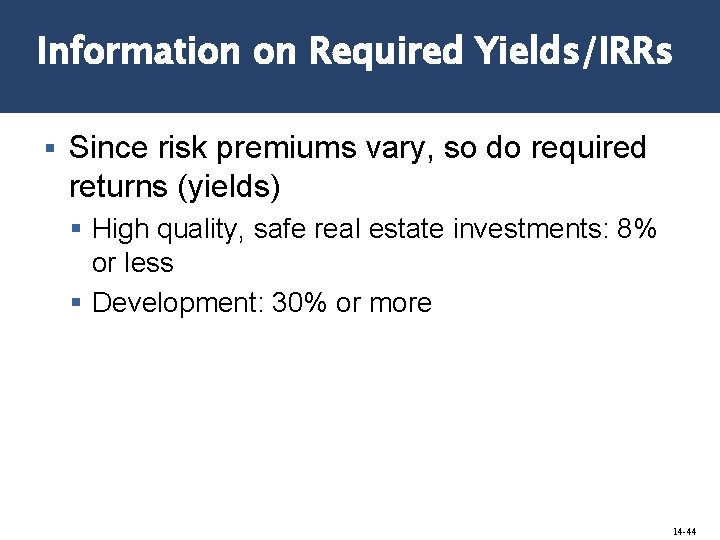
Information on Required Yields/IRRs § Since risk premiums vary, so do required returns (yields) § High quality, safe real estate investments: 8% or less § Development: 30% or more 14 -44
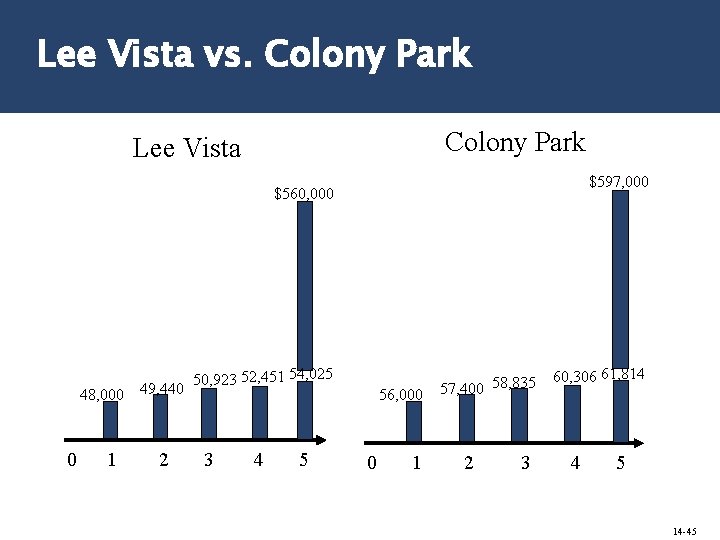
Lee Vista vs. Colony Park Lee Vista $597, 000 $560, 000 48, 000 0 1 49, 440 2 50, 923 52, 451 54, 025 3 4 5 56, 000 0 1 57, 400 58, 835 2 3 60, 306 61, 814 4 5 14 -45
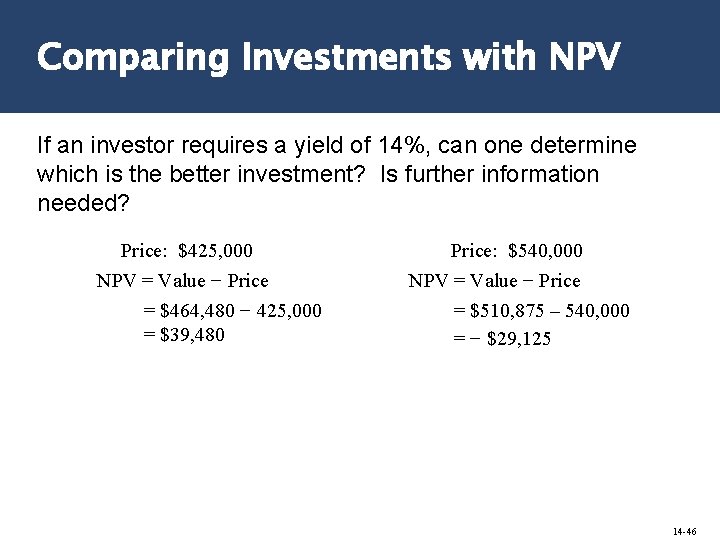
Comparing Investments with NPV If an investor requires a yield of 14%, can one determine which is the better investment? Is further information needed? Price: $425, 000 NPV = Value − Price = $464, 480 − 425, 000 = $39, 480 Price: $540, 000 NPV = Value − Price = $510, 875 – 540, 000 = − $29, 125 14 -46
End of Chapter 14 14 -