
Chapter 14 The Bureaucracy American Democracy Now 4e
Chapter 14: The Bureaucracy American Democracy Now, 4/e
Bureaucrats and Bureaucracy n n n Most people think of government agencies when they hear the word bureaucracy, and they think of government employees when they hear the word bureaucrat —and their thoughts are often negative. Are the negative images and the criticisms of bureaucrats and bureaucracies fair? Before we answer, we must understand who the bureaucrats are, what they are hired to do, and how they are expected to accomplish their work. Copyright © 2015 Mc. Graw-Hill Education. All rights reserved. No reproduction or distribution without the prior written consent of Mc. Graw. Hill Education.
Who Are the Bureaucrats? n n n Bureaucrats provide the public services that elected officials authorize, and in doing so they make decisions that affect people daily. Studies show government employees to be very hard workers who are motivated by the recognition of the importance of public service. Compared with private-sector employees, public servants have higher levels of formal education, must comply with more stringent codes of behavior, and express a greater concern for serving the public. Copyright © 2015 Mc. Graw-Hill Education. All rights reserved. No reproduction or distribution without the prior written consent of Mc. Graw. Hill Education.
Who Are the Bureaucrats? n n Joining the 28 million national, state, and local bureaucrats are the so-called shadow bureaucrats— employees on the payroll of private for-profit businesses and private nonprofit organizations with government contracts. Through a process of contracting-out (also called outsourcing or privatizing), the government signs work contracts with these organizations to assist in the implementation of national policy. Copyright © 2015 Mc. Graw-Hill Education. All rights reserved. No reproduction or distribution without the prior written consent of Mc. Graw. Hill Education.
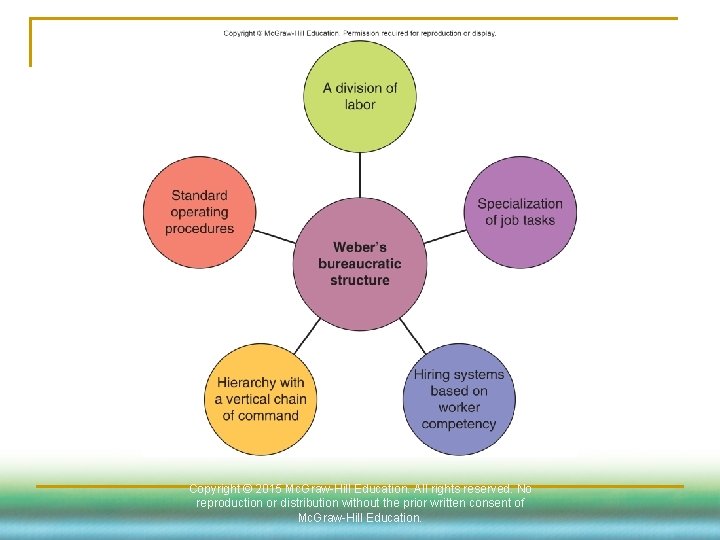
The Bureaucratic Structure n n Max Weber (1864– 1920) coined the word bureaucracy to describe large organizations, such as government, with the following features: a division of labor, specialization of job tasks, hiring systems based on worker competency, hierarchy with a vertical chain of command, and standard operating procedures. Organizations with bureaucratic features are not unique to government. Copyright © 2015 Mc. Graw-Hill Education. All rights reserved. No reproduction or distribution without the prior written consent of Mc. Graw. Hill Education.
Copyright © 2015 Mc. Graw-Hill Education. All rights reserved. No reproduction or distribution without the prior written consent of Mc. Graw-Hill Education.
Federal Bureaucrats n n Political scientists distinguish among national bureaucrats according to several factors, including the process by which they are hired, the procedures by which they can be fired, and the grounds for which they can be fired. On the basis of these factors, we can differentiate among three categories of national civilian bureaucrats: political appointees, senior executive service employees, and civil servants. Copyright © 2015 Mc. Graw-Hill Education. All rights reserved. No reproduction or distribution without the prior written consent of Mc. Graw. Hill Education.
Political Appointees n n n Every four years, after the presidential election, the federal government publishes the plum book, which lists thousands of top jobs in the bureaucracy to which the president will appoint people through the patronage system. The president not only hires but also fires political appointees at his or her pleasure. More common than firing is the resignation or retirement of appointees who no longer enjoy presidential approval. Copyright © 2015 Mc. Graw-Hill Education. All rights reserved. No reproduction or distribution without the prior written consent of Mc. Graw. Hill Education.
Civil Servants n n n The Senior Executive Service Open Competition and Competence Political Neutrality Civil Service Reform Act (1978) Unionized Civil Servants Copyright © 2015 Mc. Graw-Hill Education. All rights reserved. No reproduction or distribution without the prior written consent of Mc. Graw. Hill Education.
Copyright © 2015 Mc. Graw-Hill Education. All rights reserved. No reproduction or distribution without the prior written consent of Mc. Graw-Hill Education.
State, Local, and Shadow Bureaucrats n n Today, the overwhelming majority of the almost 20 million state and local bureaucrats, and at least 7 million shadow bureaucrats, provide various public services. Through devolution and contracting-out, the national government relies on these non-national bureaucrats to serve the people’s daily needs. Copyright © 2015 Mc. Graw-Hill Education. All rights reserved. No reproduction or distribution without the prior written consent of Mc. Graw. Hill Education.
The Evolution of the Federal Bureaucracy n Today, as the U. S. population tops 310 million, more than 2, 000 executive branch units, employing 4 million bureaucrats (2. 7 million civilian bureaucrats and about 1. 5 million military personnel), implement volumes of national policies. Copyright © 2015 Mc. Graw-Hill Education. All rights reserved. No reproduction or distribution without the prior written consent of Mc. Graw. Hill Education.
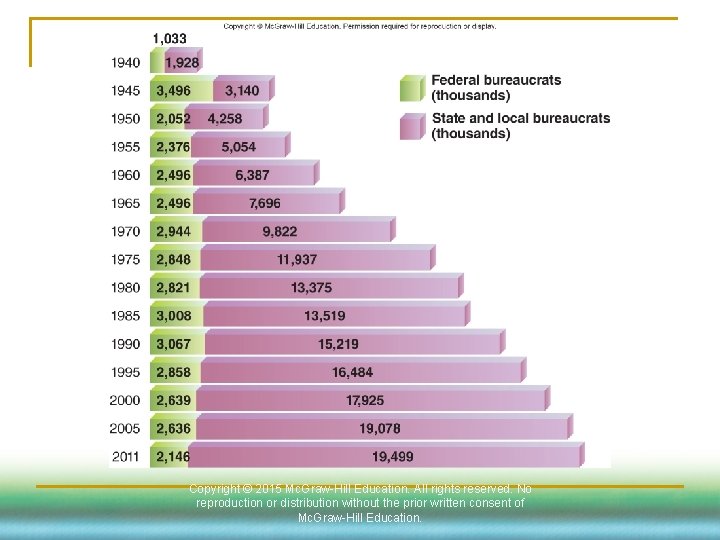
Copyright © 2015 Mc. Graw-Hill Education. All rights reserved. No reproduction or distribution without the prior written consent of Mc. Graw-Hill Education.
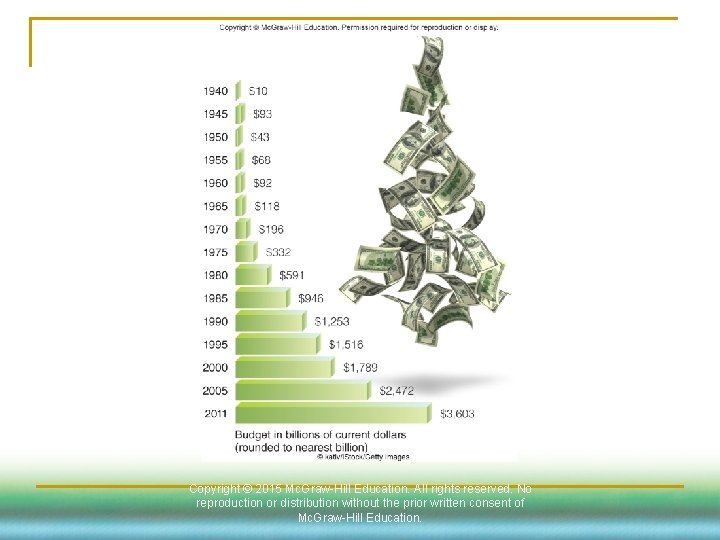
Copyright © 2015 Mc. Graw-Hill Education. All rights reserved. No reproduction or distribution without the prior written consent of Mc. Graw-Hill Education.
Departments n n n The Department of Homeland Security, established in 2002, is the newest of 15 federal departments, each responsible for one broadly defined policy area. The president holds the 15 departments accountable through the appointment of a head official. Secretary is the title of this top political appointee in all departments except the Department of Justice, where the head is the attorney general. Copyright © 2015 Mc. Graw-Hill Education. All rights reserved. No reproduction or distribution without the prior written consent of Mc. Graw. Hill Education.
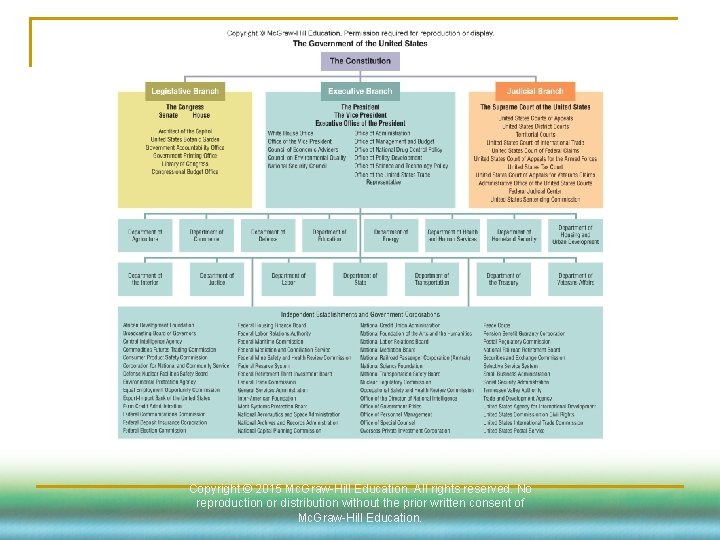
Independent Administrative Agencies n n A host of independent administrative agencies are each responsible for a more narrowly defined function of the national government. Structurally independent administrative agencies look like cabinet departments, with a single head appointed by the president. However, these agencies are “independent” because Congresses and presidents place them outside of the cabinet departments. In addition, these agencies have a varying level of independence from the president. Copyright © 2015 Mc. Graw-Hill Education. All rights reserved. No reproduction or distribution without the prior written consent of Mc. Graw. Hill Education.
Independent Regulatory Commissions n Independent regulatory commissions are bureaucracies outside of the cabinet departments with the authority to develop standards of behavior for specific industries and businesses, to monitor compliance with these standards, and to impose sanctions on those it finds guilty of violating the standards. Copyright © 2015 Mc. Graw-Hill Education. All rights reserved. No reproduction or distribution without the prior written consent of Mc. Graw. Hill Education.
Government Corporations n n Like private businesses, government corporations sell a service or a product; but unlike private businesses, they are government owned. A bipartisan board typically directs each government corporation. Copyright © 2015 Mc. Graw-Hill Education. All rights reserved. No reproduction or distribution without the prior written consent of Mc. Graw. Hill Education.
Executive Office of the President (EOP) n n The EOP is composed of dozens of offices and councils that assist the president in managing the complex and sprawling executive branch of the bureaucracy. The president has the authority to fire these appointees at his pleasure. Copyright © 2015 Mc. Graw-Hill Education. All rights reserved. No reproduction or distribution without the prior written consent of Mc. Graw. Hill Education.
Copyright © 2015 Mc. Graw-Hill Education. All rights reserved. No reproduction or distribution without the prior written consent of Mc. Graw-Hill Education.
The Bureaucracy Where Do You Stand? Do you think the United States is safer with the creation of the Department of Homeland Security? a. Yes, we’re safer b. No, we’re not safer c. Made no difference Source: “Homeland Security: Do Americans Feel Safer? ” www. gallup. com/poll/7321/Homeland-Security-Americans-Feel-Safer. aspx. Copyright © 2015 Mc. Graw-Hill Education. All rights reserved. No reproduction or distribution without the prior written consent of Mc. Graw. Hill Education.
The Bureaucracy Where Do You Stand? Do you think the U. S. government should be bigger and provide more services, or smaller and provide fewer services? a. Bigger with more services b. Smaller with fewer services Source: “U. S. Public Opinion Poll of Government, ” www. ropercenter. uconn. edu/cgibin/hsrun. exe/Roperweb/pom/State. Id/D 0 VKru. XZJfm. B 2 Ddabjpyu. XEHZvh. Uo. U 4 Jw/HAHTpage/Summary_Link? qstn_id=1702684. Copyright © 2015 Mc. Graw-Hill Education. All rights reserved. No reproduction or distribution without the prior written consent of Mc. Graw. Hill Education.
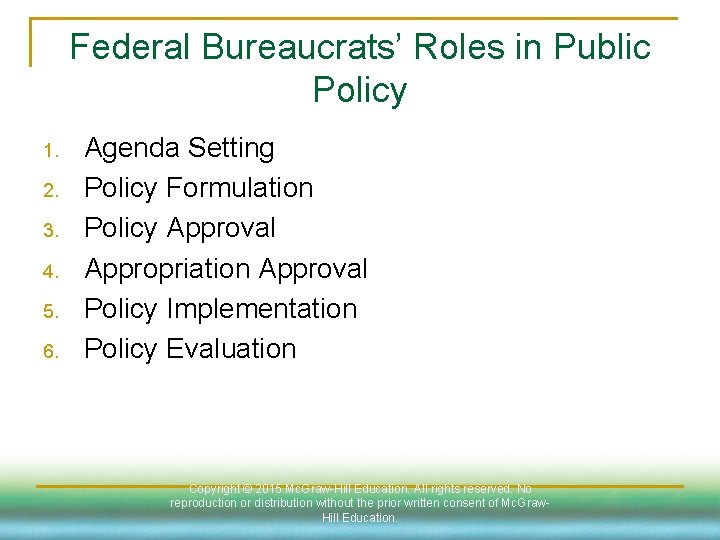
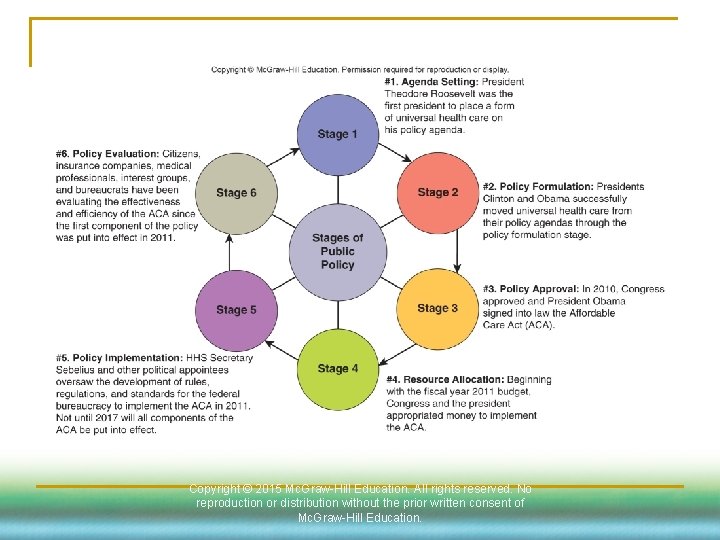
Federal Bureaucrats’ Roles in Public Policy 1. 2. 3. 4. 5. 6. Agenda Setting Policy Formulation Policy Approval Appropriation Approval Policy Implementation Policy Evaluation Copyright © 2015 Mc. Graw-Hill Education. All rights reserved. No reproduction or distribution without the prior written consent of Mc. Graw. Hill Education.
Copyright © 2015 Mc. Graw-Hill Education. All rights reserved. No reproduction or distribution without the prior written consent of Mc. Graw-Hill Education.
Federal Bureaucratic Accountability n n When it comes to public service, everyone is watching. National sunshine laws open up government functions and documents to the public, ensuring transparency and the public’s right to know about government business and decision making. Copyright © 2015 Mc. Graw-Hill Education. All rights reserved. No reproduction or distribution without the prior written consent of Mc. Graw. Hill Education.
Accountability to the People n n The Administrative Procedure Act (APA) of 1946 The Freedom of Information Act (FOIA) of 1966 The Government in the Sunshine Act of 1976 Sunshine laws and e-government provide citizens with the means to find out what is going on in the bureaucracy. Copyright © 2015 Mc. Graw-Hill Education. All rights reserved. No reproduction or distribution without the prior written consent of Mc. Graw. Hill Education.
Accountability to the Courts n Individuals that believe the action of a bureaucrat or bureaucracy has caused them harm can file suit in a court of law once they have exhausted all quasi-judicial processes of the bureaucracy. Copyright © 2015 Mc. Graw-Hill Education. All rights reserved. No reproduction or distribution without the prior written consent of Mc. Graw. Hill Education.
Accountability to Congress n n Congress approves the legislation that creates, regulates, and funds bureaucracies. More than one-quarter of the president’s appointees are subject to Senate confirmation. Congress encourages bureaucratic accountability through the monitoring of bureaucracies’ policy implementation, a form of legislative oversight. An evaluation of bureaucratic performance can also be required in the authorization legislation by a sunset clause, which forces the expiration of the program or policy after a specified number of years unless Congress reauthorizes it through new legislation. Copyright © 2015 Mc. Graw-Hill Education. All rights reserved. No reproduction or distribution without the prior written consent of Mc. Graw. Hill Education.
Accountability to the President n n n Like Congress, the president can use the authorization and appropriation processes to ensure accountability. In addition, because most top political appointees serve at the president’s pleasure, they are responsive to the president’s policy preferences. The OMB evaluates bureaucratic performance for the president. Copyright © 2015 Mc. Graw-Hill Education. All rights reserved. No reproduction or distribution without the prior written consent of Mc. Graw. Hill Education.
Internal Accountability n n n Codes of Behavior and the Ethics in Government Act q Conflict of interest Whistleblowers Inspectors general Copyright © 2015 Mc. Graw-Hill Education. All rights reserved. No reproduction or distribution without the prior written consent of Mc. Graw. Hill Education.
Can Bureaucratic Performance Be Improved? n n Charles Goodsell has found that two-thirds to three-fourths of Americans report their encounters with government bureaucrats and bureaucracy as “satisfactory. ” However, research consistently shows that some national agencies perform better than do others. Copyright © 2015 Mc. Graw-Hill Education. All rights reserved. No reproduction or distribution without the prior written consent of Mc. Graw. Hill Education.
Can Bureaucratic Performance Be Improved? n n William T. Gormley and Steven Balla reviewed national performance data and summarized the characteristics of national agencies that perform well. These characteristics include legislative language that clearly states the goal of the legislation and provides high levels of administrative discretion, allowing bureaucrats to determine the best way to achieve the goal. Copyright © 2015 Mc. Graw-Hill Education. All rights reserved. No reproduction or distribution without the prior written consent of Mc. Graw. Hill Education.
Can Bureaucratic Performance Be Improved? n n n Better-performing bureaucracies tend to be those with easily measured goals, especially goals that include providing resources to citizens (such as Social Security checks) as opposed to taking resources (tax collection). Another factor is high levels of support from elected officials, the media, and diverse groups of citizens for the legislated goal and the implementing agency. Effective leaders also important. Copyright © 2015 Mc. Graw-Hill Education. All rights reserved. No reproduction or distribution without the prior written consent of Mc. Graw. Hill Education.
Does Contracting-Out Improve Performance? n Charles Goodsell has analyzed the body of research that assesses the efficiency of public policy implementation by government bureaucrats compared with the efficiency of private organizations. He has found that “the assumption that business always does better than government is not upheld. ” Copyright © 2015 Mc. Graw-Hill Education. All rights reserved. No reproduction or distribution without the prior written consent of Mc. Graw. Hill Education.
The Bureaucracy Where Do You Stand? Would you agree or disagree that when programs are run by the federal government, they tend to be wasteful and inefficient? a. Agree b. Disagree Source: “Trends in Political Values and Core Attitudes: 1987– 2007, ” http: //peoplepress. org/reports/pdf/312. pdf. Copyright © 2015 Mc. Graw-Hill Education. All rights reserved. No reproduction or distribution without the prior written consent of Mc. Graw. Hill Education.
Citizens’ Role in Bureaucratic Performance n n n The effectiveness of public policies depends on people’s knowledge of and compliance with the law. It depends on their applying for the government programs for which they qualify and their conformity to the rules, regulations, standards, and directions of bureaucrats. This symbiotic relationship is essential to the success of government. Copyright © 2015 Mc. Graw-Hill Education. All rights reserved. No reproduction or distribution without the prior written consent of Mc. Graw. Hill Education.
- Slides: 36