
Chapter 14 The Brain and Cranial Nerves 6
Chapter 14: The Brain and Cranial Nerves
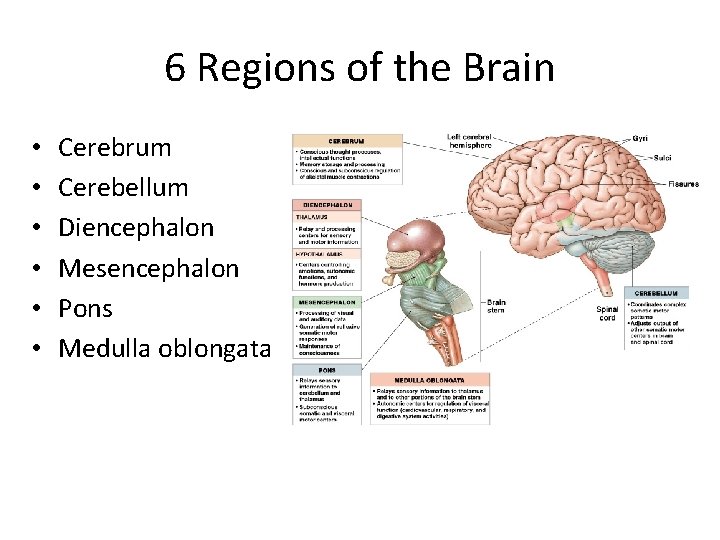
6 Regions of the Brain • • • Cerebrum Cerebellum Diencephalon Mesencephalon Pons Medulla oblongata

Cerebrum • • Largest part of brain Controls higher mental functions Divided into left and right cerebral hemispheres Surface layer of gray matter (neural cortex) – Also called cerebral cortex • Folded surface increases surface area – Elevated ridges (gyri) – Shallow depressions (sulci) – Deep grooves (fissures)
Cerebellum • • Second largest part of brain Coordinates repetitive body movements 2 hemispheres Covered with cerebellar cortex
Diencephalon • Located under cerebrum and cerebellum • Links cerebrum with brain stem • 3 divisions: – Thalamus - relays and processes sensory information – Hypothalamus - hormone production, emotion, & autonomic function – Epithalamus (Pineal gland)

Pituitary Gland • • Major endocrine gland Connected to hypothalamus Via infundibulum (stalk) Interfaces nervous and endocrine systems
The Brain Stem • Processes information between: – spinal cord and cerebrum or cerebellum • Includes: – Mesencephalon (midbrain) • Processes sight, sound, and associated reflexes, & maintains consciousness – Pons • Connects cerebellum to brain stem & is involved in somatic and visceral motor control – Medulla oblongata • Regulates autonomic functions: HR, BP, and digestion
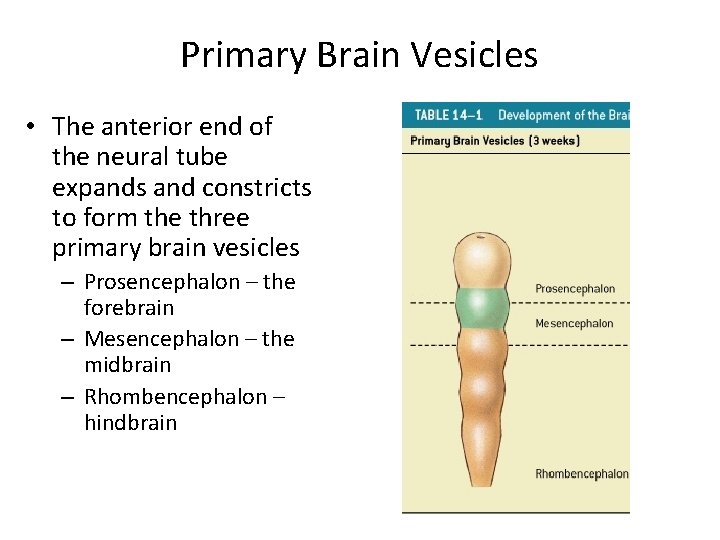
Primary Brain Vesicles • The anterior end of the neural tube expands and constricts to form the three primary brain vesicles – Prosencephalon – the forebrain – Mesencephalon – the midbrain – Rhombencephalon – hindbrain
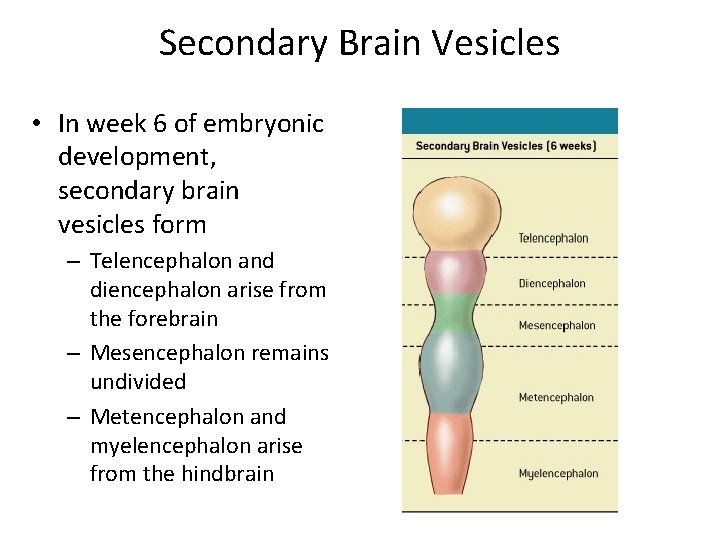
Secondary Brain Vesicles • In week 6 of embryonic development, secondary brain vesicles form – Telencephalon and diencephalon arise from the forebrain – Mesencephalon remains undivided – Metencephalon and myelencephalon arise from the hindbrain

Adult Brain Structures • Fates of the secondary brain vesicles: – Telencephalon – cerebrum: cortex, white matter, and basal nuclei – Diencephalon – thalamus, hypothalamus, and epithalamus – Mesencephalon – brain stem: midbrain – Metencephalon – brain stem: pons – Myelencephalon – brain stem: medulla oblongata
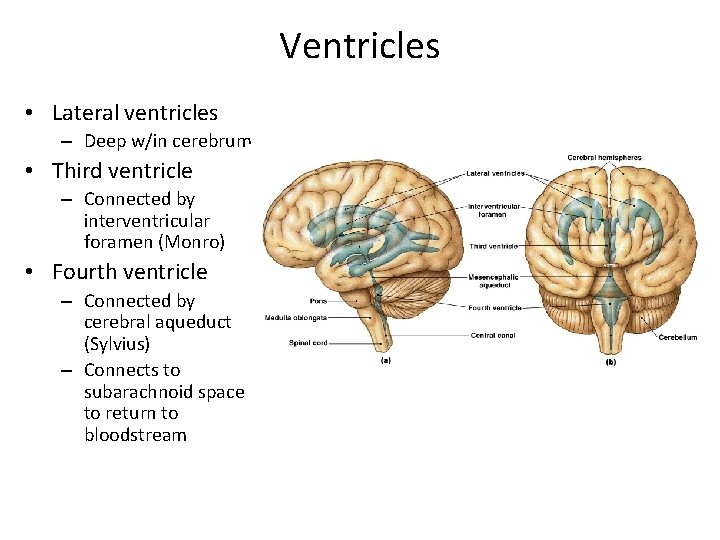
Ventricles • Lateral ventricles – Deep w/in cerebrum • Third ventricle – Connected by interventricular foramen (Monro) • Fourth ventricle – Connected by cerebral aqueduct (Sylvius) – Connects to subarachnoid space to return to bloodstream
Brain Protection and Support • Physical protection: – bones of the cranium – cranial meninges – cerebrospinal fluid • Biochemical isolation: – blood–brain barrier
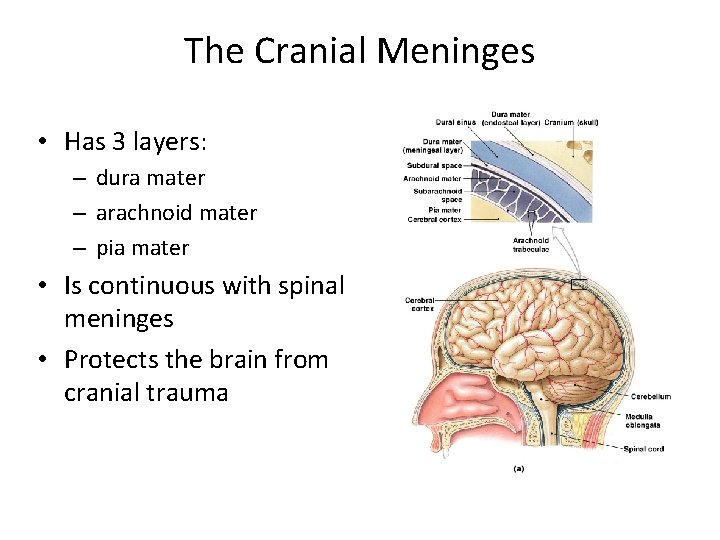
The Cranial Meninges • Has 3 layers: – dura mater – arachnoid mater – pia mater • Is continuous with spinal meninges • Protects the brain from cranial trauma
Characteristics of Cranial Meninges • Dura mater: – inner fibrous layer (meningeal layer) – outer fibrous layer (endosteal layer) fused to periosteum – venous sinuses between 2 layers • Arachnoid mater: – contacts epithelial layer of dura mater • Subarachnoid space b/t arachnoid and pia mater • Pia mater: – attached to brain surface by astrocytes
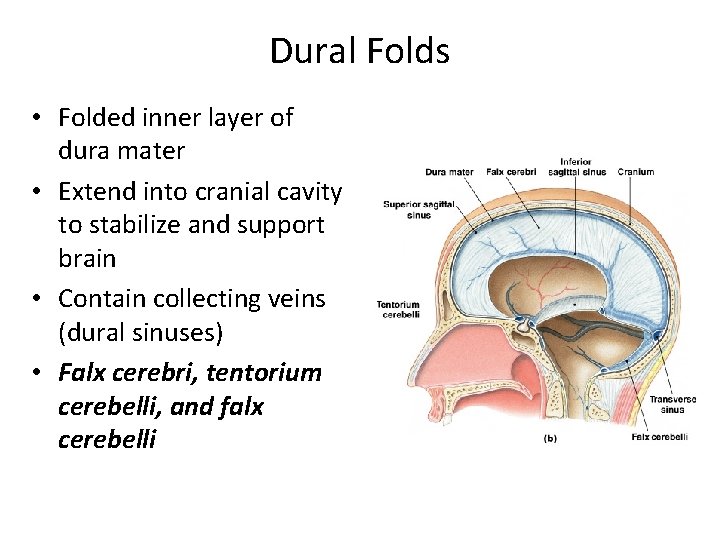
Dural Folds • Folded inner layer of dura mater • Extend into cranial cavity to stabilize and support brain • Contain collecting veins (dural sinuses) • Falx cerebri, tentorium cerebelli, and falx cerebelli
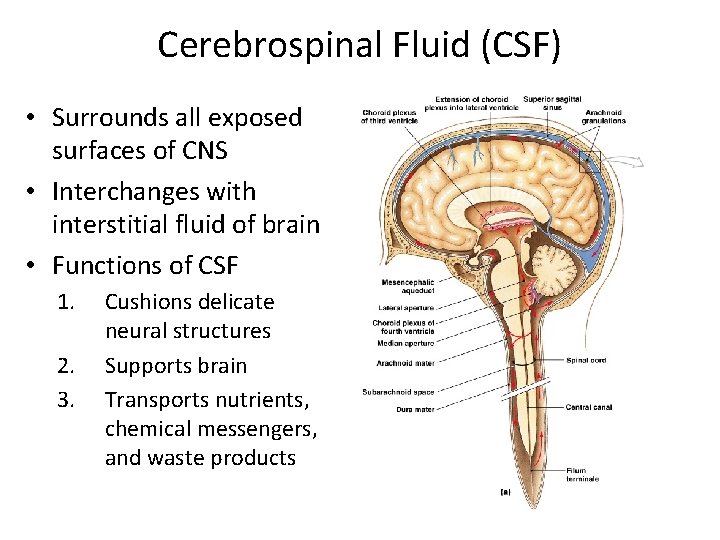
Cerebrospinal Fluid (CSF) • Surrounds all exposed surfaces of CNS • Interchanges with interstitial fluid of brain • Functions of CSF 1. 2. 3. Cushions delicate neural structures Supports brain Transports nutrients, chemical messengers, and waste products
Forming CSF • Choroid plexus: – Specialized ependymal cells and capillaries: • secrete CSF into ventricles • remove waste products from CSF • adjust composition of CSF • Produces about 500 ml of CSF/day – Room for ~ 150 ml
Circulating CSF • CSF produced from choroid plexus (in all ventricles) – Lateral Ventricle (thru interventricular foramen of Monro) – Third Ventricle (thru cerebral aquaduct of Sylvius) – Fourth Ventricle (thru median & lateral apertures) – To central canal of spinal cord & subarachnoid space around the brain, spinal cord, and cauda equina – Thru arachnoid villi/granulations (into dural venous sinuses) – DVS’s merge into Internal Jugular Vein
Blood Supply to the Brain • Supplies nutrients and oxygen to brain • Delivered by internal carotid arteries and vertebral arteries • Removed from dural sinuses by internal jugular veins
Cerebrovascular Disease • Disorders interfere with blood circulation to brain • Stroke or cerebrovascular accident (CVA): – shuts off blood to portion of brain – neurons die • Transient ischemic attack (TIA): – temporary reduction in blood flow
Blood–Brain Barrier (BBB) • Isolates CNS neural tissue from general circulation • Formed by network of tight junctions between endothelial cells of CNS capillaries • Lipid–soluble compounds (O 2, CO 2), steroids, and prostaglandins diffuse into interstitial fluid of brain and spinal cord • Astrocytes control blood–brain barrier by releasing chemicals that control permeability of endothelium
4 Breaks in the BBB 1. Portions of hypothalamus: – secrete hypothalamic hormones 2. Posterior lobe of pituitary gland: – secrete hormones ADH and oxytocin 3. Pineal glands: – pineal secretions 4. Choroid plexus: – where special ependymal cells maintain blood– CSF barrier
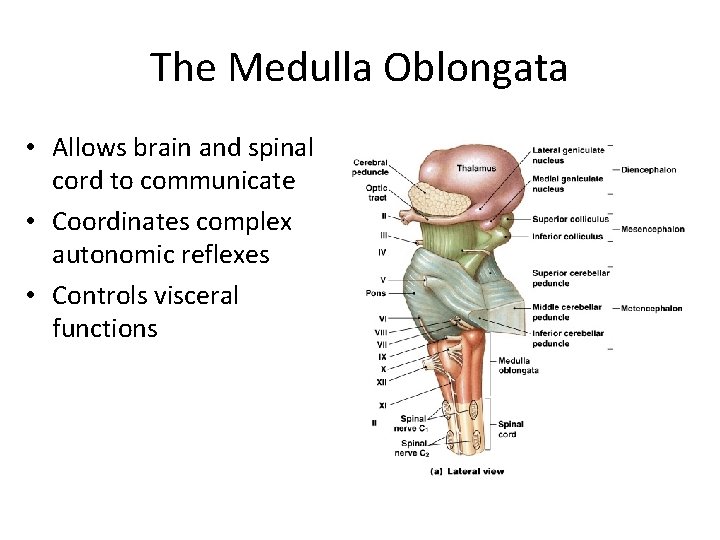
The Medulla Oblongata • Allows brain and spinal cord to communicate • Coordinates complex autonomic reflexes • Controls visceral functions
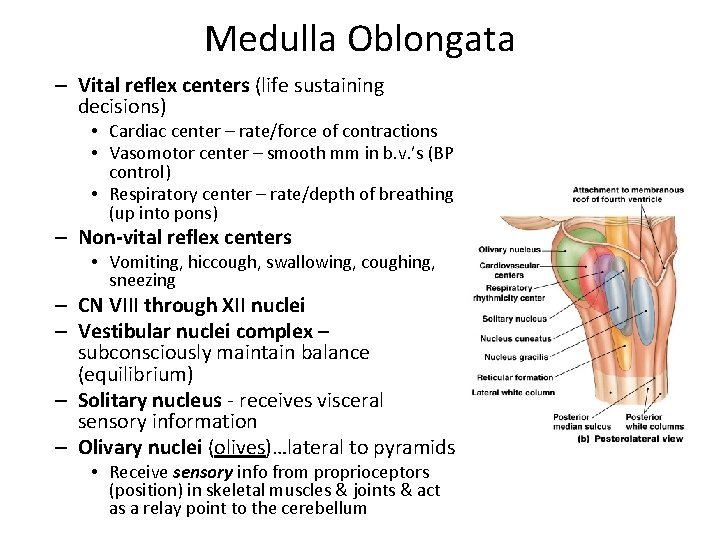
Medulla Oblongata – Vital reflex centers (life sustaining decisions) • Cardiac center – rate/force of contractions • Vasomotor center – smooth mm in b. v. ’s (BP control) • Respiratory center – rate/depth of breathing (up into pons) – Non-vital reflex centers • Vomiting, hiccough, swallowing, coughing, sneezing – CN VIII through XII nuclei – Vestibular nuclei complex – subconsciously maintain balance (equilibrium) – Solitary nucleus - receives visceral sensory information – Olivary nuclei (olives)…lateral to pyramids • Receive sensory info from proprioceptors (position) in skeletal muscles & joints & act as a relay point to the cerebellum
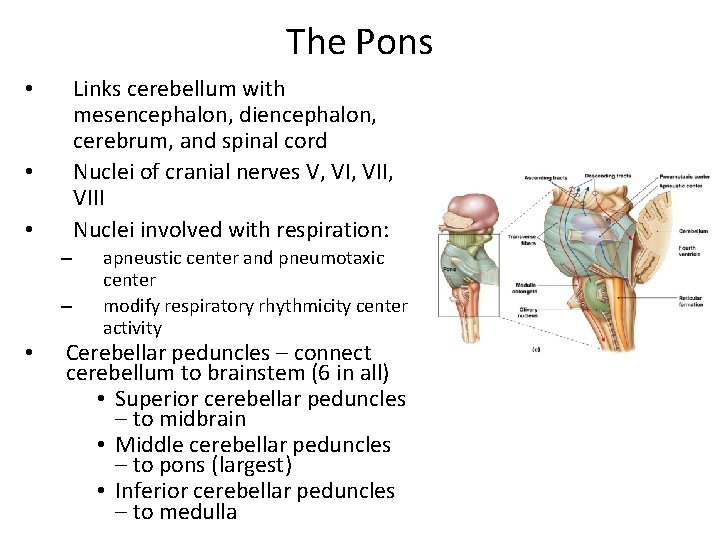
The Pons Links cerebellum with mesencephalon, diencephalon, cerebrum, and spinal cord Nuclei of cranial nerves V, VII, VIII Nuclei involved with respiration: • • • – – • apneustic center and pneumotaxic center modify respiratory rhythmicity center activity Cerebellar peduncles – connect cerebellum to brainstem (6 in all) • Superior cerebellar peduncles – to midbrain • Middle cerebellar peduncles – to pons (largest) • Inferior cerebellar peduncles – to medulla
Functions of the Cerebellum 1. Adjusts postural muscles 2. Fine-tunes conscious and subconscious movements • Ataxia: – damage from trauma or stroke – intoxication (temporary disturbance) – disturbs muscle coordination
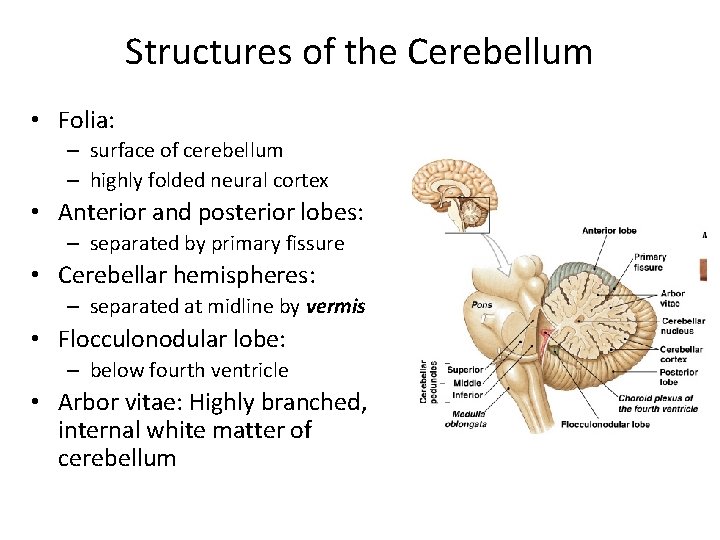
Structures of the Cerebellum • Folia: – surface of cerebellum – highly folded neural cortex • Anterior and posterior lobes: – separated by primary fissure • Cerebellar hemispheres: – separated at midline by vermis • Flocculonodular lobe: – below fourth ventricle • Arbor vitae: Highly branched, internal white matter of cerebellum
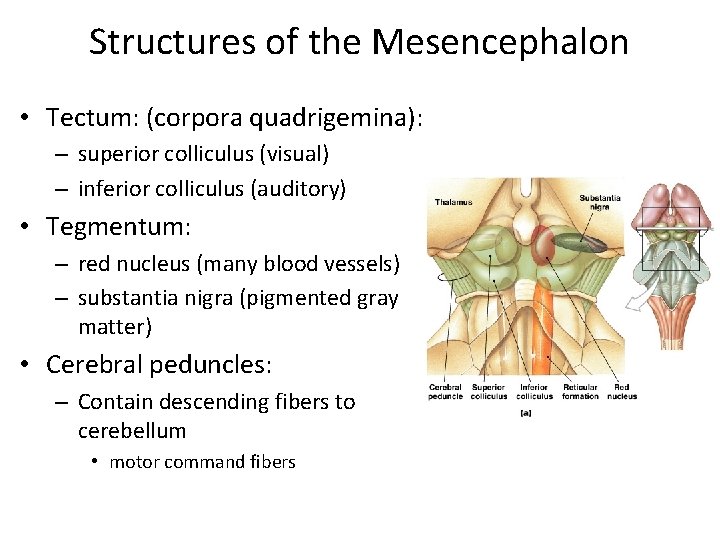
Structures of the Mesencephalon • Tectum: (corpora quadrigemina): – superior colliculus (visual) – inferior colliculus (auditory) • Tegmentum: – red nucleus (many blood vessels) – substantia nigra (pigmented gray matter) • Cerebral peduncles: – Contain descending fibers to cerebellum • motor command fibers
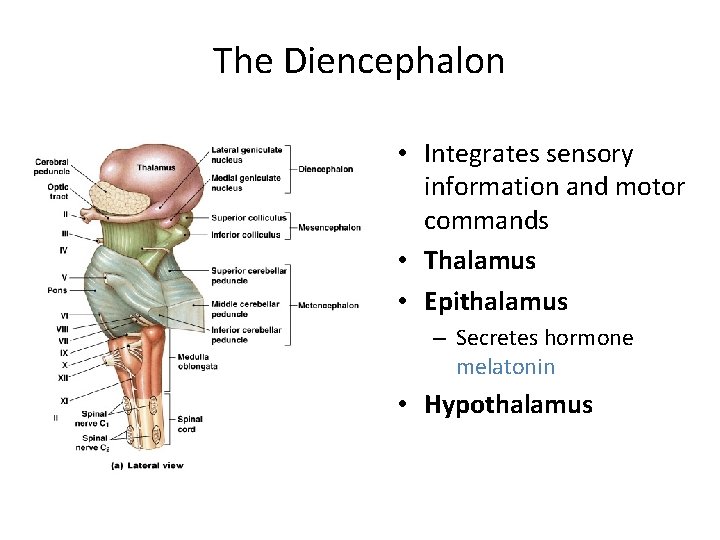
The Diencephalon • Integrates sensory information and motor commands • Thalamus • Epithalamus – Secretes hormone melatonin • Hypothalamus Figure 14– 5 a
The Thalamus • Filters ascending sensory information for primary sensory cortex • Relays center to funnel information between basal nuclei and cerebral cortex
5 Groups of Thalamic Nuclei 1. Anterior group: part of limbic system (emotions) 2. Medial group: provides awareness of emotional states 3. Ventral group: relays sensory information 4. Posterior group: 1. pulvinar nucleus (sensory) 2. lateral geniculate nucleus (visual) 3. medial geniculate nucleus (auditory) 5. Lateral group: affects emotional states – integrates sensory info
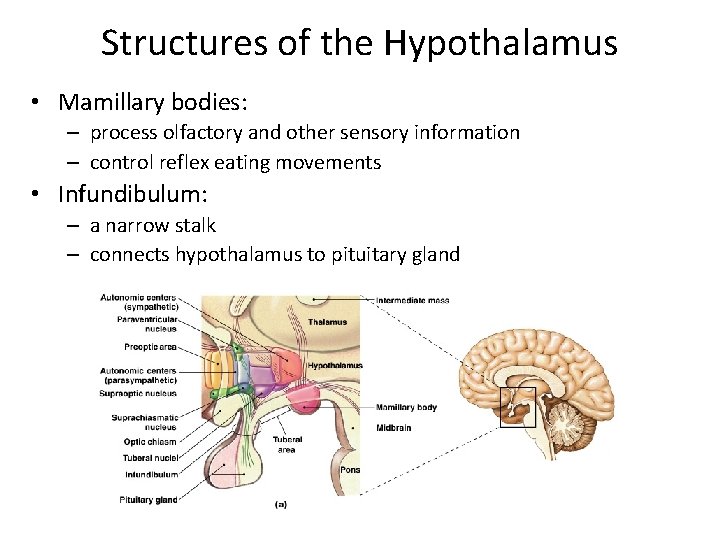
Structures of the Hypothalamus • Mamillary bodies: – process olfactory and other sensory information – control reflex eating movements • Infundibulum: – a narrow stalk – connects hypothalamus to pituitary gland
8 Functions of the Hypothalamus 1. Provides subconscious control of skeletal muscle 2. Controls autonomic function 3. Coordinates activities of nervous and endocrine systems 4. Secretes hormones: – antidiuretic hormone (ADH) & oxytocin (OT) 5. Produces emotions and behavioral drives: – the feeding center (hunger) & the thirst center 6. Coordinates voluntary and autonomic functions 7. Regulates body temperature: 8. Controls circadian rhythms (day–night cycles)
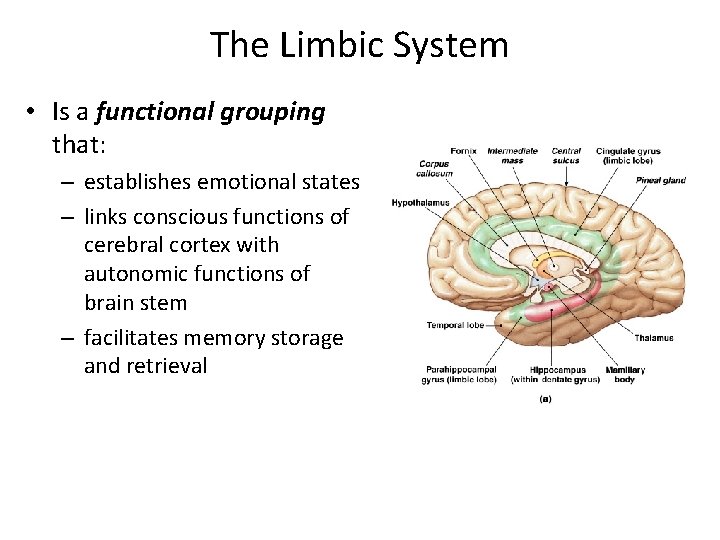
The Limbic System • Is a functional grouping that: – establishes emotional states – links conscious functions of cerebral cortex with autonomic functions of brain stem – facilitates memory storage and retrieval
Components of the Limbic System • Amygdala: deals with anger, danger, and fear responses – interfaces limbic system, cerebrum, and sensory systems • Limbic lobe of cerebral hemisphere: – cingulate gyrus - plays a role in expressing emotions via gestures, and resolves mental conflict – hippocampus - converts short-term memory to long-term memory…memories charged w/ emotion are often retained • Fornix: tract of white matter – connects hippocampus with hypothalamus • Anterior nucleus of the thalamus: – relays information from mamillary body to cingulate gyrus • Reticular formation: – stimulation or inhibition affects emotions (rage, fear, pain, sexual arousal, pleasure)
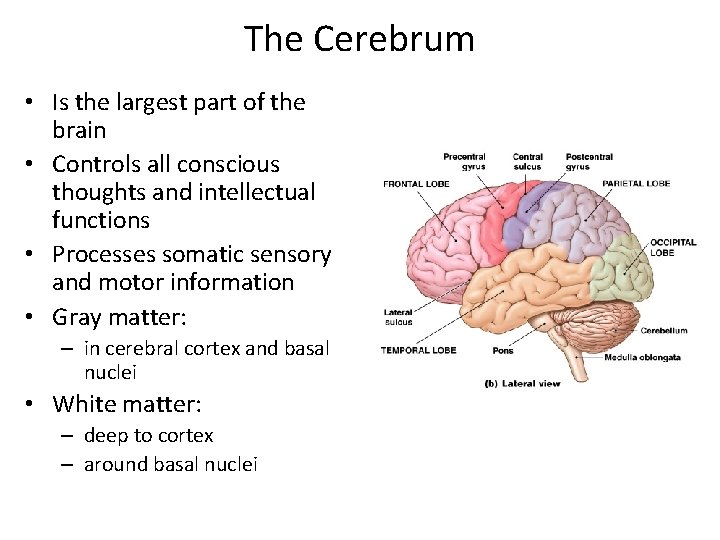
The Cerebrum • Is the largest part of the brain • Controls all conscious thoughts and intellectual functions • Processes somatic sensory and motor information • Gray matter: – in cerebral cortex and basal nuclei • White matter: – deep to cortex – around basal nuclei
Structures of the Cerebrum • Gyri of neural cortex: increase surface area (number of cortical neurons) • Longitudinal fissure: separates cerebral hemispheres • Lobes: divisions of hemispheres • Central sulcus divides: anterior frontal lobe from posterior parietal lobe • Lateral sulcus divides: frontal lobe from temporal lobe • Parieto-occipital sulcus divides: parietal lobe from occipital lobe
3 Functional Principles of the Cerebrum 1. Each cerebral hemisphere receives sensory information from, and sends motor commands to, the opposite side of body 2. The 2 hemispheres have different functions although their structures are alike 3. Correspondence between a specific function and a specific region of cerebral cortex is not precise
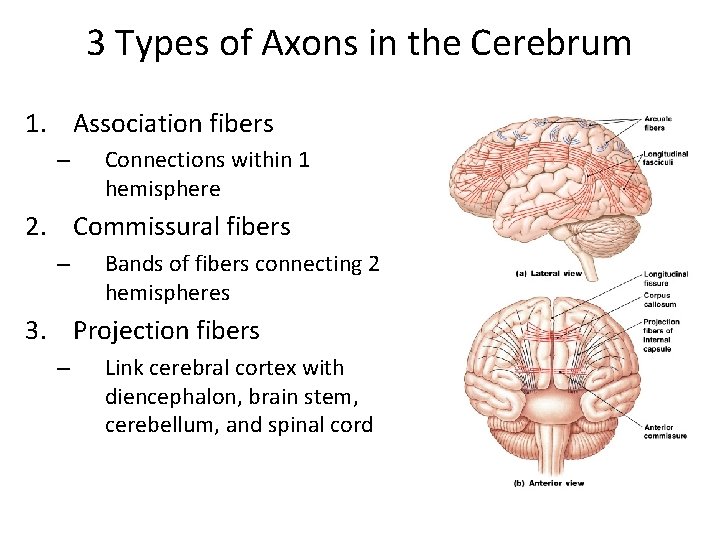
3 Types of Axons in the Cerebrum 1. Association fibers – Connections within 1 hemisphere 2. Commissural fibers – Bands of fibers connecting 2 hemispheres 3. Projection fibers – Link cerebral cortex with diencephalon, brain stem, cerebellum, and spinal cord
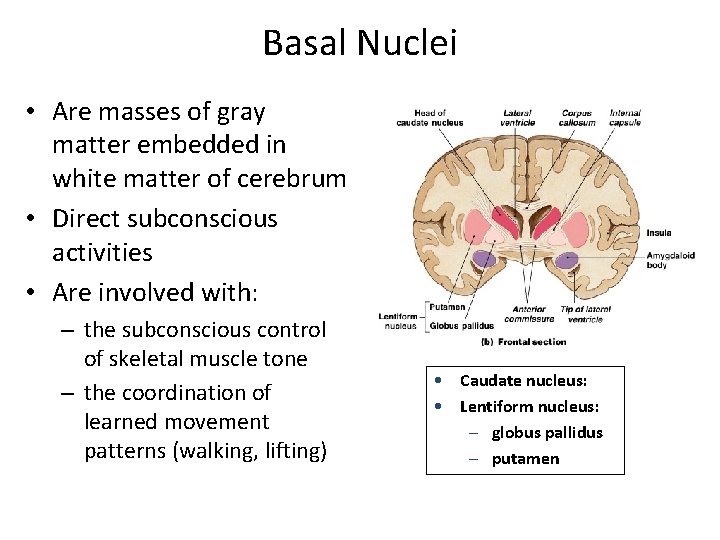
Basal Nuclei • Are masses of gray matter embedded in white matter of cerebrum • Direct subconscious activities • Are involved with: – the subconscious control of skeletal muscle tone – the coordination of learned movement patterns (walking, lifting) • Caudate nucleus: • Lentiform nucleus: – globus pallidus – putamen
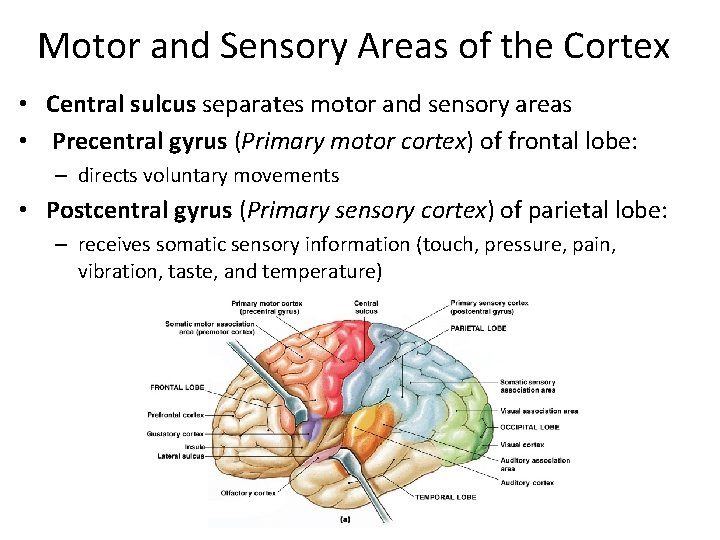
Motor and Sensory Areas of the Cortex • Central sulcus separates motor and sensory areas • Precentral gyrus (Primary motor cortex) of frontal lobe: – directs voluntary movements • Postcentral gyrus (Primary sensory cortex) of parietal lobe: – receives somatic sensory information (touch, pressure, pain, vibration, taste, and temperature)
Special Sensory Cortexes • Visual cortex: occipital lobe – information from sight receptors • Auditory cortex: temporal lobe – information from sound receptors • Olfactory cortex: frontal & medial temporal lobe – information from odor receptors • Gustatory cortex: insula (deep to temporal lobe) – information from taste receptors
Association Areas • Premotor cortex: – coordinates somatic motor responses (learned movements) • Somatic sensory association area: – interprets input to primary sensory cortex (e. g. , recognizes and responds to touch) • Visual association area: – interprets activity in visual cortex • Auditory association area: – monitors auditory cortex
Integrative Areas • Wernicke’s area (General Interpretive Area ) – Present in only 1 hemisphere – Receives information from all sensory association areas – Coordinates access to complex visual and auditory memories • Speech center: coordinates all vocalization functions – is associated with general interpretive area • Prefrontal cortex of frontal lobe: – integrates information from sensory association areas – performs abstract intellectual activities (e. g. , predicting consequences of actions)
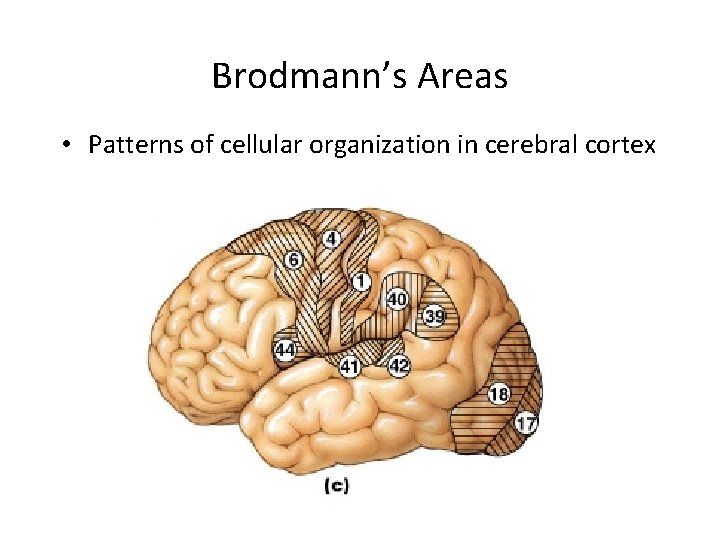
Brodmann’s Areas • Patterns of cellular organization in cerebral cortex Figure 14– 15 c
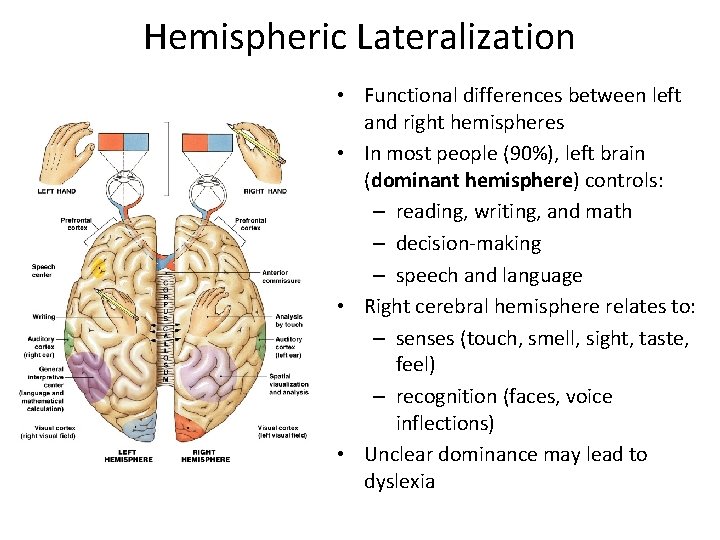
Hemispheric Lateralization • Functional differences between left and right hemispheres • In most people (90%), left brain (dominant hemisphere) controls: – reading, writing, and math – decision-making – speech and language • Right cerebral hemisphere relates to: – senses (touch, smell, sight, taste, feel) – recognition (faces, voice inflections) • Unclear dominance may lead to dyslexia
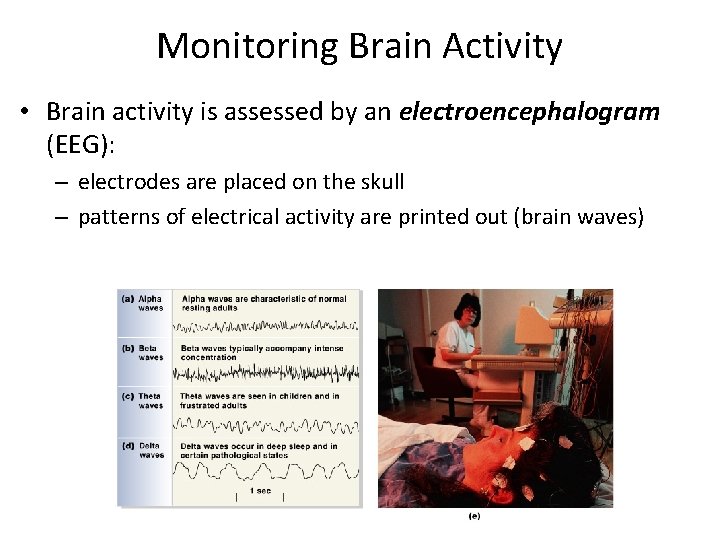
Monitoring Brain Activity • Brain activity is assessed by an electroencephalogram (EEG): – electrodes are placed on the skull – patterns of electrical activity are printed out (brain waves)
4 Categories of Brain Waves 1. Alpha waves: – found in healthy, awake adults at rest with eyes closed 2. Beta waves: – – 3. higher frequency found in adults concentrating or mentally stressed Theta waves: – – – found in children found in intensely frustrated adults may indicate brain disorder in adults 4. Delta waves: – – during sleep found in awake adults with brain damage
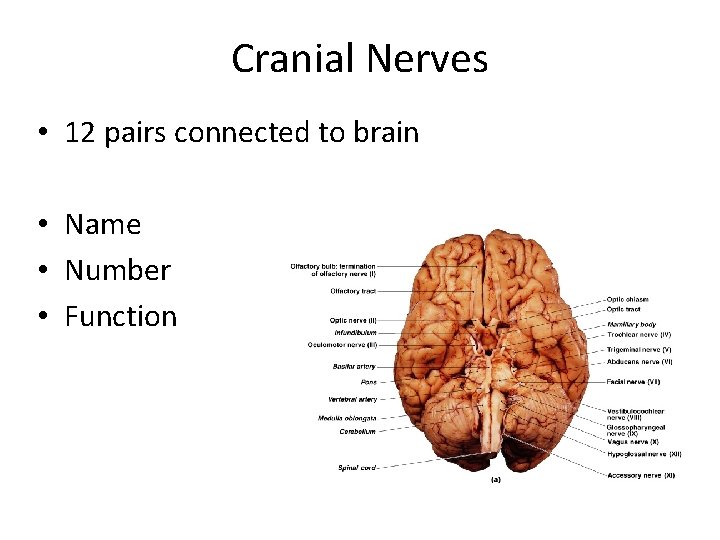
Cranial Nerves • 12 pairs connected to brain • Name • Number • Function
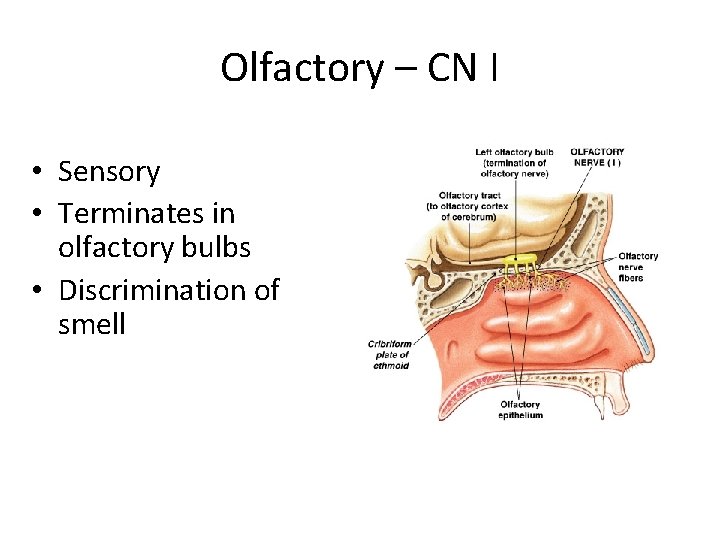
Olfactory – CN I • Sensory • Terminates in olfactory bulbs • Discrimination of smell
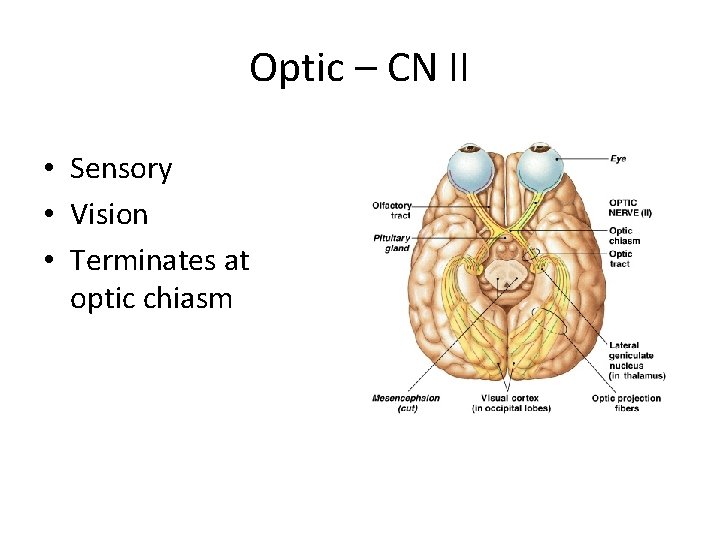
Optic – CN II • Sensory • Vision • Terminates at optic chiasm
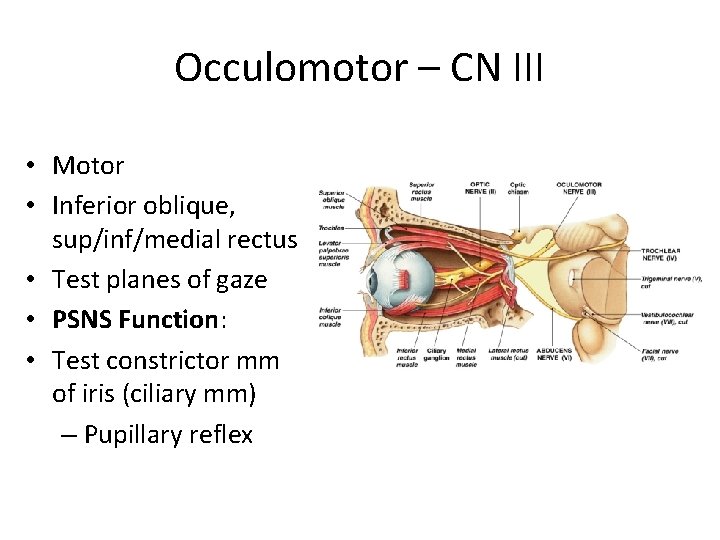
Occulomotor – CN III • Motor • Inferior oblique, sup/inf/medial rectus • Test planes of gaze • PSNS Function: • Test constrictor mm of iris (ciliary mm) – Pupillary reflex
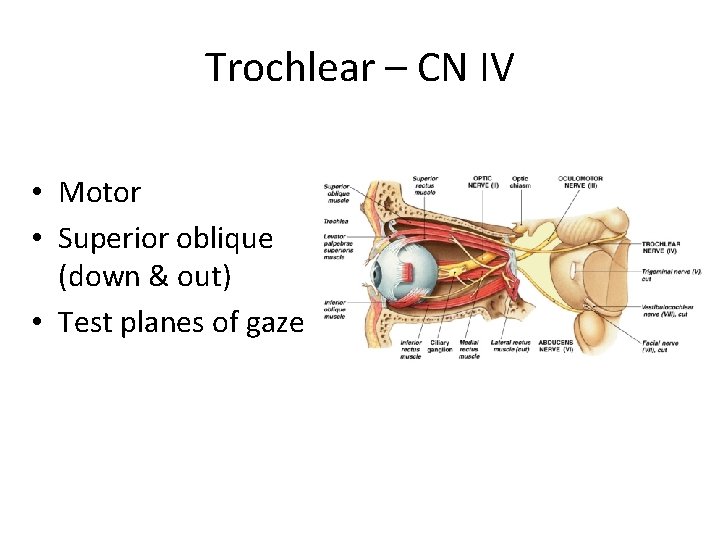
Trochlear – CN IV • Motor • Superior oblique (down & out) • Test planes of gaze
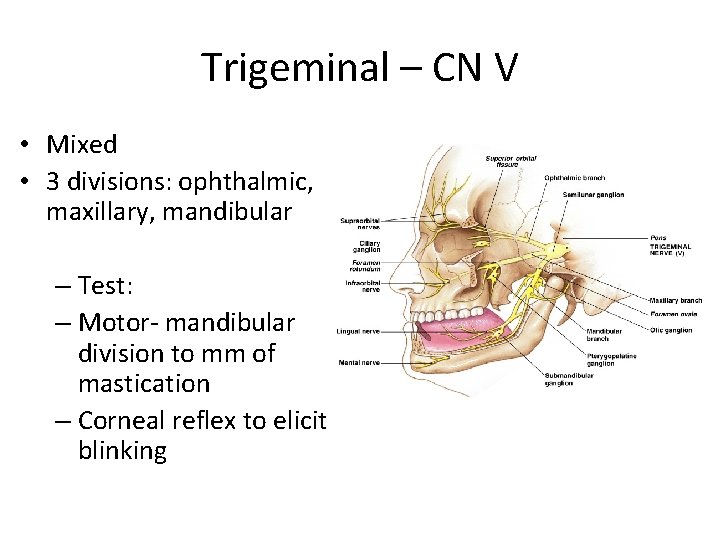
Trigeminal – CN V • Mixed • 3 divisions: ophthalmic, maxillary, mandibular – Test: – Motor- mandibular division to mm of mastication – Corneal reflex to elicit blinking
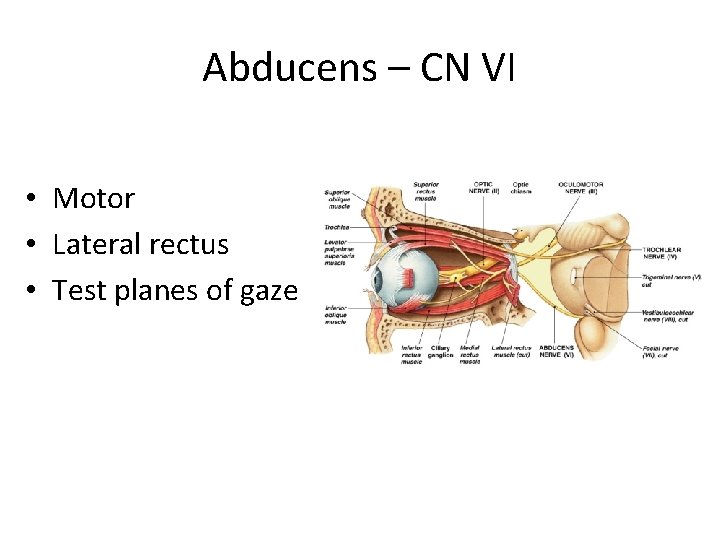
Abducens – CN VI • Motor • Lateral rectus • Test planes of gaze
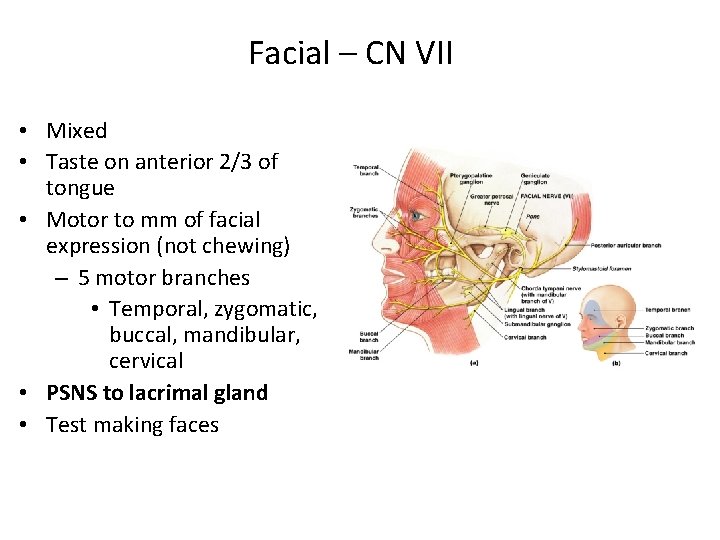
Facial – CN VII • Mixed • Taste on anterior 2/3 of tongue • Motor to mm of facial expression (not chewing) – 5 motor branches • Temporal, zygomatic, buccal, mandibular, cervical • PSNS to lacrimal gland • Test making faces
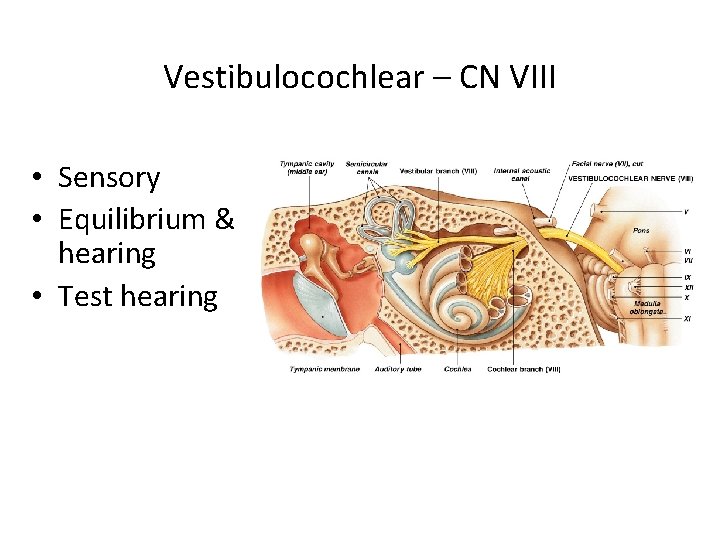
Vestibulocochlear – CN VIII • Sensory • Equilibrium & hearing • Test hearing
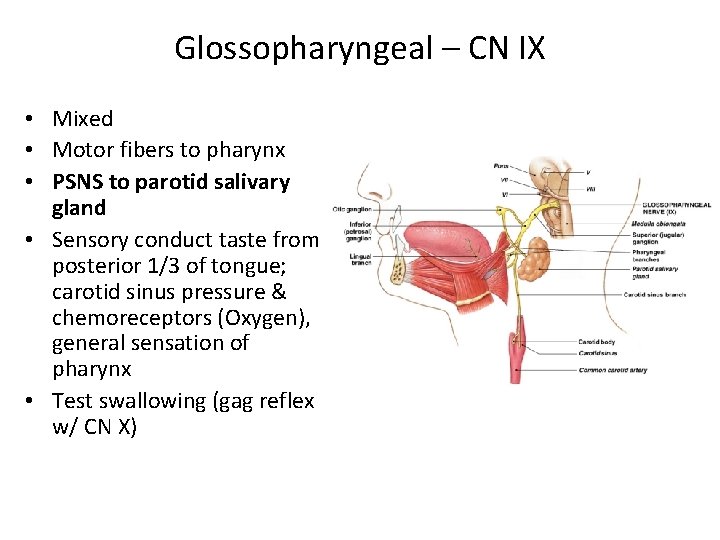
Glossopharyngeal – CN IX • Mixed • Motor fibers to pharynx • PSNS to parotid salivary gland • Sensory conduct taste from posterior 1/3 of tongue; carotid sinus pressure & chemoreceptors (Oxygen), general sensation of pharynx • Test swallowing (gag reflex w/ CN X)
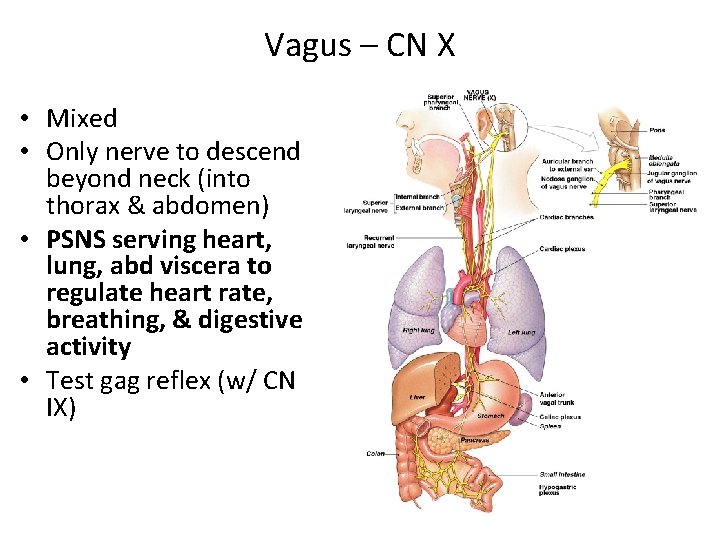
Vagus – CN X • Mixed • Only nerve to descend beyond neck (into thorax & abdomen) • PSNS serving heart, lung, abd viscera to regulate heart rate, breathing, & digestive activity • Test gag reflex (w/ CN IX)
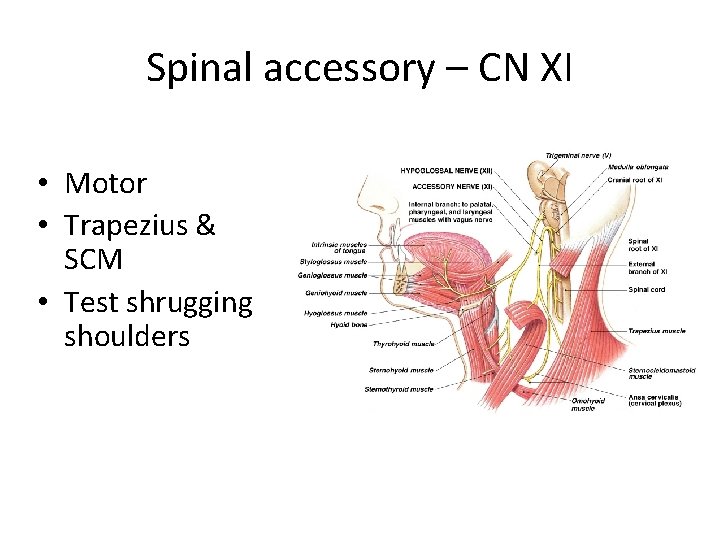
Spinal accessory – CN XI • Motor • Trapezius & SCM • Test shrugging shoulders
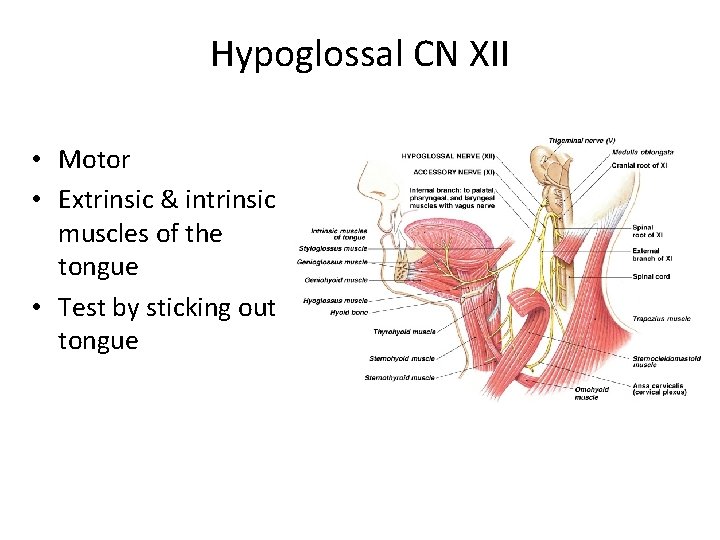
Hypoglossal CN XII • Motor • Extrinsic & intrinsic muscles of the tongue • Test by sticking out tongue
- Slides: 61