
Chapter 14 TCPIP and Routing Part 2 Unix





- Slides: 12
Chapter 14 TCP/IP and Routing Part #2 Unix System Administration
Roto-Routing z. There are several routing protocols to meet specific needs y. RIP - Routing Information Protocol y. OSPF - Open Shortest Path First y. IGRP - Interior Gateway Protocol y. EGP - Exterior Gateway Protocol y. BGP - Border Gateway Protocol y. DVMRP - Distance Vector Multicast Routing Protocol
Let’s All RIP One z. RIP is commonly implemented in the routed or gated daemon z. RIP uses hop count as its metric z. RIP is a resource hog due to its heavy use of broadcasting z. RIP is good for small networks without redundant paths or paths of varying bandwidth
Roger, Roger; What’s Your Vector Victor? z. OSPF is an industrial strength routing protocol for large, complex networks z. OSPF uses distance (hop count) and vector (cost/weight) as its metrics z. OSPF handles multiple paths and varying bandwidth links better than RIP z. OSPF is more complicated to administrate
IGRP Your EGP z. IGRP is a proprietary routing protocol from Cisco system z. EGP is an old routing protocol from the ARPANET (pre-Internet) z. BGP is the preferred Internet routing protocol
Border Your Gateway z. BGP expands on EGP z. BGP supports an arbitrarily complex topology of autonomous systems. z. BGP is typically used if your company want to use two different Internet Providers
Cheap Routing z. ICMP Redirects y. Use with hosts that don’t understand routing and only know how to send non-local packets to a smarter device (e. g. router). y. If the default router isn’t the correct one, it the forwards packet to the appropriate router and sends back an ICMP redirect to the host for future use.
ICMP Redirect at Work
Let’s Catch A U-Boat With Our Subnet z Subnets is the further breaking down of a network in smaller parts z You subnet the portion of the IP address that is meant for hosts devices (not the part assigned to you) z Subnets let you control traffic and routing policies z The dreaded subnet mask is used to separate the host portion and subnet portion of the IP address
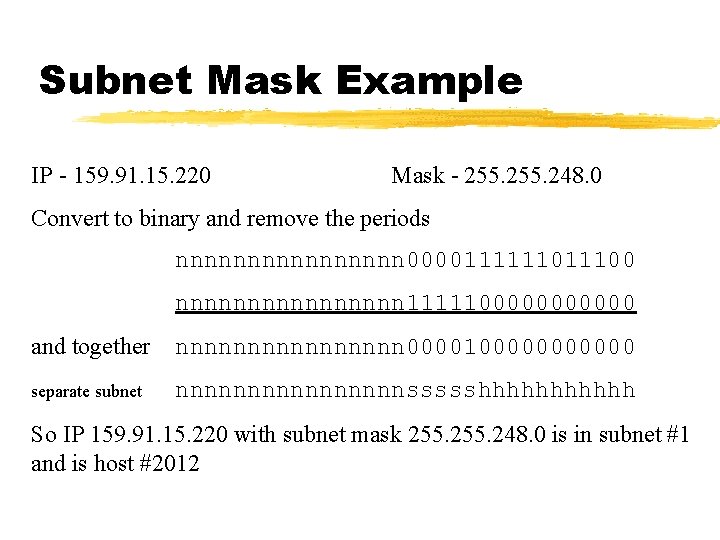
Subnet Mask Example IP - 159. 91. 15. 220 Mask - 255. 248. 0 Convert to binary and remove the periods nnnnnnnn 000011111100 nnnnnnnn 11111000000 and together nnnnnnnn 00001000000 separate subnet nnnnnnnnssssshhhhhh So IP 159. 91. 15. 220 with subnet mask 255. 248. 0 is in subnet #1 and is host #2012
Subnet Mask Example #2 z Assume you have a Class C address, say 192. 168. 1. 0 and you want to create a subnet mask that will allow you to have 6 subnets with up to 26 hosts per subnet. What subnet mask should you use? z Since it is a class C, you only get to work with the last octet which is 8 bits. z How many bits do you need for 6 subnets? How many for 26 hosts? z The subnet mask must be 255. 224
Route This! z. Which subnet mask should you select if there are multiple solutions to the # subnets/hosts required? z. What would you need to do if you can’t satisfy the number of subnet and hosts per subnet with your IP address class?