
Chapter 14 Solutions Outline I Solutions II Units















- Slides: 43
Chapter 14 Solutions Outline I. Solutions II. Units of Concentration III. Properties of Solutions IV. Solubility V. Reactions VI. Colligative Properties I have no doubt that in reality the future will be vastly more surprising than anything I can imagine. Now my own suspicion is that the universe is not only queerer than we suppose, but queerer than we can suppose. John Burdon Sanderson Haldane
How are solutions quantified?
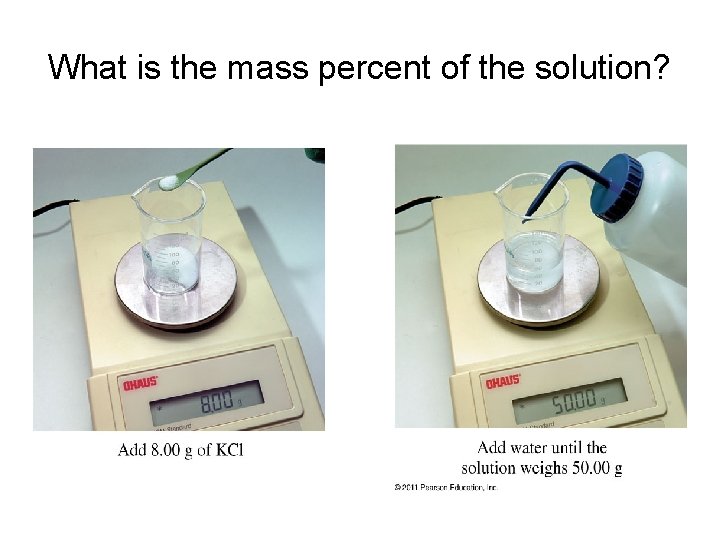
What is the mass percent of the solution?
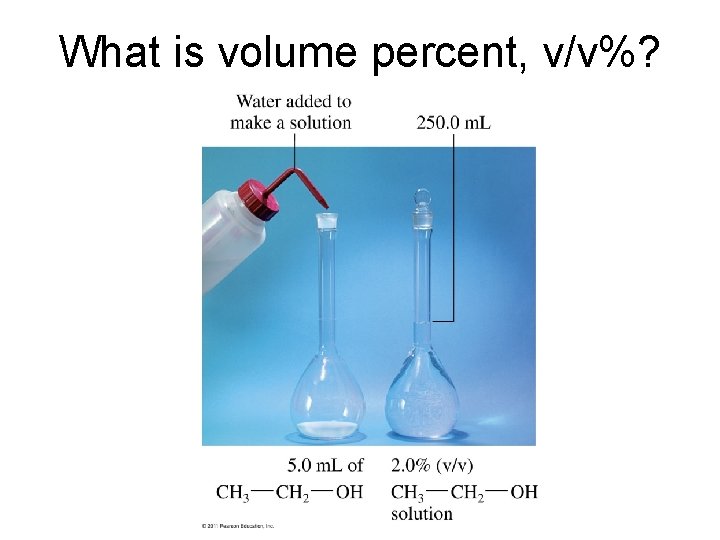
What is volume percent, v/v%?
Example – Mass Percent • A solution consists of 31. 7 g of Ag. NO 3 in 52. 0 g of water. What is the mass % of Ag. NO 3?
Example – Mass Percent • How much of a 25. 0% glucose solution is needed to get 56. 1 g of glucose?
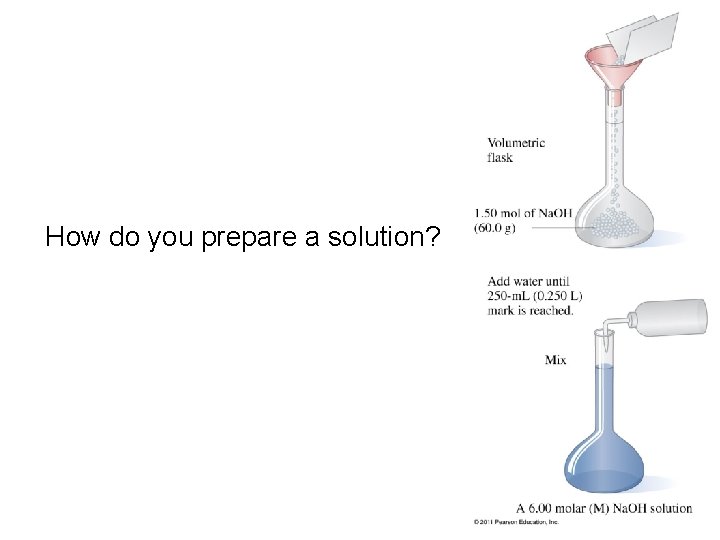
How do you prepare a solution?
Example - Molarity M = moles/L • What is the molarity of a sodium hydroxide solution that contains 24. 6 g of Na. OH dissolved to 500. 0 m. L total volume?
Example - Molarity • Calculate the volume of a 2. 50 M sugar solution containing 0. 400 mol of sugar.
Example - Molarity • What volume of 3. 0 M Na. OH can be prepared from 52. 0 g Na. OH?
Example – Molarity • What mass of solute is dissolved in 25. 0 m. L of 0. 500 M Cu. Cl 2?
Example – Units of Concentration • Calculate the molarity of a solution that is 30. 0% glucose, C 6 H 12 O 6, and has a density of 1. 42 g/m. L.
Example – Units of Concentration • Calculate the % acetic acid in a solution of vinegar that is 3. 50 M in acetic acid and has a density of 1. 06 g/m. L.
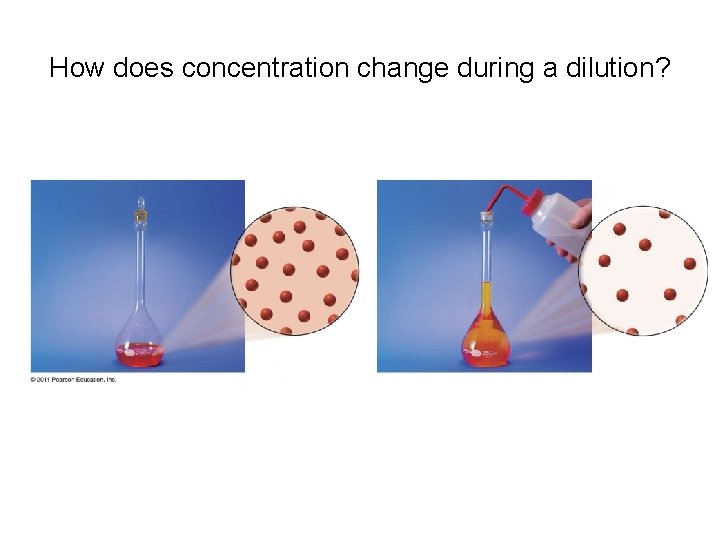
How does concentration change during a dilution?
Example - Dilutions • A concentrated acetic acid is 20. 0 M. What is the new molarity if 10. 00 m. L is diluted to 50. 00 m. L with distilled water?
Example - Dilution • What volume in m. L of a 0. 20 M strontium chloride solution can be prepared by diluting 5. 00 m. L of a 1. 0 M stock solution?
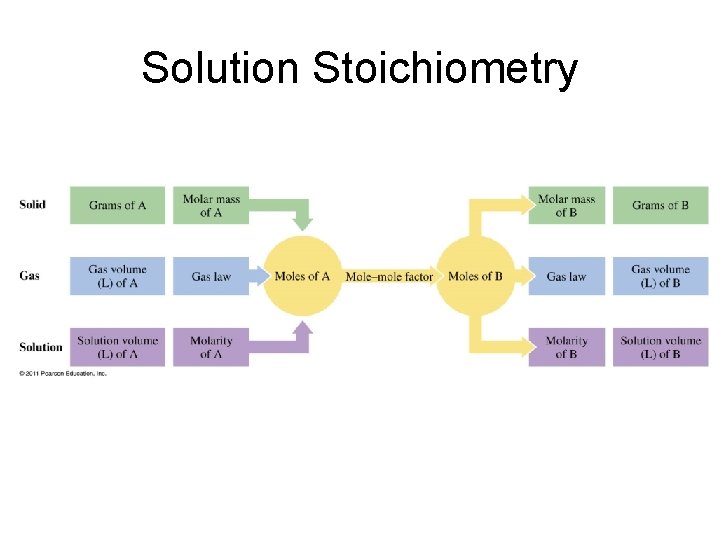
Solution Stoichiometry
Example - Solution Stoichiometry • Calculate the mass of Ba. SO 4 formed from 0. 104 L of 2. 00 M H 2 SO 4 and excess Ba(OH)2.
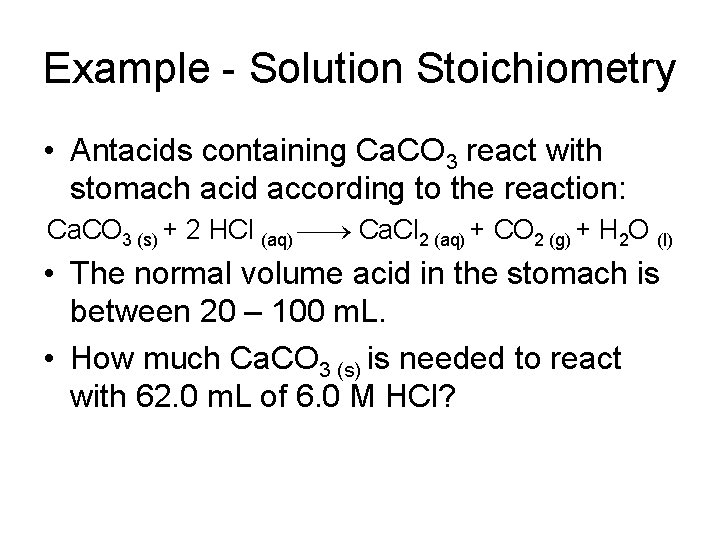
Example - Solution Stoichiometry • Antacids containing Ca. CO 3 react with stomach acid according to the reaction: Ca. CO 3 (s) + 2 HCl (aq) Ca. Cl 2 (aq) + CO 2 (g) + H 2 O (l) • The normal volume acid in the stomach is between 20 – 100 m. L. • How much Ca. CO 3 (s) is needed to react with 62. 0 m. L of 6. 0 M HCl?
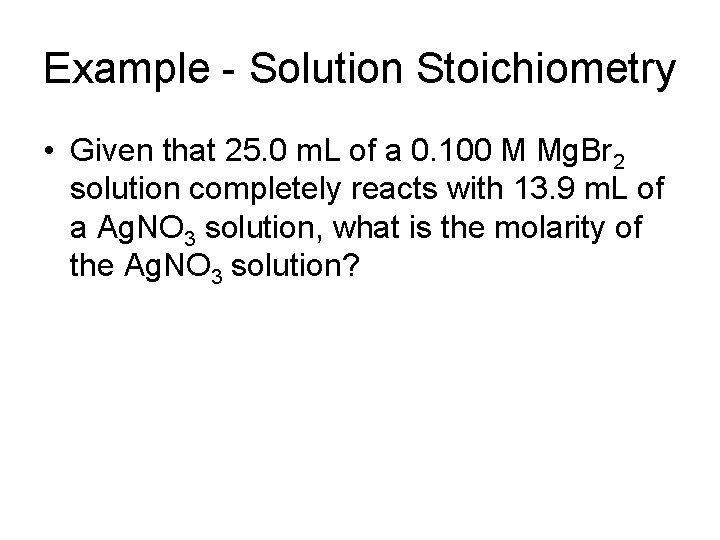
Example - Solution Stoichiometry • Given that 25. 0 m. L of a 0. 100 M Mg. Br 2 solution completely reacts with 13. 9 m. L of a Ag. NO 3 solution, what is the molarity of the Ag. NO 3 solution?
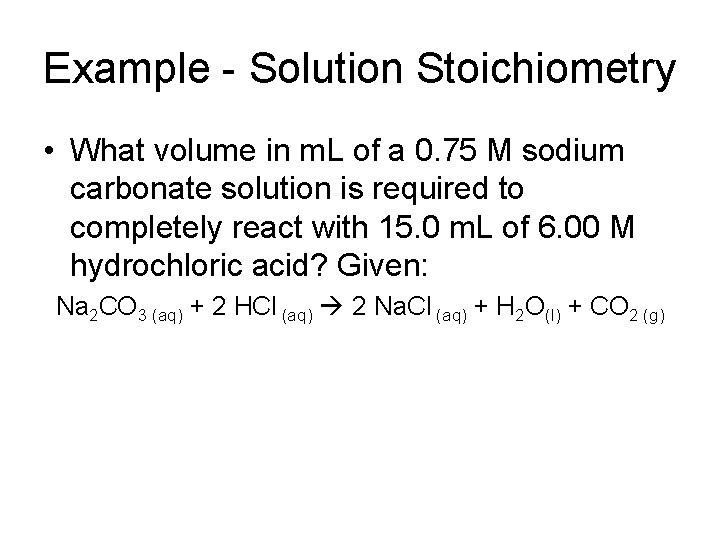
Example - Solution Stoichiometry • What volume in m. L of a 0. 75 M sodium carbonate solution is required to completely react with 15. 0 m. L of 6. 00 M hydrochloric acid? Given: Na 2 CO 3 (aq) + 2 HCl (aq) 2 Na. Cl (aq) + H 2 O(l) + CO 2 (g)
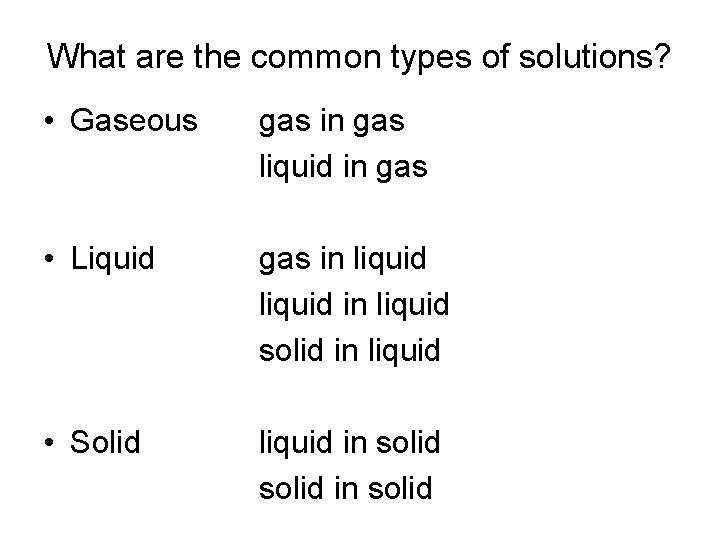
What are the common types of solutions? • Gaseous gas in gas liquid in gas • Liquid gas in liquid solid in liquid • Solid liquid in solid
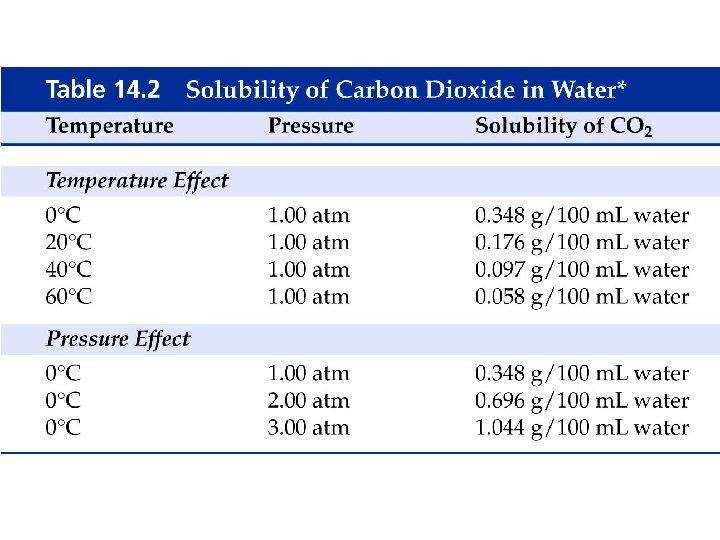
How does pressure affect gas solubility?
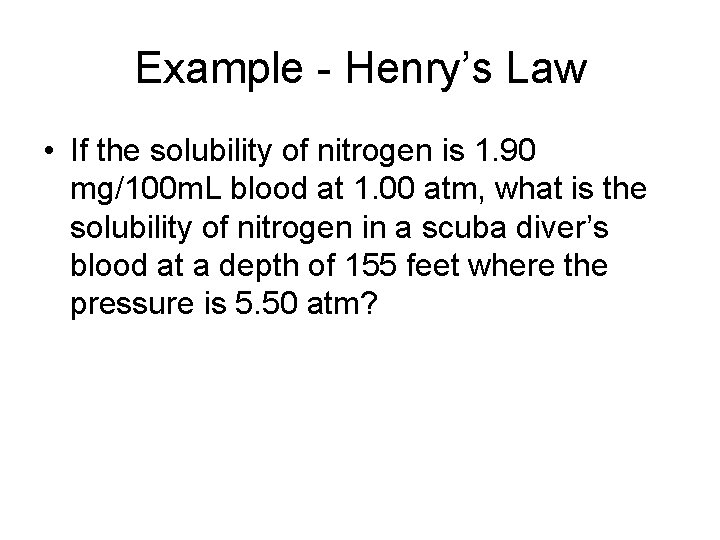
Example - Henry’s Law • If the solubility of nitrogen is 1. 90 mg/100 m. L blood at 1. 00 atm, what is the solubility of nitrogen in a scuba diver’s blood at a depth of 155 feet where the pressure is 5. 50 atm?
Example - Solubility • Which of the following pairs are miscible? A. Water and ethanol, CH 3 CH 2 OH B. Hexane, CH 3(CH 2)4 CH 3 and xylene, C. Ethanol, CH 3 CH 2 OH, and xylene, D. A and B E. All of the above
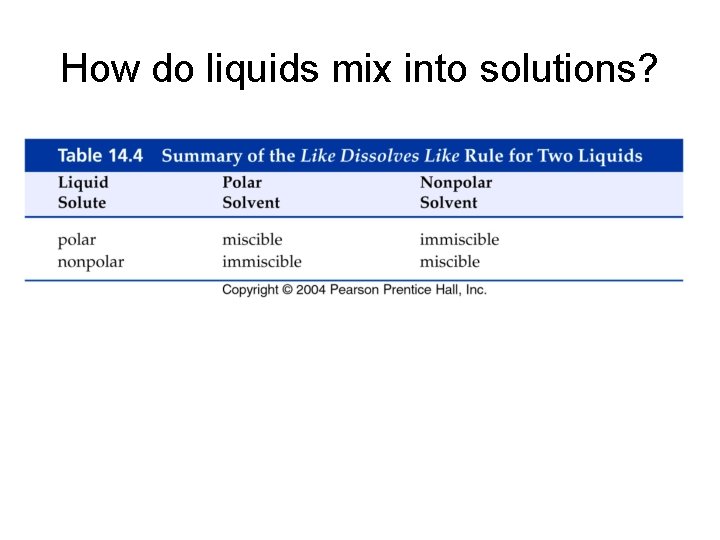
How do liquids mix into solutions?
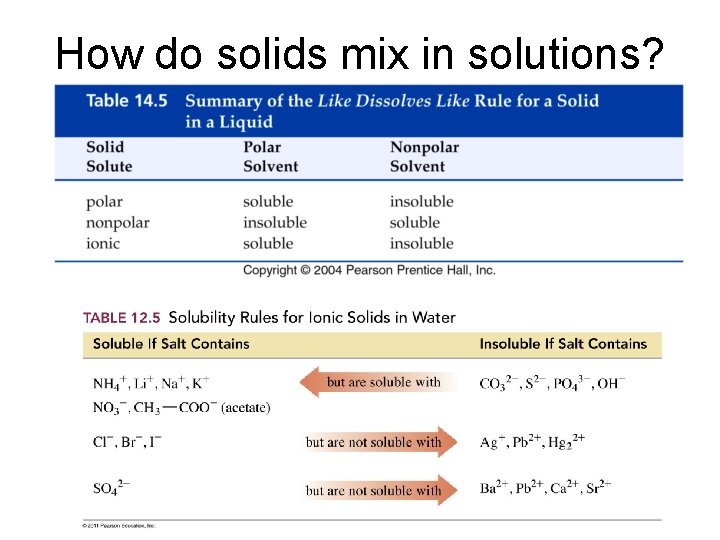
How do solids mix in solutions?
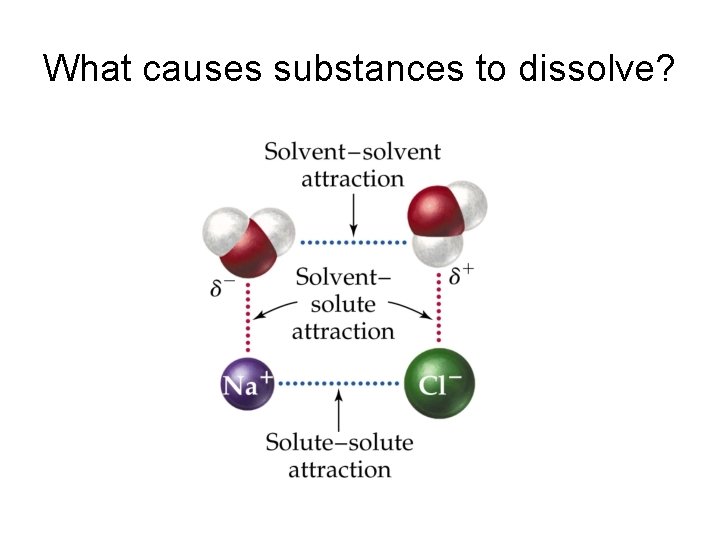
What causes substances to dissolve?
What is a solvent cage?
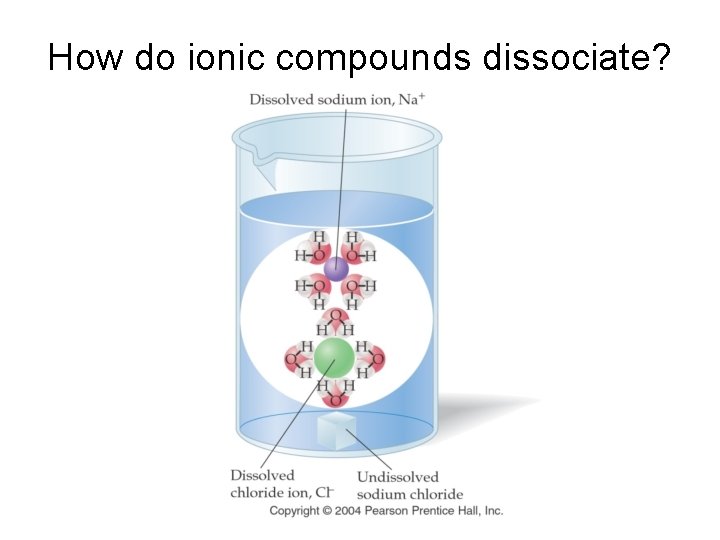
How do ionic compounds dissociate?
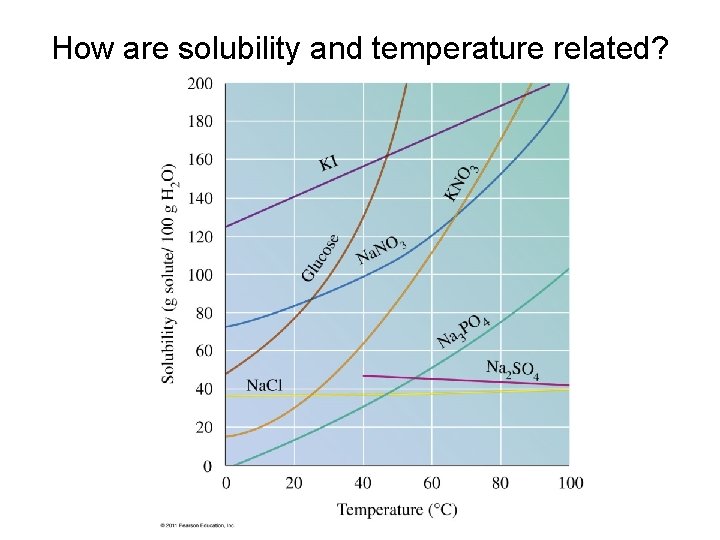
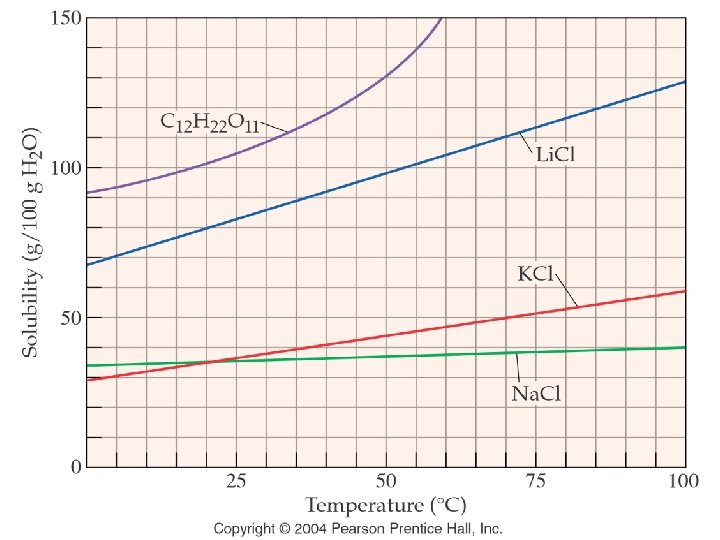
How are solubility and temperature related?
How are solubility and temperature related?
Example - Solutions • What type of solution is sodium acetate at 75 °C and 50 g/100 g H 2 O? A. Saturated B. Unsaturated C. Supersaturated D. Not enough information
What happens to a supersaturated solution if more solute is added?
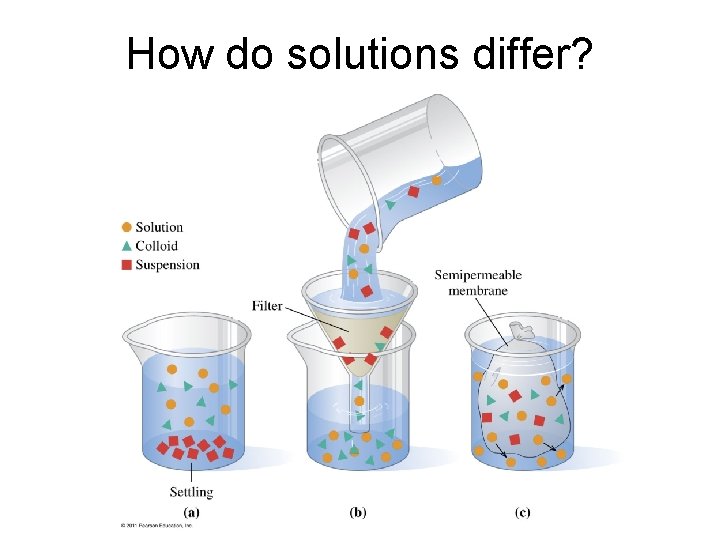
How do solutions differ?
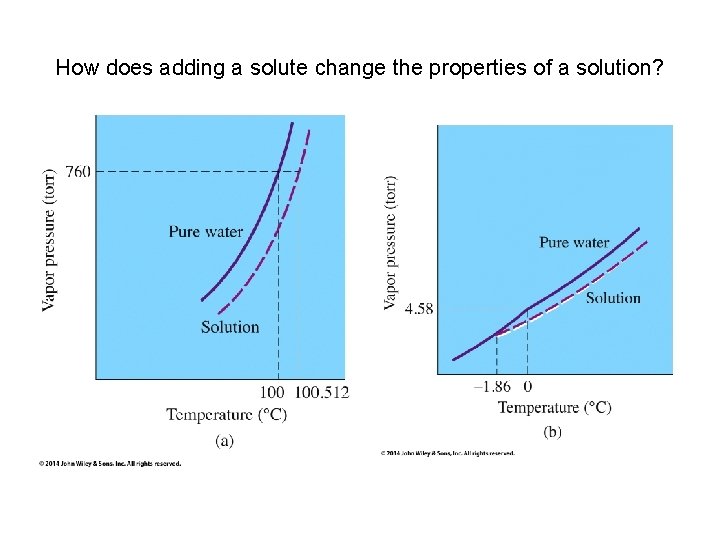
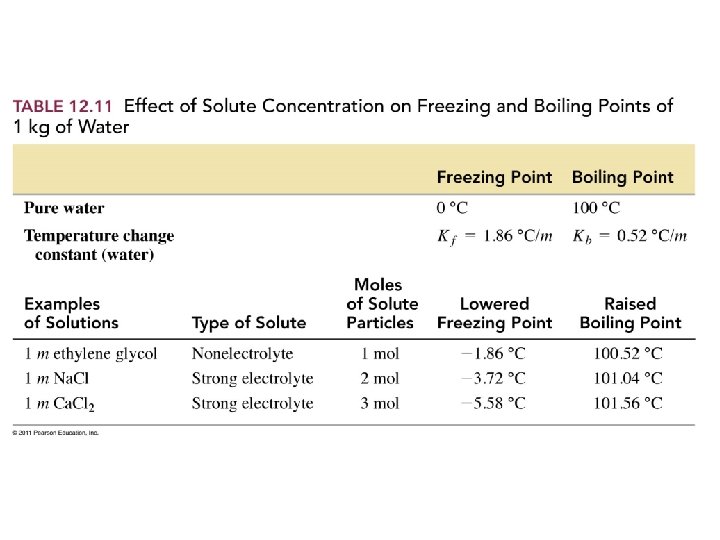
How does adding a solute change the properties of a solution?
Example – Colligative Properties • A 1. 00 -kg sample of water contains 0. 500 mol of Na 3 PO 4. What is the freezing point of the solution? Kf water = 1. 86 °C/m.
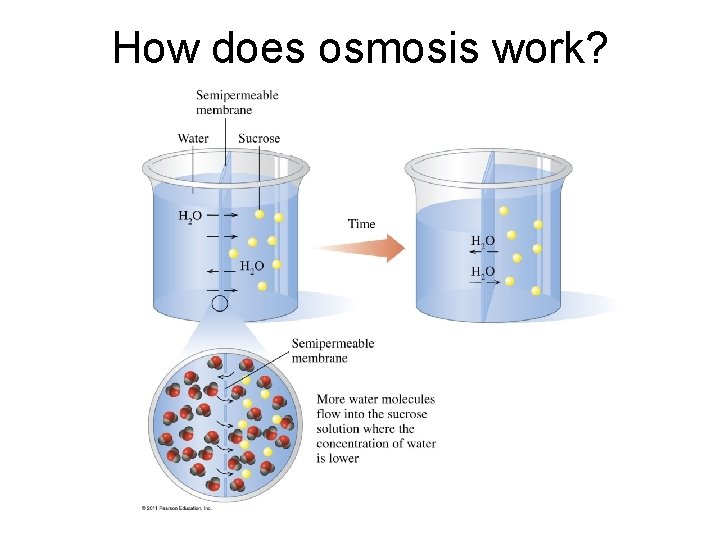
How does osmosis work?
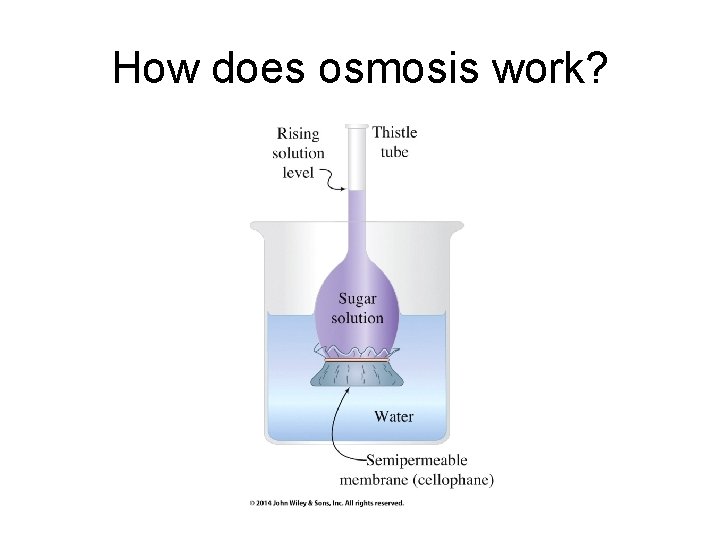
How does osmosis work?
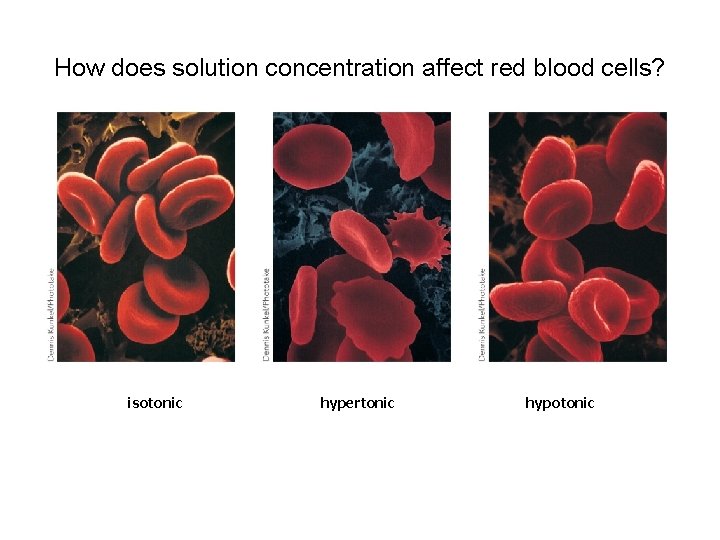
How does solution concentration affect red blood cells? isotonic hypertonic hypotonic