
Chapter 14 Settings used by Children and Young
Chapter 14 Settings used by Children and Young People © John Hubley & June Copeman 2013
Key settings to reach young people • Nursery schools, crèches attached to workplaces, playgroups • Primary schools/before- and after-school clubs/holiday play schemes • Secondary (high) schools • Further education colleges • Vocational training institutions • Universities • Other colleges (e. g. police, military) • Youth job creation schemes/employment exchanges • Youth centres • Young offenders institutions • Uniformed groups: scouts, guides, brownies, cubs, boys’ brigade, girls’ brigade
Contribution of schools to public health • Benefitting directly the health of the child • Promoting future health • Benefitting the health of the community
• enabling parents to work and so increase family income • providing opportunities for reaching children with health and nutrition services including screening, growth monitoring, immunization, feeding programmes preschool provisions improve child health and development by • offering educational opportunities (e. g. for social, emotional, language and intellectual development) for children from poor and deprived communities and laying the foundations for good performance at school • providing specific health education activities which encourage healthy routines such as hand washing, care of teeth, nutrition • providing opportunities to carry out nonformal education with parents on child health and development
Importance of play • While playing, children learn many things • Children are curious often involving the people around them in their play. • Play is the best way of introducing ideas about health to the pre-school child. • You can introduce basic health concepts through puzzles, stories, songs, acting games, drawing and games.
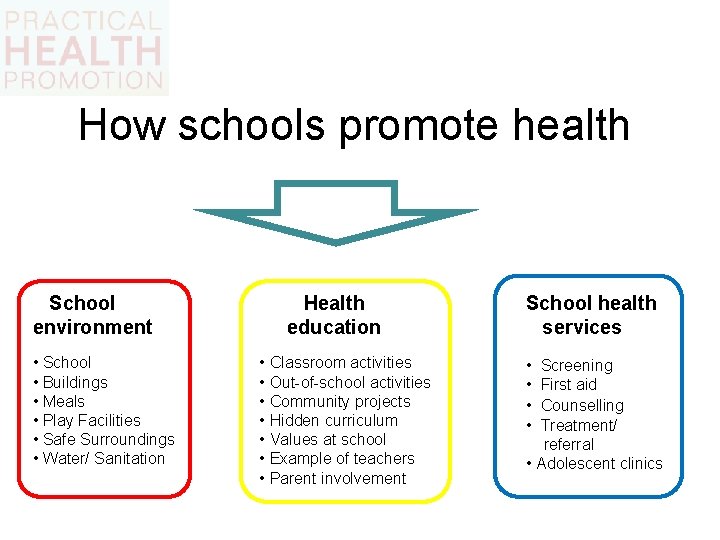
How schools promote health School environment • School • Buildings • Meals • Play Facilities • Safe Surroundings • Water/ Sanitation Health education • Classroom activities • Out-of-school activities • Community projects • Hidden curriculum • Values at school • Example of teachers • Parent involvement School health services • • Screening First aid Counselling Treatment/ referral • Adolescent clinics
Improving the school environment ü Promote safer school environments and play areas, speed restriction/crossings, cycling proficiency and first-aid training courses ü Provide individual/group support for children and young people involved in bullying ü Provide group/individual support to help children and parents to cope with managing behaviour problems
Improving the school environment ü Establish a School Nutrition Action Group to develop a ‘whole school food and drink policy’ ü Provide/promote confidential drop-ins/ counselling services at school and community venues ü Provide sessions for parents to support them in their central role as educators ü Work with parenting groups to promote increased physical activity with their children

Approaches in school health education (PSHE) • • Child-centred approach Active learning methods Problem-solving or 'issue-based' Decision-making methods Life skills Peer teaching methods Drama and role play Self-esteem enhancement
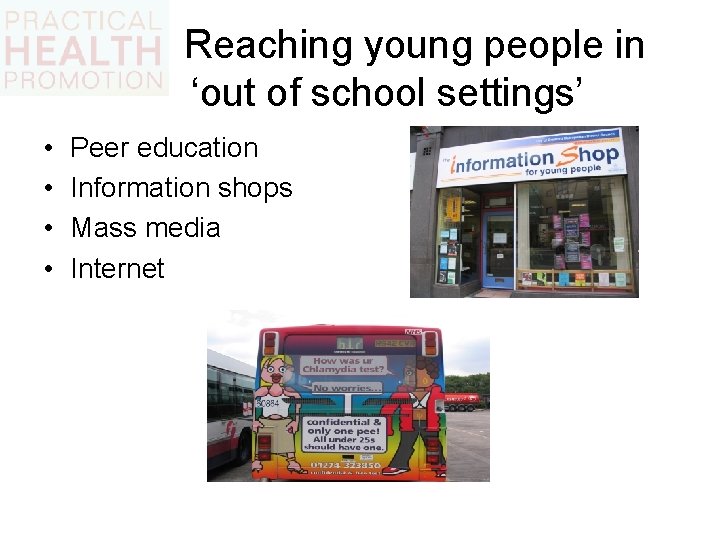
Reaching young people in ‘out of school settings’ • • Peer education Information shops Mass media Internet
Post-compulsory education settings This is an important transitionary stage for young people, it often involves leaving home and adopting a student lifestyle, taking up new ideas and challenging traditional authority
Opportunities for health promotion • Health Promotion is mainly provided through student services – such as health centres and counselling – and through specific health campaigns provided by student unions and other agencies. • There is considerable scope and potential for development of health promotion in highereducation settings.
- Slides: 12