
Chapter 14 Service Failures and Recovery Strategies COPYRIGHT
- Slides: 26
Chapter 14 Service Failures and Recovery Strategies COPYRIGHT © 2002 Thomson Learning, Inc. Thomson Learning is a trademark used herein under license. ALL RIGHTS RESERVED.
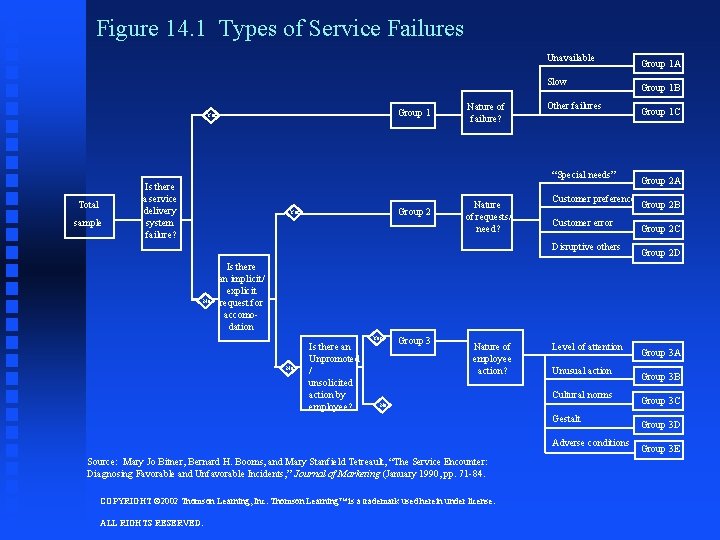
Figure 14. 1 Types of Service Failures Unavailable Slow Group 1 Yes Nature of failure? Other failures “Special needs” Total sample Is there a service delivery system failure? Group 2 Yes Nature of requests/ need? Customer preference Customer error Disruptive others No Group 1 B Group 1 C Group 2 A Group 2 B Group 2 C Group 2 D Is there an implicit/ explicit request for accomodation No Is there an Unpromoted / unsolicited action by employee? Yes Group 3 Nature of employee action? Level of attention Unusual action Cultural norms No Gestalt Adverse conditions Source: Mary Jo Bitner, Bernard H. Booms, and Mary Stanfield Tetreault, “The Service Encounter: Diagnosing Favorable and Unfavorable Incidents, ” Journal of Marketing (January 1990, pp. 71 -84. COPYRIGHT © 2002 Thomson Learning, Inc. Thomson Learning is a trademark used herein under license. ALL RIGHTS RESERVED. Group 1 A Group 3 B Group 3 C Group 3 D Group 3 E
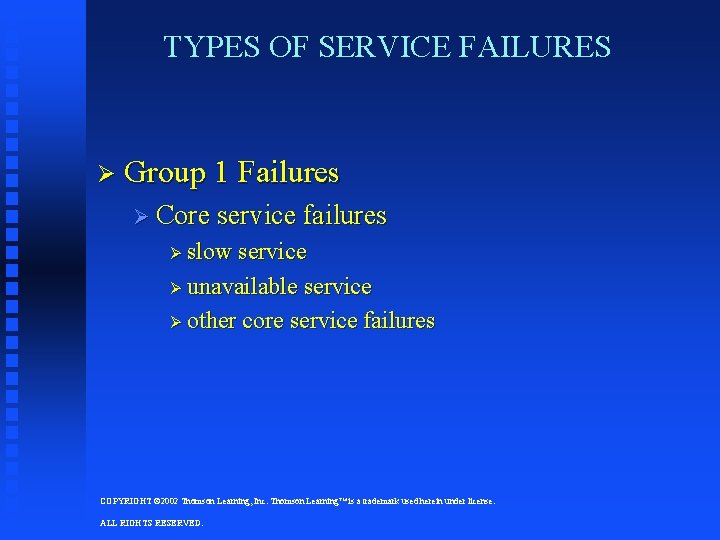
TYPES OF SERVICE FAILURES Ø Group 1 Failures Ø Core service failures Ø slow service Ø unavailable service Ø other core service failures COPYRIGHT © 2002 Thomson Learning, Inc. Thomson Learning is a trademark used herein under license. ALL RIGHTS RESERVED.
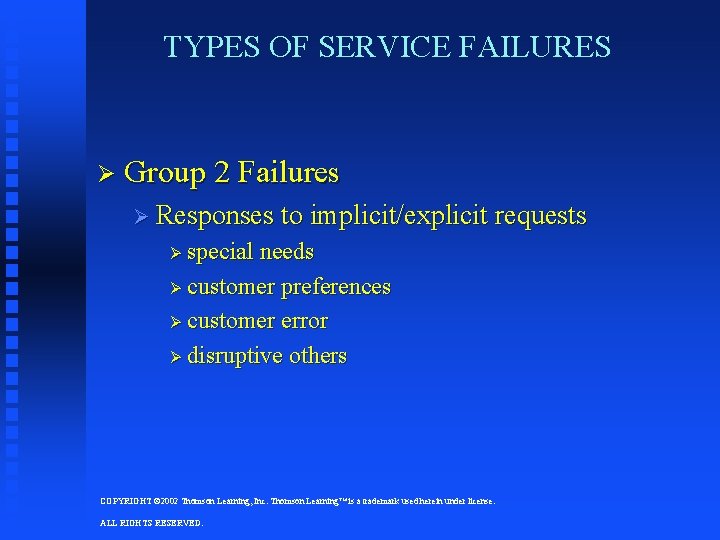
TYPES OF SERVICE FAILURES Ø Group 2 Failures Ø Responses to implicit/explicit requests Ø special needs Ø customer preferences Ø customer error Ø disruptive others COPYRIGHT © 2002 Thomson Learning, Inc. Thomson Learning is a trademark used herein under license. ALL RIGHTS RESERVED.
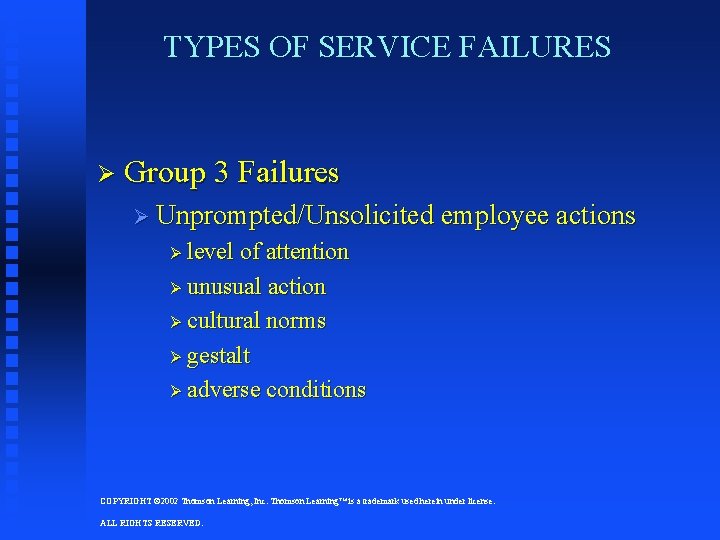
TYPES OF SERVICE FAILURES Ø Group 3 Failures Ø Unprompted/Unsolicited employee actions Ø level of attention Ø unusual action Ø cultural norms Ø gestalt Ø adverse conditions COPYRIGHT © 2002 Thomson Learning, Inc. Thomson Learning is a trademark used herein under license. ALL RIGHTS RESERVED.
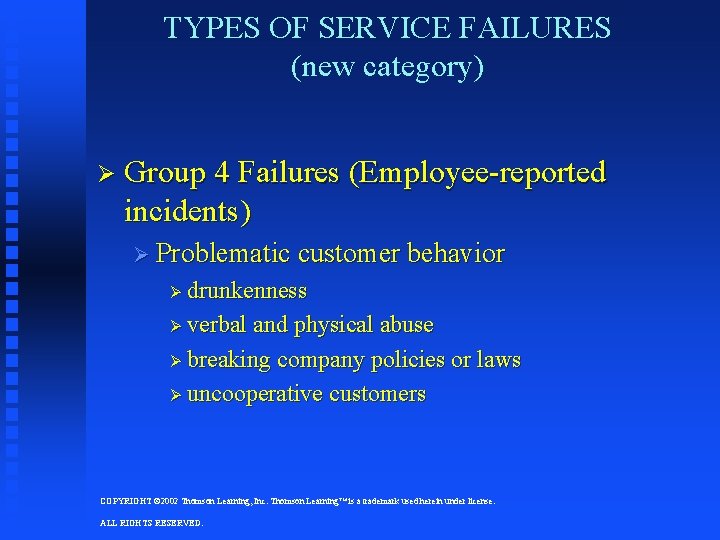
TYPES OF SERVICE FAILURES (new category) Ø Group 4 Failures (Employee-reported incidents) Ø Problematic customer behavior Ø drunkenness Ø verbal and physical abuse Ø breaking company policies or laws Ø uncooperative customers COPYRIGHT © 2002 Thomson Learning, Inc. Thomson Learning is a trademark used herein under license. ALL RIGHTS RESERVED.
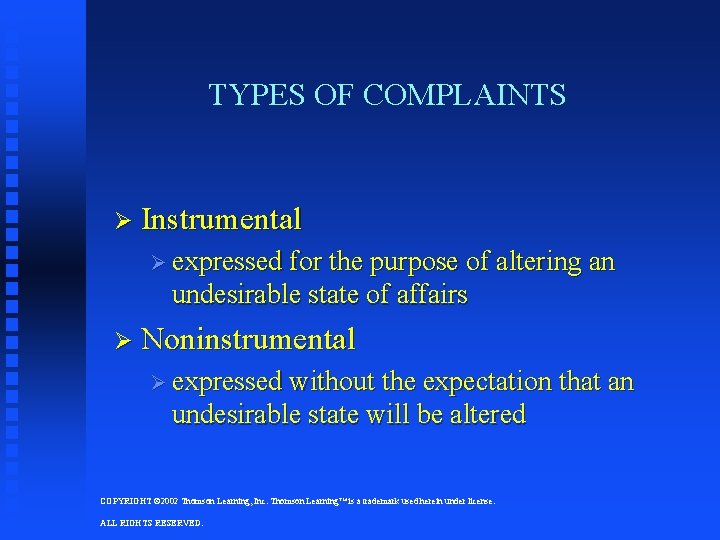
TYPES OF COMPLAINTS Ø Instrumental Ø expressed for the purpose of altering an undesirable state of affairs Ø Noninstrumental Ø expressed without the expectation that an undesirable state will be altered COPYRIGHT © 2002 Thomson Learning, Inc. Thomson Learning is a trademark used herein under license. ALL RIGHTS RESERVED.
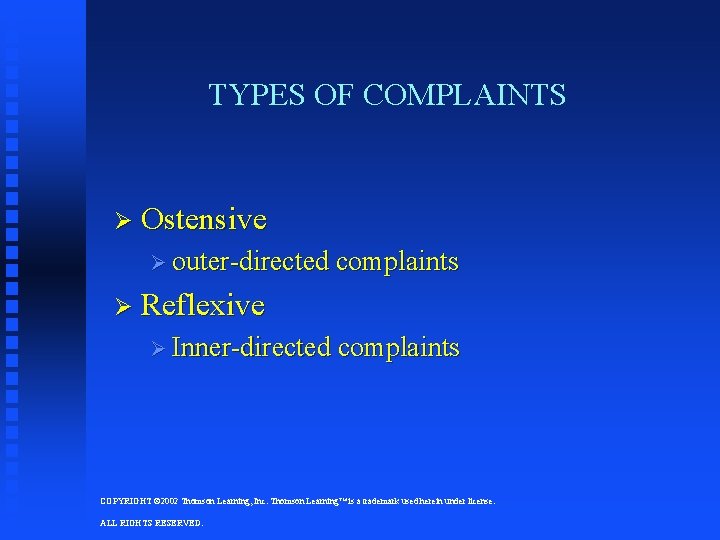
TYPES OF COMPLAINTS Ø Ostensive Ø outer-directed complaints Ø Reflexive Ø Inner-directed complaints COPYRIGHT © 2002 Thomson Learning, Inc. Thomson Learning is a trademark used herein under license. ALL RIGHTS RESERVED.
WHY DO CUSTOMERS COMPLAIN? Ø Correct the problem Ø Emotional release from frustration Ø Regain some measure of control by spreading negative w-o-m Ø Solicit sympathy Ø Test for consensus Ø Create an impression of being more intelligent and discerning COPYRIGHT © 2002 Thomson Learning, Inc. Thomson Learning is a trademark used herein under license. ALL RIGHTS RESERVED.
WHY DON’T CUSTOMERS COMPLAIN? Ø Don’t know who to complain to Ø Don’t think it will do any good Ø May doubt their own subjective evaluation Ø May accept part of the blame Ø May want to avoid confrontation Ø May lack expertise COPYRIGHT © 2002 Thomson Learning, Inc. Thomson Learning is a trademark used herein under license. ALL RIGHTS RESERVED.
COMPLAINING OUTCOMES Ø Voice Ø High => store manager Ø Medium => sales clerk Ø Low => no one associated with the store Ø Exit Ø High => never purchases again Ø Medium => only purchases if other alternatives are not available Ø Low => continues to shop as usual COPYRIGHT © 2002 Thomson Learning, Inc. Thomson Learning is a trademark used herein under license. ALL RIGHTS RESERVED.
COMPLAINING OUTCOMES Ø Retaliation Ø High => tells lots of people and attempts to physically damage the store Ø Medium => tells a few people and created minor inconveniences Ø Low => does not retaliate at all COPYRIGHT © 2002 Thomson Learning, Inc. Thomson Learning is a trademark used herein under license. ALL RIGHTS RESERVED.
TRENDS IN COMPLAINT RESOLUTION Ø Complaints are more likely to be acted upon when: Ø complaints are made to managers Ø formally designated complaint handlers are involved Ø someone with a personal tie to the company is involved Ø the complaint is about the quality of service as opposed to an employee’s personality COPYRIGHT © 2002 Thomson Learning, Inc. Thomson Learning is a trademark used herein under license. ALL RIGHTS RESERVED.
SERVICE RECOVERY Ø Service recovery paradox Ø customers are likely to evaluate a firm higher if a mistake is made and corrected than had the service been delivered correctly the first time. COPYRIGHT © 2002 Thomson Learning, Inc. Thomson Learning is a trademark used herein under license. ALL RIGHTS RESERVED.
DEVELOPING A SERVICE RECOVERY PROGRAM Ø Measure the costs Ø calculate the lifetime value of a customer Ø Actively encourage complaints Ø Anticipate needs for recovery Ø Respond quickly Ø Train employees Ø Empower the front-line Ø Close the loop COPYRIGHT © 2002 Thomson Learning, Inc. Thomson Learning is a trademark used herein under license. ALL RIGHTS RESERVED.
SERVICE RECOVERY EVALUATION Ø Perceived justice needs--based on equity theory which weighs outcomes versus inputs Ø distributive justice Ø outcomes Ø procedural justice Ø process Ø interactional justice Ø the human content of the recovery process COPYRIGHT © 2002 Thomson Learning, Inc. Thomson Learning is a trademark used herein under license. ALL RIGHTS RESERVED.
TYPICAL RECOVERY STRATEGIES (distributive justice outcomes) Ø Compensatory strategies Ø gratis Ø discounts Ø upgrades Ø free ancillary service Ø Refunds COPYRIGHT © 2002 Thomson Learning, Inc. Thomson Learning is a trademark used herein under license. ALL RIGHTS RESERVED.
TYPICAL RECOVERY STRATEGIES (distributive justice outcomes) Ø Corrections Ø Replacement strategies Ø Apology Ø Disregard COPYRIGHT © 2002 Thomson Learning, Inc. Thomson Learning is a trademark used herein under license. ALL RIGHTS RESERVED.
RECOVERY TACTICS Ø Poor responses Ø Fail to recognize the seriousness of the problem Ø Fail to adequately accommodate the customer Ø Act as though nothing is wrong Ø Fail to explain why the problem occurred Ø Leave the customer to solve the problem on his or her own Ø Promise to do something and don’t follow through COPYRIGHT © 2002 Thomson Learning, Inc. Thomson Learning is a trademark used herein under license. ALL RIGHTS RESERVED.
SERVICE FAILURES & RECOVERY STRATEGIES: THE RESTAURANT INDUSTRY COPYRIGHT © 2002 Thomson Learning, Inc. Thomson Learning is a trademark used herein under license. ALL RIGHTS RESERVED.
SERVICE FAILURES: THE RESTAURANT INDUSTRY Ø Group 1 failure categories (44. 4%) Ø Product defects (20. 9%) Ø food was described as cold, soggy, raw, burnt, spoiled, or containing inanimate objects such as hair, glass, bandages, bag ties, and cardboard. Ø Slow/unavailable service (17. 9%) Ø waiting excessively, not being able to find assistance COPYRIGHT © 2002 Thomson Learning, Inc. Thomson Learning is a trademark used herein under license. ALL RIGHTS RESERVED.
SERVICE FAILURES: THE RESTAURANT INDUSTRY Ø Facility problems (3. 2%) Ø cleanliness issues such as bad smells, dirty utensils, and animate objects (e. g. , insects) found on the table or in the food Ø Unclear policies (1. 6%) Ø policies that were perceived as unfair by the customer, such as coupon redemption, or forms of payment Ø Out-of-stock conditions (. 8%) Ø inadequate supply of menu items COPYRIGHT © 2002 Thomson Learning, Inc. Thomson Learning is a trademark used herein under license. ALL RIGHTS RESERVED.
SERVICE FAILURES: THE RESTAURANT INDUSTRY Ø Group 2 failure categories (18. 4%) Ø food not cooked to order (15. 0%) Ø requested food be prepared in a particular manner and restaurant failed to meet request Ø seating problems (3. 4%) Ø seating nonsmokers in smoking section and vice versa Ø lost or disregarded reservations Ø requests for special tables that were denied Ø seating among unruly and disruptive customers COPYRIGHT © 2002 Thomson Learning, Inc. Thomson Learning is a trademark used herein under license. ALL RIGHTS RESERVED.
SERVICE FAILURES: THE RESTAURANT INDUSTRY Ø Group 3 failure categories (37. 2%) Ø inappropriate employee behavior (15. 2%) Ø rudeness, inappropriate verbal exchanges, and poor attitudes Ø wrong Orders (12. 6%) Ø delivery of the incorrect food item, either to the table, or in the case of fast food, in packaging so that the mistake was not discovered until the customer had left the premises COPYRIGHT © 2002 Thomson Learning, Inc. Thomson Learning is a trademark used herein under license. ALL RIGHTS RESERVED.
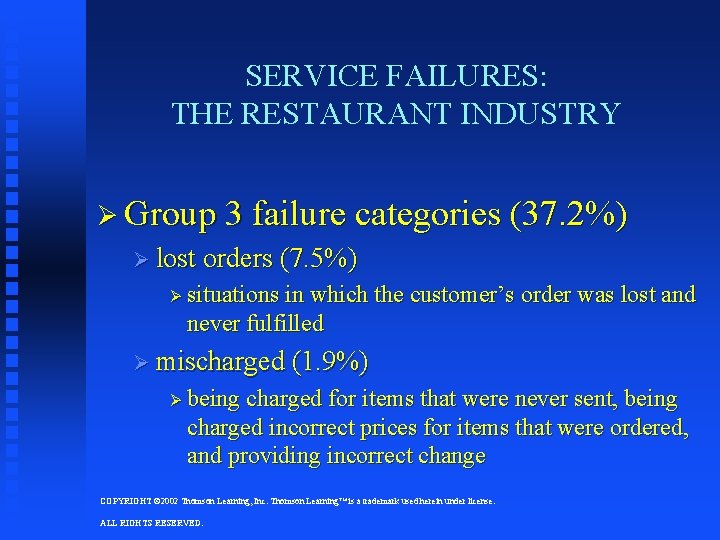
SERVICE FAILURES: THE RESTAURANT INDUSTRY Ø Group 3 failure categories (37. 2%) Ø lost orders (7. 5%) Ø situations in which the customer’s order was lost and never fulfilled Ø mischarged (1. 9%) Ø being charged for items that were never sent, being charged incorrect prices for items that were ordered, and providing incorrect change COPYRIGHT © 2002 Thomson Learning, Inc. Thomson Learning is a trademark used herein under license. ALL RIGHTS RESERVED.
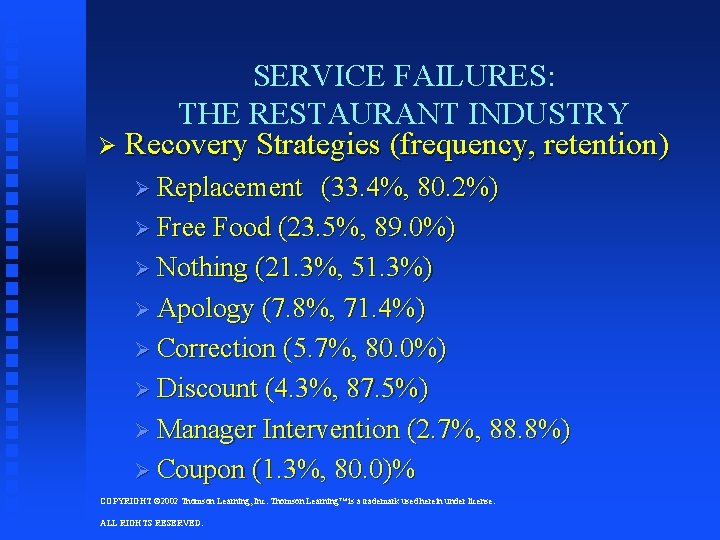
SERVICE FAILURES: THE RESTAURANT INDUSTRY Ø Recovery Strategies (frequency, retention) Ø Replacement (33. 4%, 80. 2%) Ø Free Food (23. 5%, 89. 0%) Ø Nothing (21. 3%, 51. 3%) Ø Apology (7. 8%, 71. 4%) Ø Correction (5. 7%, 80. 0%) Ø Discount (4. 3%, 87. 5%) Ø Manager Intervention (2. 7%, 88. 8%) Ø Coupon (1. 3%, 80. 0)% COPYRIGHT © 2002 Thomson Learning, Inc. Thomson Learning is a trademark used herein under license. ALL RIGHTS RESERVED.