
Chapter 14 Section 2 Currents and Climate Bellringer
Chapter 14 Section 2 Currents and Climate Bellringer Given the average yearly temperatures for the Scilly Isles in England Newfoundland in Canada, can you explain why the two locations have very different year-round temperatures? Note their locations on the globe, and use what you know about the movement of ocean currents to support your answer. Chapter menu Resources Copyright © by Holt, Rinehart and Winston. All rights reserved.
Chapter 14 Section 2 Currents and Climate Objectives • Explain how currents affect climate. • Describe the effects of El Niño. • Explain how scientists study and predict the pattern of El Niño. Chapter menu Resources Copyright © by Holt, Rinehart and Winston. All rights reserved.
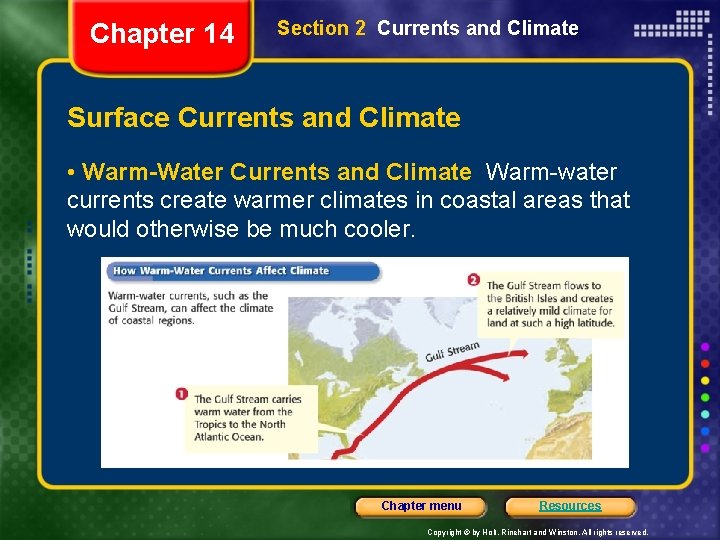
Chapter 14 Section 2 Currents and Climate Surface Currents and Climate • Warm-Water Currents and Climate Warm-water currents create warmer climates in coastal areas that would otherwise be much cooler. Chapter menu Resources Copyright © by Holt, Rinehart and Winston. All rights reserved.
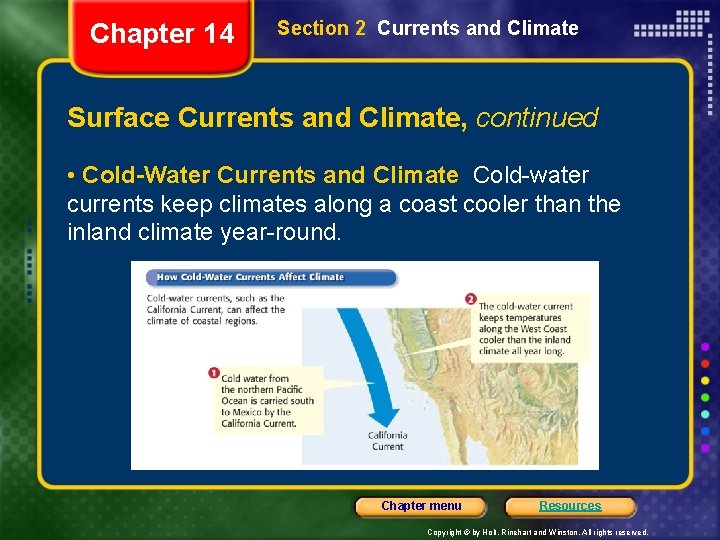
Chapter 14 Section 2 Currents and Climate Surface Currents and Climate, continued • Cold-Water Currents and Climate Cold-water currents keep climates along a coast cooler than the inland climate year-round. Chapter menu Resources Copyright © by Holt, Rinehart and Winston. All rights reserved.
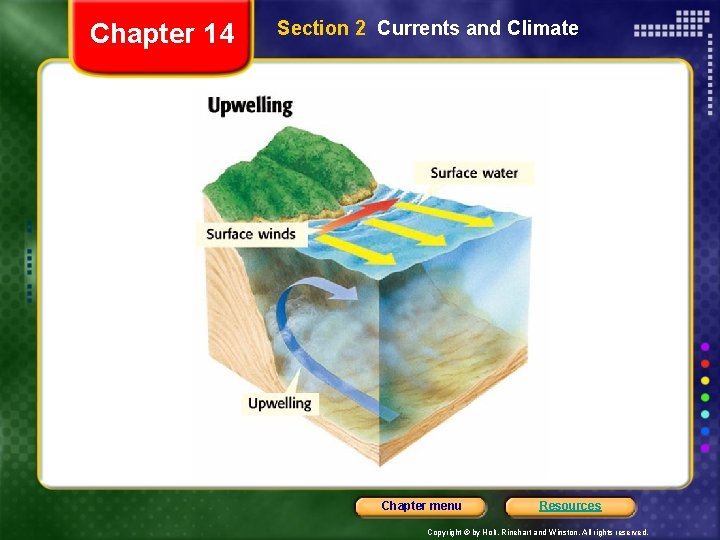
Chapter 14 Section 2 Currents and Climate Surface Currents and Climate, continued • Upwelling is the movement of deep, cold, and nutrient-rich water to the surface of the ocean. • The nutrients that are brought to the surface support the growth of plankton. Plankton support larger organisms, such as fish and seabirds. • Upwelling is shown on the next slide. Chapter menu Resources Copyright © by Holt, Rinehart and Winston. All rights reserved.
Chapter 14 Section 2 Currents and Climate Chapter menu Resources Copyright © by Holt, Rinehart and Winston. All rights reserved.
Chapter 14 Section 2 Currents and Climate Surface Currents and Climate, continued • El Niño is a change in the water temperature in the Pacific Ocean that produces a warm current. • Effects of El Niño alters weather patterns enough to cause disasters, including flash floods, mudslides, and droughts. El Niño also prevents upwelling off the coast of South America. Chapter menu Resources Copyright © by Holt, Rinehart and Winston. All rights reserved.
Chapter 14 Section 2 Currents and Climate Surface Currents and Climate, continued • Studying and Predicting El Niño Learning as much as possible about El Niño is important because of its effects on organisms and land. • To study El Niño, scientist use a network of buoys located along the equator. The buoys collect data about surface temperature, air temperature, currents, and wind. Chapter menu Resources Copyright © by Holt, Rinehart and Winston. All rights reserved.
- Slides: 8