
Chapter 14 Routing Protocols RIP OSPF and BGP
Chapter 14 Routing Protocols (RIP, OSPF, and BGP) Mi-Jung Choi Dept. of Computer Science and Engineering mjchoi@postech. ac. kr 1
Introduction o An internet is a combination of networks connected by routers o A metric is a cost assigned for passing through a network. the total metric of a particular route is equal to the sum of the metrics of networks that comprise the router chooses the route with the shortest (smallest) metric o RIP (Routing Information Protocol): treating each network equals. The cost of passing through each network is the same. l so if a packet passes through 10 networks to reach the destination, the total cost is hop counts. 2
Introduction o OSPF (Open Shortest Path First) Allowing the administrator to assign a cost for passing through a network based on the type of service required. A route through a network can have different costs (metrics) o BGP (Border Router Protocol) Criterion is the policy, which can be set by the administrator. Policy defines what paths should be chosen. o Static and Dynamic tables o Unicast Routing and Multicast Routing 3
14. 1 Intra and Extra Domain Routing o Because an internet can be so large, one routing protocol cannot handle the task of updating routing tables of all routers. o So, an internet is divided into autonomous systems. o An autonomous system (AS) is a group of networks and routers under the authority of a single administration. o Intradomain routing used for the routing inside an autonomous system o Interdomain routing used for the routing between autonomous systems 4
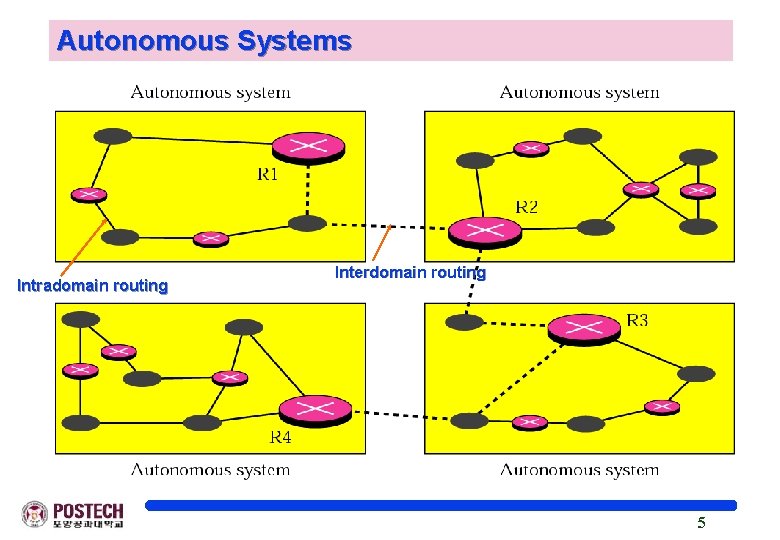
Autonomous Systems Intradomain routing Interdomain routing 5
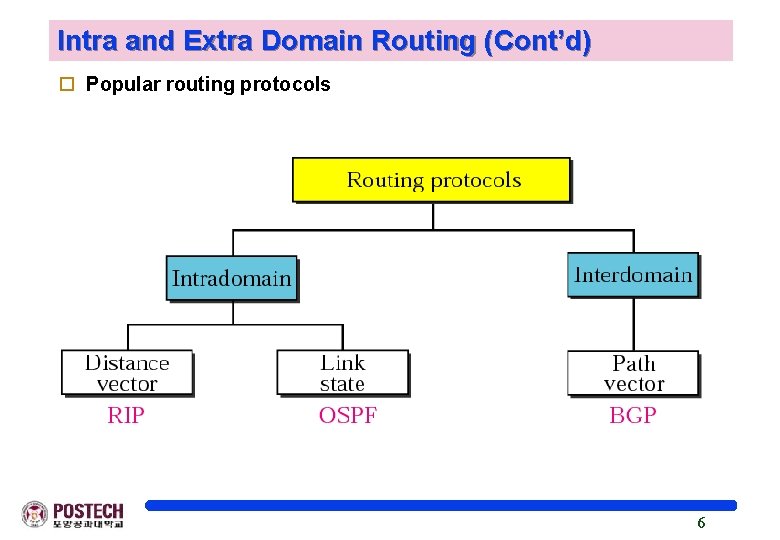
Intra and Extra Domain Routing (Cont’d) o Popular routing protocols 6
14. 2 Distance Vector Routing o In distance vector routing, the least cost route between any two nodes is the route with minimum distance. In this protocol each node maintains a vector (table) of minimum distances to every node o Distance Vector Routing each router periodically shares its knowledge about the entire internet with neighbors the operational principles of this algorithm 1. Sharing knowledge about the entire autonomous system 2. Sharing only with neighbors 3. Sharing at regular intervals (ex, every 30 seconds) 7
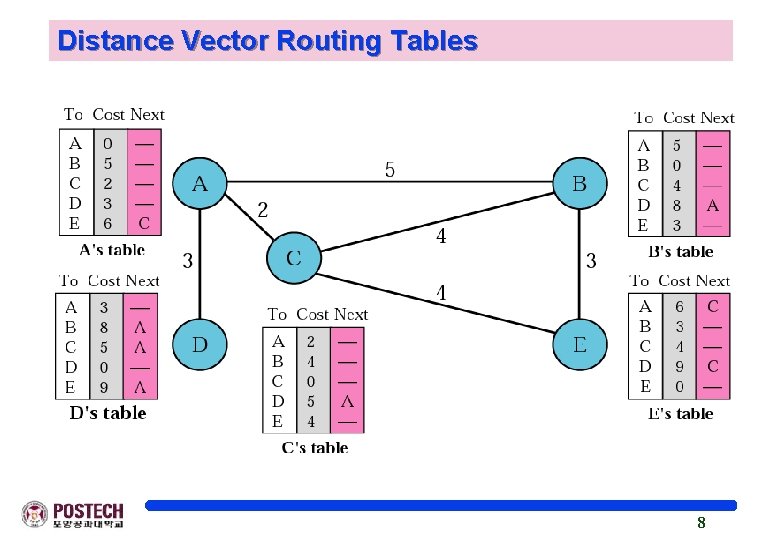
Distance Vector Routing Tables 8
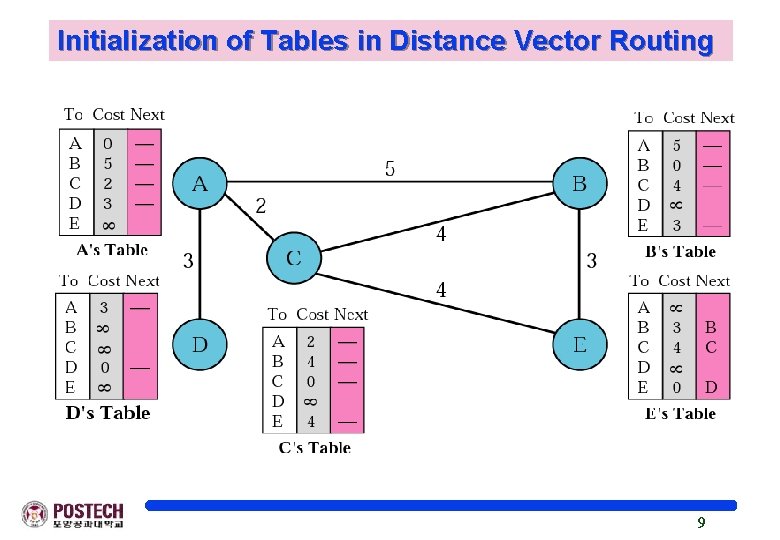
Initialization of Tables in Distance Vector Routing 9
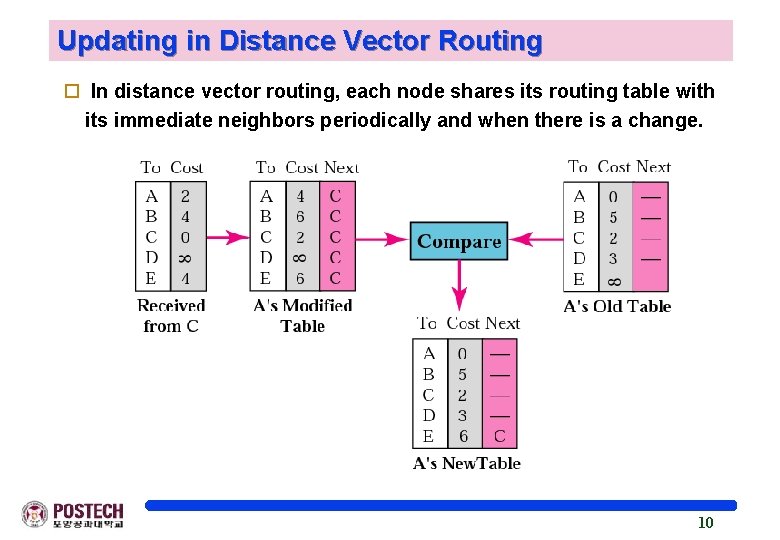
Updating in Distance Vector Routing o In distance vector routing, each node shares its routing table with its immediate neighbors periodically and when there is a change. 10
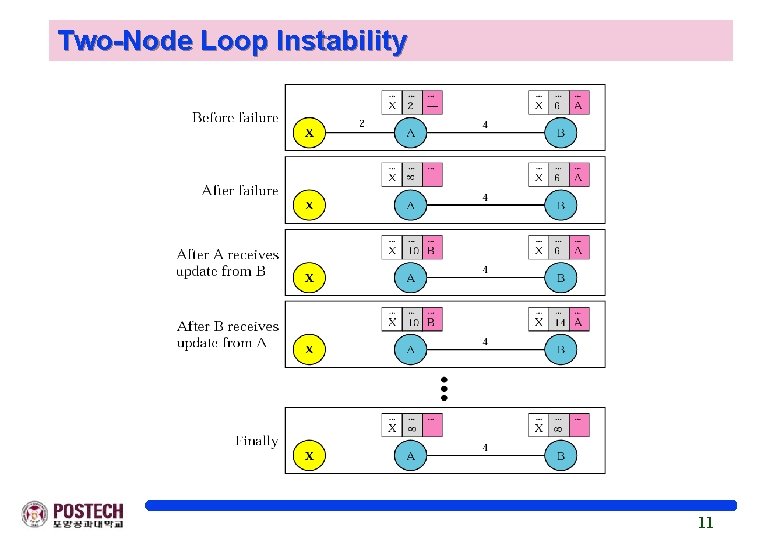
Two-Node Loop Instability 11
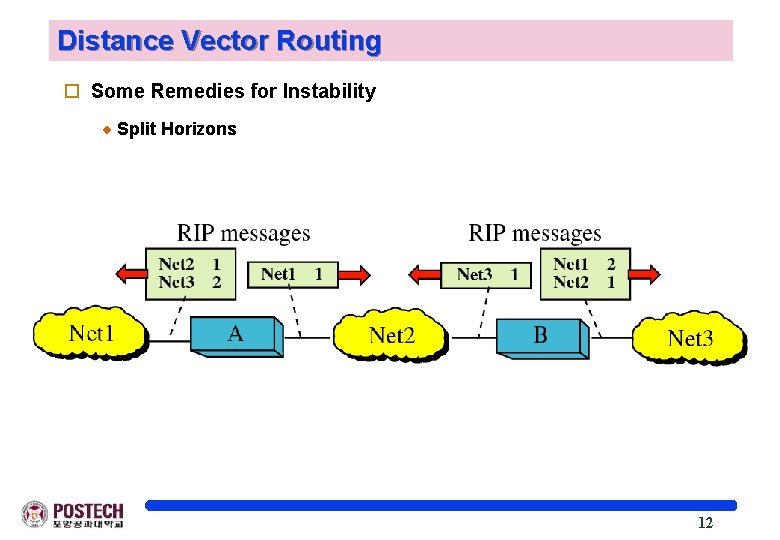
Distance Vector Routing o Some Remedies for Instability Split Horizons 12
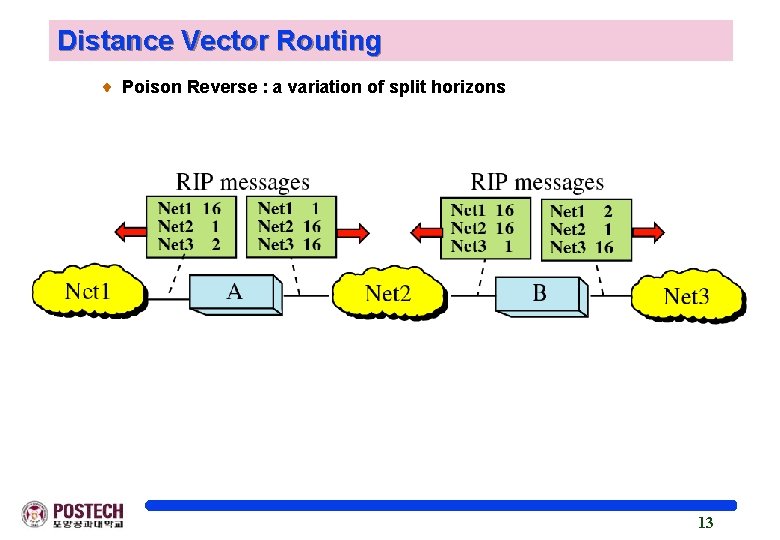
Distance Vector Routing Poison Reverse : a variation of split horizons 13
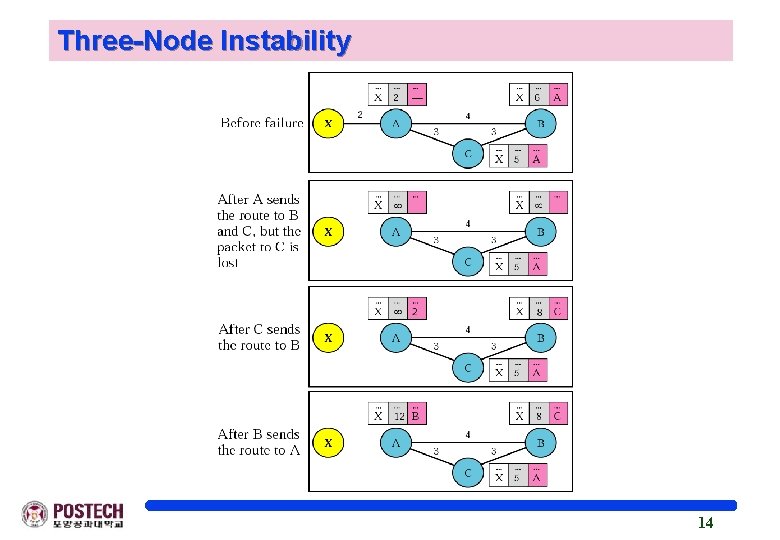
Three-Node Instability 14
14. 3 RIP o The Routing Information Protocol (RIP) is an intradomain routing protocol used inside an autonomous system. It is a very simple protocol based on distance vector routing. o The destination in a routing table is a network, which means the first column defines a network address. o A metric in RIP is called a hop count; distance; defined as the number of links (networks) that have to be used to reach the destination. 15
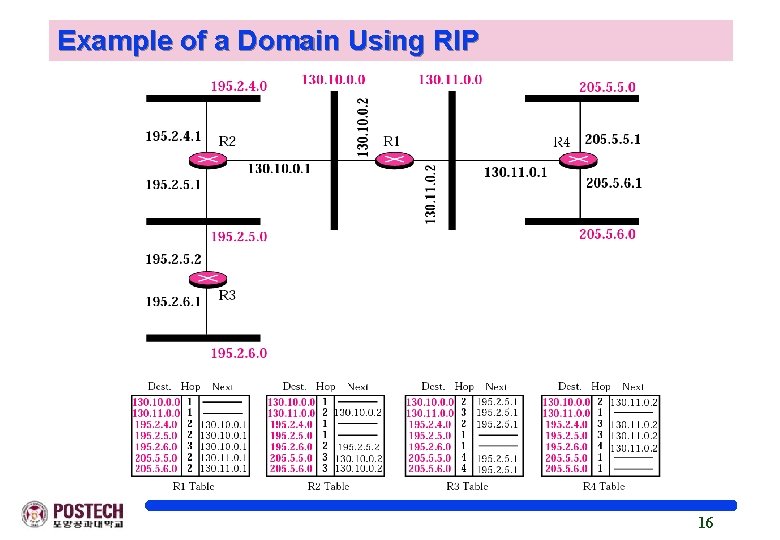
Example of a Domain Using RIP 16
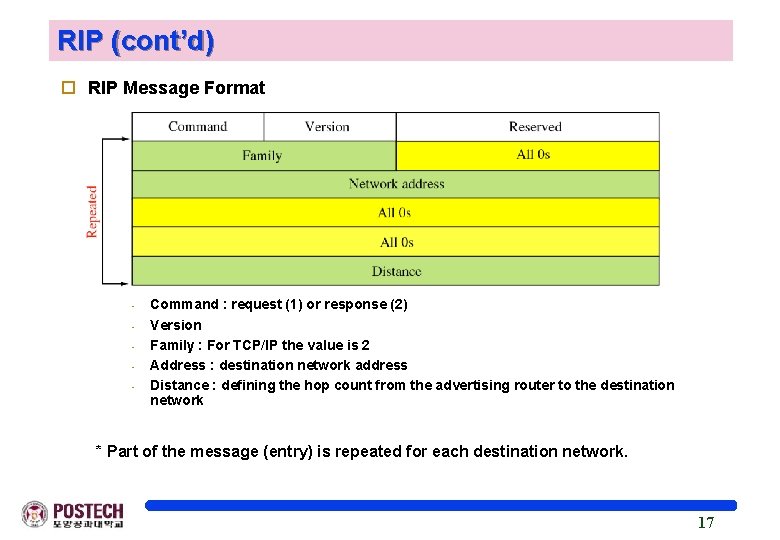
RIP (cont’d) o RIP Message Format - Command : request (1) or response (2) Version Family : For TCP/IP the value is 2 Address : destination network address Distance : defining the hop count from the advertising router to the destination network * Part of the message (entry) is repeated for each destination network. 17
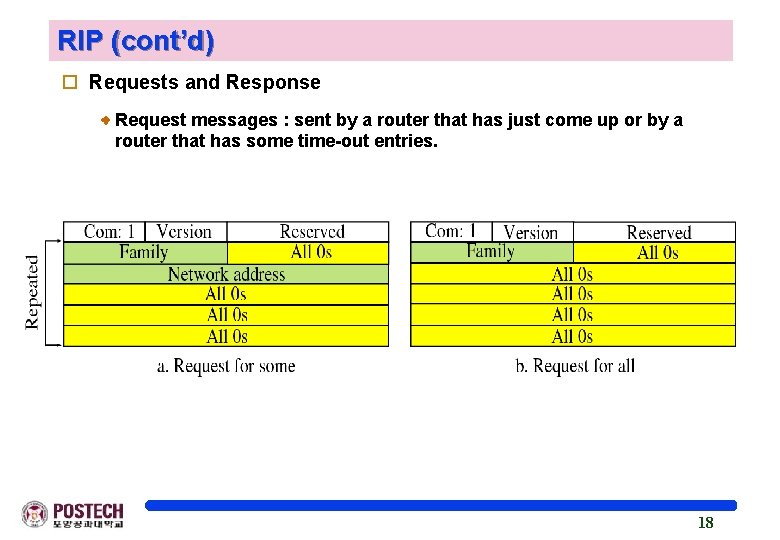
RIP (cont’d) o Requests and Response Request messages : sent by a router that has just come up or by a router that has some time-out entries. 18
RIP (cont’d) Response l solicited response – – l is sent only in answer to a request containing information about the destination specified in the corresponding request unsolicited response – is sent periodically, every 30 seconds – containing information covering the whole routing table 19
Example 1 o Figure 14. 11 shows the update message sent from router R 1 to router R 2 in Figure 14. 8. The message is sent out of interface 130. 10. 0. 2. 20
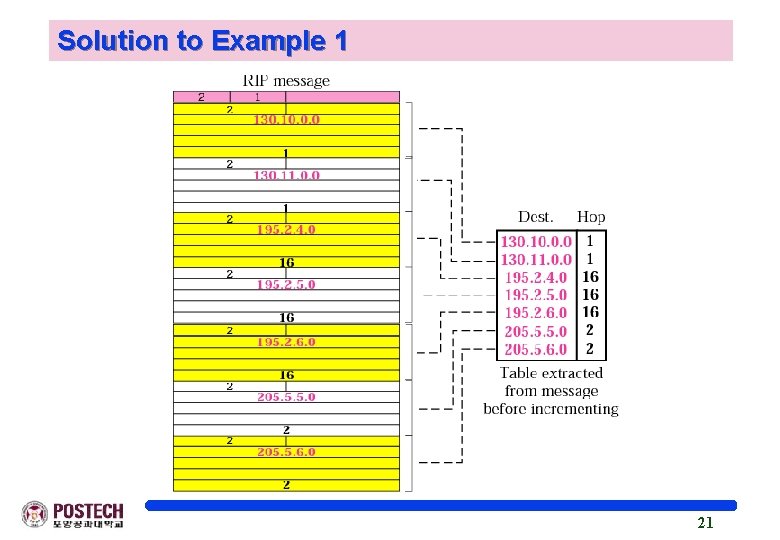
Solution to Example 1 21
RIP (cont’d) o Timers in RIP Periodic timer : controlling the advertisements of regular update messages expiration timer : governing the validity of a route the garbage collection timer : advertising the failure of a route o Periodic timer controlling the advertising of regular update messages using random number between 25 to 35 seconds 22
RIP (cont’d) o Expiration timer In normal situation, the new update for a route occurs every 30 seconds But, if there is a problem on an Internet and no update is received within the allotted 180 seconds, the route is considered expired and the hop count of the route is set to 16. Each router has its own expiration timer. o Garbage Collection Timer When the information about a route becomes invalid, the router continues to advertise the route with a metric value of 16 and the garbage collection timer is set to 120 sec for that route When the count reaches zero, the route is purged from the table. 23
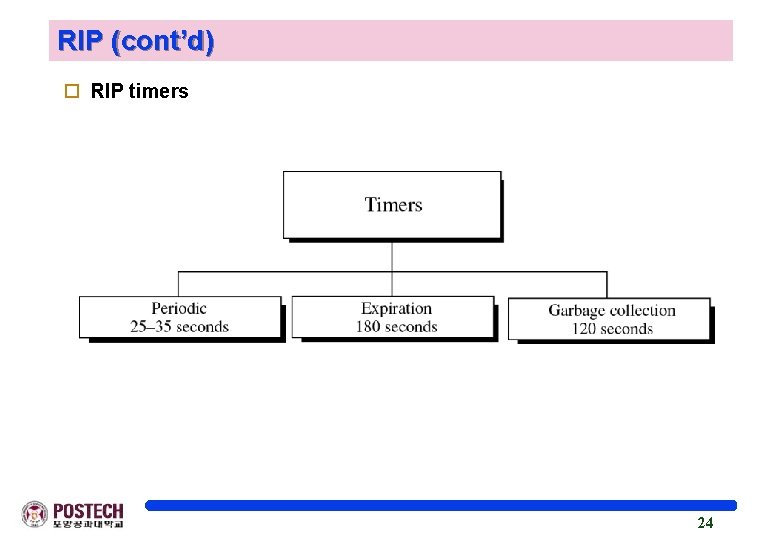
RIP (cont’d) o RIP timers 24
RIP (cont’d) Example 2 A routing table has 20 entries. It does not receive information about five routes for 200 seconds. How many timers are running at this time? The timers are listed below: Periodic timer: 1 Expiration timer: 20 - 5 = 15 Garbage collection timer: 5 25
RIP Version 2 o Designed for overcoming some of the shortcomings of version 1 o Replaced fields in version 1 that were filled with 0 s for the TCP/IP protocols with some new fields o Can use classless addressing 26
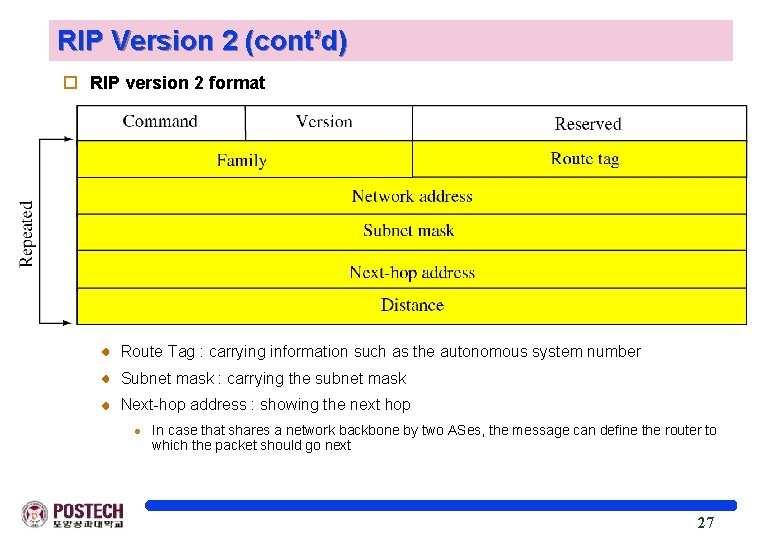
RIP Version 2 (cont’d) o RIP version 2 format Route Tag : carrying information such as the autonomous system number Subnet mask : carrying the subnet mask Next-hop address : showing the next hop l In case that shares a network backbone by two ASes, the message can define the router to which the packet should go next 27
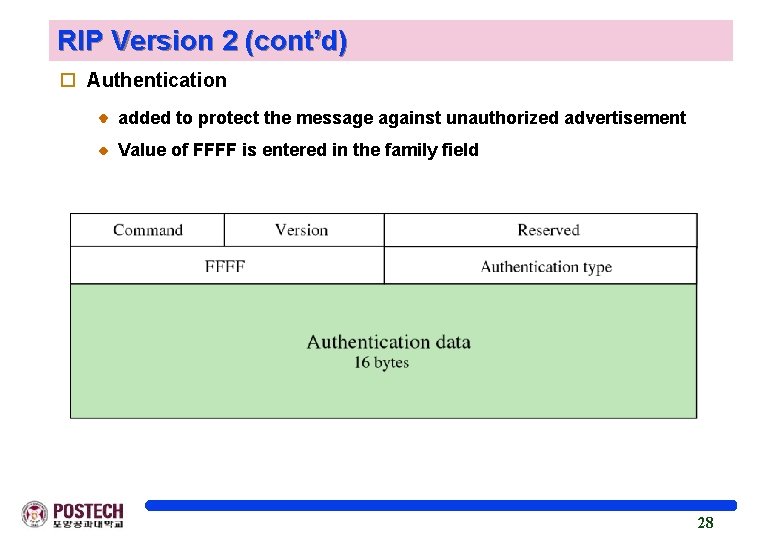
RIP Version 2 (cont’d) o Authentication added to protect the message against unauthorized advertisement Value of FFFF is entered in the family field 28
RIP Version 2 (cont’d) o Multicasting Using the multicast address 224. 0. 0. 9 to multicast RIP messages only to RIP routers in the network o Encapsulation of RIP messages encapsulated in UDP user datagram not included a field that indicates the length of the message Well-known port assigned to RIP in UDP is port 520 29
14. 4 Link State Routing o In link state routing, if each node in the domain has the entire topology of the domain, the node can use Dijkstra’s algorithm to build a routing table. 30
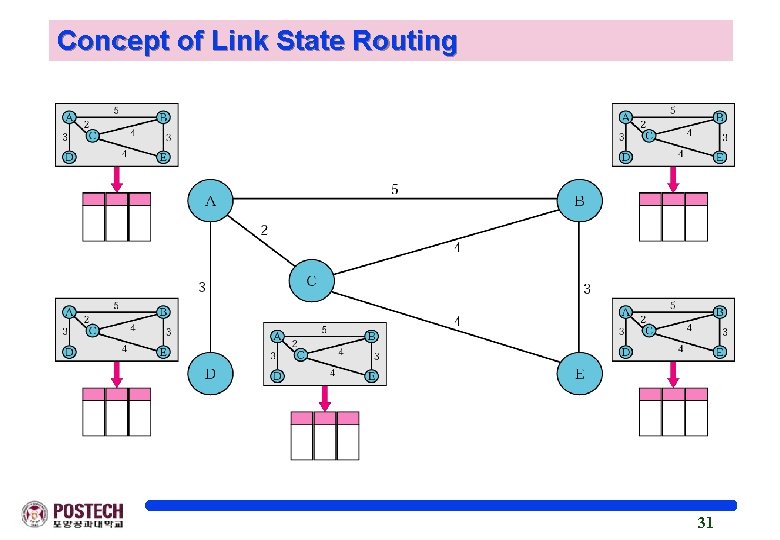
Concept of Link State Routing 31
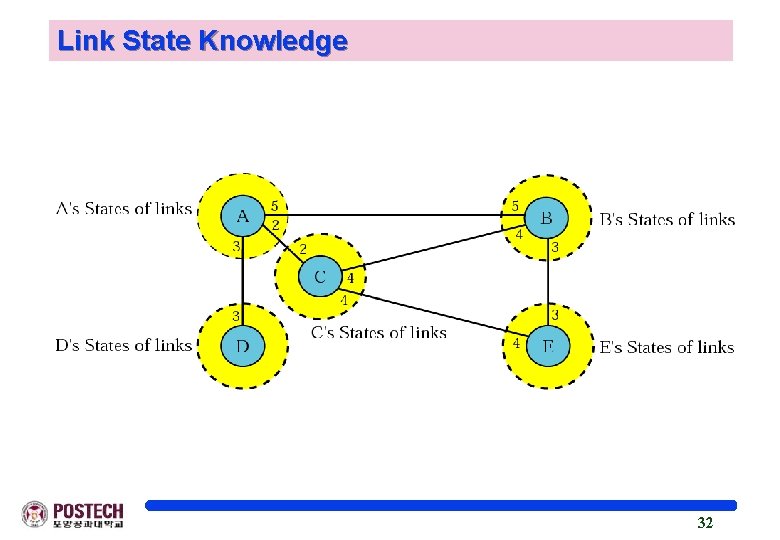
Link State Knowledge 32
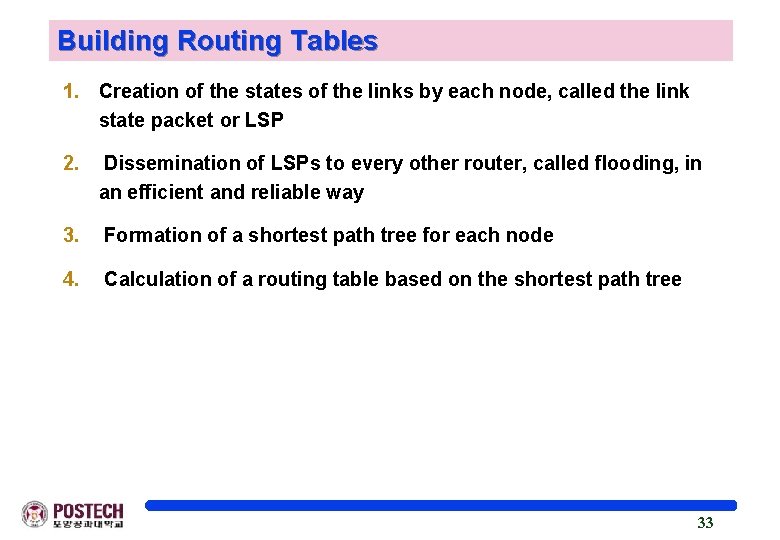
Building Routing Tables 1. Creation of the states of the links by each node, called the link state packet or LSP 2. Dissemination of LSPs to every other router, called flooding, in an efficient and reliable way 3. Formation of a shortest path tree for each node 4. Calculation of a routing table based on the shortest path tree 33
Creation of LSP o When there is a change in the topology of the domain o On a periodic basis 60 minutes or 2 hours 34
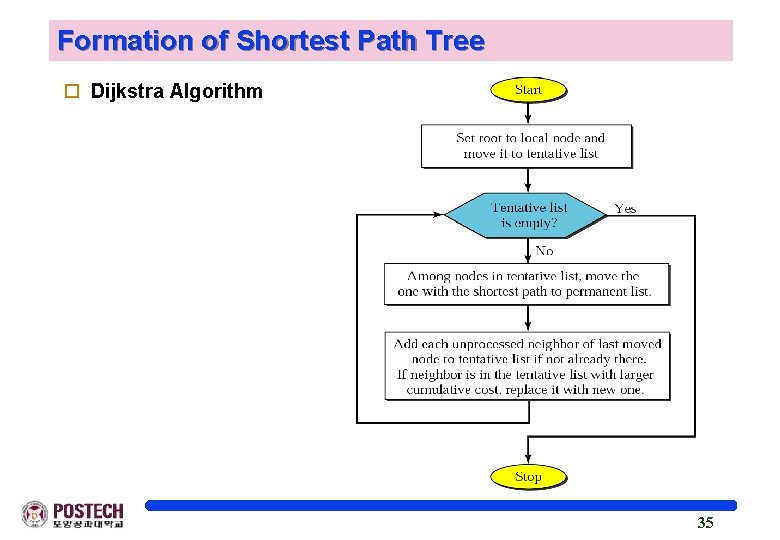
Formation of Shortest Path Tree o Dijkstra Algorithm 35
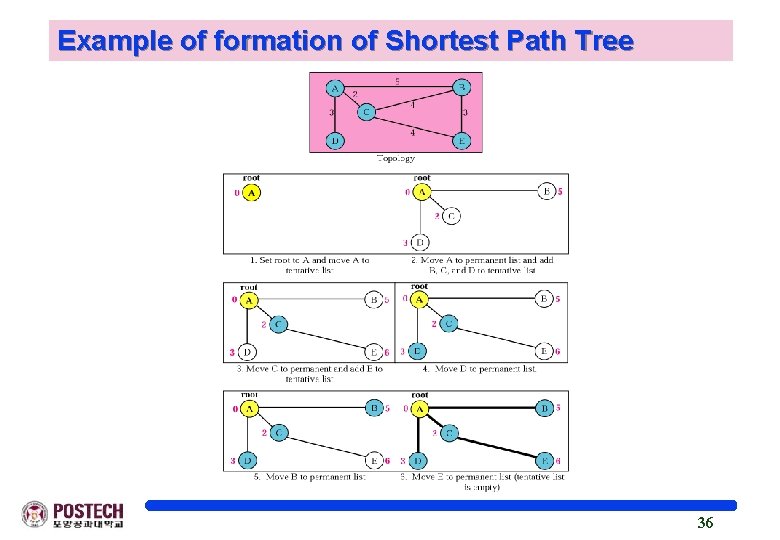
Example of formation of Shortest Path Tree 36
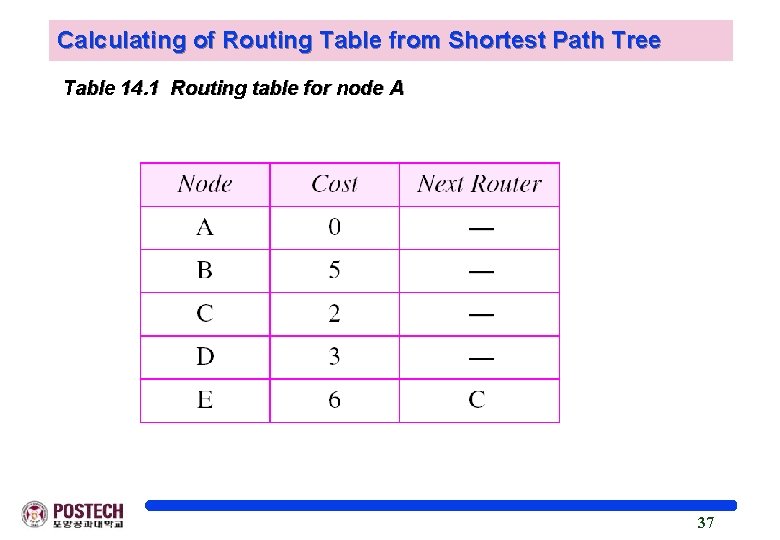
Calculating of Routing Table from Shortest Path Tree Table 14. 1 Routing table for node A 37
14. 5 OSPF (Open Shortest Path First) o The Open Shortest Path First (OSPF) protocol is an intradomain routing protocol based on link state routing. Its domain is also an autonomous system o Dividing an AS into areas to handle routing efficiently and in a timely manner 38
OSPF (cont’d) o Areas Is a collection of networks, hosts, and routers in AS AS can be divided into many different areas. All networks inside an area must be connected. Routers inside an area flood the area with routing information. o Area Border Router Summarizes the information about the area and sends it to other areas o Backbone All of the areas inside an AS must be connected to the backbone Serving as a primary area Consisting of backbone routers Back bone routers can be an area border router 39
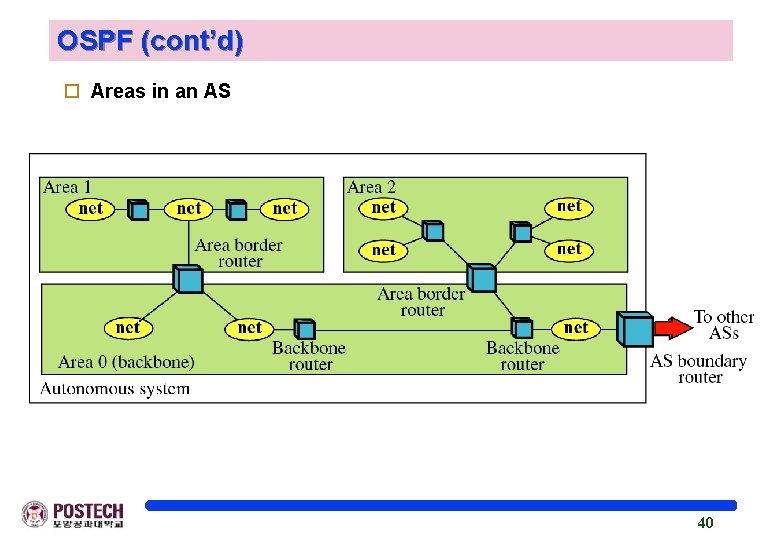
OSPF (cont’d) o Areas in an AS 40
OSPF (cont’d) o Metric OSPF protocol allows the administrator to assign a cost, called the metric, to each route Based on a type of service (minimum delay, maximum throughput, and so on) A router can have multiple routing tables, each based on a different type of service. o Link State Routing OSPF uses Link State Routing to update the routing tables in an area Each router shares its knowledge about its neighborhood with every router in the area. 41
OSPF (cont’d) 1. Sharing knowledge about the neighborhood 2. Sharing with every other router by flooding 3. Sharing when there is a change cf. Distance Vector Routing : sending the information at regular intervals regardless of change o So, every router can calculate the shortest path between itself and each network 42
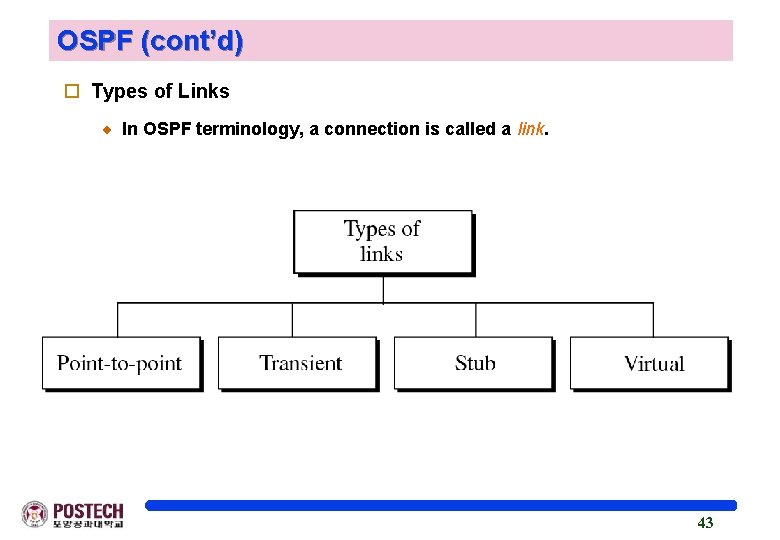
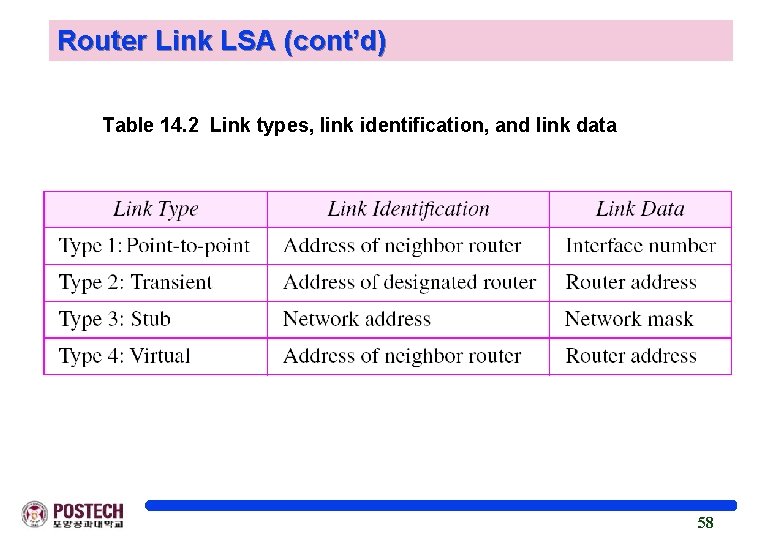
OSPF (cont’d) o Types of Links In OSPF terminology, a connection is called a link. 43
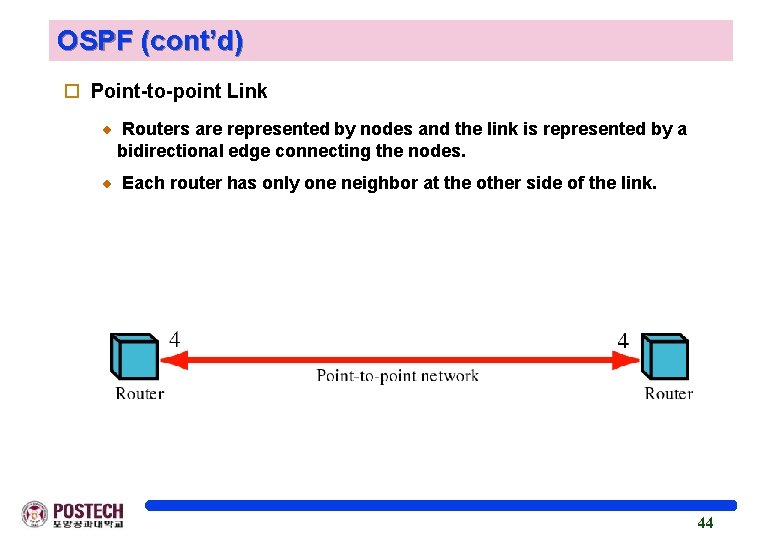
OSPF (cont’d) o Point-to-point Link Routers are represented by nodes and the link is represented by a bidirectional edge connecting the nodes. Each router has only one neighbor at the other side of the link. 44
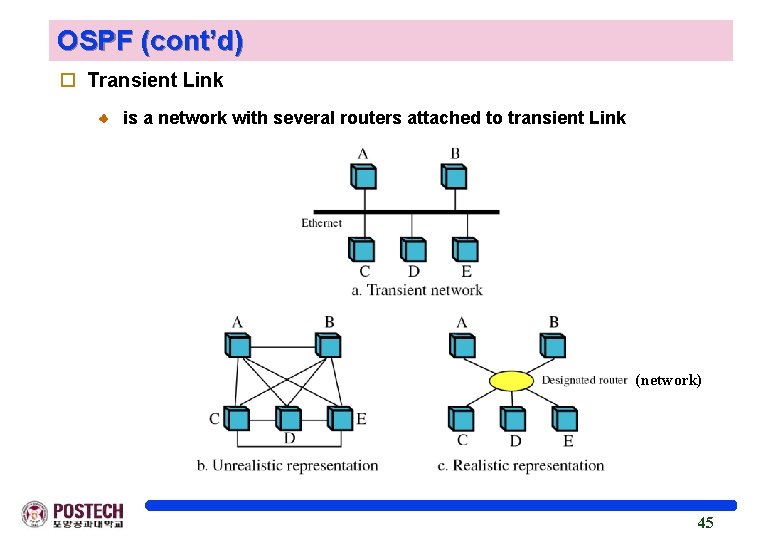
OSPF (cont’d) o Transient Link is a network with several routers attached to transient Link (network) 45
OSPF (cont’d) o In “C”, each router has only one neighbor, the designated router (network) The designated router has five neighbors. Number of neighbor announcements is reduced from 20 to 10 There is no metric from the designated router to any other node. l Because the designated router represents the network. 46
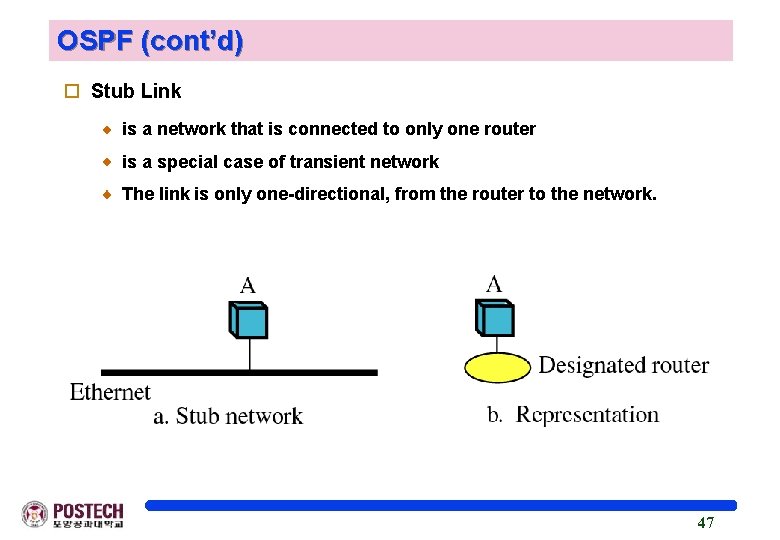
OSPF (cont’d) o Stub Link is a network that is connected to only one router is a special case of transient network The link is only one-directional, from the router to the network. 47
OSPF (cont’d) o Virtual Link When the link between two routers is broken, the administration may create a virtual link between them using a longer path o Graphical Representation An internet with 7 networks and 6 routers 48
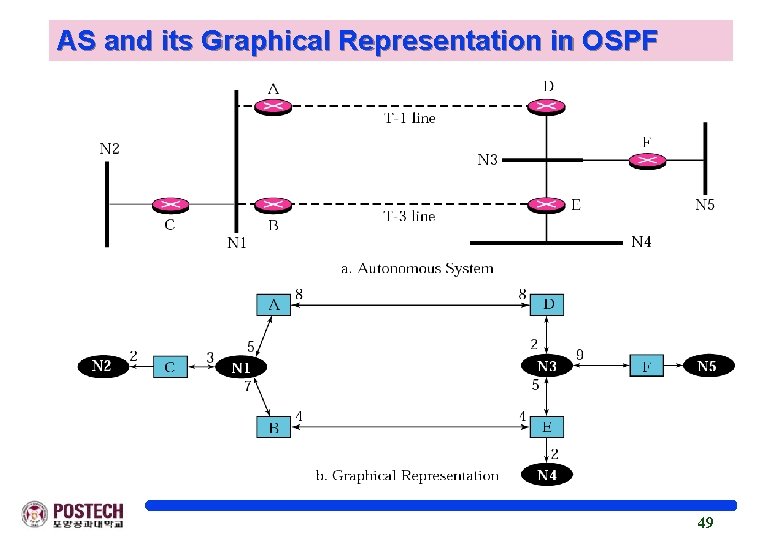
AS and its Graphical Representation in OSPF 49
AS and its Graphical Representation in OSPF o Graphical Representation (cont’d) N 1 : transient, N 2 : Stub using square nodes for the routers and ovals for the networks 50
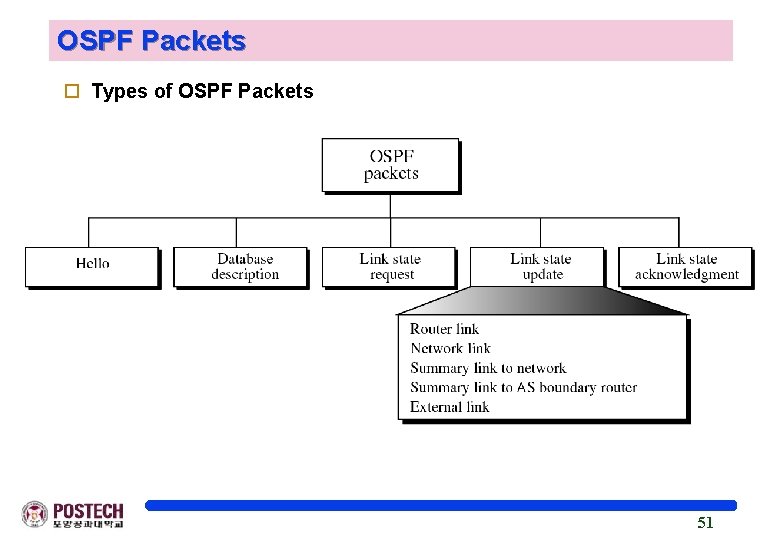
OSPF Packets o Types of OSPF Packets 51
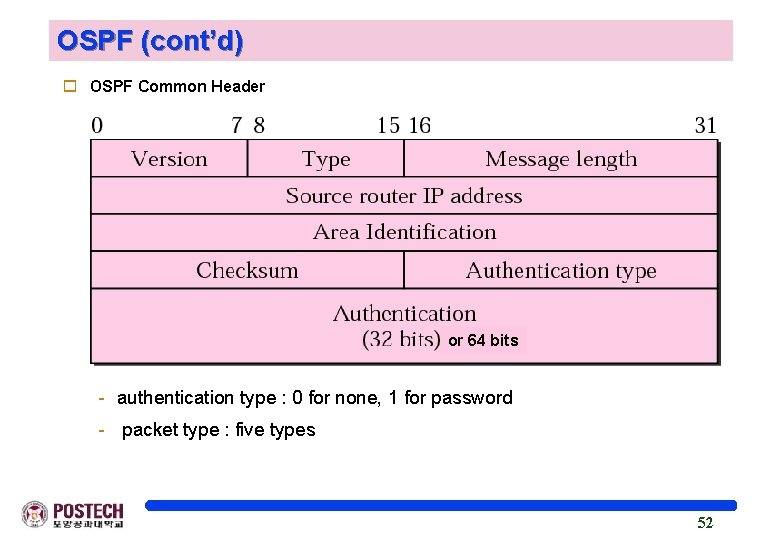
OSPF (cont’d) o OSPF Common Header or 64 bits - authentication type : 0 for none, 1 for password - packet type : five types 52
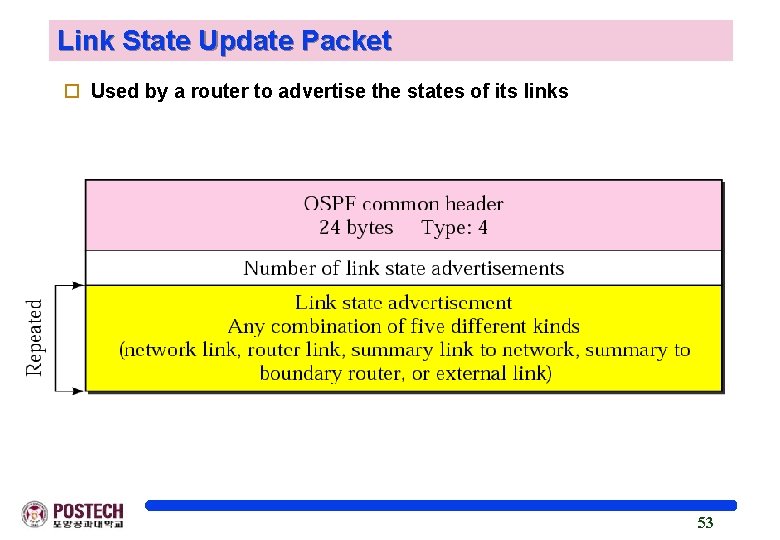
Link State Update Packet o Used by a router to advertise the states of its links 53
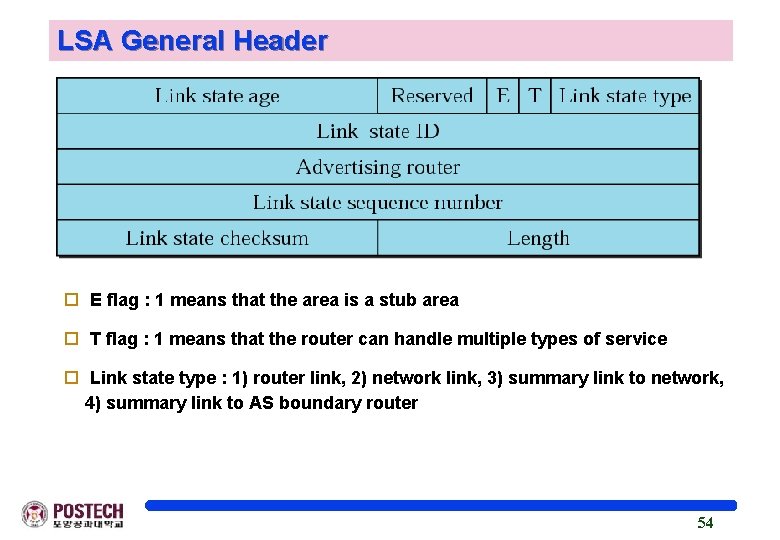
LSA General Header o E flag : 1 means that the area is a stub area o T flag : 1 means that the router can handle multiple types of service o Link state type : 1) router link, 2) network link, 3) summary link to network, 4) summary link to AS boundary router 54
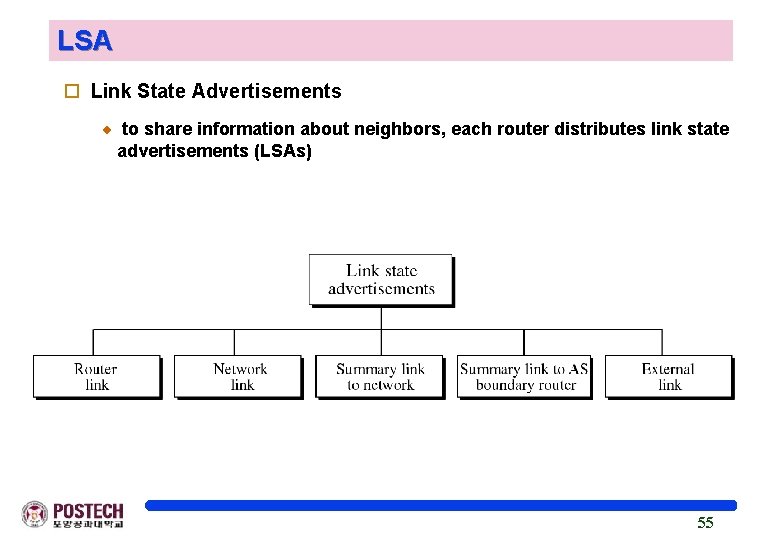
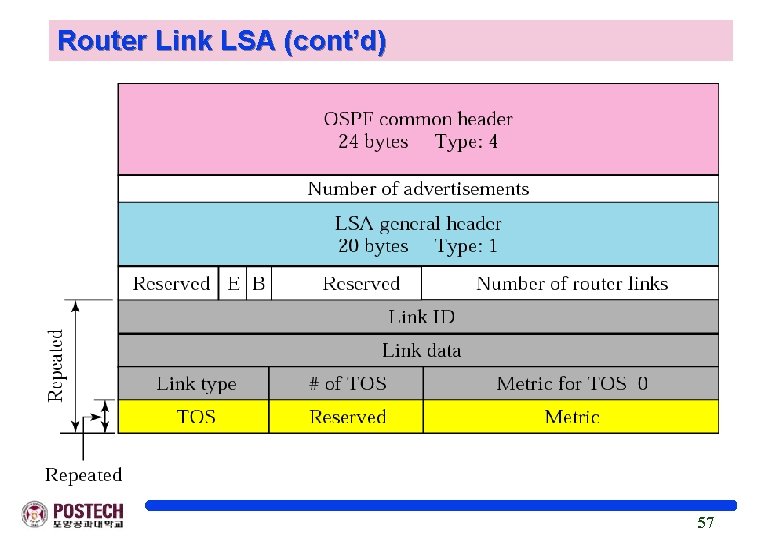
LSA o Link State Advertisements to share information about neighbors, each router distributes link state advertisements (LSAs) 55
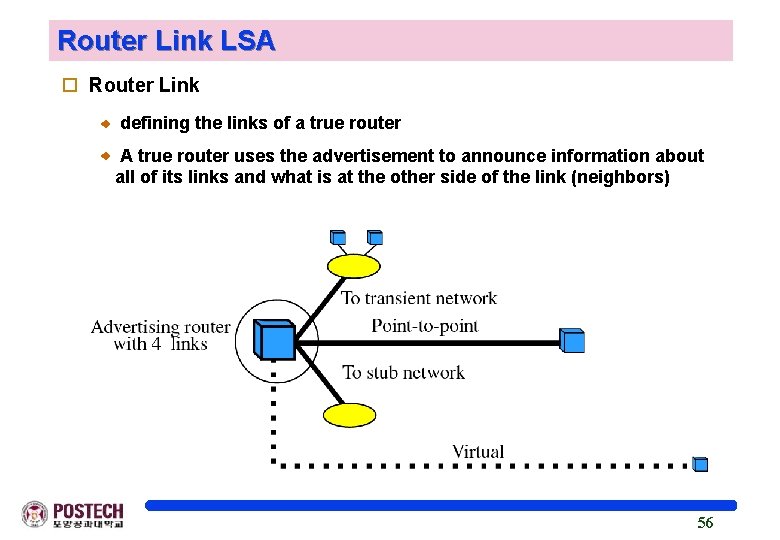
Router Link LSA o Router Link defining the links of a true router A true router uses the advertisement to announce information about all of its links and what is at the other side of the link (neighbors) 56
Router Link LSA (cont’d) 57
Router Link LSA (cont’d) Table 14. 2 Link types, link identification, and link data 58
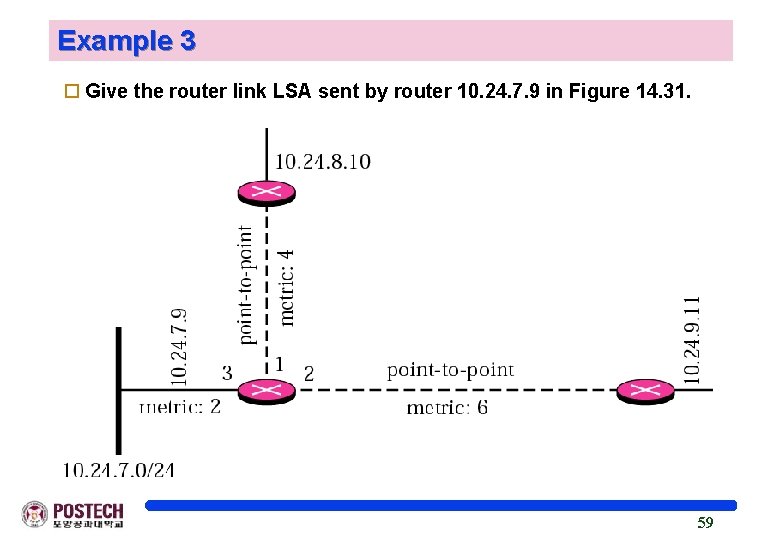
Example 3 o Give the router link LSA sent by router 10. 24. 7. 9 in Figure 14. 31. 59
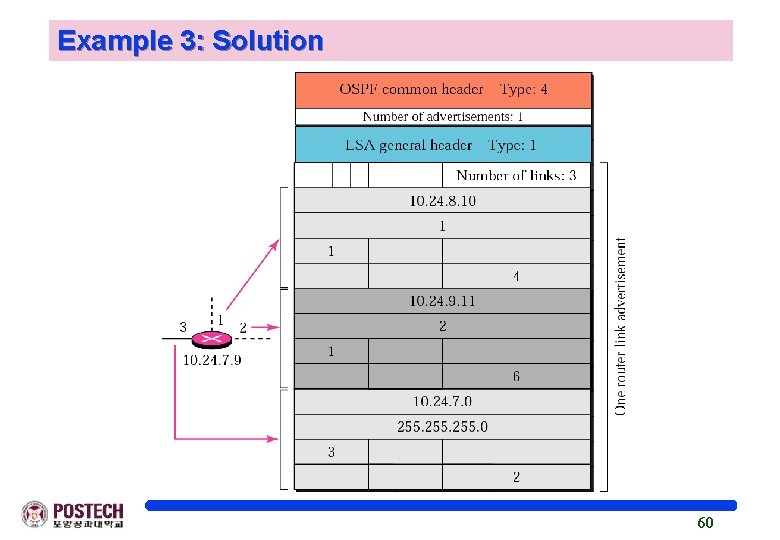
Example 3: Solution 60
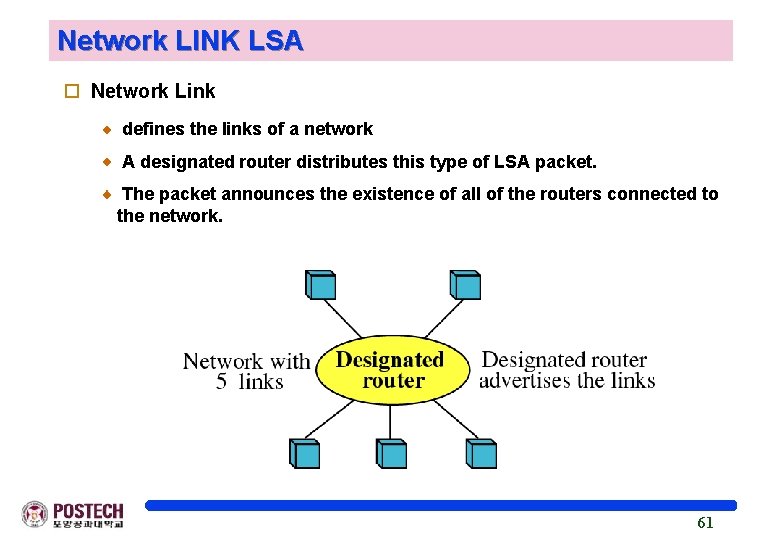
Network LINK LSA o Network Link defines the links of a network A designated router distributes this type of LSA packet. The packet announces the existence of all of the routers connected to the network. 61
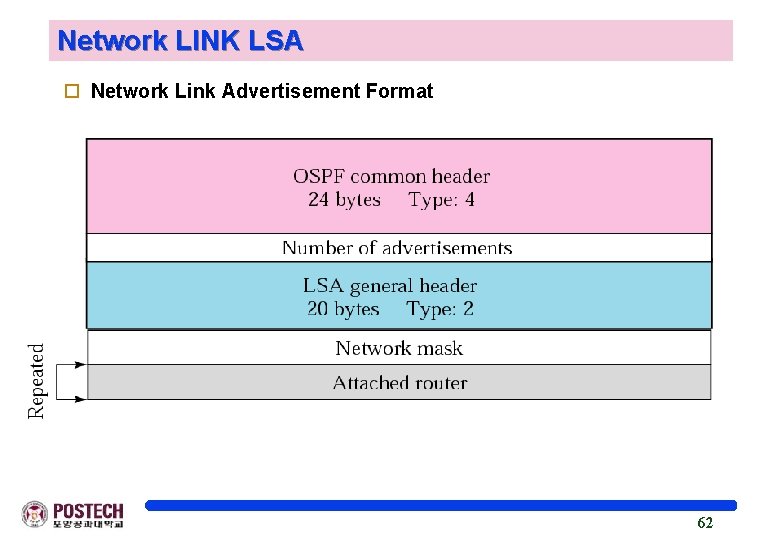
Network LINK LSA o Network Link Advertisement Format 62
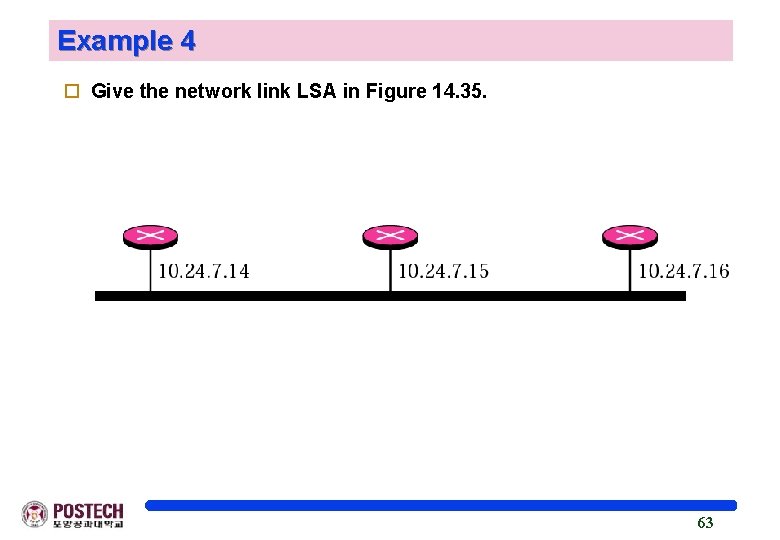
Example 4 o Give the network link LSA in Figure 14. 35. 63
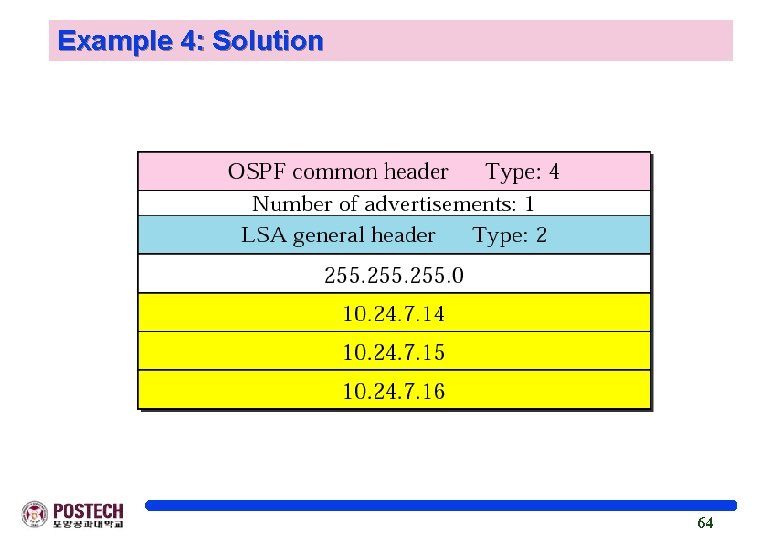
Example 4: Solution 64
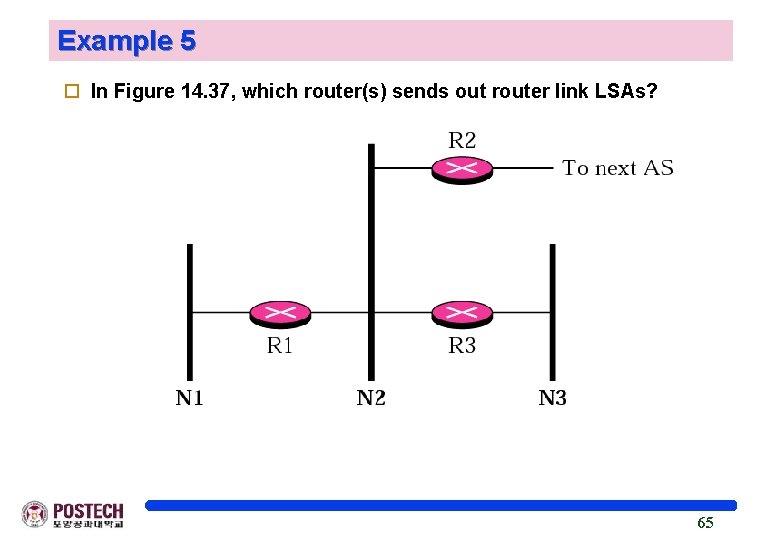
Example 5 o In Figure 14. 37, which router(s) sends out router link LSAs? 65
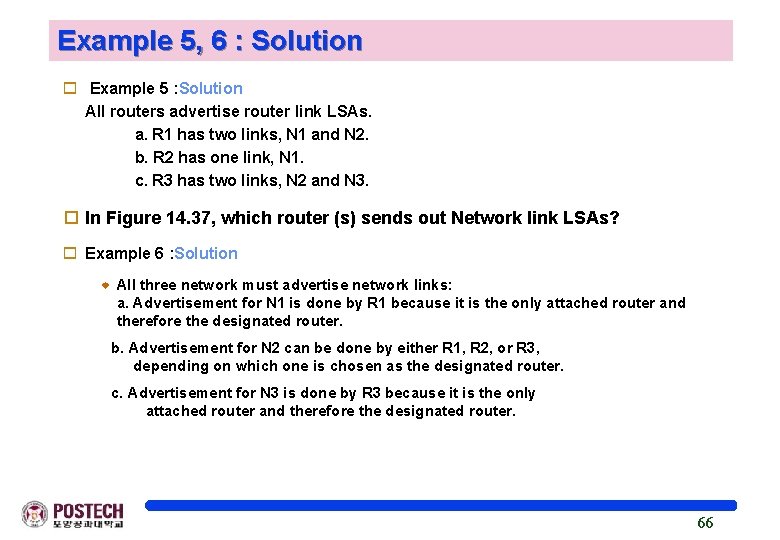
Example 5, 6 : Solution o Example 5 : Solution All routers advertise router link LSAs. a. R 1 has two links, N 1 and N 2. b. R 2 has one link, N 1. c. R 3 has two links, N 2 and N 3. o In Figure 14. 37, which router (s) sends out Network link LSAs? o Example 6 : Solution All three network must advertise network links: a. Advertisement for N 1 is done by R 1 because it is the only attached router and therefore the designated router. b. Advertisement for N 2 can be done by either R 1, R 2, or R 3, depending on which one is chosen as the designated router. c. Advertisement for N 3 is done by R 3 because it is the only attached router and therefore the designated router. 66
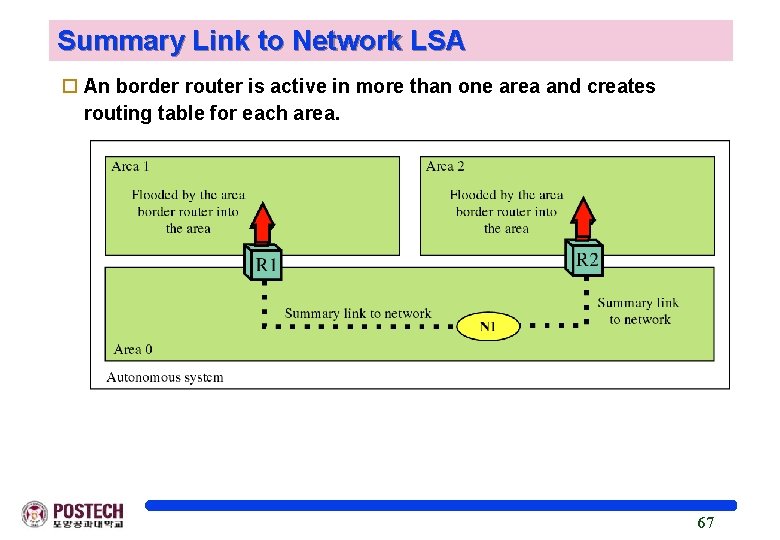
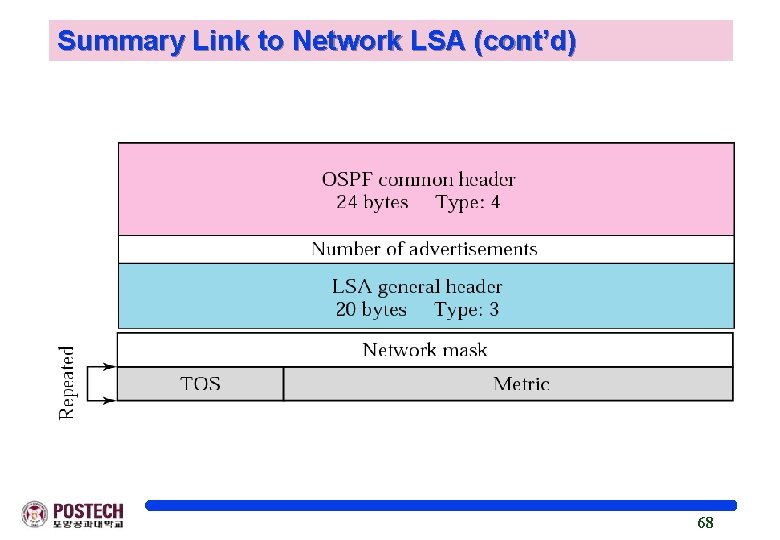
Summary Link to Network LSA o An border router is active in more than one area and creates routing table for each area. Router R 1 floods area 1 with information about how to reach a network located in area 0. 67
Summary Link to Network LSA (cont’d) 68
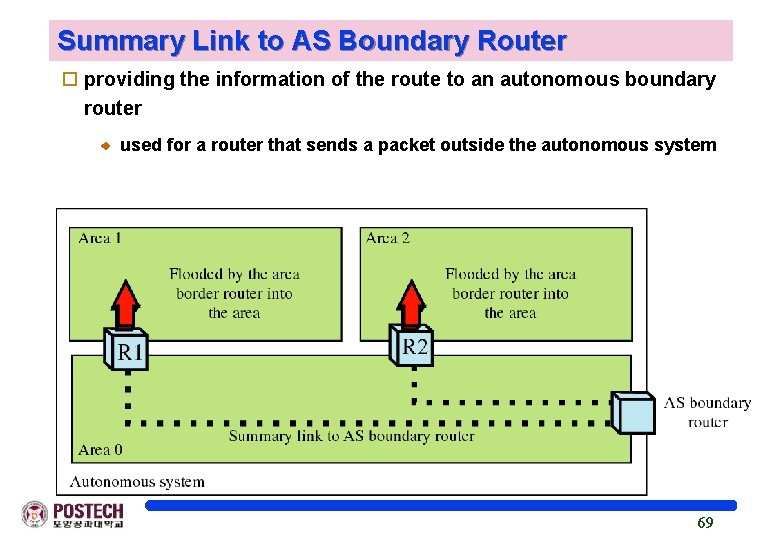
Summary Link to AS Boundary Router o providing the information of the route to an autonomous boundary router used for a router that sends a packet outside the autonomous system 69
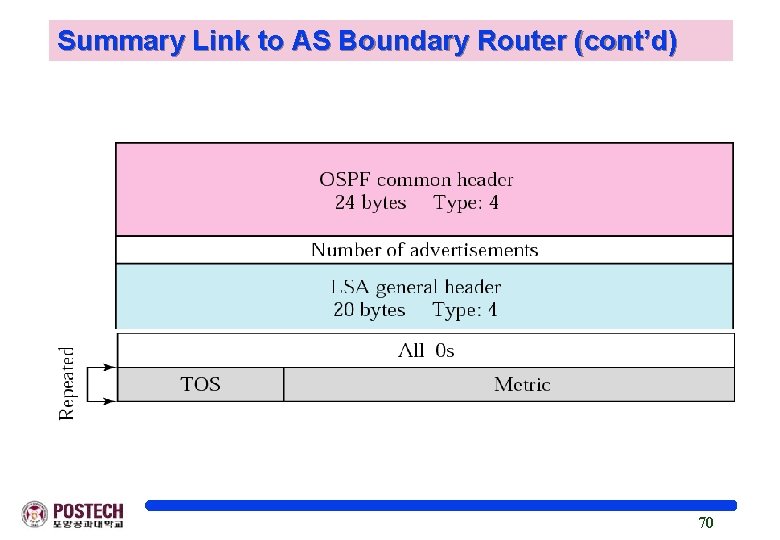
Summary Link to AS Boundary Router (cont’d) 70
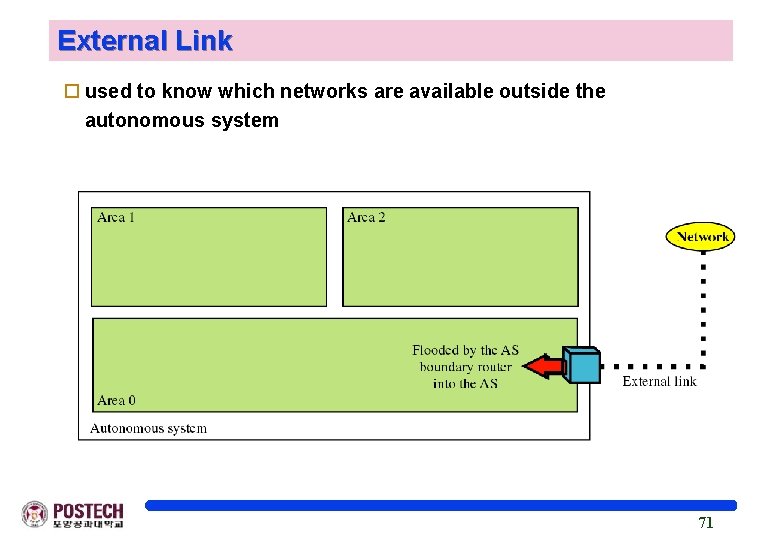
External Link o used to know which networks are available outside the autonomous system 71
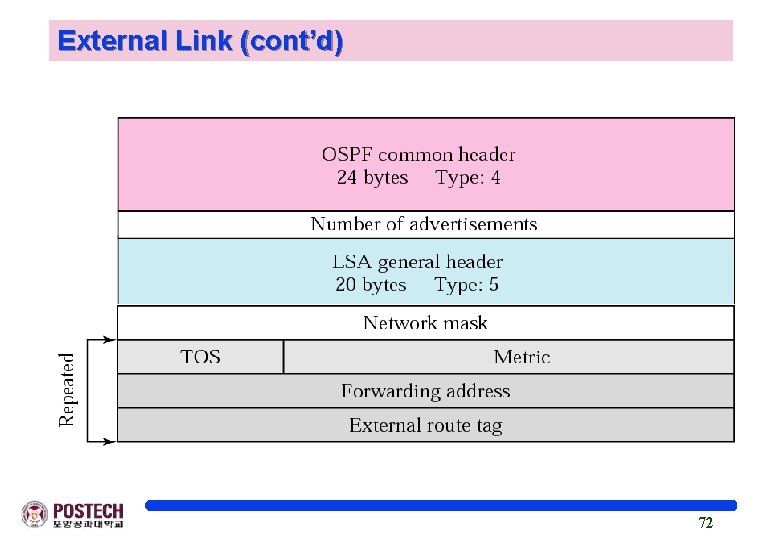
External Link (cont’d) 72
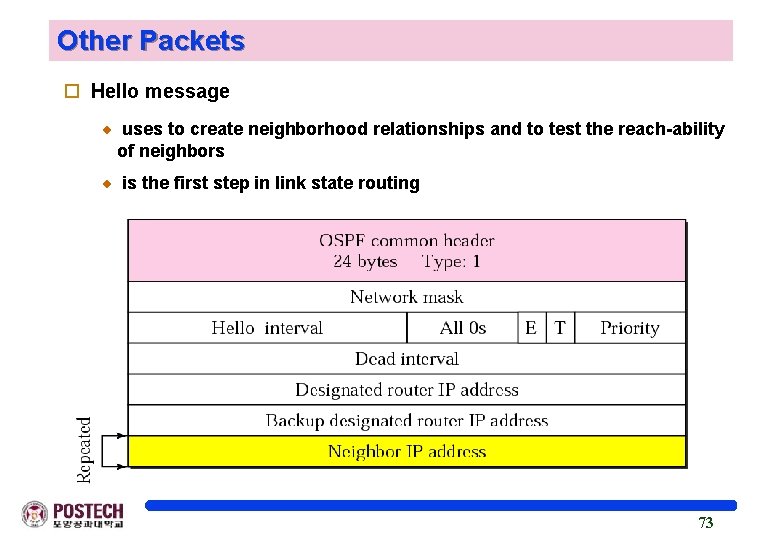
Other Packets o Hello message uses to create neighborhood relationships and to test the reach-ability of neighbors is the first step in link state routing 73
Other Packets (cont’d) o Database description message When router is connected to the system for the first time or after a failure, it needs the complete link state database immediately used when a router is connected to the system for the first time or after a failure l l l After a router is connected to the system, the router sends hello packets to greet its neighbor. If it is first time that neighbors hear from the router, they send a database description packet. – The packet does not contain complete database information Then, the router sends one or more link state request packets to get full information about that particular link o Link State Request Packet Is sent by a router that needs information about a specific route or routes It is answered with a link state update packet. 74
Other Packets (cont’d) o Link state acknowledgment packet OSPF makes routing more reliable by forcing every router to acknowledge the receipt of every link state update packet. o Link State Update Packet used by a router to advertise the states of its links 75
Encapsulation of OSPF Packets o Encapsulation OSPF packets are encapsulated in IP datagram l l These packets contain the acknowledgment mechanism for flow and error control Do not need a transport layer protocol to provide these services 76
14. 6 Path Vector Routing o is similar to distance vector routing o Assuming that there is one node in each AS that acts as on behalf of the entire AS: Speaker Node o Speaker node creates a routing table and advertises it speaker nodes in the neighboring ASs advertising the path, not the metric of the nodes 77
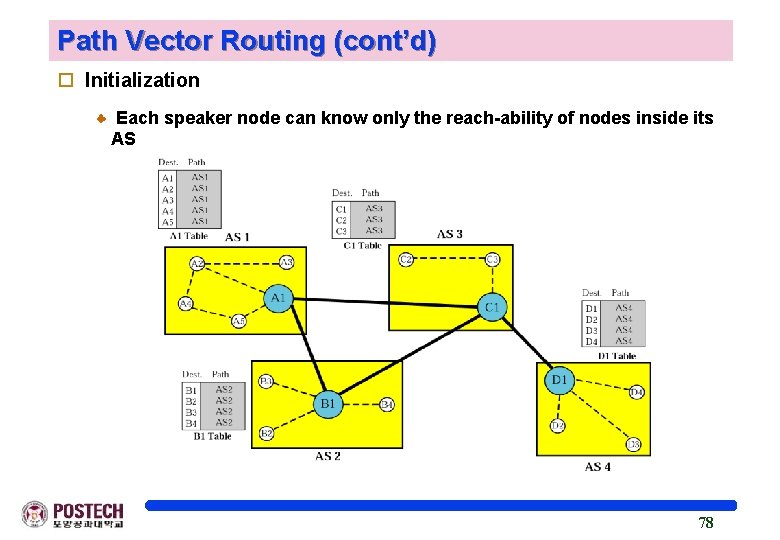
Path Vector Routing (cont’d) o Initialization Each speaker node can know only the reach-ability of nodes inside its AS 78
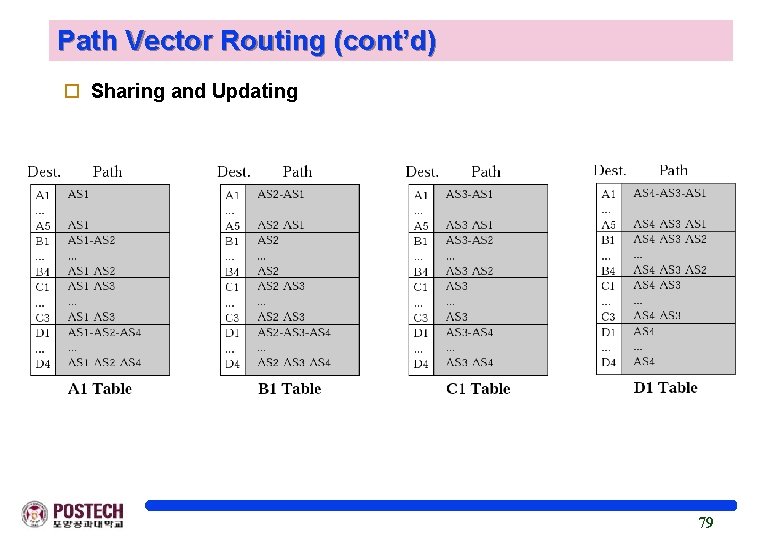
Path Vector Routing (cont’d) o Sharing and Updating 79
14. 7 BGP o Border Gateway Protocol is an interdomain routing protocol using path vector routing o Distance vector routing and link state routing distance vector routing : just considering the number of hops link state routing : requiring each router to have a huge link state database o Path Vector Routing Each entry in the routing table contains the destination network, the next router, and the path to reach the destination The path is usually defined as an ordered list of autonomous systems that a packet should travel through to reach the destination 80
BGP (cont’d) o Stub AS has only one connection to another AS o Multihomed AS has more than one connection to other AS o Transit AS is a multihomed AS that also allows transient traffic. l ex) national and international ISPs 81
BGP (cont’d) o Path attributes Well-known attributes l l well-known mandatory : ORIGIN (RIP, OSPF, and so on), AS-PATH, NEXT_HOP well-known discretionary Optional attributes l l Optional transitive : must be passed to the next router by the router has not implemented this attribute Optional nontransitive : must be discarded if the receiving router has not implemented this attribute 82
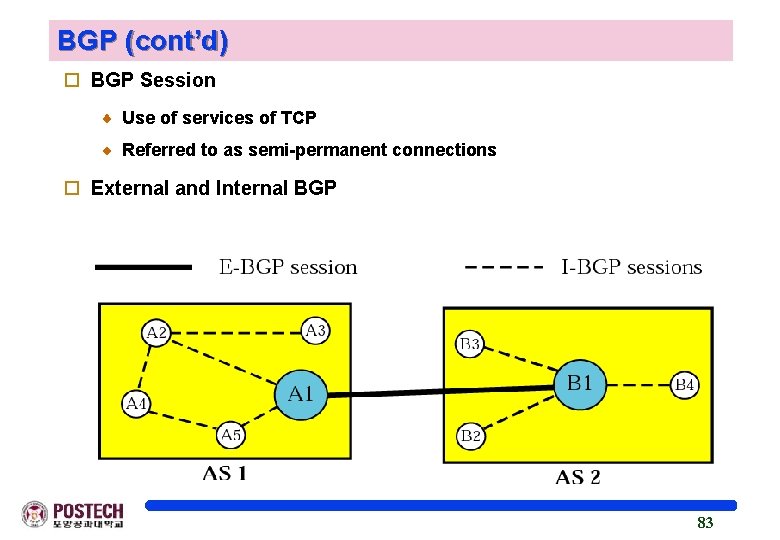
BGP (cont’d) o BGP Session Use of services of TCP Referred to as semi-permanent connections o External and Internal BGP 83
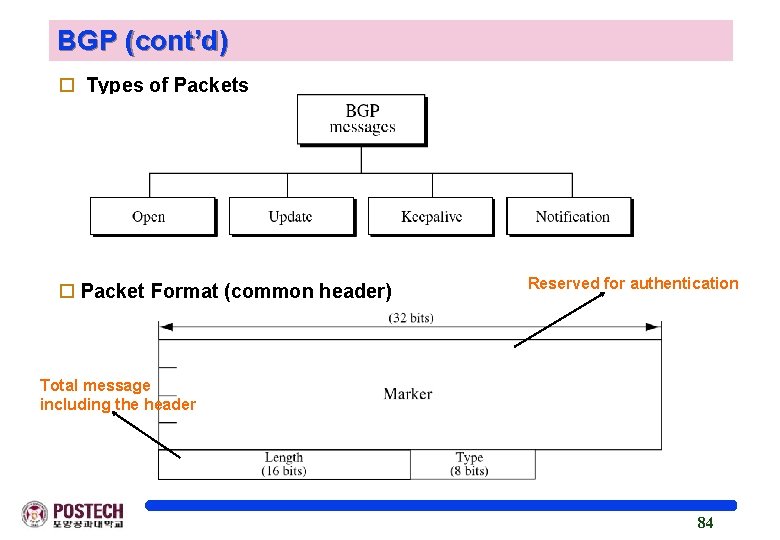
BGP (cont’d) o Types of Packets o Packet Format (common header) Reserved for authentication Total message including the header 84
BGP (cont’d) o Open message To create a neighborhood relationship, a router running BGP opens a TCP connection with a neighbor and sends an open message o Update message used by a router to withdraw destinations that have been advertised previously, announce a route to a new destination, or both o Keepalive message exchange keepalive messages regularly (before their hold time expires) to tell each other that routers are alive o Notification message sent by a router whenever an error condition is detected or a router wants to close the connection 85
BGP (cont’d) o Encapsulation BGP messages are encapsulated in TCP segments using the wellknown port 179 86
- Slides: 86