
Chapter 14 Review Light 1 List the parts






- Slides: 54
Chapter 14 Review Light
1. List the parts of the visible spectrum. Rank them by frequency, wavelength, and energy.
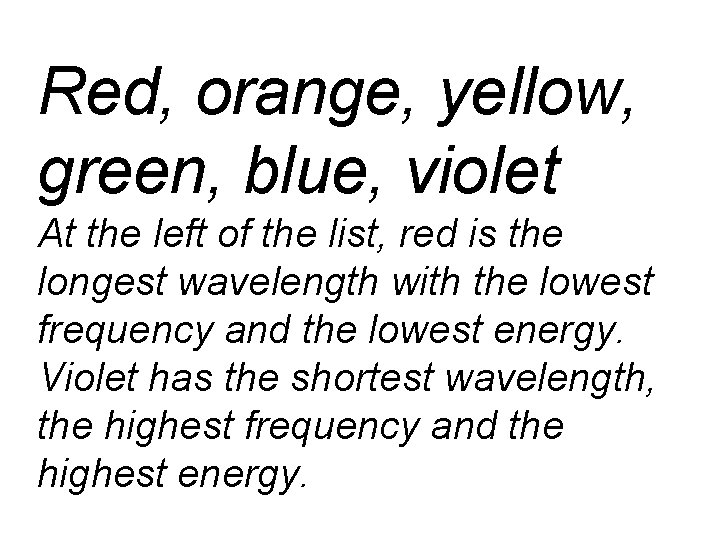
Red, orange, yellow, green, blue, violet At the left of the list, red is the longest wavelength with the lowest frequency and the lowest energy. Violet has the shortest wavelength, the highest frequency and the highest energy.
2. List the parts of the invisible spectrum. Rank them by frequency, wavelength, and energy.
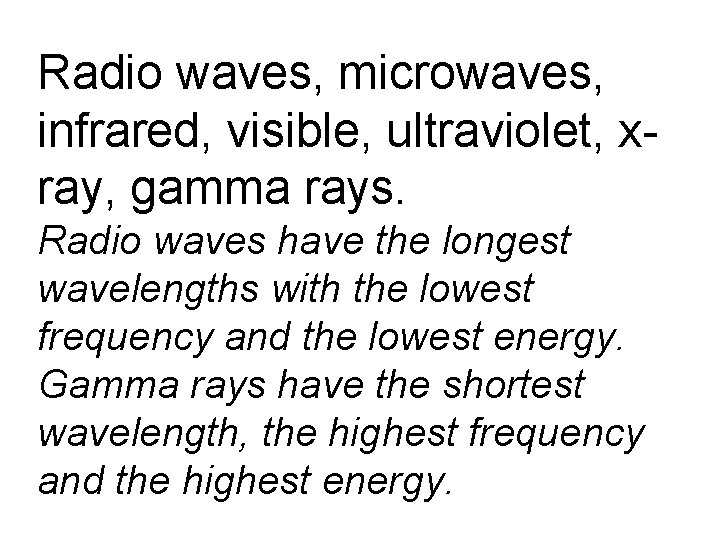
Radio waves, microwaves, infrared, visible, ultraviolet, xray, gamma rays. Radio waves have the longest wavelengths with the lowest frequency and the lowest energy. Gamma rays have the shortest wavelength, the highest frequency and the highest energy.
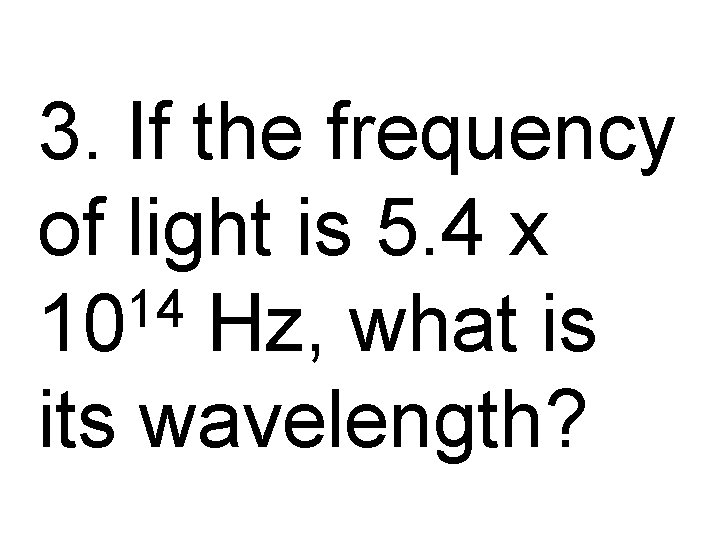
3. If the frequency of light is 5. 4 x 14 10 Hz, what is its wavelength?
c = fλ 8 14 3 x 10 = 5. 4 x 10 λ -7 λ = 5. 56 x 10
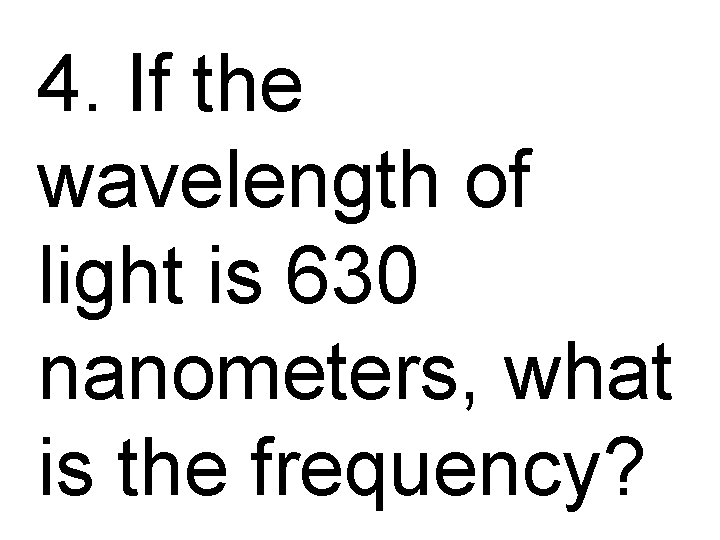
4. If the wavelength of light is 630 nanometers, what is the frequency?
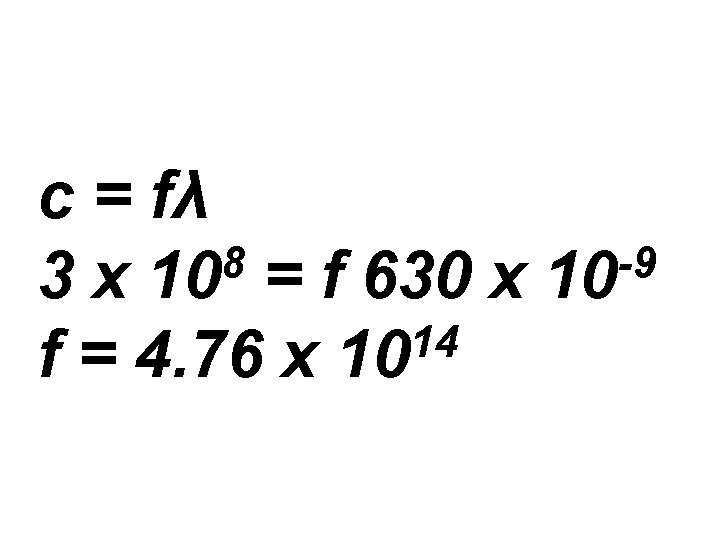
c = fλ 8 -9 3 x 10 = f 630 x 10 14 f = 4. 76 x 10
5. How does the wavelength of the light affect the speed of light in a vacuum?
It doesn’t.
6. If you move twice as far way from a light reading lamp, by what factor does the brightness change? If you move three times as far away? If you move four times as far away?
Inverse square law. Doubling the distance decreases the intensity by a factor of four. Tripling decreases it by a factor of nine. Quadrupling decreases it by a factor of sixteen.
7. If a ray is incident on a mirror at an angle of 33° to the normal, at what angle is it reflected?
33°, law of reflection.
8. Describe the image formed by a flat mirror.
Virtual, upright, same size.
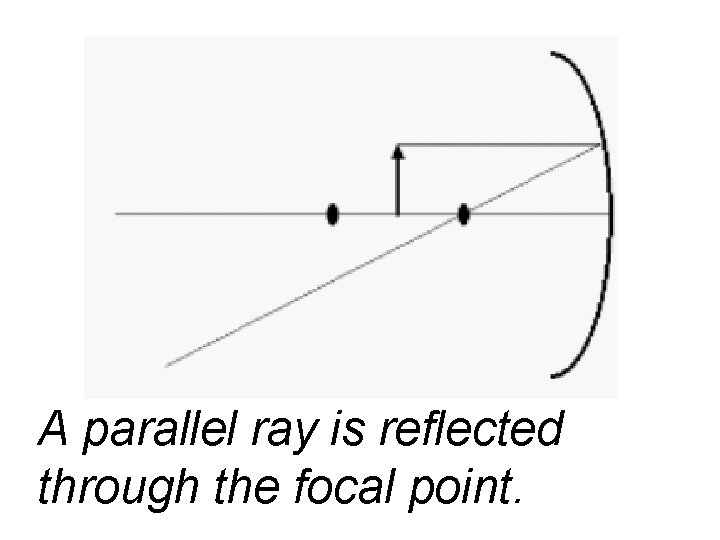
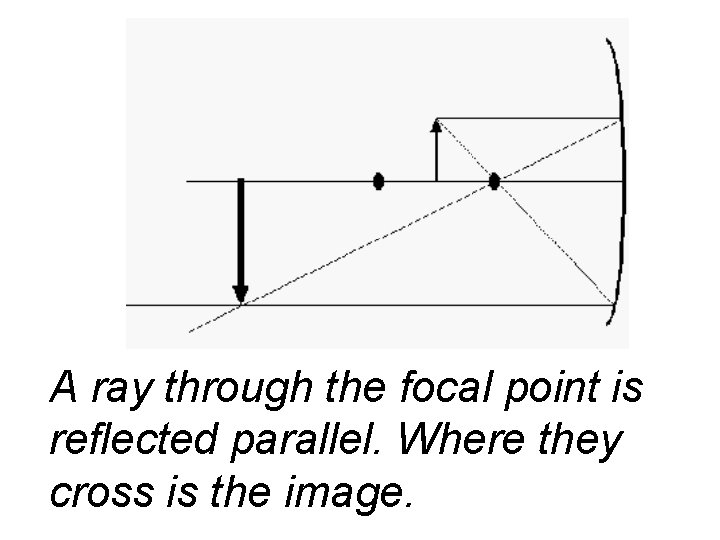
9. A concave mirror has a focal length of 12 cm. If an object is placed 18 cm from the mirror, where is the image formed? What is the image’s type and orientation? What is the magnification? If the image is 2 cm tall, how big is the image? Draw a ray diagram of this situation.
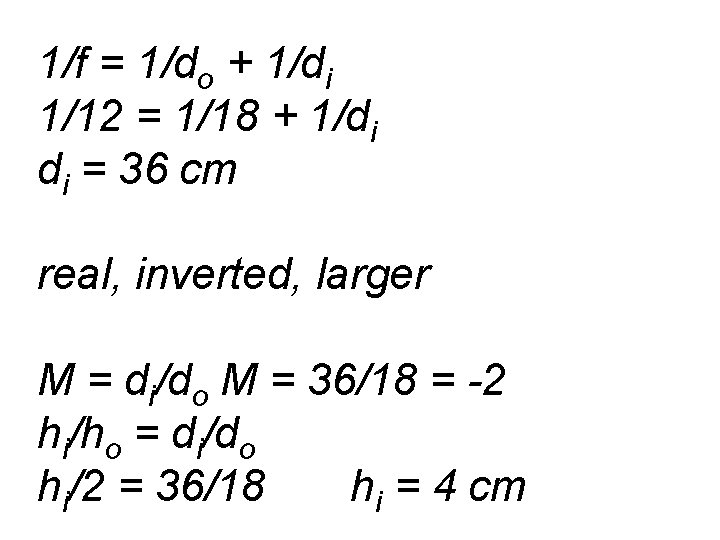
1/f = 1/do + 1/di 1/12 = 1/18 + 1/di di = 36 cm real, inverted, larger M = di/do M = 36/18 = -2 hi/ho = di/do hi/2 = 36/18 hi = 4 cm
A parallel ray is reflected through the focal point.
A ray through the focal point is reflected parallel. Where they cross is the image.
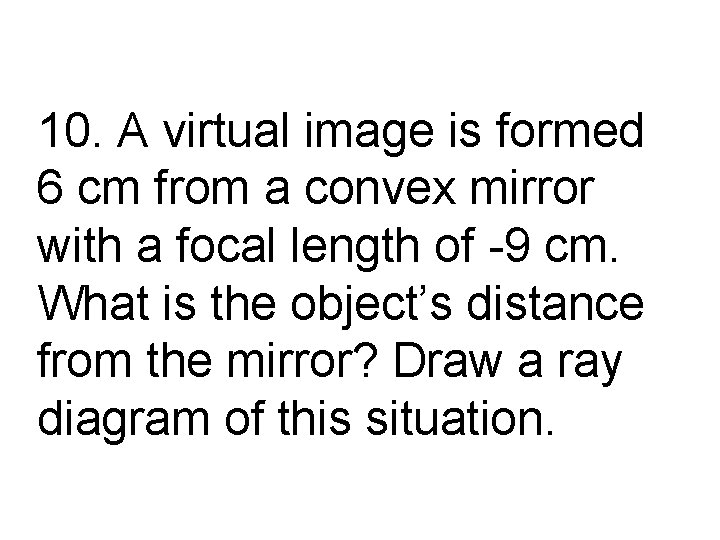
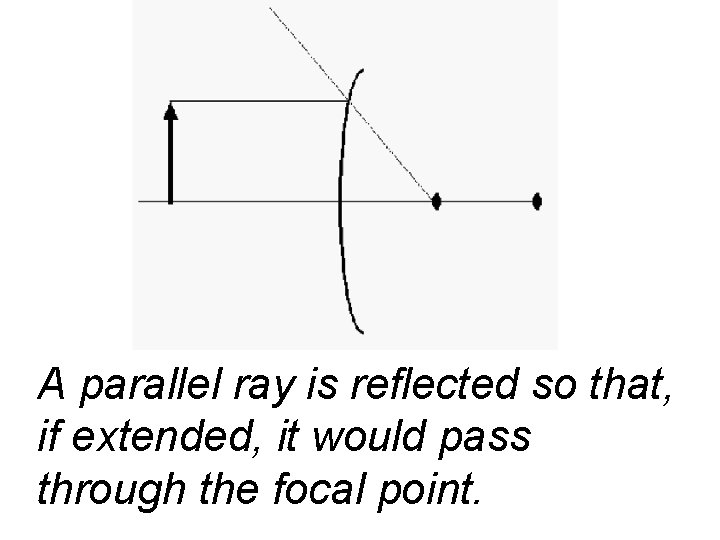
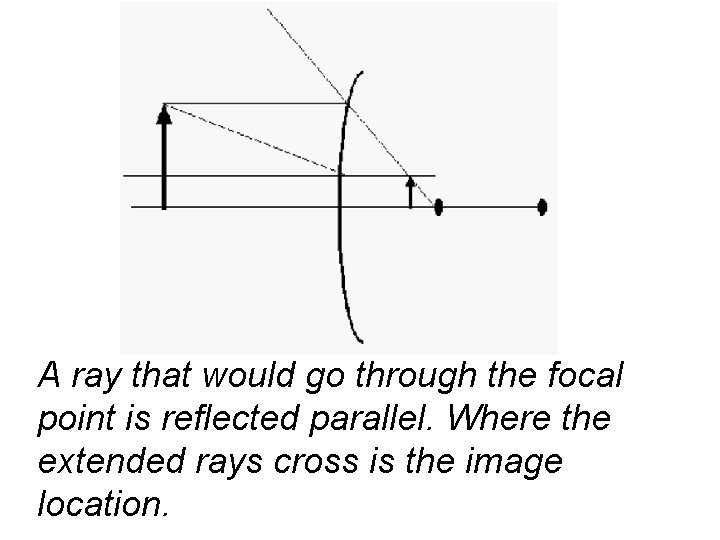
10. A virtual image is formed 6 cm from a convex mirror with a focal length of -9 cm. What is the object’s distance from the mirror? Draw a ray diagram of this situation.
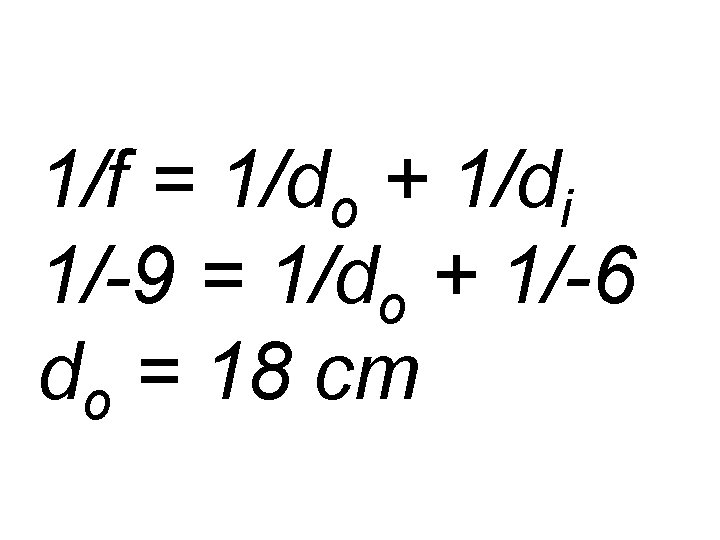
1/f = 1/do + 1/di 1/-9 = 1/do + 1/-6 do = 18 cm
A parallel ray is reflected so that, if extended, it would pass through the focal point.
A ray that would go through the focal point is reflected parallel. Where the extended rays cross is the image location.
11. In the diagram above, describe the image formed by object A. Object B.
Object A: real, inverted, smaller. Object B: virtual, upright, larger
12. In the diagram above, describe the image formed by object A. Object B.
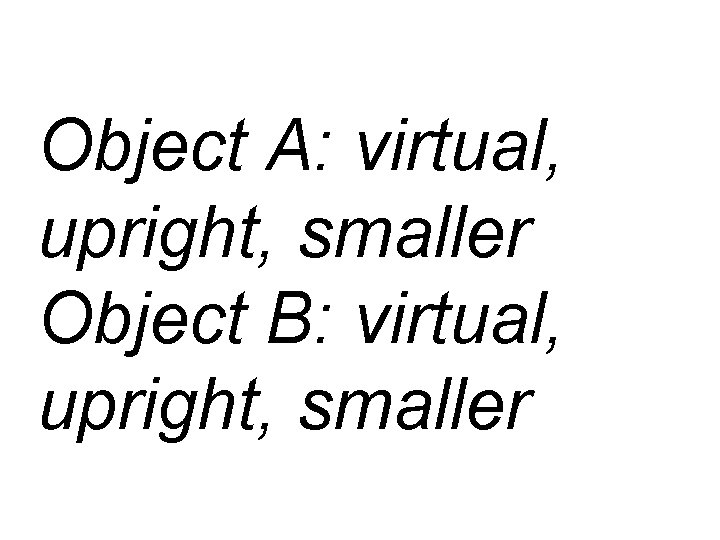
Object A: virtual, upright, smaller Object B: virtual, upright, smaller
13. Describe the image formed by a concave mirror when the object is placed between infinity and the center of curvature.
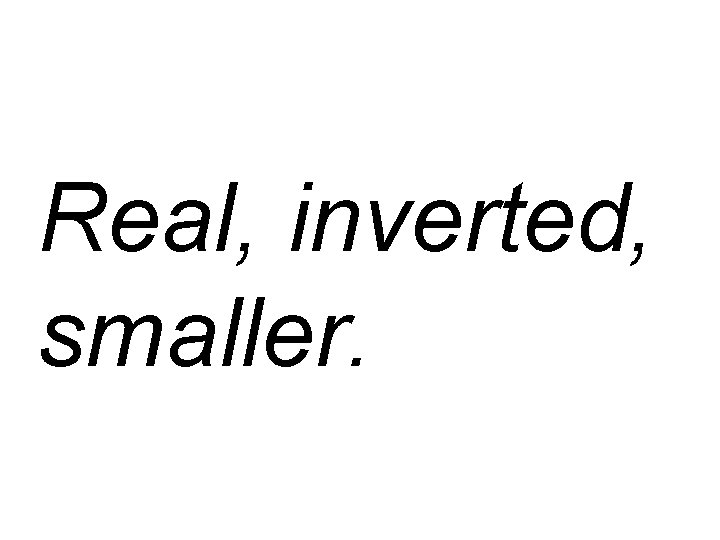
Real, inverted, smaller.
14. Describe the image formed by a concave mirror when the object is placed between the center of curvature and the focal point.
Real, inverted, larger.
15. Describe the image formed by a concave mirror when the object is placed between the focal point and the mirror.
Virtual, upright, larger.
16. Describe the image formed by a convex mirror when the object is placed between infinity and the center of curvature.
Virtual, upright, smaller.
17. Describe the image formed by a convex mirror when the object is placed between the center of curvature and the focal point.
Virtual, upright, smaller.
18. Describe the image formed by a convex mirror when the object is placed between the focal point and the mirror.
Virtual, upright, smaller.
19. What type of curved mirror is used to reduce spherical aberration?
parabolic
20. What are three primary colors of light? What are the complementary colors to each of these primary colors? What are the primary subtractive colors of pigment?
Red, green, blue. Red and cyan, green and magenta, blue and yellow. Cyan, magenta, and yellow.
21. What two primary colors of light combine to form cyan light? Magenta light? yellow light?
Cyan = blue + green Magenta = blue + red Yellow = green + red
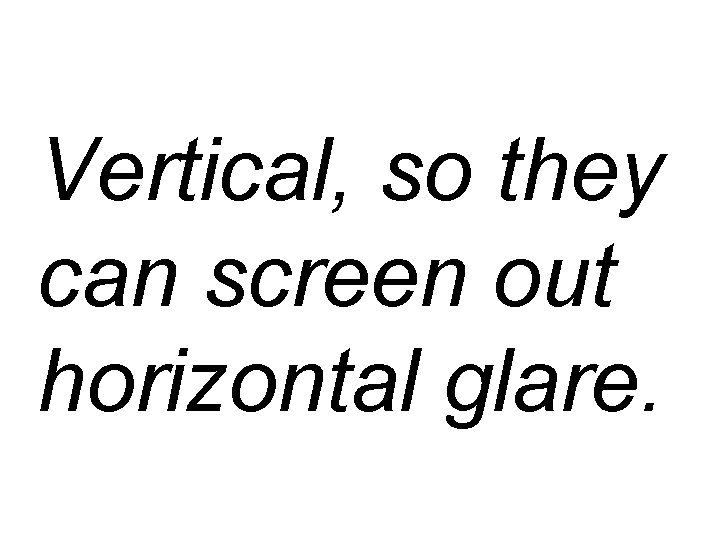
22. What is the angle of polarization of polarized sunglasses? Why?
Vertical, so they can screen out horizontal glare.
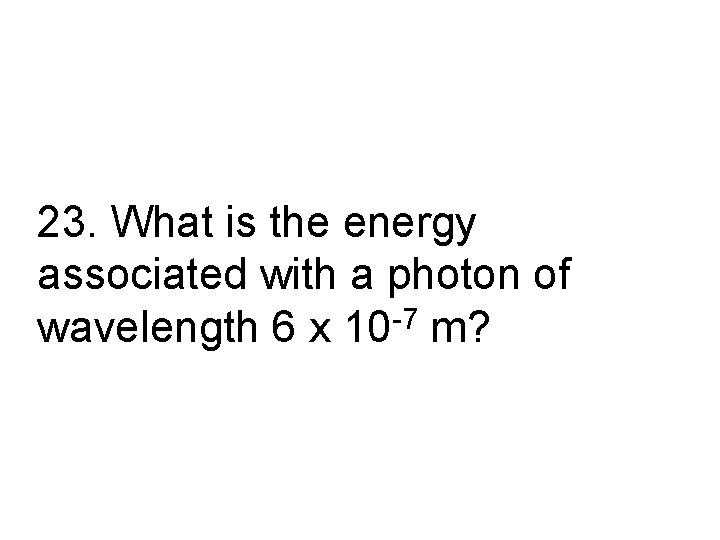
23. What is the energy associated with a photon of wavelength 6 x 10 -7 m?
c = fλ 8 -7 3 x 10 = f 6 x 10 14 f = 5 x 10 E = hf -34 14 E = 6. 63 x 10 x 5 x 10 -19 E = 3. 315 x 10 joules
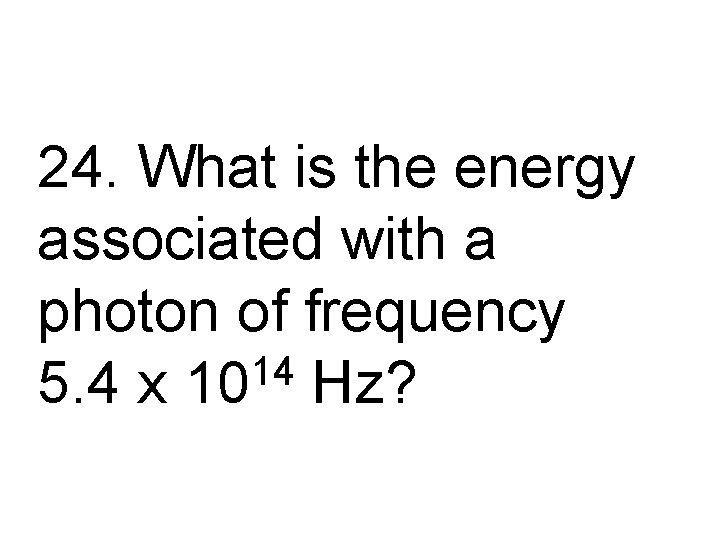
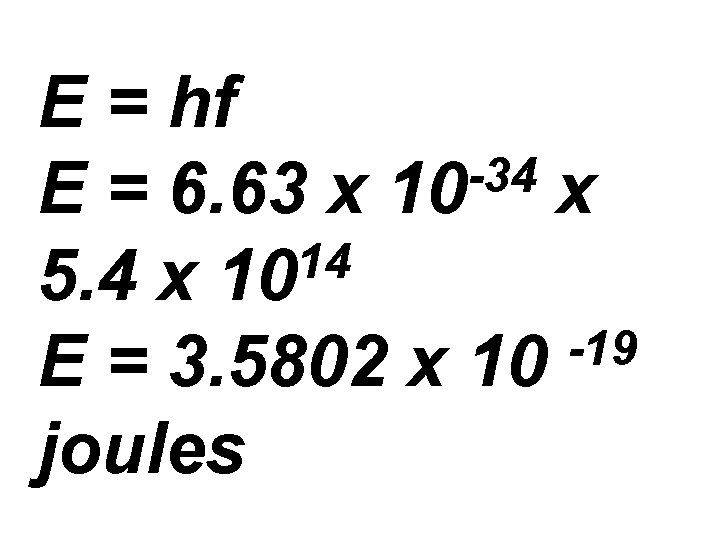
24. What is the energy associated with a photon of frequency 14 5. 4 x 10 Hz?
E = hf -34 E = 6. 63 x 10 x 14 5. 4 x 10 -19 E = 3. 5802 x 10 joules