
Chapter 14 Respiratory Monitoring in the Intensive Care



![Monitoring Tissue Oxygenation (cont’d) _ Oxygen extraction ratio [C(a – v)O 2/Ca. O 2]](https://slidetodoc.com/presentation_image_h/24c0db36c6ced1d871365377f1ab7564/image-47.jpg "Monitoring Tissue Oxygenation (cont’d) _ Oxygen extraction ratio [C(a – v)O 2/Ca. O 2]")
- Slides: 49
Chapter 14 Respiratory Monitoring in the Intensive Care Unit Mosby items and derived items © 2010 by Mosby, Inc. , an affiliate of Elsevier Inc. 1
Learning Objectives After reading this chapter you will be able to: Identify the methods, normal values, and significance of measuring the following lung volumes in the ICU: tidal volume, rapid-shallow breathing index, vital capacity, functional residual capacity Mosby items and derived items © 2010 by Mosby, Inc. , an affiliate of Elsevier Inc. 2
Learning Objectives (cont’d) Identify the methods, normal values, and significance of measuring the following airway pressures or related indices in the ICU: peak pressure, plateau pressure, compliance, airway resistance, mean airway pressure, maximum inspiratory pressure List the definition, methods of detection, and methods of minimizing auto-PEEP Mosby items and derived items © 2010 by Mosby, Inc. , an affiliate of Elsevier Inc. 3
Learning Objectives (cont’d) Describe value of monitoring pressure, volume and flow waveforms, and pressure volume curves in mechanically ventilated patients Describe methods and significance of measuring the fraction of inspired oxygen and exhaled carbon dioxide in the ICU List the components of oxygen transport and their significance List components of clinical evaluation of oxygenation and their significance Mosby items and derived items © 2010 by Mosby, Inc. , an affiliate of Elsevier Inc. 4
Learning Objectives (cont’d) Explain how these parameters can evaluate tissue oxygen delivery and use: Oxygen delivery and availability Oxygen consumption Mixed venous oxygen tension Venous saturation Arterial to mixed venous oxygen content difference Ø Oxygen extraction ratio Ø Blood lactate Ø Ø Ø Mosby items and derived items © 2010 by Mosby, Inc. , an affiliate of Elsevier Inc. 5
Learning Objectives (cont’d) Describe the value and limitations of pulse oximetry in monitoring oxygenation and oxygen delivery Identify the techniques for monitoring tissue oxygenation and utilization Mosby items and derived items © 2010 by Mosby, Inc. , an affiliate of Elsevier Inc. 6
Overview Monitoring: repeated or continuous observations or measurements of the patient Guide therapeutic interventions Assess interventions Alert clinicians to changes in patient’s condition Mosby items and derived items © 2010 by Mosby, Inc. , an affiliate of Elsevier Inc. 7
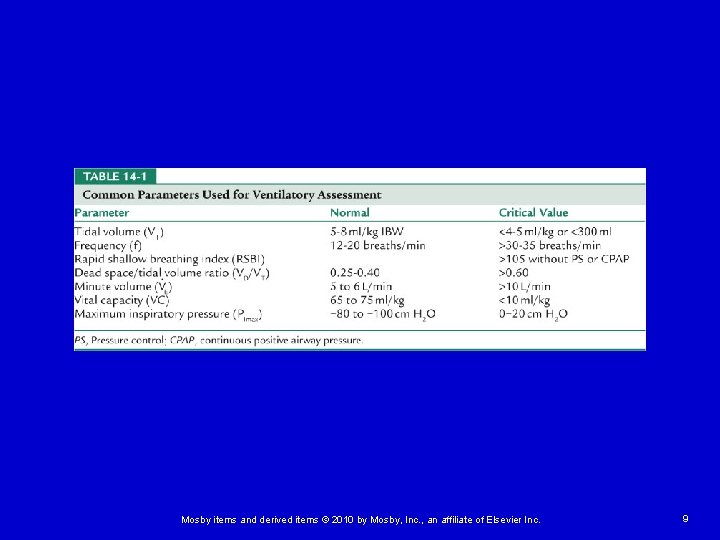
Ventilatory Assessment Pa. CO 2: standard for assessing ventilation Changes in metabolism, lung mechanics, ventilatory efficiency, equipment function may precede changes in blood gas Ventilatory parameters monitored Ø Ø Ø Lung volumes and flows Airway pressures Fractional gas concentrations Mosby items and derived items © 2010 by Mosby, Inc. , an affiliate of Elsevier Inc. 8
Mosby items and derived items © 2010 by Mosby, Inc. , an affiliate of Elsevier Inc. 9
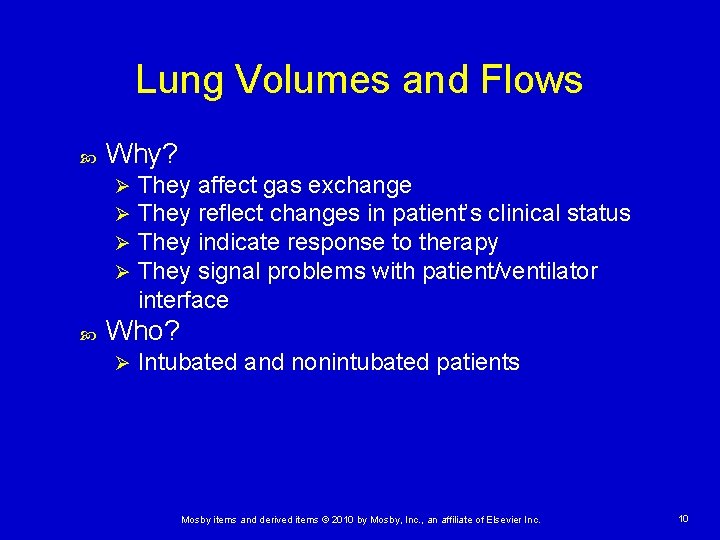
Lung Volumes and Flows Why? Ø Ø They affect gas exchange They reflect changes in patient’s clinical status They indicate response to therapy They signal problems with patient/ventilator interface Who? Ø Intubated and nonintubated patients Mosby items and derived items © 2010 by Mosby, Inc. , an affiliate of Elsevier Inc. 10
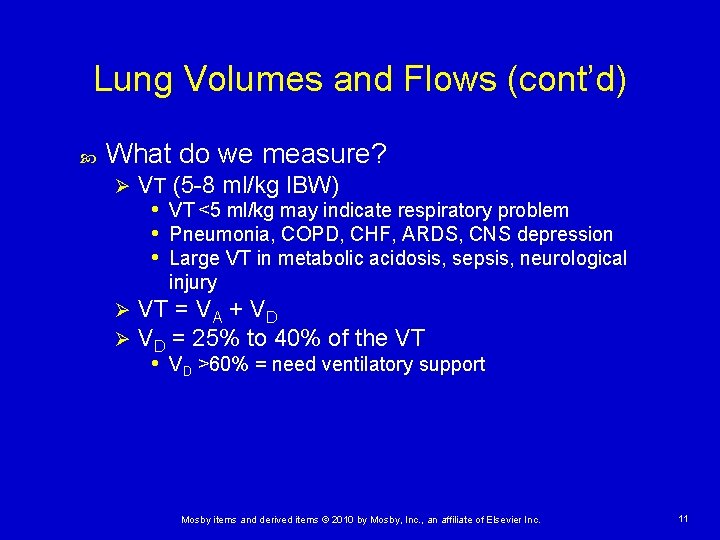
Lung Volumes and Flows (cont’d) What do we measure? Ø VT (5 -8 ml/kg IBW) • VT <5 ml/kg may indicate respiratory problem • Pneumonia, COPD, CHF, ARDS, CNS depression • Large VT in metabolic acidosis, sepsis, neurological injury Ø Ø VT = VA + VD VD = 25% to 40% of the VT • VD >60% = need ventilatory support Mosby items and derived items © 2010 by Mosby, Inc. , an affiliate of Elsevier Inc. 11
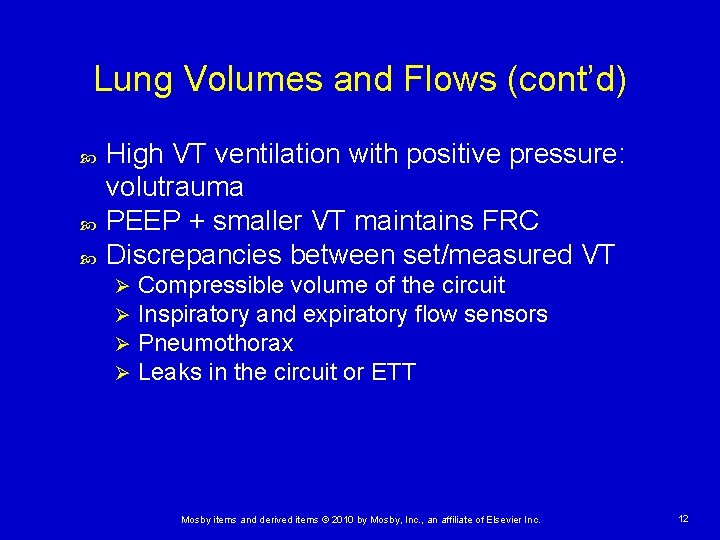
Lung Volumes and Flows (cont’d) High VT ventilation with positive pressure: volutrauma PEEP + smaller VT maintains FRC Discrepancies between set/measured VT Ø Ø Compressible volume of the circuit Inspiratory and expiratory flow sensors Pneumothorax Leaks in the circuit or ETT Mosby items and derived items © 2010 by Mosby, Inc. , an affiliate of Elsevier Inc. 12
Lung Volumes and Flows (cont’d) Spontaneous breathing trial (SBT) failure: Ø Ø Ø Ø VT <300 ml or <4 ml/kg Sp. O 2 <85% to 90% Blood pressure and heart rate change >20% Respiratory rate >35/min Change in mental status Accessory muscle use Diaphoresis Mosby items and derived items © 2010 by Mosby, Inc. , an affiliate of Elsevier Inc. 13
Lung Volumes and Flows (cont’d) Rapid shallow breathing index (RSBI) Ø Ø RSBI = f (breaths/min)/VT (liters) RSBI >105: prognostic of failure VE = 5 to 6 L/min Ø VE > 10 L/min: weaning not likely successful Mosby items and derived items © 2010 by Mosby, Inc. , an affiliate of Elsevier Inc. 14
Lung Volumes and Flows (cont’d) Vital capacity (VC) 65 to 75 ml/kg IBW FVC <20 ml/kg preoperative: risk of pulmonary complications Ø VC 10 to 15 ml/kg needed for deep breathing and coughing Ø VC >10 to 15 ml/kg for successful weaning and extubation Ø Ø Mosby items and derived items © 2010 by Mosby, Inc. , an affiliate of Elsevier Inc. 15
Lung Volumes and Flows (cont’d) Functional residual capacity (FRC) Ø Ø Ø FRC = 40 ml/kg IBW PEEP and CPAP increase FRC Beneficial in atelectasis and refractory hypoxemia as occurs with ARDS Mosby items and derived items © 2010 by Mosby, Inc. , an affiliate of Elsevier Inc. 16
Airway Pressures Important to monitor airway pressures: Need for mechanical ventilation and readiness for weaning Ø Determine site and cause of impedance to mechanical ventilation Ø Evaluate elastic recoil, compliance of thorax Ø Estimate amount of airway pressure transmitted to heart and major vessels Ø Assess respiratory muscle strength Ø Mosby items and derived items © 2010 by Mosby, Inc. , an affiliate of Elsevier Inc. 17
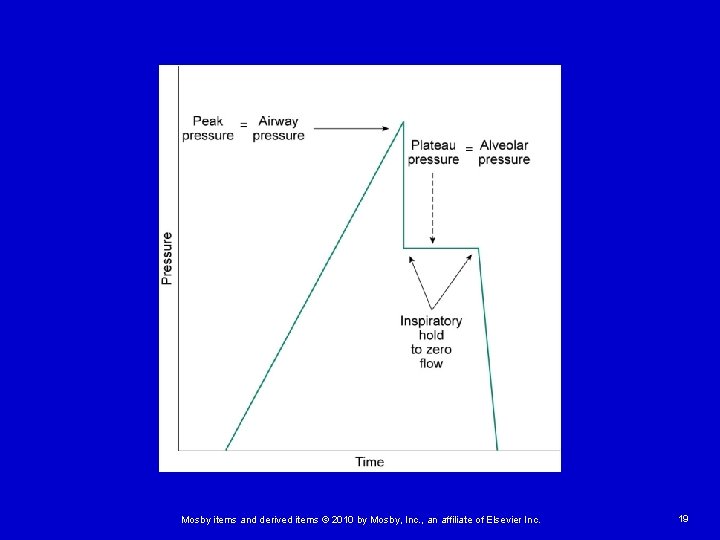
Airway Pressures (cont’d) Peak pressure or PIP Pressure required to overcome opposition to airflow in the lungs Ø Increased resistance • Bronchospasm, airway secretions, mucus plugging Ø Decreased compliance (lung or chest wall) Ø Patient-ventilator interface problem Ø Mosby items and derived items © 2010 by Mosby, Inc. , an affiliate of Elsevier Inc. 18
Mosby items and derived items © 2010 by Mosby, Inc. , an affiliate of Elsevier Inc. 19
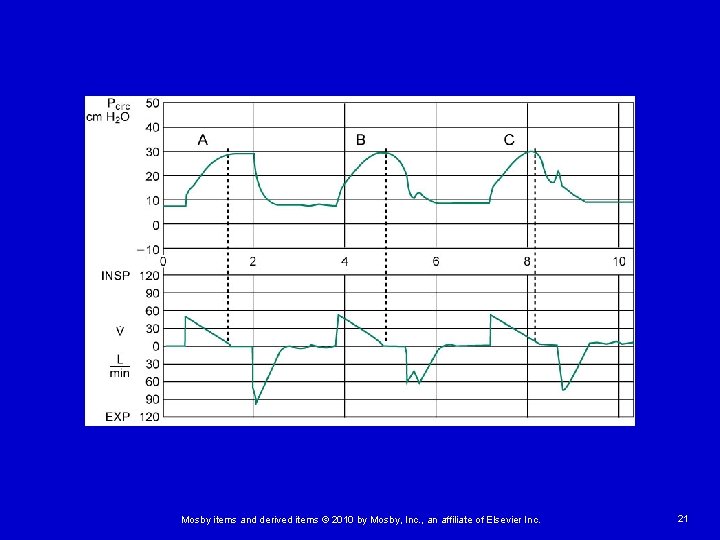
Airway Pressures (cont’d) Plateau pressure Ø Ø Ø Elastic recoil of lung and chest wall Static pressure during period of no gas flow Pressure required to maintain inflation Mosby items and derived items © 2010 by Mosby, Inc. , an affiliate of Elsevier Inc. 20
Mosby items and derived items © 2010 by Mosby, Inc. , an affiliate of Elsevier Inc. 21
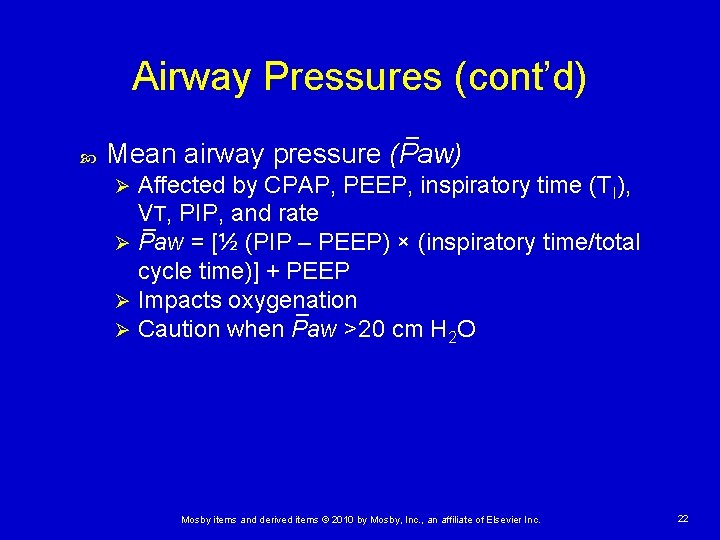
Airway Pressures (cont’d) _ Mean airway pressure (Paw) Affected by CPAP, PEEP, inspiratory time (TI), V_T, PIP, and rate Ø Paw = [½ (PIP – PEEP) × (inspiratory time/total cycle time)] + PEEP Ø Impacts oxygenation _ Ø Caution when Paw >20 cm H 2 O Ø Mosby items and derived items © 2010 by Mosby, Inc. , an affiliate of Elsevier Inc. 22
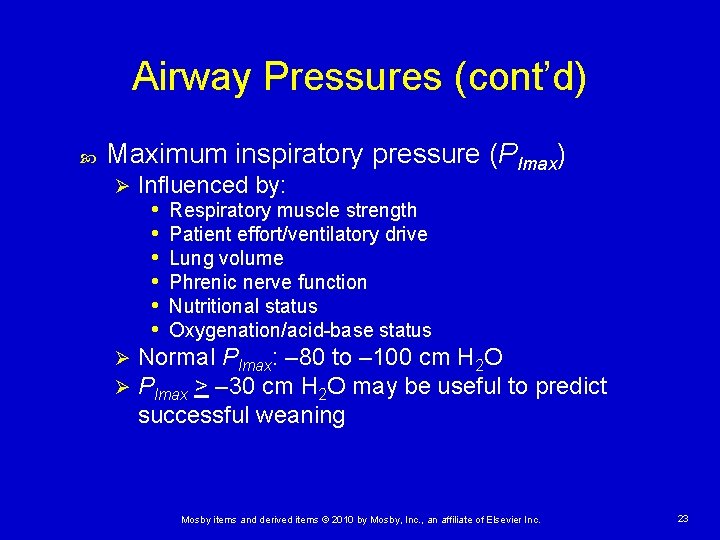
Airway Pressures (cont’d) Maximum inspiratory pressure (PImax) Influenced by: • Respiratory muscle strength • Patient effort/ventilatory drive • Lung volume • Phrenic nerve function • Nutritional status • Oxygenation/acid-base status Ø Normal PImax: – 80 to – 100 cm H 2 O Ø PImax > – 30 cm H 2 O may be useful to predict successful weaning Ø Mosby items and derived items © 2010 by Mosby, Inc. , an affiliate of Elsevier Inc. 23
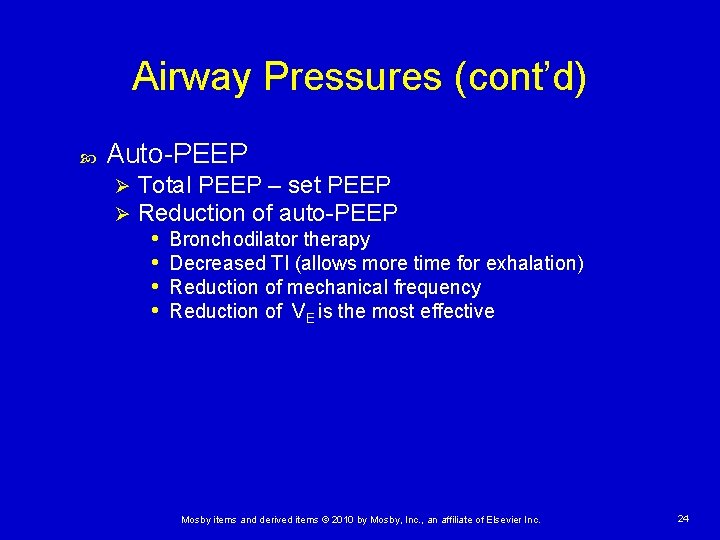
Airway Pressures (cont’d) Auto-PEEP Ø Ø Total PEEP – set PEEP Reduction of auto-PEEP • Bronchodilator therapy • Decreased TI (allows more time for exhalation) • Reduction of mechanical frequency • Reduction of VE is the most effective Mosby items and derived items © 2010 by Mosby, Inc. , an affiliate of Elsevier Inc. 24
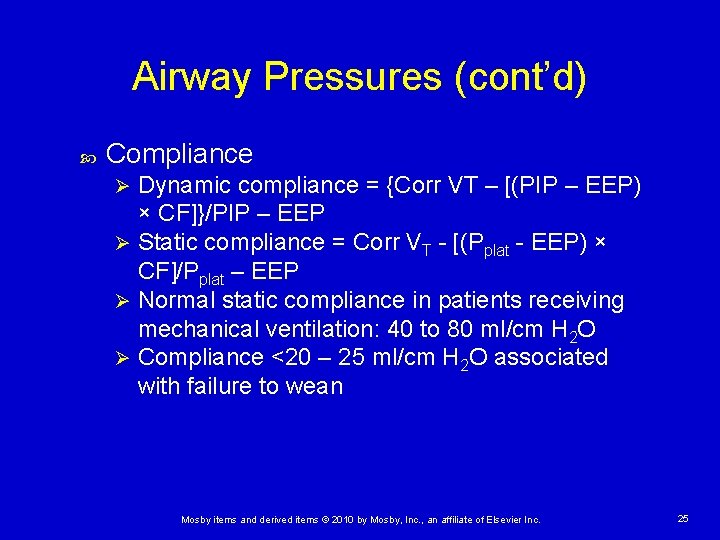
Airway Pressures (cont’d) Compliance Dynamic compliance = {Corr VT – [(PIP – EEP) × CF]}/PIP – EEP Ø Static compliance = Corr VT - [(Pplat - EEP) × CF]/Pplat – EEP Ø Normal static compliance in patients receiving mechanical ventilation: 40 to 80 ml/cm H 2 O Ø Compliance <20 – 25 ml/cm H 2 O associated with failure to wean Ø Mosby items and derived items © 2010 by Mosby, Inc. , an affiliate of Elsevier Inc. 25
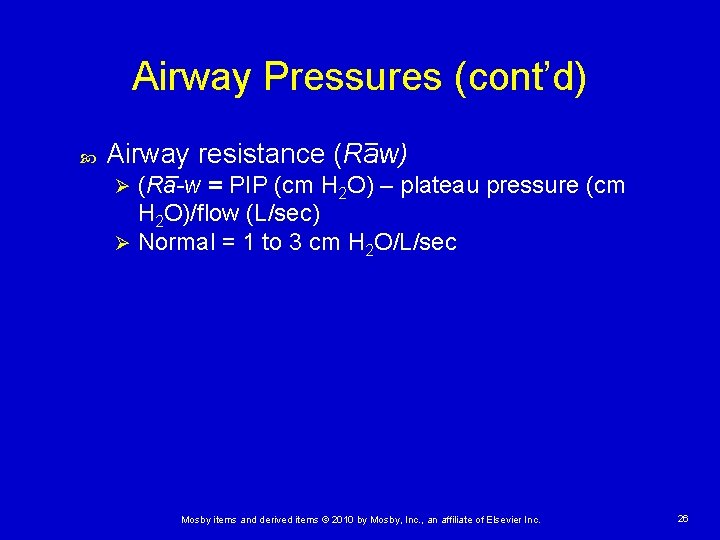
Airway Pressures (cont’d) _ Airway _ resistance (Raw) (Ra-w = PIP (cm H 2 O) – plateau pressure (cm H 2 O)/flow (L/sec) Ø Normal = 1 to 3 cm H 2 O/L/sec Ø Mosby items and derived items © 2010 by Mosby, Inc. , an affiliate of Elsevier Inc. 26
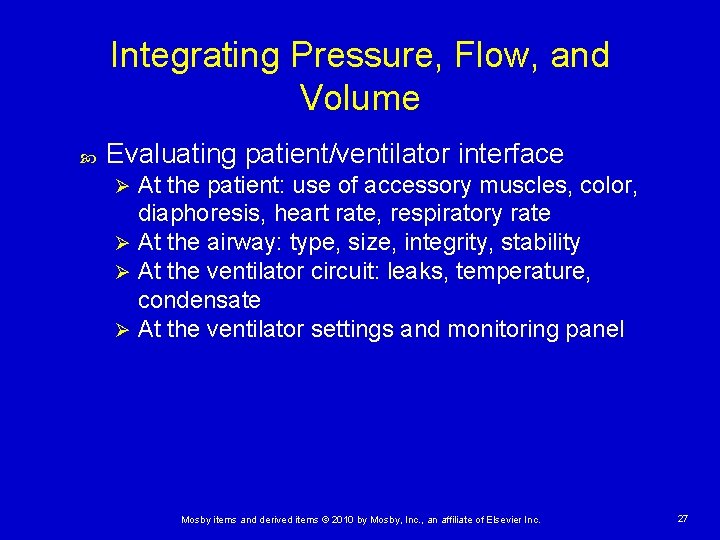
Integrating Pressure, Flow, and Volume Evaluating patient/ventilator interface At the patient: use of accessory muscles, color, diaphoresis, heart rate, respiratory rate Ø At the airway: type, size, integrity, stability Ø At the ventilator circuit: leaks, temperature, condensate Ø At the ventilator settings and monitoring panel Ø Mosby items and derived items © 2010 by Mosby, Inc. , an affiliate of Elsevier Inc. 27
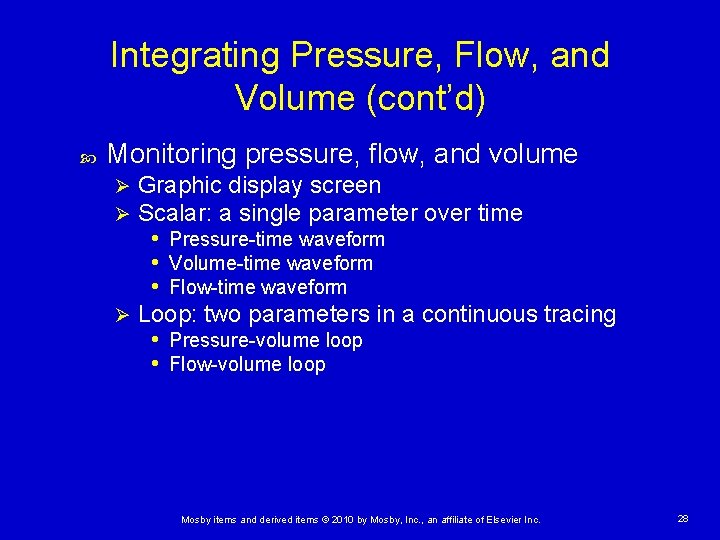
Integrating Pressure, Flow, and Volume (cont’d) Monitoring pressure, flow, and volume Graphic display screen Scalar: a single parameter over time • Pressure-time waveform • Volume-time waveform • Flow-time waveform Ø Loop: two parameters in a continuous tracing • Pressure-volume loop • Flow-volume loop Ø Ø Mosby items and derived items © 2010 by Mosby, Inc. , an affiliate of Elsevier Inc. 28
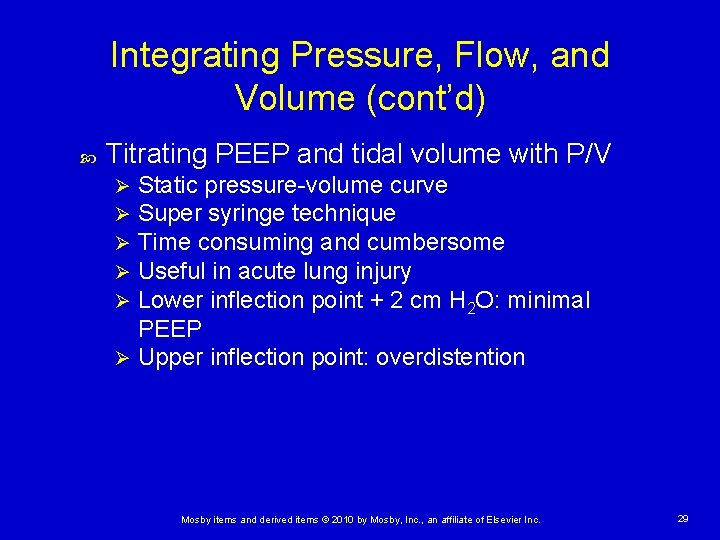
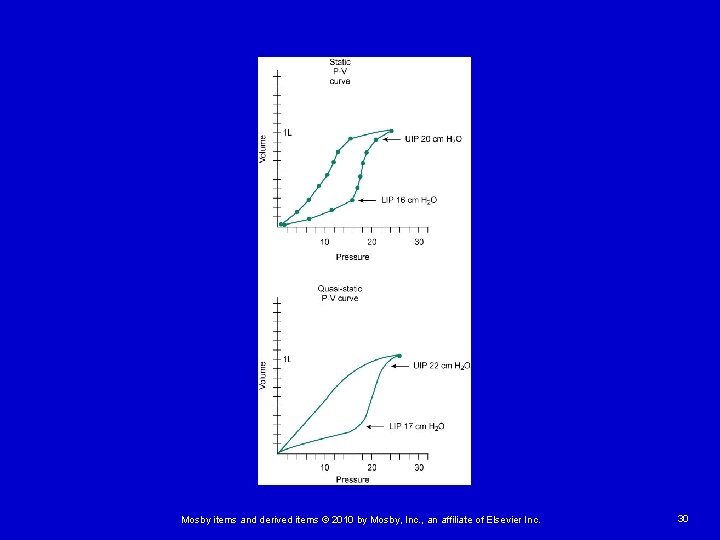
Integrating Pressure, Flow, and Volume (cont’d) Titrating PEEP and tidal volume with P/V Static pressure-volume curve Super syringe technique Time consuming and cumbersome Useful in acute lung injury Lower inflection point + 2 cm H 2 O: minimal PEEP Ø Upper inflection point: overdistention Ø Ø Ø Mosby items and derived items © 2010 by Mosby, Inc. , an affiliate of Elsevier Inc. 29
Mosby items and derived items © 2010 by Mosby, Inc. , an affiliate of Elsevier Inc. 30
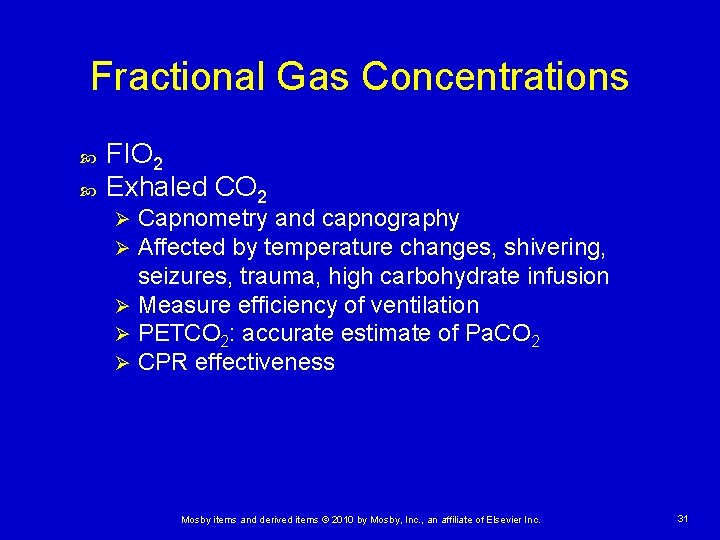
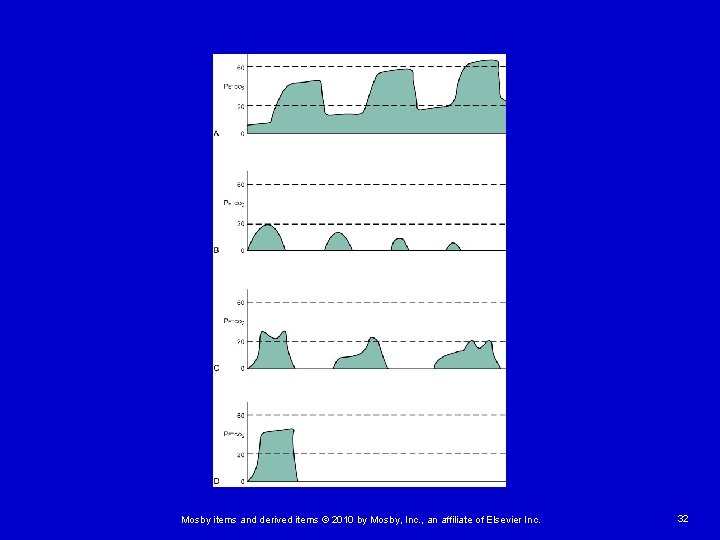
Fractional Gas Concentrations FIO 2 Exhaled CO 2 Capnometry and capnography Affected by temperature changes, shivering, seizures, trauma, high carbohydrate infusion Ø Measure efficiency of ventilation Ø PETCO 2: accurate estimate of Pa. CO 2 Ø CPR effectiveness Ø Ø Mosby items and derived items © 2010 by Mosby, Inc. , an affiliate of Elsevier Inc. 31
Mosby items and derived items © 2010 by Mosby, Inc. , an affiliate of Elsevier Inc. 32
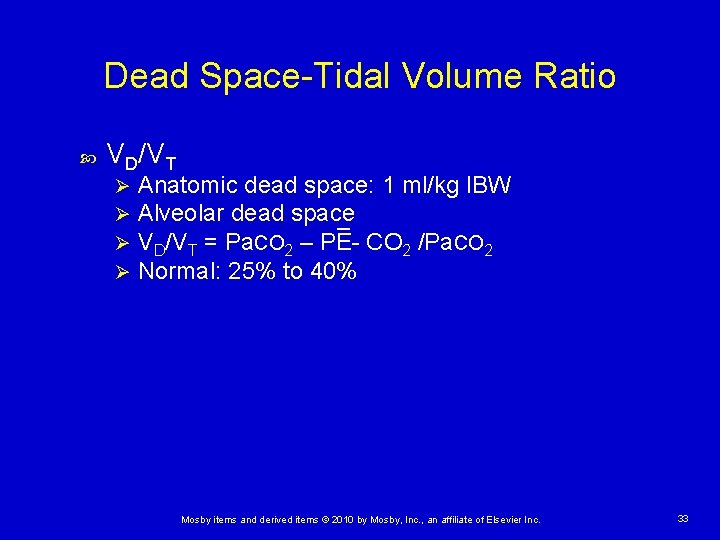
Dead Space-Tidal Volume Ratio VD/VT Ø Ø Anatomic dead space: 1 ml/kg IBW Alveolar dead space _ VD/VT = Pa. CO 2 – PE- CO 2 /Pa. CO 2 Normal: 25% to 40% Mosby items and derived items © 2010 by Mosby, Inc. , an affiliate of Elsevier Inc. 33
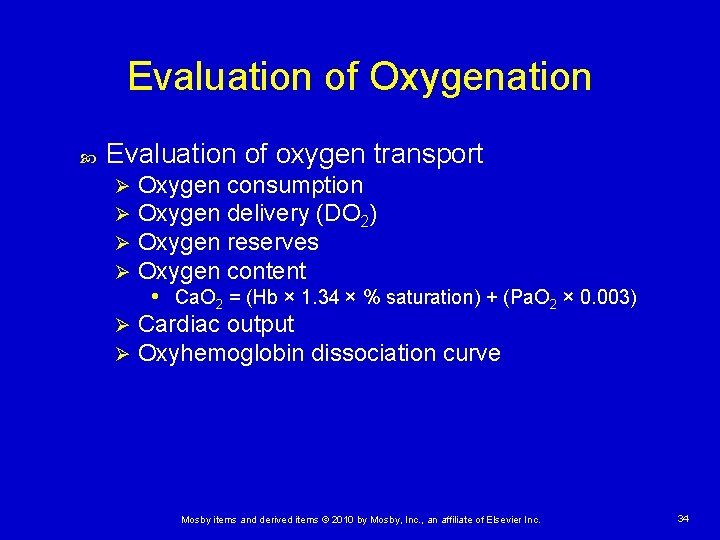
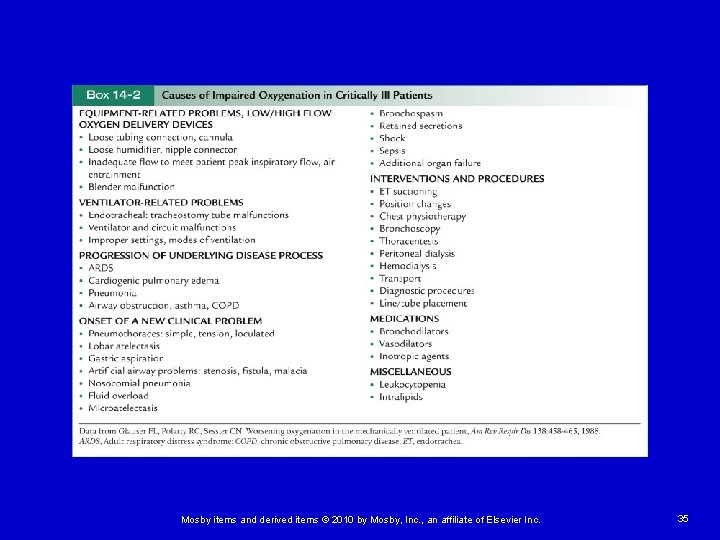
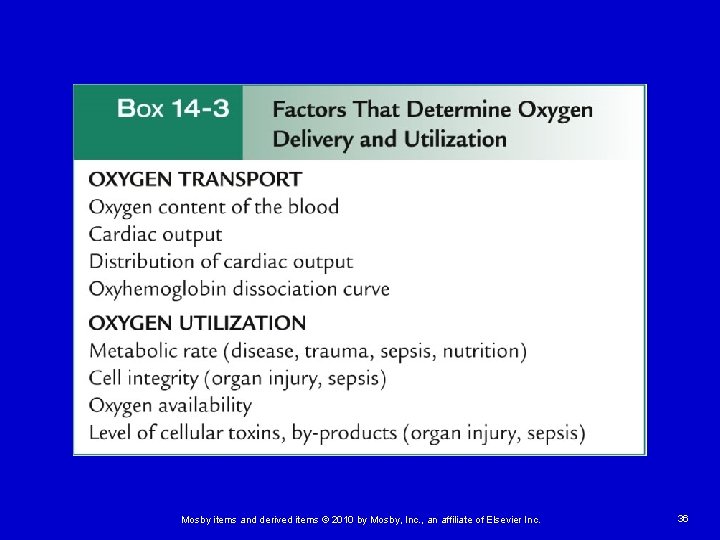
Evaluation of Oxygenation Evaluation of oxygen transport Oxygen consumption Oxygen delivery (DO 2) Oxygen reserves Oxygen content • Ca. O 2 = (Hb × 1. 34 × % saturation) + (Pa. O 2 × 0. 003) Ø Cardiac output Ø Oxyhemoglobin dissociation curve Ø Ø Mosby items and derived items © 2010 by Mosby, Inc. , an affiliate of Elsevier Inc. 34
Mosby items and derived items © 2010 by Mosby, Inc. , an affiliate of Elsevier Inc. 35
Mosby items and derived items © 2010 by Mosby, Inc. , an affiliate of Elsevier Inc. 36
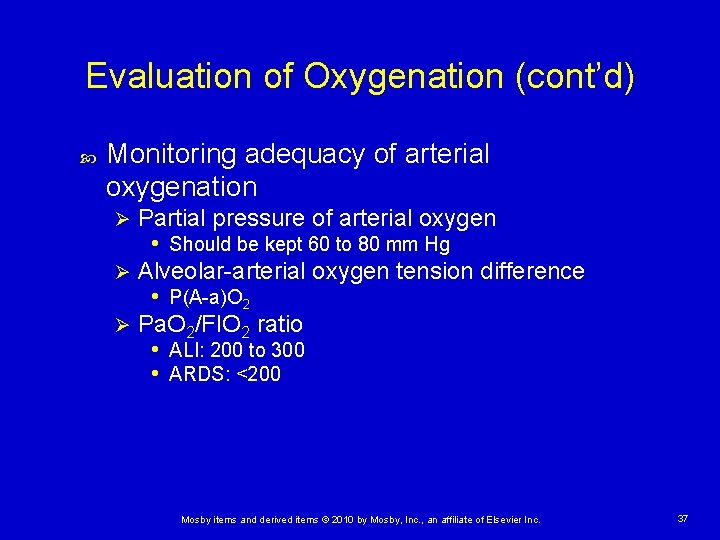
Evaluation of Oxygenation (cont’d) Monitoring adequacy of arterial oxygenation Partial pressure of arterial oxygen • Should be kept 60 to 80 mm Hg Ø Alveolar-arterial oxygen tension difference • P(A-a)O 2 Ø Pa. O 2/FIO 2 ratio • ALI: 200 to 300 • ARDS: <200 Ø Mosby items and derived items © 2010 by Mosby, Inc. , an affiliate of Elsevier Inc. 37
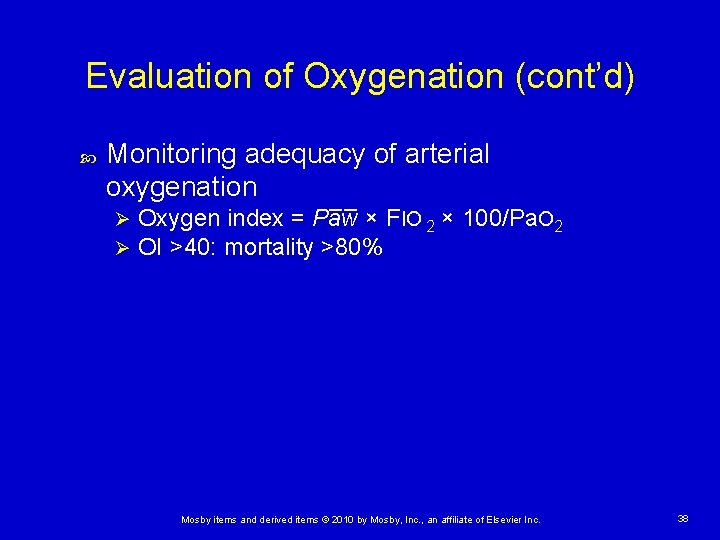
Evaluation of Oxygenation (cont’d) Monitoring adequacy of arterial oxygenation __ Ø Ø Oxygen index = Paw × FIO 2 × 100/Pa. O 2 OI >40: mortality >80% Mosby items and derived items © 2010 by Mosby, Inc. , an affiliate of Elsevier Inc. 38
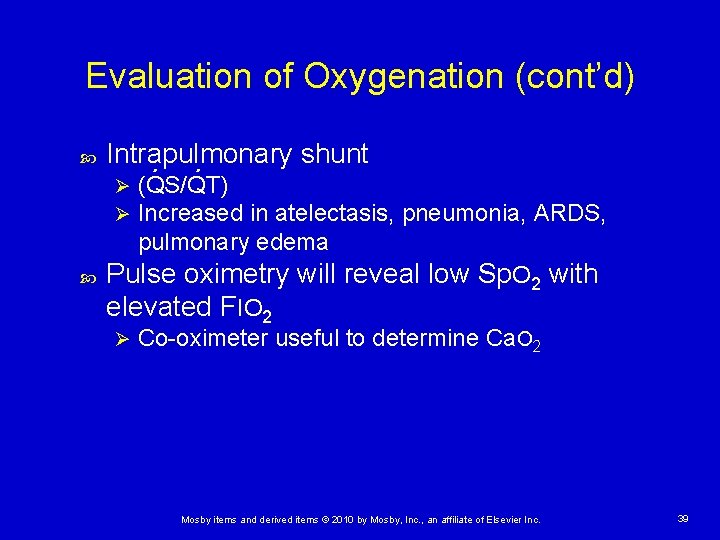
Evaluation of Oxygenation (cont’d) Intrapulmonary shunt. . (QS/QT) Increased in atelectasis, pneumonia, ARDS, pulmonary edema Pulse oximetry will reveal low Sp. O 2 with elevated FIO 2 Ø Co-oximeter useful to determine Ca. O 2 Ø Ø Mosby items and derived items © 2010 by Mosby, Inc. , an affiliate of Elsevier Inc. 39
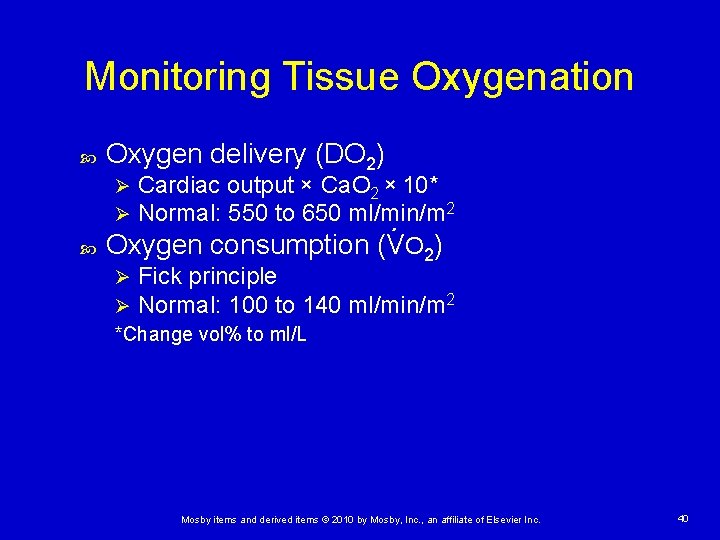
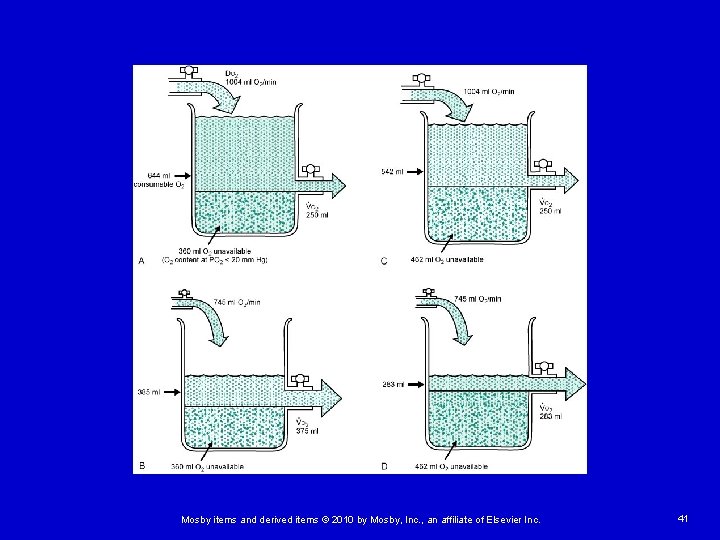
Monitoring Tissue Oxygenation Oxygen delivery (DO 2) Cardiac output × Ca. O 2 × 10* 2 Normal: 550 to 650 ml/min/m. Oxygen consumption (VO 2) Ø Fick principle Ø Normal: 100 to 140 ml/min/m 2 Ø Ø *Change vol% to ml/L Mosby items and derived items © 2010 by Mosby, Inc. , an affiliate of Elsevier Inc. 40
Mosby items and derived items © 2010 by Mosby, Inc. , an affiliate of Elsevier Inc. 41
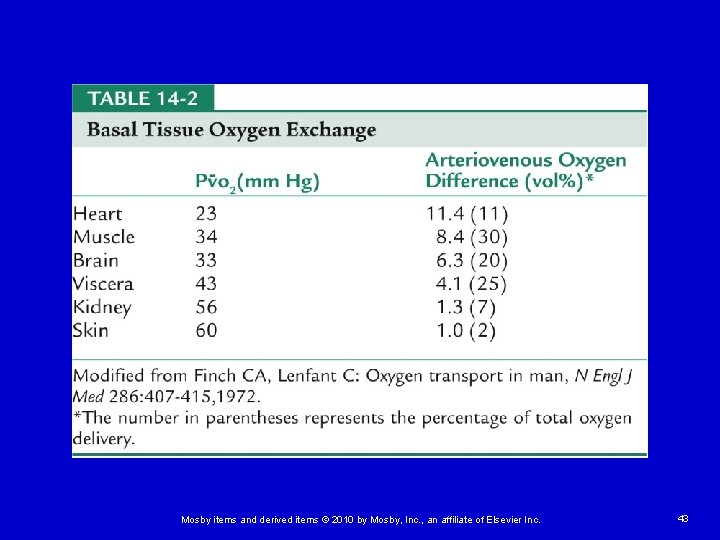
Monitoring Tissue Oxygenation (cont’d) _ Mixed venous oxygen tension Pv. O 2 Normal: 38 to 42 mm Hg Low: inadequate cardiac output, anemia, hypoxia Ø High: poor sampling technique, left-to-right shunt, septic shock, increased cardiac output, cyanide poisoning Ø Ø Mosby items and derived items © 2010 by Mosby, Inc. , an affiliate of Elsevier Inc. 42
Mosby items and derived items © 2010 by Mosby, Inc. , an affiliate of Elsevier Inc. 43
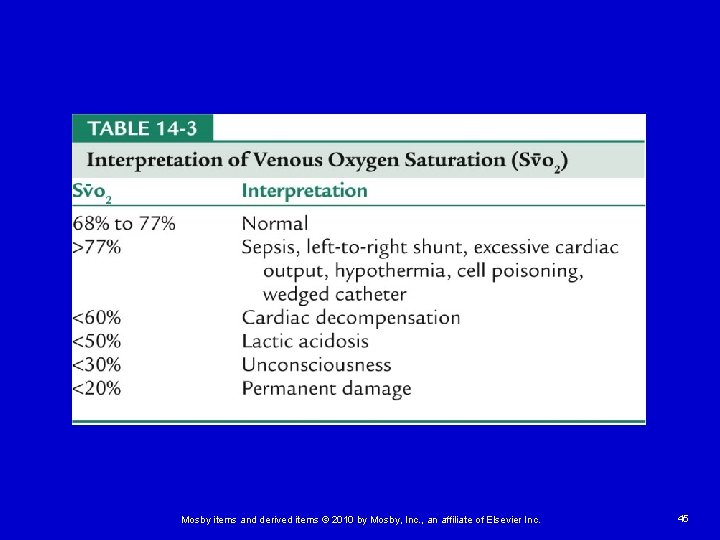
Monitoring Tissue Oxygenation (cont’d) _ Mixed venous oxygen saturation (Sv. O 2) Ø Ø Fiberoptic reflectance oximetry Decreased: suctioning, shivering, extubation, weaning, PPV Mosby items and derived items © 2010 by Mosby, Inc. , an affiliate of Elsevier Inc. 44
Mosby items and derived items © 2010 by Mosby, Inc. , an affiliate of Elsevier Inc. 45
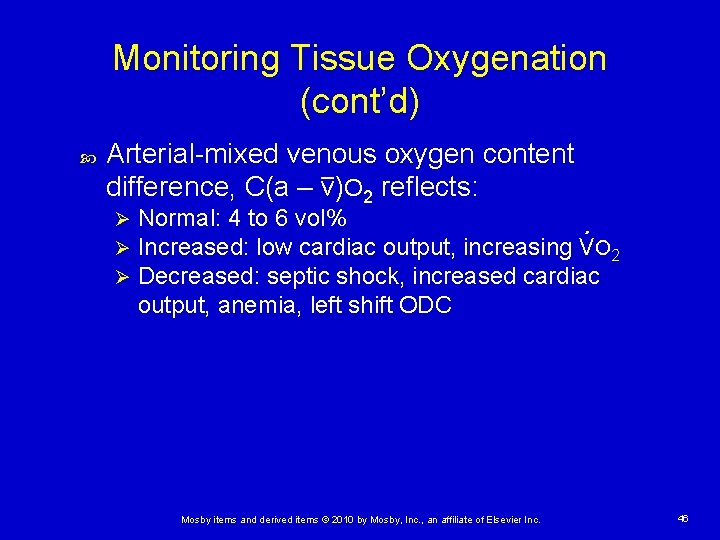
Monitoring Tissue Oxygenation (cont’d) Arterial-mixed venous oxygen content _ difference, C(a – v)O 2 reflects: Ø Ø Ø Normal: 4 to 6 vol%. Increased: low cardiac output, increasing VO 2 Decreased: septic shock, increased cardiac output, anemia, left shift ODC Mosby items and derived items © 2010 by Mosby, Inc. , an affiliate of Elsevier Inc. 46
Monitoring Tissue Oxygenation (cont’d) _ Oxygen extraction ratio [C(a – v)O 2/Ca. O 2] Normal: 25% to 30%. Increased: low cardiac output, increased VO 2, decreased Ca. O 2, Ø Decreased: high cardiac output, sepsis Ø Mosby items and derived items © 2010 by Mosby, Inc. , an affiliate of Elsevier Inc. 47
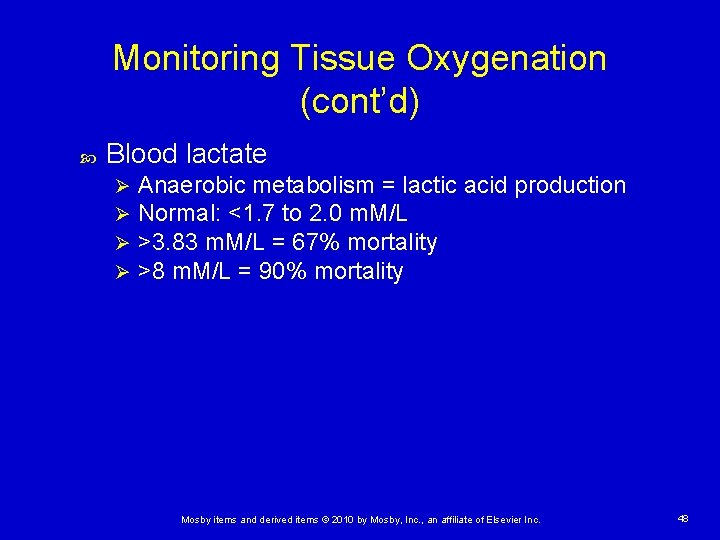
Monitoring Tissue Oxygenation (cont’d) Blood lactate Ø Ø Anaerobic metabolism = lactic acid production Normal: <1. 7 to 2. 0 m. M/L >3. 83 m. M/L = 67% mortality >8 m. M/L = 90% mortality Mosby items and derived items © 2010 by Mosby, Inc. , an affiliate of Elsevier Inc. 48
Summary Common ventilatory measurements Ø Ø Ø Lung volumes and flows Airway pressures Fractional gas concentrations These measurements allow clinicians to determine the need for mechanical ventilation, monitor the patient, and determine the readiness for weaning Mosby items and derived items © 2010 by Mosby, Inc. , an affiliate of Elsevier Inc. 49