
Chapter 14 Recombination and repair 14 1 Introduction
Chapter 14 Recombination and repair
14. 1 Introduction 14. 2 Breakage and reunion involves heteroduplex DNA 14. 3 Double-strand breaks initiate recombination 14. 4 Double-strand breaks initiate snapsis 14. 5 Bacterial recombination involves single-strand assimilation 14. 6 Gene conversion accounts for interallelic recombination 14. 7 Topological manipulation of DNA 14. 8 Specialized recombination involves breakage and reunion at specific sites 14. 9 Repair systems correct damage to DNA 14. 10 Excision repair systems in E. coli 14. 11 Controlling the direction of mismatch repair 14. 12 Retrieval systems in E. coli 14. 13 Rec. A triggers the SOS system 14. 14 Eukaryotic repair systems
14. 1 Introduction Bivalent is the structure containing all four chromatids (two representing each homologue) at the start of meiosis. Breakage and reunion describes the mode of genetic recombination, in which two DNA duplex molecules are broken at corresponding points and then rejoined crosswise (involving formation of a length of heteroduplex DNA around the site of joining). Site-specific recombination occurs between two specific (not necessarily homologous) sequences, as in phage integration/excision or resolution of cointegrate structures during transposition. Synapsis describes the association of the two pairs of sister chromatids representing homologous chromosomes that occurs at the start of meiosis; resulting structure is called a bivalent. Synaptonemal complex describes the morphological structure of synapsed chromosomes. Transposition refers to the movement of a transposon to a new site in the genome.
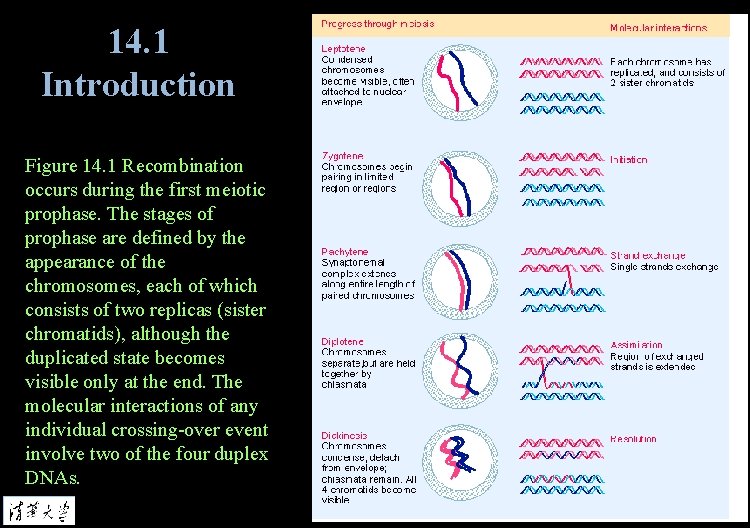
14. 1 Introduction Figure 14. 1 Recombination occurs during the first meiotic prophase. The stages of prophase are defined by the appearance of the chromosomes, each of which consists of two replicas (sister chromatids), although the duplicated state becomes visible only at the end. The molecular interactions of any individual crossing-over event involve two of the four duplex DNAs.
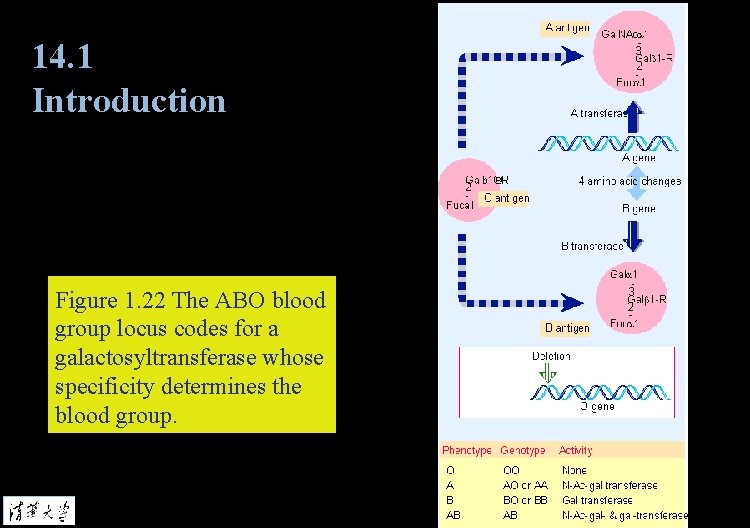
14. 1 Introduction Figure 1. 22 The ABO blood group locus codes for a galactosyltransferase whose specificity determines the blood group.

14. 2 Breakage and reunion involves heteroduplex DNA Branch migration describes the ability of a DNA strand partially paired with its complement in a duplex to extend its pairing by displacing the resident strand with which it is homologous. Hybrid DNA is another term for heteroduplex DNA. Recombinant joint is the point at which two recombining molecules of duplex DNA are connected (the edge of the heteroduplex region).
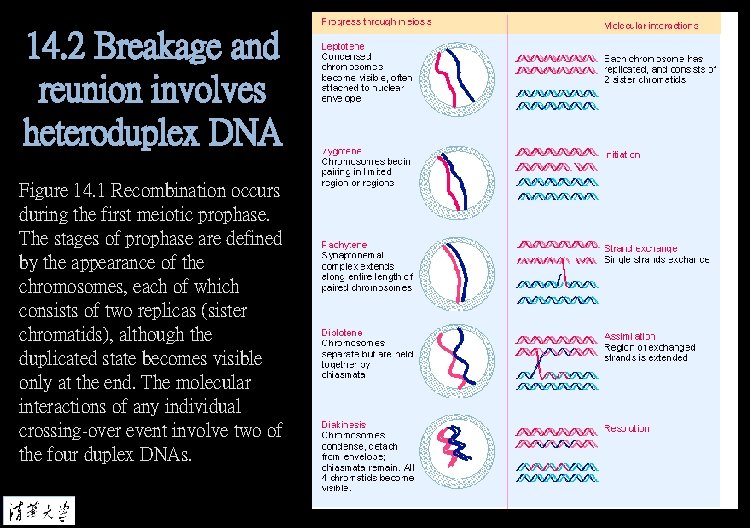
14. 2 Breakage and reunion involves heteroduplex DNA Figure 14. 1 Recombination occurs during the first meiotic prophase. The stages of prophase are defined by the appearance of the chromosomes, each of which consists of two replicas (sister chromatids), although the duplicated state becomes visible only at the end. The molecular interactions of any individual crossing-over event involve two of the four duplex DNAs.
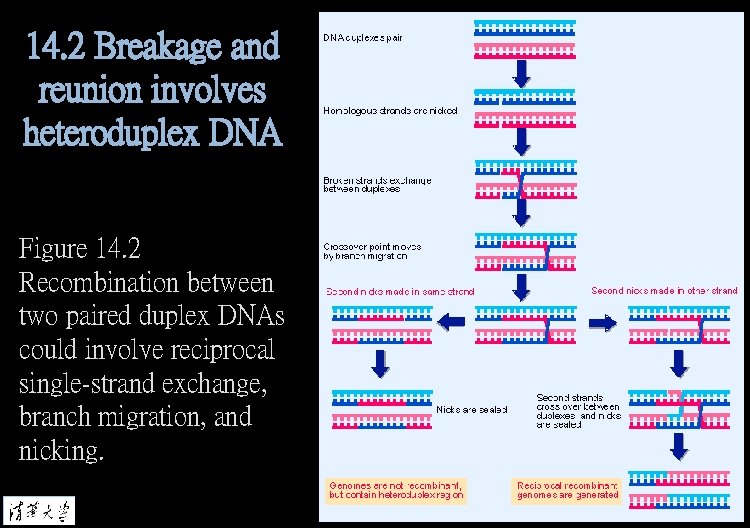
14. 2 Breakage and reunion involves heteroduplex DNA Figure 14. 2 Recombination between two paired duplex DNAs could involve reciprocal single-strand exchange, branch migration, and nicking.
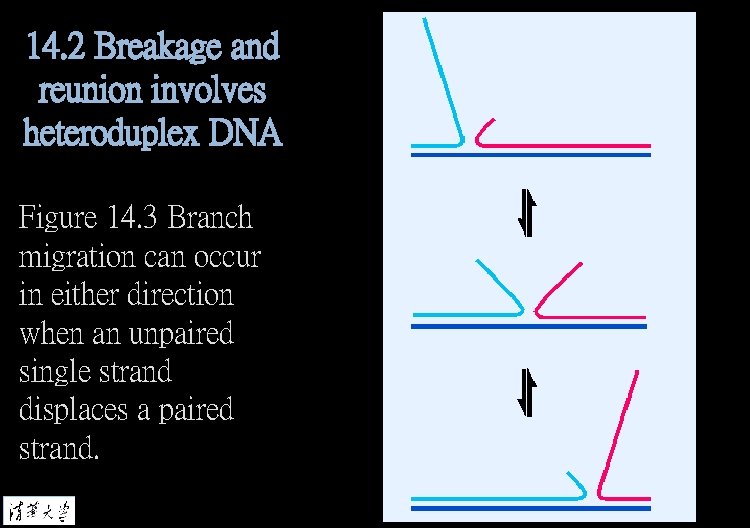
14. 2 Breakage and reunion involves heteroduplex DNA Figure 14. 3 Branch migration can occur in either direction when an unpaired single strand displaces a paired strand.

14. 2 Breakage and reunion involves heteroduplex DNA Figure 14. 4 Resolution of a Holliday junction can generate parental or recombinant duplexes, depending on which strands are nicked. Both types of product have a region of heteroduplex DNA.
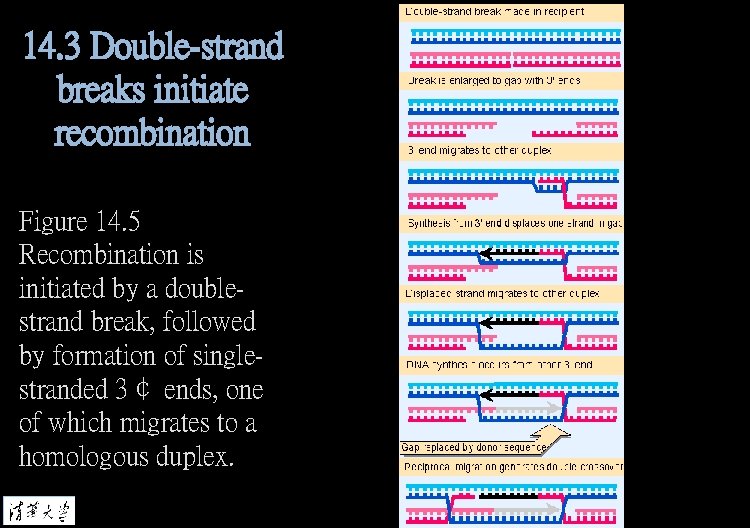
14. 3 Double-strand breaks initiate recombination Figure 14. 5 Recombination is initiated by a doublestrand break, followed by formation of singlestranded 3¢ ends, one of which migrates to a homologous duplex.
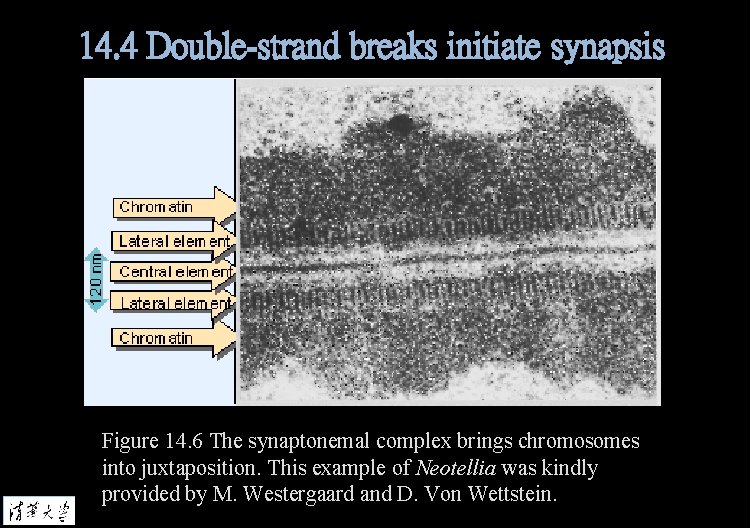
14. 4 Double-strand breaks initiate synapsis Figure 14. 6 The synaptonemal complex brings chromosomes into juxtaposition. This example of Neotellia was kindly provided by M. Westergaard and D. Von Wettstein.
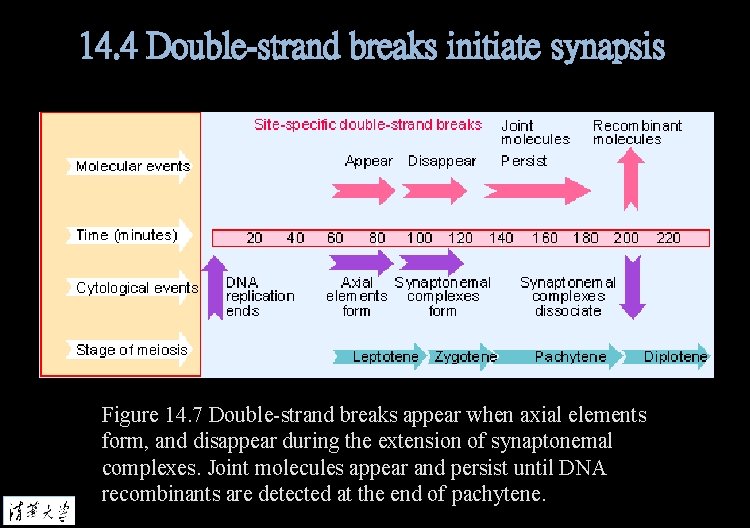
14. 4 Double-strand breaks initiate synapsis Figure 14. 7 Double-strand breaks appear when axial elements form, and disappear during the extension of synaptonemal complexes. Joint molecules appear and persist until DNA recombinants are detected at the end of pachytene.
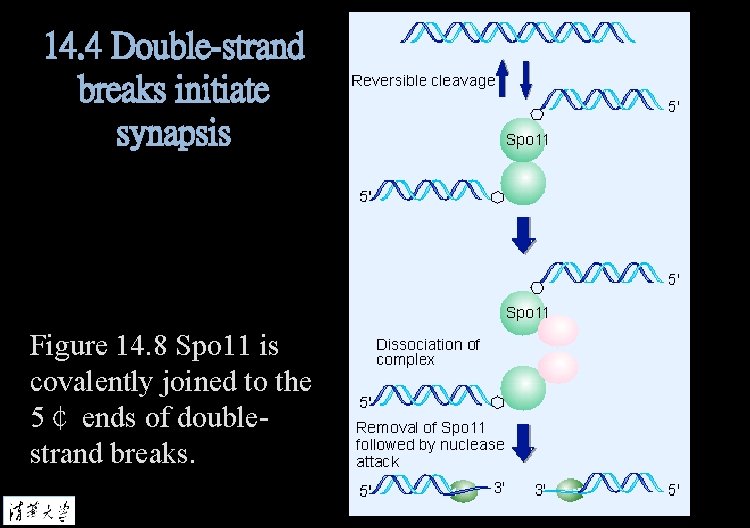
14. 4 Double-strand breaks initiate synapsis Figure 14. 8 Spo 11 is covalently joined to the 5¢ ends of doublestrand breaks.
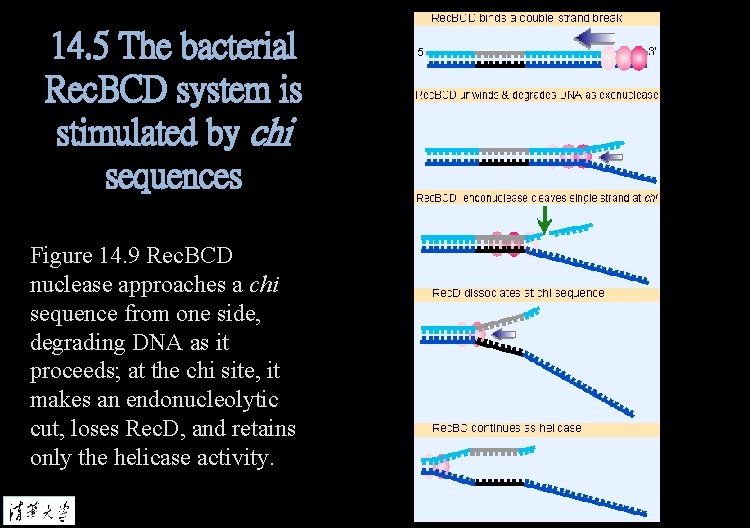
14. 5 The bacterial Rec. BCD system is stimulated by chi sequences Figure 14. 9 Rec. BCD nuclease approaches a chi sequence from one side, degrading DNA as it proceeds; at the chi site, it makes an endonucleolytic cut, loses Rec. D, and retains only the helicase activity.
14. 6 Rec. A catalyzes singlestrand assimilation Paranemic joint describes a region in which two complementary sequences of DNA are associated side by side instead of being intertwined in a double helical structure. Single-strand assimilation describes the ability of Rec. A protein to cause a single strand of DNA to displace its homologous strand in a duplex; that is, the single strand is assimilated into the duplex.
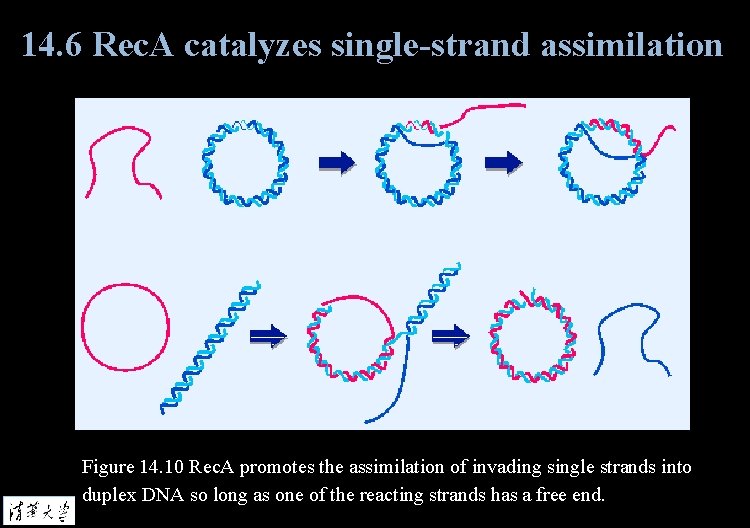
14. 6 Rec. A catalyzes single-strand assimilation Figure 14. 10 Rec. A promotes the assimilation of invading single strands into duplex DNA so long as one of the reacting strands has a free end.
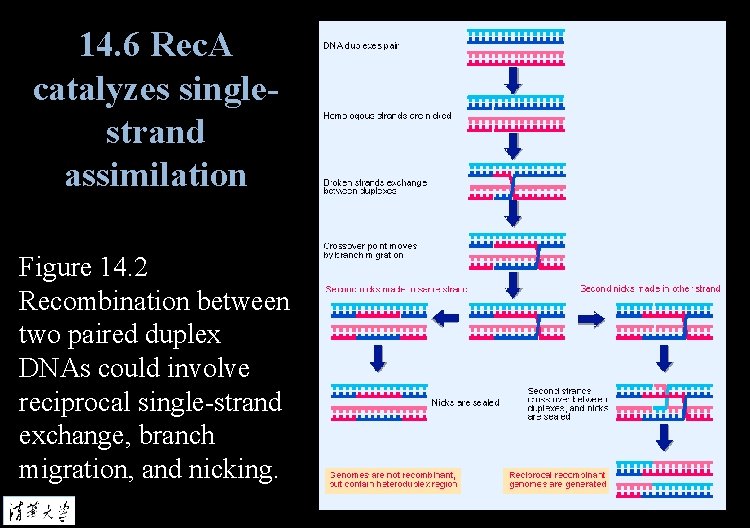
14. 6 Rec. A catalyzes singlestrand assimilation Figure 14. 2 Recombination between two paired duplex DNAs could involve reciprocal single-strand exchange, branch migration, and nicking.
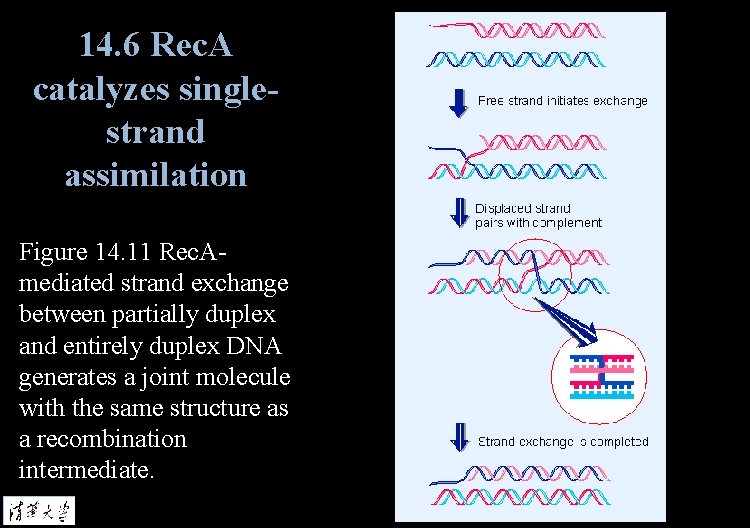
14. 6 Rec. A catalyzes singlestrand assimilation Figure 14. 11 Rec. Amediated strand exchange between partially duplex and entirely duplex DNA generates a joint molecule with the same structure as a recombination intermediate.
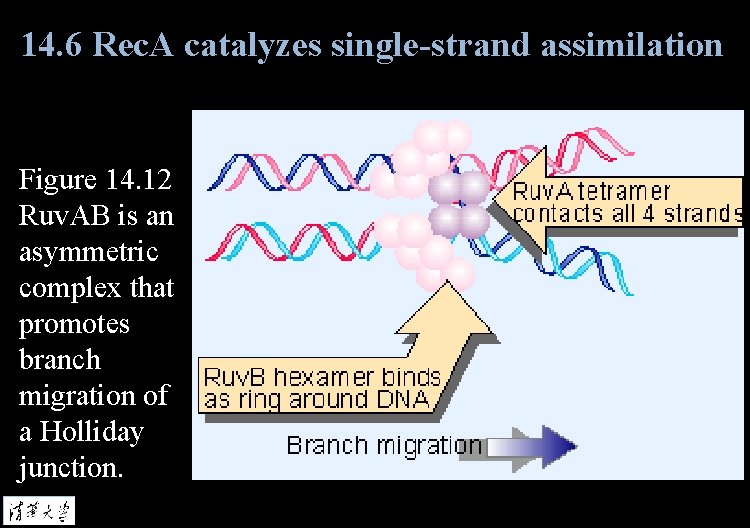
14. 6 Rec. A catalyzes single-strand assimilation Figure 14. 12 Ruv. AB is an asymmetric complex that promotes branch migration of a Holliday junction.
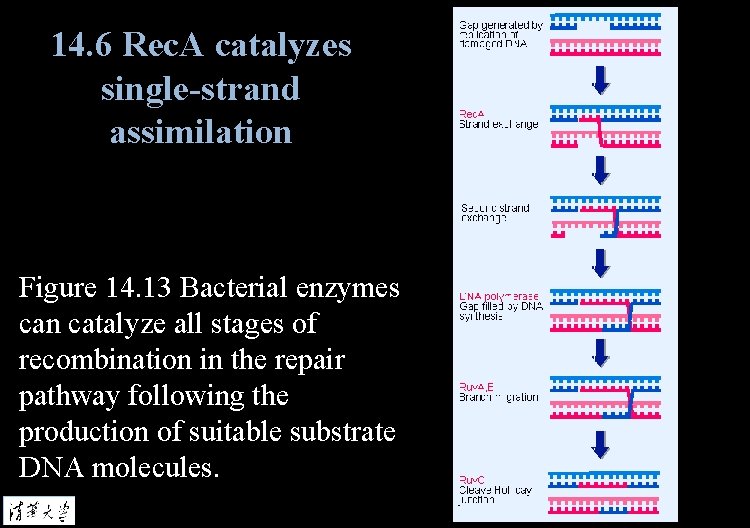
14. 6 Rec. A catalyzes single-strand assimilation Figure 14. 13 Bacterial enzymes can catalyze all stages of recombination in the repair pathway following the production of suitable substrate DNA molecules.
14. 8 Gene conversion accounts for interallelic recombination Gene conversion is the alteration of one strand of a heteroduplex DNA to make it complementary with the other strand at any position(s) where there were mispaired bases. Postmeiotic segregation describes the segregation of two strands of a duplex DNA that bear different information (created by heteroduplex formation during meiosis) when a subsequent replication allows the strands to separate.
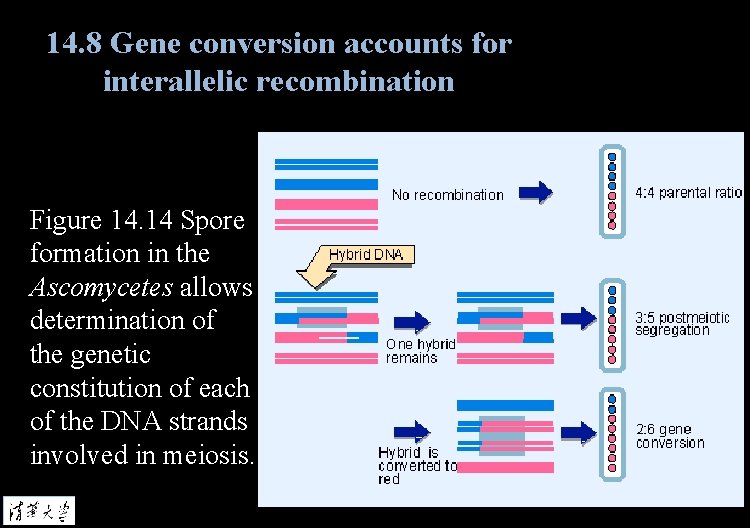
14. 8 Gene conversion accounts for interallelic recombination Figure 14. 14 Spore formation in the Ascomycetes allows determination of the genetic constitution of each of the DNA strands involved in meiosis.
14. 9 Topological manipulation of DNA Supercoiling describes the coiling of a closed duplex DNA in space so that it crosses over its own axis. Topological isomers are molecules of DNA that are identical except for a difference in linking number. Twisting number of a DNA is the number of base pairs divided by the number of base pairs per turn of the double helix. Writhing number is the number of times a duplex axis crosses over itself in space.
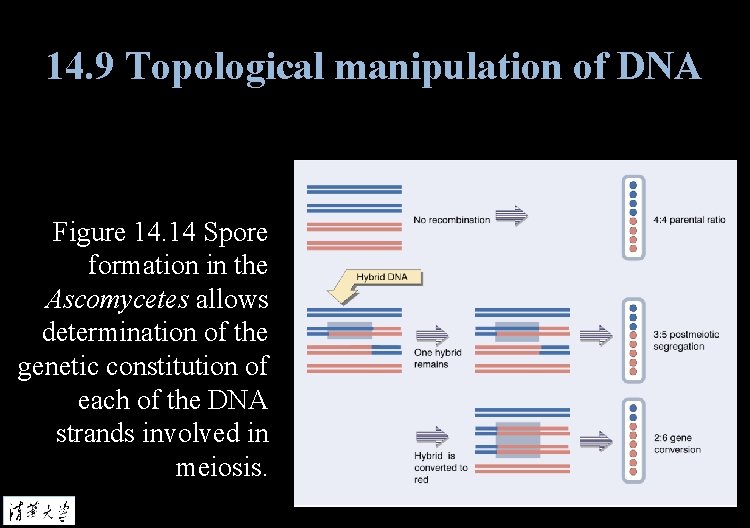
14. 9 Topological manipulation of DNA Figure 14. 14 Spore formation in the Ascomycetes allows determination of the genetic constitution of each of the DNA strands involved in meiosis.
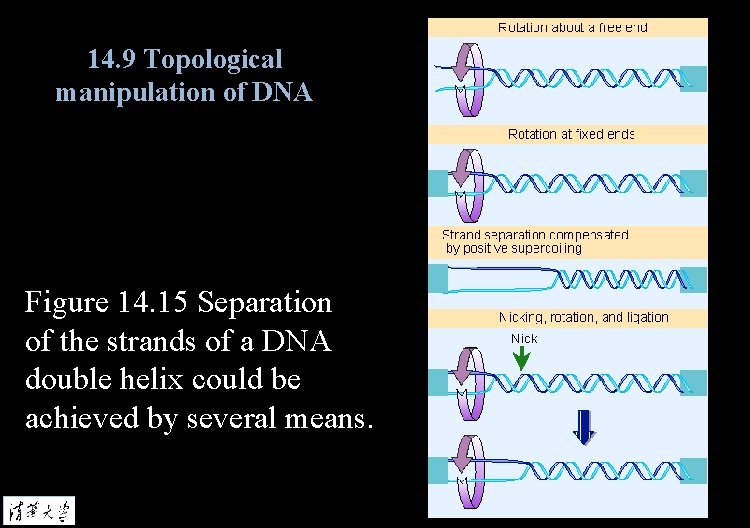
14. 9 Topological manipulation of DNA Figure 14. 15 Separation of the strands of a DNA double helix could be achieved by several means.
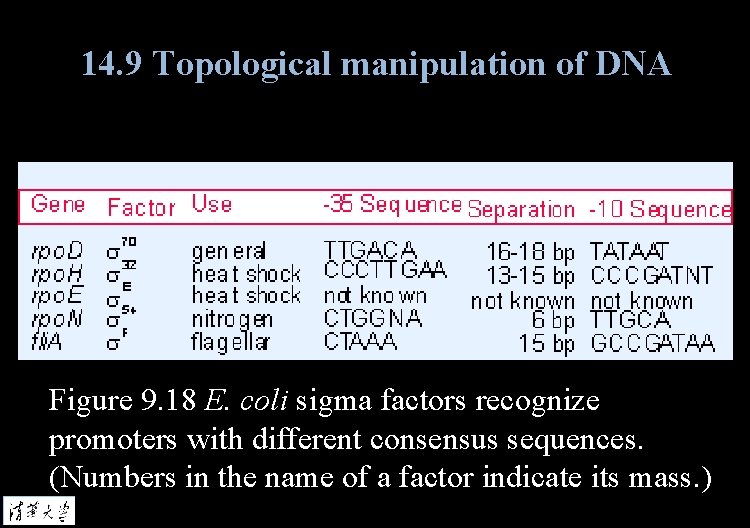
14. 9 Topological manipulation of DNA Figure 9. 18 E. coli sigma factors recognize promoters with different consensus sequences. (Numbers in the name of a factor indicate its mass. )
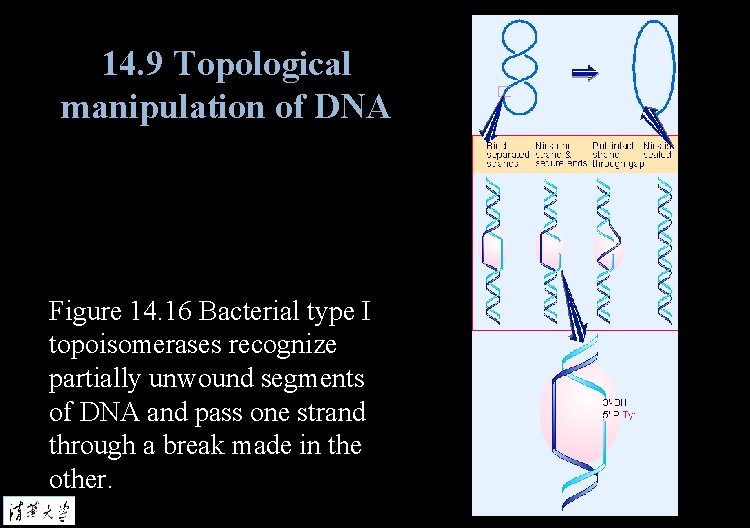
14. 9 Topological manipulation of DNA Figure 14. 16 Bacterial type I topoisomerases recognize partially unwound segments of DNA and pass one strand through a break made in the other.
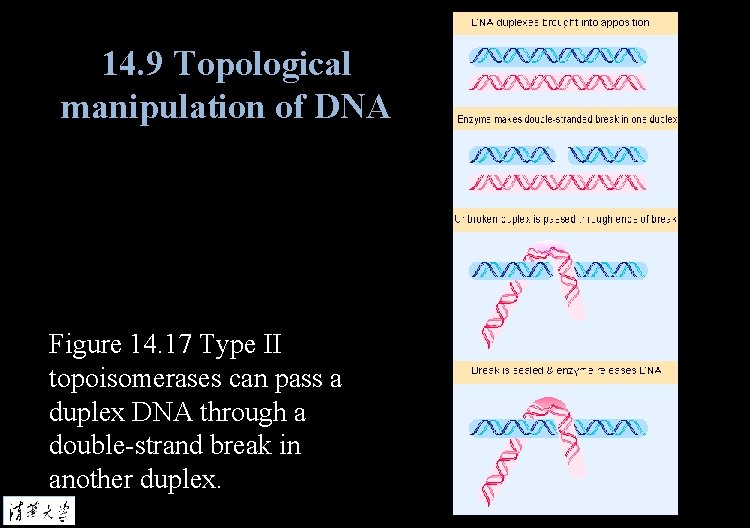
14. 9 Topological manipulation of DNA Figure 14. 17 Type II topoisomerases can pass a duplex DNA through a double-strand break in another duplex.
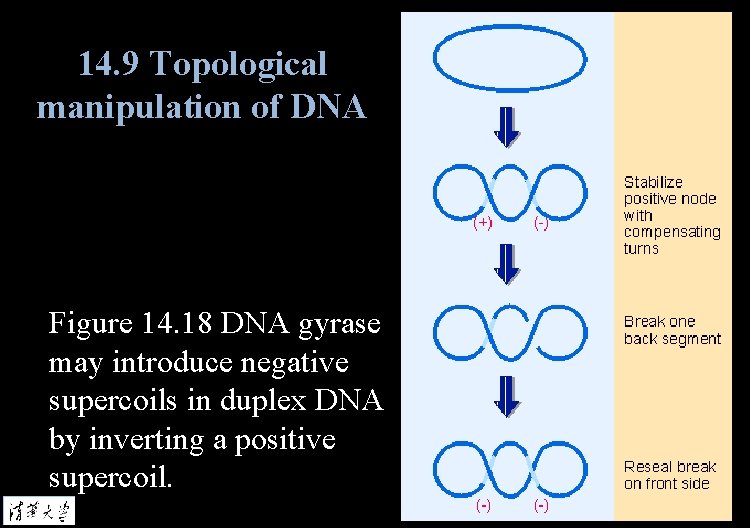
14. 9 Topological manipulation of DNA Figure 14. 18 DNA gyrase may introduce negative supercoils in duplex DNA by inverting a positive supercoil.
14. 10 Specialized recombination involves breakage and reunion at specific sites att sites are the loci on a phage and the bacterial chromosome at which recombination integrates the phage into, or excises it from, the bacterial chromosome.
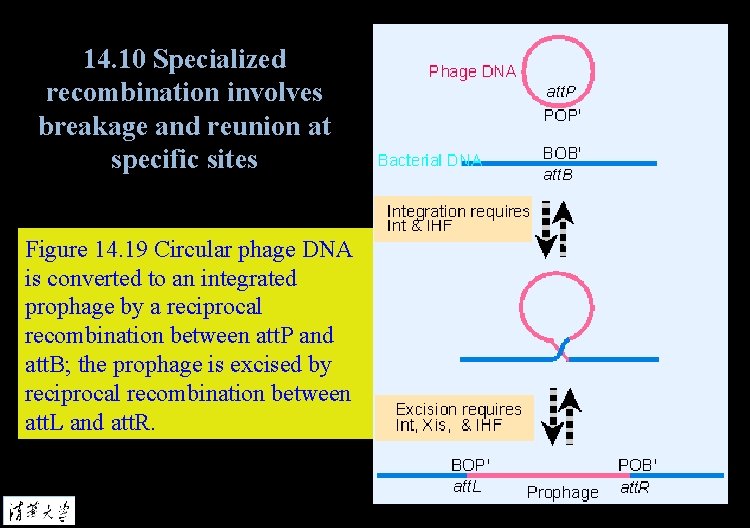
14. 10 Specialized recombination involves breakage and reunion at specific sites Figure 14. 19 Circular phage DNA is converted to an integrated prophage by a reciprocal recombination between att. P and att. B; the prophage is excised by reciprocal recombination between att. L and att. R.
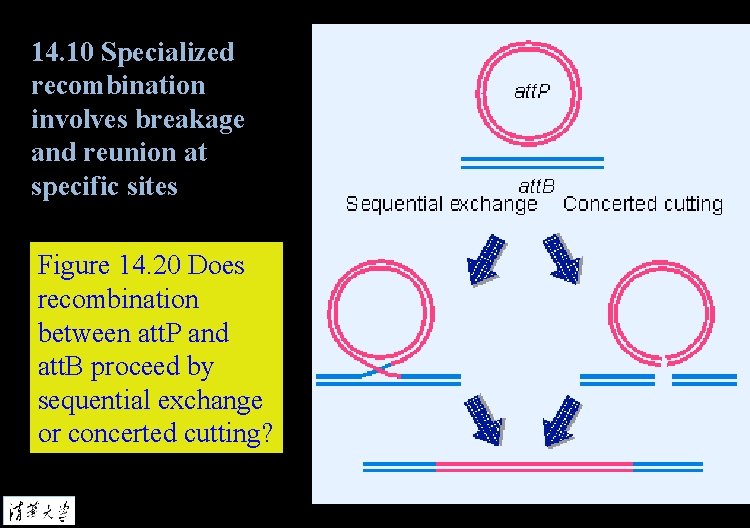
14. 10 Specialized recombination involves breakage and reunion at specific sites Figure 14. 20 Does recombination between att. P and att. B proceed by sequential exchange or concerted cutting?
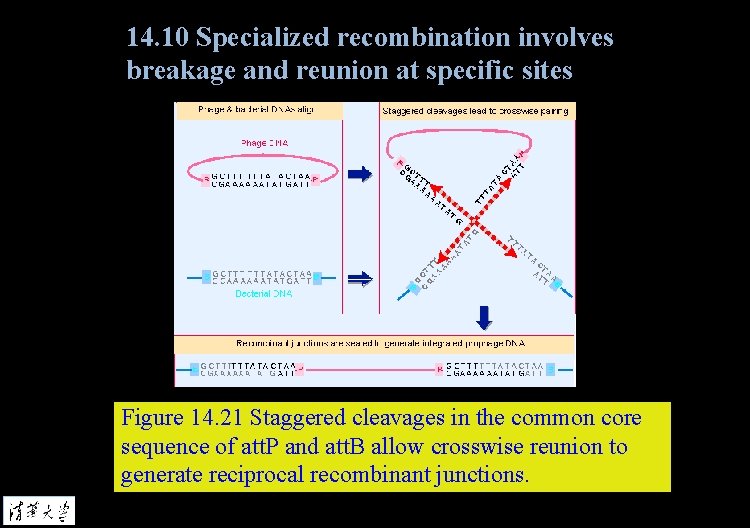
14. 10 Specialized recombination involves breakage and reunion at specific sites Figure 14. 21 Staggered cleavages in the common core sequence of att. P and att. B allow crosswise reunion to generate reciprocal recombinant junctions.
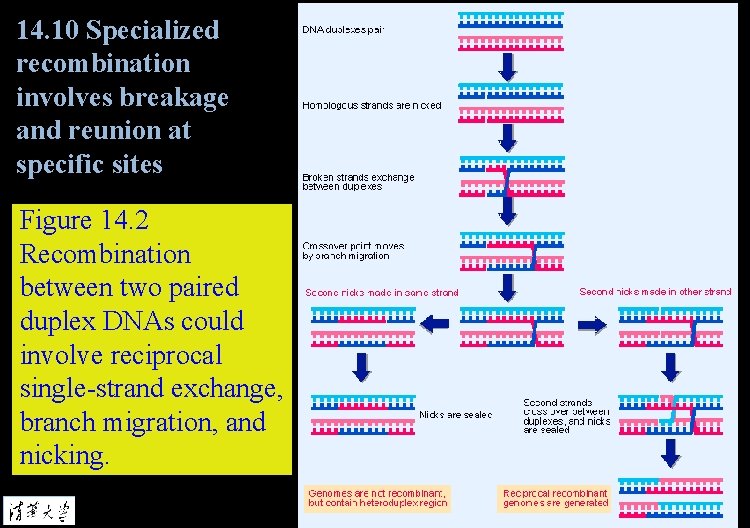
14. 10 Specialized recombination involves breakage and reunion at specific sites Figure 14. 2 Recombination between two paired duplex DNAs could involve reciprocal single-strand exchange, branch migration, and nicking.
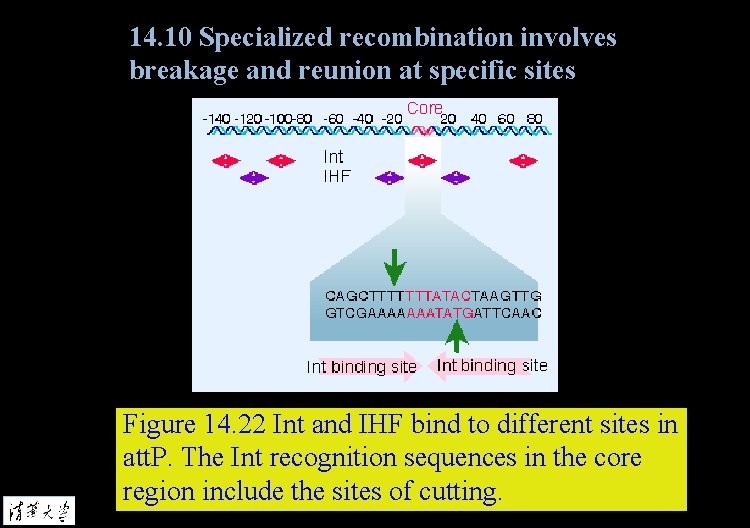
14. 10 Specialized recombination involves breakage and reunion at specific sites Figure 14. 22 Int and IHF bind to different sites in att. P. The Int recognition sequences in the core region include the sites of cutting.
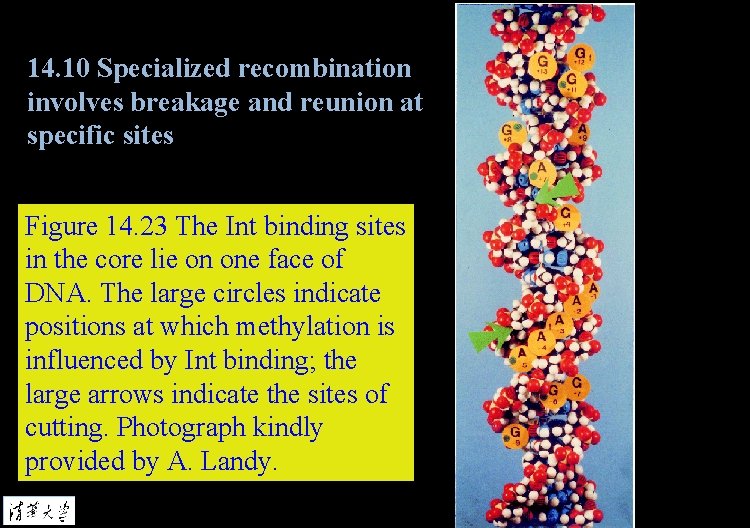
14. 10 Specialized recombination involves breakage and reunion at specific sites Figure 14. 23 The Int binding sites in the core lie on one face of DNA. The large circles indicate positions at which methylation is influenced by Int binding; the large arrows indicate the sites of cutting. Photograph kindly provided by A. Landy.
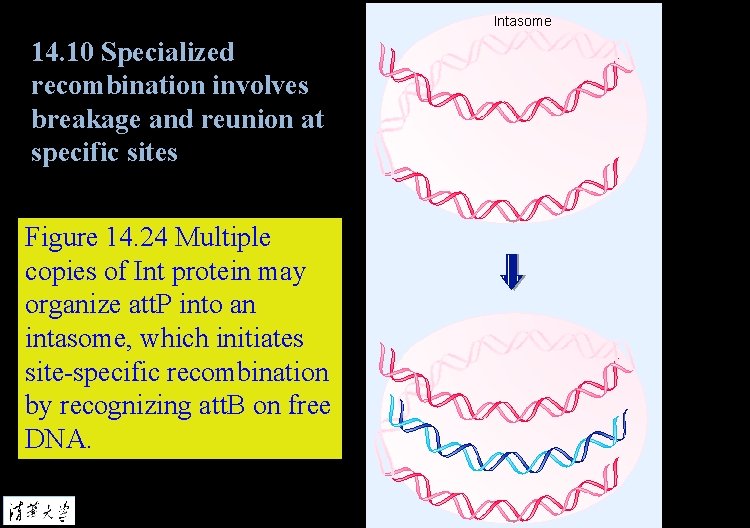
14. 10 Specialized recombination involves breakage and reunion at specific sites Figure 14. 24 Multiple copies of Int protein may organize att. P into an intasome, which initiates site-specific recombination by recognizing att. B on free DNA.
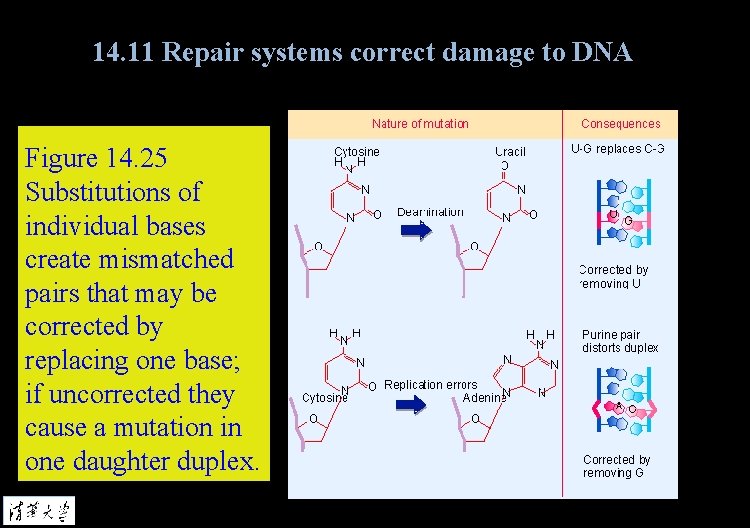
14. 11 Repair systems correct damage to DNA Figure 14. 25 Substitutions of individual bases create mismatched pairs that may be corrected by replacing one base; if uncorrected they cause a mutation in one daughter duplex.
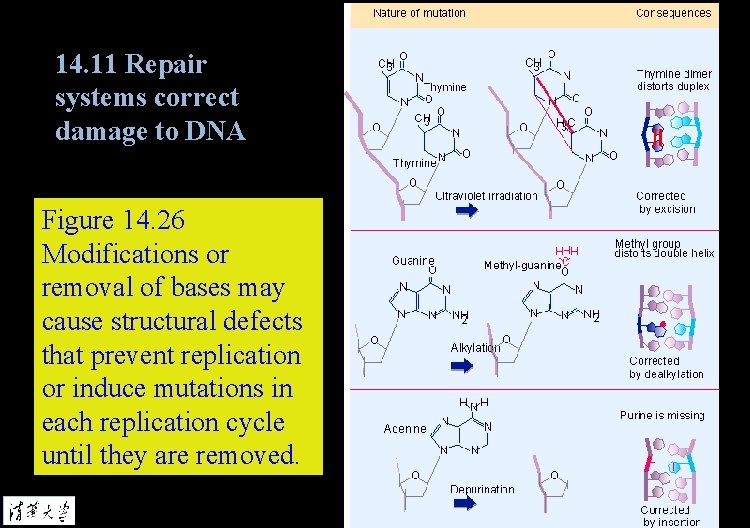
14. 11 Repair systems correct damage to DNA Figure 14. 26 Modifications or removal of bases may cause structural defects that prevent replication or induce mutations in each replication cycle until they are removed.
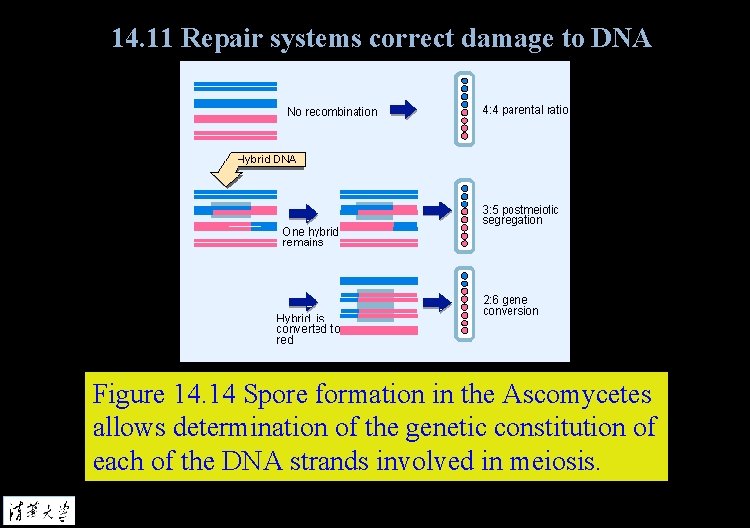
14. 11 Repair systems correct damage to DNA Figure 14. 14 Spore formation in the Ascomycetes allows determination of the genetic constitution of each of the DNA strands involved in meiosis.
14. 12 Excision repair systems in E. coli Excision of phage or episome or other sequence describes its release from the host chromosome as an autonomous DNA molecule.
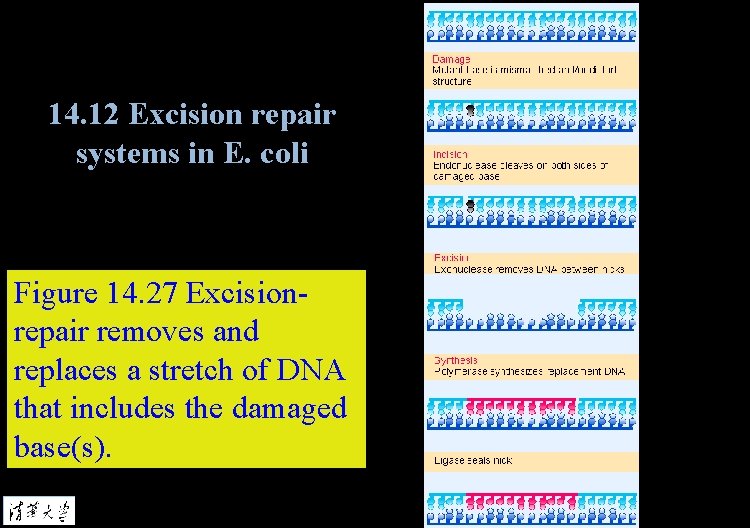
14. 12 Excision repair systems in E. coli Figure 14. 27 Excisionrepair removes and replaces a stretch of DNA that includes the damaged base(s).
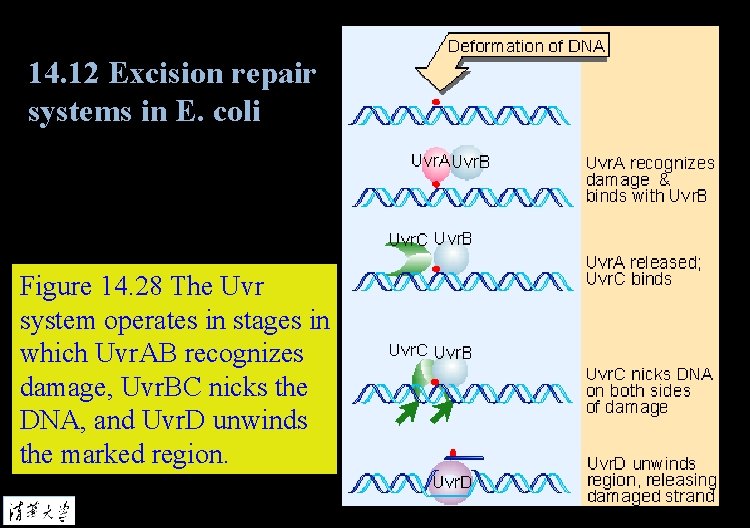
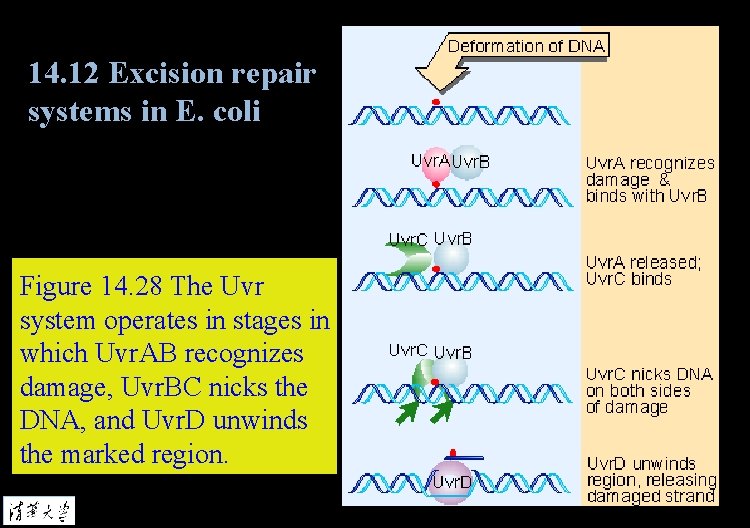
14. 12 Excision repair systems in E. coli Figure 14. 28 The Uvr system operates in stages in which Uvr. AB recognizes damage, Uvr. BC nicks the DNA, and Uvr. D unwinds the marked region.
14. 12 Excision repair systems in E. coli Figure 14. 28 The Uvr system operates in stages in which Uvr. AB recognizes damage, Uvr. BC nicks the DNA, and Uvr. D unwinds the marked region.
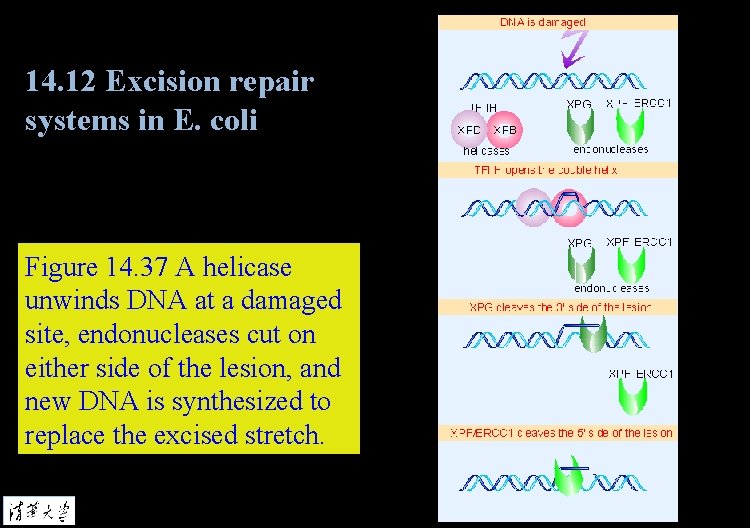
14. 12 Excision repair systems in E. coli Figure 14. 37 A helicase unwinds DNA at a damaged site, endonucleases cut on either side of the lesion, and new DNA is synthesized to replace the excised stretch.
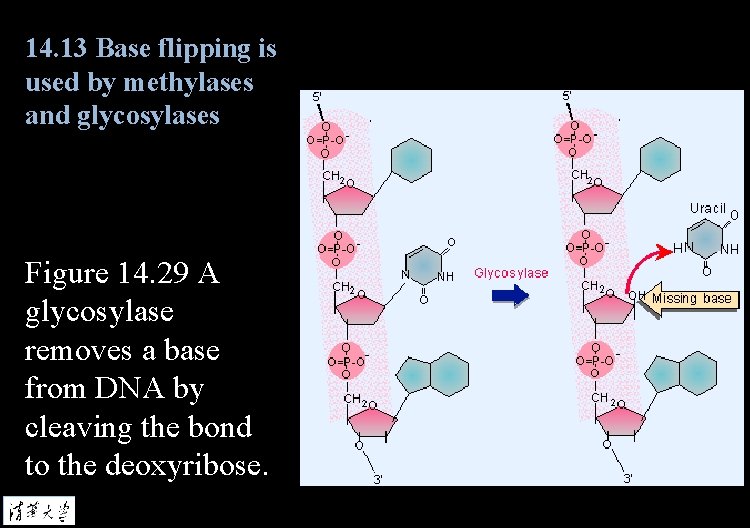
14. 13 Base flipping is used by methylases and glycosylases Figure 14. 29 A glycosylase removes a base from DNA by cleaving the bond to the deoxyribose.
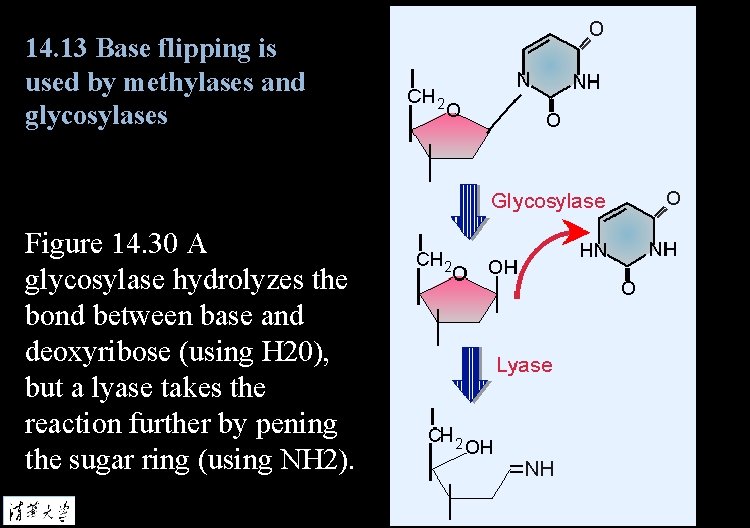
14. 13 Base flipping is used by methylases and glycosylases Figure 14. 30 A glycosylase hydrolyzes the bond between base and deoxyribose (using H 20), but a lyase takes the reaction further by pening the sugar ring (using NH 2).
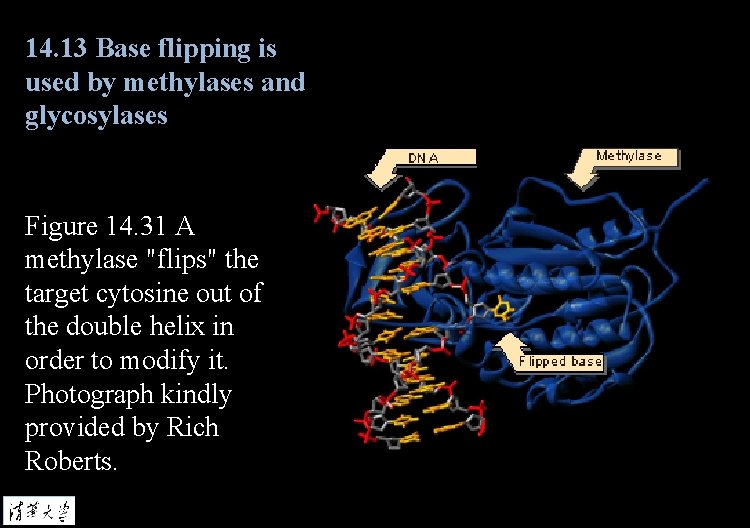
14. 13 Base flipping is used by methylases and glycosylases Figure 14. 31 A methylase "flips" the target cytosine out of the double helix in order to modify it. Photograph kindly provided by Rich Roberts.
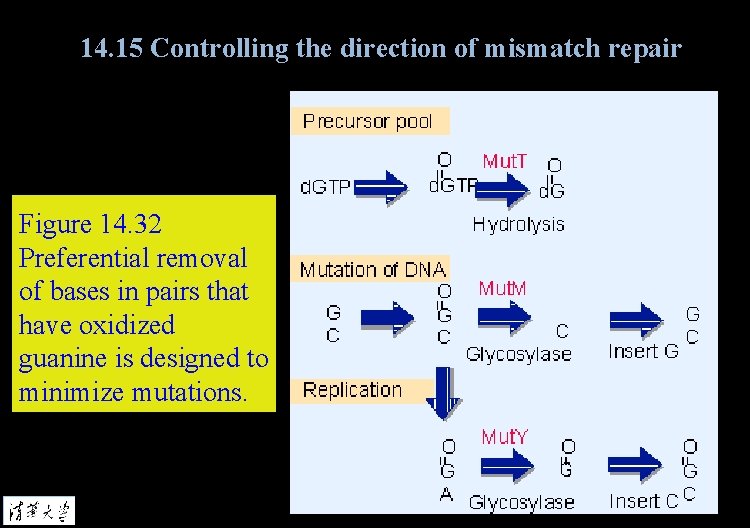
14. 15 Controlling the direction of mismatch repair Figure 14. 32 Preferential removal of bases in pairs that have oxidized guanine is designed to minimize mutations.
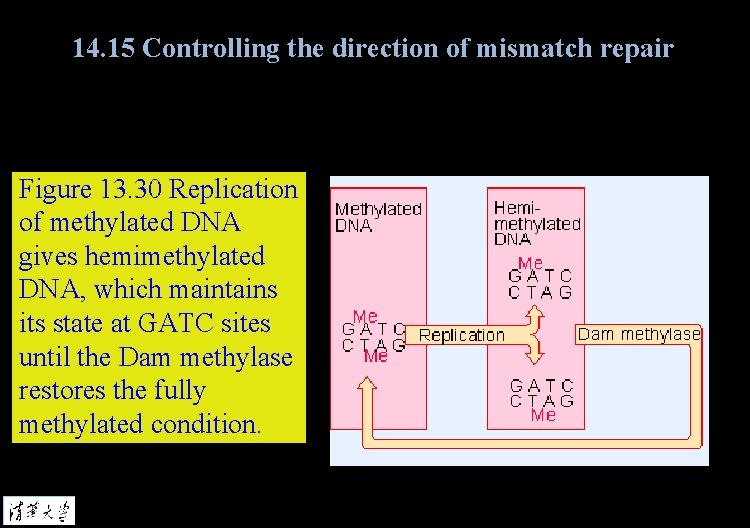
14. 15 Controlling the direction of mismatch repair Figure 13. 30 Replication of methylated DNA gives hemimethylated DNA, which maintains its state at GATC sites until the Dam methylase restores the fully methylated condition.
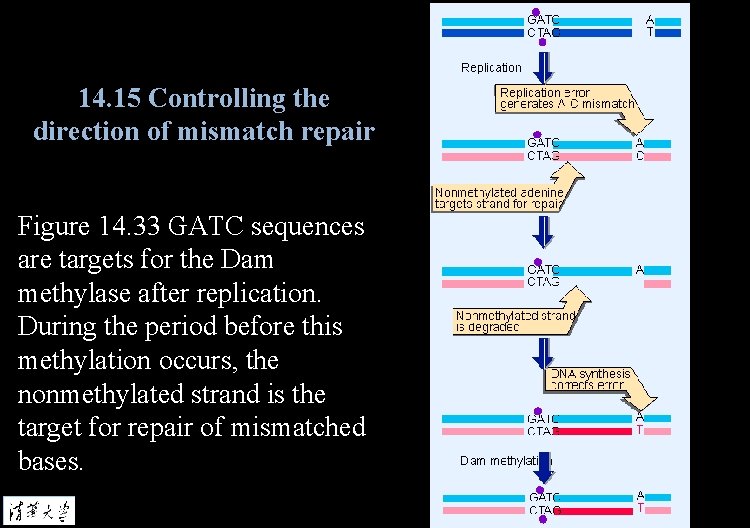
14. 15 Controlling the direction of mismatch repair Figure 14. 33 GATC sequences are targets for the Dam methylase after replication. During the period before this methylation occurs, the nonmethylated strand is the target for repair of mismatched bases.
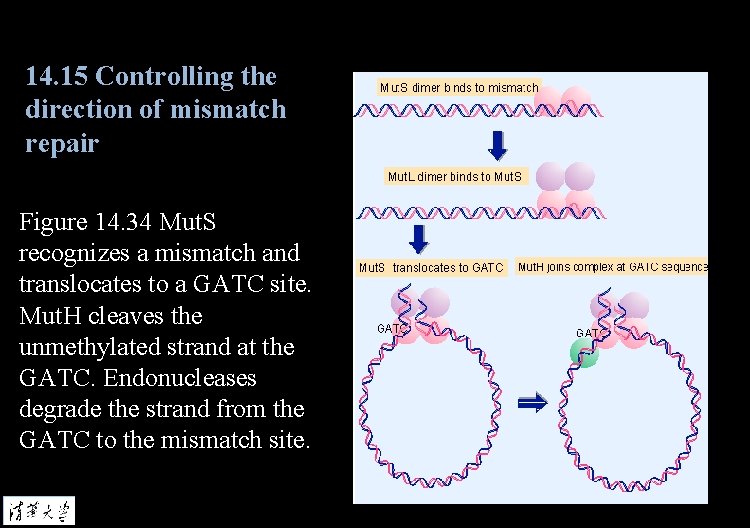
14. 15 Controlling the direction of mismatch repair Figure 14. 34 Mut. S recognizes a mismatch and translocates to a GATC site. Mut. H cleaves the unmethylated strand at the GATC. Endonucleases degrade the strand from the GATC to the mismatch site.
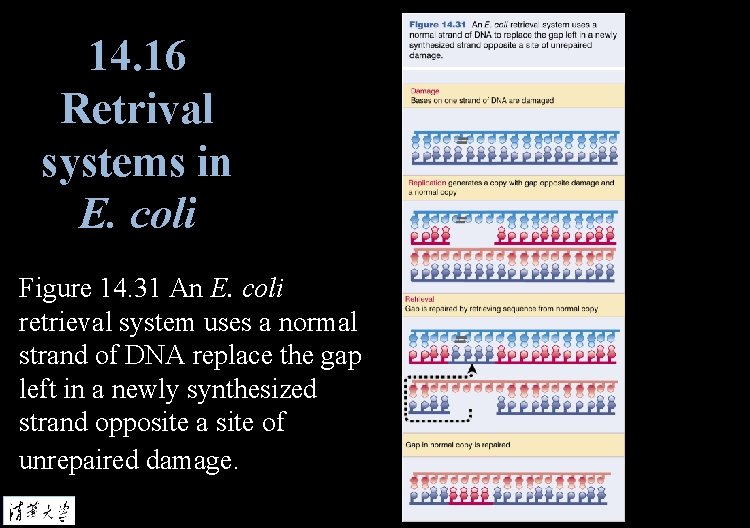
14. 16 Retrival systems in E. coli Figure 14. 31 An E. coli retrieval system uses a normal strand of DNA replace the gap left in a newly synthesized strand opposite a site of unrepaired damage.
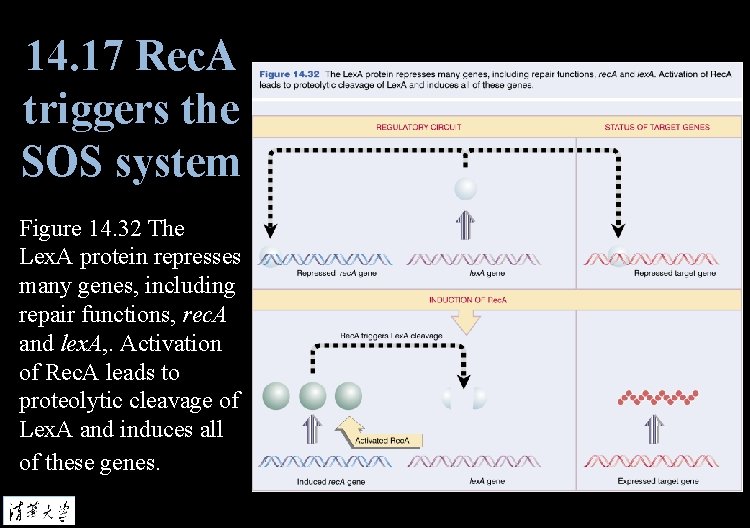
14. 17 Rec. A triggers the SOS system Figure 14. 32 The Lex. A protein represses many genes, including repair functions, rec. A and lex. A, . Activation of Rec. A leads to proteolytic cleavage of Lex. A and induces all of these genes.
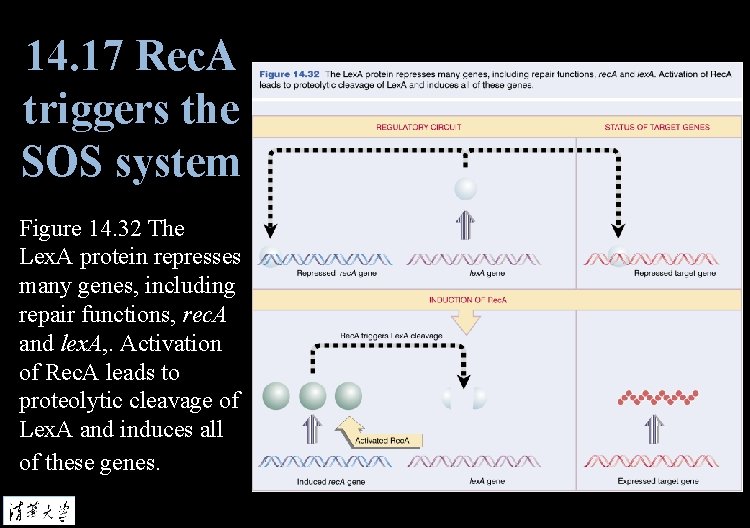
14. 17 Rec. A triggers the SOS system Figure 14. 32 The Lex. A protein represses many genes, including repair functions, rec. A and lex. A, . Activation of Rec. A leads to proteolytic cleavage of Lex. A and induces all of these genes.
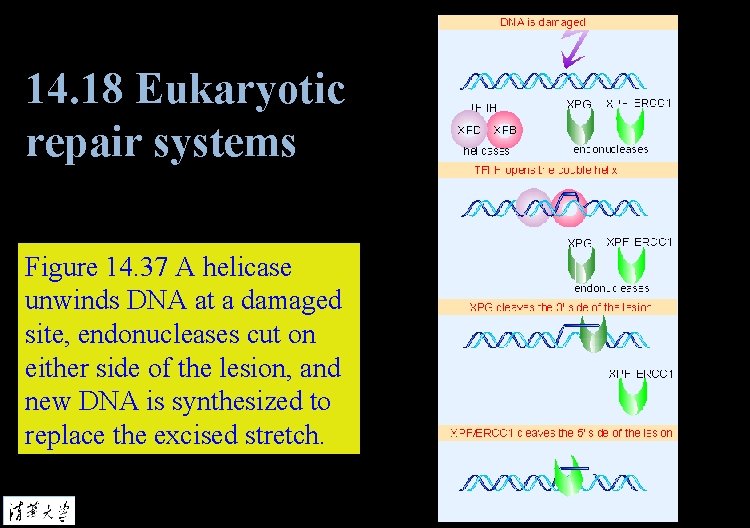
14. 18 Eukaryotic repair systems Figure 14. 37 A helicase unwinds DNA at a damaged site, endonucleases cut on either side of the lesion, and new DNA is synthesized to replace the excised stretch.

Summary
- Slides: 58