
Chapter 14 Population and Environmental Problems l l
Chapter 14, Population and Environmental Problems l l The Global Context: a World View of Population Growth Sociological Theories of Population and Environmental Problems Social Problems Related to Population Growth Strategies for Action: Slowing Population Growth
Chapter 14, Population and Environmental Problems l l l Environmental Problems Social Causes of Environmental Problems Strategies for Action: Responding to Environmental Problems
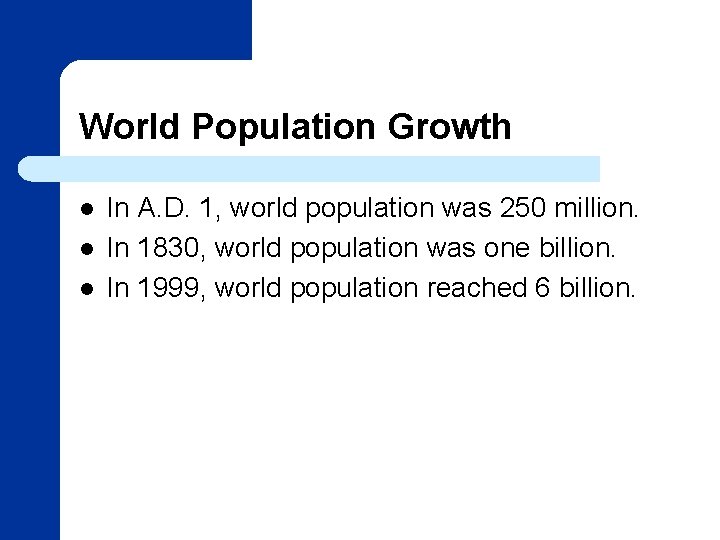
World Population Growth l l l In A. D. 1, world population was 250 million. In 1830, world population was one billion. In 1999, world population reached 6 billion.
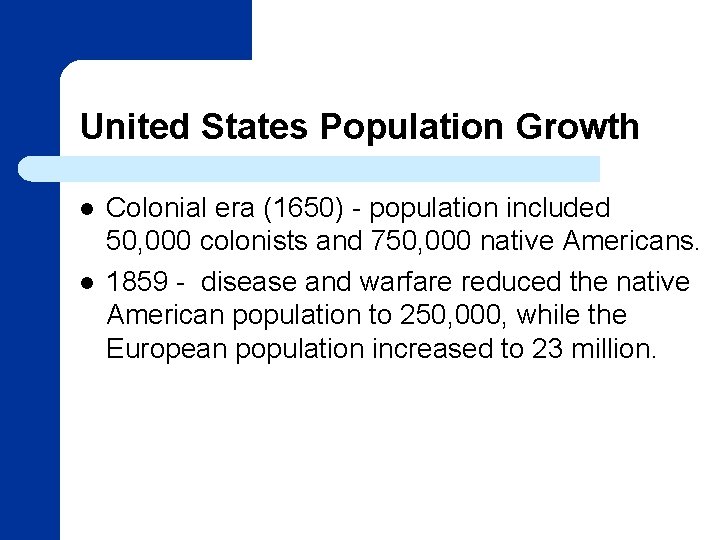
United States Population Growth l l Colonial era (1650) - population included 50, 000 colonists and 750, 000 native Americans. 1859 - disease and warfare reduced the native American population to 250, 000, while the European population increased to 23 million.
United States Population Growth l l Between 1990 and 2000 - U. S. Population grew by 32. 7 million people, representing the largest census-to-census increase in U. S. History. U. S. Population is expected to reach more than 400 million by 2050.
Structural-Functionalist Perspective l l Emphasizes the interdependence between human beings and the natural environment. Focuses on how changes in one aspect of the social system affect other aspects of society.
Conflict Perspective l l l Focuses on how wealth and power affect population and environmental problems. Population growth results from poverty and subordinate position of women in less developed countries. Wealth, power, and the pursuit of profit underlie many environmental problems.
Symbolic Interactionist Perspective l Focuses on how meanings, labels, and definitions affect population and environmental problems. – Women in pronatalistic societies learn that control of fertility is socially unacceptable. – Once they learn new definitions of fertility, they can influence behaviors of others.
Global Food Requirements l l In 1950, 20% of world’s population was malnourished. In the late 1990 s, one-half of the world’s population suffered from malnutrition.
Water Shortages l l Water use has tripled since 1950. In U. S. , per capita water consumption is about 185 gallons. 40% of the world population faces water shortages at some time during the year. 33 countries are expected to have chronic water shortages by 2025.
Slowing Population Growth: Improve the Status of Women l l l Status of women throughout developing world is restricted to wife and mother. Educated women are more likely to use contraception, and to limit their children. High levels of female labor force participation and higher wages for women are associated with smaller family size.
Air Pollution l l l Air pollution levels highest in areas with heavy industry and traffic congestion. In mid-1990 s, breathing the air in Mexico City was like smoking 2 packs of cigarettes a day. Indoor pollutants include carpet, mattresses, dry-cleaned clothes, paints, varnishes, potpourri, mothballs, air fresheners, fragrances.
Destruction of the Ozone Layer l l l Allows hazardous levels of ultraviolet rays to reach the earth's surface. Largest ozone hole is over Antarctica and spans 11. 5 million square miles. Previously, ozone hole exposed only ocean and barren land; now it exposes Puntas Arenas, Chile.
Effects of Global Warming: l l l As temperature increases, some regions will experience more rain and others will get drier. Shifts in plant and animal habitats - extinction of some species. Melting of glaciers and permafrost, resulting in rise in sea level.
Nuclear Waste l l l Radioactive waste from nuclear power plants and weapons production is associated with cancer and genetic defects. Radioactive plutonium, used in nuclear power and weapons production, has a half-life of 24, 000 years. Disposal of nuclear waste is risky and costly,
Computers and the Environment l l l 14% of used computers are recycled or donated. Most discarded computers end up in landfills, where toxic materials leach into soil and groundwater. Toxic components include lead, cadmium, barium, mercury, flame retardants, PCBs, and polyvinyl chloride.
Water Pollution l l l 40% of all U. S. waters are not fishable or swimmable. Water is polluted by pesticides, industrial waste, acid rain, oil spills, and feces. In 1998, more than 8, 000 oil spills occurred in or around U. S. waters.
Threats to Biodiversity l l Primary cause of species decline is humaninduced habitat destruction Estimates suggest that at least 1, 000 species of life are lost each year.
- Slides: 18