
CHAPTER 14 Patient Education 14 2 Learning Outcomes
- Slides: 46
CHAPTER 14 Patient Education
14 -2 Learning Outcomes (cont. ) 14. 1 Identify the benefits of patient education and the medical assistant’s role in providing education. 14. 2 Describe factors that affect learning and teaching. 14. 3 Implement teaching techniques. 14. 4 Choose reliable patient education materials used in the medical office.
14 -3 Learning Outcomes (cont. ) 14. 5 Explain how patient education can be used to promote good health habits. 14. 6 Describe the types of information that should be included in the patient information packet. 14. 7 Describe the benefits and special considerations of patient education prior to surgery.
14 -4 Introduction • Health education = lifelong pursuit • Encourage and teach healthy habits and behaviors • Medical assistants – Recognize and overcome roadblocks to education – Become comfortable with teaching – Lead others to their highest level of health
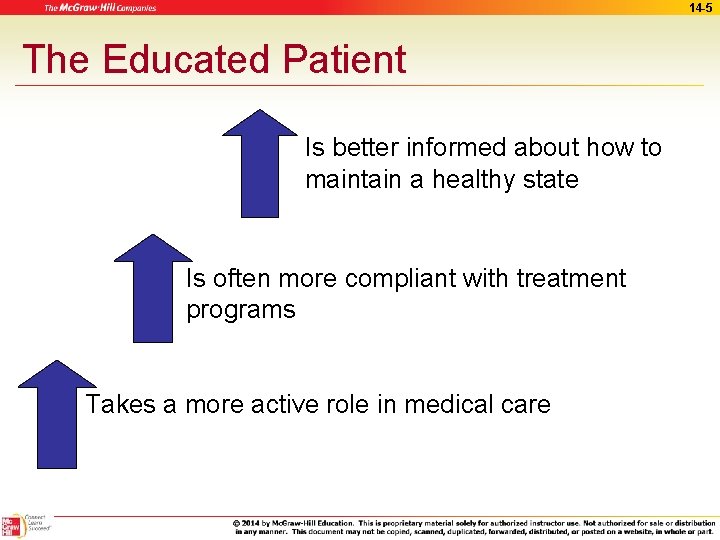
14 -5 The Educated Patient Is better informed about how to maintain a healthy state Is often more compliant with treatment programs Takes a more active role in medical care
14 -6 The Educated Patient (cont. ) • Benefits to the medical office – Satisfaction – Follows instructions – Less likely to call with questions, so staff spends less time on the telephone • Medical assistant participation in patient education – Place of employment and scope of practice – Awareness of patient understanding and needs
14 -7 Apply Your Knowledge What are the results of patient education? ANSWER: Patients can take a more active role in their health care. They are more compliant with the treatment program, stay healthier, and are more satisfied clients of the medical practice. EXCELLENT!
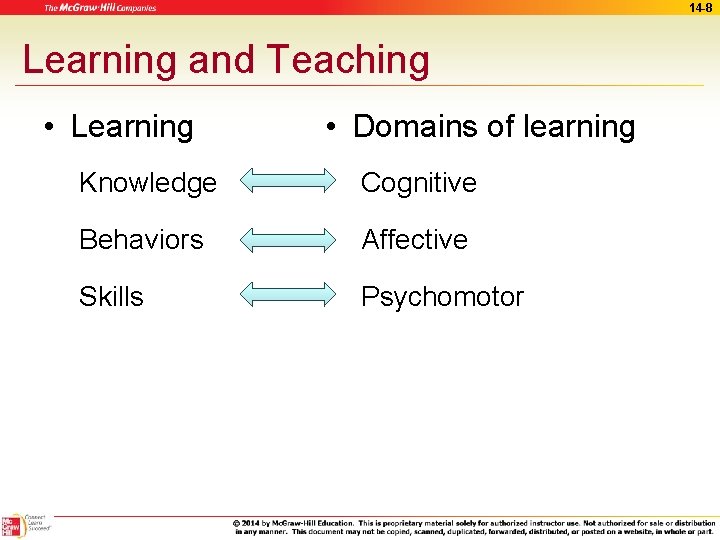
14 -8 Learning and Teaching • Learning • Domains of learning Knowledge Cognitive Behaviors Affective Skills Psychomotor
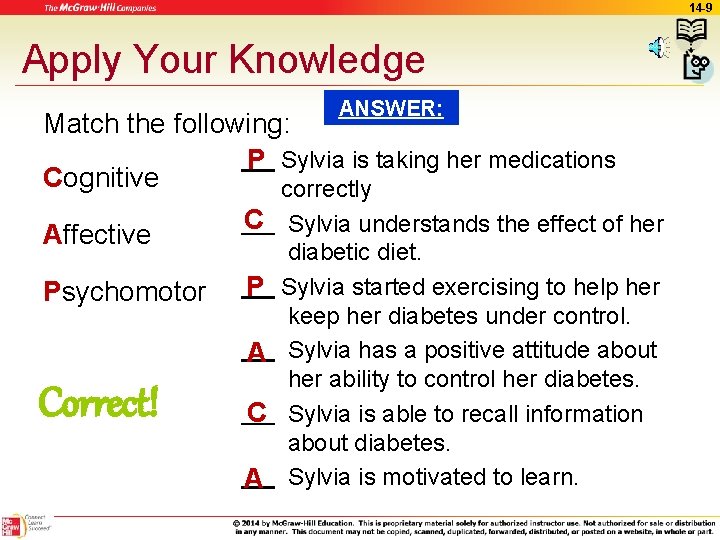
14 -9 Apply Your Knowledge ANSWER: Match the following: P Sylvia is taking her medications Cognitive correctly Affective C Sylvia understands the effect of her Psychomotor P A Correct! C A diabetic diet. Sylvia started exercising to help her keep her diabetes under control. Sylvia has a positive attitude about her ability to control her diabetes. Sylvia is able to recall information about diabetes. Sylvia is motivated to learn.
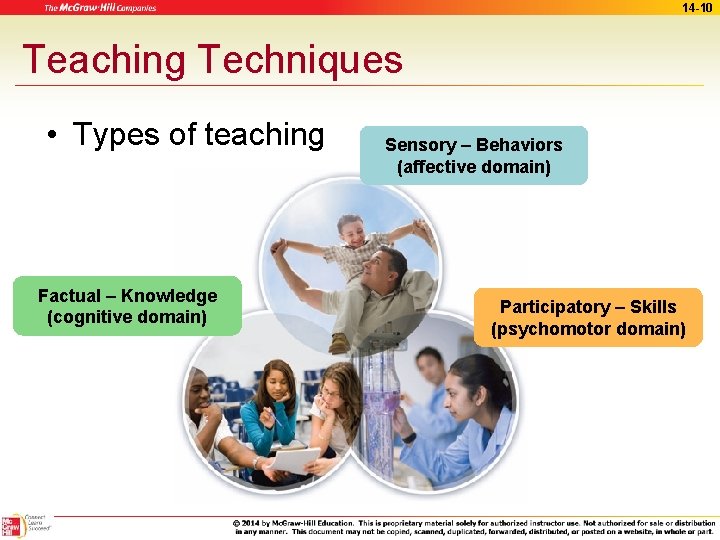
14 -10 Teaching Techniques • Types of teaching Factual – Knowledge (cognitive domain) Sensory – Behaviors (affective domain) Participatory – Skills (psychomotor domain)
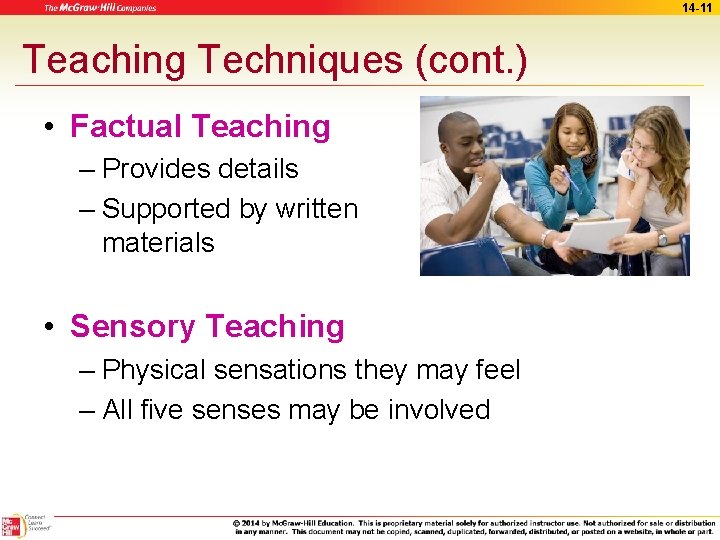
14 -11 Teaching Techniques (cont. ) • Factual Teaching – Provides details – Supported by written materials • Sensory Teaching – Physical sensations they may feel – All five senses may be involved
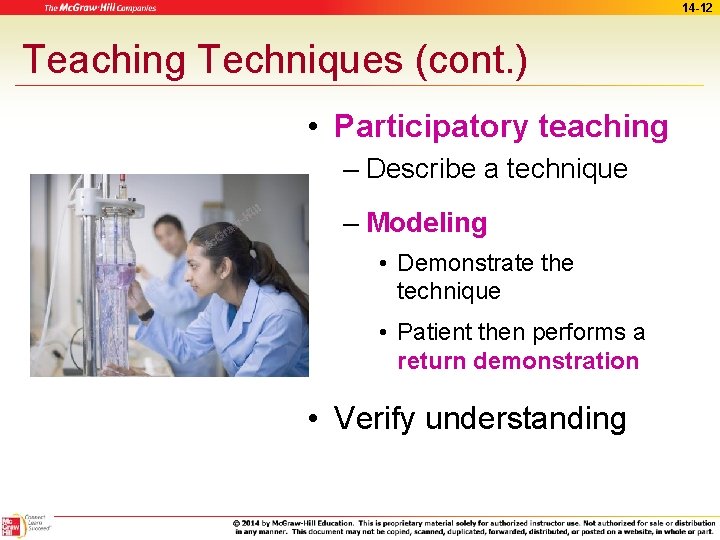
14 -12 Teaching Techniques (cont. ) • Participatory teaching – Describe a technique – Modeling • Demonstrate the technique • Patient then performs a return demonstration • Verify understanding
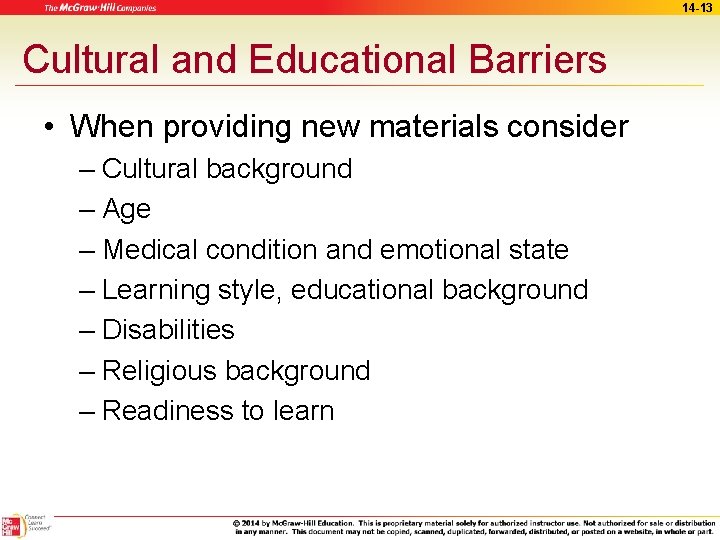
14 -13 Cultural and Educational Barriers • When providing new materials consider – Cultural background – Age – Medical condition and emotional state – Learning style, educational background – Disabilities – Religious background – Readiness to learn
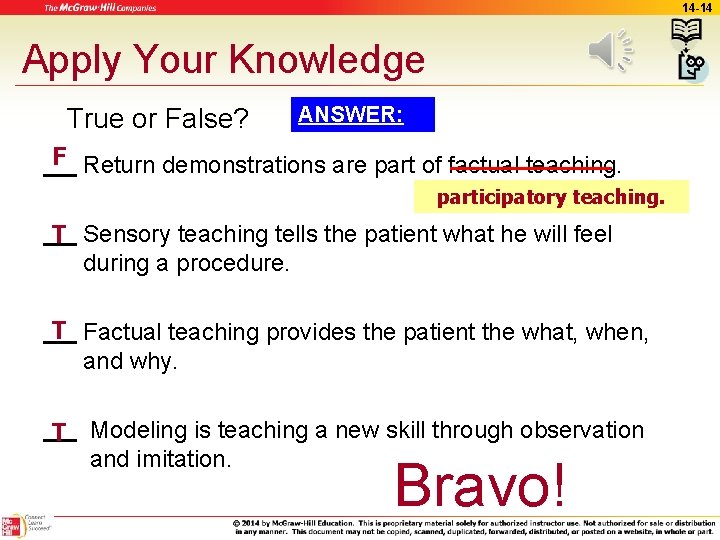
14 -14 Apply Your Knowledge True or False? ANSWER: F Return demonstrations are part of factual teaching. participatory teaching. T Sensory teaching tells the patient what he will feel during a procedure. T Factual teaching provides the patient the what, when, and why. T Modeling is teaching a new skill through observation and imitation. Bravo!
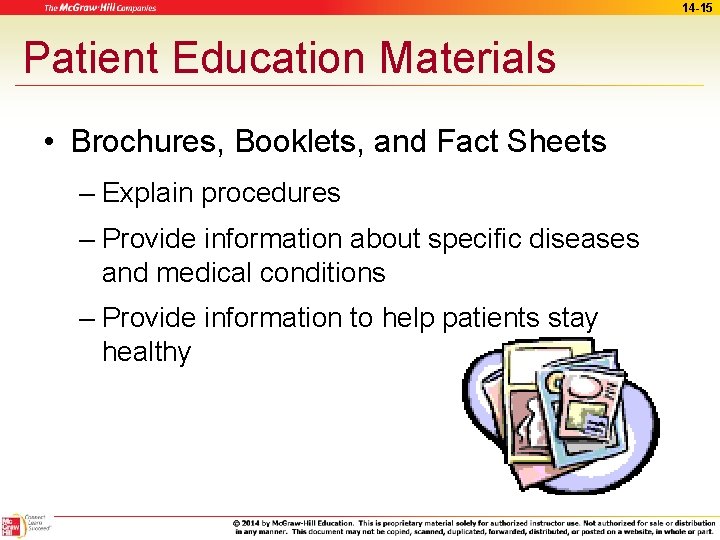
14 -15 Patient Education Materials • Brochures, Booklets, and Fact Sheets – Explain procedures – Provide information about specific diseases and medical conditions – Provide information to help patients stay healthy
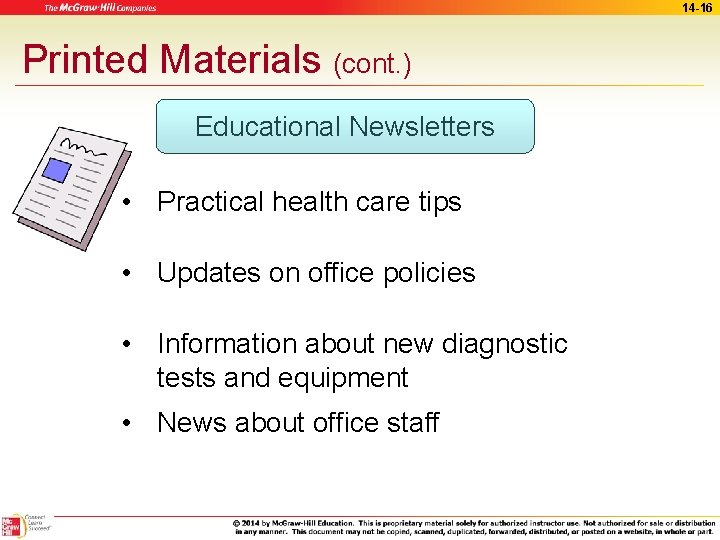
14 -16 Printed Materials (cont. ) Educational Newsletters • Practical health care tips • Updates on office policies • Information about new diagnostic tests and equipment • News about office staff
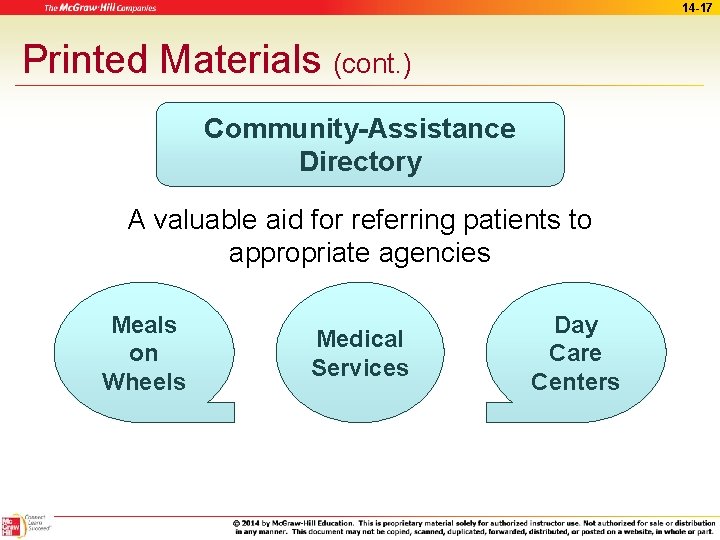
14 -17 Printed Materials (cont. ) Community-Assistance Directory A valuable aid for referring patients to appropriate agencies Meals on Wheels Medical Services Day Care Centers
14 -18 Visual Materials DVDs and videotapes – effective for educating about complex subjects and procedures Many physicians arrange seminars and classes for their patients.
14 -19 Visual Materials (cont. ) Libraries and patient resource rooms have a variety of educational materials. Health organizations and associations also provide health information.
14 -20 Visual Materials (cont. ) • Online health information – Check credibility of website – Develop a list for the patient • Education plan – – – Education needs Outline Resources Teach Evaluate
14 -21 Apply Your Knowledge List resources that are available to provide patient education materials. ANSWER: Community resources for patient education include libraries and patient resource rooms, online resources, community resources such as home health, and health-related associations such as the AHA. Correct!
14 -22 Promoting Health and Wellness Through Education • Consumer Education – increased awareness of good health practices • Ways to achieve good health – Develop healthy habits – Protect self from injury – Take preventive measures
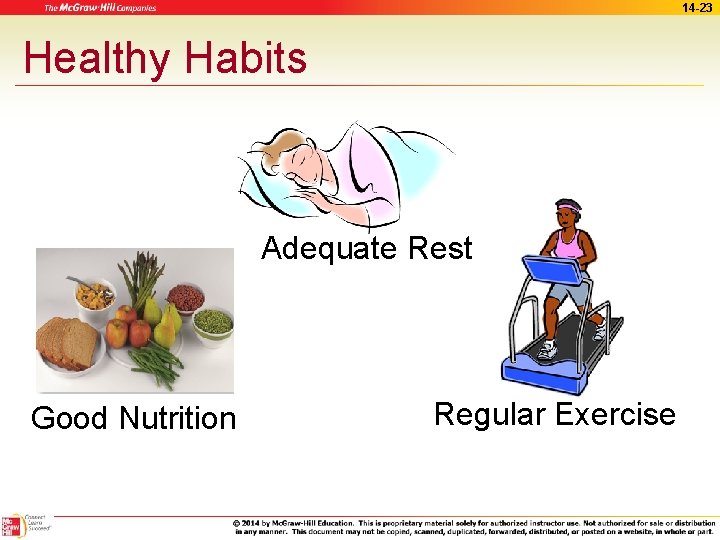
14 -23 Healthy Habits Adequate Rest Good Nutrition Regular Exercise
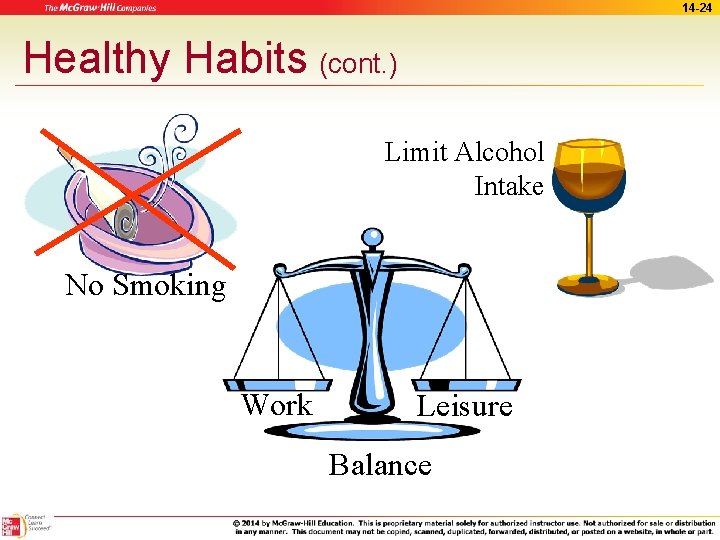
14 -24 Healthy Habits (cont. ) Limit Alcohol Intake No Smoking Work Leisure Balance
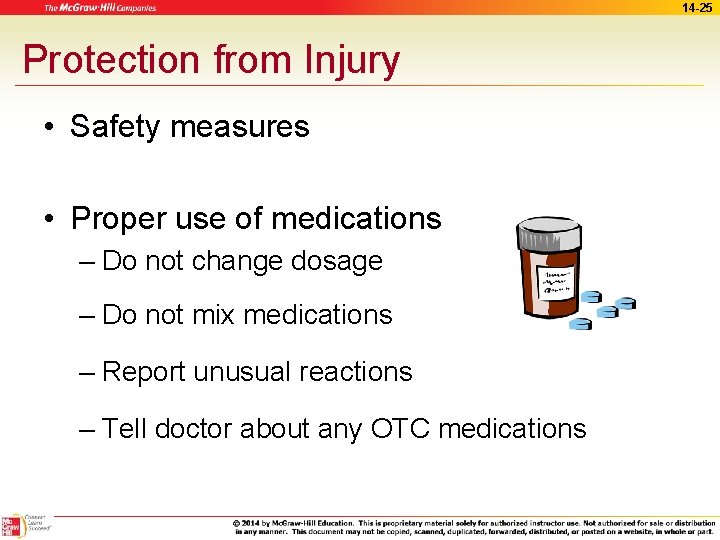
14 -25 Protection from Injury • Safety measures • Proper use of medications – Do not change dosage – Do not mix medications – Report unusual reactions – Tell doctor about any OTC medications
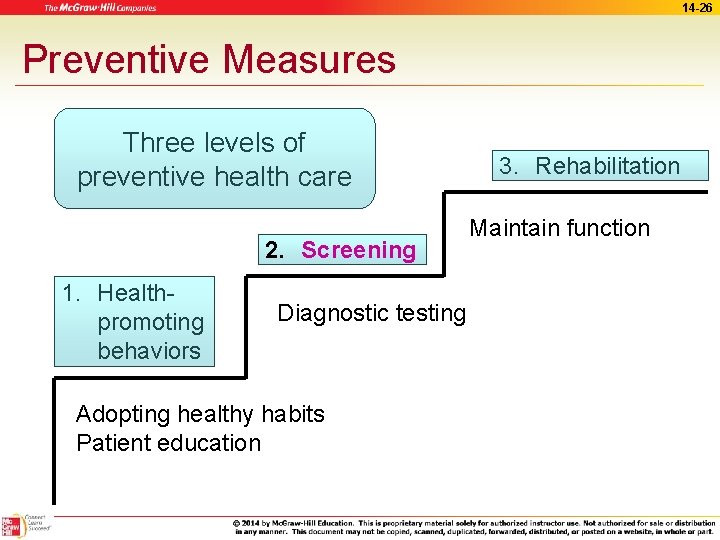
14 -26 Preventive Measures Three levels of preventive health care 2. Screening 1. Healthpromoting behaviors Diagnostic testing Adopting healthy habits Patient education 3. Rehabilitation Maintain function
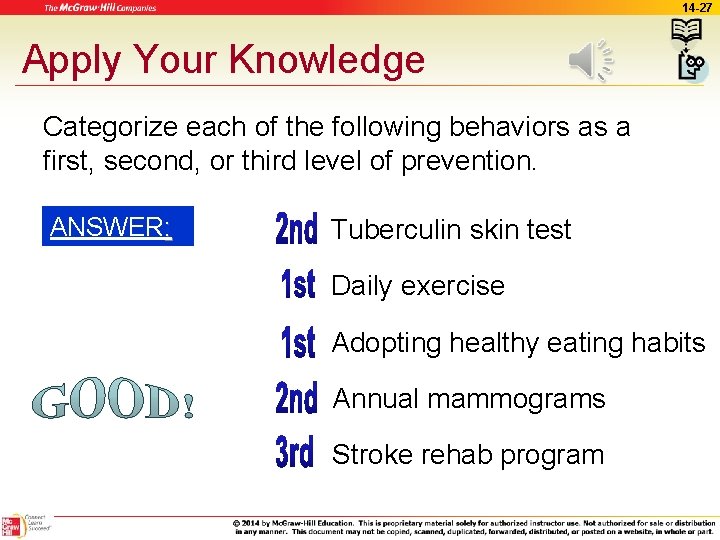
14 -27 Apply Your Knowledge Categorize each of the following behaviors as a first, second, or third level of prevention. ANSWER: Tuberculin skin test Daily exercise Adopting healthy eating habits Annual mammograms Stroke rehab program
14 -28 The Patient Information Packet • Benefits for patients – Improves relationships between the office and patients – Provides important information about office policies and staff roles • Office hours • Scheduling appointments • Payment policies
14 -29 The Patient Information Packet (cont. ) • Benefits for office staff – Marketing tool – Aid to running office smoothly – Saves time answering questions – Use to acquaint new staff members with office policies
14 -30 Contents of the Information Packet (cont. ) • Introduction to the office • Physician’s qualifications • Description of the practice • Introduction to the office staff Materials should be written at a sixth-grade reading
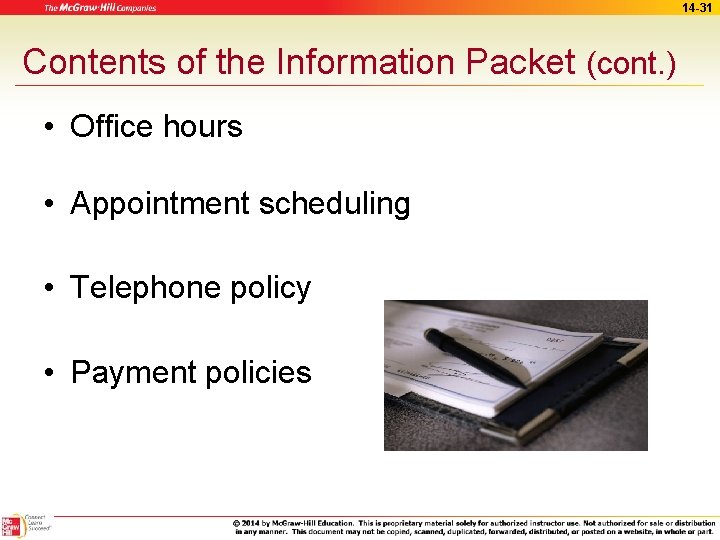
14 -31 Contents of the Information Packet (cont. ) • Office hours • Appointment scheduling • Telephone policy • Payment policies
14 -32 Contents of the Information Packet (cont. ) • Insurance policies • Patient confidentiality statement • Other information
14 -33 Distribution of Patient Information Packet • Give the packet to new patients • Mail the packet to patients • Refer patient to office website
14 -34 Apply Your Knowledge Following their office visit, several patients inquire about the credentials of the practitioner seeing them during the visit. How can this information be made available to the patients? ANSWER: Add this information to the patient information packet and also placed on the office website. IMPRESSIVE!
14 -35 Patient Education Prior to Surgery • Vital to successful outcomes • Medical assistant – Support and explanations – Verify patient understands information given – Document • Informed consent – Signed – Placed in medical record
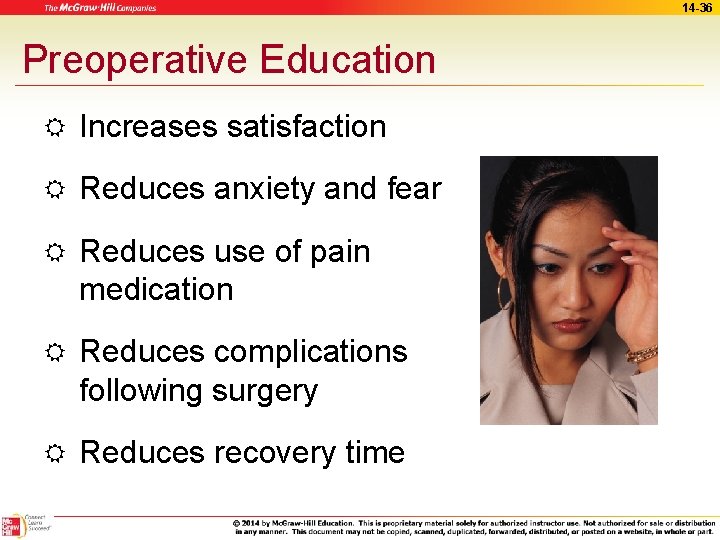
14 -36 Preoperative Education R Increases satisfaction R Reduces anxiety and fear R Reduces use of pain medication R Reduces complications following surgery R Reduces recovery time
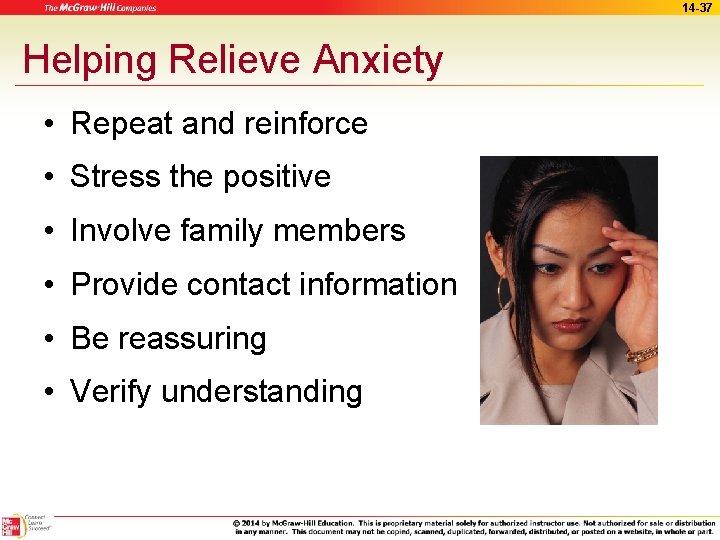
14 -37 Helping Relieve Anxiety • Repeat and reinforce • Stress the positive • Involve family members • Provide contact information • Be reassuring • Verify understanding
14 -38 Right Answer! Apply Your Knowledge What are the benefits of preoperative education for the patient? ANSWER: Preoperative education is important to the success of the procedure. It helps reduce anxiety and fear, use of pain medication, postoperative complications, and recovery time.
14 -39 In Summary 14. 1 Patients benefit from patient education because it can help them regain their health and independence more quickly. The medical office also benefits because patients will be less likely to call the office with questions. Educated patients take a more active role in their medical care.
14 -40 In Summary (cont. ) 14. 2 Learning occurs in three domains: knowledge, behaviors, and skills. The patient must be able to recall the information, have the right attitude and be motivated to learn, and then implement the skills needed to demonstrate that the knowledge is retained.
14 -41 In Summary (cont. ) 14. 3 Teaching methods and formats are adjusted for the best possible result depending on patient need and level of understanding. The best possible education plan comes from knowing your patient and his needs and abilities, as well as the goal of the instruction. Always assess your instruction at its completion and revise the plan as needed.
14 -42 In Summary (cont. ) 14. 4 There a variety of types of patient education materials in medical offices. Using already-completed print or electronic patient instruction sheets, ensuring that Internet sources are credible, and obtaining assistance from other healthcare team members are all methods of ensuring reliability of educational materials.
14 -43 In Summary (cont. ) 14. 5 Patient education promotes good health by teaching patients the importance of developing healthy habits such as eating properly and exercising regularly.
14 -44 In Summary (cont. ) 14. 6 The contents of the patient’s information packet should include an introduction to the medical office, the physician’s qualifications, a description of the practice, an introduction to the staff, office hours, appointment scheduling, telephone policies, payment and insurance policies, a confidentiality statement, and other pertinent information.
14 -45 In Summary (cont. ) 14. 7 Educating patients prior to surgery is vital to a successful outcome and involves instructing them on proper procedures before surgery and also having the patient sign a surgical consent.
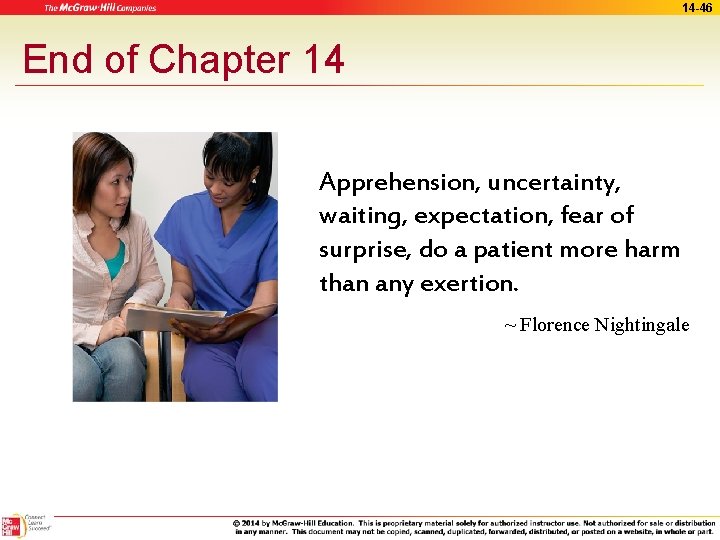
14 -46 End of Chapter 14 Apprehension, uncertainty, waiting, expectation, fear of surprise, do a patient more harm than any exertion. ~ Florence Nightingale