
CHAPTER 14 Organizational Structure Culture and Development Introduction
- Slides: 44
CHAPTER 14 Organizational Structure, Culture, and Development Introduction to Industrial/Organizational Psychology by Ronald E. Riggio
Organizational Structure ¢ Organizational structure refers to the arrangement of positions in an organization and the authority and responsibility relationships among them. l ¢ Organizational structure is determined by the interrelationships among the responsibilities of various employee positions and roles. Organizational structure can be characterized by several features, including traditionality, chain of command span of control, functional versus divisional structure, and centralization.
Dimensions of Organizational Structure ¢ Traditional organizations have formally defined roles for members and are ruledriven, stable, and resistant to change. l ¢ Jobs and lines of authority are clearly defined, so that much work behavior is regulated and kept within organizational standards. Nontraditional organizations are characterized by less formalized work roles and procedures. l They are flexible and adaptable, without a rigid status hierarchy; they are often called “organic”.
Dimensions of Organizational Structure ¢ Traditional organizations: Tend to be large, with greater coordination needed with larger numbers of workers. l Examples include government agencies, universities, and large factories. l Are often called “mechanistic” or “bureaucratic”. l
Dimensions of Organizational Structure ¢ Nontraditional organizations: Tend to be smaller. l May occur as a smaller organization within a larger, more traditionally structured organization. l Are often organized around a particular project or product line, and are responsible for all aspects of the project. l
Dimensions of Organizational Structure ¢ Nontraditional organizations have four important characteristics. High flexibility and adaptability l Collaboration among workers l Less emphasis on organizational status l Group decision making l
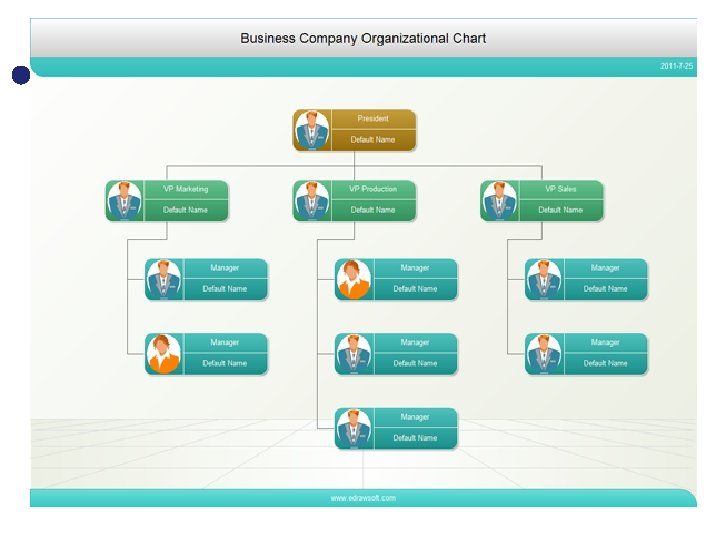
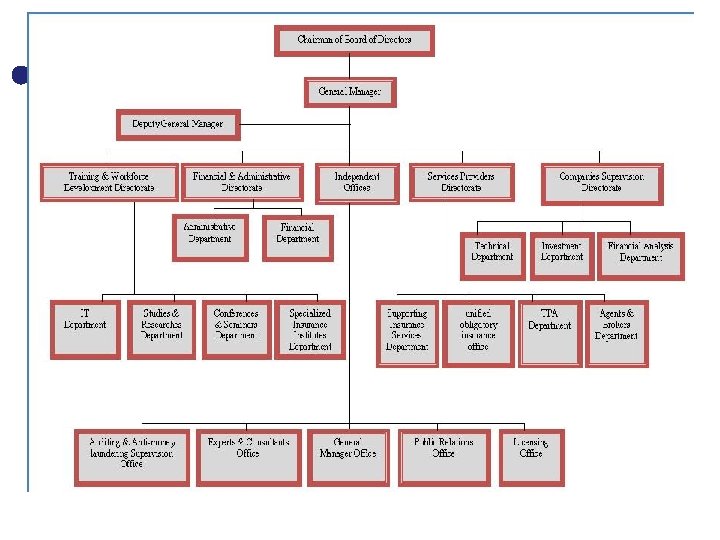
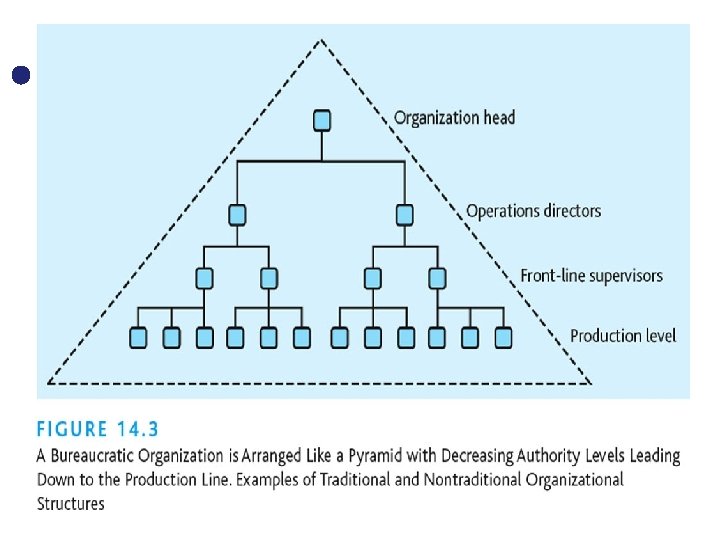
Dimensions of Organizational Structure ¢ Chain of command refers to the number of authority levels in an organization. l ¢ Follows the status hierarchy Span of control is the number of workers who must report to a single supervisor. l A wide span of control involves many subordinates reporting to each supervisor; a narrow span has few subordinates per supervisor.
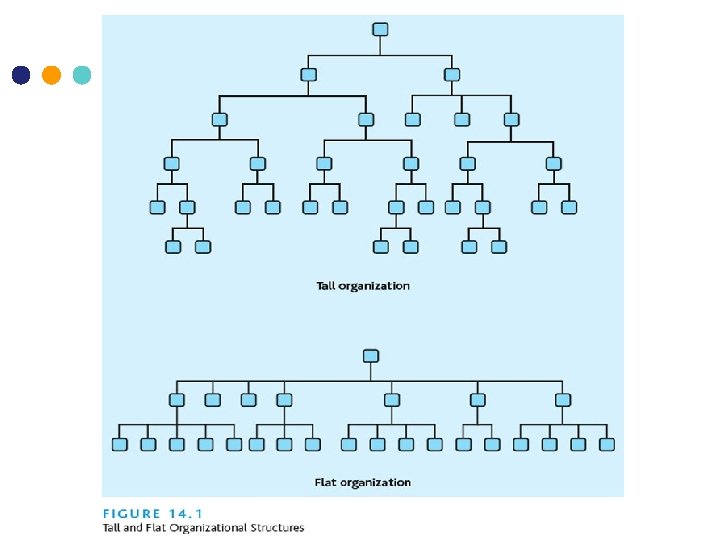
Dimensions of Organizational Structure ¢ Based on chain of command span of control, the shape of traditional organizational structures can be: l l l “Tall, ” with a long chain of command narrow span of control. “Flat, ” with short chain of command wide span of control. Very nontraditional organizations may have a very small chain of command, if any.
Dimensions of Organizational Structure ¢ Organization shape can affect work life in the organization. l l In “tall” structures, workers may feel cut off from the top levels, with little interaction between levels. “Tall” structures may become “top heavy” with management. “Tall” structures offer many opportunities for advancement. There is adequate supervision in “tall” structures, with a narrow span of control.
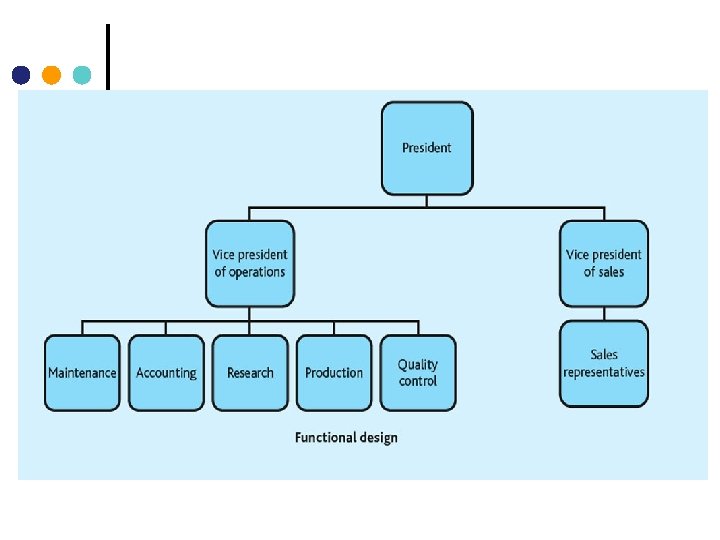
Dimensions of Organizational Structure ¢ Functional structure divides the organization into departments based on the functions or tasks they perform. l Creates job specialists l Eliminates duplication of functions l Interdepartmental rivalry and conflict l Work must move from one large department to another, which may decrease productivity
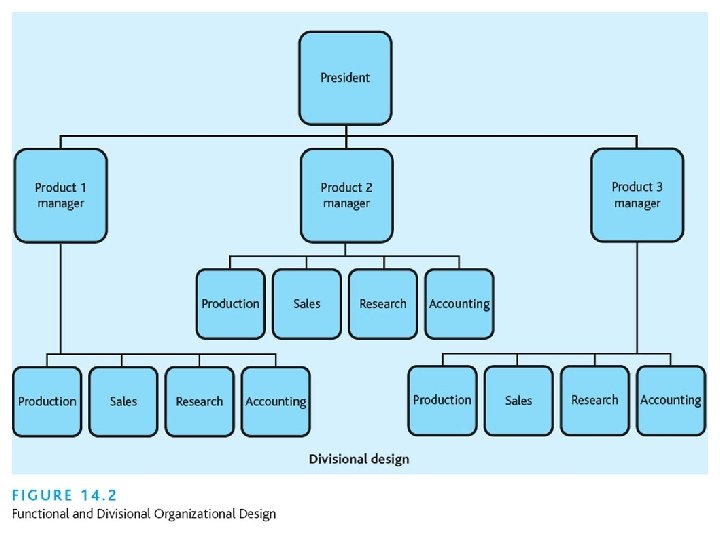
Dimensions of Organizational Structure ¢ Divisional structure divides the organization according to types of products or customers. l The organization can easily expand products or services by adding a new division. l It is easier to determine which units are performing at substandard or high levels. l Duplication of areas of expertise exist. l Workers with similar skills may not interact because they are in separate divisions.
Dimensions of Organizational Structure ¢ ¢ Centralization is the degree to which decision-making power rests at the upper levels of the organizational hierarchy. Decentralization is the process of taking decision-making authority away from the top levels of the organization and distributing it to the lower levels. l Employees in decentralized structures may perceive more fairness in the organization than those in centralized structures (Schminke et al. , 2000).
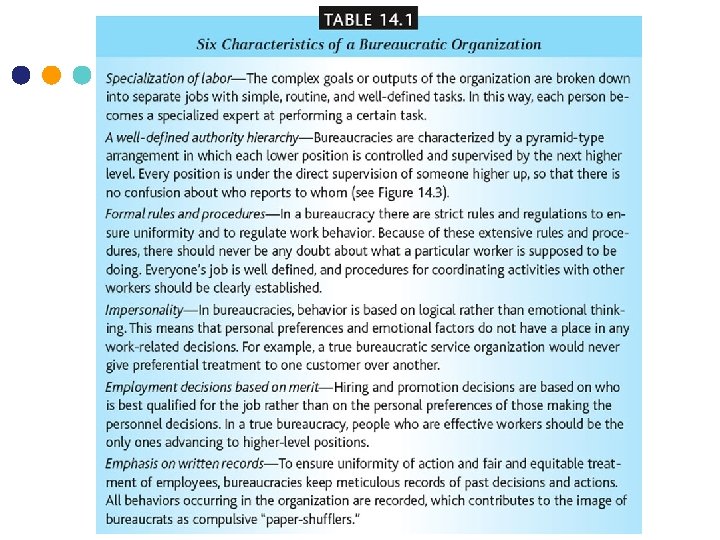
Examples of Traditional and Nontraditional Organizational Structures ¢ The bureaucracy is a traditional structure typified by a well-defined authority hierarchy and strict rules governing work behavior. Developed in the early 20 th century by Max Weber l Weber believed the bureaucracy established order in work settings and increased productivity by reducing inefficiencies in operations. l True bureaucracies have six qualities. l
Examples of Traditional and Nontraditional Organizational Structures With its emphasis on job specialization, bureaucratic structure leads to greater productivity and efficiency when manufacturing or delivering services is routine. l Their formality and inflexible rules may stifle individual worker creativity and initiative, and lead to low job satisfaction. l Bureaucratic structure may restrict an organization’s ability to grow and innovate. l
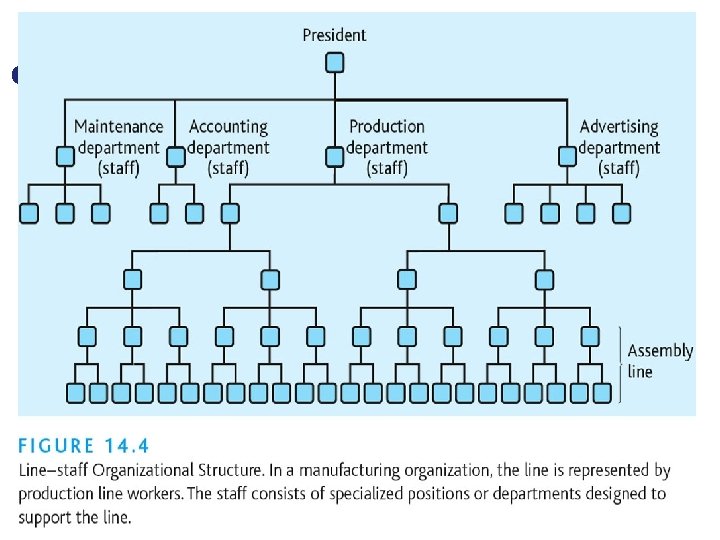
Examples of Traditional and Nontraditional Organizational Structures ¢ The line-staff structure is a traditional structure composed of one group of employees who achieve the goals of the organization (the line), and another group who supports the line (the staff). l l Line workers are directly involved in the tasks that accomplish the primary goals of the organization. Staff provide support to the line, accomplishing tasks that may have little to do with primary organizational goals and functions.
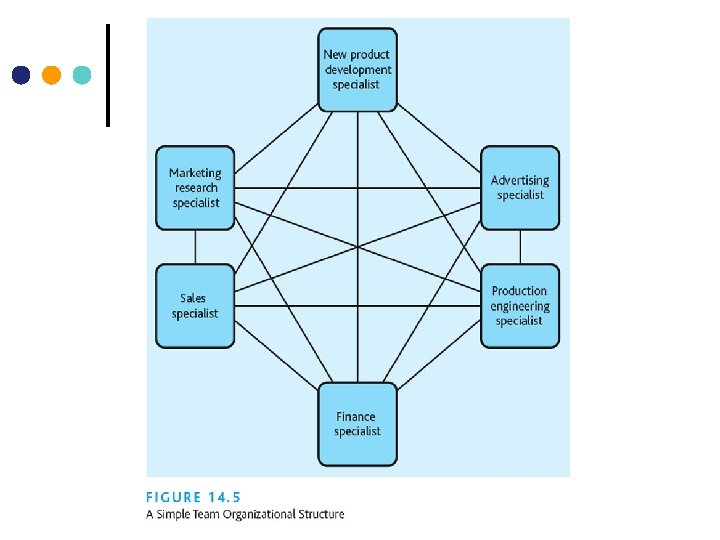
Examples of Traditional and Nontraditional Organizational Structures ¢ The team organization is a nontraditional structure consisting of a team of members organized around a particular project or product. l Workers have broadly defined jobs: • Each worker has a variety of skills. • They adopt new technology and innovative strategies readily. l High collaboration exits among workers. • High communication, shared decision making
Examples of Traditional and Nontraditional Organizational Structures ¢ The project task force is a nontraditional organization of workers who are assembled temporarily to complete a specific job or project. A “temporary” team organization exists. l All members are viewed as professionals who contribute collaboratively to the group’s output. l
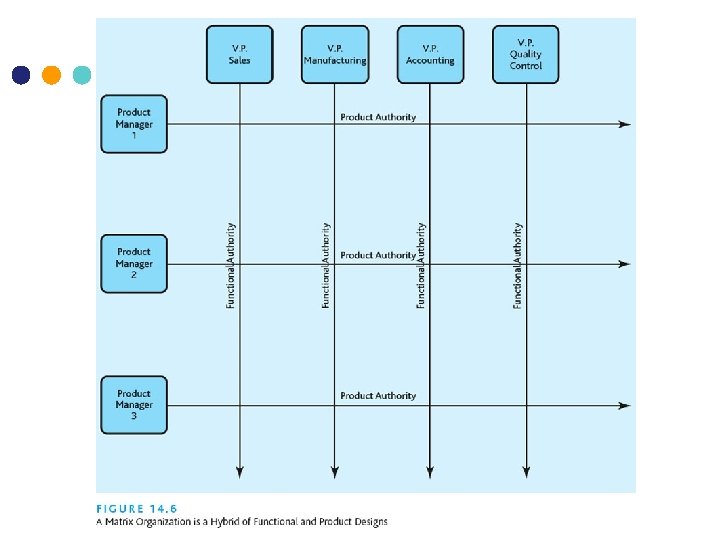
Examples of Traditional and Nontraditional Organizational Structures ¢ The matrix organization is a nontraditional organizational design that blends functional and product structures. l Workers report to a functional manager and a product manager. • Adapt rapidly to changing conditions • High flexibility • Best for products requiring creativity • Greater worker communication and job satisfaction • Greater potential for conflict with two “bosses”
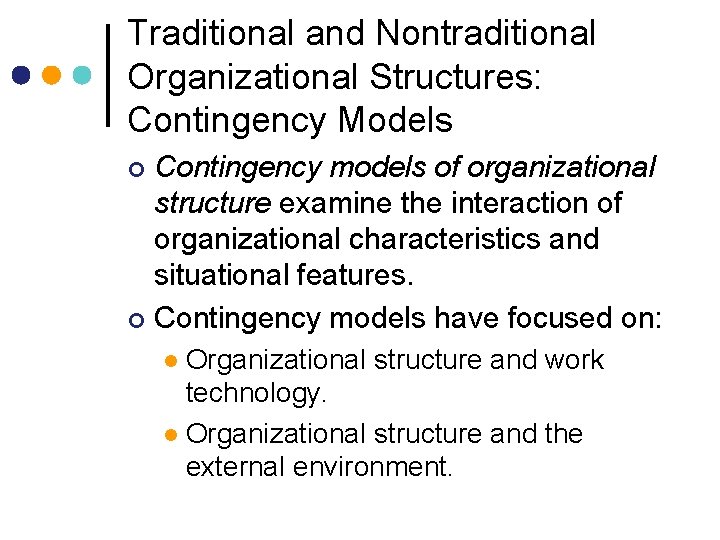
Traditional and Nontraditional Organizational Structures: Contingency Models Contingency models of organizational structure examine the interaction of organizational characteristics and situational features. ¢ Contingency models have focused on: ¢ Organizational structure and work technology. l Organizational structure and the external environment. l
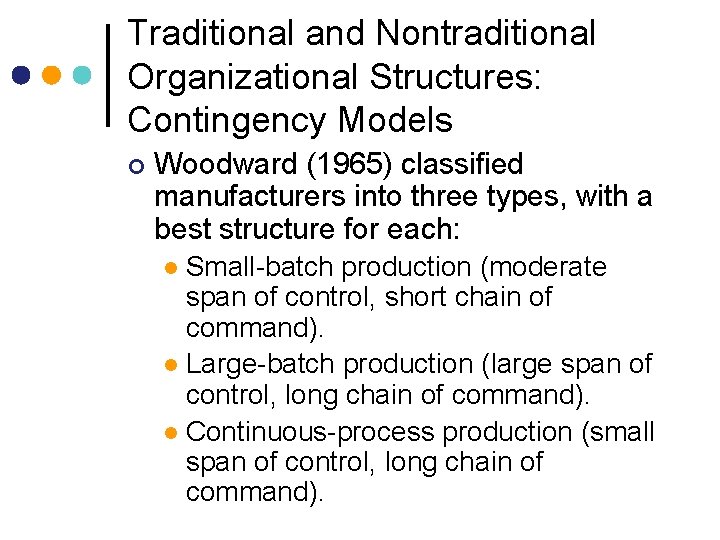
Traditional and Nontraditional Organizational Structures: Contingency Models ¢ Woodward (1965) classified manufacturers into three types, with a best structure for each: Small-batch production (moderate span of control, short chain of command). l Large-batch production (large span of control, long chain of command). l Continuous-process production (small span of control, long chain of command). l
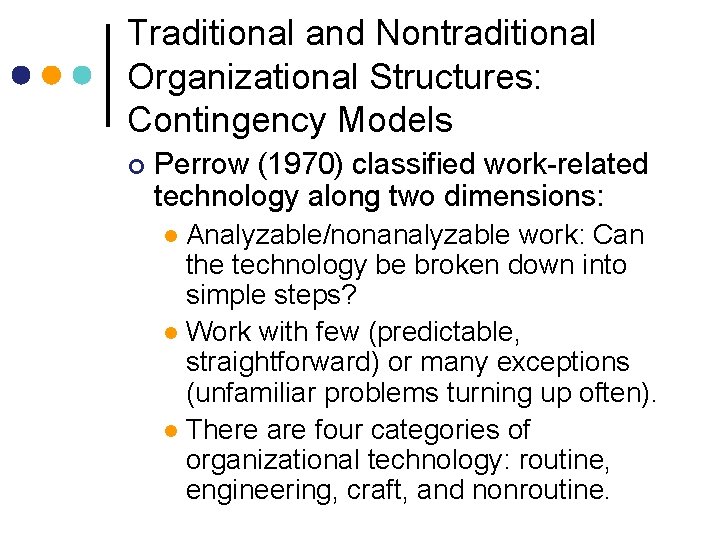
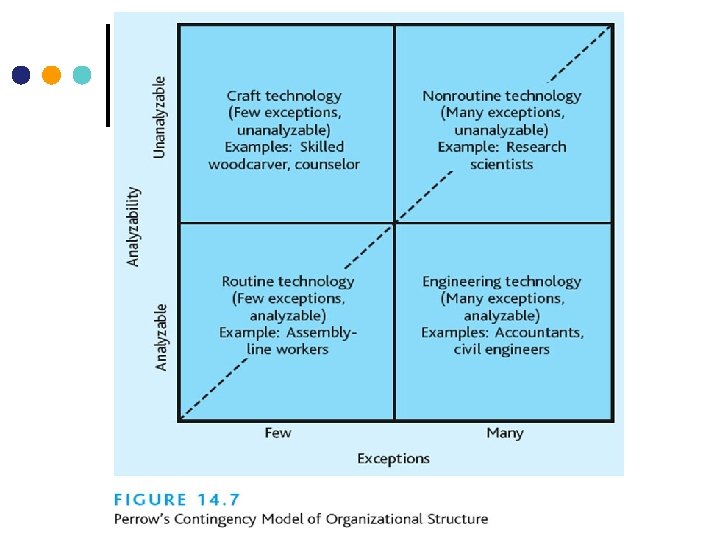
Traditional and Nontraditional Organizational Structures: Contingency Models ¢ Perrow (1970) classified work-related technology along two dimensions: Analyzable/nonanalyzable work: Can the technology be broken down into simple steps? l Work with few (predictable, straightforward) or many exceptions (unfamiliar problems turning up often). l There are four categories of organizational technology: routine, engineering, craft, and nonroutine. l
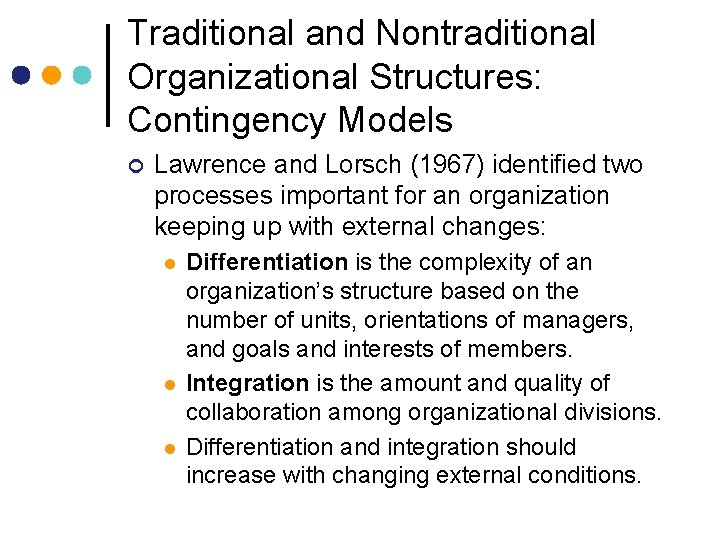
Traditional and Nontraditional Organizational Structures: Contingency Models ¢ Lawrence and Lorsch (1967) identified two processes important for an organization keeping up with external changes: l l l Differentiation is the complexity of an organization’s structure based on the number of units, orientations of managers, and goals and interests of members. Integration is the amount and quality of collaboration among organizational divisions. Differentiation and integration should increase with changing external conditions.
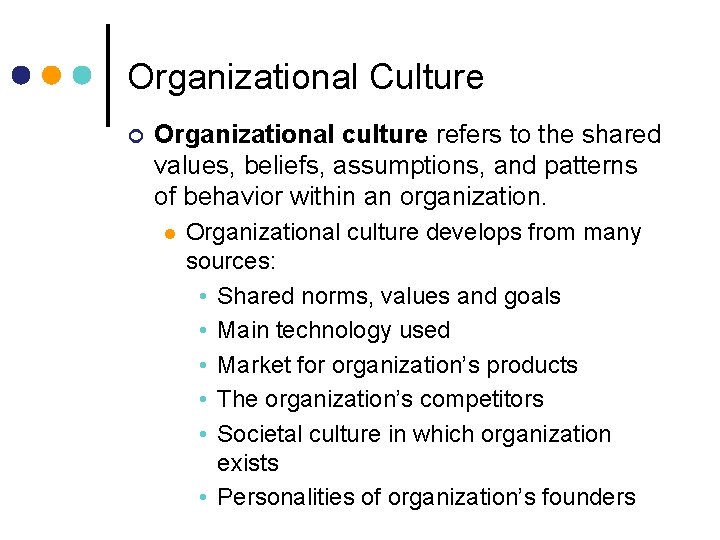
Organizational Culture ¢ Organizational culture refers to the shared values, beliefs, assumptions, and patterns of behavior within an organization. l Organizational culture develops from many sources: • Shared norms, values and goals • Main technology used • Market for organization’s products • The organization’s competitors • Societal culture in which organization exists • Personalities of organization’s founders
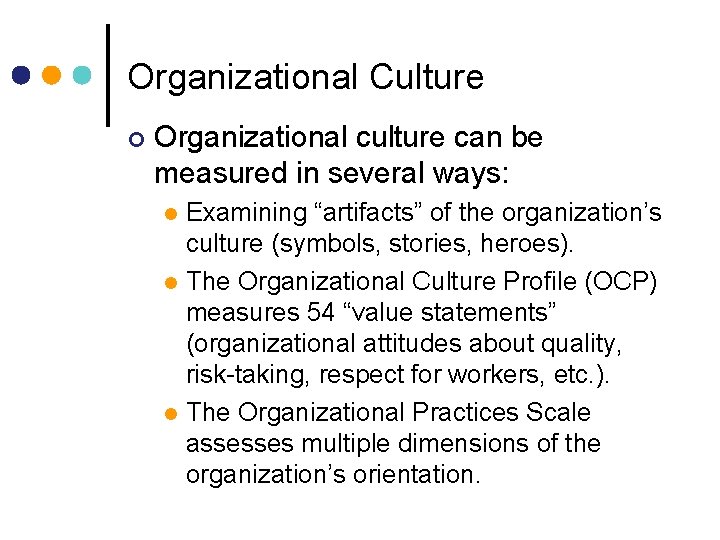
Organizational Culture ¢ Organizational culture can be measured in several ways: Examining “artifacts” of the organization’s culture (symbols, stories, heroes). l The Organizational Culture Profile (OCP) measures 54 “value statements” (organizational attitudes about quality, risk-taking, respect for workers, etc. ). l The Organizational Practices Scale assesses multiple dimensions of the organization’s orientation. l
Organizational Development ¢ Organizational development is the process of assisting organizations in preparing for and managing change. l Occurs in phases: • • l Diagnosis of significant problems Development of appropriate interventions Intervention implementation Evaluation of intervention results Uses a variety of orientations and methods
Organizational Development OD practitioners are often called change agents, referring to their role as a catalyst who helps organizations through the process of change. ¢ One popular OD technique is action research, which applies social science research methods to collecting relevant organizational data that are used for solving organizational problems. ¢
Organizational Development ¢ Organizational development techniques include: Survey feedback (the consultant develops and administers a survey to collect data that are fed back to members and used as the starting point for change). l T-groups (unstructured group interaction to assist workers in achieving insight into their motivations and behavior patterns in dealing with other members). l
Organizational Development ¢ Organizational development techniques include: Team building (teams of workers discuss how to improve team performance by analyzing group interaction). l Process consultation (a consultant helps a client-organization study its problems objectively and learn to solve them). l
Organizational Development ¢ Management by objectives (MBO) is a goal-setting OD technique in which supervisors and subordinates jointly set performance goals and evaluate their attainment.
Organizational Development ¢ For MBO to be effective, several criteria must be met: • Employees must participate in setting personal performance goals. • Feedback on goal attainment and guidelines for improvement must be provided. • Goals must be realistic. • Upper organizational levels must support program. • Individual, work group, and organizational goals must be equally emphasized.
Organizational Development ¢ Quality circles are small groups of volunteer employees from the same work area who meet regularly to solve work-related problems. Quality circles can lead to increased quality and productivity, and may enhance job satisfaction. l Failure of quality circles and other OD programs can often be traced to unsupportive management. l
Organizational Development The effectiveness of OD programs is difficult to evaluate. ¢ Results of evaluations of OD programs are mixed. ¢ Positive effects may be greater in job satisfaction and organizational commitment than in increased productivity (Bass, 1983). ¢ Successes of OD programs may be long-term changes that are difficult to trace back to OD. ¢