
Chapter 14 Organizational Design Structure Nelson Quick Organizational
- Slides: 25
Chapter 14 Organizational Design & Structure Nelson & Quick
Organizational Design - the process of constructing and adjusting an organization’s structure to achieve its goals. the linking of departments and jobs within an organization H. Mintzberg, The Structuring of Organizations, Prentice Hall, © 1979, 301. Reprinted by permission of Prentice-Hall, Inc, Upper Saddle River, NJ.
Key Organizational Design Processes
The process of deciding how to divide the work in an organization Four Dimensions • Goal orientation • Time orientation • Interpersonal orientation • Formality of structure
Horizontal Differentiation • The degree of differentiation between organizational subunits • Based on employees’ specialized knowledge, education, or training
Vertical Differentiation • The difference in authority and responsibility in the organizational hierarchy • Greater in tall, narrow organizations than in flat, wide organizations
Spatial Differentiation • Geographic dispersion of an organization’s offices, plants and personnel • Complicates organizational design, may simplify goal achievement or protection
The process of coordinating the different parts of an organization • Designed to achieve unity among individuals and groups • Supports a state of dynamic equilibrium - elements of organization are integrated, balanced
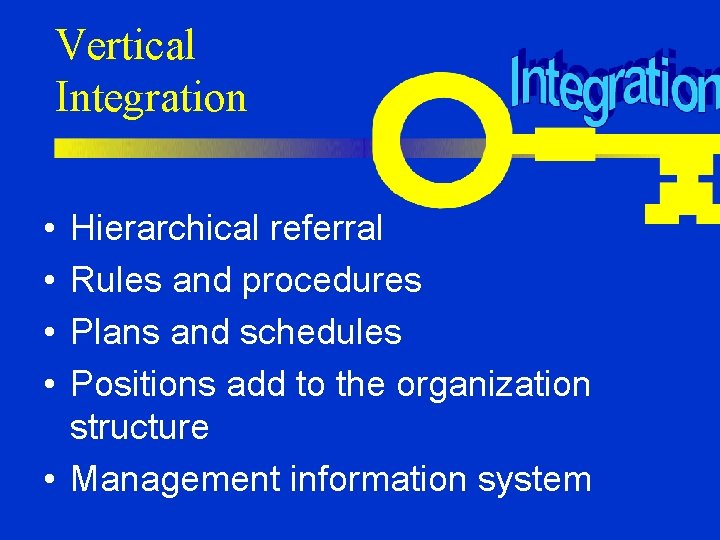
Vertical Integration • • Hierarchical referral Rules and procedures Plans and schedules Positions add to the organization structure • Management information system
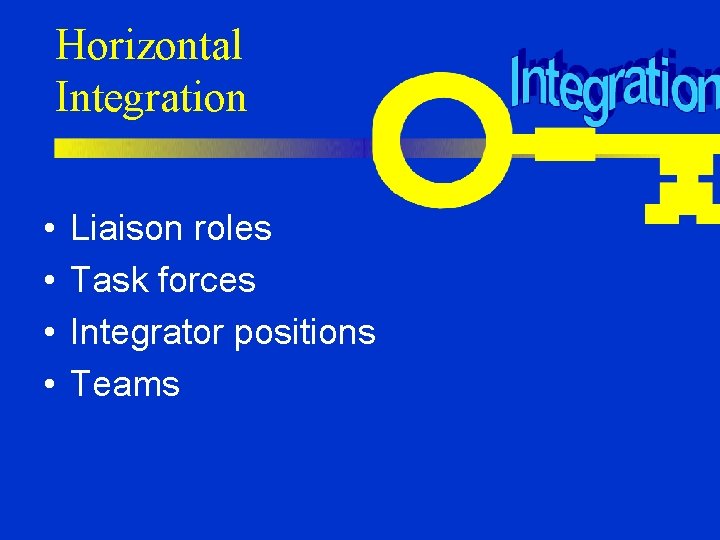
Horizontal Integration • • Liaison roles Task forces Integrator positions Teams
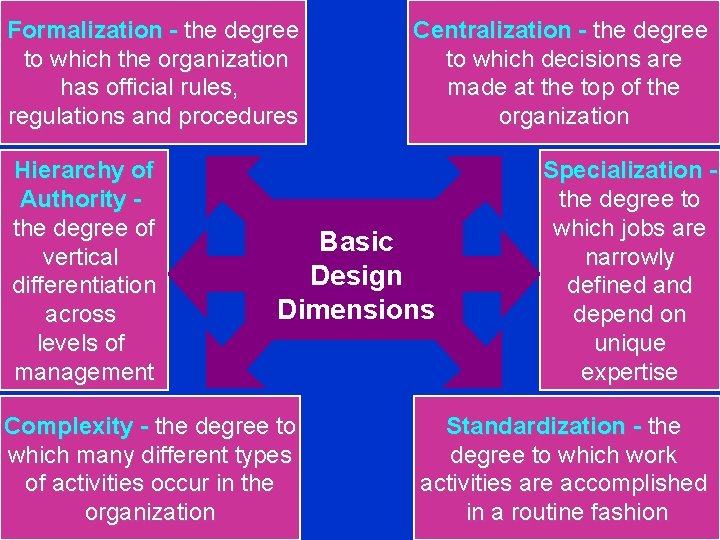
Formalization - the degree to which the organization has official rules, regulations and procedures Hierarchy of Authority the degree of vertical differentiation across levels of management Centralization - the degree to which decisions are made at the top of the organization Basic Design Dimensions Complexity - the degree to which many different types of activities occur in the organization Specialization the degree to which jobs are narrowly defined and depend on unique expertise Standardization - the degree to which work activities are accomplished in a routine fashion
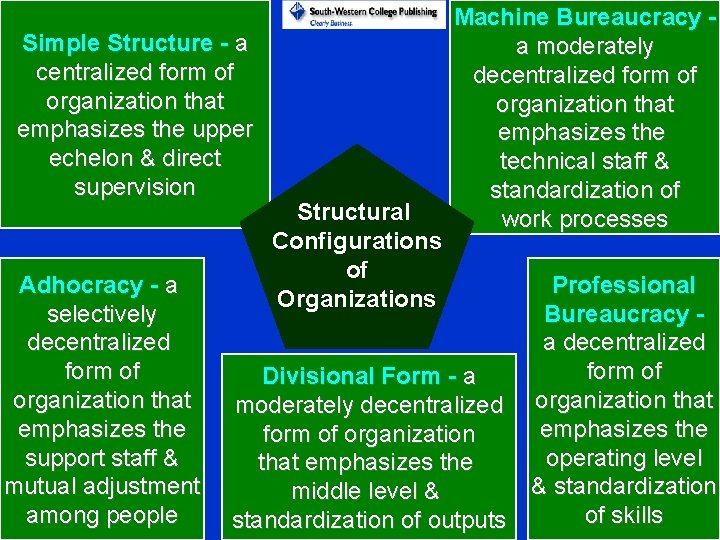
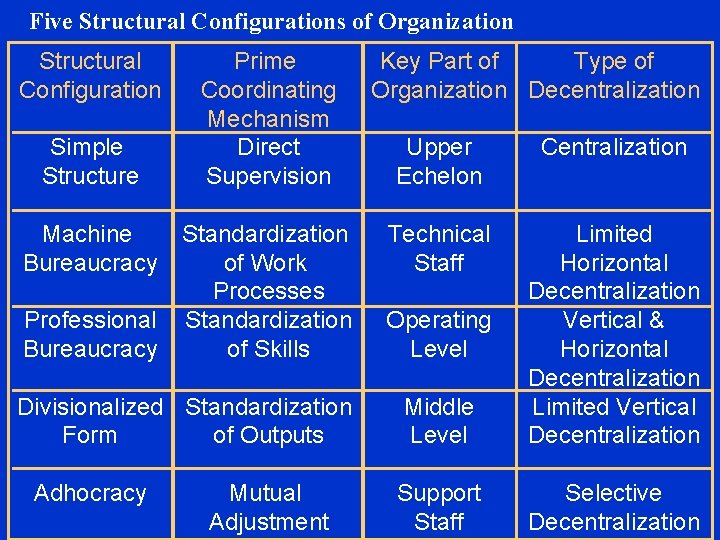
Simple Structure - a centralized form of organization that emphasizes the upper echelon & direct supervision Adhocracy - a selectively decentralized form of organization that emphasizes the support staff & mutual adjustment among people Structural Configurations of Organizations Machine Bureaucracy a moderately decentralized form of organization that emphasizes the technical staff & standardization of work processes Divisional Form - a moderately decentralized form of organization that emphasizes the middle level & standardization of outputs Professional Bureaucracy a decentralized form of organization that emphasizes the operating level & standardization of skills
Five Structural Configurations of Organization Structural Configuration Simple Structure Machine Bureaucracy Professional Bureaucracy Prime Coordinating Mechanism Direct Supervision Standardization of Work Processes Standardization of Skills Divisionalized Standardization Form of Outputs Adhocracy Mutual Adjustment Key Part of Type of Organization Decentralization Upper Echelon Centralization Technical Staff Middle Level Limited Horizontal Decentralization Vertical & Horizontal Decentralization Limited Vertical Decentralization Support Staff Selective Decentralization Operating Level
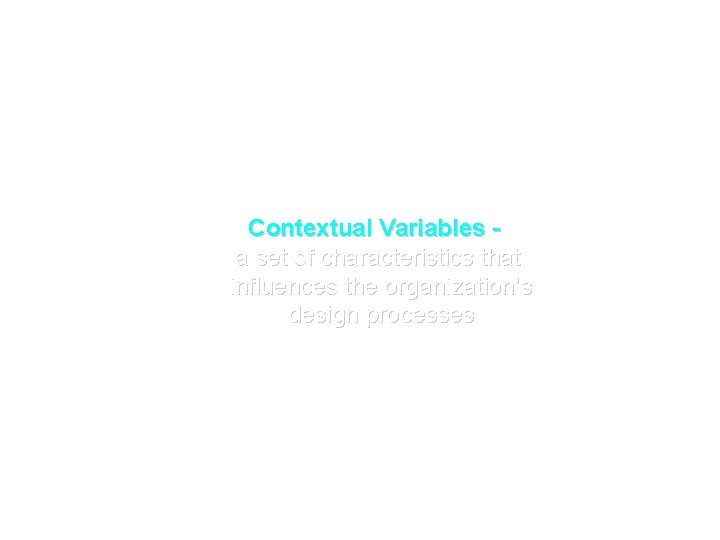
Size Technology Contextual Variables a set of characteristics that influences the organization’s design processes Strategy & Goals Environment
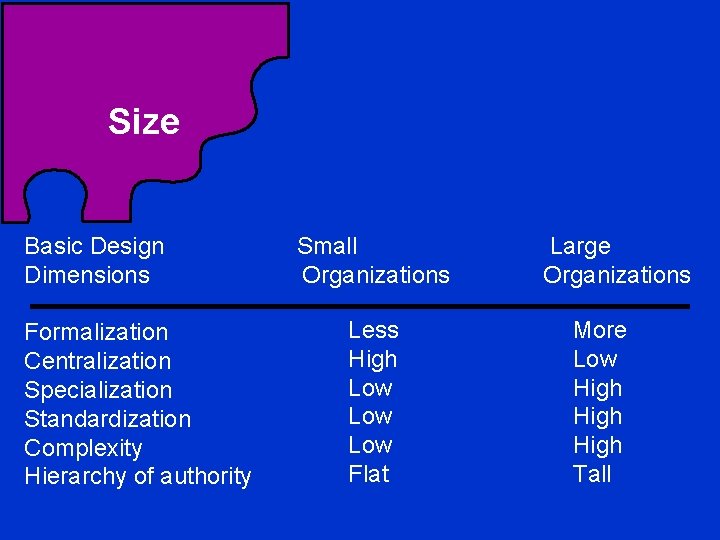
Size Basic Design Dimensions Formalization Centralization Specialization Standardization Complexity Hierarchy of authority Small Organizations Less High Low Low Flat Large Organizations More Low High Tall
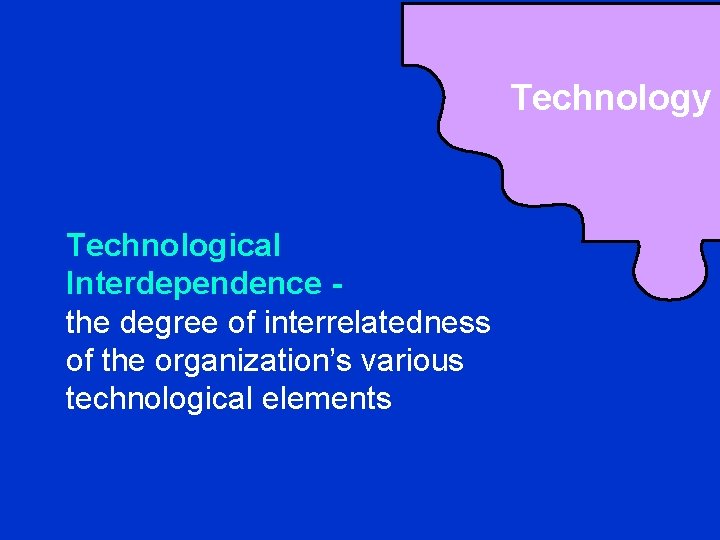
Technology Technological Interdependence the degree of interrelatedness of the organization’s various technological elements
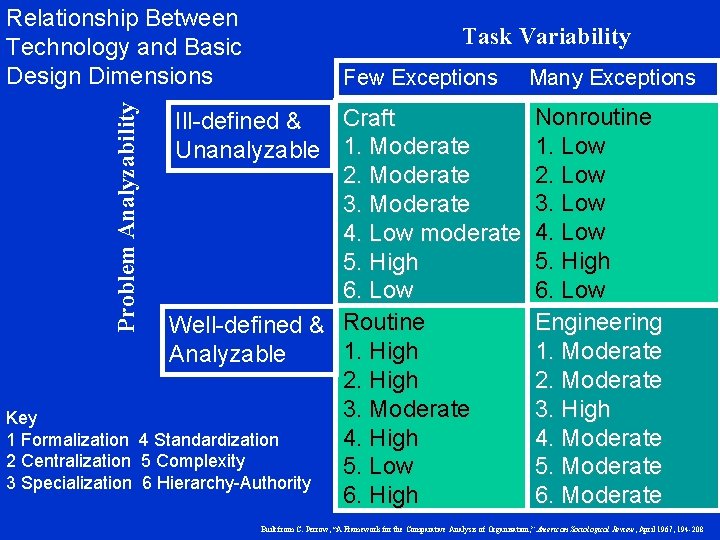
Problem Analyzability Relationship Between Technology and Basic Design Dimensions Task Variability Few Exceptions Craft Ill-defined & Unanalyzable 1. Moderate 2. Moderate 3. Moderate 4. Low moderate 5. High 6. Low Well-defined & Routine 1. High Analyzable 2. High 3. Moderate Key 4. High 1 Formalization 4 Standardization 2 Centralization 5 Complexity 5. Low 3 Specialization 6 Hierarchy-Authority 6. High Many Exceptions Nonroutine 1. Low 2. Low 3. Low 4. Low 5. High 6. Low Engineering 1. Moderate 2. Moderate 3. High 4. Moderate 5. Moderate 6. Moderate Built from C. Perrow, “A Framework for the Comparative Analysis of Organization, ” American Sociological Review, April 1967, 194 -208
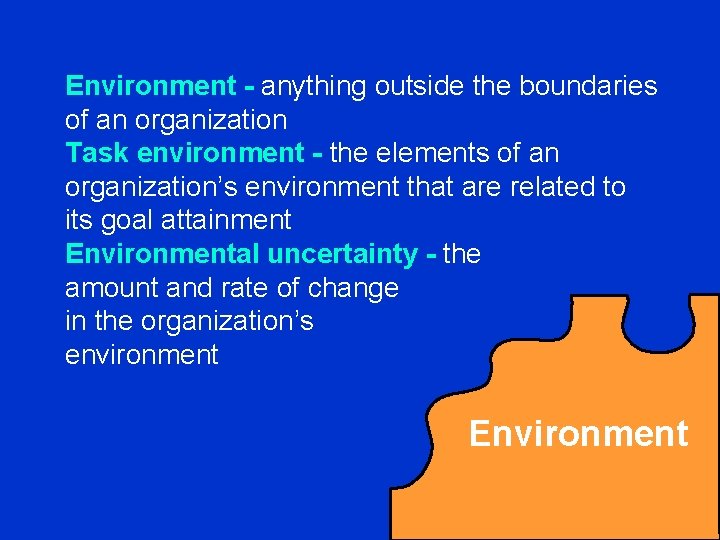
Environment - anything outside the boundaries of an organization Task environment - the elements of an organization’s environment that are related to its goal attainment Environmental uncertainty - the amount and rate of change in the organization’s environment Environment
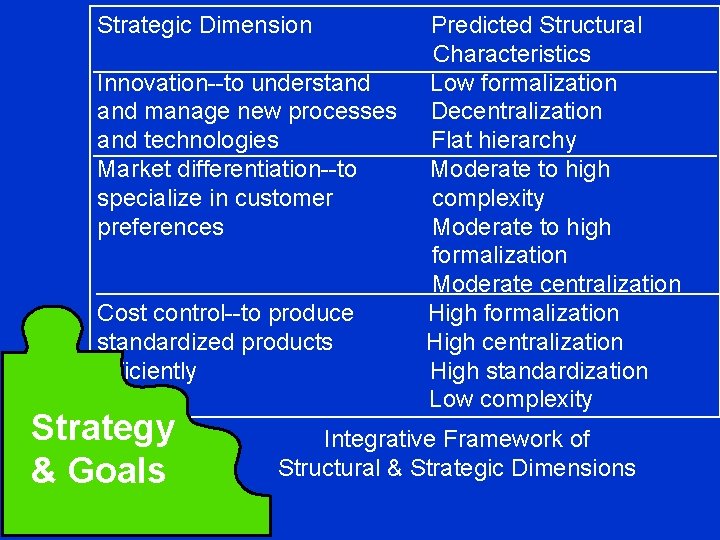
Strategic Dimension Innovation--to understand manage new processes and technologies Market differentiation--to specialize in customer preferences Cost control--to produce standardized products efficiently Strategy & Goals Predicted Structural Characteristics Low formalization Decentralization Flat hierarchy Moderate to high complexity Moderate to high formalization Moderate centralization High formalization High centralization High standardization Low complexity Integrative Framework of Structural & Strategic Dimensions
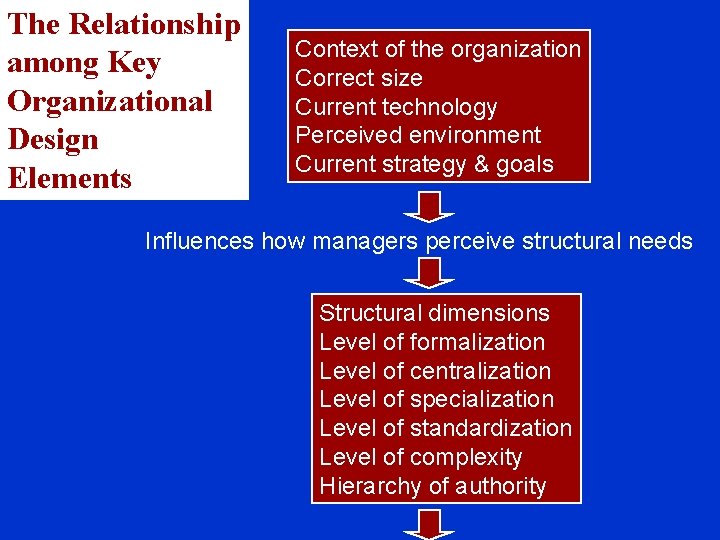
The Relationship among Key Organizational Design Elements Context of the organization Correct size Current technology Perceived environment Current strategy & goals Influences how managers perceive structural needs Structural dimensions Level of formalization Level of centralization Level of specialization Level of standardization Level of complexity Hierarchy of authority
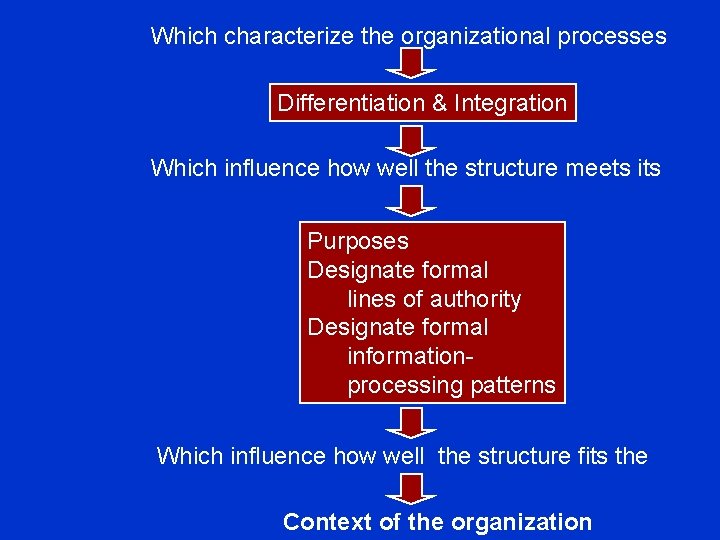
Which characterize the organizational processes Differentiation & Integration Which influence how well the structure meets its Purposes Designate formal lines of authority Designate formal informationprocessing patterns Which influence how well the structure fits the Context of the organization
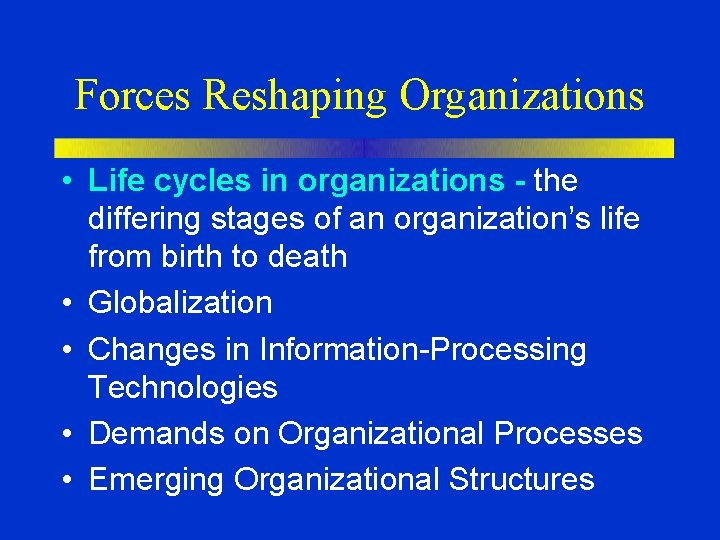
Forces Reshaping Organizations • Life cycles in organizations - the differing stages of an organization’s life from birth to death • Globalization • Changes in Information-Processing Technologies • Demands on Organizational Processes • Emerging Organizational Structures
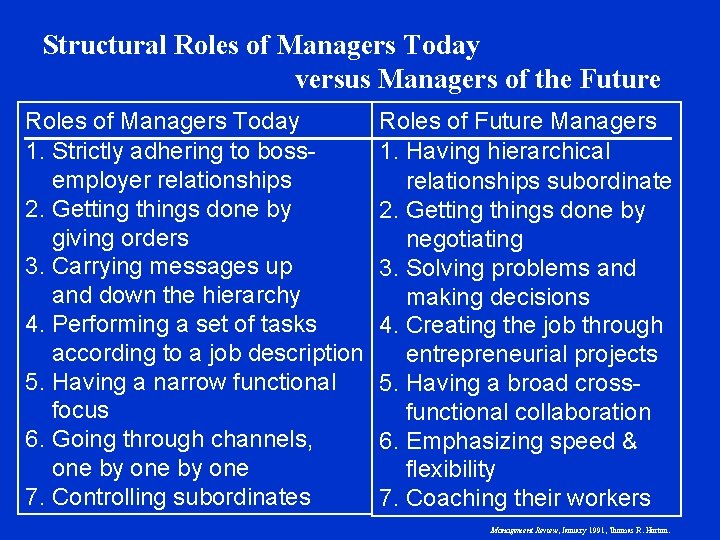
Structural Roles of Managers Today versus Managers of the Future Roles of Managers Today 1. Strictly adhering to bossemployer relationships 2. Getting things done by giving orders 3. Carrying messages up and down the hierarchy 4. Performing a set of tasks according to a job description 5. Having a narrow functional focus 6. Going through channels, one by one 7. Controlling subordinates Roles of Future Managers 1. Having hierarchical relationships subordinate 2. Getting things done by negotiating 3. Solving problems and making decisions 4. Creating the job through entrepreneurial projects 5. Having a broad crossfunctional collaboration 6. Emphasizing speed & flexibility 7. Coaching their workers Management Review, January 1991, Thomas R. Horton.
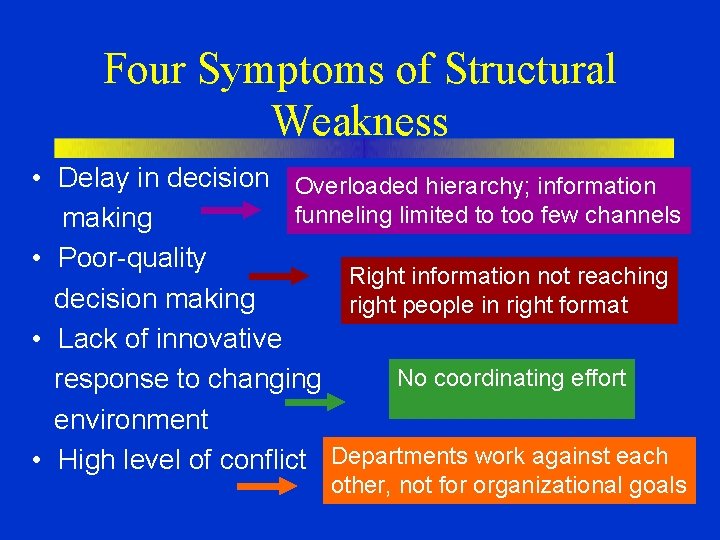
Four Symptoms of Structural Weakness • Delay in decision Overloaded hierarchy; information funneling limited to too few channels making • Poor-quality Right information not reaching decision making right people in right format • Lack of innovative No coordinating effort response to changing environment • High level of conflict Departments work against each other, not for organizational goals
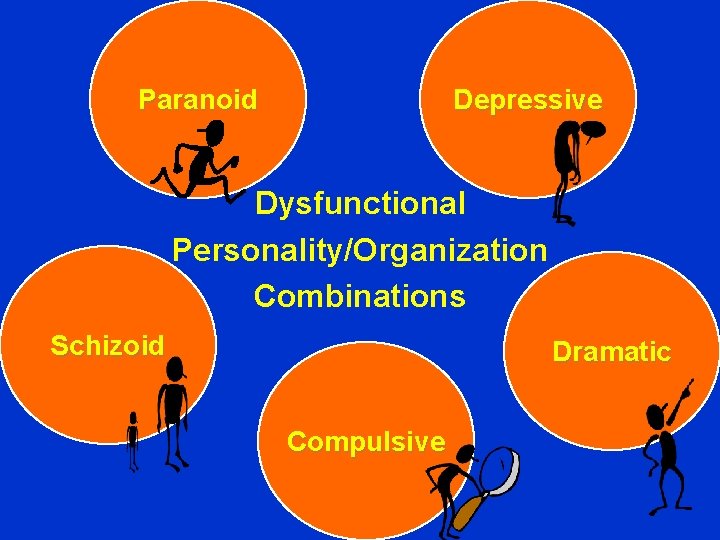
Paranoid Depressive Dysfunctional Personality/Organization Combinations Schizoid Dramatic Compulsive