
CHAPTER 14 MULTIPLE REGRESSION Prem Mann Introductory Statistics

- Slides: 30
CHAPTER 14 MULTIPLE REGRESSION Prem Mann, Introductory Statistics, 7/E Copyright © 2010 John Wiley & Sons. All right reserved
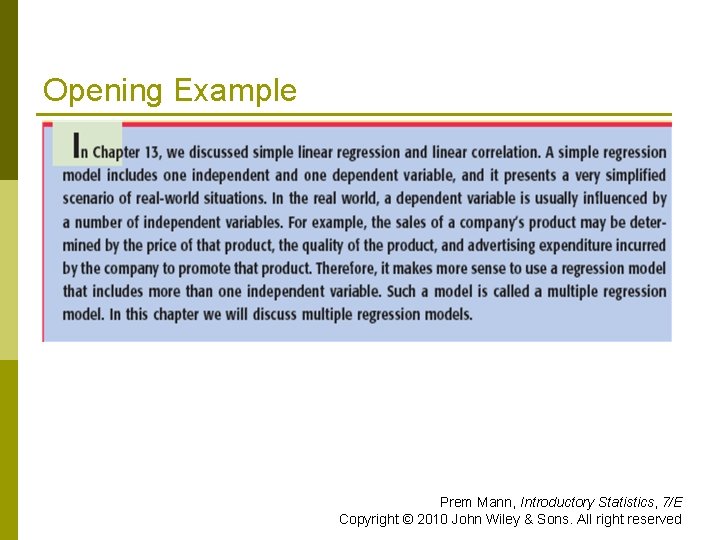
Opening Example Prem Mann, Introductory Statistics, 7/E Copyright © 2010 John Wiley & Sons. All right reserved
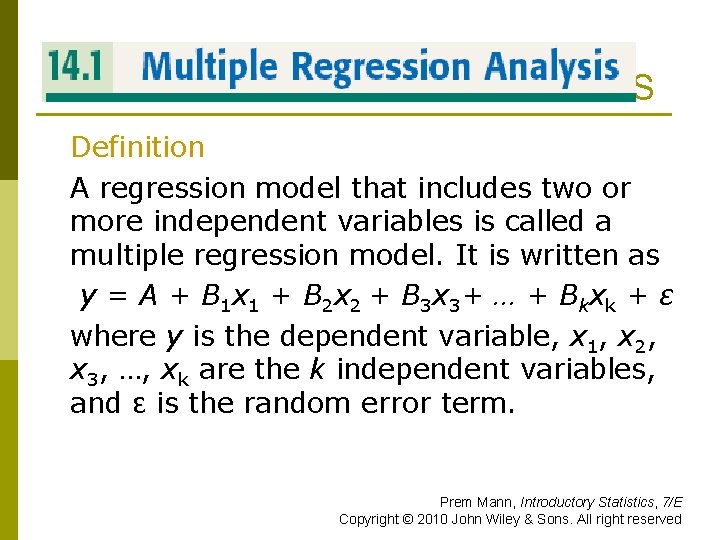
MULTIPLE REGRESSION ANALYSIS Definition A regression model that includes two or more independent variables is called a multiple regression model. It is written as y = A + B 1 x 1 + B 2 x 2 + B 3 x 3+ … + B kx k + ε where y is the dependent variable, x 1, x 2, x 3, …, xk are the k independent variables, and ε is the random error term. Prem Mann, Introductory Statistics, 7/E Copyright © 2010 John Wiley & Sons. All right reserved
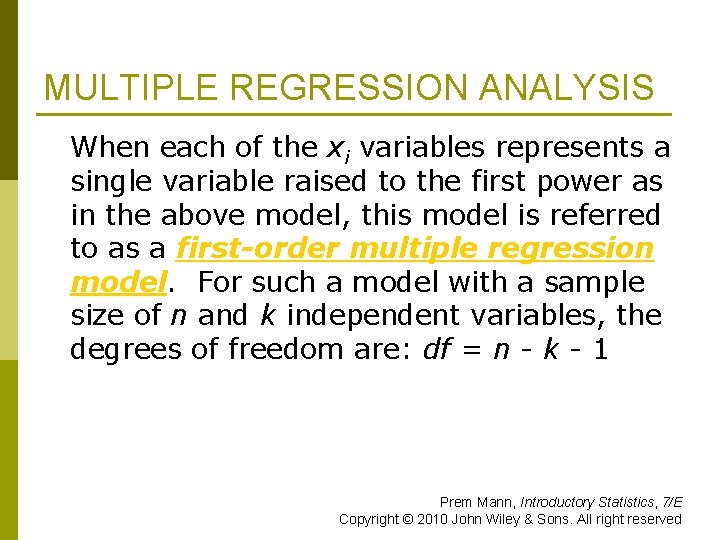
MULTIPLE REGRESSION ANALYSIS When each of the xi variables represents a single variable raised to the first power as in the above model, this model is referred to as a first-order multiple regression model. For such a model with a sample size of n and k independent variables, the degrees of freedom are: df = n - k - 1 Prem Mann, Introductory Statistics, 7/E Copyright © 2010 John Wiley & Sons. All right reserved
ASSUMPTIONS OF THE MULTIPLE REGRESSION MODEL Assumption 1: The mean of the probability distribution of ε is zero, that is, E(ε) = 0 Assumption 2: The errors associated with different sets of values of independent variables are independent. Furthermore, these errors are normally distributed and have a constant standard deviation, which is denoted by σε. Prem Mann, Introductory Statistics, 7/E Copyright © 2010 John Wiley & Sons. All right reserved
ASSUMPTIONS OF THE MULTIPLE REGRESSION MODEL Assumption 3: The independent variables are not linearly related. However, they can have a nonlinear relationship. When independent variables are highly linearly correlated, it is referred to as multicollinearity. Assumption 4: There is no linear association between the random error term ε and each independent variable xi. Prem Mann, Introductory Statistics, 7/E Copyright © 2010 John Wiley & Sons. All right reserved
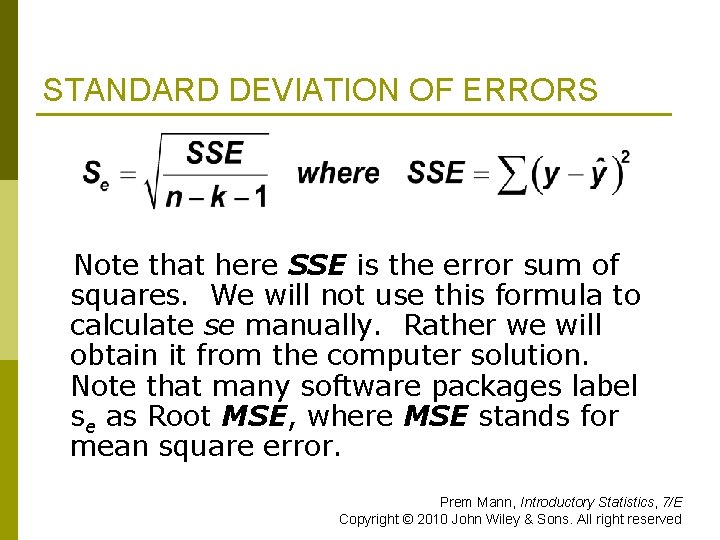
STANDARD DEVIATION OF ERRORS The standard deviation of errors (also called the standard error of the estimate) for the multiple regression model is denoted by σε, and it is a measure of variation among errors. However, when sample data are used to estimate multiple regression model, the standard deviation of errors is denoted by se. The formula to calculate se is as follows. Prem Mann, Introductory Statistics, 7/E Copyright © 2010 John Wiley & Sons. All right reserved
STANDARD DEVIATION OF ERRORS Note that here SSE is the error sum of squares. We will not use this formula to calculate se manually. Rather we will obtain it from the computer solution. Note that many software packages label se as Root MSE, where MSE stands for mean square error. Prem Mann, Introductory Statistics, 7/E Copyright © 2010 John Wiley & Sons. All right reserved
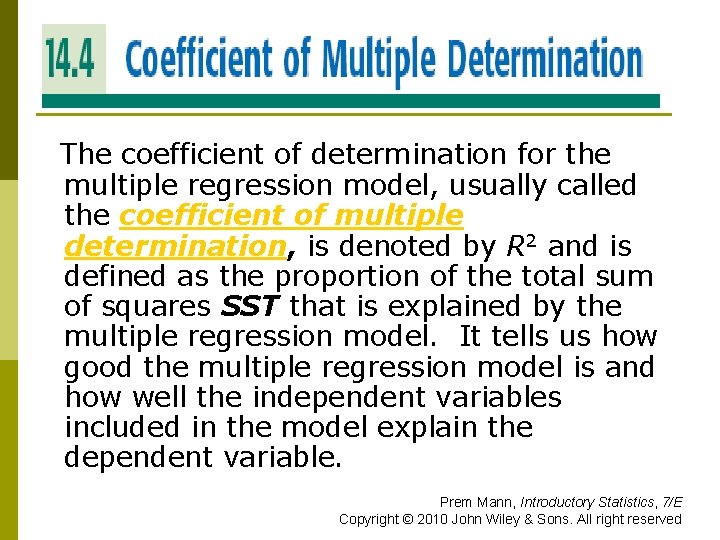
COEFFICIENT OF MULTIPLE DETERMINATION The coefficient of determination for the multiple regression model, usually called the coefficient of multiple determination, is denoted by R 2 and is defined as the proportion of the total sum of squares SST that is explained by the multiple regression model. It tells us how good the multiple regression model is and how well the independent variables included in the model explain the dependent variable. Prem Mann, Introductory Statistics, 7/E Copyright © 2010 John Wiley & Sons. All right reserved
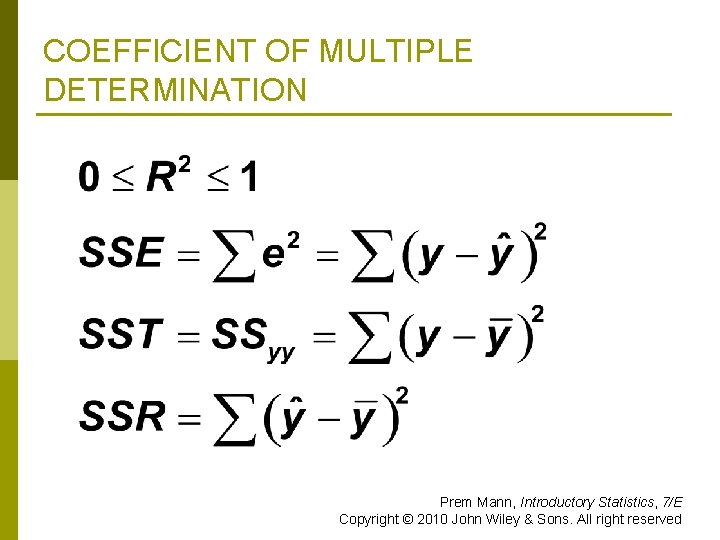
COEFFICIENT OF MULTIPLE DETERMINATION Prem Mann, Introductory Statistics, 7/E Copyright © 2010 John Wiley & Sons. All right reserved
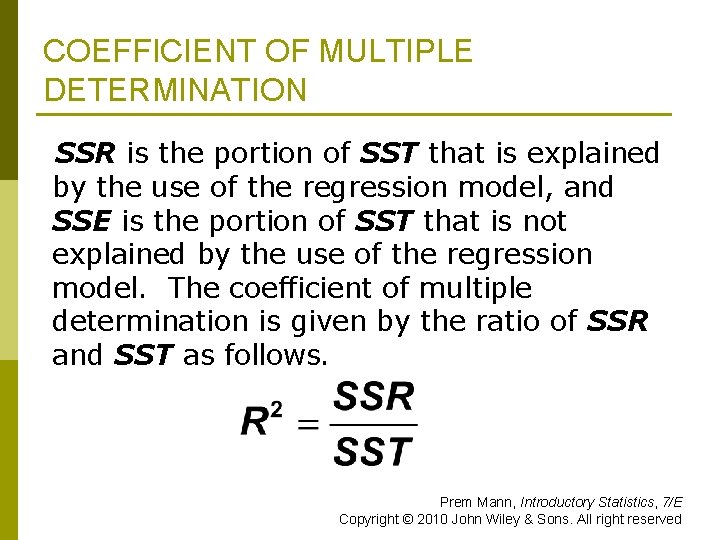
COEFFICIENT OF MULTIPLE DETERMINATION SSR is the portion of SST that is explained by the use of the regression model, and SSE is the portion of SST that is not explained by the use of the regression model. The coefficient of multiple determination is given by the ratio of SSR and SST as follows. Prem Mann, Introductory Statistics, 7/E Copyright © 2010 John Wiley & Sons. All right reserved
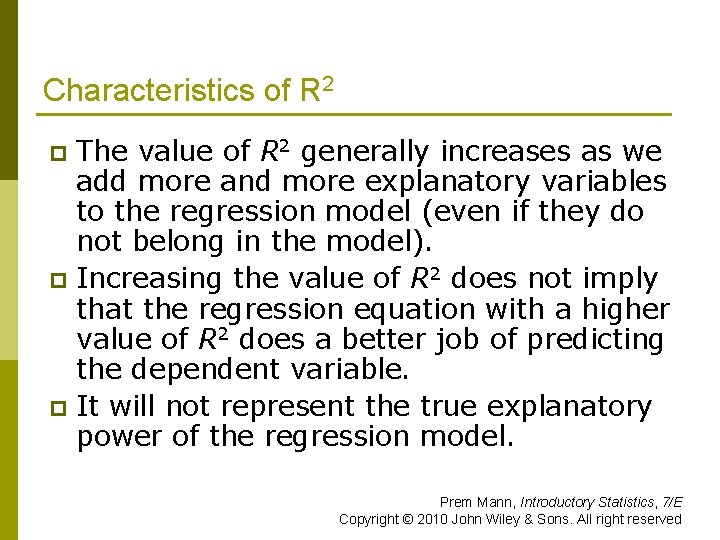
Characteristics of R 2 The value of R 2 generally increases as we add more and more explanatory variables to the regression model (even if they do not belong in the model). p Increasing the value of R 2 does not imply that the regression equation with a higher value of R 2 does a better job of predicting the dependent variable. p It will not represent the true explanatory power of the regression model. p Prem Mann, Introductory Statistics, 7/E Copyright © 2010 John Wiley & Sons. All right reserved
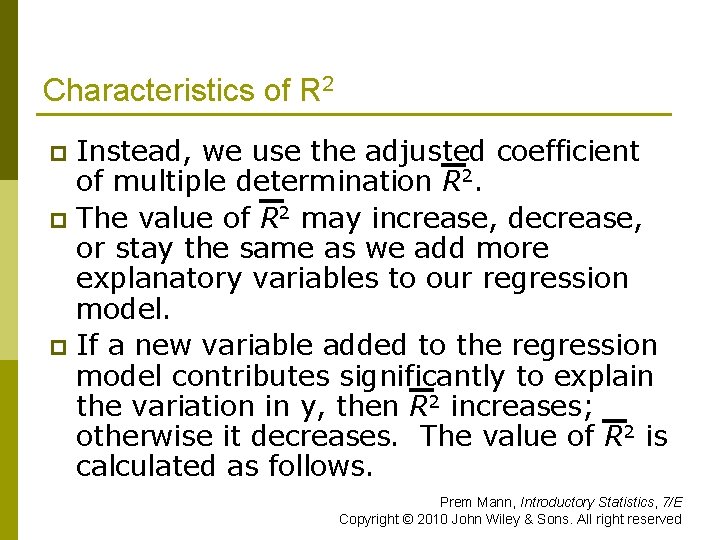
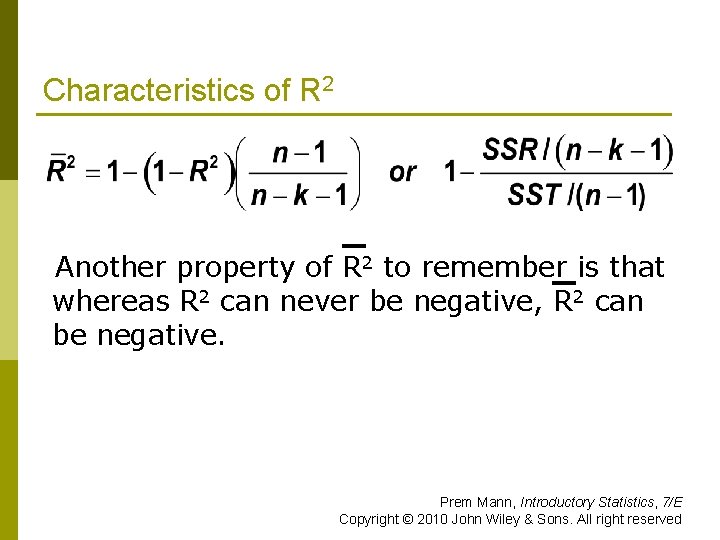
Characteristics of R 2 Instead, we use the adjusted coefficient of multiple determination R 2. p The value of R 2 may increase, decrease, or stay the same as we add more explanatory variables to our regression model. p If a new variable added to the regression model contributes significantly to explain the variation in y, then R 2 increases; otherwise it decreases. The value of R 2 is calculated as follows. p Prem Mann, Introductory Statistics, 7/E Copyright © 2010 John Wiley & Sons. All right reserved
Characteristics of R 2 Another property of R 2 to remember is that whereas R 2 can never be negative, R 2 can be negative. Prem Mann, Introductory Statistics, 7/E Copyright © 2010 John Wiley & Sons. All right reserved
COMPUTER SOLUTION OF MULTIPLE REGRESSION In this section, we take an example of a multiple regression model, solve it using STATA, interpret the solution, and make inferences about the population parameters of the regression model. Prem Mann, Introductory Statistics, 7/E Copyright © 2010 John Wiley & Sons. All right reserved
Example 14 -1 A researcher wanted to find the effect of driving experience and the number of driving violations on auto insurance premiums. A random sample of 12 drivers insured with the same company and having similar auto insurance policies was selected from a large city. Prem Mann, Introductory Statistics, 7/E Copyright © 2010 John Wiley & Sons. All right reserved
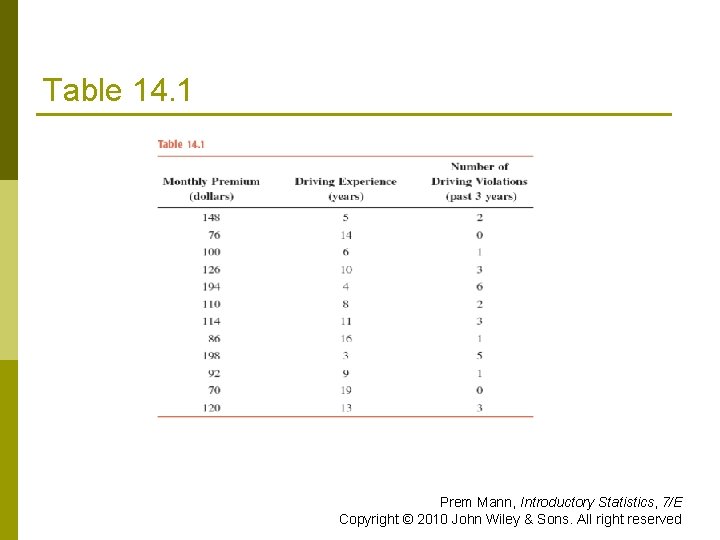
Example 14 -1 Table 14. 1 lists the monthly auto insurance premiums (in dollars) paid by these drivers, their driving experi ences (in years), and the numbers of driving violations committed by them during the past three years. Using STATA, find the regression equation of monthly premiums paid by drivers on the driving experiences and the numbers of driving violations. Prem Mann, Introductory Statistics, 7/E Copyright © 2010 John Wiley & Sons. All right reserved
Table 14. 1 Prem Mann, Introductory Statistics, 7/E Copyright © 2010 John Wiley & Sons. All right reserved
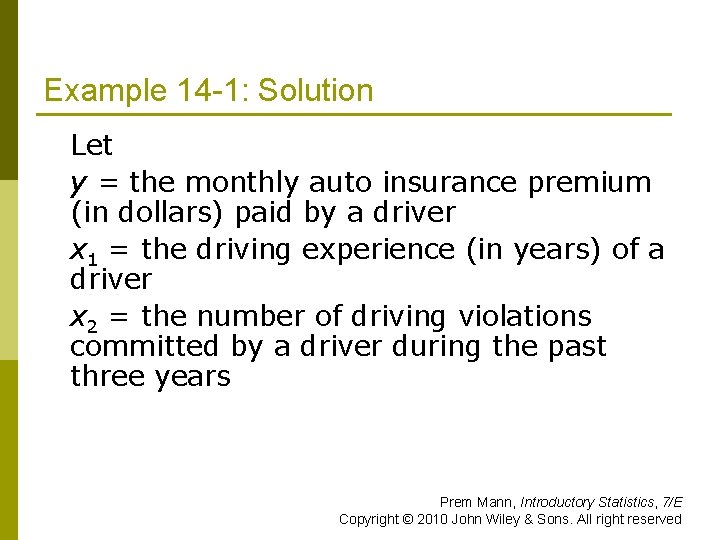
Example 14 -1: Solution Let y = the monthly auto insurance premium (in dollars) paid by a driver x 1 = the driving experience (in years) of a driver x 2 = the number of driving violations committed by a driver during the past three years Prem Mann, Introductory Statistics, 7/E Copyright © 2010 John Wiley & Sons. All right reserved
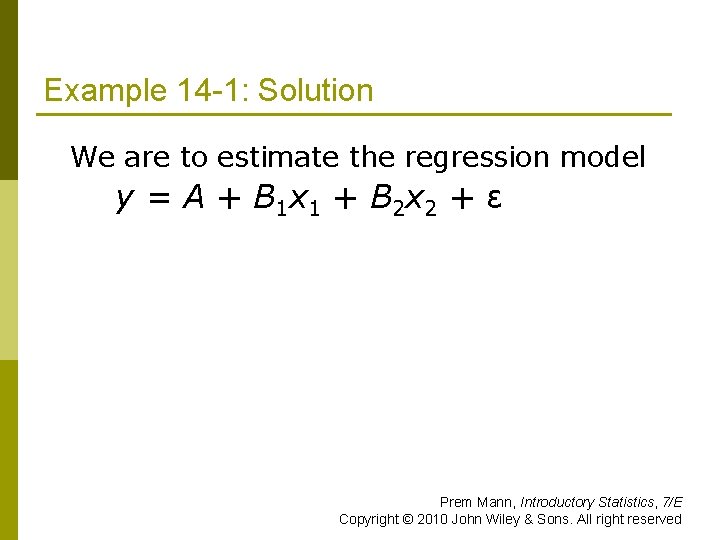
Example 14 -1: Solution We are to estimate the regression model y = A + B 1 x 1 + B 2 x 2 + ε Prem Mann, Introductory Statistics, 7/E Copyright © 2010 John Wiley & Sons. All right reserved
Example 14 -2 (a) Explain the meaning of the estimated regression coefficients. (b) What are the values the coefficient of multiple determination, and the adjusted coefficient of multiple determination? Prem Mann, Introductory Statistics, 7/E Copyright © 2010 John Wiley & Sons. All right reserved
Example 14 -2 (c) What is the predicted auto insurance premium paid per month by a driver with seven years of driving experience and three driving violations committed in the past three years? (d) What is the point estimate of the expected (or mean) auto insurance premium paid per month by all drivers with 12 years of driving experience and 4 driving violations committed in the past three years? Prem Mann, Introductory Statistics, 7/E Copyright © 2010 John Wiley & Sons. All right reserved
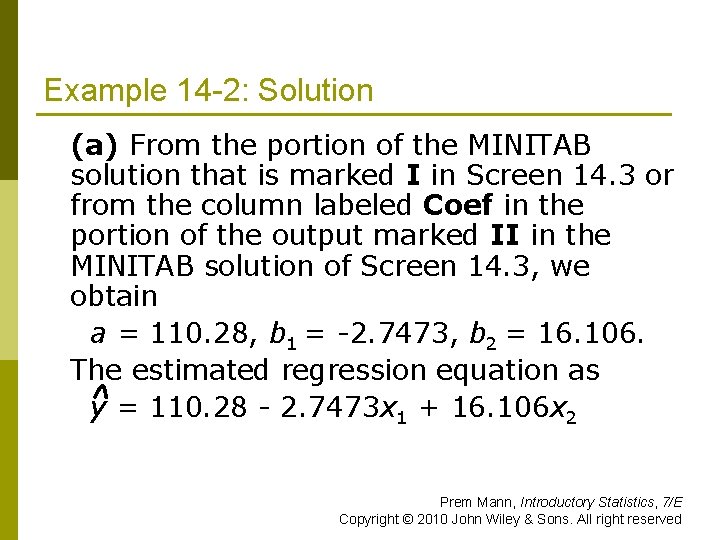
Example 14 -2: Solution (a) From the portion of the MINITAB solution that is marked I in Screen 14. 3 or from the column labeled Coef in the portion of the output marked II in the MINITAB solution of Screen 14. 3, we obtain a = 110. 28, b 1 = 2. 7473, b 2 = 16. 106. The estimated regression equation as y = 110. 28 2. 7473 x 1 + 16. 106 x 2 Prem Mann, Introductory Statistics, 7/E Copyright © 2010 John Wiley & Sons. All right reserved
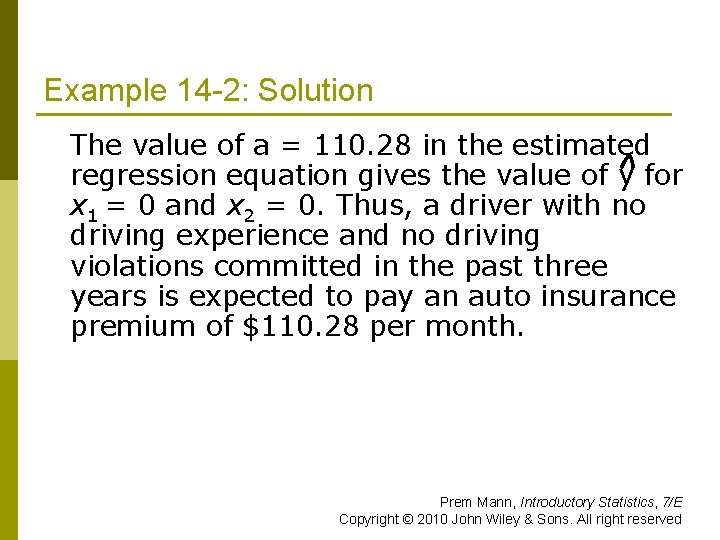
Example 14 -2: Solution The value of a = 110. 28 in the estimated regression equation gives the value of y for x 1 = 0 and x 2 = 0. Thus, a driver with no driving experience and no driving violations committed in the past three years is expected to pay an auto insurance premium of $110. 28 per month. Prem Mann, Introductory Statistics, 7/E Copyright © 2010 John Wiley & Sons. All right reserved
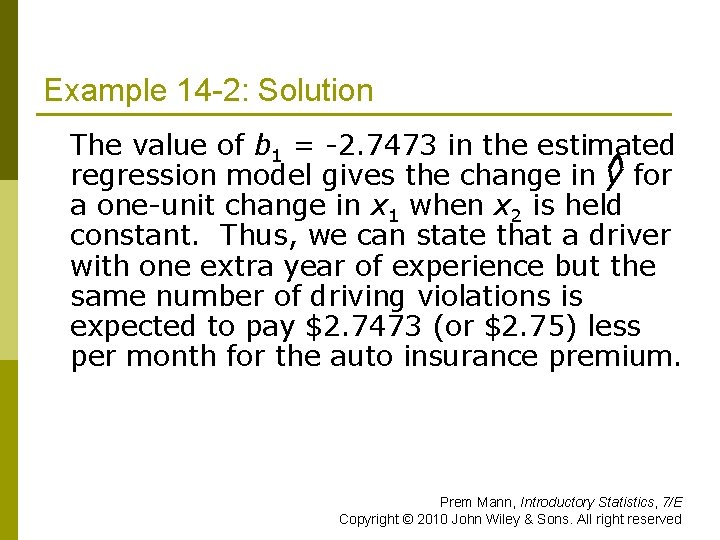
Example 14 -2: Solution The value of b 1 = 2. 7473 in the estimated regression model gives the change in y for a one unit change in x 1 when x 2 is held constant. Thus, we can state that a driver with one extra year of experience but the same number of driving violations is expected to pay $2. 7473 (or $2. 75) less per month for the auto insurance premium. Prem Mann, Introductory Statistics, 7/E Copyright © 2010 John Wiley & Sons. All right reserved
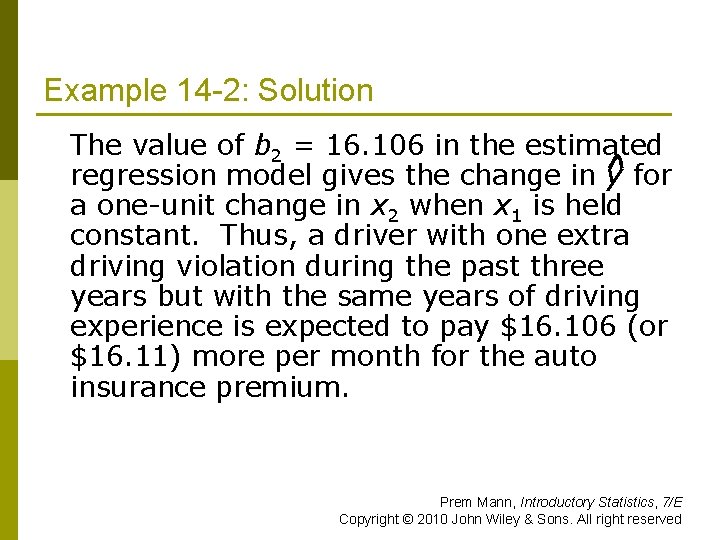
Example 14 -2: Solution The value of b 2 = 16. 106 in the estimated regression model gives the change in y for a one unit change in x 2 when x 1 is held constant. Thus, a driver with one extra driving violation during the past three years but with the same years of driving experience is expected to pay $16. 106 (or $16. 11) more per month for the auto insurance premium. Prem Mann, Introductory Statistics, 7/E Copyright © 2010 John Wiley & Sons. All right reserved
Example 14 -2: Solution (b) The values the coefficient of multiple determination, and the adjusted coefficient of multiple determination are Prem Mann, Introductory Statistics, 7/E Copyright © 2010 John Wiley & Sons. All right reserved
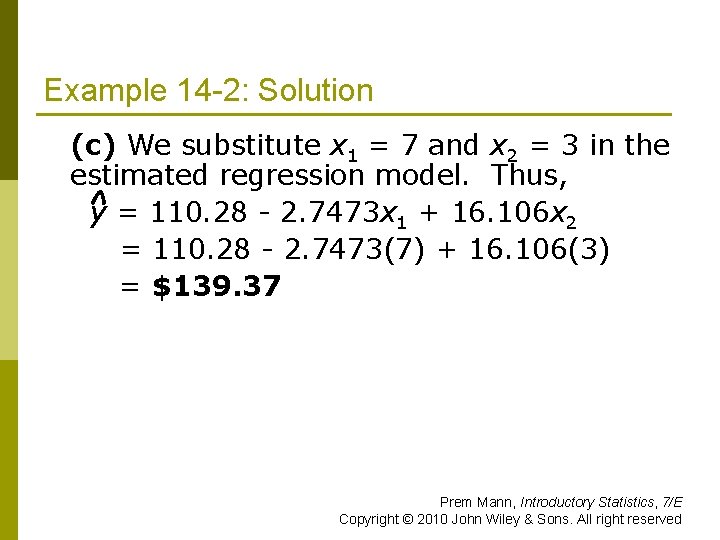
Example 14 -2: Solution (c) We substitute x 1 = 7 and x 2 = 3 in the estimated regression model. Thus, y = 110. 28 2. 7473 x 1 + 16. 106 x 2 = 110. 28 2. 7473(7) + 16. 106(3) = $139. 37 Prem Mann, Introductory Statistics, 7/E Copyright © 2010 John Wiley & Sons. All right reserved
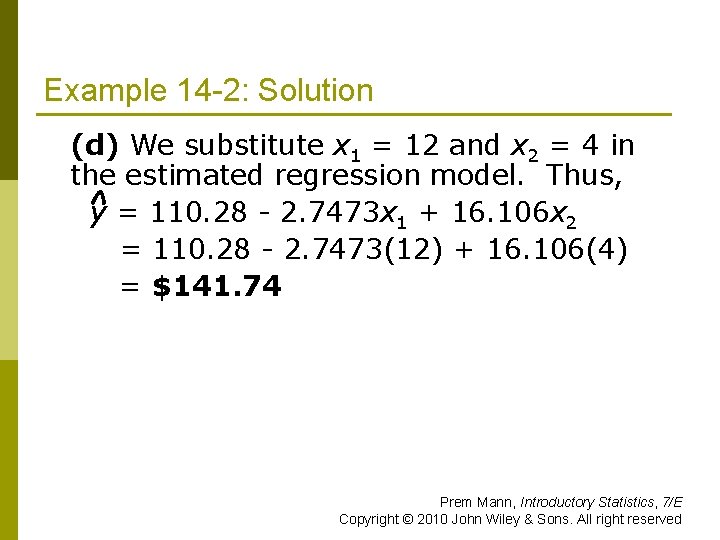
Example 14 -2: Solution (d) We substitute x 1 = 12 and x 2 = 4 in the estimated regression model. Thus, y = 110. 28 2. 7473 x 1 + 16. 106 x 2 = 110. 28 2. 7473(12) + 16. 106(4) = $141. 74 Prem Mann, Introductory Statistics, 7/E Copyright © 2010 John Wiley & Sons. All right reserved
Example 14 -3 Determine a 95% confidence interval for B 1 (the coefficient of experience) for the multiple regression of auto insurance premium on driving experience and the number of driving violations. Prem Mann, Introductory Statistics, 7/E Copyright © 2010 John Wiley & Sons. All right reserved