
Chapter 14 Managing Quality Improvement Teams and Projects


- Slides: 25
Chapter 14 Managing Quality Improvement Teams and Projects ØCopyright © 2010 Pearson Education, Inc. Publishing as Prentice Hall. 14 - 1
Strategic Quality Planning Managing Quality Improvement Teams and Projects Chapter 14 ØWhy employees enjoy teams. ØLeading teams for quality improvement. ØTypes of teams. ØImplementing teams ØManaging and controlling projects ØCopyright © 2010 Pearson Education, Inc. Publishing as Prentice Hall. 14 - 2
Strategic Quality Planning Managing Quality Improvement Teams and Projects Why Employees Enjoy Teams In a study of Project Managers, five motivators emerged: 1. Mutuality 2. Recognition for personal achievement 3. Belonging 4. Bounded power 5. Creative autonomy ØCopyright © 2010 Pearson Education, Inc. Publishing as Prentice Hall. 14 - 3
Strategic Quality Planning Managing Quality Improvement Teams and Projects Leading teams for Quality Improvement Employee Empowerment and Involvement Ø You will have greater control over your work Ø You will not be penalized for making decisions that don’t pan out Ø Management is changing and becoming more contemporary Ø Management is committed to quality improvement over the long haul ØCopyright © 2010 Pearson Education, Inc. Publishing as Prentice Hall. 14 - 4
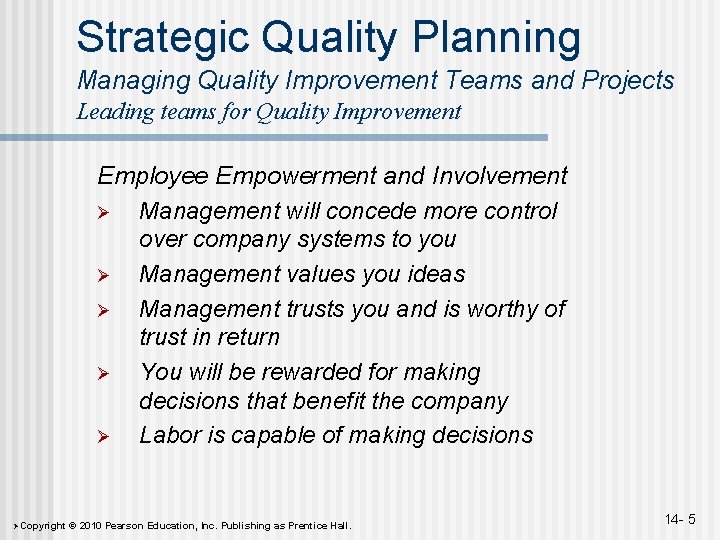
Strategic Quality Planning Managing Quality Improvement Teams and Projects Leading teams for Quality Improvement Employee Empowerment and Involvement Ø Management will concede more control over company systems to you Ø Management values you ideas Ø Management trusts you and is worthy of trust in return Ø You will be rewarded for making decisions that benefit the company Ø Labor is capable of making decisions ØCopyright © 2010 Pearson Education, Inc. Publishing as Prentice Hall. 14 - 5
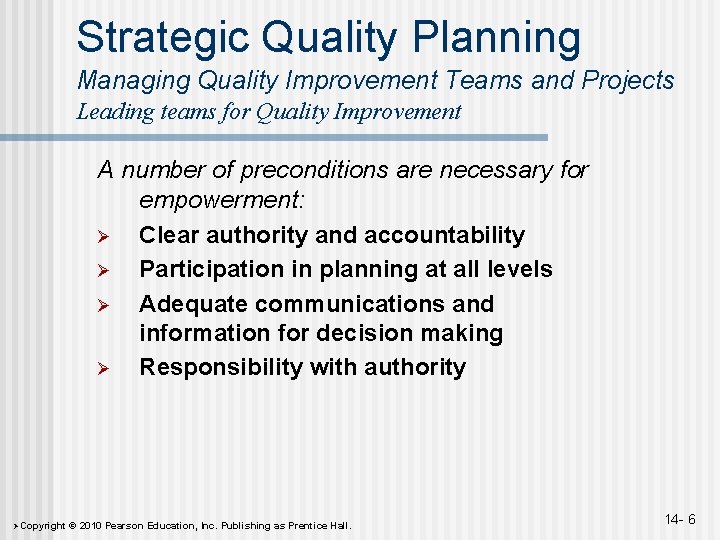
Strategic Quality Planning Managing Quality Improvement Teams and Projects Leading teams for Quality Improvement A number of preconditions are necessary for empowerment: Ø Clear authority and accountability Ø Participation in planning at all levels Ø Adequate communications and information for decision making Ø Responsibility with authority ØCopyright © 2010 Pearson Education, Inc. Publishing as Prentice Hall. 14 - 6
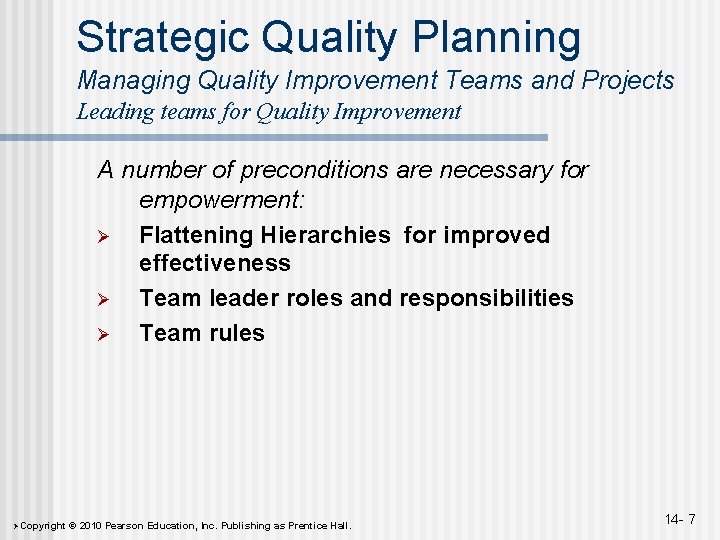
Strategic Quality Planning Managing Quality Improvement Teams and Projects Leading teams for Quality Improvement A number of preconditions are necessary for empowerment: Ø Flattening Hierarchies for improved effectiveness Ø Team leader roles and responsibilities Ø Team rules ØCopyright © 2010 Pearson Education, Inc. Publishing as Prentice Hall. 14 - 7
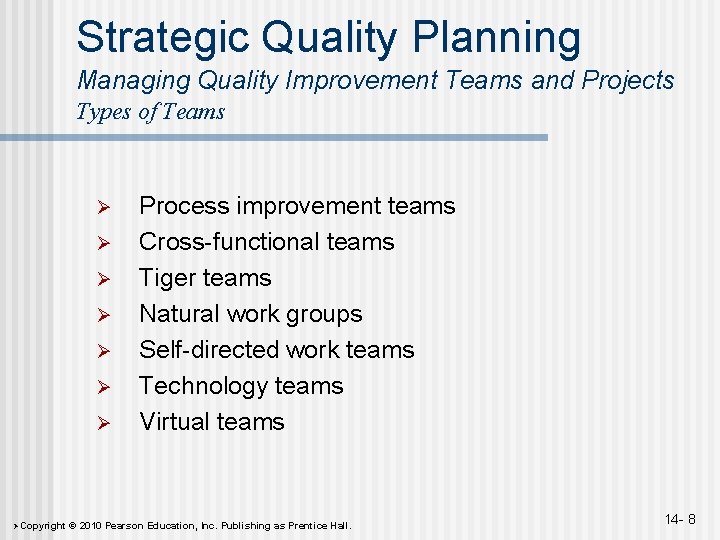
Strategic Quality Planning Managing Quality Improvement Teams and Projects Types of Teams Ø Ø Ø ØCopyright Process improvement teams Cross-functional teams Tiger teams Natural work groups Self-directed work teams Technology teams Virtual teams © 2010 Pearson Education, Inc. Publishing as Prentice Hall. 14 - 8
Strategic Quality Planning Managing Quality Improvement Teams and Projects Implementing teams Facilitation Ø ØCopyright Helping or aiding teams by maintaining a process orientation © 2010 Pearson Education, Inc. Publishing as Prentice Hall. 14 - 9
Strategic Quality Planning Managing Quality Improvement Teams and Projects Implementing teams Team Building Ø ØCopyright Follows a process that identifies rules for team members and helps them become competent © 2010 Pearson Education, Inc. Publishing as Prentice Hall. 14 - 10
Strategic Quality Planning Managing Quality Improvement Teams and Projects Implementing teams Examples of Teams: Ø ØCopyright Navy Seals Massachusetts General Hospital Emergency Room The Childress NASCAR team © 2010 Pearson Education, Inc. Publishing as Prentice Hall. 14 - 11
Strategic Quality Planning Managing Quality Improvement Teams and Projects Implementing teams Meeting Management 1. 2. 3. 4. 5. ØCopyright Developing an agenda Developing meeting objectives Designing the agenda activity outline Using process techniques Parking lot © 2010 Pearson Education, Inc. Publishing as Prentice Hall. 14 - 12
Strategic Quality Planning Managing Quality Improvement Teams and Projects Implementing teams Conflict Resolution in Teams Team leaders and project managers spend 20% of their time resolving conflict ØCopyright © 2010 Pearson Education, Inc. Publishing as Prentice Hall. 14 - 13
Strategic Quality Planning Managing Quality Improvement Teams and Projects Implementing teams Conflict Resolution in Teams 1. 2. 3. 4. ØCopyright There are 4 stages in conflict resolution: Frustration Conceptualization and orientation Interaction Outcome © 2010 Pearson Education, Inc. Publishing as Prentice Hall. 14 - 14
Strategic Quality Planning Managing Quality Improvement Teams and Projects Implementing teams Conflict Resolution in Teams Leaders resolve conflict in different ways: 1. Passive conflict resolution 2. Win-win 3. Structured problem solving 4. Confronting conflict 5. Choosing a winner 6. Selecting a better alternative ØCopyright © 2010 Pearson Education, Inc. Publishing as Prentice Hall. 14 - 15
Strategic Quality Planning Managing Quality Improvement Teams and Projects Implementing teams Conflict Resolution in Teams Ø ØCopyright Avoidance Diffusion Confrontation © 2010 Pearson Education, Inc. Publishing as Prentice Hall. 14 - 16
Strategic Quality Planning Managing Quality Improvement Teams and Projects Managing and Controlling Teams Tools: Ø Ø ØCopyright Qualifying projects Project Charters Force Field Analysis Work Breakdown Structures © 2010 Pearson Education, Inc. Publishing as Prentice Hall. 14 - 17
Strategic Quality Planning Managing Quality Improvement Teams and Projects Managing and Controlling Teams Qualifying Projects Ø Cost Benefit Analysis (CBA) Ø Payback Period Ø Difference between soft costs and hard costs ØCopyright © 2010 Pearson Education, Inc. Publishing as Prentice Hall. 14 - 18
Strategic Quality Planning Managing Quality Improvement Teams and Projects Managing and Controlling Teams Project Charters Help teams identify objectives, participants and expected benefits ØCopyright © 2010 Pearson Education, Inc. Publishing as Prentice Hall. 14 - 19
Strategic Quality Planning Managing Quality Improvement Teams and Projects Managing and Controlling Teams Force Field Analysis Designed to identify and quantify all of the forces for and against organizational change ØCopyright © 2010 Pearson Education, Inc. Publishing as Prentice Hall. 14 - 20
Strategic Quality Planning Managing Quality Improvement Teams and Projects Managing and Controlling Teams Work Breakdown Structures WBS Ø Ø Identify Precedence Relationships Identify Outcome Measures Identify Task Times Ø ØCopyright Optimistic completion time Most likely completion time Pessimistic completion time © 2010 Pearson Education, Inc. Publishing as Prentice Hall. 14 - 21
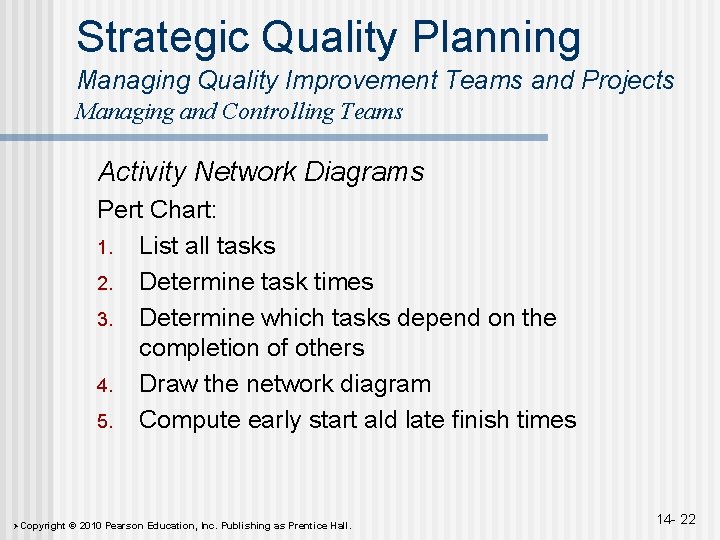
Strategic Quality Planning Managing Quality Improvement Teams and Projects Managing and Controlling Teams Activity Network Diagrams Pert Chart: 1. List all tasks 2. Determine task times 3. Determine which tasks depend on the completion of others 4. Draw the network diagram 5. Compute early start ald late finish times ØCopyright © 2010 Pearson Education, Inc. Publishing as Prentice Hall. 14 - 22
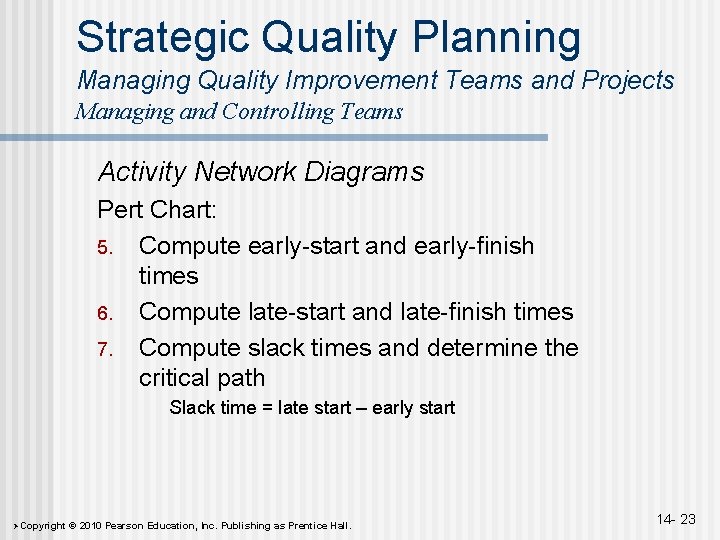
Strategic Quality Planning Managing Quality Improvement Teams and Projects Managing and Controlling Teams Activity Network Diagrams Pert Chart: 5. Compute early-start and early-finish times 6. Compute late-start and late-finish times 7. Compute slack times and determine the critical path Slack time = late start – early start ØCopyright © 2010 Pearson Education, Inc. Publishing as Prentice Hall. 14 - 23
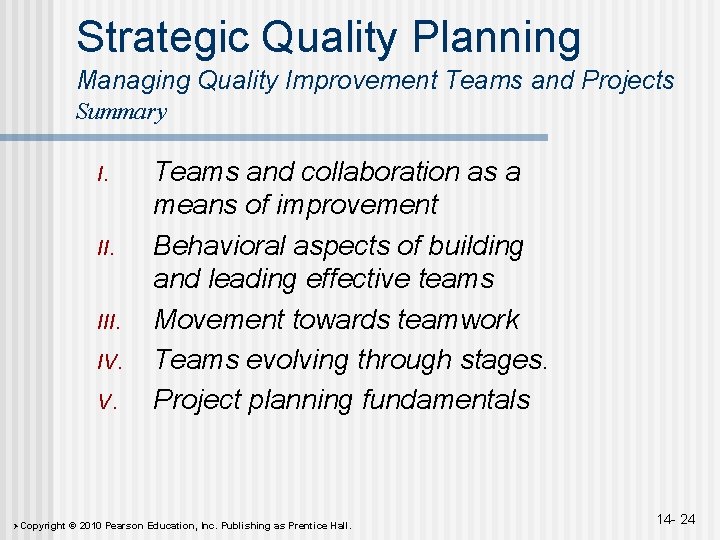
Strategic Quality Planning Managing Quality Improvement Teams and Projects Summary I. III. IV. V. ØCopyright Teams and collaboration as a means of improvement Behavioral aspects of building and leading effective teams Movement towards teamwork Teams evolving through stages. Project planning fundamentals © 2010 Pearson Education, Inc. Publishing as Prentice Hall. 14 - 24
All rights reserved. No part of this publication may be reproduced, stored in a retrieval system, or transmitted, in any form or by any means, electronic, mechanical, photocopying, recording, or otherwise, without the prior written permission of the publisher. Printed in the United States of America. ØCopyright © 2010 Pearson Education, Inc. Publishing as Prentice Hall. 14 - 25