
Chapter 14 Maintaining and Repairing Relationships Miller Intimate

- Slides: 32
Chapter 14 Maintaining and Repairing Relationships Miller Intimate Relationships, 6/e Mc. Graw-Hill/Irwin Copyright (c) 2012 by The Mc. Graw-Hill Companies, Inc. All rights reserved.
Maintaining and Repairing Relationships Relationship science has shown us that bad is stronger than good, conflict is unavoidable, romantic passion declines over time, and a lot of us are insecure. But there’s no reason to pessimistic about your relationships… 14 -2
Maintaining and Repairing Relationships People who are committed to their partnerships engage in a variety of actions that help to protect and maintain the satisfaction they enjoy. Furthermore, if they occur, many problems can be repaired, and many wounds can be healed. 14 -3
Maintaining and Enhancing Relationships Relationship maintenance mechanisms are the strategic actions people take to sustain their partnerships. 14 -4
Maintaining and Enhancing Relationships Staying Committed People who are committed to a partnership --who want and expect it to continue-both think and behave differently than less committed partners do. 14 -5
Maintaining and Enhancing Relationships Staying Committed Cognitive Maintenance Mechanisms: • Cognitive interdependence – Committed partners think of themselves not as separate individuals but as a couple. Plural pronouns such as “we, ” “us, ” and “ours” replace “I, ” “me, ” and “mine. ” 14 -6
Maintaining and Enhancing Relationships Staying Committed Cognitive Maintenance Mechanisms: • Positive illusions – Partners idealize one another, judging each other’s faults to be relatively trivial, the relationship’s deficiencies to be relatively unimportant, and the partner’s misbehavior to be an unintentional or temporary aberration. 14 -7
Maintaining and Enhancing Relationships Staying Committed Cognitive Maintenance Mechanisms: • Perceived superiority – People consider their relationships to be better than most. • Inattention to alternatives – Committed partners pay less heed to the other potential partners that are available to them. They are relatively uninterested and unaware of how well they could be doing in alternative relationships. 14 -8
Maintaining and Enhancing Relationships Staying Committed Cognitive Maintenance Mechanisms: • Derogation of tempting alternatives – When committed partners do notice attractive rivals to their relationships, they judge them to be less desirable than others think them to be. Commitment leads people to disparage those who could lure them away from their existing relationships. 14 -9
Maintaining and Enhancing Relationships Staying Committed Behavioral Maintenance Mechanisms: • Willingness to sacrifice – Committed people often make various personal sacrifices, doing things they would prefer not to do, or not doing things that they would like to do, in order to promote the well-being of their partners or their relationships. 14 -10
Maintaining and Enhancing Relationships Staying Committed Behavioral Maintenance Mechanisms: • Michelangelo phenomenon – Committed lovers also promote their partners’ growth, helping them become the people they want to be by supporting their development of desired new skills and endorsing their acceptance of promising new roles and responsibilities. • A KEY!!!! 14 -11
Maintaining and Enhancing Relationships Staying Committed Behavioral Maintenance Mechanisms: • Play – Committed partners find ways to engage in novel, challenging, exciting, and pleasant activities together. Couples that play together really do tend to stay together. 14 -12
Maintaining and Enhancing Relationships Staying Committed Behavioral Maintenance Mechanisms: • Forgiveness – Committed partners offer forgiveness after a betrayal more readily than less committed partners do. Forgiveness benefits both the relationship and the partner who was wronged because it is less stressful to forgive an intimate partner than to nurse a grudge. 14 -13
Maintaining and Enhancing Relationships Staying Content Communication scholars have noted other actions that distinguish happy partners from those who are less content. They include: • Positivity – Contented partners strive to be polite and cheerful to one another. • Assurances – Contented partners continue to announce their love, commitment, and regard for each other. 14 -14
Maintaining and Enhancing Relationships Staying Content • Sharing tasks – Contented partners do their fair share of household chores. • Openness – Contented partners share their thoughts and feelings with one another. • Support – Contented partners provide comfort and advice when they’re needed. 14 -15
Maintaining and Enhancing Relationships Staying Content These various actions seem to work: Partners who routinely engage in these activities are happier than are those who work less hard to maintain their partnerships. However, the effects of these actions are short-lived, and people apparently need to keep doing them in order for them to be beneficial. 14 -16
Repairing Relationships Thoughtful, consistent maintenance helps keep relationships in good condition, but they may still break down and need repair. 14 -17
Repairing Relationships Preventive Maintenance It can be helpful to seek useful advice and counsel before anything goes wrong. The PREP program tries: • to instill realistic expectations, • to open lines of communication, and • to encourage play among partners. 14 -18
Repairing Relationships Preventive Maintenance The centerpiece of the PREP program is the speaker-listener technique. It provides a structure for calm, clear communication about contentious issues that increases the chances that partners will understand validate each other despite their disagreement. 14 -19
Repairing Relationships Preventive Maintenance PREP training seems to result in increased satisfaction during the first years of marriage. Some premarital preventive maintenance appears to facilitate a few years of smooth sailing when marriages begin. 14 -20
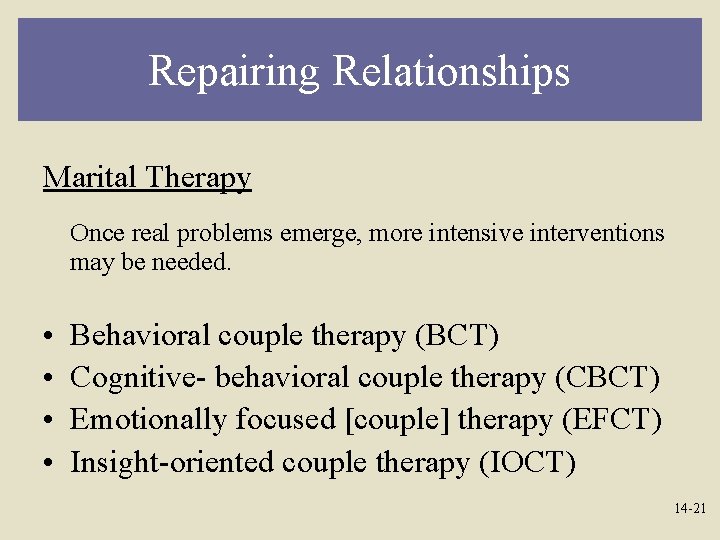
Repairing Relationships Marital Therapy Once real problems emerge, more intensive interventions may be needed. • • Behavioral couple therapy (BCT) Cognitive- behavioral couple therapy (CBCT) Emotionally focused [couple] therapy (EFCT) Insight-oriented couple therapy (IOCT) 14 -21
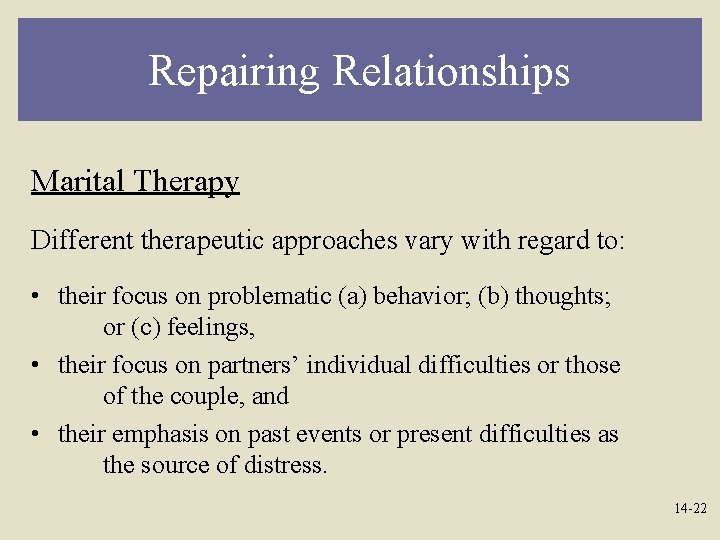
Repairing Relationships Marital Therapy Different therapeutic approaches vary with regard to: • their focus on problematic (a) behavior; (b) thoughts; or (c) feelings, • their focus on partners’ individual difficulties or those of the couple, and • their emphasis on past events or present difficulties as the source of distress. 14 -22
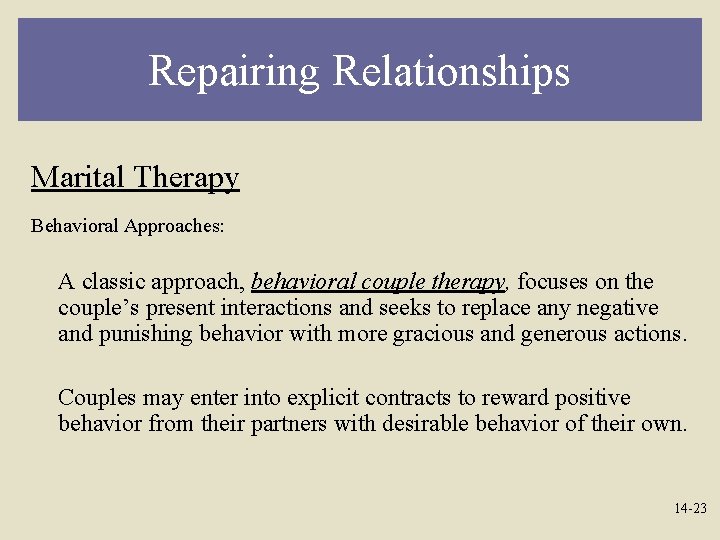
Repairing Relationships Marital Therapy Behavioral Approaches: A classic approach, behavioral couple therapy, focuses on the couple’s present interactions and seeks to replace any negative and punishing behavior with more gracious and generous actions. Couples may enter into explicit contracts to reward positive behavior from their partners with desirable behavior of their own. 14 -23
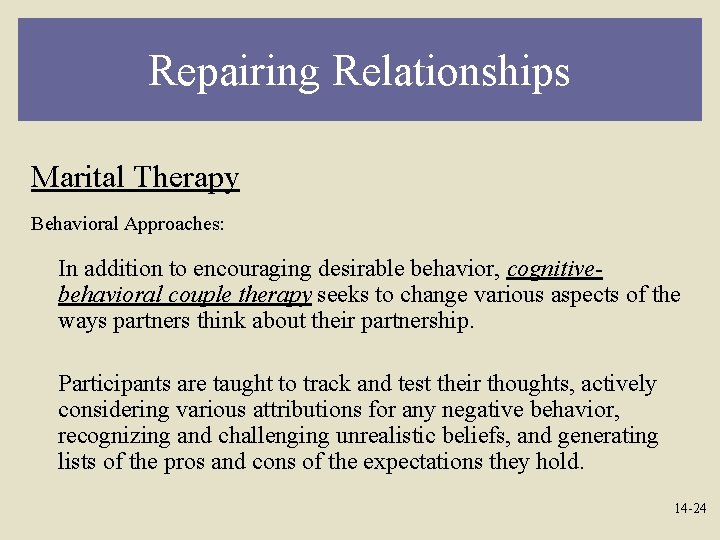
Repairing Relationships Marital Therapy Behavioral Approaches: In addition to encouraging desirable behavior, cognitivebehavioral couple therapy seeks to change various aspects of the ways partners think about their partnership. Participants are taught to track and test their thoughts, actively considering various attributions for any negative behavior, recognizing and challenging unrealistic beliefs, and generating lists of the pros and cons of the expectations they hold. 14 -24
Repairing Relationships Marital Therapy Emotionally Focused Therapy: Attachment Therapy Emotionally focused couple therapy seeks to train spouses to treat each other in ways that allow them to feel safe, loved, and securely connected to one another. Its primary focus is to create healthy attachment that is corrective. Partners are taught to provide reassurance and comfort that acknowledges and fulfills the other’s needs. 14 -25
Repairing Relationships Marital Therapy Emotionally Focused Therapy: Emotionally focused couple therapy is quite effective with couples who are moderately distressed, with about 70 % of them overcoming their dissatisfaction by the time treatment is complete. 14 -26
Repairing Relationships Marital Therapy Insight Oriented Therapy: A last approach, insight-oriented couple therapy, seeks to free spouses of some of the problematic emotional baggage they carry from prior relationships. Looks for current patterns in their interpersonal dynamics and looks for roots of those patterns in past history of relationships and experiences. 14 -27
Repairing Relationships Marital Therapy Marital therapy helps most couples. So, which one is for you? Pick therapy—and therapist—that appeal to you the most. 14 -28
Repairing Relationships Marital Therapy Thus, it is regrettable that all of these therapies tend to be underutilized. Most people who divorce do so without ever consulting a marital therapist, and those who do usually wait to seek help until their problems are severe. Time counts; the sooner marital problems are addressed, the easier they are to solve. 14 -29
In Conclusion Most of us hope that we will ultimately construct an intimate relationship with a particular partner that we will find fulfilling for the rest of our lives. We may. 14 -30
In Conclusion Relationship scientists hope that, now that you have studied their work, you are better equipped to create, understand, and manage successful, happy, rewarding relationships that last. They wish you the very best in the interpersonal journey that awaits you. 14 -31
For Your Consideration When she reached the end of this book, Carolyn decided to talk with her husband about her increasing discontent with him and their marriage. He had been considerate and charming when they were engaged, but she had come to feel that he had stopped trying to please her, and she felt lonely and hurt. She felt that she was constantly changing to accommodate his wishes, but that he was doing little to satisfy her in return. He never asked her how her day had been. It was a little thing, but it nettled her, and it was just one example of his self-absorption and apparent lack of care. However, when she suggested that they seek therapy, he resolutely refused. So, she decided to go by herself; she went to the website of the American Association for Marriage and Family Therapy at www. aamft. org, found a therapist, and made an individual appointment. What do you think the future holds for Carolyn and her husband? Why? 14 -32