
Chapter 14 Local Area Networks Ethernet Kyung Hee

- Slides: 45
Chapter 14 Local Area Networks : Ethernet Kyung Hee University 1
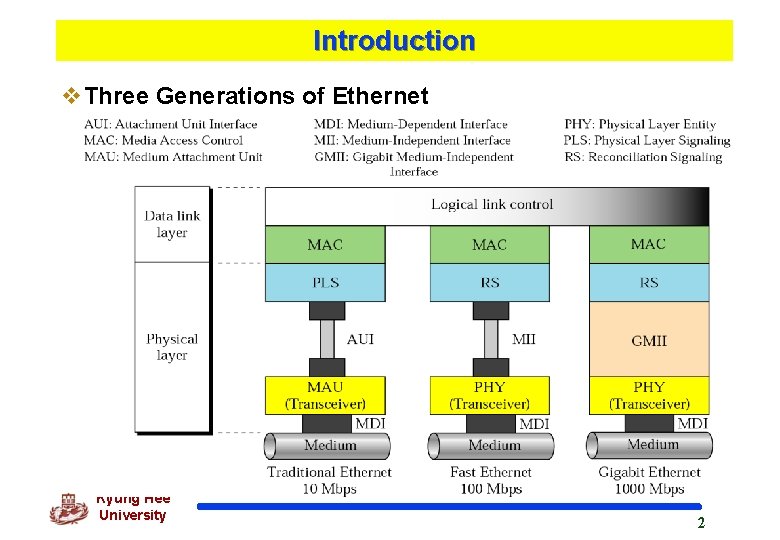
Introduction v. Three Generations of Ethernet Kyung Hee University 2
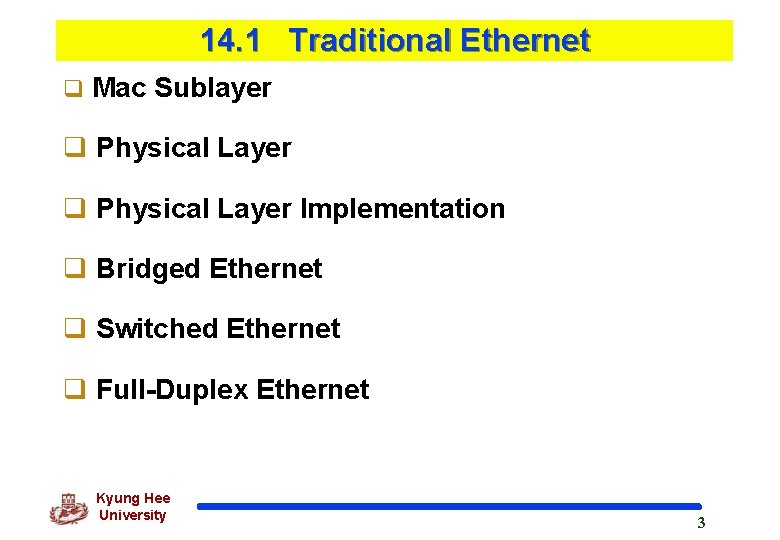
14. 1 Traditional Ethernet q Mac Sublayer q Physical Layer Implementation q Bridged Ethernet q Switched Ethernet q Full-Duplex Ethernet Kyung Hee University 3
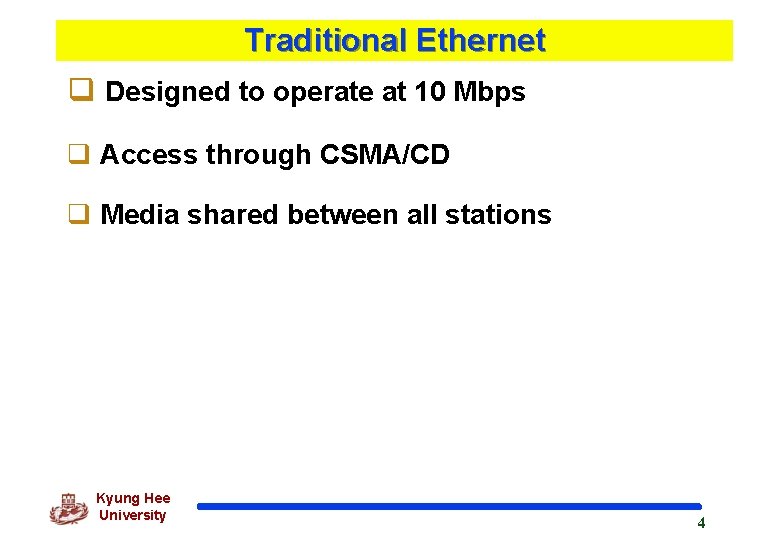
Traditional Ethernet q Designed to operate at 10 Mbps q Access through CSMA/CD q Media shared between all stations Kyung Hee University 4
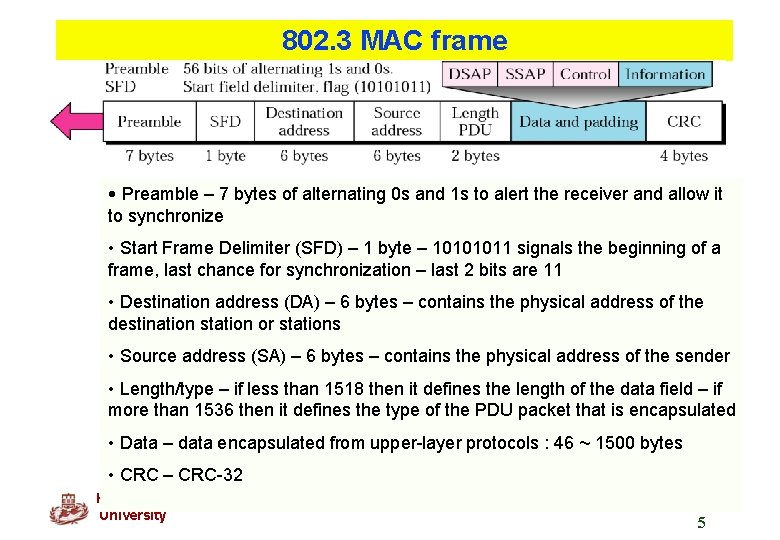
802. 3 MAC frame • Preamble – 7 bytes of alternating 0 s and 1 s to alert the receiver and allow it to synchronize • Start Frame Delimiter (SFD) – 1 byte – 10101011 signals the beginning of a frame, last chance for synchronization – last 2 bits are 11 • Destination address (DA) – 6 bytes – contains the physical address of the destination station or stations • Source address (SA) – 6 bytes – contains the physical address of the sender • Length/type – if less than 1518 then it defines the length of the data field – if more than 1536 then it defines the type of the PDU packet that is encapsulated • Data – data encapsulated from upper-layer protocols : 46 ~ 1500 bytes • CRC – CRC-32 Kyung Hee University 5
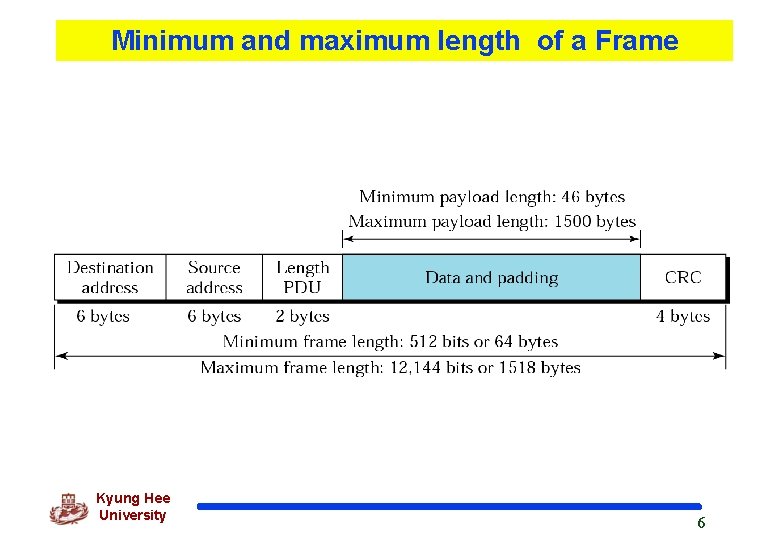
Minimum and maximum length of a Frame Kyung Hee University 6
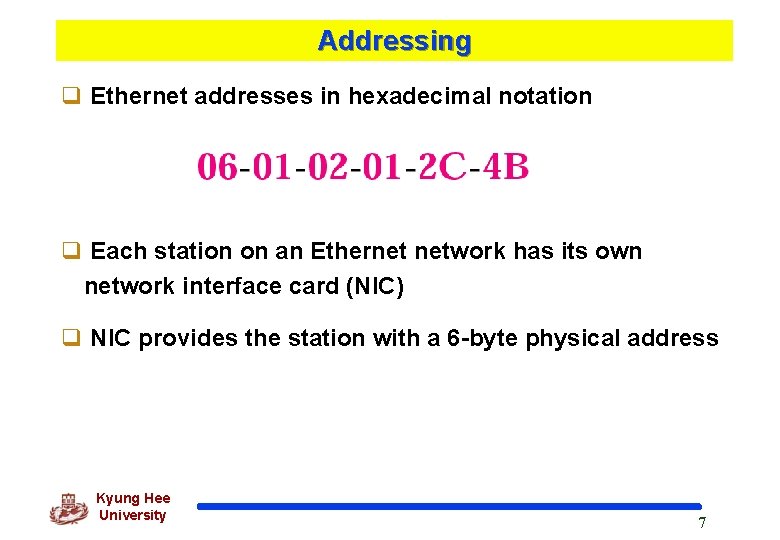
Addressing q Ethernet addresses in hexadecimal notation q Each station on an Ethernet network has its own network interface card (NIC) q NIC provides the station with a 6 -byte physical address Kyung Hee University 7
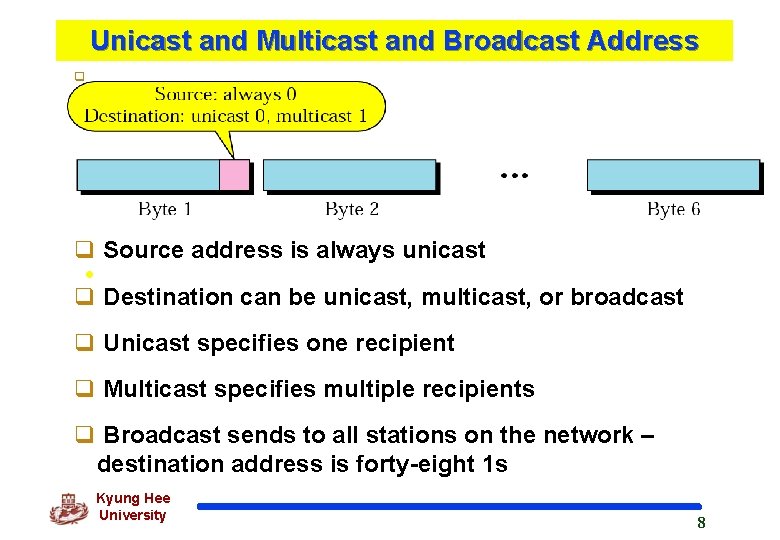
Unicast and Multicast and Broadcast Address q q Source address is always unicast • q Destination can be unicast, multicast, or broadcast q Unicast specifies one recipient q Multicast specifies multiple recipients q Broadcast sends to all stations on the network – destination address is forty-eight 1 s Kyung Hee University 8
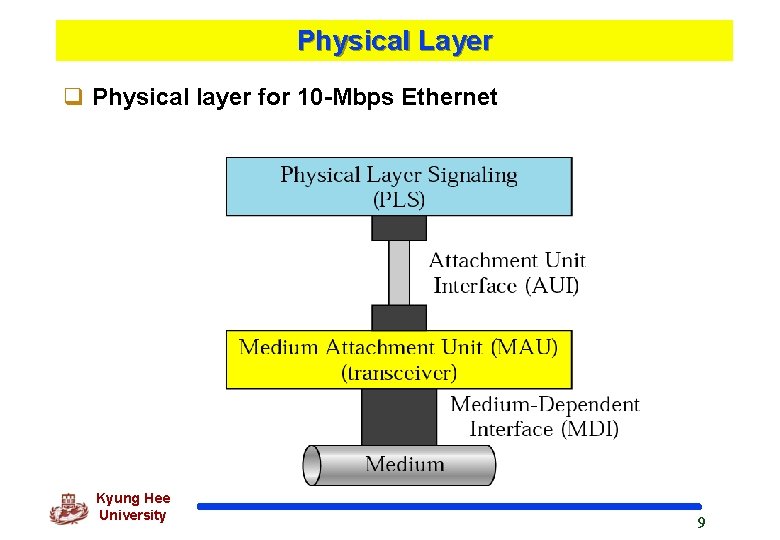
Physical Layer q Physical layer for 10 -Mbps Ethernet Kyung Hee University 9
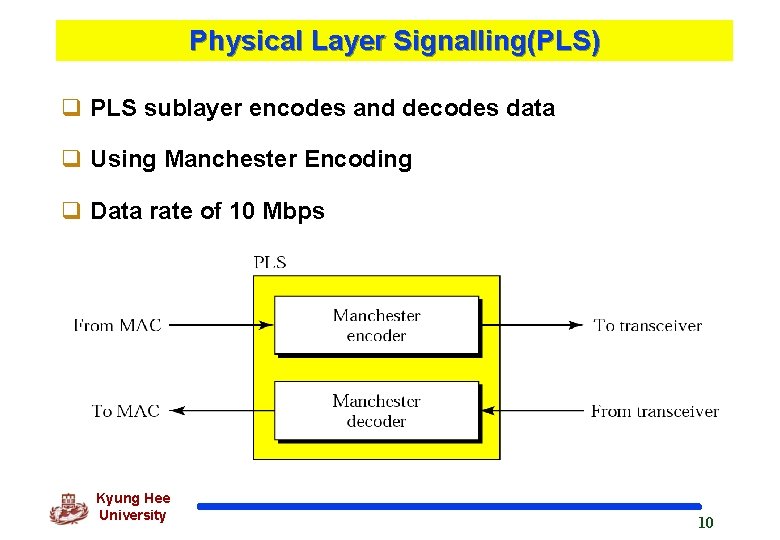
Physical Layer Signalling(PLS) q PLS sublayer encodes and decodes data q Using Manchester Encoding q Data rate of 10 Mbps Kyung Hee University 10
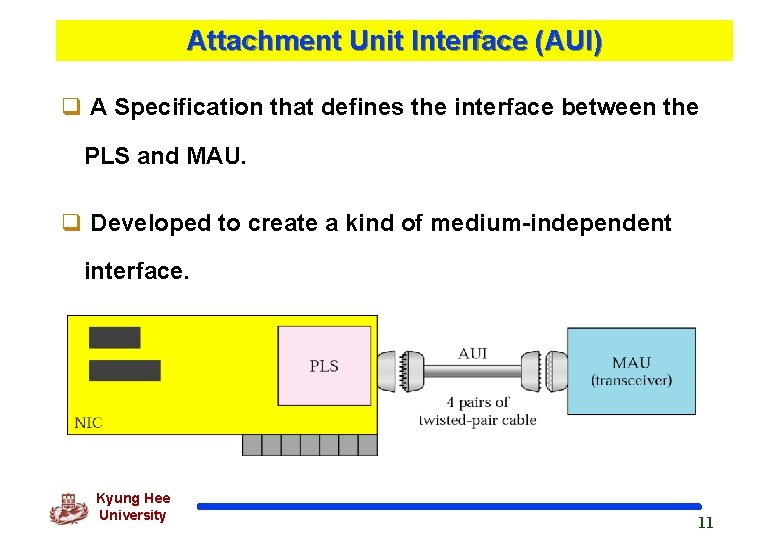
Attachment Unit Interface (AUI) q A Specification that defines the interface between the PLS and MAU. q Developed to create a kind of medium-independent interface. Kyung Hee University 11
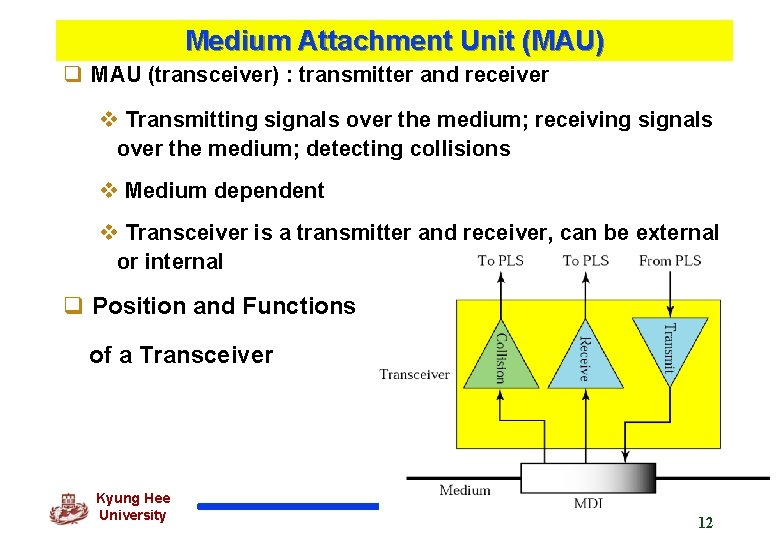
Medium Attachment Unit (MAU) q MAU (transceiver) : transmitter and receiver v Transmitting signals over the medium; receiving signals over the medium; detecting collisions v Medium dependent v Transceiver is a transmitter and receiver, can be external or internal q Position and Functions of a Transceiver Kyung Hee University 12
Medium Dependent Interface (MDI) q To connect the transceiver (internal, external) to medium, we need a MDI. q For an external transceiver, it can be a tap or a tee connector. q For an internal transceiver, it can be a jack. Kyung Hee University 13
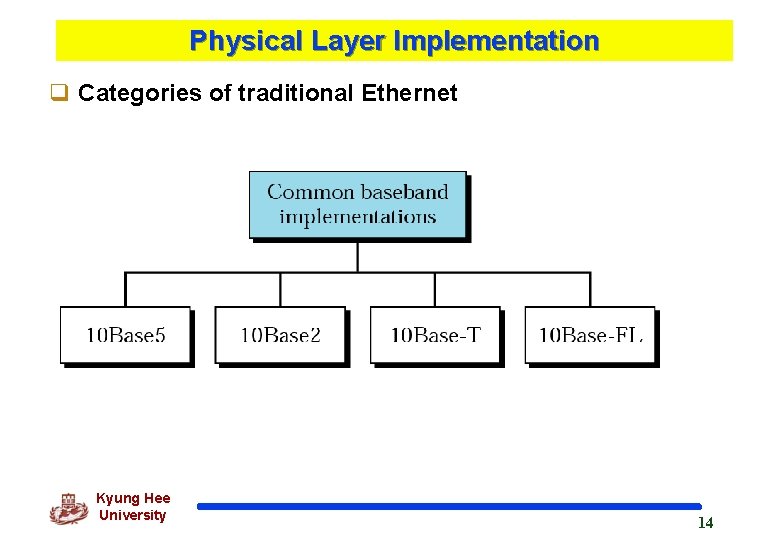
Physical Layer Implementation q Categories of traditional Ethernet Kyung Hee University 14
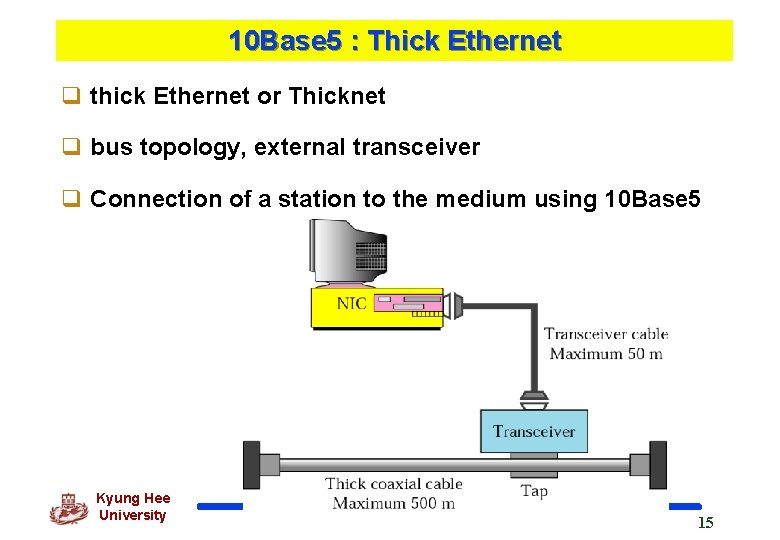
10 Base 5 : Thick Ethernet q thick Ethernet or Thicknet q bus topology, external transceiver q Connection of a station to the medium using 10 Base 5 Kyung Hee University 15
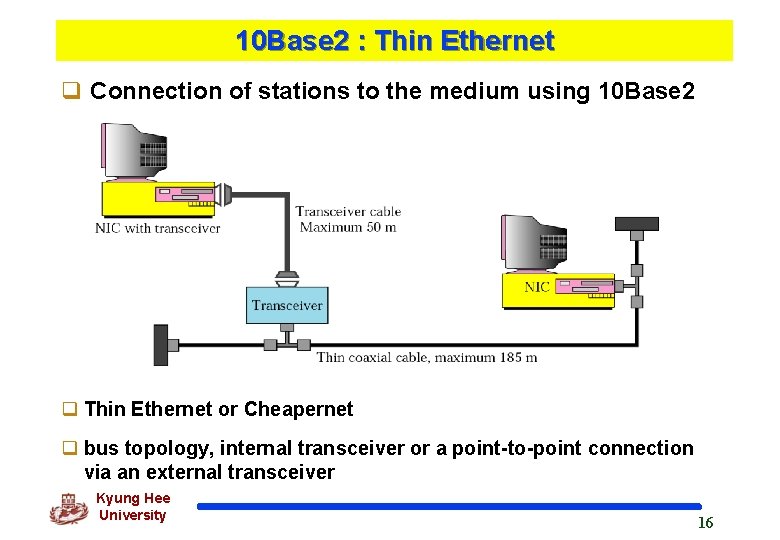
10 Base 2 : Thin Ethernet q Connection of stations to the medium using 10 Base 2 q Thin Ethernet or Cheapernet q bus topology, internal transceiver or a point-to-point connection via an external transceiver Kyung Hee University 16
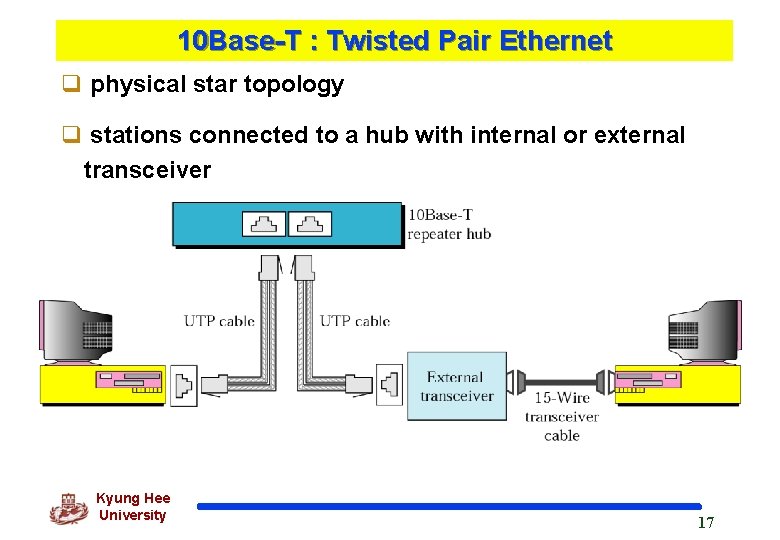
10 Base-T : Twisted Pair Ethernet q physical star topology q stations connected to a hub with internal or external transceiver Kyung Hee University 17
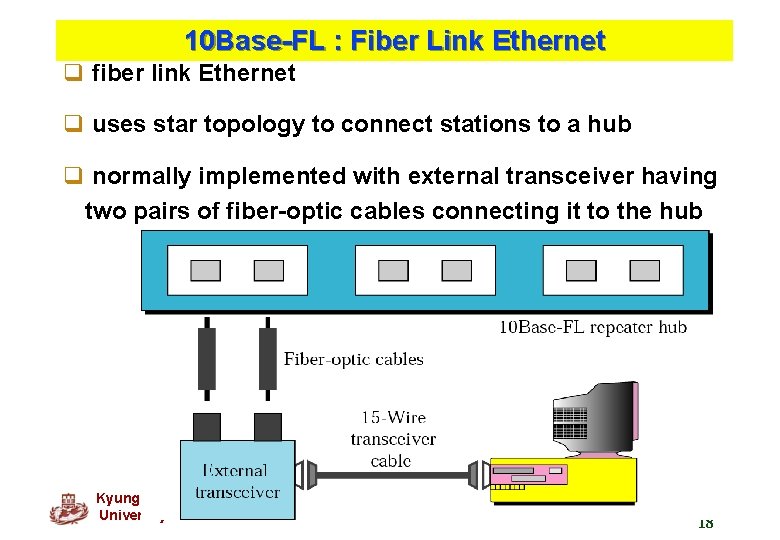
10 Base-FL : Fiber Link Ethernet q fiber link Ethernet q uses star topology to connect stations to a hub q normally implemented with external transceiver having two pairs of fiber-optic cables connecting it to the hub Kyung Hee University 18
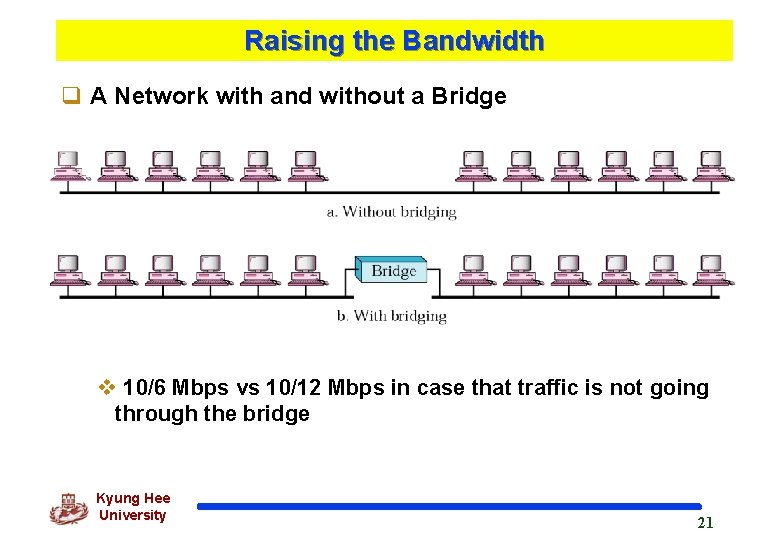
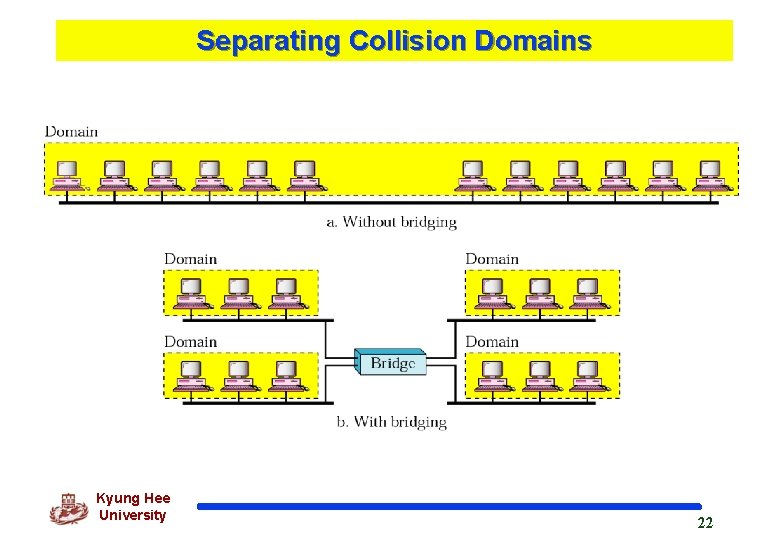
Bridged Ethernet q Raising the bandwidth q Separating collision domains Kyung Hee University 19
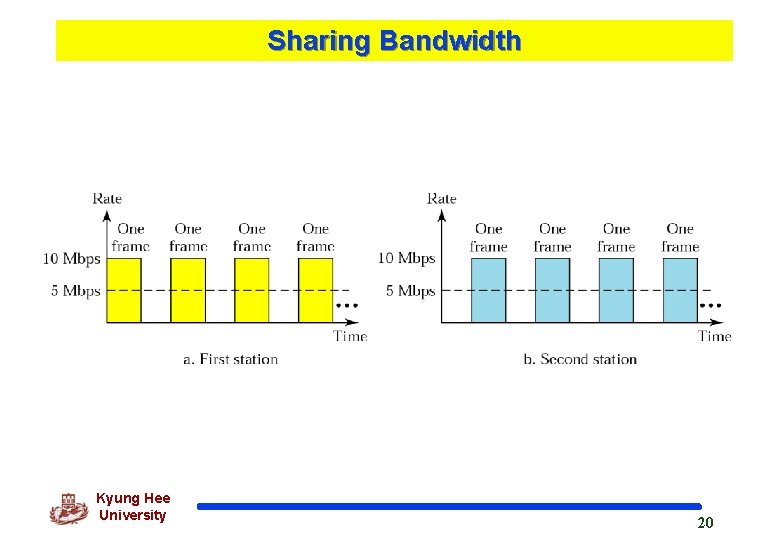
Sharing Bandwidth Kyung Hee University 20
Raising the Bandwidth q A Network with and without a Bridge v 10/6 Mbps vs 10/12 Mbps in case that traffic is not going through the bridge Kyung Hee University 21
Separating Collision Domains Kyung Hee University 22
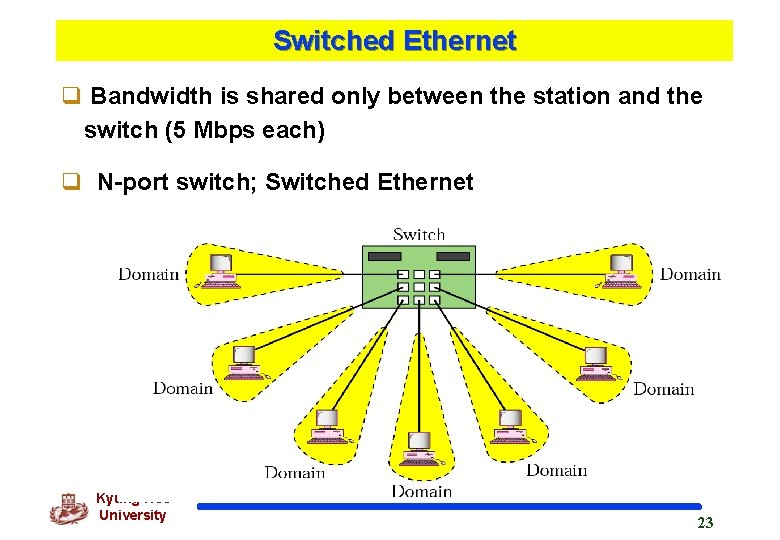
Switched Ethernet q Bandwidth is shared only between the station and the switch (5 Mbps each) q N-port switch; Switched Ethernet Kyung Hee University 23
Full-Duplex Ethernet q A Limitation of 10 Base 5 and 10 Base 2 half-duplex. q Evolution : switched Ethernet full duplex Switched Ethenet v 10 Base-T is always Full-duplex. q Full duplex mode increases the capacity of each domain from 10 to 20 Mpbs. Kyung Hee University 24
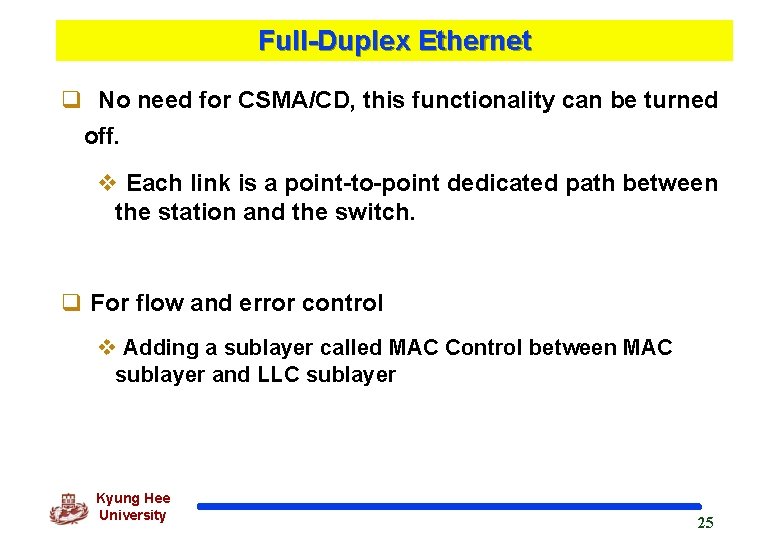
Full-Duplex Ethernet q No need for CSMA/CD, this functionality can be turned off. v Each link is a point-to-point dedicated path between the station and the switch. q For flow and error control v Adding a sublayer called MAC Control between MAC sublayer and LLC sublayer Kyung Hee University 25
14. 2 Fast Ethernet q Evolution from 10 to 100 Mpbs doesn’t change the MAC sublayer. q Access method is CSMA/CD, which is kept for backward compatibility. q Frame format, minimum and maximum frame lengths, and addressing are the same. Kyung Hee University 26
Autonegotiation q Allowing two devices to negotiate the mode or data rate of operation. v To allow incompatible devices to connect to one another. For example, between 10 Mbps-device and 100 Mbpsdevice v To allow one device to have multiple capabilities v To allow a station to check a hub’s capabilities Kyung Hee University 27
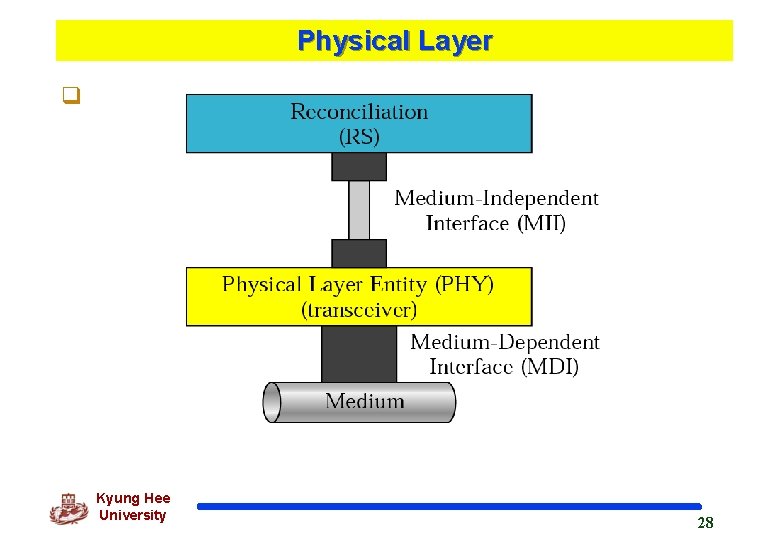
Physical Layer q Kyung Hee University 28
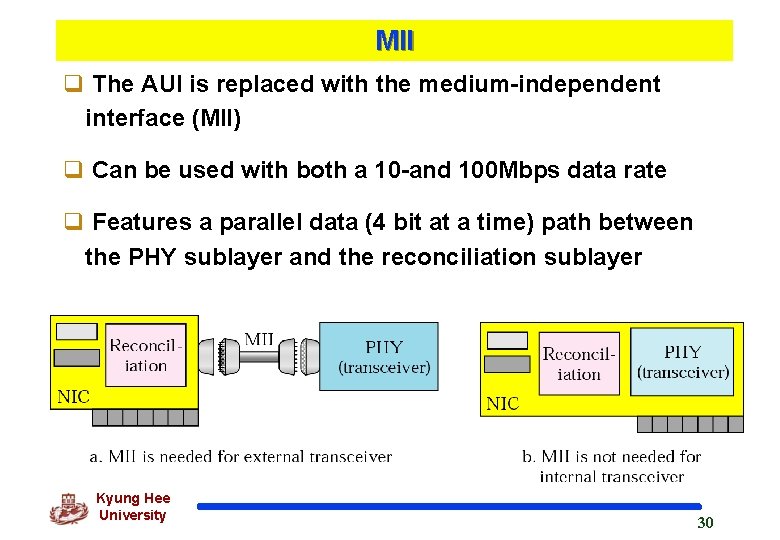
Reconciliation q Replacing PLS sublayer in 10 Mbps Ethernet v. But, encoding and decoding, which were performed by the PLS, are moved to the PHY sublayer (transceiver), because encoding in Fast Ethernet is medium-dependent. q Is responsible for passing of data in 4 -bit format (nibble) to the MII. Kyung Hee University 29
MII q The AUI is replaced with the medium-independent interface (MII) q Can be used with both a 10 -and 100 Mbps data rate q Features a parallel data (4 bit at a time) path between the PHY sublayer and the reconciliation sublayer Kyung Hee University 30
PHY (Transceiver) and MDI q Transceiver is responsible for encoding and decoding. q MDI is need to connect the transceiver to the medium. Kyung Hee University 31
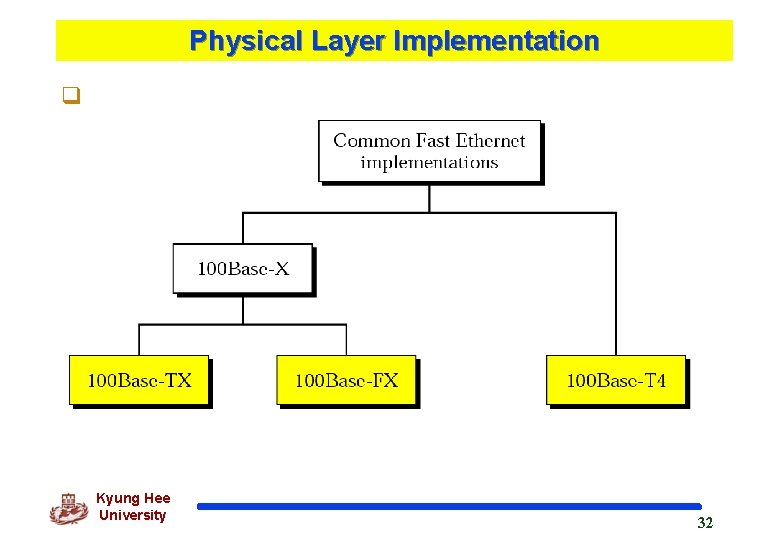
Physical Layer Implementation q Kyung Hee University 32
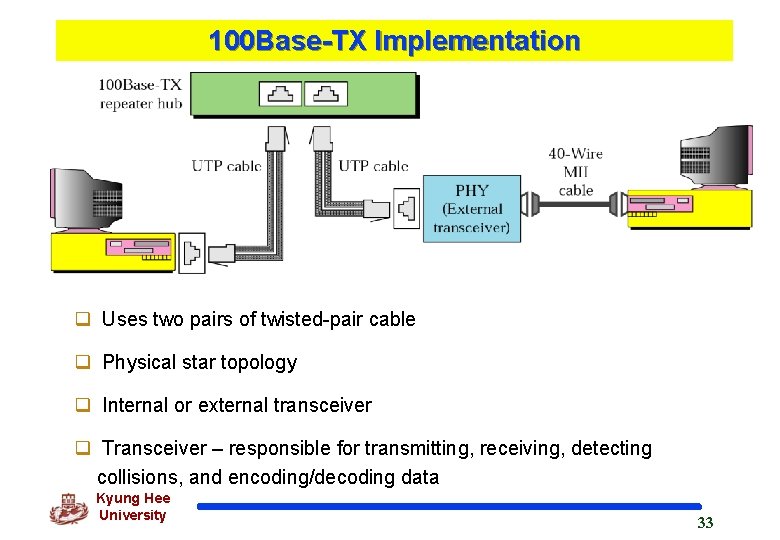
100 Base-TX Implementation q Uses two pairs of twisted-pair cable q Physical star topology q Internal or external transceiver q Transceiver – responsible for transmitting, receiving, detecting collisions, and encoding/decoding data Kyung Hee University 33
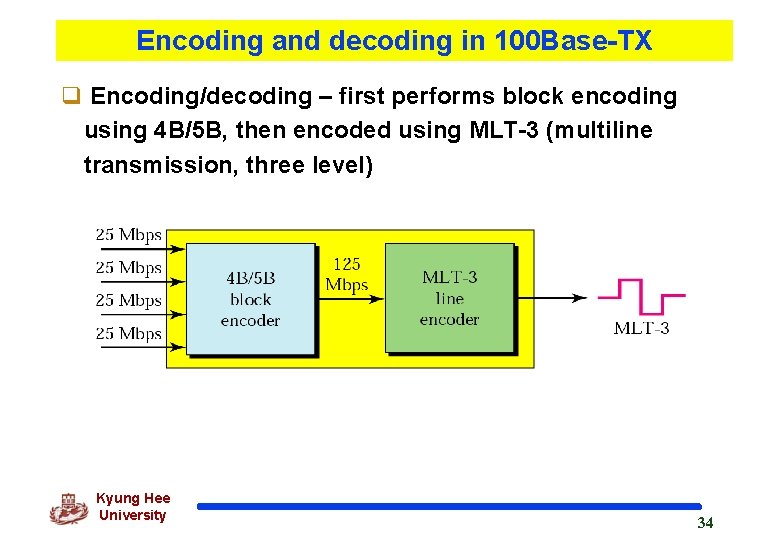
Encoding and decoding in 100 Base-TX q Encoding/decoding – first performs block encoding using 4 B/5 B, then encoded using MLT-3 (multiline transmission, three level) Kyung Hee University 34
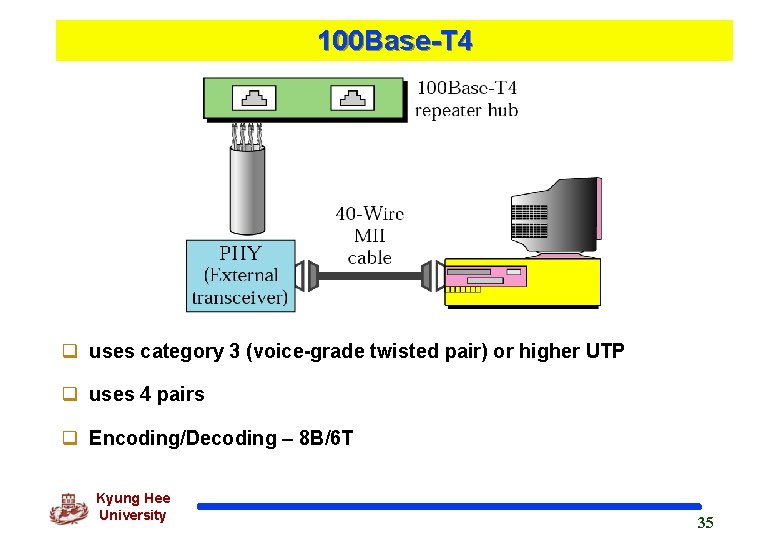
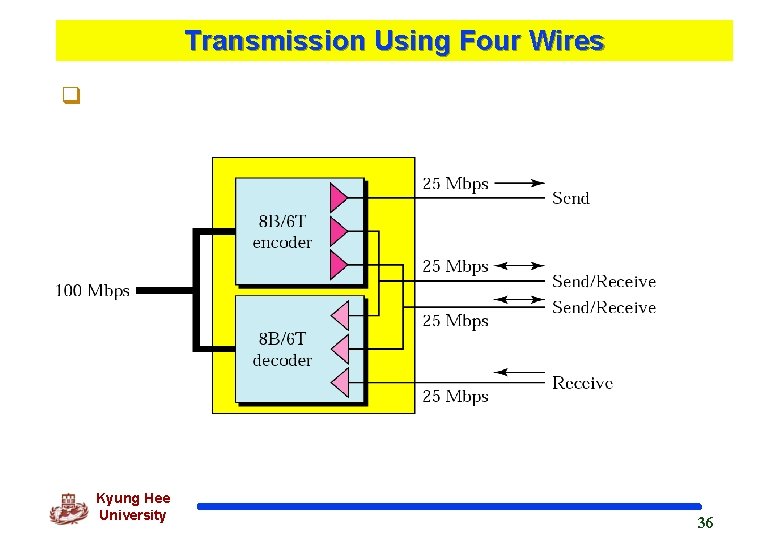
100 Base-T 4 q uses category 3 (voice-grade twisted pair) or higher UTP q uses 4 pairs q Encoding/Decoding – 8 B/6 T Kyung Hee University 35
Transmission Using Four Wires q Kyung Hee University 36
Giga-bit Ethernet q No longer possible to keep the MAC sublayer untouched q Two distinctive approaches: half-duplex using CSMA/CD or full-duplex with no need for CSMA/CD Kyung Hee University 37
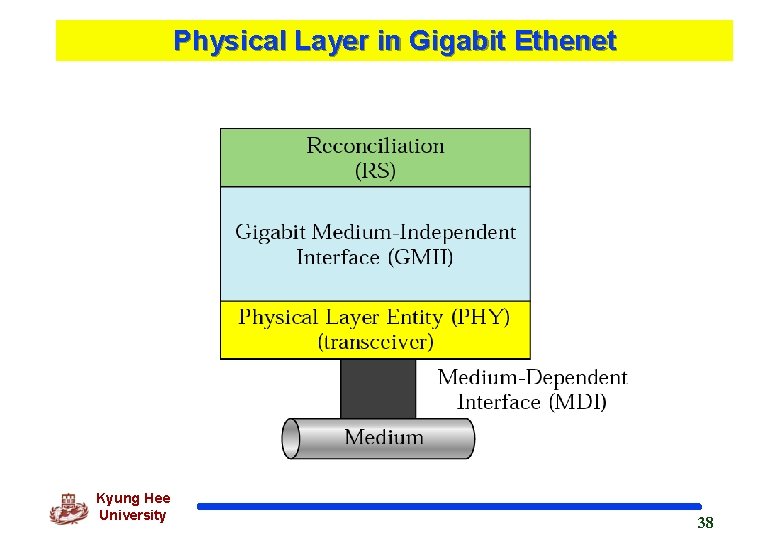
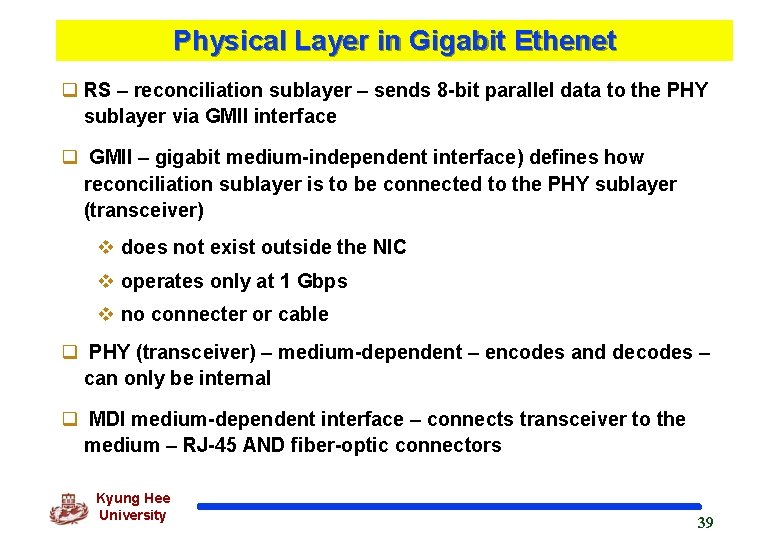
Physical Layer in Gigabit Ethenet Kyung Hee University 38
Physical Layer in Gigabit Ethenet q RS – reconciliation sublayer – sends 8 -bit parallel data to the PHY sublayer via GMII interface q GMII – gigabit medium-independent interface) defines how reconciliation sublayer is to be connected to the PHY sublayer (transceiver) v does not exist outside the NIC v operates only at 1 Gbps v no connecter or cable q PHY (transceiver) – medium-dependent – encodes and decodes – can only be internal q MDI medium-dependent interface – connects transceiver to the medium – RJ-45 AND fiber-optic connectors Kyung Hee University 39
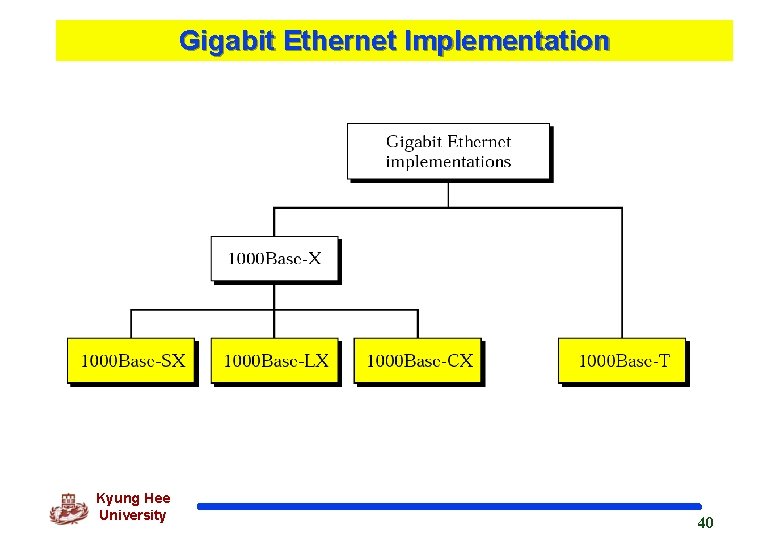
Gigabit Ethernet Implementation Kyung Hee University 40
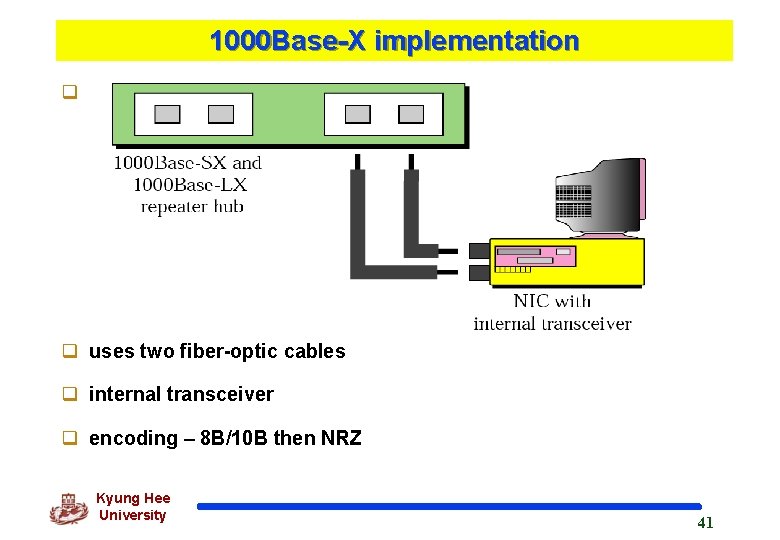
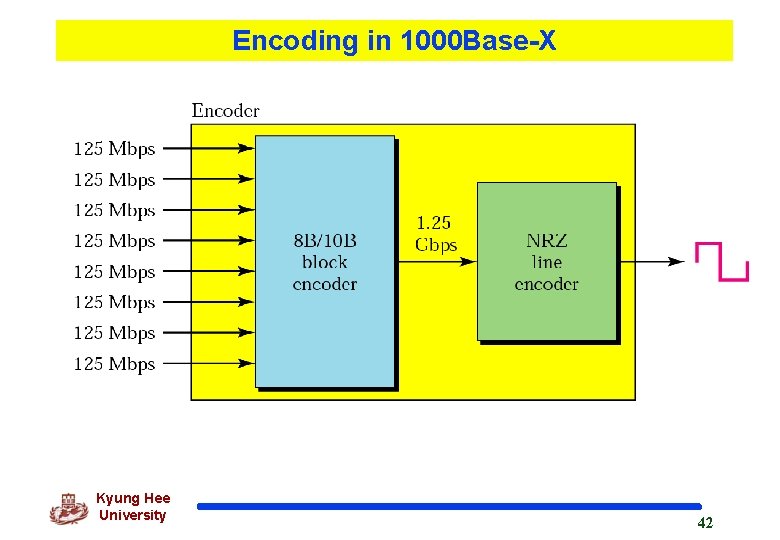
1000 Base-X implementation q q uses two fiber-optic cables q internal transceiver q encoding – 8 B/10 B then NRZ Kyung Hee University 41
Encoding in 1000 Base-X Kyung Hee University 42
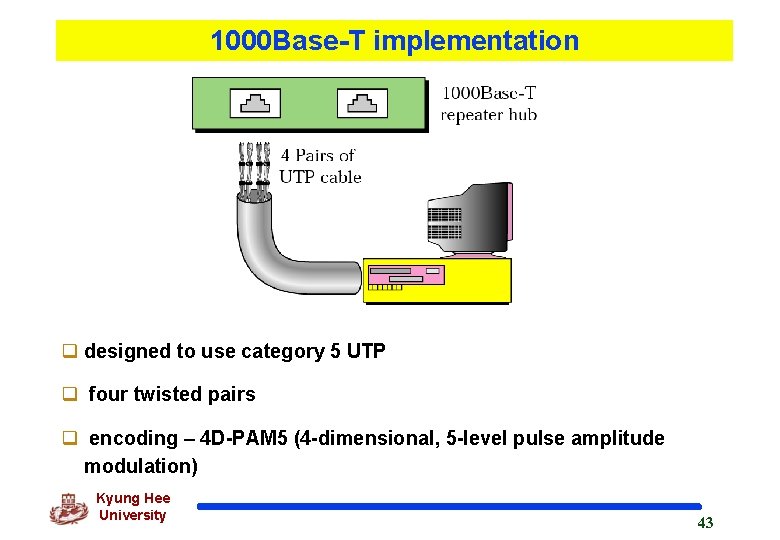
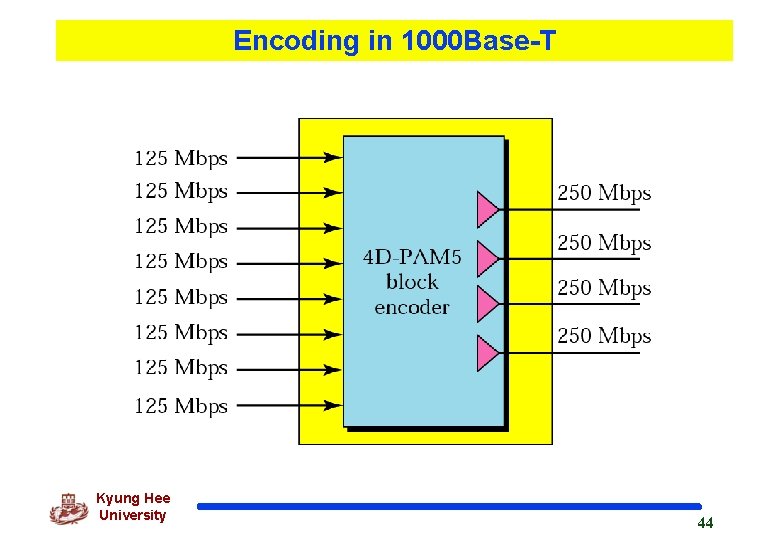
1000 Base-T implementation q designed to use category 5 UTP q four twisted pairs q encoding – 4 D-PAM 5 (4 -dimensional, 5 -level pulse amplitude modulation) Kyung Hee University 43
Encoding in 1000 Base-T Kyung Hee University 44
Questions ! Kyung Hee University 45