
Chapter 14 Liquids and Solids Phase changes and

- Slides: 18
Chapter 14 Liquids and Solids
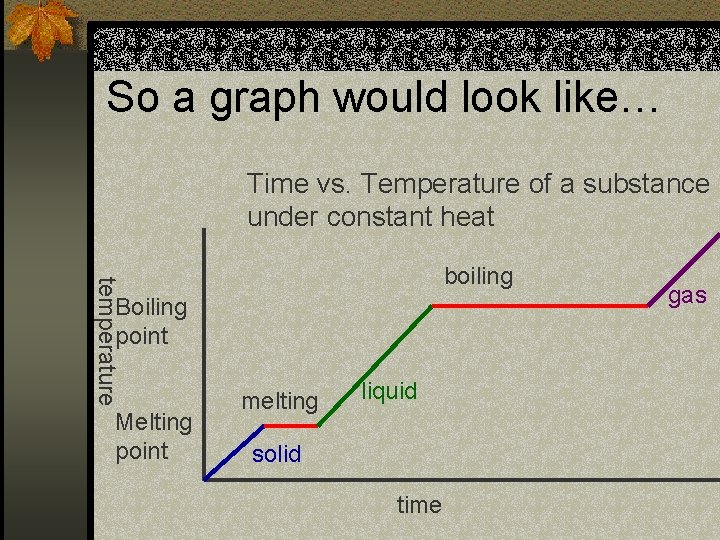
Phase changes and temperature n Normally when heat is added the temperature goes up. n However when you hit a phase change point (melting/freezing, boiling/condensation)… n The temperature stays constant when heat is added, at least until the phase change is complete.
Why should you… n Turn the heat down once the water is boiling? n Recipes will always tell you to do this. n Heat the water to a boil. Add spaghetti, and turn the heat down. n Won’t your spaghetti cook faster if you turn the heat up? n No n The water can only get to 100 o C n Increasing the heat would increase how fast it boils off, but that water leaves.
So a graph would look like… Time vs. Temperature of a substance under constant heat temperature boiling Boiling point Melting point melting liquid solid time gas
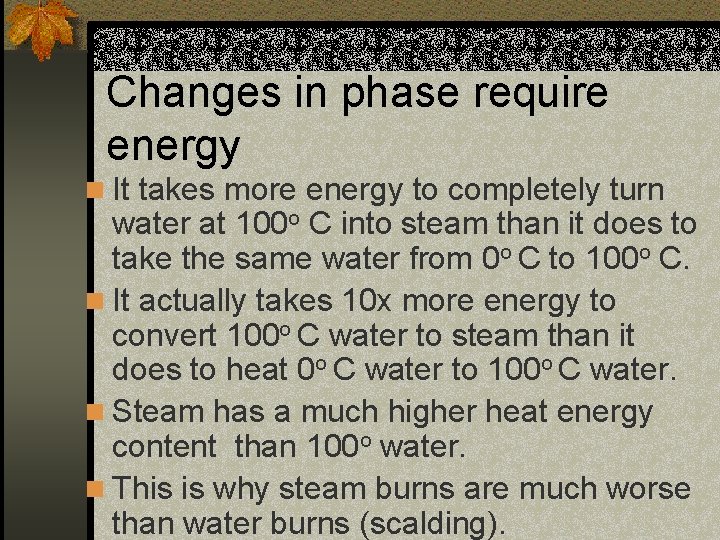
Changes in phase require energy n It takes more energy to completely turn water at 100 o C into steam than it does to take the same water from 0 o C to 100 o C. n It actually takes 10 x more energy to convert 100 o C water to steam than it does to heat 0 o C water to 100 o C water. n Steam has a much higher heat energy content than 100 o water. n This is why steam burns are much worse than water burns (scalding).
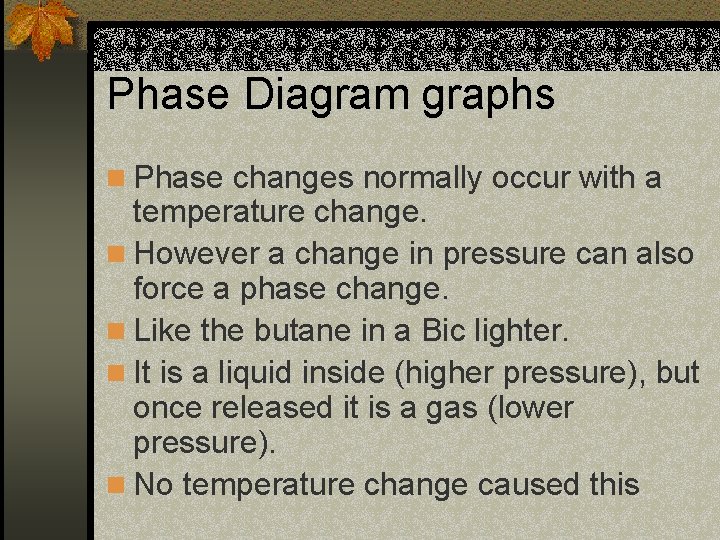
Phase Diagram graphs n Phase changes normally occur with a temperature change. n However a change in pressure can also force a phase change. n Like the butane in a Bic lighter. n It is a liquid inside (higher pressure), but once released it is a gas (lower pressure). n No temperature change caused this
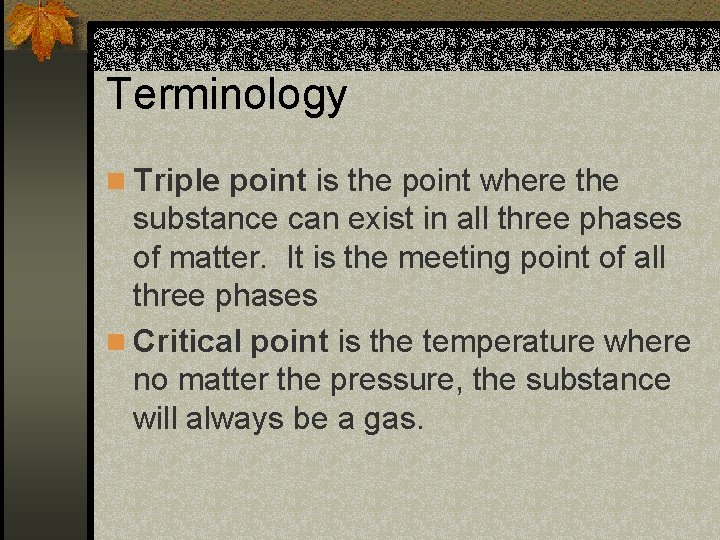
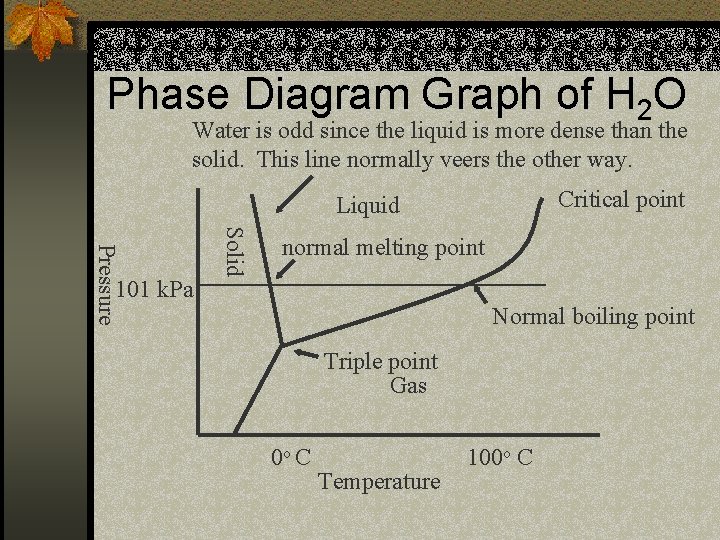
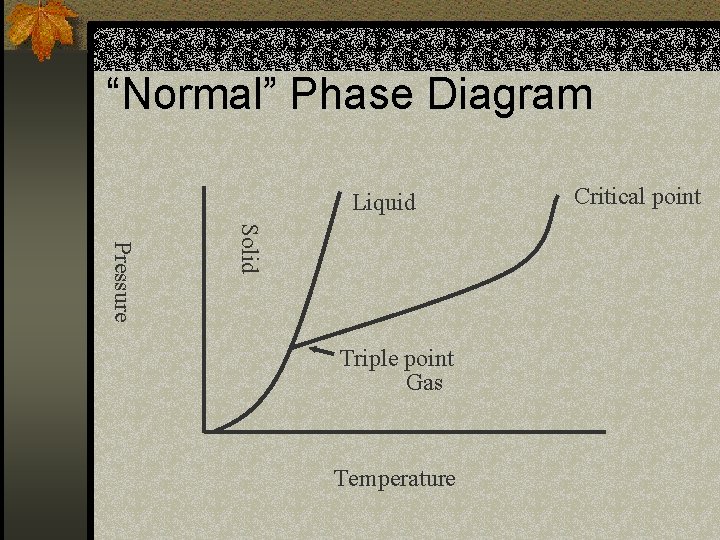
Terminology n Triple point is the point where the substance can exist in all three phases of matter. It is the meeting point of all three phases n Critical point is the temperature where no matter the pressure, the substance will always be a gas.
Phase Diagram Graph of H 2 O Water is odd since the liquid is more dense than the solid. This line normally veers the other way. Critical point Liquid Solid Pressure 101 k. Pa normal melting point Normal boiling point Triple point Gas 0 o C Temperature 100 o C
“Normal” Phase Diagram Liquid Solid Pressure Triple point Gas Temperature Critical point
Why is water more dense than ice? n Intermolecular forces- forces of attraction between molecules that forces them to come together to form solids or liquids. n Intermolecular Forces are collectively called Van der Waals Forces. n Don’t confuse these with bonds which are intramolecular forces or forces that hold a molecule together.
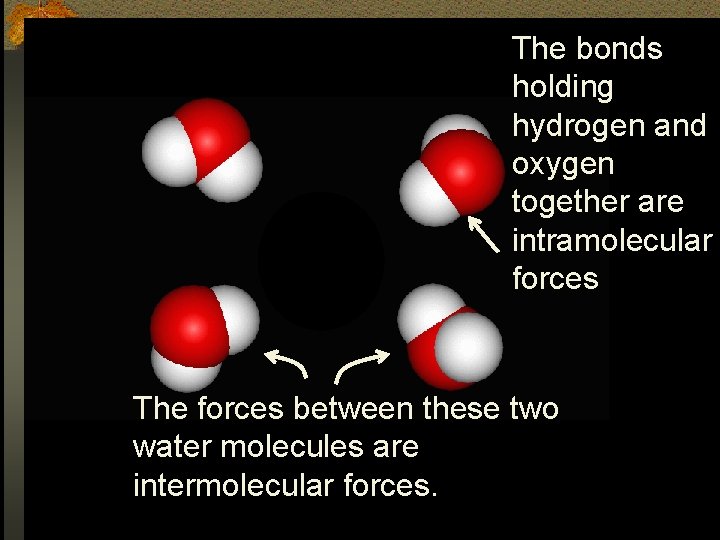
The bonds holding hydrogen and oxygen together are intramolecular forces The forces between these two water molecules are intermolecular forces.
Phase changes n When intermolecular forces are strong enough to hold particles in place you have a solid. n As you increase the amount of energy in the particles, they break free of Van der Waals forces and start to move around some. This is a liquid. n When the atoms break free of all significant intermolecular forces they become a gas.
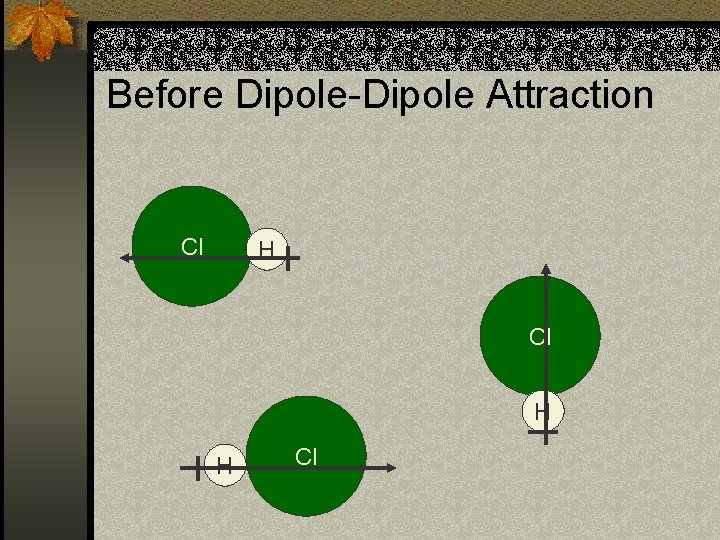
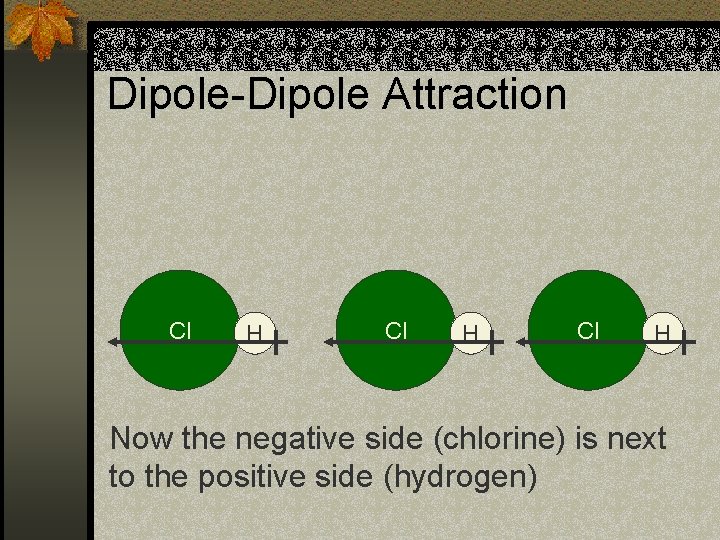
Dipole-Dipole Attraction n There are several intermolecular forces that we are not discussing. n One specific intermolecular force is dipole-dipole attraction. n Remember we said some molecules have a dipole moment or positive and negative ends. n A dipole-dipole attraction is when the molecules arrange themselves so that the opposite ends face each other.
Before Dipole-Dipole Attraction Cl H H Cl
Dipole-Dipole Attraction Cl H Now the negative side (chlorine) is next to the positive side (hydrogen)
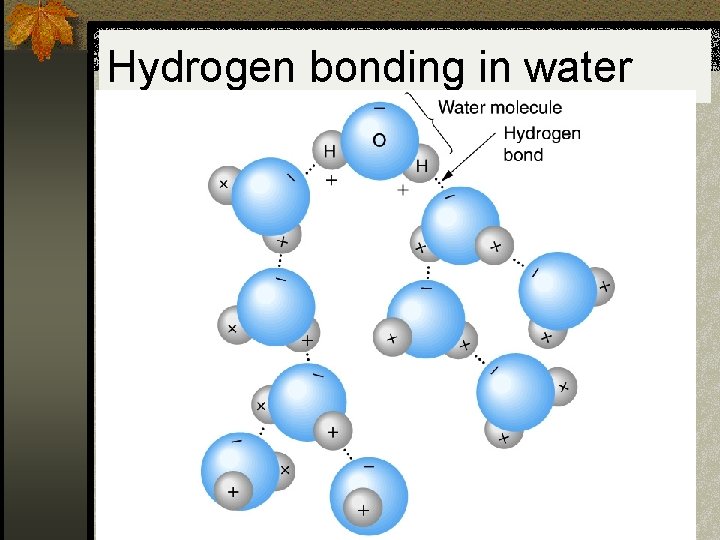
A really strong dipole-dipole force n A strong dipole-dipole force occurs when you have a molecules that have hydrogen bonding with nitrogen, oxygen or fluorine. n This is called hydrogen bonding. n Hydrogen bonding is a misnomer, it is not an intramolecular force (regular bond), it is an intermolecular force. n It is much weaker than a regular bond, but stronger than the average intermolecular force.
Hydrogen bonding in water
Why is liquid water more dense… n Hydrogen bonding. n In solid water, the molecules can’t rearrange themselves. n In liquid water, they are capable of moving around. n Normally random movement would increase the spaces between molecules, but with hydrogen bonding the molecules “purposefully” move to a position where they can be pulled in closer.