
chapter 14 Knowledge as Functional Constraint in Motor

- Slides: 20
chapter 14 Knowledge as Functional Constraint in Motor Development
Knowledge Bases • Performance related to size of knowledge base – Less need to remember great deal of information – More effective use of cognitive processes – Less demand for conscious attention to some tasks • Performance facilitated by practice of physical skills and by increased knowledge • Sport- or dance-form specific
Types of Knowledge • Declarative – Factual information – Topic-specific • Procedural – How-to information – Topic-specific • Strategic – General rules and strategies – Generalizable across activities • Examples for your favorite activity?
Novice–Expert Differences As compared with novices, experts – – – – have more declarative and procedural knowledge, organize information in a methodical structure, make more inferences, analyze problems at a more advanced level, recognize patterns more quickly, preplan some responses to specific situations, organize knowledge relative to the goal of the game, and – spend much time learning about the topic.
Development of Knowledge Base • Declarative knowledge comes before procedural knowledge. • Strategic knowledge develops last. • French & Thomas (1987) – Studied 8 - to 12 -year-old boys in basketball – Knowledge led to better decisions • French et al. (1996) – Studied 7 - to 10 -year-olds in baseball – Problem solving was related to knowledge rather than age (continued)
Development of Knowledge Base (continued) • Nevett & French (1997) – Researchers studied baseball shortstops. – Use of procedural knowledge was evident by adolescence. • Mc. Pherson (1999) – Focused on 18 - to 22 -year-old female tennis players. – Adult novices had fewer tactical concepts than did youth experts.
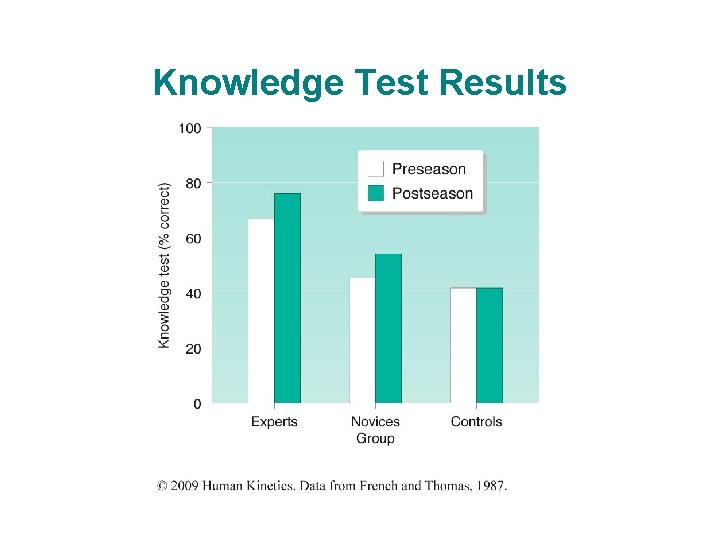
Knowledge Test Results
Gender Differences • Gender differences in sport performance may result partially from differences in knowledge of a sport. • Boys’ sport knowledge development is fostered. • Do you know of any programs designed to increase girls’ sport knowledge?
Knowledge Bases in Older Adulthood • Expert knowledge might offset some loss of physical ability. • Learning about an activity can improve older adults’ performances. • Langley & Knight (1996) study provides an example.
Memory • How are learning and memory related to each other? • Have researchers studied learning and memory together or separately? Why? • What types of things do you remember best?
Memory in Adulthood • Adults, too, remember more when they know more about a topic and are motivated. • Fit older adults remember better than unfit older adults.
Speed of Cognitive Function • Many activities require quick, accurate responses. • Researchers generally work from an information processing perspective. • Children and older adults take longer to process cognitive information than young adults do.
Speed of Cognitive Processing in Children • Reaction time – Time is measured between onset of stimulus and initiation of response. – Speed increases from age 3 years through adolescence. • Continuous tracking – Process involves matching movement to a target. – Time to response improves with advancing age. (continued)
Speed of Cognitive Processing in Children (continued) • Selection of a response – Selection improves with advancing age. – It improves especially for incompatible stimulus–response arrangements. • Central (rather than peripheral) functions account for children’s slower processing speeds.
Speed of Cognitive Processing in Adults • Speed in single, discrete actions does not change much. • Speed in simple, continuous, or repetitive actions does not change much. • Speed in sequences of different types of movements slows noticeably. • Speed in learning new tasks is reduced. • Older adults are more susceptible to distraction.
Older Adult Slowing • Central nervous system functions are more responsible. – Choice reaction time slows relatively more than simple reaction time. – Slowing is more pronounced on more complicated tasks. • Developmentalists speculate that “neural noise” increases with age and contributes to slowing.
Active Lifestyles Minimize Slowing • Active older adults are not much slower than young adults in reaction time. • Meta-analysis established that fitness training improves cognitive performance, especially if it uses a challenging exercise program at a sufficient training level. • Exercise may favorably affect both brain structure and function. (continued)
Active Lifestyles Minimize Slowing (continued) • The older adult brain may have more plasticity than previously thought. • What are the implications of findings regarding older adult fitness and cognitive performance? – For individuals – For health care programs – For teachers and therapists
Knowledge as Functional Constraint: Summary • Performance can be limited by limited knowledge. • Performance can be enhanced by expert knowledge. • Knowledge can be acquired at any age. • Acquiring knowledge takes time and experience.
Assessment of Decision Making as an Indicator of Knowledge • Written knowledge tests • Interviews • Observing, recording, and coding decisions made by athletes during play • Talk-aloud recordings made between points or pitches