
Chapter 14 IT Security Management and Risk Assessment
- Slides: 36
Chapter 14 IT Security Management and Risk Assessment
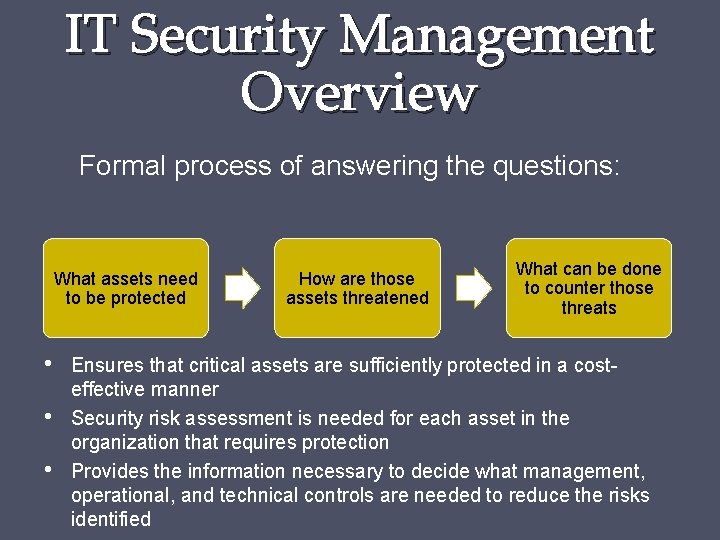
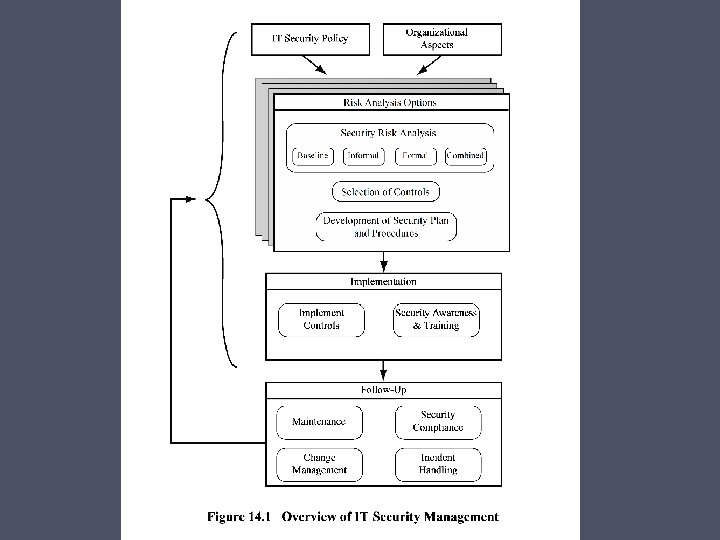
IT Security Management Overview Formal process of answering the questions: What assets need to be protected • • • How are those assets threatened What can be done to counter those threats Ensures that critical assets are sufficiently protected in a costeffective manner Security risk assessment is needed for each asset in the organization that requires protection Provides the information necessary to decide what management, operational, and technical controls are needed to reduce the risks identified
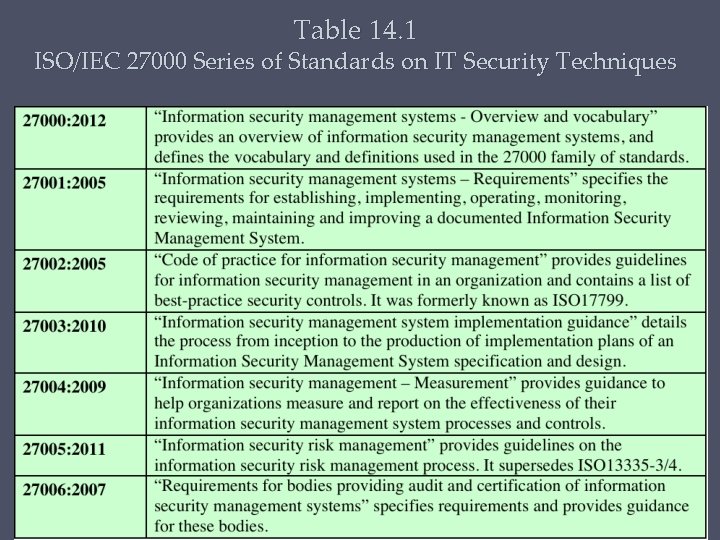
Table 14. 1 ISO/IEC 27000 Series of Standards on IT Security Techniques
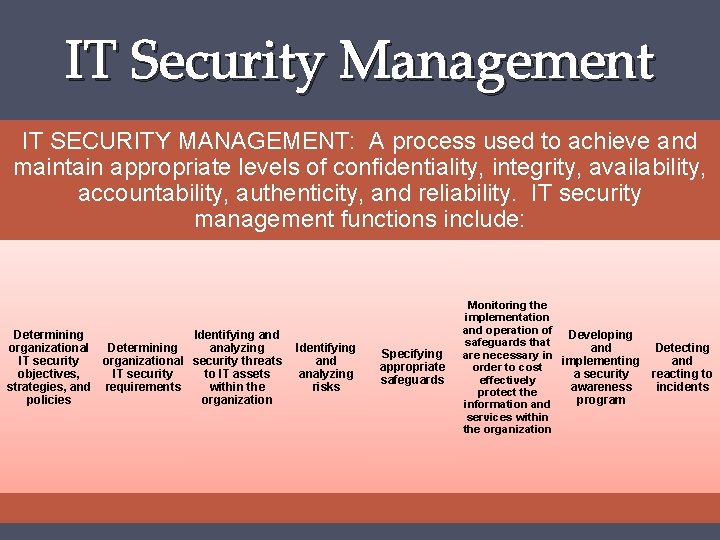
IT Security Management IT SECURITY MANAGEMENT: A process used to achieve and maintain appropriate levels of confidentiality, integrity, availability, accountability, authenticity, and reliability. IT security management functions include: Determining Identifying and organizational Determining analyzing IT security organizational security threats objectives, IT security to IT assets strategies, and requirements within the policies organization Identifying and analyzing risks Specifying appropriate safeguards Monitoring the implementation and operation of Developing safeguards that and are necessary in implementing order to cost a security effectively awareness protect the program information and services within the organization Detecting and reacting to incidents
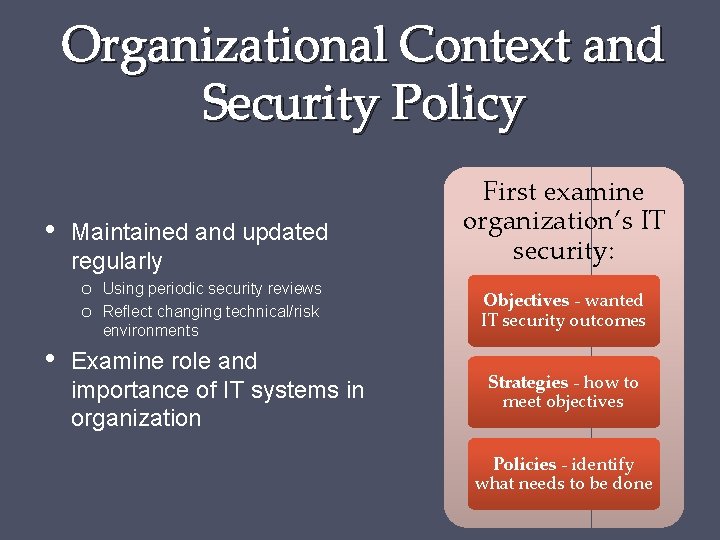
Organizational Context and Security Policy • Maintained and updated regularly o o • Using periodic security reviews Reflect changing technical/risk environments Examine role and importance of IT systems in organization First examine organization’s IT security: Objectives - wanted IT security outcomes Strategies - how to meet objectives Policies - identify what needs to be done
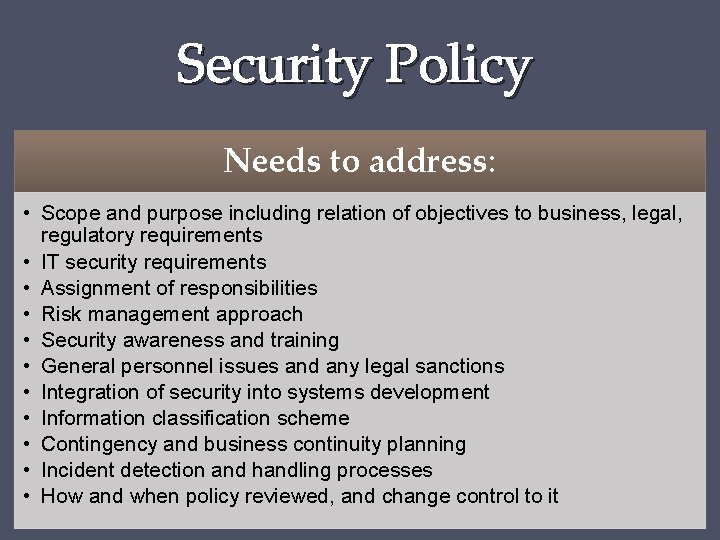
Security Policy Needs to address: • Scope and purpose including relation of objectives to business, legal, regulatory requirements • IT security requirements • Assignment of responsibilities • Risk management approach • Security awareness and training • General personnel issues and any legal sanctions • Integration of security into systems development • Information classification scheme • Contingency and business continuity planning • Incident detection and handling processes • How and when policy reviewed, and change control to it
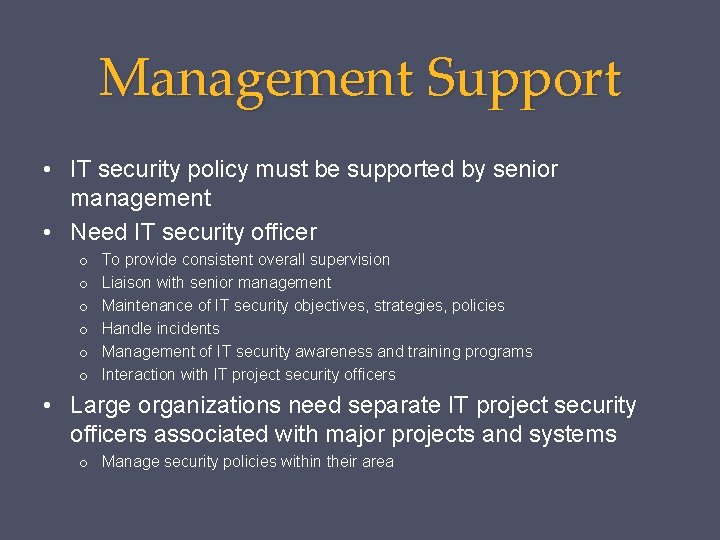
Management Support • IT security policy must be supported by senior management • Need IT security officer o o o To provide consistent overall supervision Liaison with senior management Maintenance of IT security objectives, strategies, policies Handle incidents Management of IT security awareness and training programs Interaction with IT project security officers • Large organizations need separate IT project security officers associated with major projects and systems o Manage security policies within their area
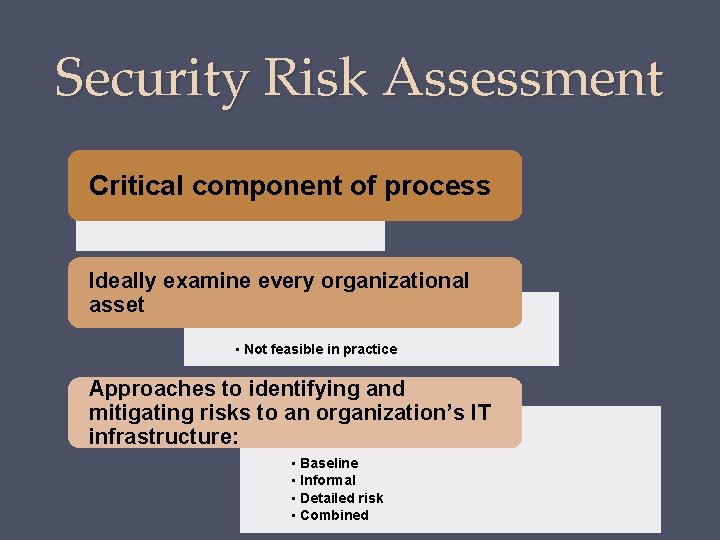
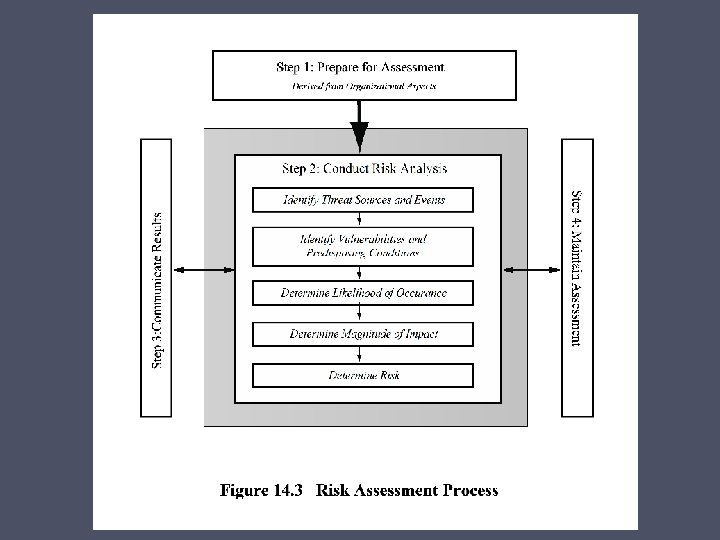
Security Risk Assessment Critical component of process Ideally examine every organizational asset • Not feasible in practice Approaches to identifying and mitigating risks to an organization’s IT infrastructure: • Baseline • Informal • Detailed risk • Combined
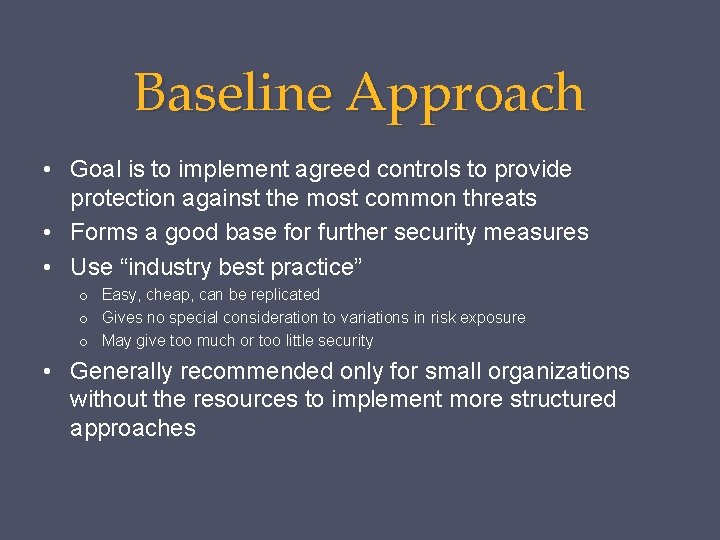
Baseline Approach • Goal is to implement agreed controls to provide protection against the most common threats • Forms a good base for further security measures • Use “industry best practice” o Easy, cheap, can be replicated o Gives no special consideration to variations in risk exposure o May give too much or too little security • Generally recommended only for small organizations without the resources to implement more structured approaches
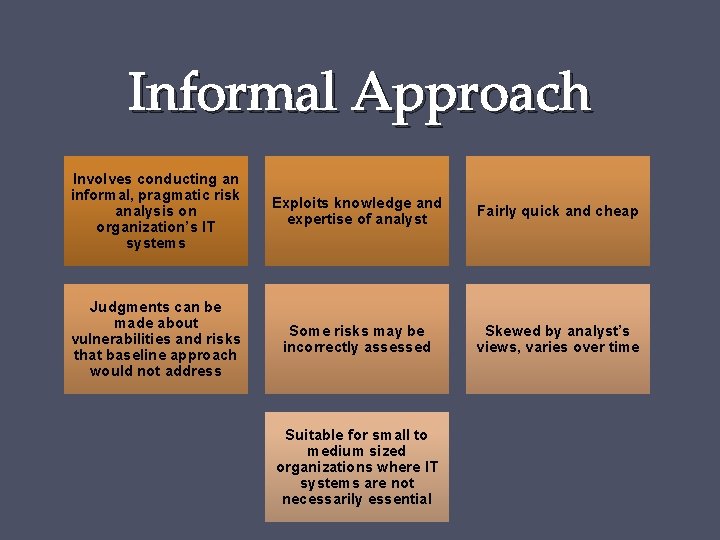
Informal Approach Involves conducting an informal, pragmatic risk analysis on organization’s IT systems Exploits knowledge and expertise of analyst Fairly quick and cheap Judgments can be made about vulnerabilities and risks that baseline approach would not address Some risks may be incorrectly assessed Skewed by analyst’s views, varies over time Suitable for small to medium sized organizations where IT systems are not necessarily essential
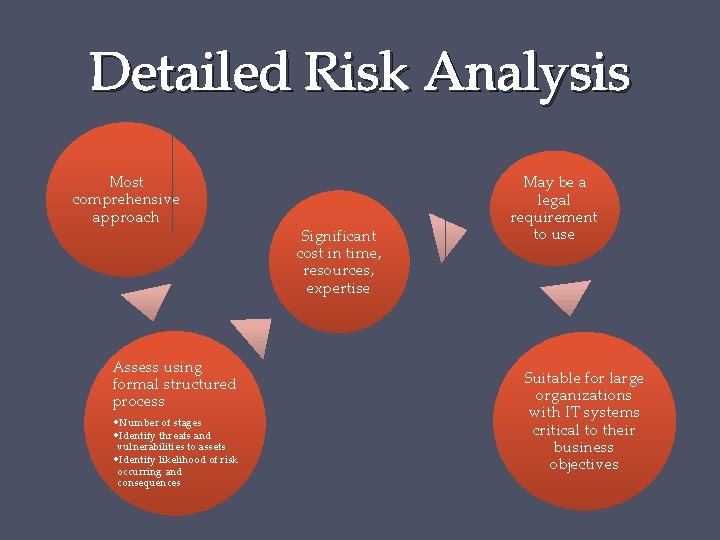
Detailed Risk Analysis Most comprehensive approach Assess using formal structured process • Number of stages • Identify threats and vulnerabilities to assets • Identify likelihood of risk occurring and consequences Significant cost in time, resources, expertise May be a legal requirement to use Suitable for large organizations with IT systems critical to their business objectives
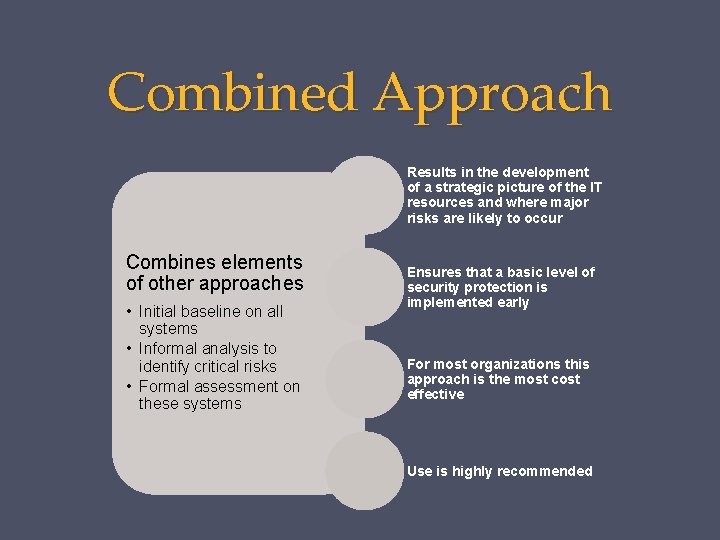
Combined Approach Results in the development of a strategic picture of the IT resources and where major risks are likely to occur Combines elements of other approaches • Initial baseline on all systems • Informal analysis to identify critical risks • Formal assessment on these systems Ensures that a basic level of security protection is implemented early For most organizations this approach is the most cost effective Use is highly recommended
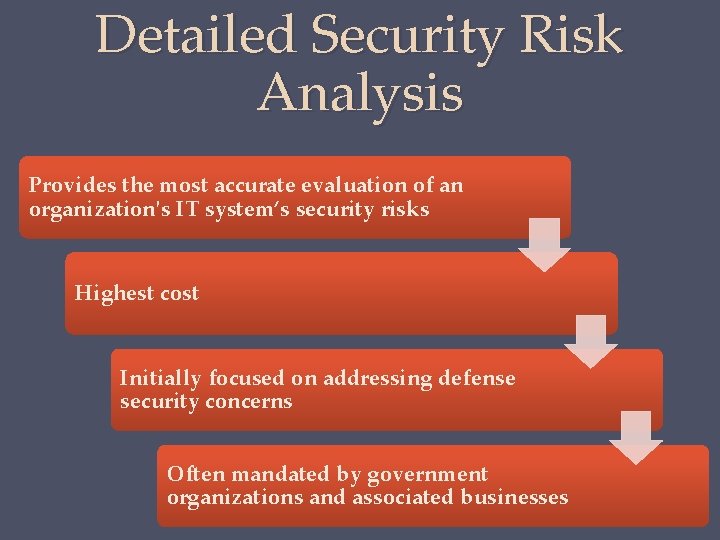
Detailed Security Risk Analysis Provides the most accurate evaluation of an organization's IT system’s security risks Highest cost Initially focused on addressing defense security concerns Often mandated by government organizations and associated businesses
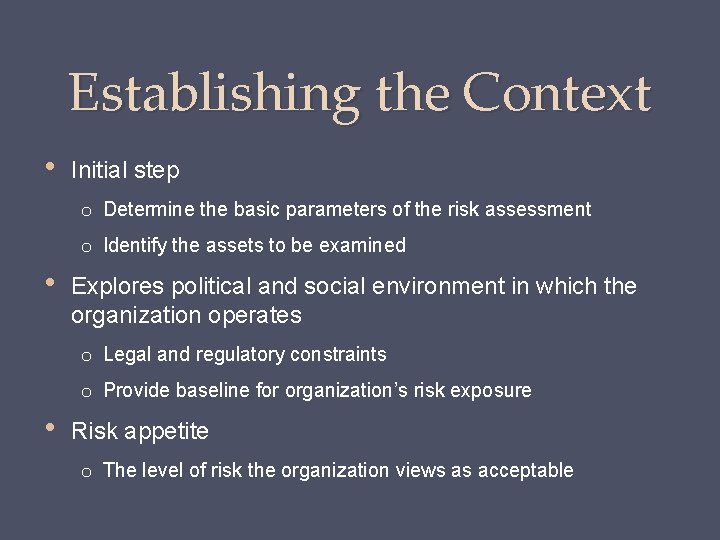
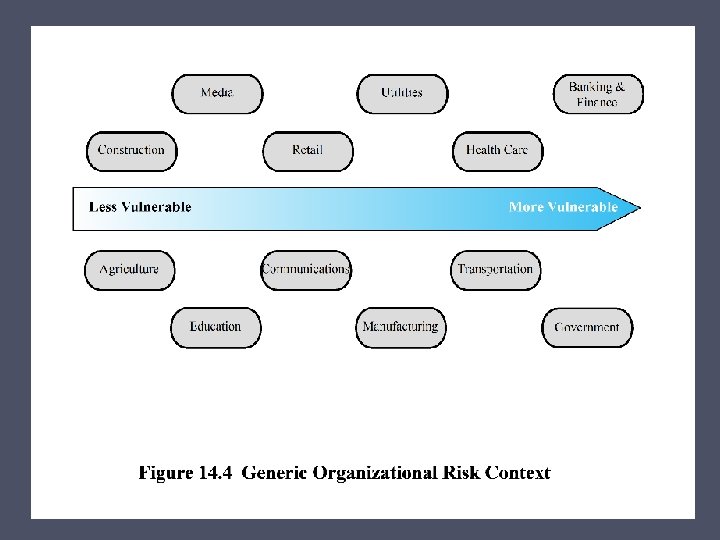
Establishing the Context • Initial step o Determine the basic parameters of the risk assessment o Identify the assets to be examined • Explores political and social environment in which the organization operates o Legal and regulatory constraints o Provide baseline for organization’s risk exposure • Risk appetite o The level of risk the organization views as acceptable
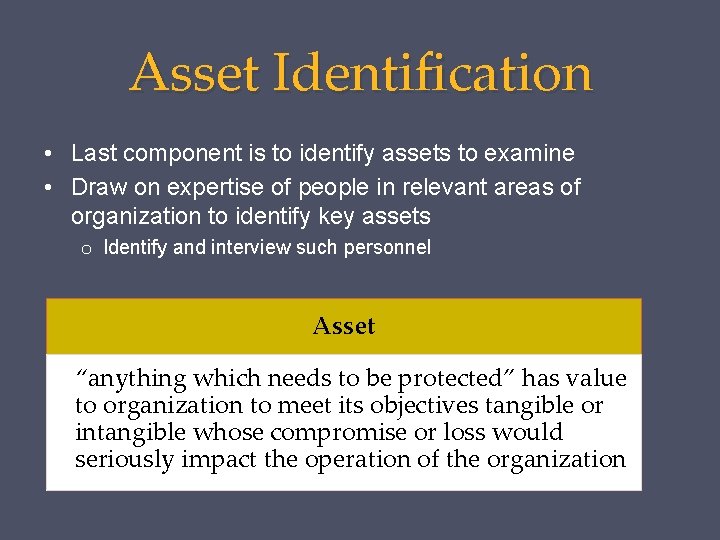
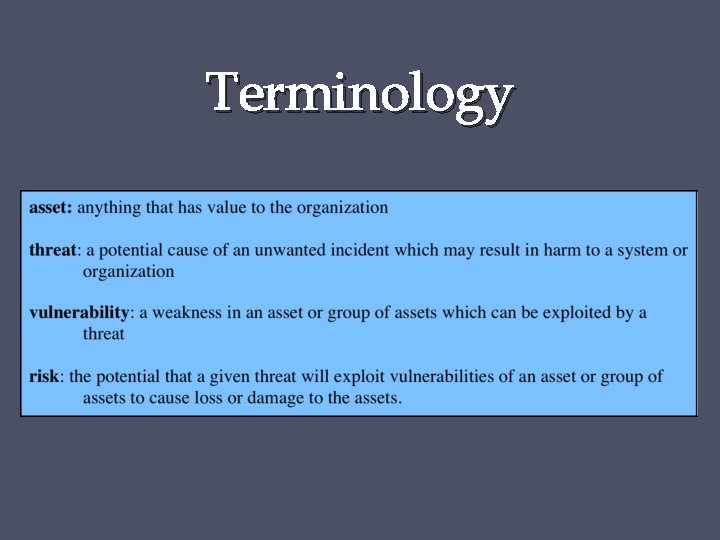
Asset Identification • Last component is to identify assets to examine • Draw on expertise of people in relevant areas of organization to identify key assets o Identify and interview such personnel Asset • “anything which needs to be protected” has value to organization to meet its objectives tangible or intangible whose compromise or loss would seriously impact the operation of the organization
Terminology
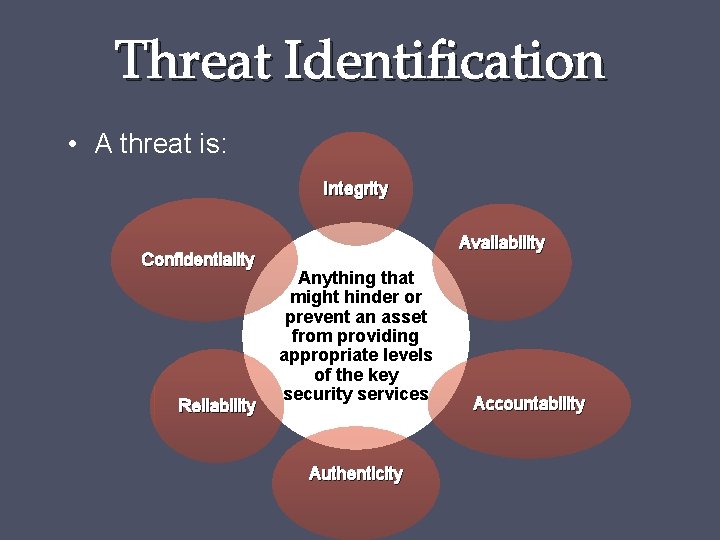
Threat Identification • A threat is: Integrity Confidentiality Reliability Availability Anything that might hinder or prevent an asset from providing appropriate levels of the key security services Authenticity Accountability
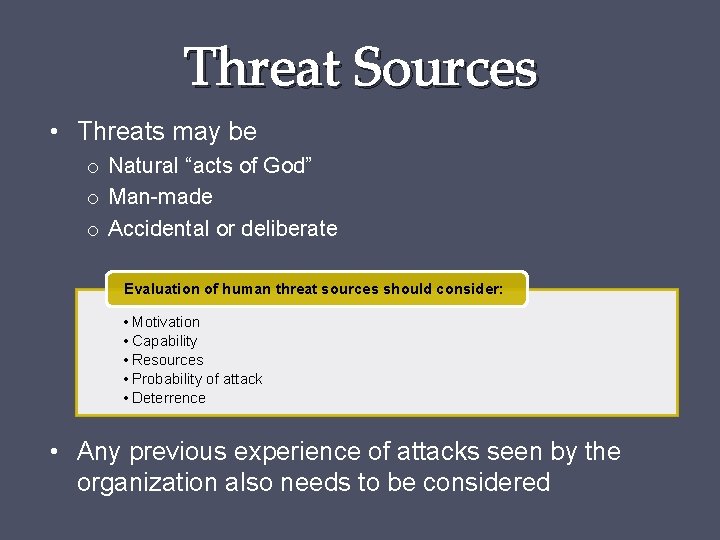
Threat Sources • Threats may be o Natural “acts of God” o Man-made o Accidental or deliberate Evaluation of human threat sources should consider: • Motivation • Capability • Resources • Probability of attack • Deterrence • Any previous experience of attacks seen by the organization also needs to be considered
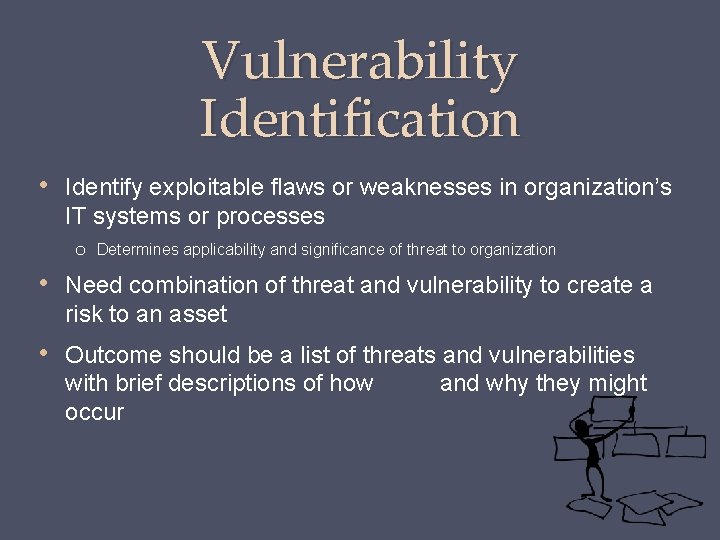
Vulnerability Identification • Identify exploitable flaws or weaknesses in organization’s IT systems or processes o Determines applicability and significance of threat to organization • Need combination of threat and vulnerability to create a risk to an asset • Outcome should be a list of threats and vulnerabilities with brief descriptions of how occur and why they might
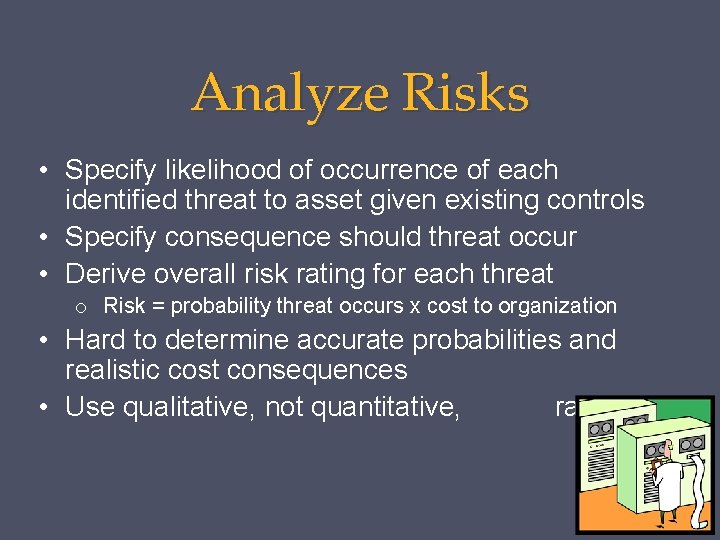
Analyze Risks • Specify likelihood of occurrence of each identified threat to asset given existing controls • Specify consequence should threat occur • Derive overall risk rating for each threat o Risk = probability threat occurs x cost to organization • Hard to determine accurate probabilities and realistic cost consequences • Use qualitative, not quantitative, ratings
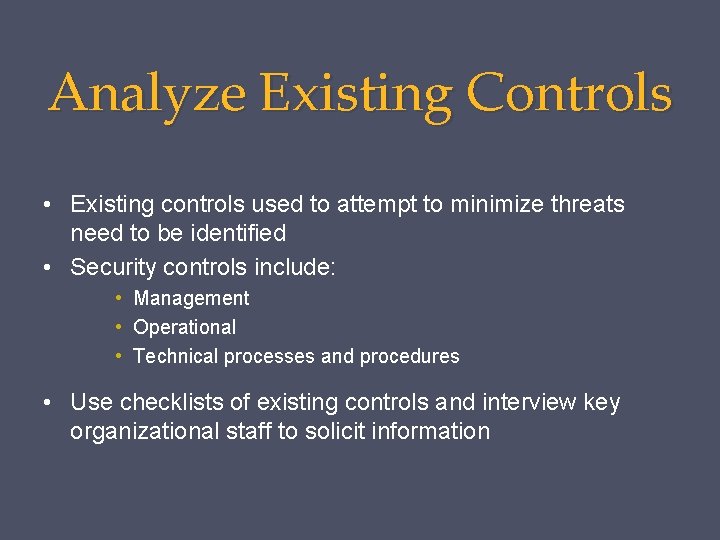
Analyze Existing Controls • Existing controls used to attempt to minimize threats need to be identified • Security controls include: • Management • Operational • Technical processes and procedures • Use checklists of existing controls and interview key organizational staff to solicit information
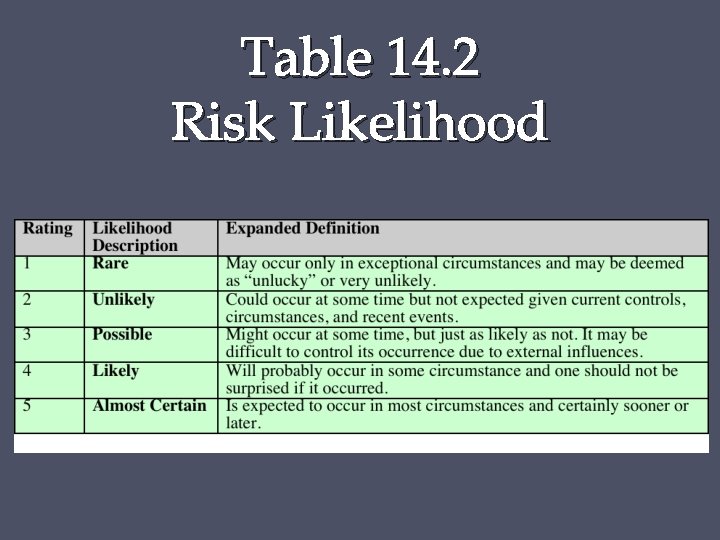
Table 14. 2 Risk Likelihood
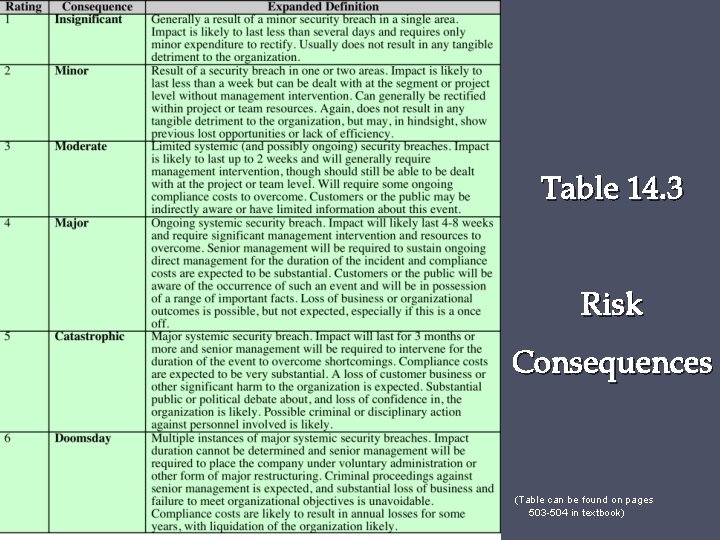
Table 14. 3 Risk Consequences (Table can be found on pages 503 -504 in textbook)
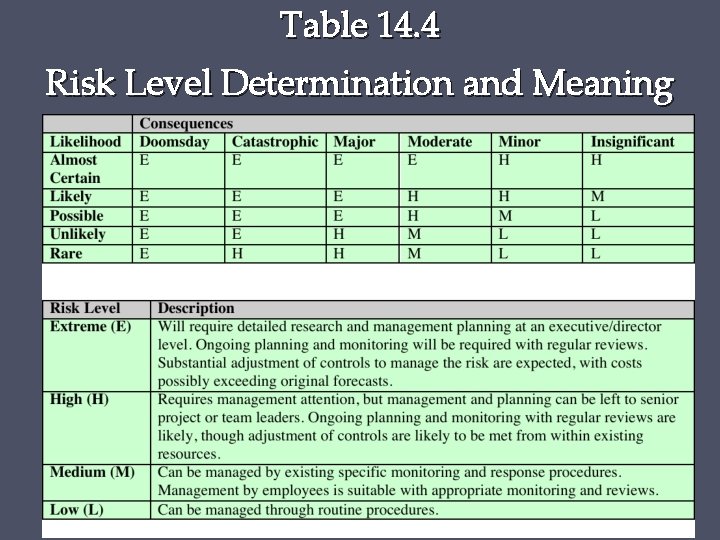
Table 14. 4 Risk Level Determination and Meaning
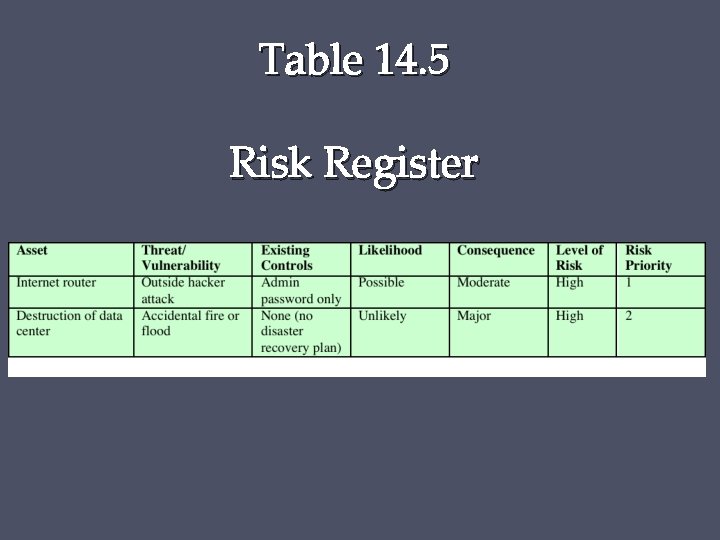
Table 14. 5 Risk Register
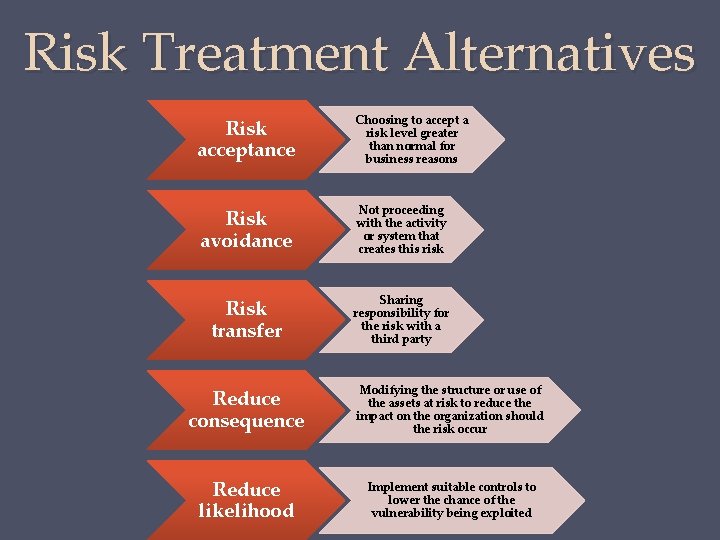
Risk Treatment Alternatives Risk acceptance Choosing to accept a risk level greater than normal for business reasons Risk avoidance Not proceeding with the activity or system that creates this risk Risk transfer Sharing responsibility for the risk with a third party Reduce consequence Modifying the structure or use of the assets at risk to reduce the impact on the organization should the risk occur Reduce likelihood Implement suitable controls to lower the chance of the vulnerability being exploited
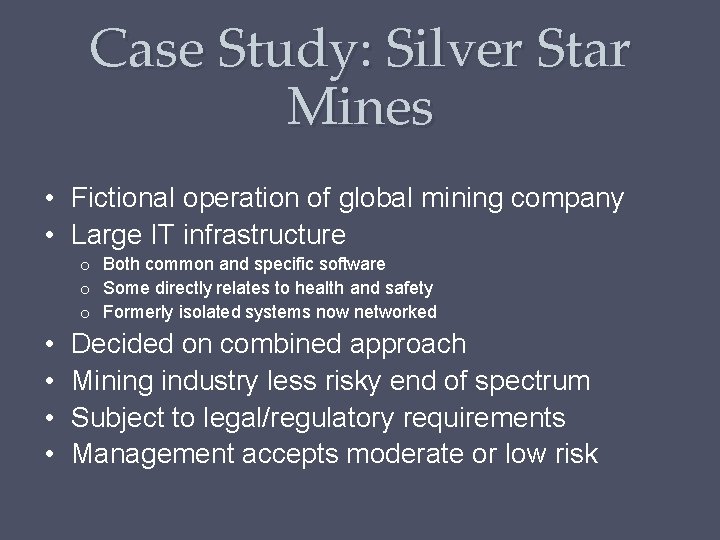
Case Study: Silver Star Mines • Fictional operation of global mining company • Large IT infrastructure o Both common and specific software o Some directly relates to health and safety o Formerly isolated systems now networked • • Decided on combined approach Mining industry less risky end of spectrum Subject to legal/regulatory requirements Management accepts moderate or low risk
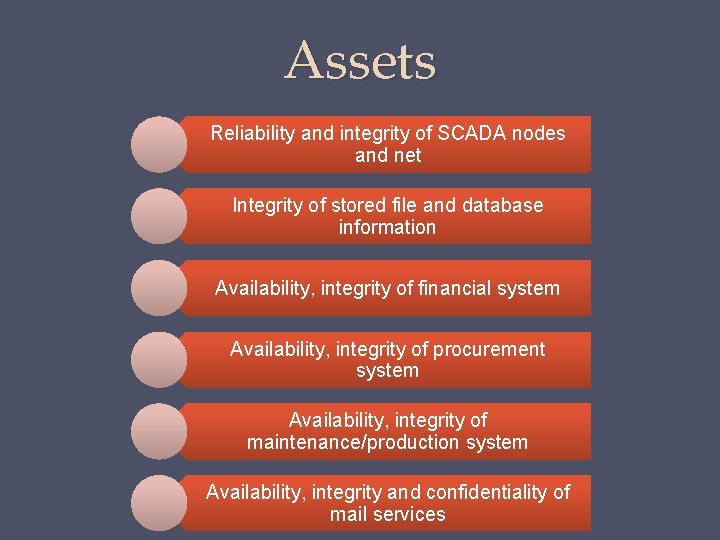
Assets Reliability and integrity of SCADA nodes and net Integrity of stored file and database information Availability, integrity of financial system Availability, integrity of procurement system Availability, integrity of maintenance/production system Availability, integrity and confidentiality of mail services
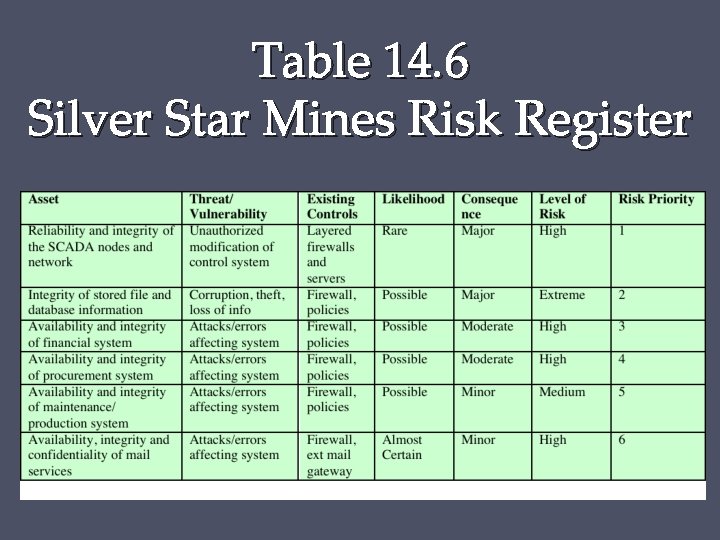
Table 14. 6 Silver Star Mines Risk Register
Summary • IT security management • Organizational context and security policy • Security risk assessment o o Baseline approach Informal approach Detailed risk analysis Combined approach • Detailed security risk analysis o Context and system characterization o Identification of threats/risks/vulnerabilities o Analyze risks o Evaluate risks o Risk treatment • Case study: Silver Star Mines