
Chapter 14 Investments Objectives 1 Explain the classification
Chapter 14 Investments
Objectives 1. Explain the classification and valuation of investments. 2. Account for investments in debt and equity trading securities. 3. Account for investments in available-forsale debt and equity securities. 4. Account for investments in held-tomaturity debt securities, including amortization of bond premiums and discounts.
3 Objectives 5. Understand transfers and impairments. 6. Understand disclosures of investments. 7. Explain the conceptual issues regarding investments in marketable securities. 8. Account for investments using the equity method. 9. Describe additional issues for investments. 10. Account for derivatives of financial instruments. (Appendix)

Classification of Investments Trading securities Available-for-sale securities Held-to-maturity debt securities
5 Classification of Investments Trading securities are investments in debt and equity securities that are purchased and held principally for the purpose of selling them in the near term.
6 Trading Securities Trading These securitiesare arereported investments at their in debt fair and market equity value securities on the balance that are sheet purchased date, and held unrealized principally holding for the gains purpose and losses of selling are includedthem in net in income the nearof term. the period.
7 Classification of Investments in available-forsale securities (a) debt …(b) debt and are equity securities that are not thatsecurities are not classified as trading classified as being held to securities. maturity, and. . .
8 Classification of Investments in available-for-sale securities are reported at their fair value on the balance sheet date. The unrealized holding gains or losses are included in other comprehensive income.
9 Classification of Investments Therefore, the unrealized holding gains and losses are not included in net income for the available-for -sale securities.
10 Classification of Investments in held-to-maturity debt securities are debt securities for which the company has the positive intent and ability to hold until they mature.
11 Classification of Investments in held-to-maturity debt securities are reported at their amortized cost on the balance sheet…not their fair value.
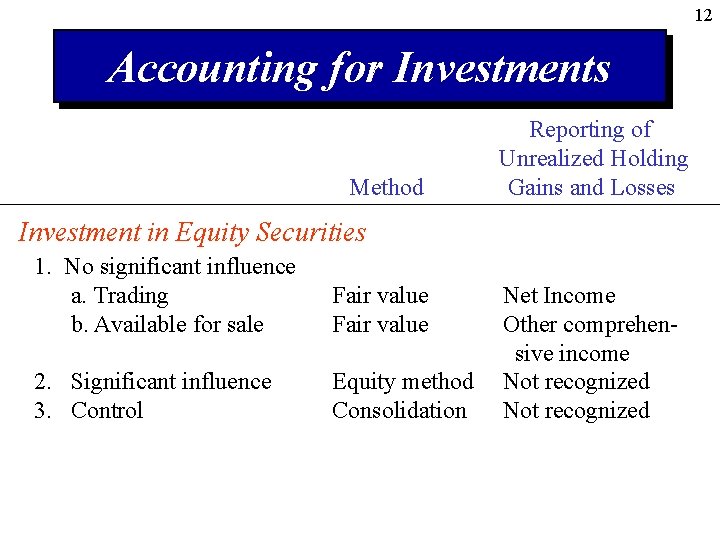
12 Accounting for Investments Method Reporting of Unrealized Holding Gains and Losses Investment in Equity Securities 1. No significant influence a. Trading b. Available for sale Fair value 2. Significant influence 3. Control Equity method Consolidation Net Income Other comprehensive income Not recognized
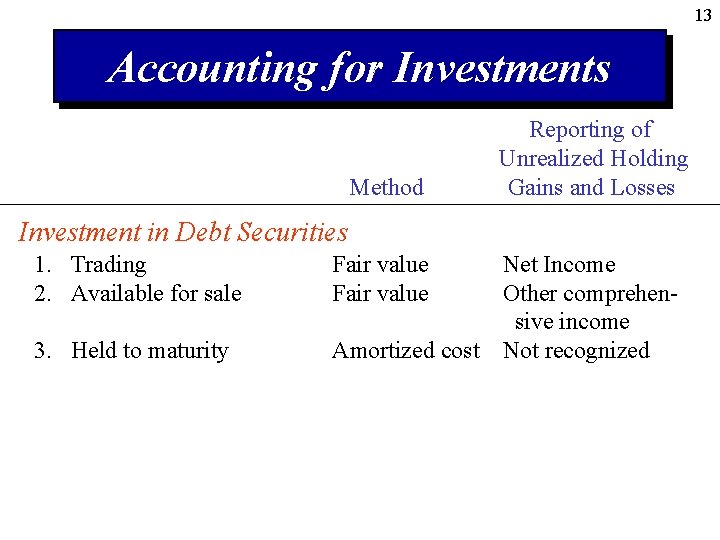
13 Accounting for Investments Method Reporting of Unrealized Holding Gains and Losses Investment in Debt Securities 1. Trading 2. Available for sale 3. Held to maturity Fair value Net Income Other comprehensive income Amortized cost Not recognized
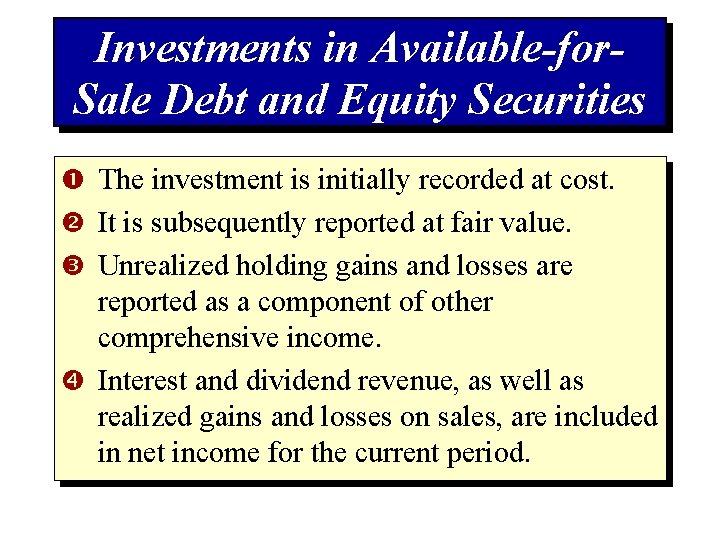
Investments in Available-for. Sale Debt and Equity Securities The investment is initially recorded at cost. It is subsequently reported at fair value. Unrealized holding gains and losses are reported as a component of other comprehensive income. Interest and dividend revenue, as well as realized gains and losses on sales, are included in net income for the current period.
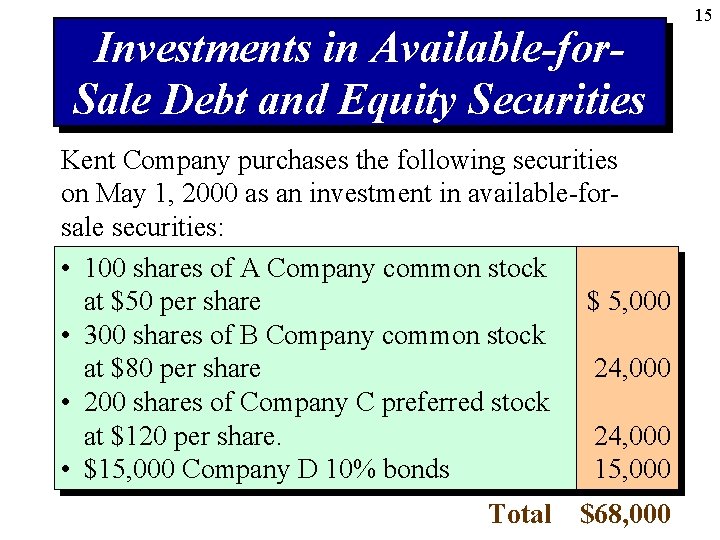
Investments in Available-for. Sale Debt and Equity Securities Kent Company purchases the following securities on May 1, 2000 as an investment in available-forsale securities: • 100 shares of A Company common stock at $50 per share $ 5, 000 • 300 shares of B Company common stock at $80 per share 24, 000 • 200 shares of Company C preferred stock at $120 per share. 24, 000 • $15, 000 Company D 10% bonds 15, 000 Total $68, 000 15
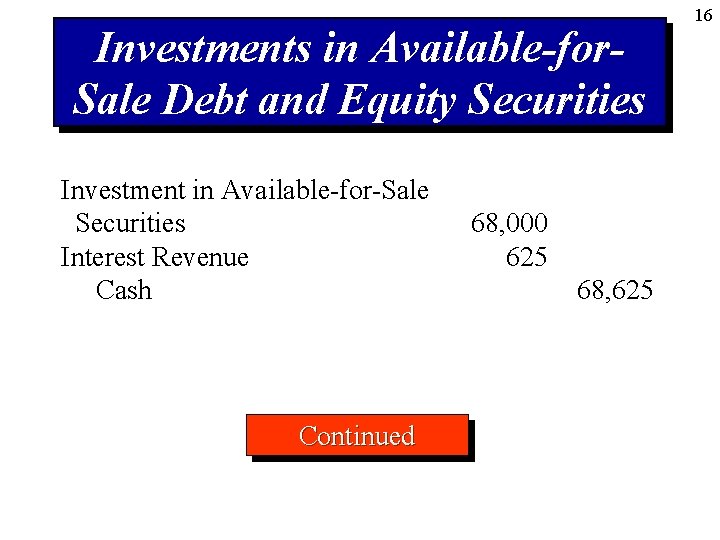
Investments in Available-for. Sale Debt and Equity Securities Investment in Available-for-Sale Securities Interest Revenue Cash Continued 68, 000 625 68, 625 16
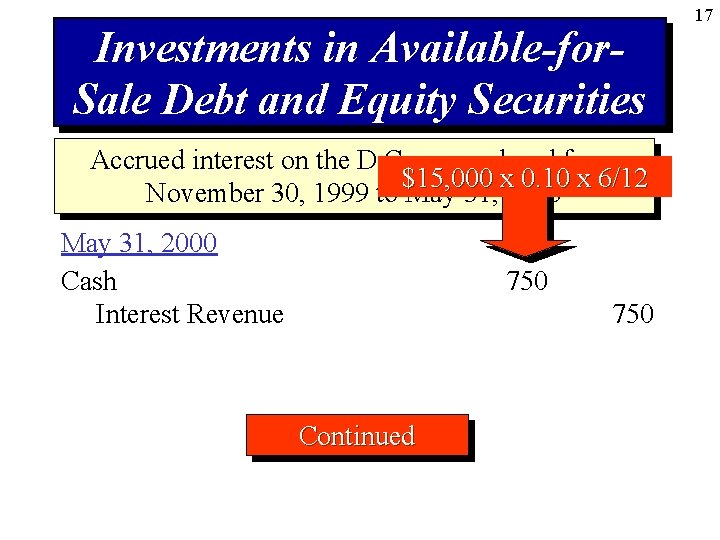
Investments in Available-for. Sale Debt and Equity Securities Accrued interest on the D Company bond from $15, 000 x 0. 10 x 6/12 November 30, 1999 to May 31, 2000 Cash Interest Revenue 750 Continued 17
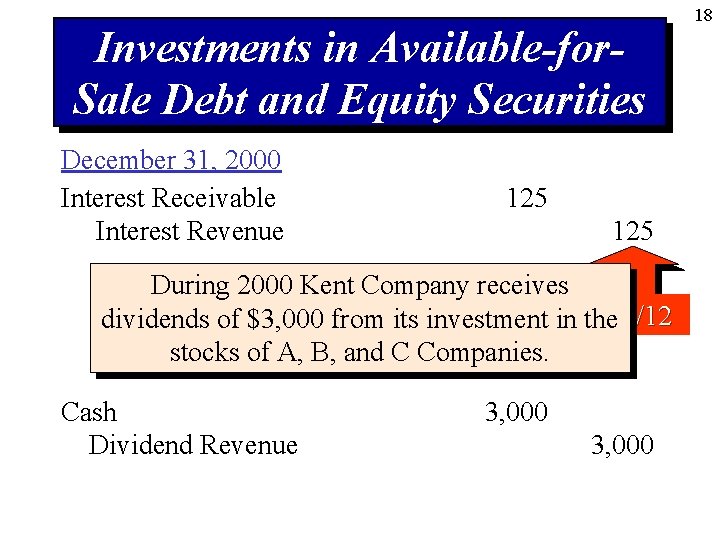
Investments in Available-for. Sale Debt and Equity Securities December 31, 2000 Interest Receivable Interest Revenue 125 During 2000 Kent Company receives $15, 000 x 0. 10 x 1/12 dividends of $3, 000 from its investment in the stocks of A, B, and C Companies. Cash Dividend Revenue 3, 000 18
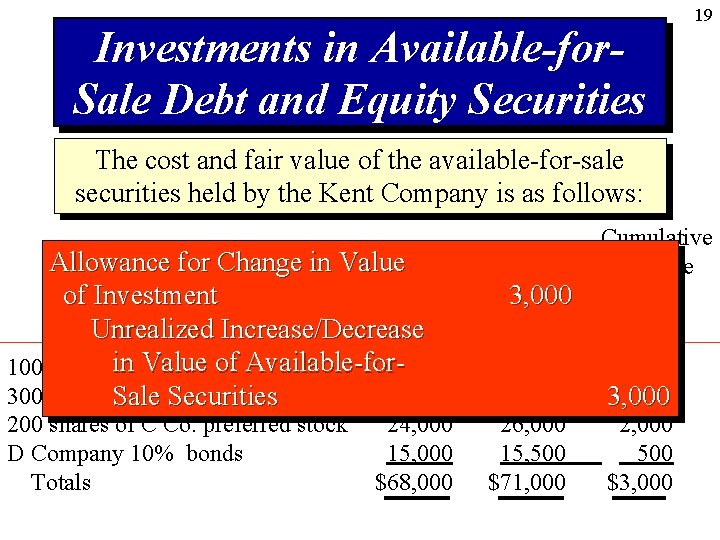
Investments in Available-for. Sale Debt and Equity Securities 19 The cost and fair value of the available-for-sale securities held by the Kent Company is as follows: Allowance for Change in Value of Investment Security Cost Unrealized Increase/Decrease of Available-for 100 shares in of Value A Co. common stock $ 5, 000 300 shares Sale of B Co. common stock 24, 000 Securities 200 shares of C Co. preferred stock D Company 10% bonds Totals 24, 000 15, 000 $68, 000 12/31/00 Fair 3, 000 Value Cumulative Change in Fair Value $ 6, 000 23, 500 26, 000 15, 500 $71, 000 $1, 000 (500) 3, 000 2, 000 500 $3, 000
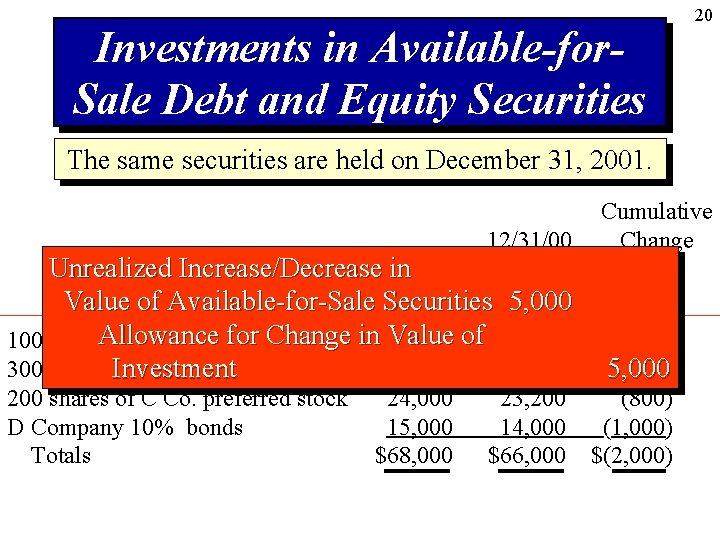
Investments in Available-for. Sale Debt and Equity Securities 20 The same securities are held on December 31, 2001. 12/31/00 Fair Unrealized Increase/Decrease in Security Cost Value of Available-for-Sale Securities 5, 000 for Change 100 shares. Allowance of A Co. common stock in$Value 5, 000 of $ 6, 100 300 shares Investment of B Co. common stock 24, 000 22, 700 200 shares of C Co. preferred stock 24, 000 23, 200 D Company 10% bonds 15, 000 14, 000 Totals $68, 000 $66, 000 Cumulative Change in Fair Value $1, 100 (1, 300) 5, 000 (800) (1, 000) $(2, 000)
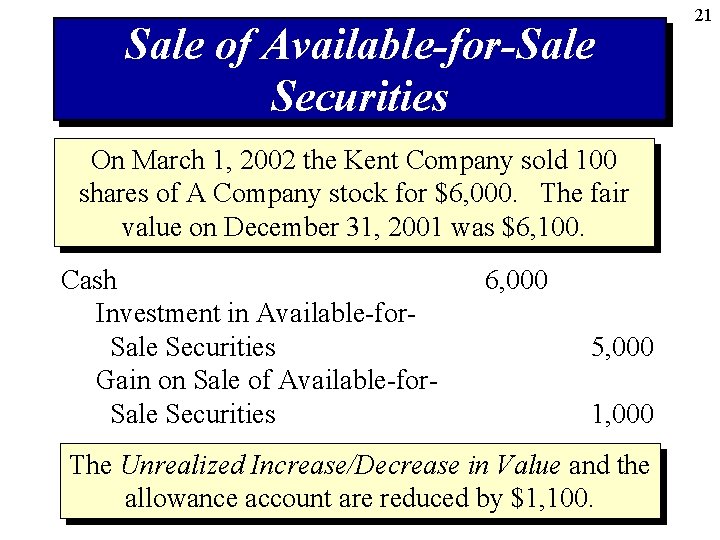
Sale of Available-for-Sale Securities On March 1, 2002 the Kent Company sold 100 shares of A Company stock for $6, 000. The fair value on December 31, 2001 was $6, 100. Cash Investment in Available-for. Sale Securities Gain on Sale of Available-for. Sale Securities 6, 000 5, 000 1, 000 The Unrealized Increase/Decrease in Value and the allowance account are reduced by $1, 100. 21
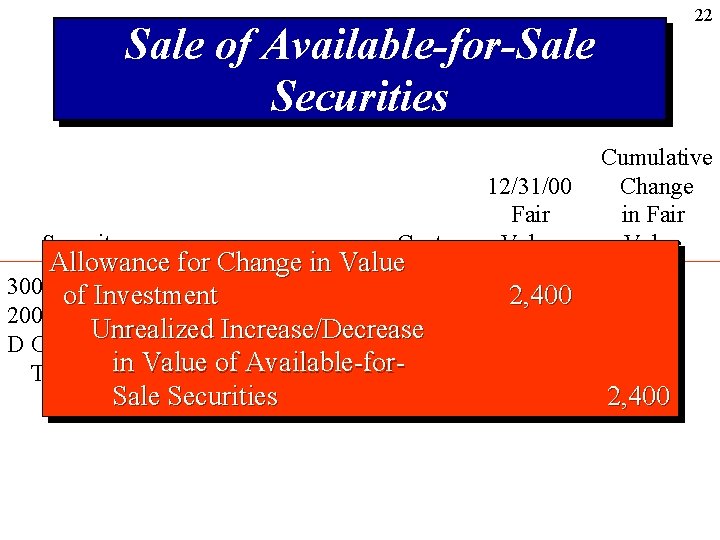
22 Sale of Available-for-Sale Securities Security Cost Allowance for Change in Value 300 shares of B Co. common stock $24, 000 of Investment 200 shares of C Co. preferred stock 24, 000 Unrealized Increase/Decrease D Company 10 bonds 15, 000 Totals in Value of Available-for$63, 000 Sale Securities 12/31/00 Fair Value $23, 500 2, 400 24, 100 14, 700 $62, 300 Cumulative Change in Fair Value $(500) 100 (300) $(700) 2, 400
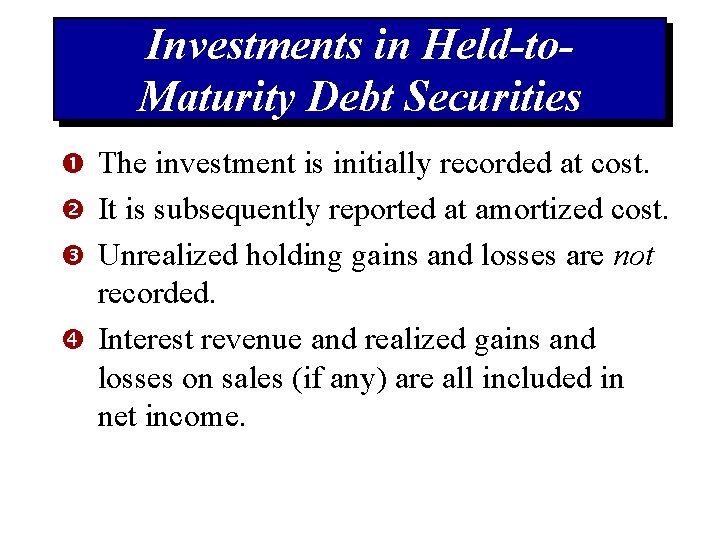
Investments in Held-to. Maturity Debt Securities The investment is initially recorded at cost. It is subsequently reported at amortized cost. Unrealized holding gains and losses are not recorded. Interest revenue and realized gains and losses on sales (if any) are all included in net income.
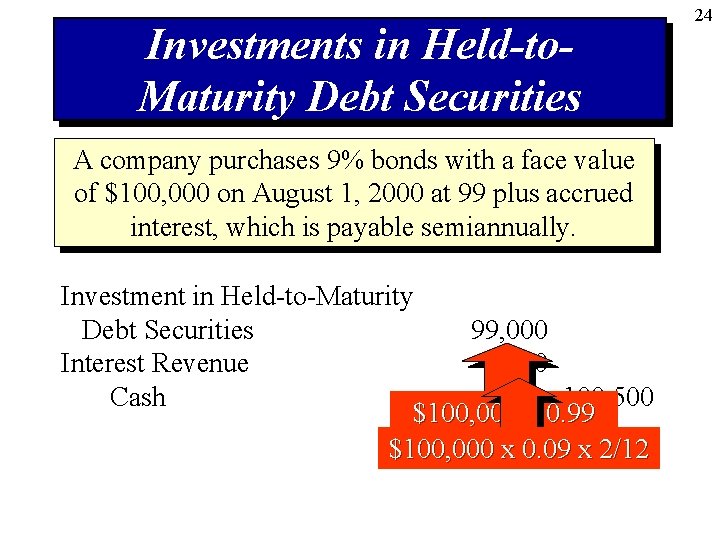
Investments in Held-to. Maturity Debt Securities A company purchases 9% bonds with a face value of $100, 000 on August 1, 2000 at 99 plus accrued interest, which is payable semiannually. Investment in Held-to-Maturity Debt Securities 99, 000 Interest Revenue 1, 500 Cash 100, 500 $100, 000 x 0. 99 $100, 000 x 0. 09 x 2/12 24
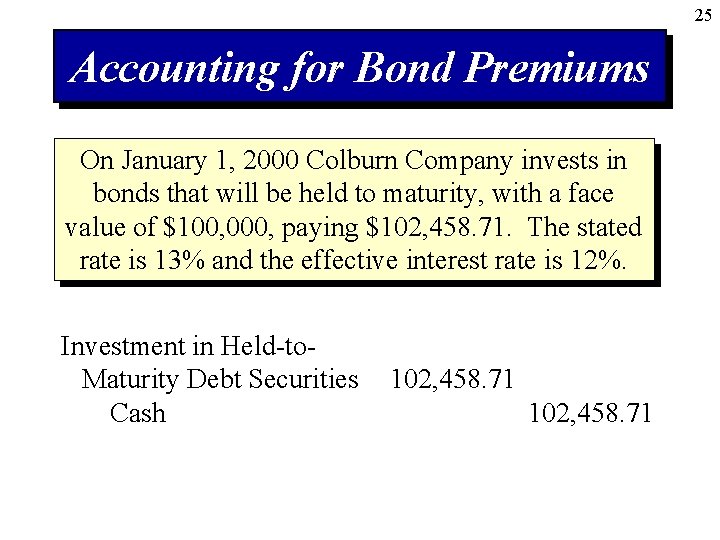
25 Accounting for Bond Premiums On January 1, 2000 Colburn Company invests in bonds that will be held to maturity, with a face value of $100, 000, paying $102, 458. 71. The stated rate is 13% and the effective interest rate is 12%. Investment in Held-to. Maturity Debt Securities Cash 102, 458. 71
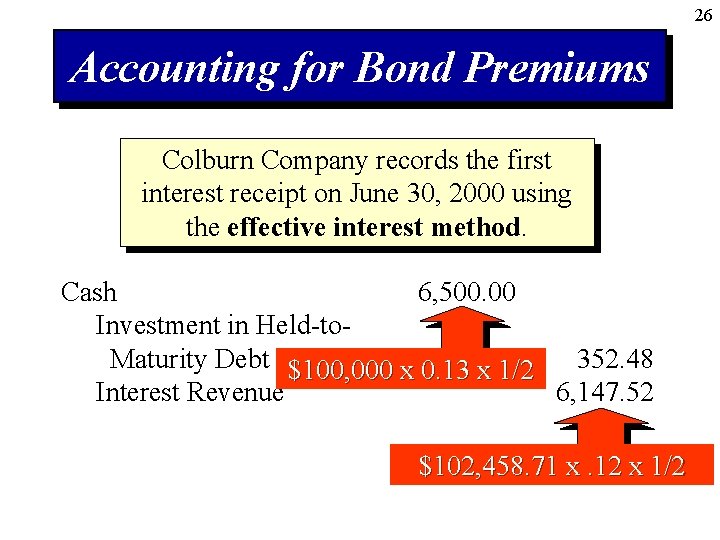
26 Accounting for Bond Premiums Colburn Company records the first interest receipt on June 30, 2000 using the effective interest method. Cash 6, 500. 00 Investment in Held-to. Maturity Debt Securities 352. 48 $100, 000 x 0. 13 x 1/2 Interest Revenue 6, 147. 52 $102, 458. 71 x. 12 x 1/2
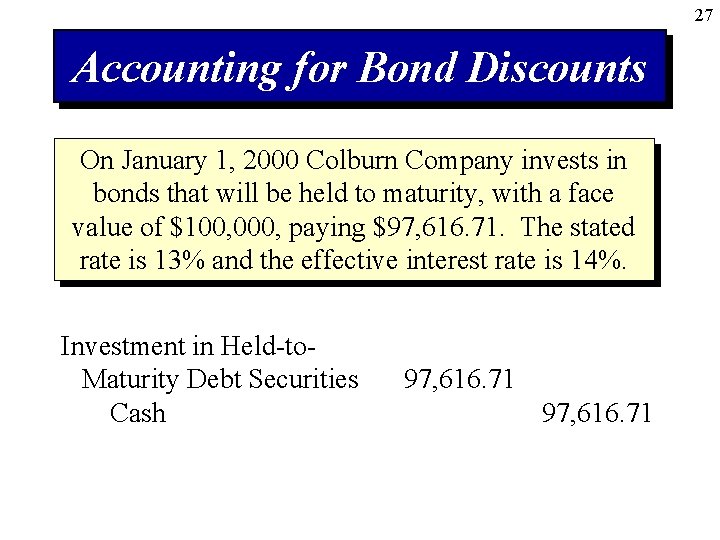
27 Accounting for Bond Discounts On January 1, 2000 Colburn Company invests in bonds that will be held to maturity, with a face value of $100, 000, paying $97, 616. 71. The stated rate is 13% and the effective interest rate is 14%. Investment in Held-to. Maturity Debt Securities Cash 97, 616. 71
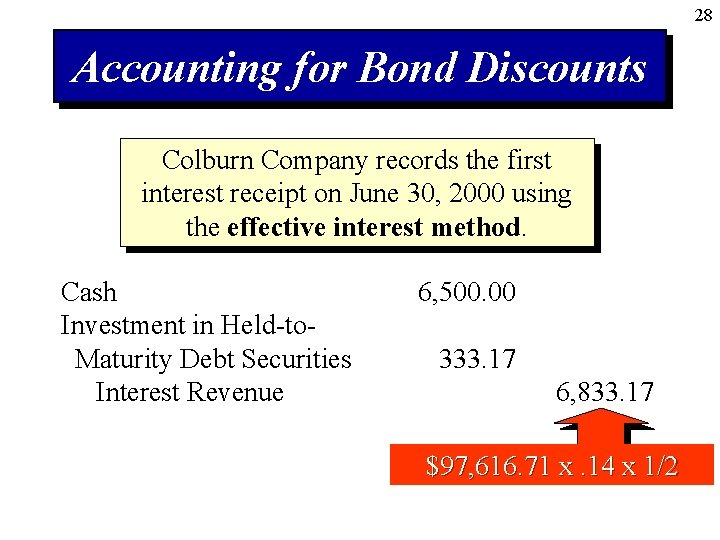
28 Accounting for Bond Discounts Colburn Company records the first interest receipt on June 30, 2000 using the effective interest method. Cash Investment in Held-to. Maturity Debt Securities Interest Revenue 6, 500. 00 333. 17 6, 833. 17 $97, 616. 71 x. 14 x 1/2
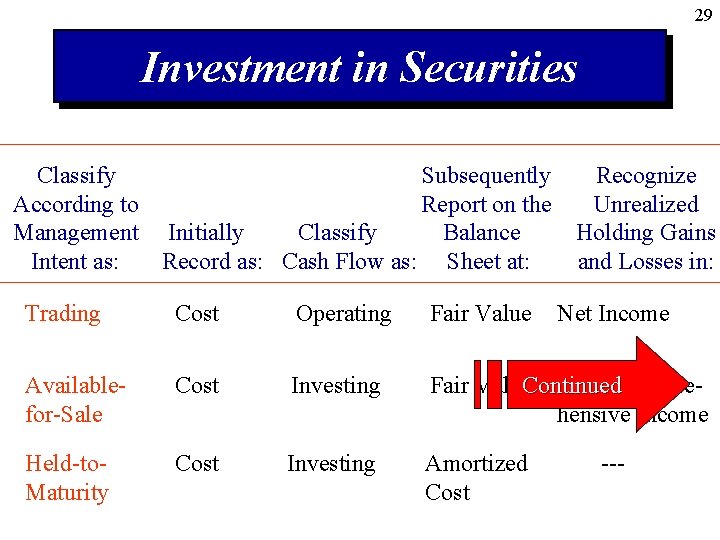
29 Investment in Securities Classify Subsequently According to Report on the Management Initially Classify Balance Intent as: Record as: Cash Flow as: Sheet at: Recognize Unrealized Holding Gains and Losses in: Trading Cost Operating Fair Value Net Income Availablefor-Sale Cost Investing Fair Value. Continued Other Comprehensive Income Held-to. Maturity Cost Investing Amortized Cost ---
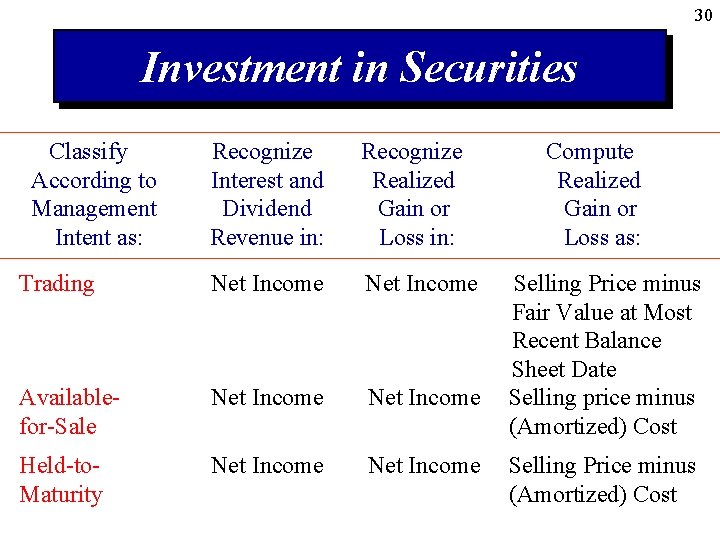
30 Investment in Securities Classify According to Management Intent as: Recognize Interest and Dividend Revenue in: Recognize Realized Gain or Loss in: Trading Net Income Availablefor-Sale Net Income Held-to. Maturity Net Income Compute Realized Gain or Loss as: Selling Price minus Fair Value at Most Recent Balance Sheet Date Selling price minus (Amortized) Cost Selling Price minus (Amortized) Cost
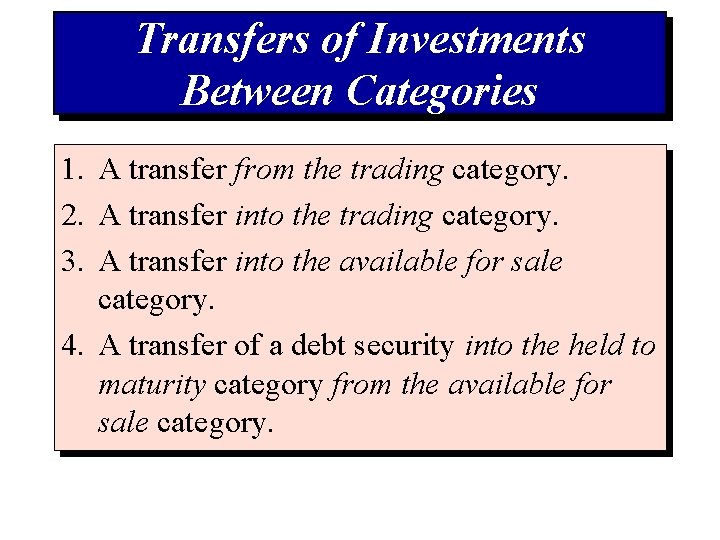
Transfers of Investments Between Categories 1. A transfer from the trading category. 2. A transfer into the trading category. 3. A transfer into the available for sale category. 4. A transfer of a debt security into the held to maturity category from the available for sale category.
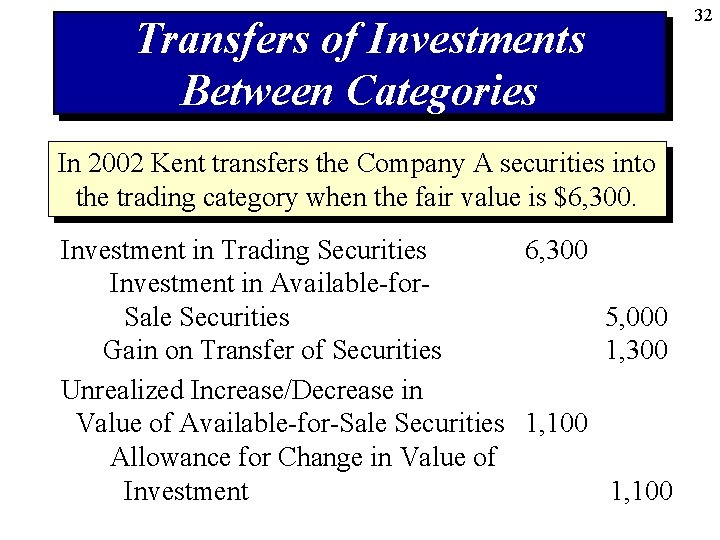
Transfers of Investments Between Categories In 2002 Kent transfers the Company A securities into the trading category when the fair value is $6, 300. Investment in Trading Securities 6, 300 Investment in Available-for. Sale Securities 5, 000 Gain on Transfer of Securities 1, 300 Unrealized Increase/Decrease in Value of Available-for-Sale Securities 1, 100 Allowance for Change in Value of Investment 1, 100 32
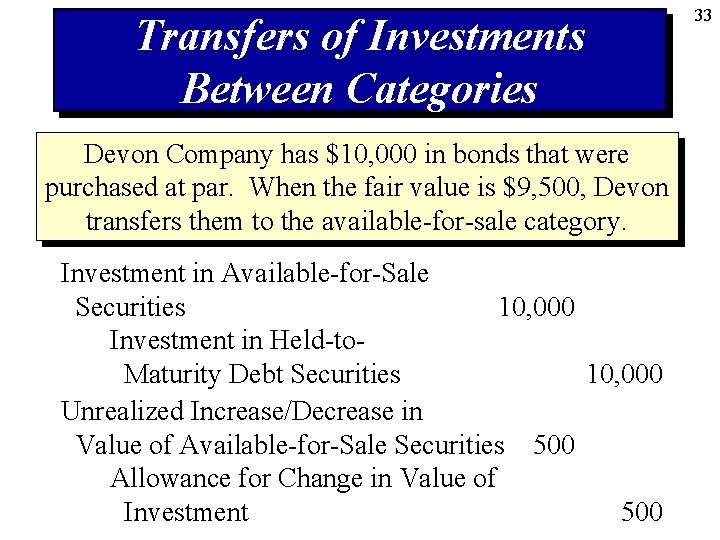
Transfers of Investments Between Categories Devon Company has $10, 000 in bonds that were purchased at par. When the fair value is $9, 500, Devon transfers them to the available-for-sale category. Investment in Available-for-Sale Securities 10, 000 Investment in Held-to. Maturity Debt Securities 10, 000 Unrealized Increase/Decrease in Value of Available-for-Sale Securities 500 Allowance for Change in Value of Investment 500 33
34 Impairments may be an “other than temporary” decline below the amortized cost of an investment in a debt security classified as available for sale or held to maturity.
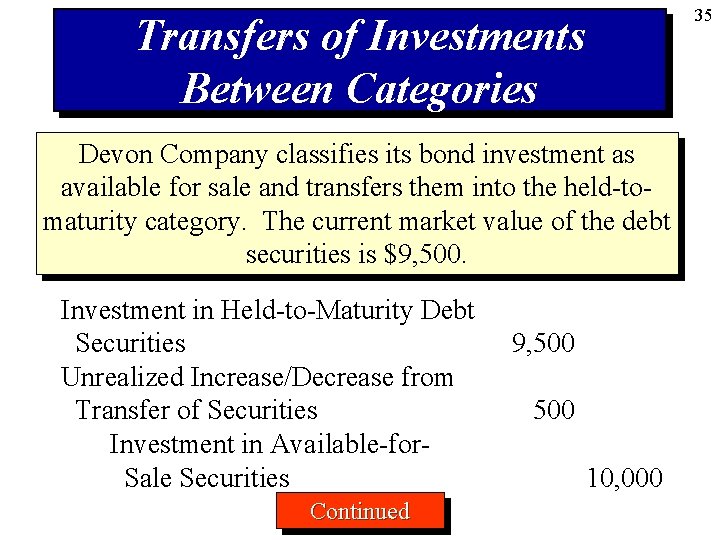
35 Transfers of Investments Between Categories Devon Company classifies its bond investment as available for sale and transfers them into the held-tomaturity category. The current market value of the debt securities is $9, 500. Investment in Held-to-Maturity Debt Securities Unrealized Increase/Decrease from Transfer of Securities Investment in Available-for. Sale Securities Continued 9, 500 10, 000
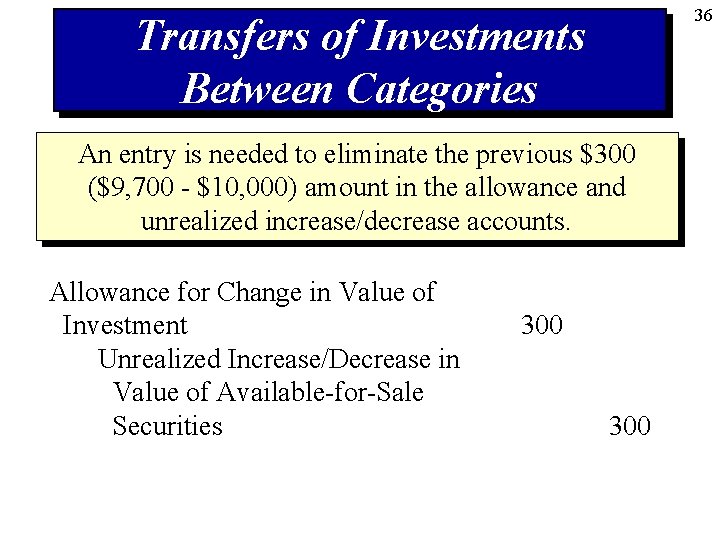
36 Transfers of Investments Between Categories An entry is needed to eliminate the previous $300 ($9, 700 - $10, 000) amount in the allowance and unrealized increase/decrease accounts. Allowance for Change in Value of Investment Unrealized Increase/Decrease in Value of Available-for-Sale Securities 300
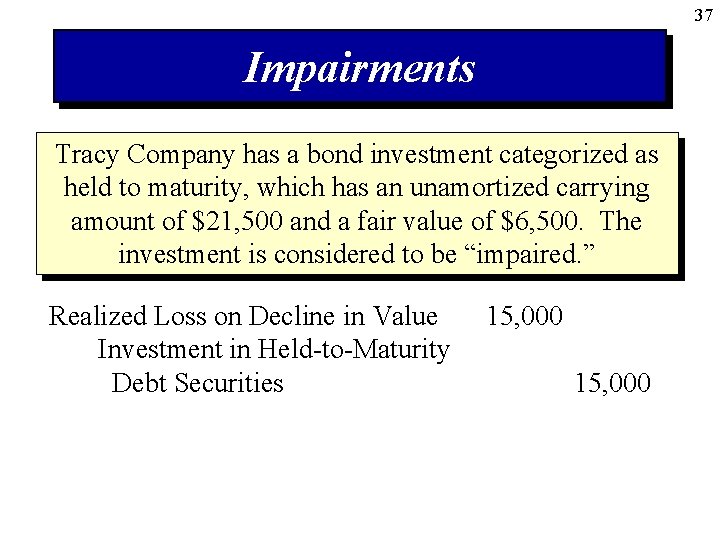
37 Impairments Tracy Company has a bond investment categorized as held to maturity, which has an unamortized carrying amount of $21, 500 and a fair value of $6, 500. The investment is considered to be “impaired. ” Realized Loss on Decline in Value Investment in Held-to-Maturity Debt Securities 15, 000
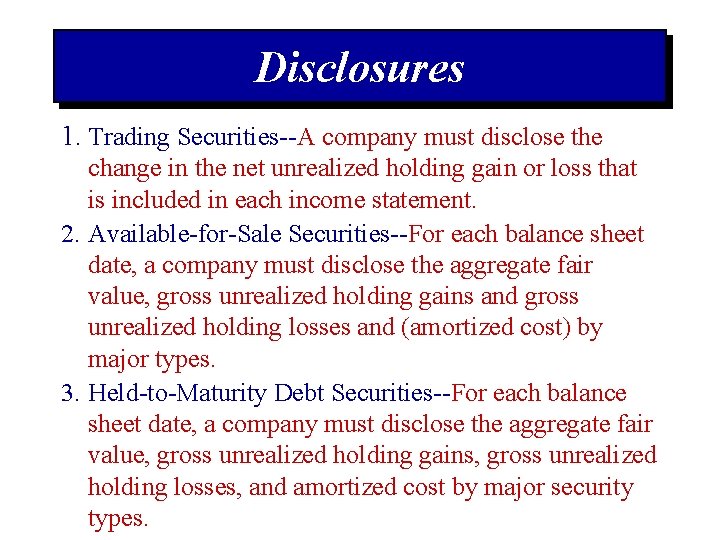
Disclosures 1. Trading Securities--A company must disclose the change in the net unrealized holding gain or loss that is included in each income statement. 2. Available-for-Sale Securities--For each balance sheet date, a company must disclose the aggregate fair value, gross unrealized holding gains and gross unrealized holding losses and (amortized cost) by major types. 3. Held-to-Maturity Debt Securities--For each balance sheet date, a company must disclose the aggregate fair value, gross unrealized holding gains, gross unrealized holding losses, and amortized cost by major security types.
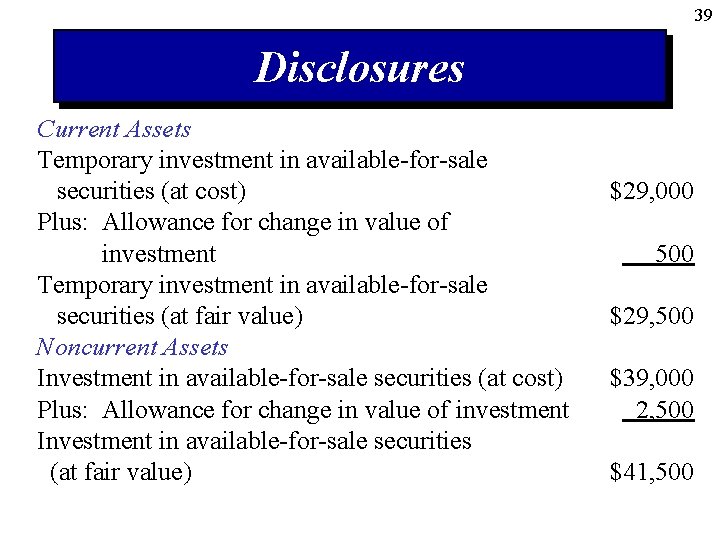
39 Disclosures Current Assets Temporary investment in available-for-sale securities (at cost) Plus: Allowance for change in value of investment Temporary investment in available-for-sale securities (at fair value) Noncurrent Assets Investment in available-for-sale securities (at cost) Plus: Allowance for change in value of investment Investment in available-for-sale securities (at fair value) $29, 000 500 $29, 500 $39, 000 2, 500 $41, 500
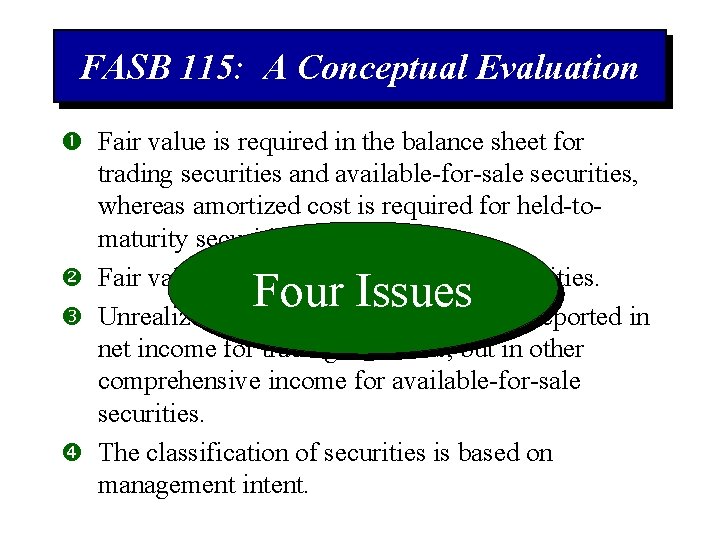
FASB 115: A Conceptual Evaluation Fair value is required in the balance sheet for trading securities and available-for-sale securities, whereas amortized cost is required for held-tomaturity securities. Fair value is not required for certain liabilities. Unrealized holding gains and losses are reported in net income for trading securities, but in other comprehensive income for available-for-sale securities. The classification of securities is based on management intent. Four Issues
41 Equity Method When an investor corporation owns a significantly large percentage of common stock, it is able to exert significant influence over the policies of the investee corporation. The equity method is used to account for this investment.
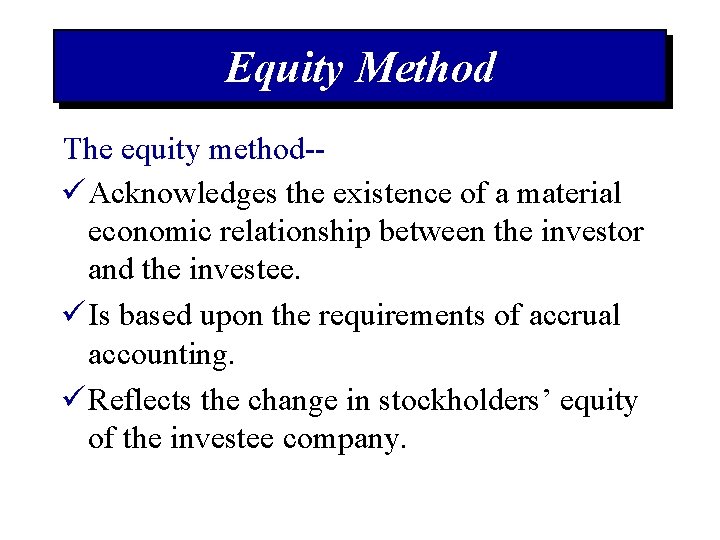
Equity Method The equity method-ü Acknowledges the existence of a material economic relationship between the investor and the investee. ü Is based upon the requirements of accrual accounting. ü Reflects the change in stockholders’ equity of the investee company.
43 Equity Method According to FASB Interpretation No. 35, what are the facts and circumstances that indicate that investors with 20% or more in the investee’s stock should not use the equity method? Continued
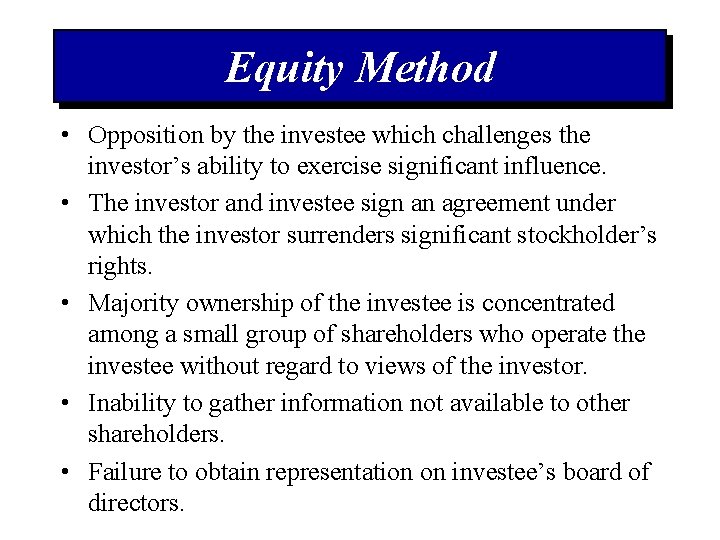
Equity Method • Opposition by the investee which challenges the investor’s ability to exercise significant influence. • The investor and investee sign an agreement under which the investor surrenders significant stockholder’s rights. • Majority ownership of the investee is concentrated among a small group of shareholders who operate the investee without regard to views of the investor. • Inability to gather information not available to other shareholders. • Failure to obtain representation on investee’s board of directors.
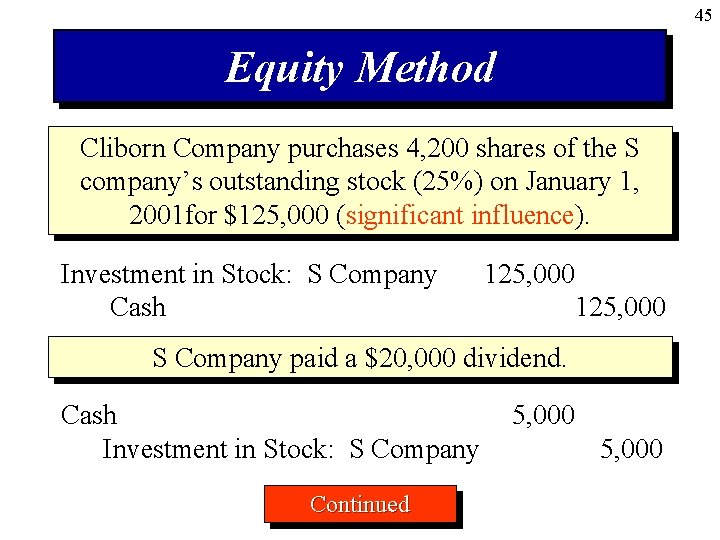
45 Equity Method Cliborn Company purchases 4, 200 shares of the S company’s outstanding stock (25%) on January 1, 2001 for $125, 000 (significant influence). Investment in Stock: S Company Cash 125, 000 S Company paid a $20, 000 dividend. Cash Investment in Stock: S Company Continued 5, 000
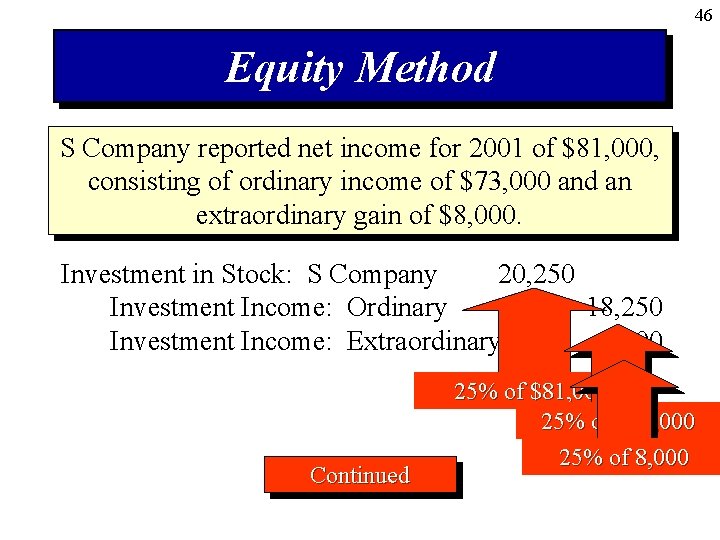
46 Equity Method S Company reported net income for 2001 of $81, 000, consisting of ordinary income of $73, 000 and an extraordinary gain of $8, 000. Investment in Stock: S Company 20, 250 Investment Income: Ordinary 18, 250 Investment Income: Extraordinary 2, 000 Continued 25% of $81, 000 25% of $73, 000 25% of 8, 000
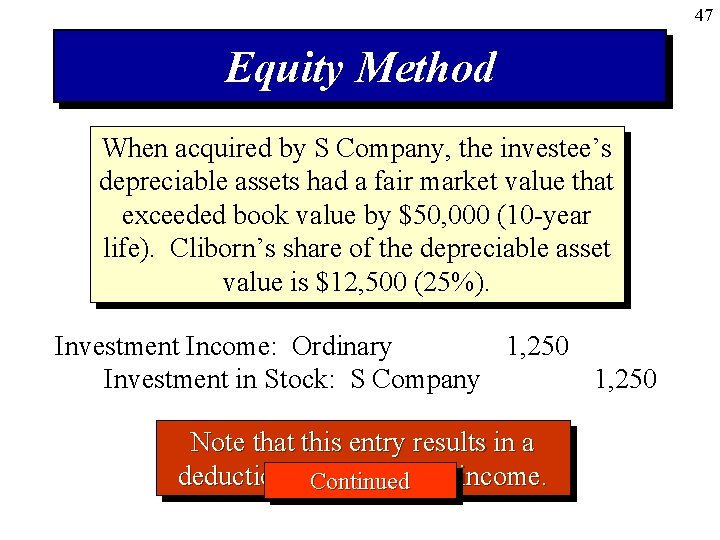
47 Equity Method When acquired by S Company, the investee’s depreciable assets had a fair market value that exceeded book value by $50, 000 (10 -year life). Cliborn’s share of the depreciable asset value is $12, 500 (25%). Investment Income: Ordinary 1, 250 Investment in Stock: S Company 1, 250 Note that this entry results in a deduction from ordinary income. Continued
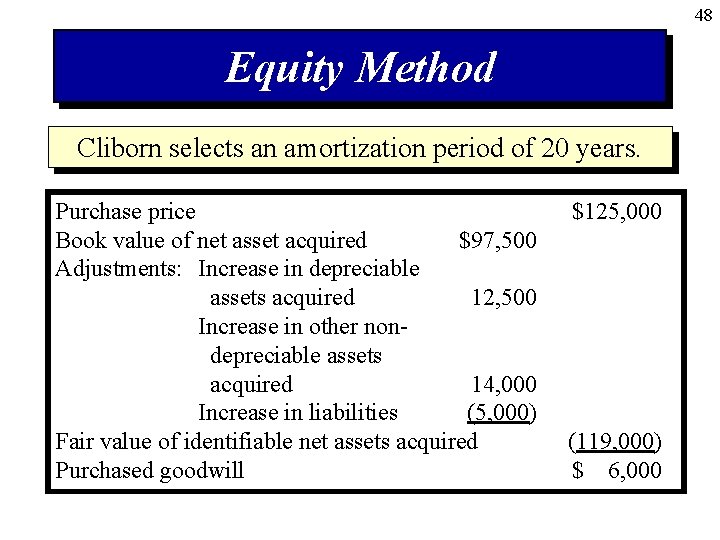
48 Equity Method Cliborn selects an amortization period of 20 years. Purchase price Book value of net asset acquired $97, 500 Adjustments: Increase in depreciable assets acquired 12, 500 Increase in other nondepreciable assets acquired 14, 000 Increase in liabilities (5, 000) Fair value of identifiable net assets acquired Purchased goodwill $125, 000 (119, 000) $ 6, 000
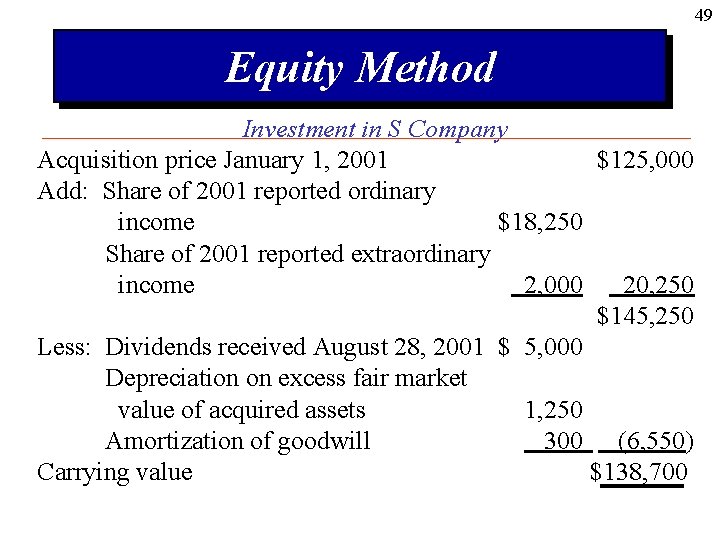
49 Equity Method Investment in S Company Acquisition price January 1, 2001 $125, 000 Add: Share of 2001 reported ordinary income $18, 250 Share of 2001 reported extraordinary income 2, 000 20, 250 $145, 250 Less: Dividends received August 28, 2001 $ 5, 000 Depreciation on excess fair market value of acquired assets 1, 250 Amortization of goodwill 300 (6, 550) Carrying value $138, 700
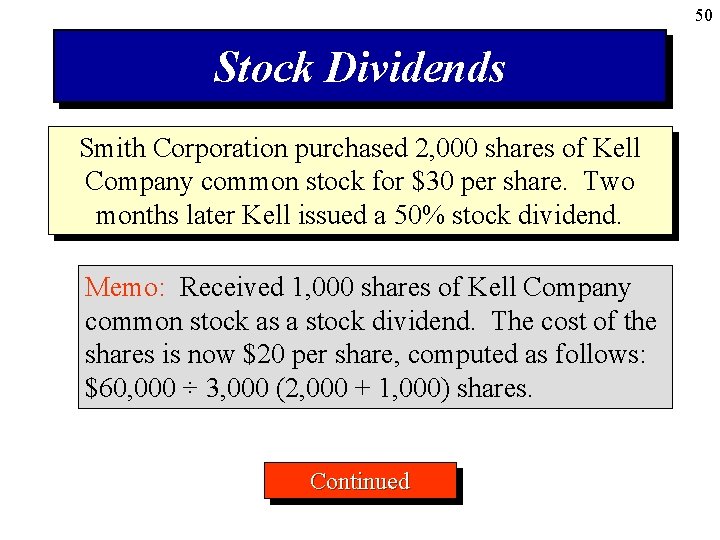
50 Stock Dividends Smith Corporation purchased 2, 000 shares of Kell Company common stock for $30 per share. Two months later Kell issued a 50% stock dividend. Memo: Received 1, 000 shares of Kell Company common stock as a stock dividend. The cost of the shares is now $20 per share, computed as follows: $60, 000 ÷ 3, 000 (2, 000 + 1, 000) shares. Continued
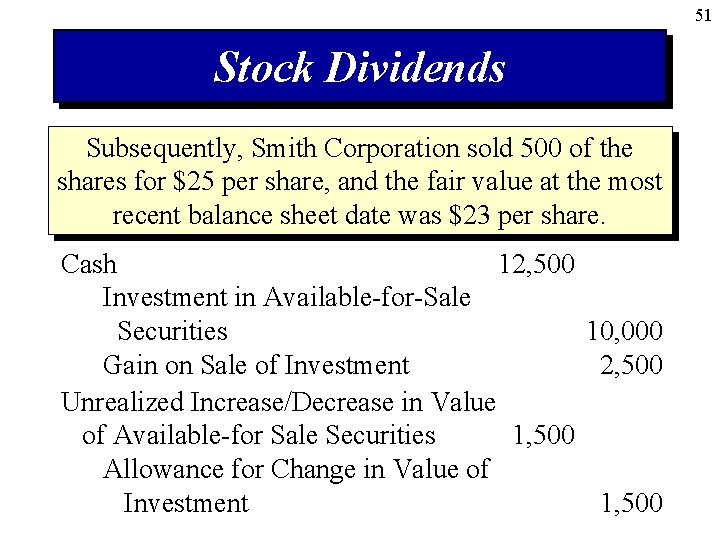
51 Stock Dividends Subsequently, Smith Corporation sold 500 of the shares for $25 per share, and the fair value at the most recent balance sheet date was $23 per share. Cash 12, 500 Investment in Available-for-Sale Securities 10, 000 Gain on Sale of Investment 2, 500 Unrealized Increase/Decrease in Value of Available-for Sale Securities 1, 500 Allowance for Change in Value of Investment 1, 500
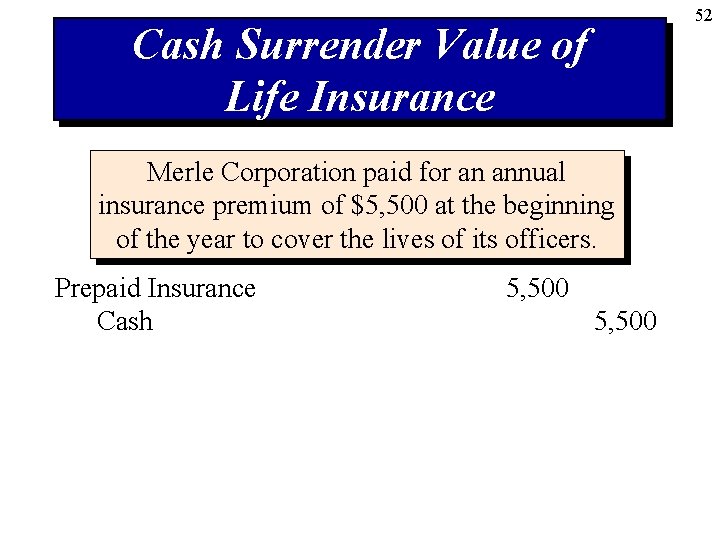
52 Cash Surrender Value of Life Insurance Merle Corporation paid for an annual insurance premium of $5, 500 at the beginning of the year to cover the lives of its officers. Prepaid Insurance Cash 5, 500
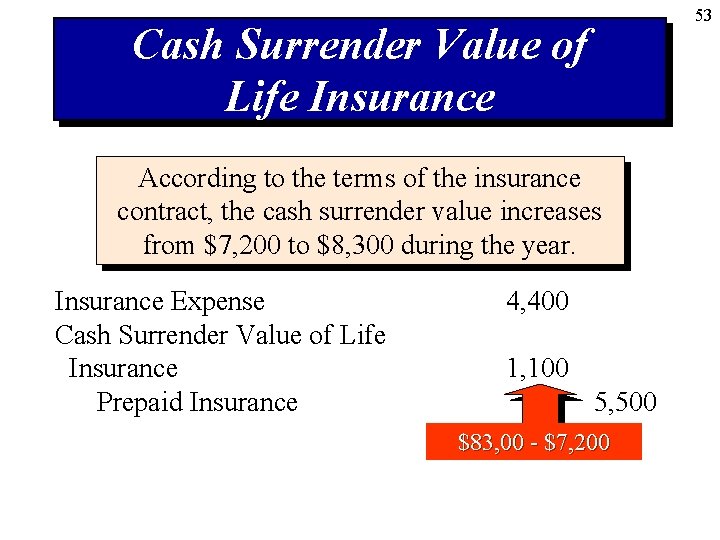
53 Cash Surrender Value of Life Insurance According to the terms of the insurance contract, the cash surrender value increases from $7, 200 to $8, 300 during the year. Insurance Expense Cash Surrender Value of Life Insurance Prepaid Insurance 4, 400 1, 100 5, 500 $83, 00 - $7, 200

54 Chapter 14
- Slides: 54