
Chapter 14 Institutional Programs Clear Cole American Corrections
- Slides: 41
Chapter 14 Institutional Programs Clear & Cole, American Corrections, 8 th
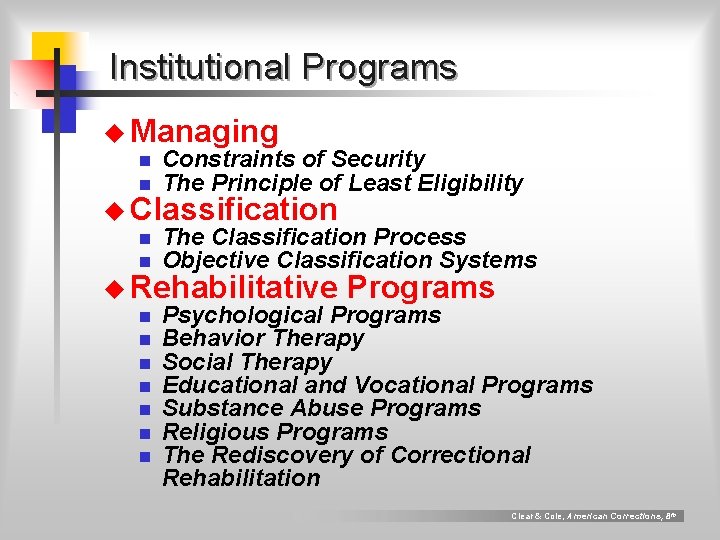
Institutional Programs u Managing n Constraints of Security n The Principle of Least Eligibility u Classification n The Classification Process n Objective Classification Systems u Rehabilitative Programs n Psychological Programs n Behavior Therapy n Social Therapy n Educational and Vocational Programs n Substance Abuse Programs n Religious Programs n The Rediscovery of Correctional Rehabilitation Clear & Cole, American Corrections, 8 th
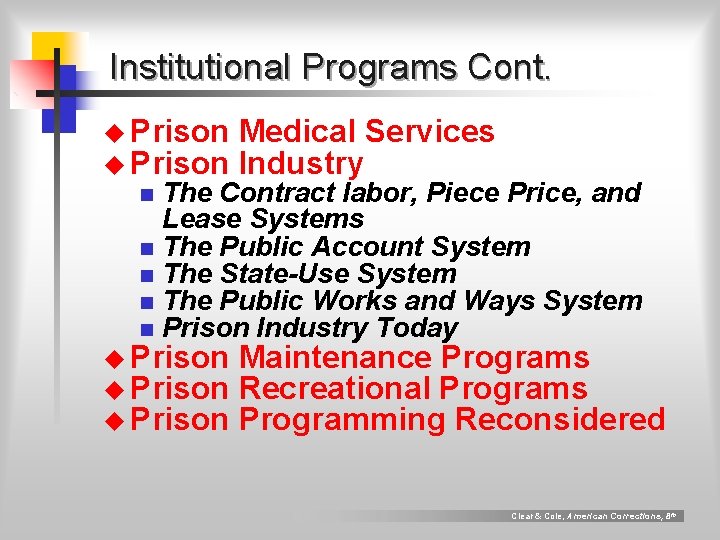
Institutional Programs Cont. u Prison Medical Services Industry The Contract labor, Piece Price, and Lease Systems n The Public Account System n The State-Use System n The Public Works and Ways System n Prison Industry Today n u Prison Maintenance Programs Recreational Programs Programming Reconsidered Clear & Cole, American Corrections, 8 th
“Prison program” u any formal, structured activity that takes prisoners out of their cells and sets them to instrumental tasks Clear & Cole, American Corrections, 8 th
“Principle of least eligibility” uthe doctrine that prisoners ought to receive no goods or services in excess of those available to people who have lived within the law Clear & Cole, American Corrections, 8 th
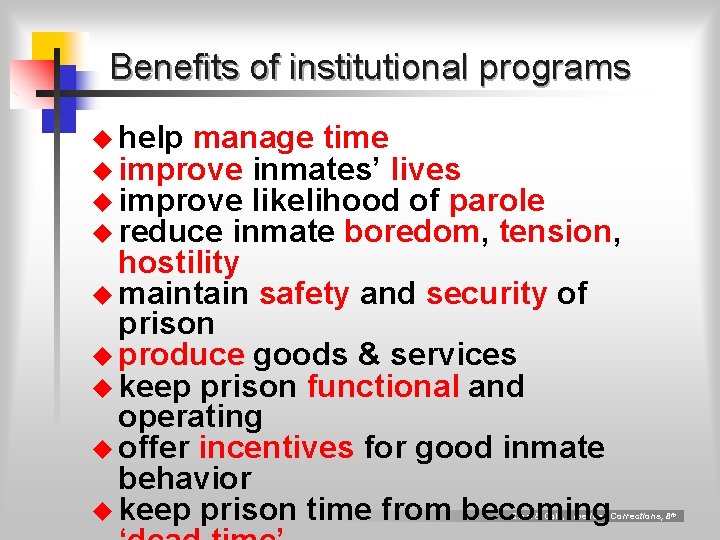
Benefits of institutional programs u help manage time u improve inmates’ lives u improve likelihood of parole u reduce inmate boredom, tension, hostility u maintain safety and security of prison u produce goods & services u keep prison functional and operating u offer incentives for good inmate behavior u keep prison time from becoming Clear & Cole, American Corrections, 8 th
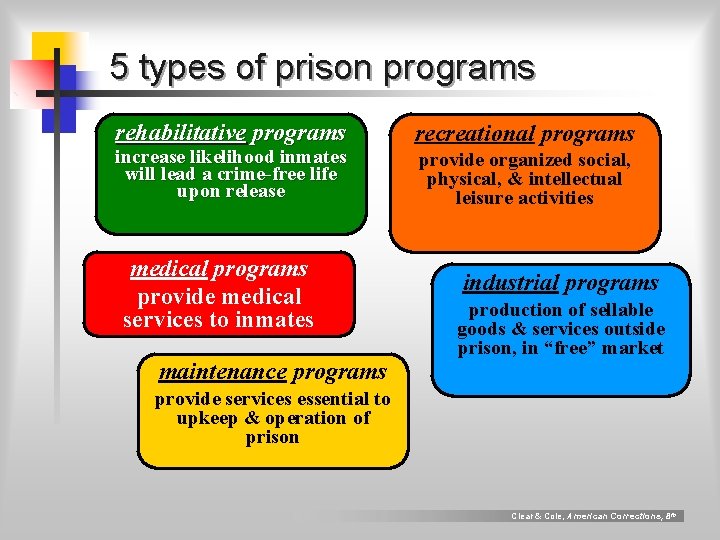
5 types of prison programs rehabilitative programs increase likelihood inmates will lead a crime-free life upon release medical programs provide medical services to inmates maintenance programs recreational programs provide organized social, physical, & intellectual leisure activities industrial programs production of sellable goods & services outside prison, in “free” market provide services essential to upkeep & operation of prison Clear & Cole, American Corrections, 8 th
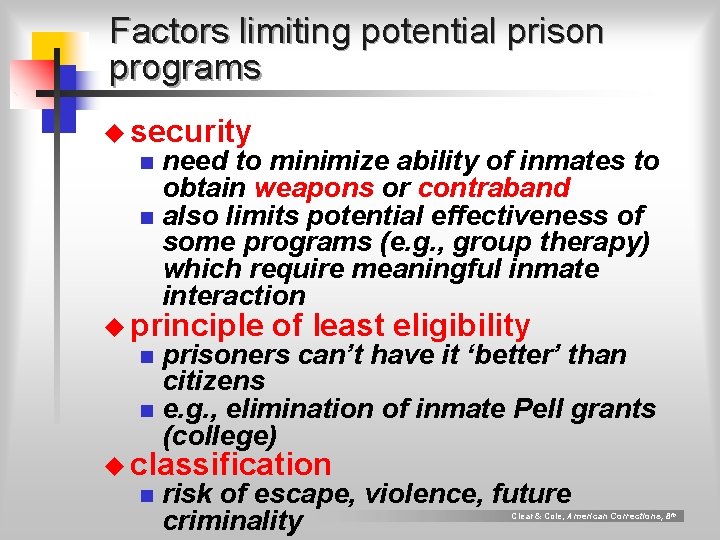
Factors limiting potential prison programs u security need to minimize ability of inmates to obtain weapons or contraband n also limits potential effectiveness of some programs (e. g. , group therapy) which require meaningful inmate interaction n u principle of least eligibility prisoners can’t have it ‘better’ than citizens n e. g. , elimination of inmate Pell grants (college) n u classification n risk of escape, violence, future criminality Clear & Cole, American Corrections, 8 th
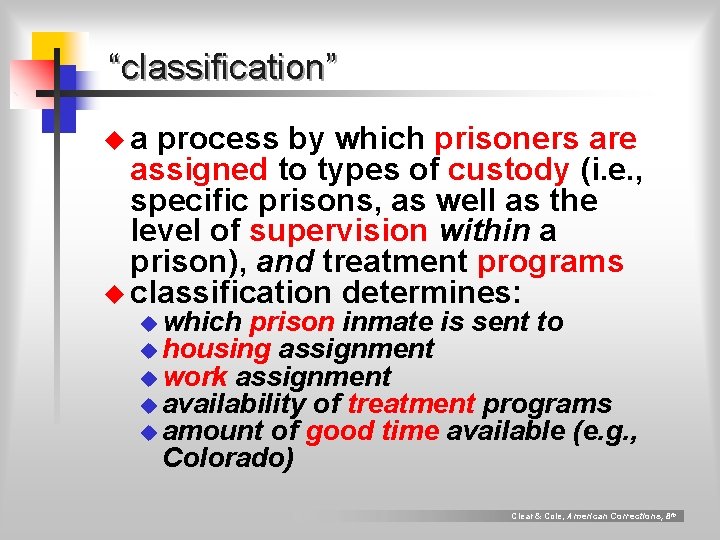
“classification” ua process by which prisoners are assigned to types of custody (i. e. , specific prisons, as well as the level of supervision within a prison), and treatment programs u classification determines: u which prison inmate is sent to u housing assignment u work assignment u availability of treatment programs u amount of good time available (e. g. , Colorado) Clear & Cole, American Corrections, 8 th
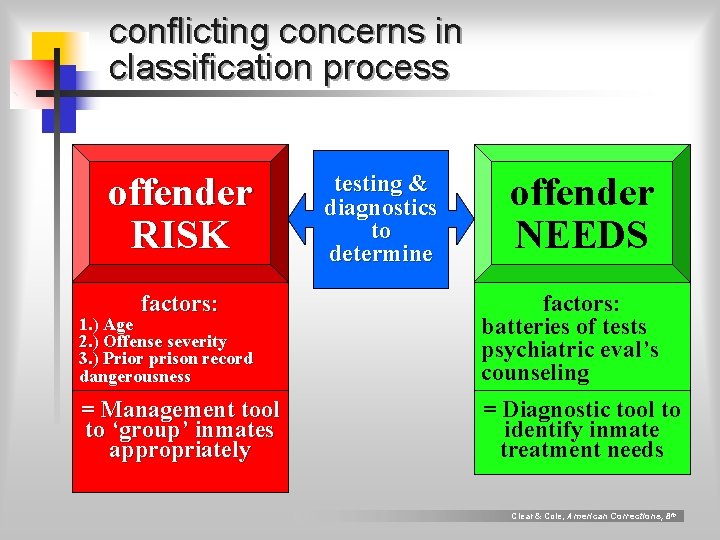
conflicting concerns in classification process offender RISK factors: testing & diagnostics to determine offender NEEDS 1. ) Age 2. ) Offense severity 3. ) Prior prison record dangerousness factors: batteries of tests psychiatric eval’s counseling = Management tool to ‘group’ inmates appropriately = Diagnostic tool to identify inmate treatment needs Clear & Cole, American Corrections, 8 th
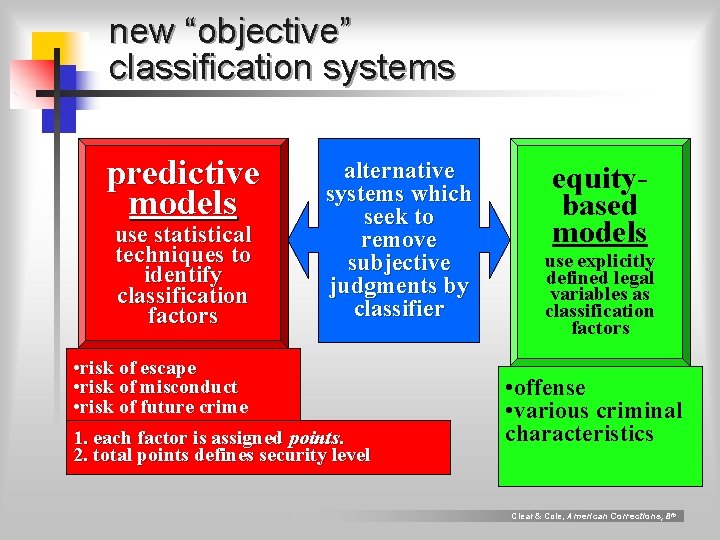
new “objective” classification systems predictive models use statistical techniques to identify classification factors alternative systems which seek to remove subjective judgments by classifier • risk of escape • risk of misconduct • risk of future crime 1. each factor is assigned points. 2. total points defines security level equitybased models use explicitly defined legal variables as classification factors • offense • various criminal characteristics Clear & Cole, American Corrections, 8 th
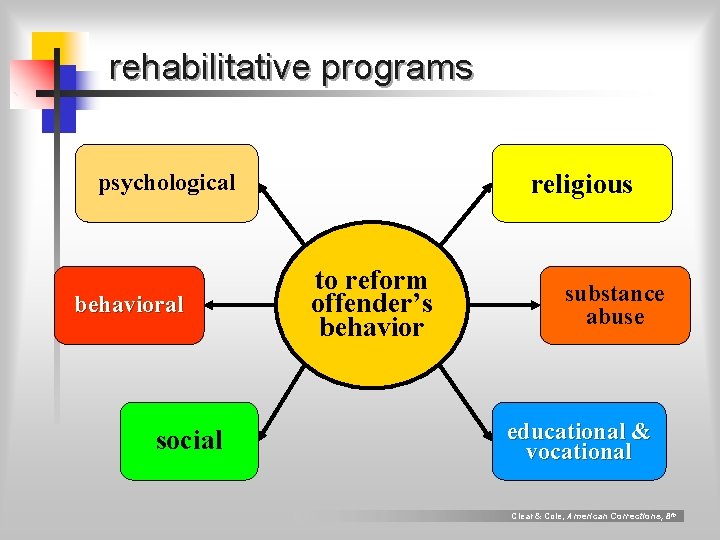
rehabilitative programs religious psychological behavioral social to reform offender’s behavior substance abuse educational & vocational Clear & Cole, American Corrections, 8 th
“psychotherapy” u in general terms, all forms of “treatment of the mind, ” i. e. , in which therapy address the individual’s thoughts and emotions; in the prison setting, these therapies are coercive in nature. umost experts agree that mental abnormalities play an insignificant role in criminality of most offenders. Clear & Cole, American Corrections, 8 th
Myths in Corrections u The Myth: Judges should send people to prison to get rehabilitation programs. u The Reality: Rehabilitation programs offered in the community are twice as effective at reducing recidivism as those same programs offered in prison. (See Figure 14. 1: Programs in Prison vs. the Community) Clear & Cole, American Corrections, 8 th
“coercive therapy” u treatment in which therapist determines the need for (and the goals of) treatment processes, whether or not the client agrees Clear & Cole, American Corrections, 8 th
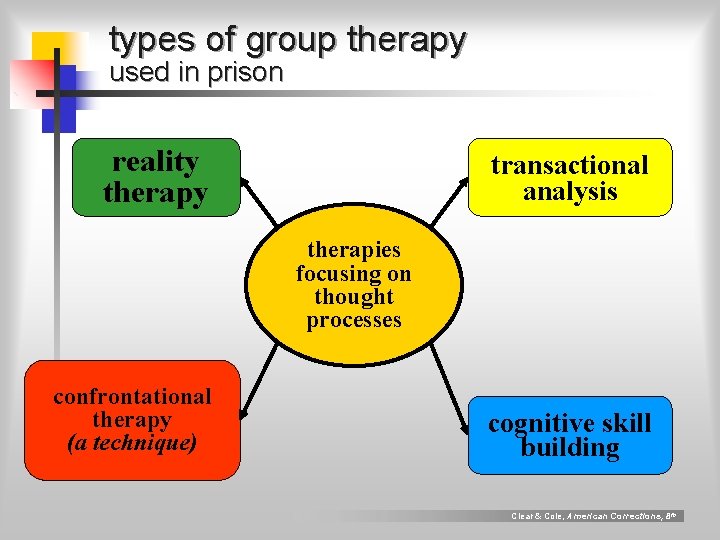
“group treatment” u therapy for which the setting is a group of individuals who are seen as having the same or similar problems or needs; designed to be highly interactive, often confrontational, as members of the group comprise essential elements of therapy Clear & Cole, American Corrections, 8 th
types of group therapy used in prison reality therapy transactional analysis therapies focusing on thought processes confrontational therapy (a technique) cognitive skill building Clear & Cole, American Corrections, 8 th
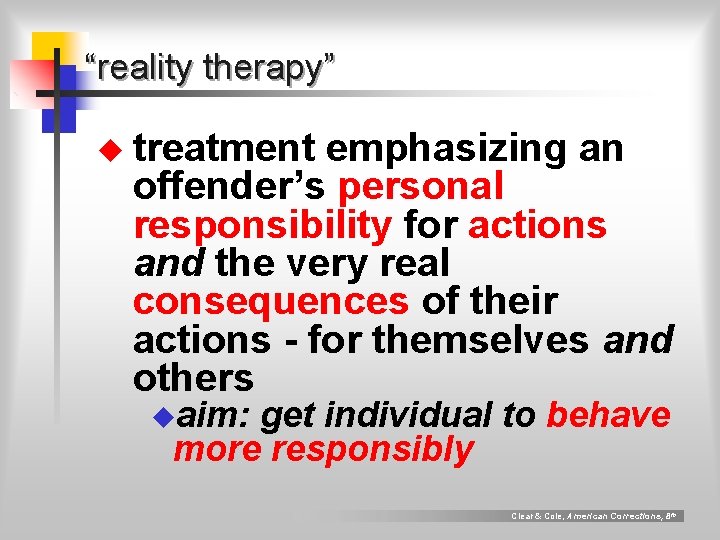
“reality therapy” u treatment emphasizing an offender’s personal responsibility for actions and the very real consequences of their actions - for themselves and others uaim: get individual to behave more responsibly Clear & Cole, American Corrections, 8 th
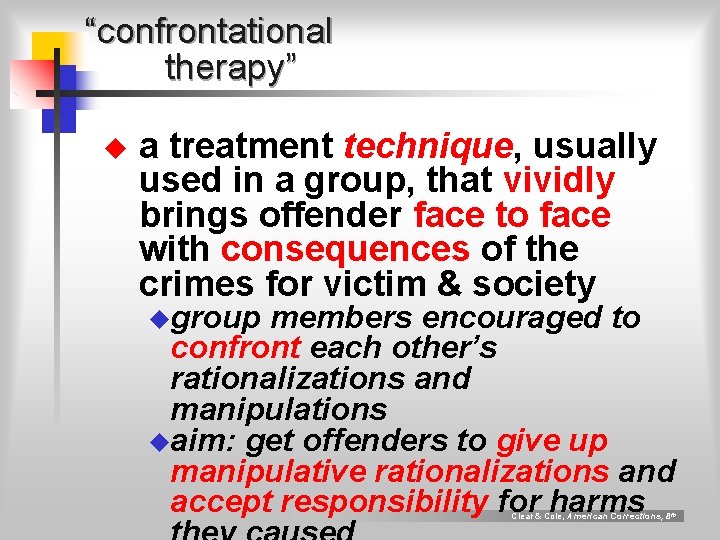
“confrontational therapy” u a treatment technique, usually used in a group, that vividly brings offender face to face with consequences of the crimes for victim & society ugroup members encouraged to confront each other’s rationalizations and manipulations uaim: get offenders to give up manipulative rationalizations and accept responsibility for harms Clear & Cole, American Corrections, 8 th
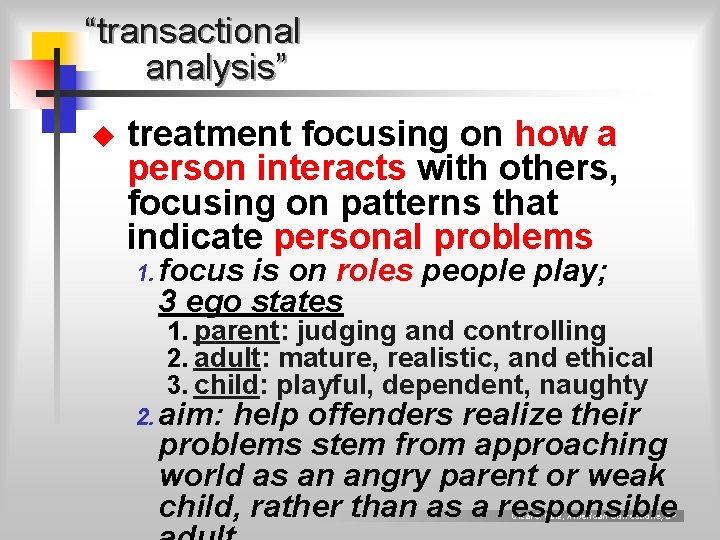
“transactional analysis” u treatment focusing on how a person interacts with others, focusing on patterns that indicate personal problems 1. focus is on roles people play; 3 ego states 1. parent: judging and controlling 2. adult: mature, realistic, and ethical 3. child: playful, dependent, naughty 2. aim: help offenders realize their problems stem from approaching world as an angry parent or weak child, rather than as a responsible Clear & Cole, American Corrections, 8 th
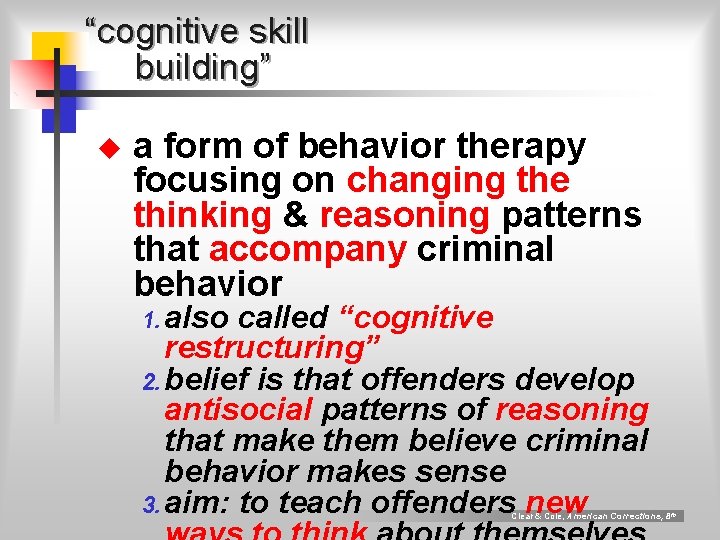
“cognitive skill building” u a form of behavior therapy focusing on changing the thinking & reasoning patterns that accompany criminal behavior 1. also called “cognitive restructuring” 2. belief is that offenders develop antisocial patterns of reasoning that make them believe criminal behavior makes sense 3. aim: to teach offenders new Clear & Cole, American Corrections, 8 th
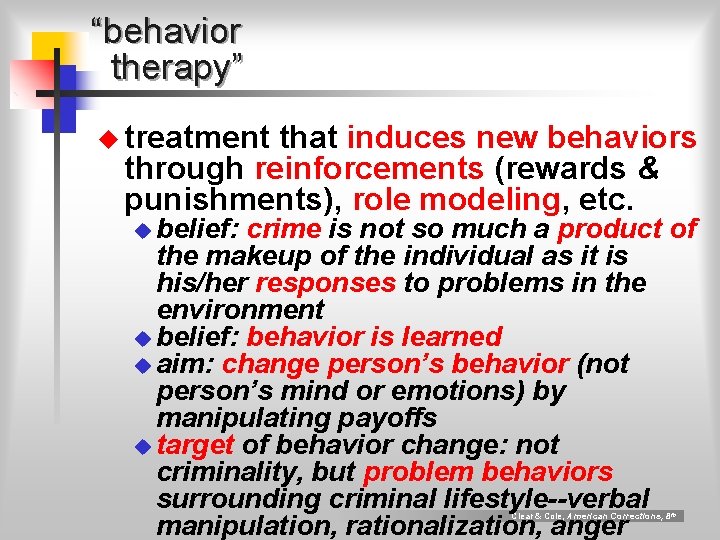
“behavior therapy” u treatment that induces new behaviors through reinforcements (rewards & punishments), role modeling, etc. u belief: crime is not so much a product of the makeup of the individual as it is his/her responses to problems in the environment u belief: behavior is learned u aim: change person’s behavior (not person’s mind or emotions) by manipulating payoffs u target of behavior change: not criminality, but problem behaviors surrounding criminal lifestyle--verbal manipulation, rationalization, anger Clear & Cole, American Corrections, 8 th
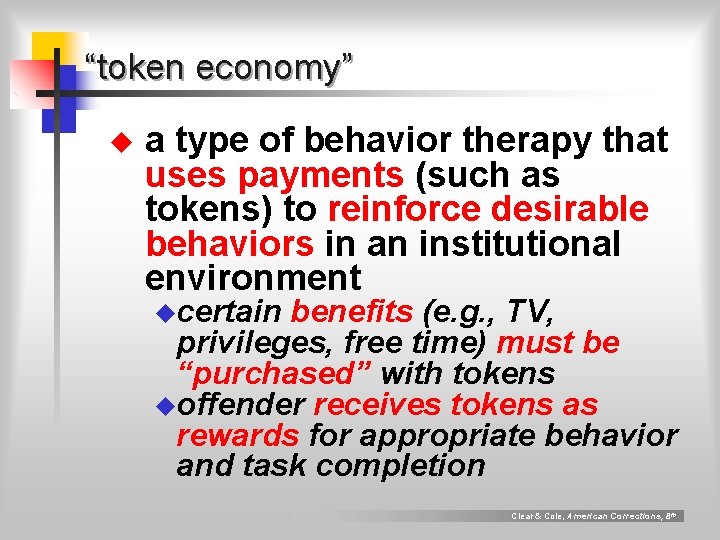
“token economy” u a type of behavior therapy that uses payments (such as tokens) to reinforce desirable behaviors in an institutional environment ucertain benefits (e. g. , TV, privileges, free time) must be “purchased” with tokens uoffender receives tokens as rewards for appropriate behavior and task completion Clear & Cole, American Corrections, 8 th
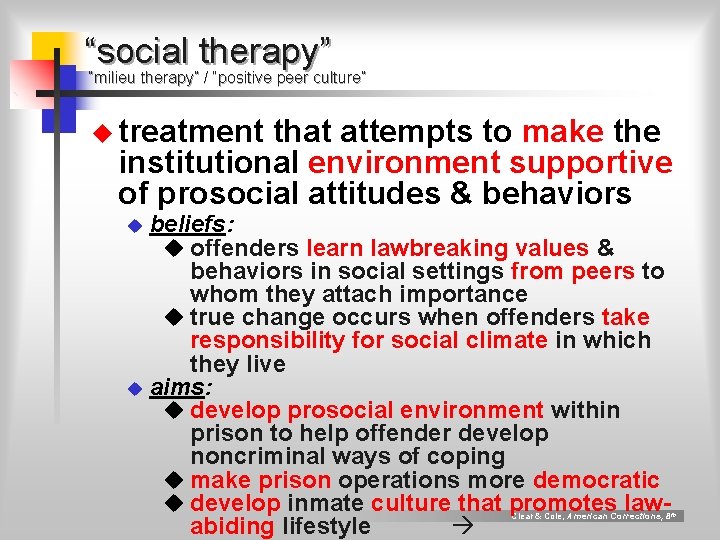
“social therapy” “milieu therapy” / “positive peer culture” u treatment that attempts to make the institutional environment supportive of prosocial attitudes & behaviors beliefs: u offenders learn lawbreaking values & behaviors in social settings from peers to whom they attach importance u true change occurs when offenders take responsibility for social climate in which they live u aims: u develop prosocial environment within prison to help offender develop noncriminal ways of coping u make prison operations more democratic u develop inmate culture that promotes lawabiding lifestyle u Clear & Cole, American Corrections, 8 th
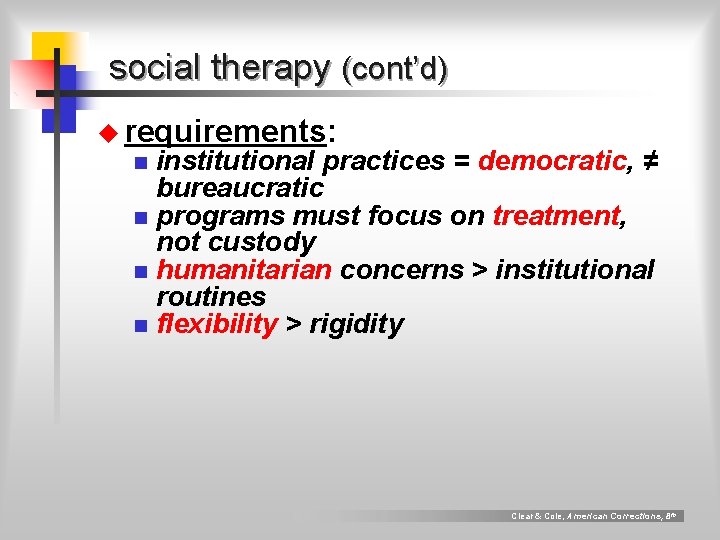
social therapy (cont’d) u requirements: institutional practices = democratic, ≠ bureaucratic n programs must focus on treatment, not custody n humanitarian concerns > institutional routines n flexibility > rigidity n Clear & Cole, American Corrections, 8 th
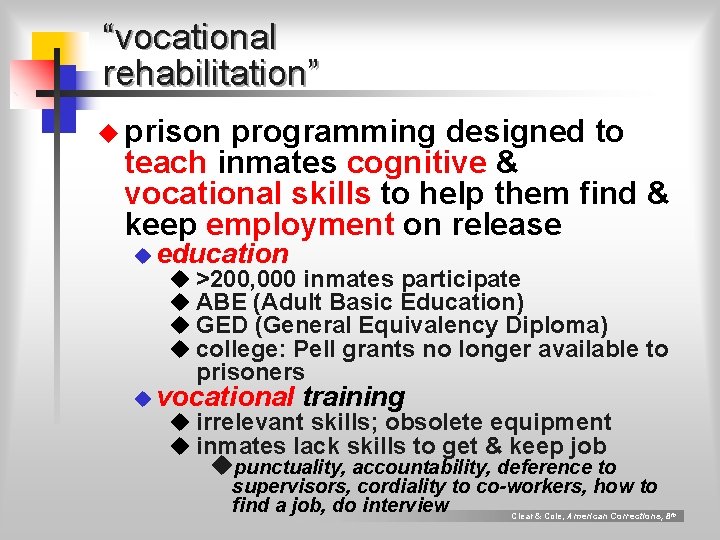
“vocational rehabilitation” u prison programming designed to teach inmates cognitive & vocational skills to help them find & keep employment on release u education u >200, 000 inmates participate u ABE (Adult Basic Education) u GED (General Equivalency Diploma) u college: Pell grants no longer available to prisoners u vocational training u irrelevant skills; obsolete equipment u inmates lack skills to get & keep job upunctuality, accountability, deference to supervisors, cordiality to co-workers, how to find a job, do interview Clear & Cole, American Corrections, 8 th
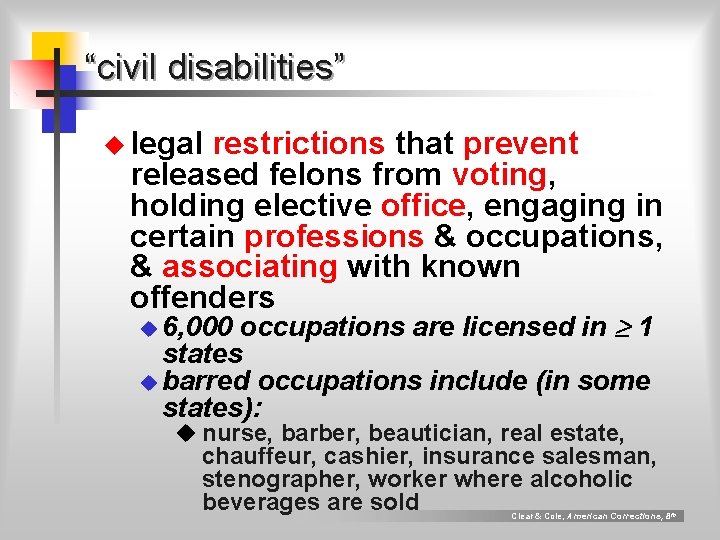
“civil disabilities” u legal restrictions that prevent released felons from voting, holding elective office, engaging in certain professions & occupations, & associating with known offenders occupations are licensed in 1 states u barred occupations include (in some states): u 6, 000 u nurse, barber, beautician, real estate, chauffeur, cashier, insurance salesman, stenographer, worker where alcoholic beverages are sold Clear & Cole, American Corrections, 8 th
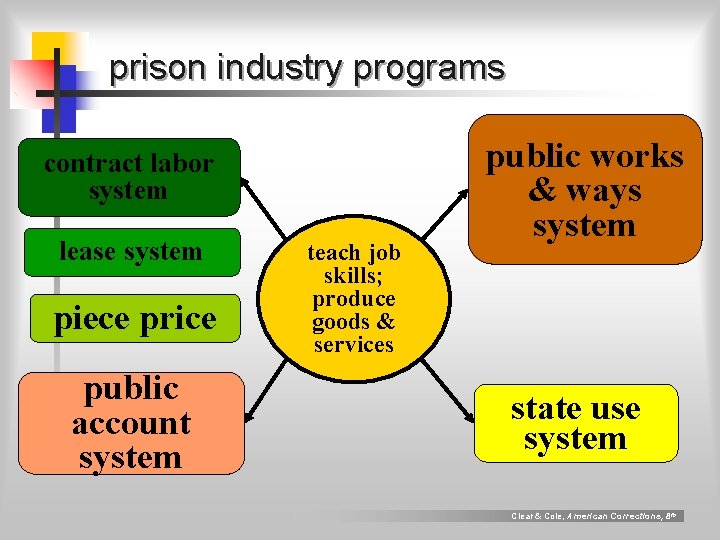
prison industry programs contract labor system lease system piece price public account system teach job skills; produce goods & services public works & ways system state use system Clear & Cole, American Corrections, 8 th
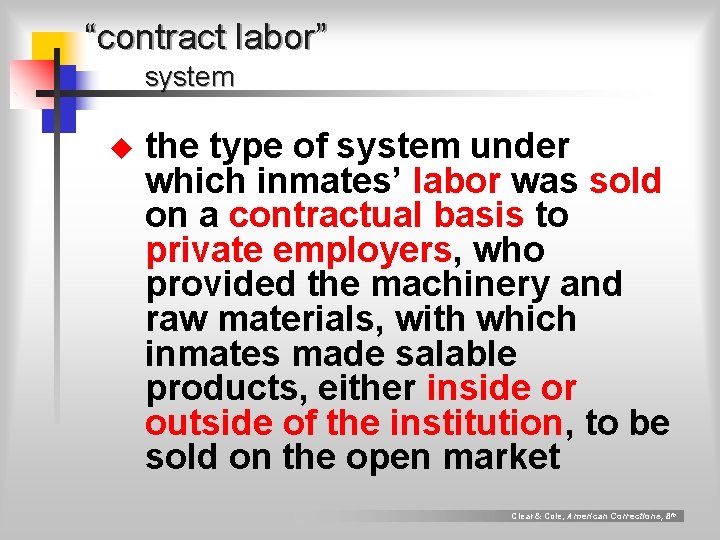
“contract labor” system u the type of system under which inmates’ labor was sold on a contractual basis to private employers, who provided the machinery and raw materials, with which inmates made salable products, either inside or outside of the institution, to be sold on the open market Clear & Cole, American Corrections, 8 th
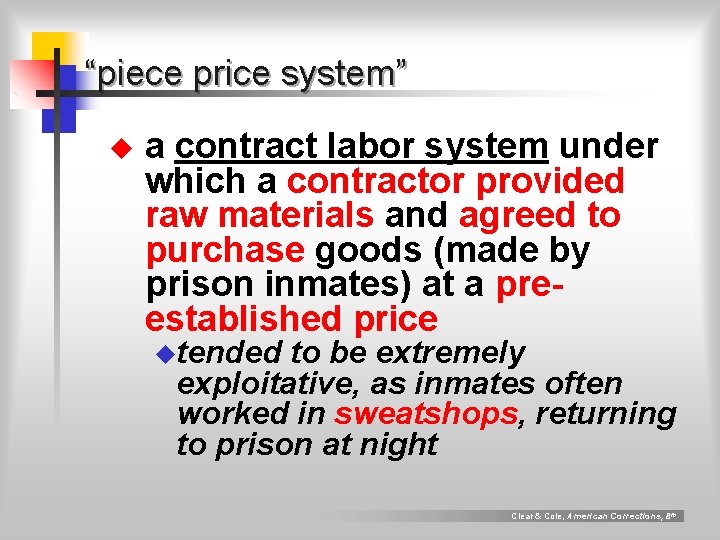
“piece price system” u a contract labor system under which a contractor provided raw materials and agreed to purchase goods (made by prison inmates) at a preestablished price utended to be extremely exploitative, as inmates often worked in sweatshops, returning to prison at night Clear & Cole, American Corrections, 8 th
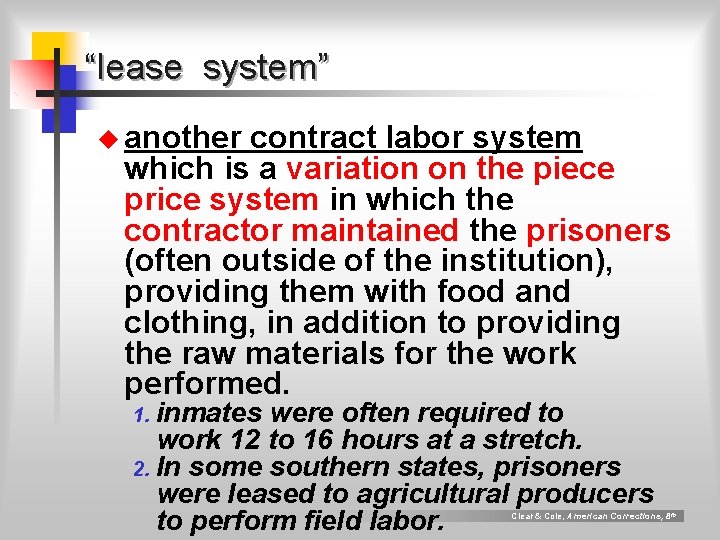
“lease system” u another contract labor system which is a variation on the piece price system in which the contractor maintained the prisoners (often outside of the institution), providing them with food and clothing, in addition to providing the raw materials for the work performed. 1. inmates were often required to work 12 to 16 hours at a stretch. 2. In some southern states, prisoners were leased to agricultural producers to perform field labor. Clear & Cole, American Corrections, 8 th
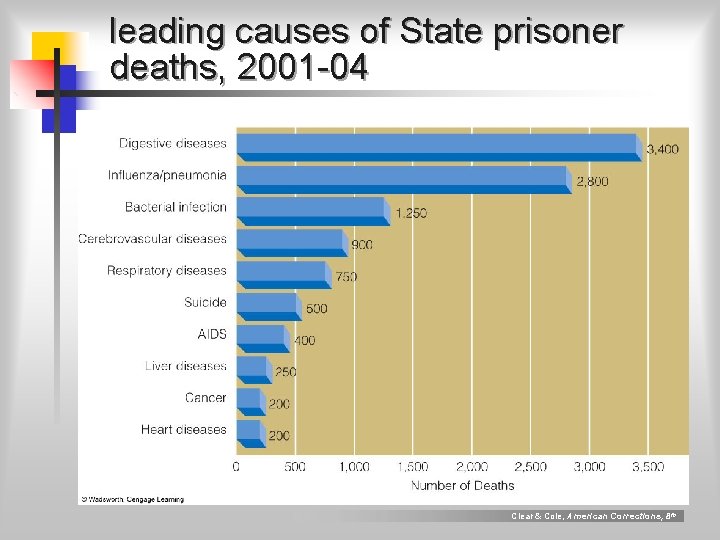
leading causes of State prisoner deaths, 2001 -04 Clear & Cole, American Corrections, 8 th
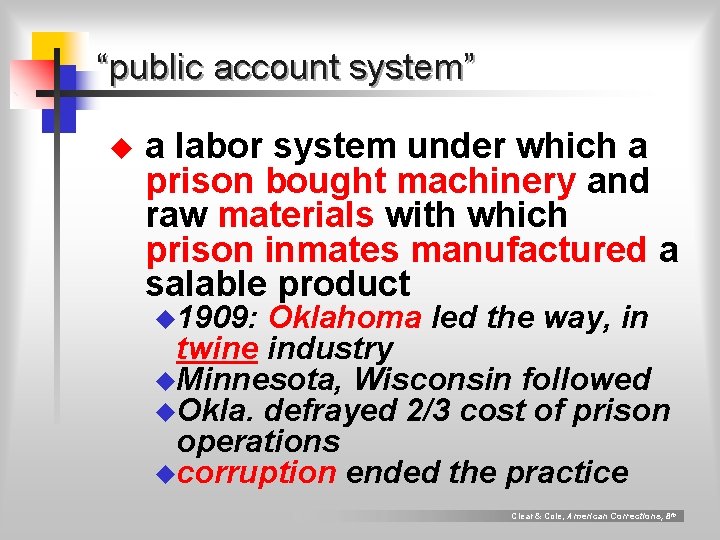
“public account system” u a labor system under which a prison bought machinery and raw materials with which prison inmates manufactured a salable product u 1909: Oklahoma led the way, in twine industry u. Minnesota, Wisconsin followed u. Okla. defrayed 2/3 cost of prison operations ucorruption ended the practice Clear & Cole, American Corrections, 8 th
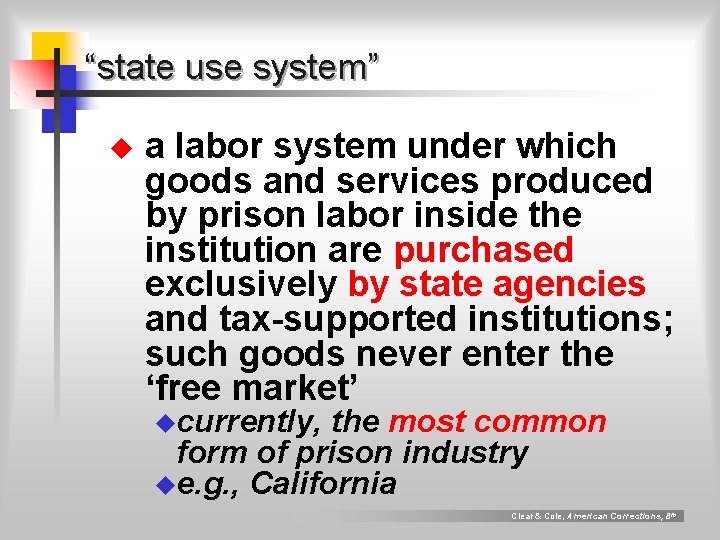
“state use system” u a labor system under which goods and services produced by prison labor inside the institution are purchased exclusively by state agencies and tax-supported institutions; such goods never enter the ‘free market’ ucurrently, the most common form of prison industry ue. g. , California Clear & Cole, American Corrections, 8 th
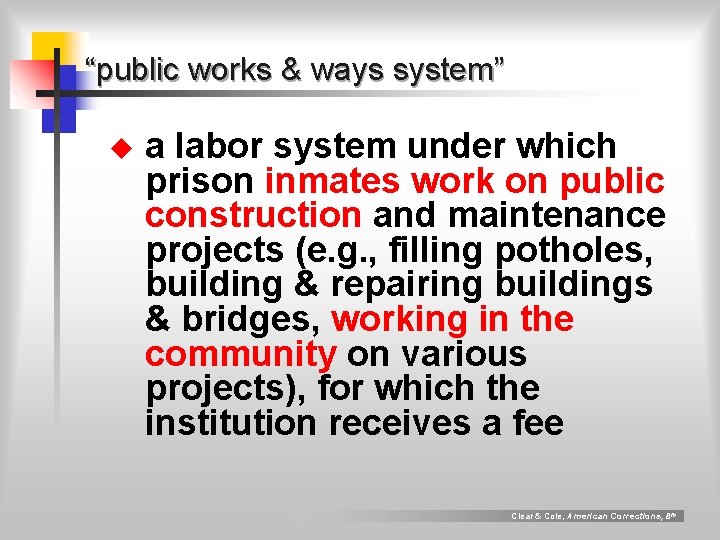
“public works & ways system” u a labor system under which prison inmates work on public construction and maintenance projects (e. g. , filling potholes, building & repairing buildings & bridges, working in the community on various projects), for which the institution receives a fee Clear & Cole, American Corrections, 8 th
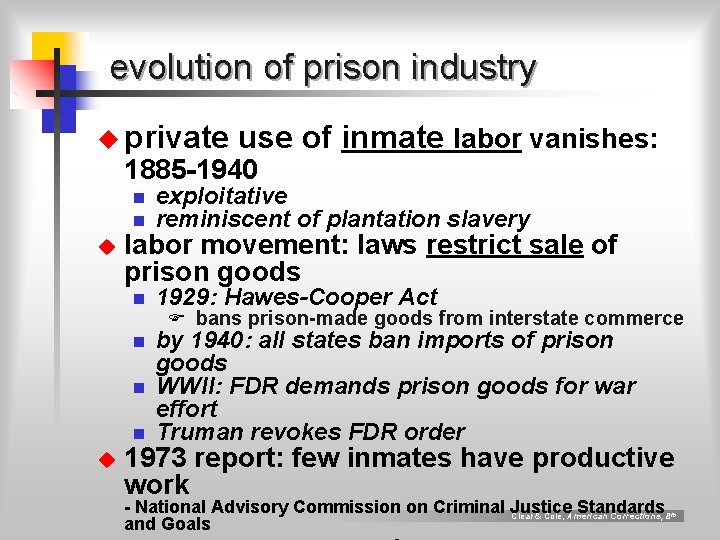
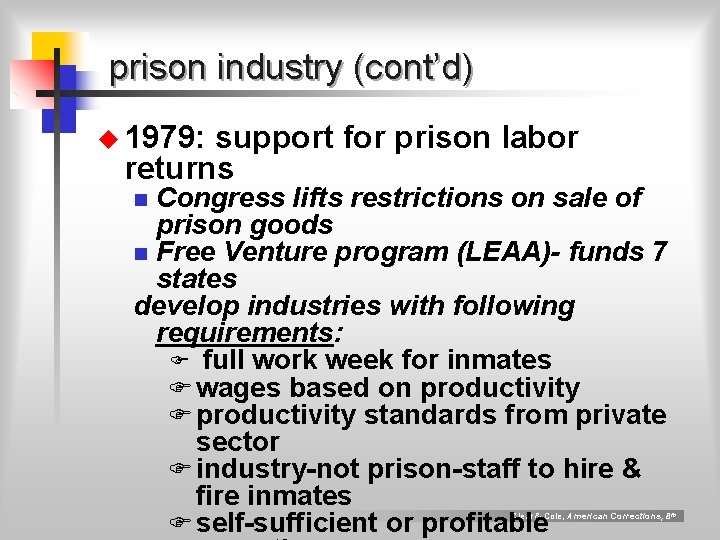
evolution of prison industry u private use of inmate labor vanishes: 1885 -1940 u n n exploitative reminiscent of plantation slavery n 1929: Hawes-Cooper Act n by 1940: all states ban imports of prison goods WWII: FDR demands prison goods for war effort Truman revokes FDR order labor movement: laws restrict sale of prison goods n n u F bans prison-made goods from interstate commerce 1973 report: few inmates have productive work - National Advisory Commission on Criminal Justice Standards Clear & Cole, American Corrections, 8 and Goals th
prison industry (cont’d) u 1979: support for prison labor returns Congress lifts restrictions on sale of prison goods n Free Venture program (LEAA)- funds 7 states develop industries with following requirements: F full work week for inmates F wages based on productivity F productivity standards from private sector F industry-not prison-staff to hire & fire inmates F self-sufficient or profitable n Clear & Cole, American Corrections, 8 th
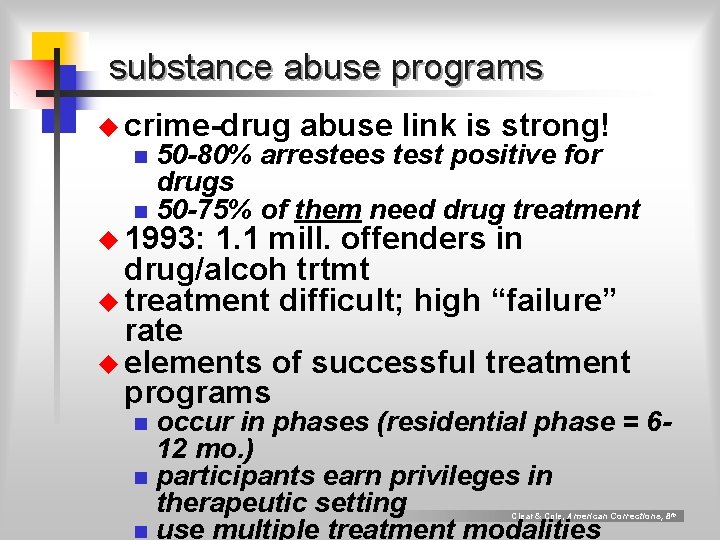
substance abuse programs u crime-drug abuse link is strong! 50 -80% arrestees test positive for drugs n 50 -75% of them need drug treatment n u 1993: 1. 1 mill. offenders in drug/alcoh trtmt u treatment difficult; high “failure” rate u elements of successful treatment programs occur in phases (residential phase = 612 mo. ) n participants earn privileges in therapeutic setting n use multiple treatment modalities n Clear & Cole, American Corrections, 8 th
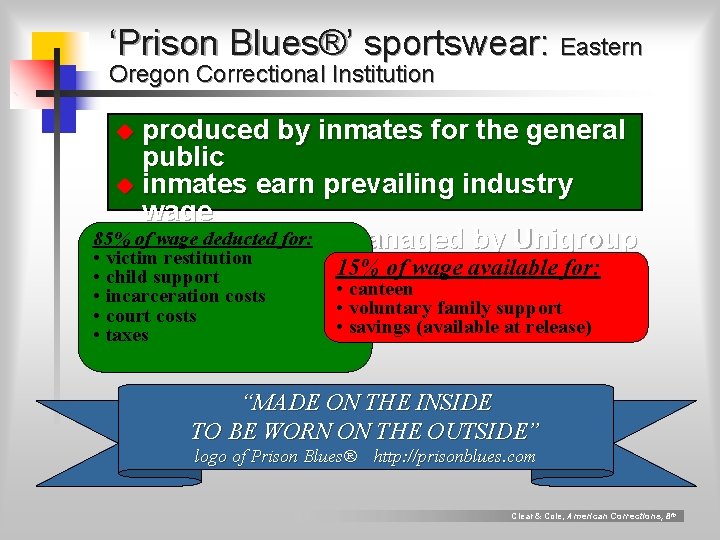
‘Prison Blues®’ sportswear: Eastern Oregon Correctional Institution produced by inmates for the general public u inmates earn prevailing industry wage 85% wage deducted for: managed by Unigroup uof. Prison Blues® • victim restitution 15% of wage available for: • child. Corp. support u • incarceration costs • court costs • taxes • canteen • voluntary family support • savings (available at release) “MADE ON THE INSIDE TO BE WORN ON THE OUTSIDE” logo of Prison Blues® http: //prisonblues. com Clear & Cole, American Corrections, 8 th
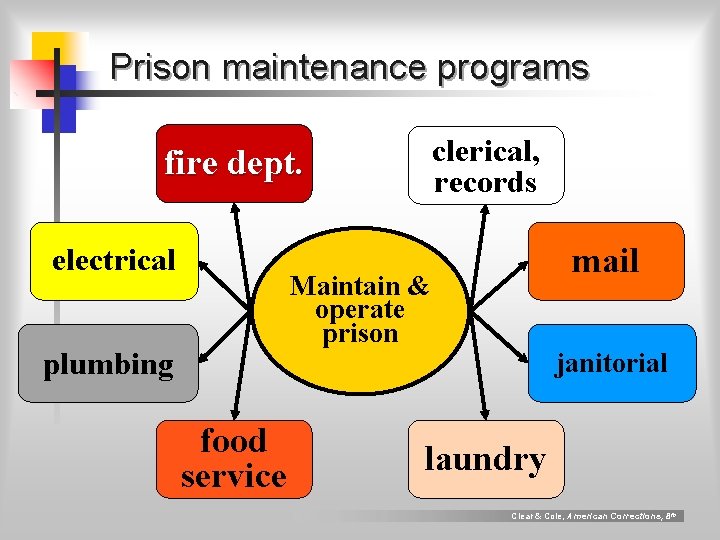
Prison maintenance programs clerical, records fire dept. electrical mail Maintain & operate prison plumbing food service janitorial laundry Clear & Cole, American Corrections, 8 th
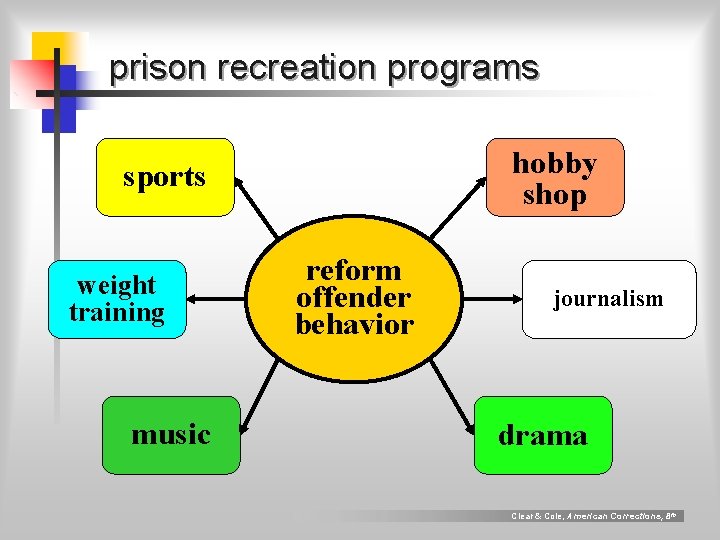
prison recreation programs hobby shop sports weight training music reform offender behavior journalism drama Clear & Cole, American Corrections, 8 th