
CHAPTER 14 Improving Service Quality and Productivity Slide


- Slides: 45
CHAPTER 14 Improving Service Quality and Productivity Slide © by Lovelock, Wirtz and Chew 2009 Essentials of Services Marketing Chapter 1 - Page 1
Overview of Chapter 14 § Integrating Service Quality and Productivity Strategies § What is Service Quality? § The GAP Model – A Conceptual Tool to Identify and Correct Service Quality Problems § Measuring and Improving Service Quality § Learning From Customer Feedback Slide © by Lovelock, Wirtz and Chew 2009 Essentials of Services Marketing Chapter 1 - Page 2
Overview of Chapter 14 § Hard Measures of Service Quality § Tools to Analyze and Address Service Quality Problems § Return on Quality § Defining and Measuring Productivity § Improving Service Productivity Slide © by Lovelock, Wirtz and Chew 2009 Essentials of Services Marketing Chapter 1 - Page 3
Integrating Service Quality and Productivity Strategies Slide © by Lovelock, Wirtz and Chew 2009 Essentials of Services Marketing Chapter 1 - Page 4
Integrating Service Quality and Productivity Strategies § Quality and productivity are twin paths to creating value for both customers and companies § Quality focuses on the benefits created for customers; productivity addresses financial costs incurred by firm Ø If service processes are more efficient and increase productivity, this may not result in better quality experience for customers Ø Getting service employees to work faster to increase productivity may sometimes be welcomed by customers, but at other times feel rushed and unwanted § Marketing, operations and human resource managers need to work together for quality and productivity improvement Slide © by Lovelock, Wirtz and Chew 2009 Essentials of Services Marketing Chapter 1 - Page 5
What is Service Quality? Slide © by Lovelock, Wirtz and Chew 2009 Essentials of Services Marketing Chapter 1 - Page 6
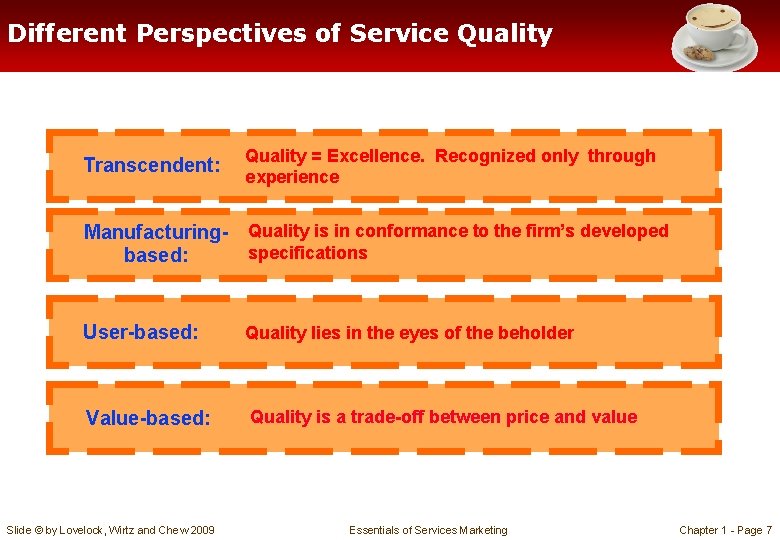
Different Perspectives of Service Quality Transcendent: Quality = Excellence. Recognized only through experience Manufacturing- Quality is in conformance to the firm’s developed specifications based: User-based: Quality lies in the eyes of the beholder Value-based: Quality is a trade-off between price and value Slide © by Lovelock, Wirtz and Chew 2009 Essentials of Services Marketing Chapter 1 - Page 7
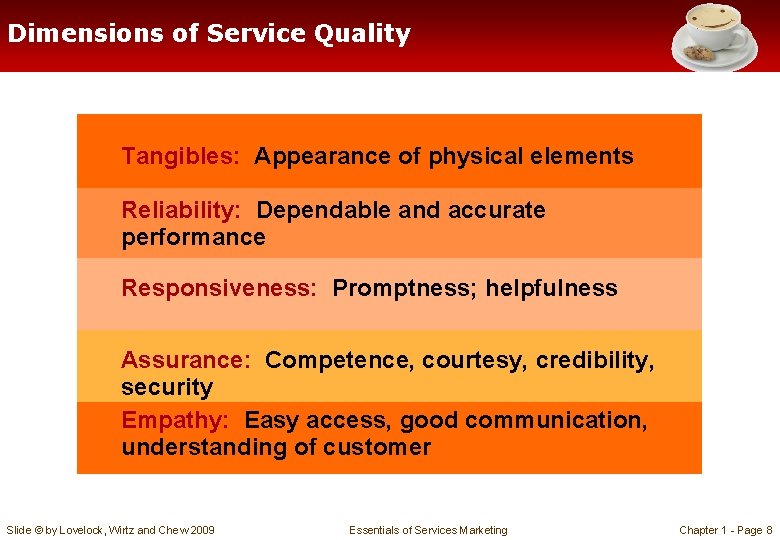
Dimensions of Service Quality Tangibles: Appearance of physical elements Reliability: Dependable and accurate performance Responsiveness: Promptness; helpfulness Assurance: Competence, courtesy, credibility, security Empathy: Easy access, good communication, understanding of customer Slide © by Lovelock, Wirtz and Chew 2009 Essentials of Services Marketing Chapter 1 - Page 8
The Gap Model – A Conceptual Tool to Identify and Correct Service Quality Problems Slide © by Lovelock, Wirtz and Chew 2009 Essentials of Services Marketing Chapter 1 - Page 9
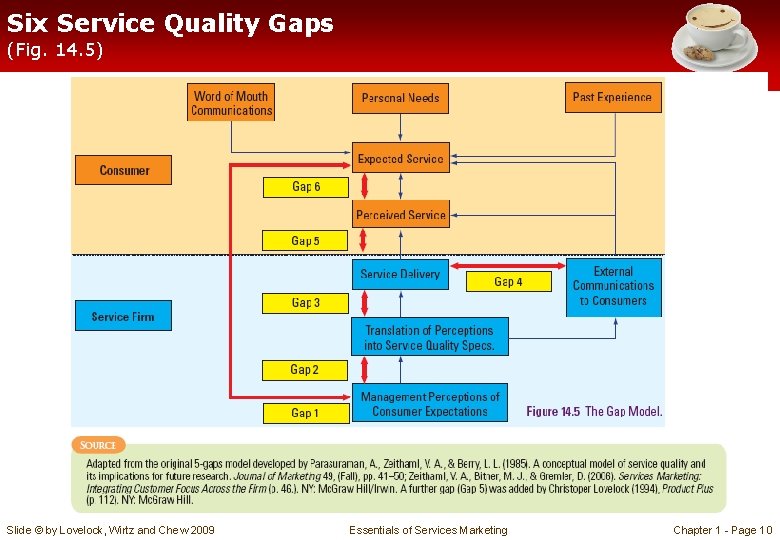
Six Service Quality Gaps (Fig. 14. 5) Slide © by Lovelock, Wirtz and Chew 2009 Essentials of Services Marketing Chapter 1 - Page 10
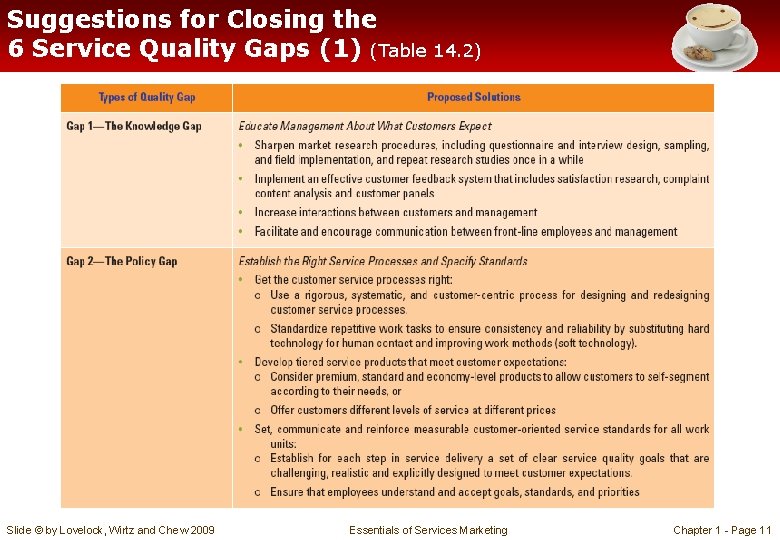
Suggestions for Closing the 6 Service Quality Gaps (1) (Table 14. 2) Slide © by Lovelock, Wirtz and Chew 2009 Essentials of Services Marketing Chapter 1 - Page 11
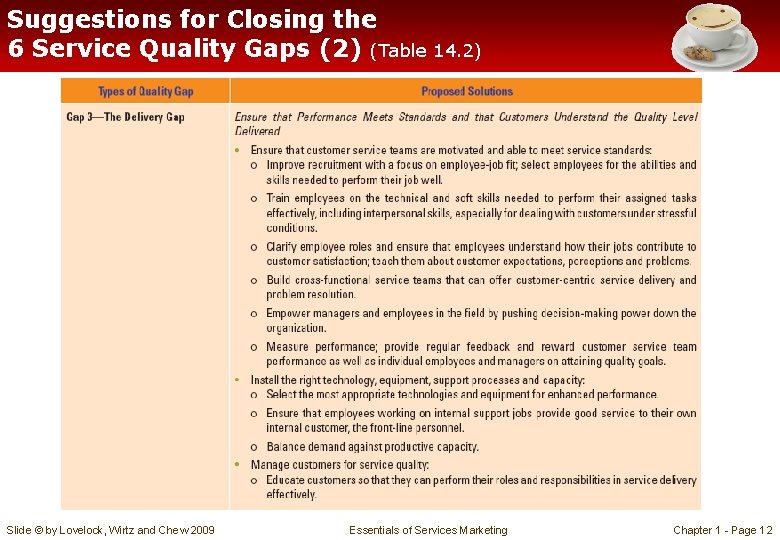
Suggestions for Closing the 6 Service Quality Gaps (2) (Table 14. 2) Slide © by Lovelock, Wirtz and Chew 2009 Essentials of Services Marketing Chapter 1 - Page 12
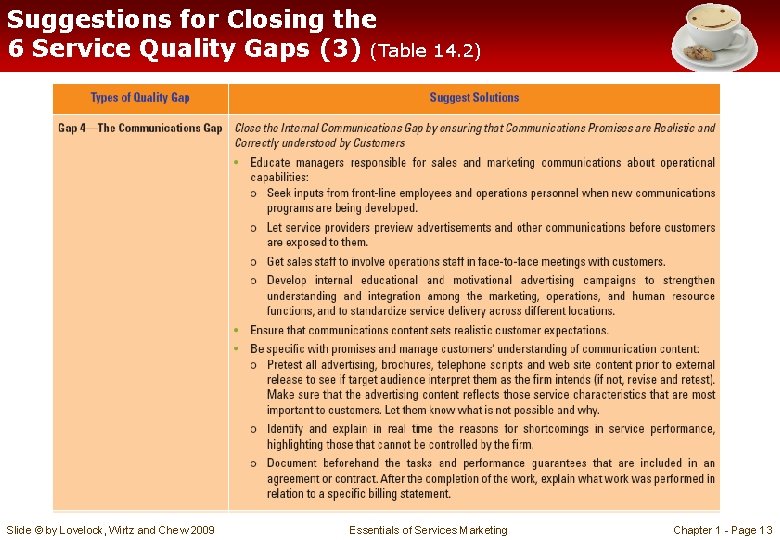
Suggestions for Closing the 6 Service Quality Gaps (3) (Table 14. 2) Slide © by Lovelock, Wirtz and Chew 2009 Essentials of Services Marketing Chapter 1 - Page 13
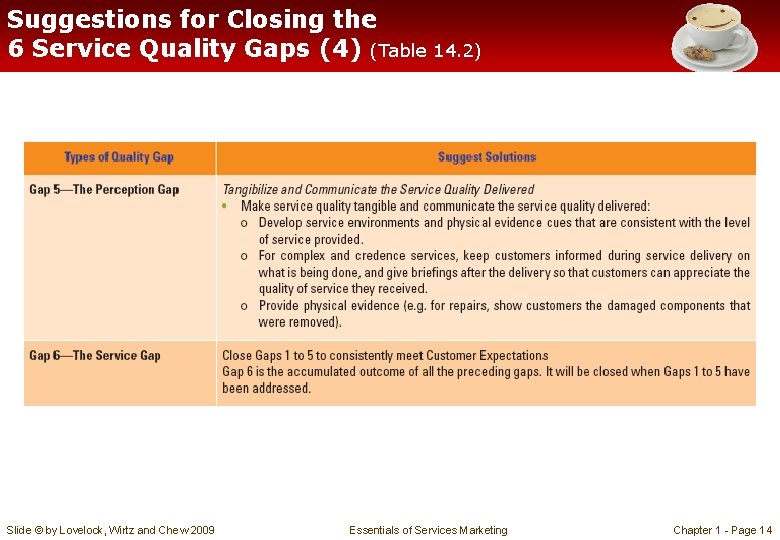
Suggestions for Closing the 6 Service Quality Gaps (4) (Table 14. 2) Slide © by Lovelock, Wirtz and Chew 2009 Essentials of Services Marketing Chapter 1 - Page 14
Measuring and Improving Service Quality Slide © by Lovelock, Wirtz and Chew 2009 Essentials of Services Marketing Chapter 1 - Page 15
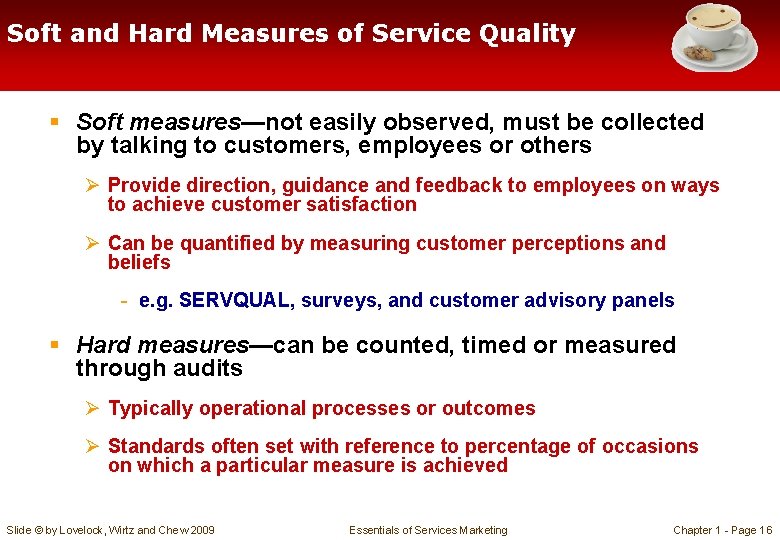
Soft and Hard Measures of Service Quality § Soft measures—not easily observed, must be collected by talking to customers, employees or others Ø Provide direction, guidance and feedback to employees on ways to achieve customer satisfaction Ø Can be quantified by measuring customer perceptions and beliefs - e. g. SERVQUAL, surveys, and customer advisory panels § Hard measures—can be counted, timed or measured through audits Ø Typically operational processes or outcomes Ø Standards often set with reference to percentage of occasions on which a particular measure is achieved Slide © by Lovelock, Wirtz and Chew 2009 Essentials of Services Marketing Chapter 1 - Page 16
Learning from Customer Feedback Slide © by Lovelock, Wirtz and Chew 2009 Essentials of Services Marketing Chapter 1 - Page 17
Key Objectives of Effective Customer Feedback Systems § Assessment and benchmarking of service quality and performance § Customer-driven learning and improvements § Creating a customer-oriented service culture Slide © by Lovelock, Wirtz and Chew 2009 Essentials of Services Marketing Chapter 1 - Page 18
Customer Feedback Collection Tools =Total market surveys =Annual surveys =Transactional surveys =Service feedback cards =Mystery shopping =Unsolicited customer feedback =Focus group discussions =Service reviews Slide © by Lovelock, Wirtz and Chew 2009 Essentials of Services Marketing Chapter 1 - Page 19
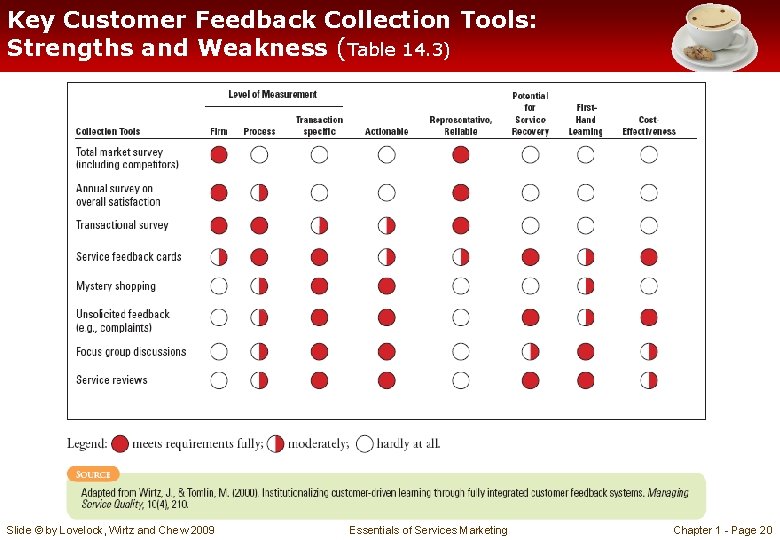
Key Customer Feedback Collection Tools: Strengths and Weakness (Table 14. 3) Slide © by Lovelock, Wirtz and Chew 2009 Essentials of Services Marketing Chapter 1 - Page 20
Analysis, Reporting and Dissemination of Customer Feedback § Choosing the relevant feedback tools and collecting customer feedback is meaningless if the information is not passed back to the relevant parties to take action § Reporting system needs to deliver feedback to frontline staff, process owners, branch/department managers and top management § Three types of performance reports: Ø Monthly Service Performance Update Ø Quarterly Service Performance Review Ø Annual Service Performance Report Slide © by Lovelock, Wirtz and Chew 2009 Essentials of Services Marketing Chapter 1 - Page 21
Hard Measures of Service Quality Slide © by Lovelock, Wirtz and Chew 2009 Essentials of Services Marketing Chapter 1 - Page 22
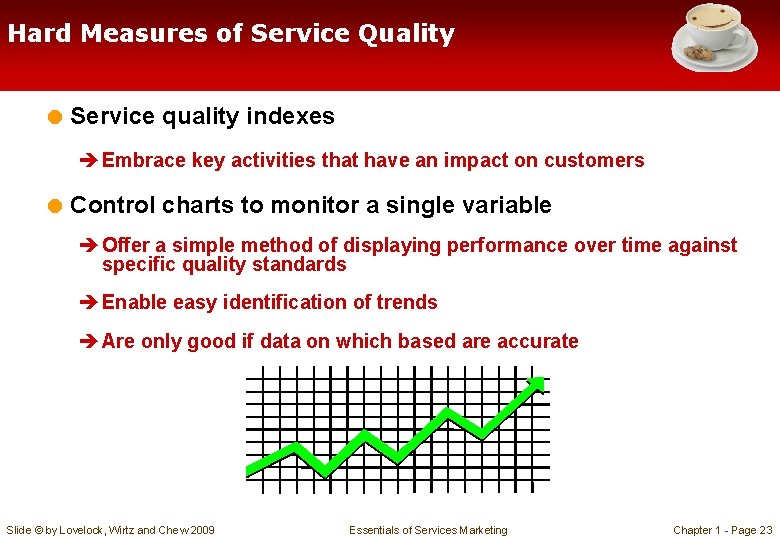
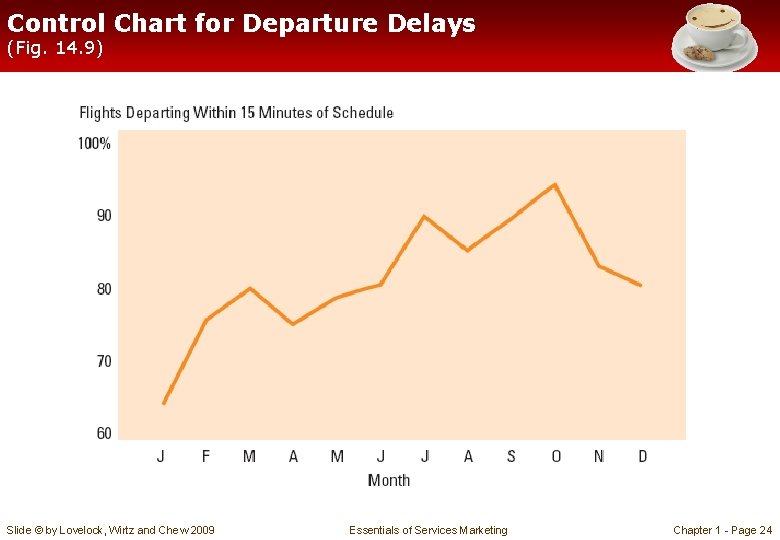
Hard Measures of Service Quality = Service quality indexes è Embrace key activities that have an impact on customers = Control charts to monitor a single variable è Offer a simple method of displaying performance over time against specific quality standards è Enable easy identification of trends è Are only good if data on which based are accurate Slide © by Lovelock, Wirtz and Chew 2009 Essentials of Services Marketing Chapter 1 - Page 23
Control Chart for Departure Delays (Fig. 14. 9) Slide © by Lovelock, Wirtz and Chew 2009 Essentials of Services Marketing Chapter 1 - Page 24
Tools to Analyze and Address Service Quality Problems Slide © by Lovelock, Wirtz and Chew 2009 Essentials of Services Marketing Chapter 1 - Page 25
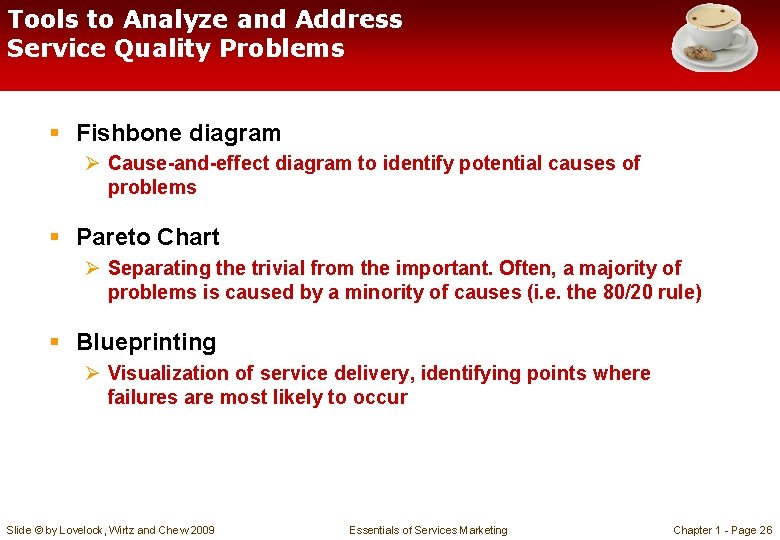
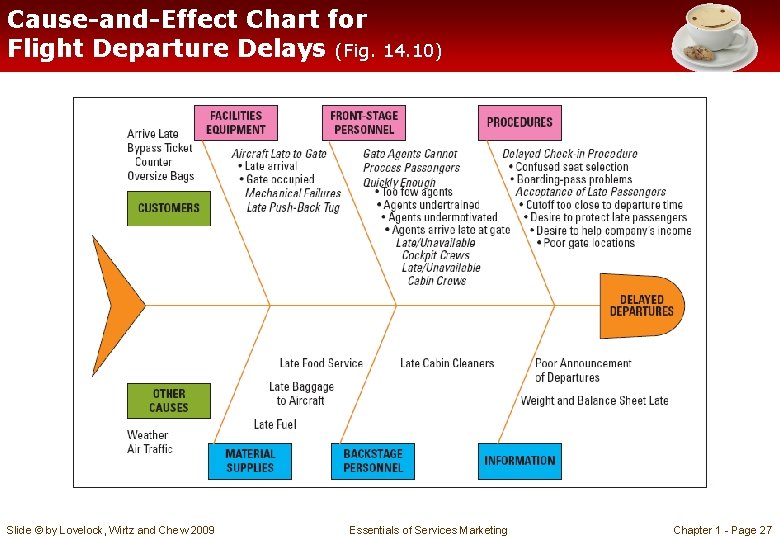
Tools to Analyze and Address Service Quality Problems § Fishbone diagram Ø Cause-and-effect diagram to identify potential causes of problems § Pareto Chart Ø Separating the trivial from the important. Often, a majority of problems is caused by a minority of causes (i. e. the 80/20 rule) § Blueprinting Ø Visualization of service delivery, identifying points where failures are most likely to occur Slide © by Lovelock, Wirtz and Chew 2009 Essentials of Services Marketing Chapter 1 - Page 26
Cause-and-Effect Chart for Flight Departure Delays (Fig. 14. 10) Slide © by Lovelock, Wirtz and Chew 2009 Essentials of Services Marketing Chapter 1 - Page 27
Analysis of Causes of Flight Departure Delays (Fig. 14. 11) Slide © by Lovelock, Wirtz and Chew 2009 Essentials of Services Marketing Chapter 1 - Page 28
Return on Quality Slide © by Lovelock, Wirtz and Chew 2009 Essentials of Services Marketing Chapter 1 - Page 29
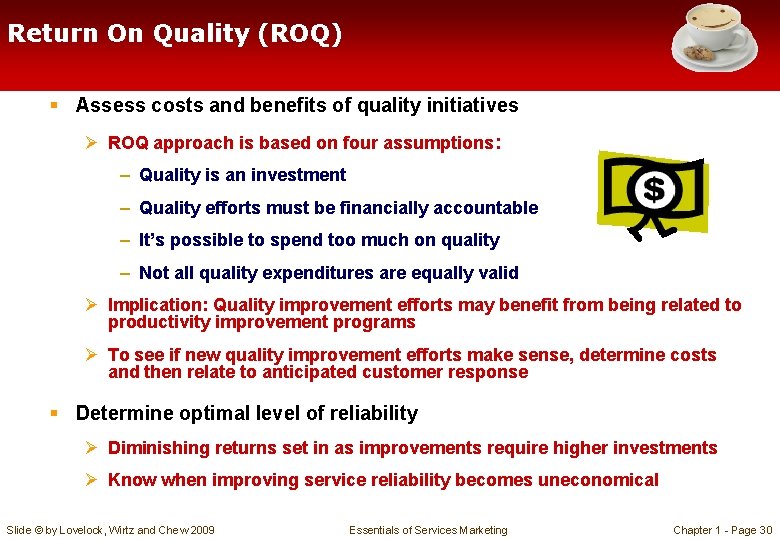
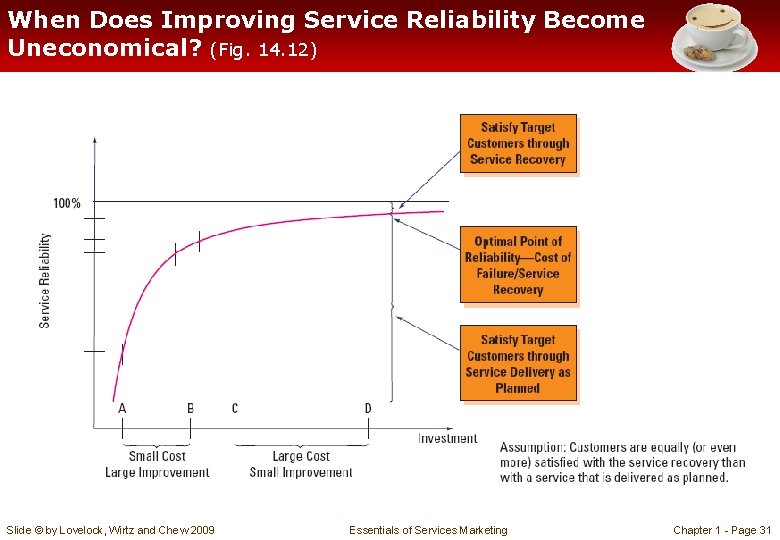
Return On Quality (ROQ) § Assess costs and benefits of quality initiatives Ø ROQ approach is based on four assumptions: – Quality is an investment – Quality efforts must be financially accountable – It’s possible to spend too much on quality – Not all quality expenditures are equally valid Ø Implication: Quality improvement efforts may benefit from being related to productivity improvement programs Ø To see if new quality improvement efforts make sense, determine costs and then relate to anticipated customer response § Determine optimal level of reliability Ø Diminishing returns set in as improvements require higher investments Ø Know when improving service reliability becomes uneconomical Slide © by Lovelock, Wirtz and Chew 2009 Essentials of Services Marketing Chapter 1 - Page 30
When Does Improving Service Reliability Become Uneconomical? (Fig. 14. 12) Slide © by Lovelock, Wirtz and Chew 2009 Essentials of Services Marketing Chapter 1 - Page 31
Defining and Measuring Productivity Slide © by Lovelock, Wirtz and Chew 2009 Essentials of Services Marketing Chapter 1 - Page 32
Productivity in a Service Context § Productivity measures amount of output produced relative to the amount of inputs. § Improvement in productivity means an improvement in the ratio of outputs to inputs. § Intangible nature of many service elements makes it hard to measure productivity of service firms, especially for information- based services Ø Difficult in most services because both input and output are hard to define Ø Relatively simpler in possession-processing services, as compared to information- and people-processing services Slide © by Lovelock, Wirtz and Chew 2009 Essentials of Services Marketing Chapter 1 - Page 33
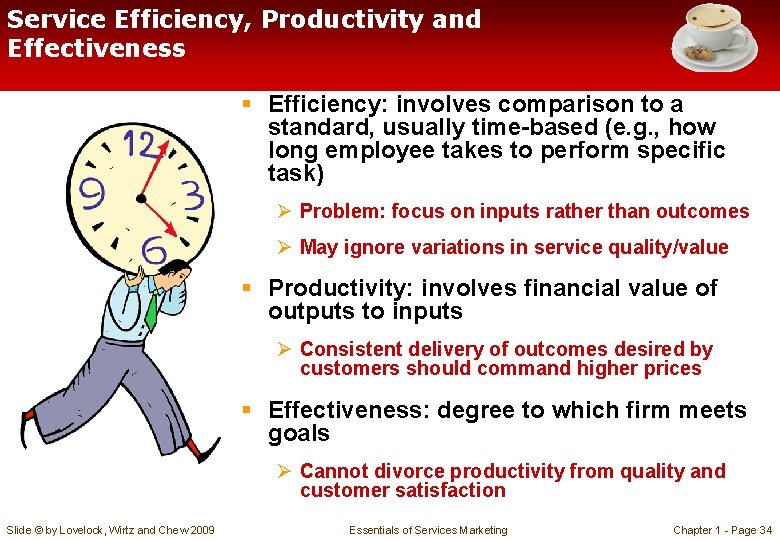
Service Efficiency, Productivity and Effectiveness § Efficiency: involves comparison to a standard, usually time-based (e. g. , how long employee takes to perform specific task) Ø Problem: focus on inputs rather than outcomes Ø May ignore variations in service quality/value § Productivity: involves financial value of outputs to inputs Ø Consistent delivery of outcomes desired by customers should command higher prices § Effectiveness: degree to which firm meets goals Ø Cannot divorce productivity from quality and customer satisfaction Slide © by Lovelock, Wirtz and Chew 2009 Essentials of Services Marketing Chapter 1 - Page 34
Improving Service Productivity Slide © by Lovelock, Wirtz and Chew 2009 Essentials of Services Marketing Chapter 1 - Page 35
Generic Productivity Improvement Strategies § Typical strategies to improve service productivity: Ø Careful control of costs at every step in process Ø Efforts to reduce wasteful use of materials or labor Ø Matching productive capacity to average rather than peak demand levels Ø Replacing workers by automated machines or self-service technologies Ø Teaching employees how to work more productively Ø Broadening variety of tasks that service worker can perform Ø Installing expert systems that allow paraprofessionals to take on work previously performed by professionals who earn higher salaries § Although improving productivity can be approached incrementally, major gains often require redesigning entire processes Slide © by Lovelock, Wirtz and Chew 2009 Essentials of Services Marketing Chapter 1 - Page 36
Customer-driven Ways to Improve Productivity § Change timing of customer demand Ø By shifting demand away from peaks, managers can make better use of firm’s productive assets and provide better service § Involve customers more in production Ø Get customers to self-serve Ø Encourage customers to obtain information and buy from firm’s corporate Websites § Ask customers to use third parties Ø Delegate delivery of supplementary service elements to intermediary organizations Slide © by Lovelock, Wirtz and Chew 2009 Essentials of Services Marketing Chapter 1 - Page 37
Backstage and Front-Stage Productivity Changes: Implications for Customers § Backstage changes may impact customers Ø Keep track of proposed backstage changes, and prepare customers for them - e. g. , new printing peripherals may affect appearance of bank statements § Front-stage productivity enhancements are especially visible in high contact services Ø Some improvements only require passive acceptance, while others require customers to change behavior Ø Must consider impacts on customers and address customer resistance to changes § See Service Insights 14. 3 : Managing Customers’ Reluctance to Change Slide © by Lovelock, Wirtz and Chew 2009 Essentials of Services Marketing Chapter 1 - Page 38
A Caution on Cost Reduction Strategies § Most attempts to improve service productivity seek to eliminate waste and reduce labor costs and does not involve new technology § Reducing staff means workers try to do several things at once and may perform each task poorly § Better to search for service process redesign opportunities that lead to Ø Improvements in productivity Ø Simultaneous improvement in service quality Ø See Service Insights 14. 4: Biometrics Slide © by Lovelock, Wirtz and Chew 2009 Essentials of Services Marketing Chapter 1 - Page 39
Summary of Chapter 14: Improving Service Quality and Productivity (1) § Quality and productivity need to be considered jointly in marketing services § Research consolidated service quality dimensions into five Ø Tangibles Ø Reliability Ø Responsiveness Ø Competence Ø Courtesy § GAP model is a tool to diagnose problems in service design and delivery. Service gap is the most critical and can only be closed if the other six gaps are closed Slide © by Lovelock, Wirtz and Chew 2009 Essentials of Services Marketing Chapter 1 - Page 40
Summary of Chapter 14: Improving Service Quality and Productivity (2) § Both soft and hard measures used to measure service quality § We can learn from customer feedback--key objectives: Ø Assessment and benchmarking of service quality and performance Ø Customer-driven learning and improvements Ø Creating a customer-oriented service culture Slide © by Lovelock, Wirtz and Chew 2009 Essentials of Services Marketing Chapter 1 - Page 41
Summary of Chapter 14: Improving Service Quality and Productivity (3) § A mix of customer feedback collection tools can help to deliver needed information to firms Ø Total market surveys, annual survey, and transactional surveys Ø Service feedback cards Ø Mystery shopping Ø Unsolicited customer feedback Ø Focus group discussions and service reviews Ø Capture unsolicited feedback § Feedback must be analyzed, reported, disseminated and used Slide © by Lovelock, Wirtz and Chew 2009 Essentials of Services Marketing Chapter 1 - Page 42
Summary of Chapter 14: Improving Service Quality and Productivity (4) § Hard measure of service quality include service index and control charts § Tools used to analyze and address service quality problems Ø Fishbone diagram Ø Pareto chart Ø Blueprinting § Measuring productivity in services is difficult – a -- and there is a need to determine when service reliability becomes uneconomical § Efficiency, productivity and effectiveness need to be distinguished when measuring service quality Slide © by Lovelock, Wirtz and Chew 2009 Essentials of Services Marketing Chapter 1 - Page 43
Summary of Chapter 14: Improving Service Quality and Productivity (5) § To improve service productivity, there are generic improvement strategies and customer-driven approaches § Customer-driven approaches to improving productivity include Ø Changing timing of customer demand Ø Involving customers more in production Ø Asking customers to use third parties § Backstage and frontstage productivity changes both affect customers § Cost-reduction strategies should be used with caution as this may impact service quality negatively. A better way may be to look for service process redesign opportunities Slide © by Lovelock, Wirtz and Chew 2009 Essentials of Services Marketing Chapter 1 - Page 44
Approaches to Productivity and Quality Improvement and Standardization (Appendix) § Total Quality Management (TQM) § ISO 9000 Ø Comprises requirements, definitions, guidelines, and related standards to provide an independent assessment and certification of a firm’s quality management system § Malcolm Baldrige Model Applied to Services Ø To promote best practices in quality management, and recognizing, and publicizing quality achievements among U. S. firms § Six Sigma Ø Statistically, only 3. 4 defects per million opportunities (1/294, 000) Ø Has evolved from defect-reduction approach to an overall business -improvement approach Slide © by Lovelock, Wirtz and Chew 2009 Essentials of Services Marketing Chapter 1 - Page 45