
Chapter 14 Gene Expression I RNA A Structure
- Slides: 19
Chapter 14: Gene Expression
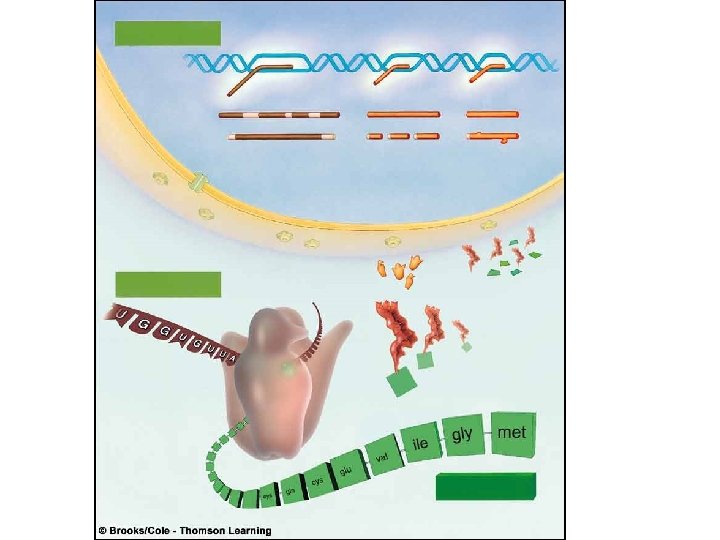
I. RNA A. Structure of RNA (Ribose Nucleic Acid) – A genetic molecule similar to DNA, with three major differences: 1. RNA is made with Uracil (U), not Thymine (T) 2. RNA is single-stranded, like half of a ladder. 3. Ribose is the sugar making up the backbone of the molecule, not deoxyribose (thus RNA, not DNA).
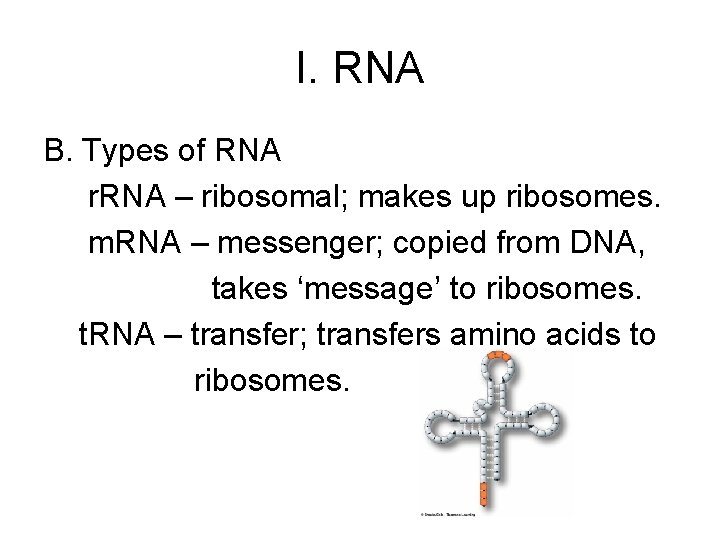
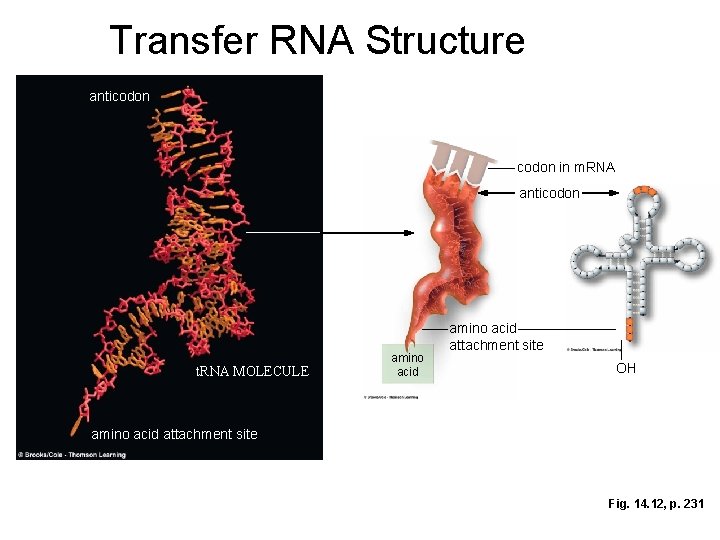
I. RNA B. Types of RNA r. RNA – ribosomal; makes up ribosomes. m. RNA – messenger; copied from DNA, takes ‘message’ to ribosomes. t. RNA – transfer; transfers amino acids to ribosomes.
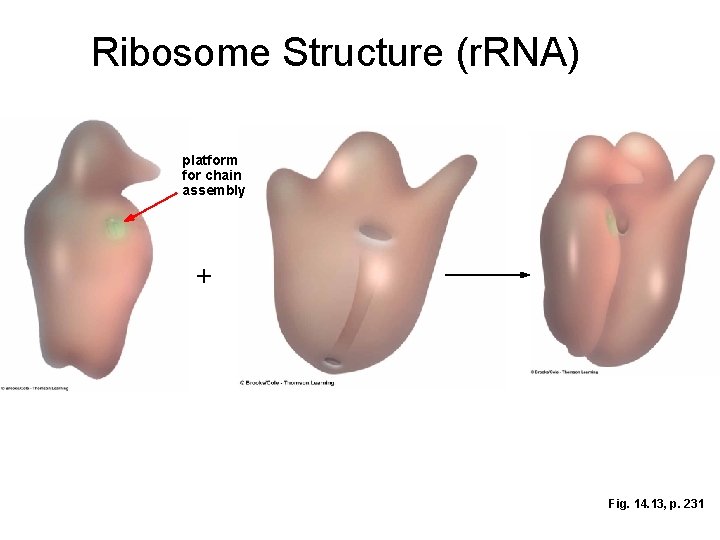
Ribosome Structure (r. RNA) platform for chain assembly + Fig. 14. 13, p. 231
Transfer RNA Structure anticodon in m. RNA anticodon t. RNA MOLECULE amino acid attachment site OH amino acid attachment site Fig. 14. 12, p. 231
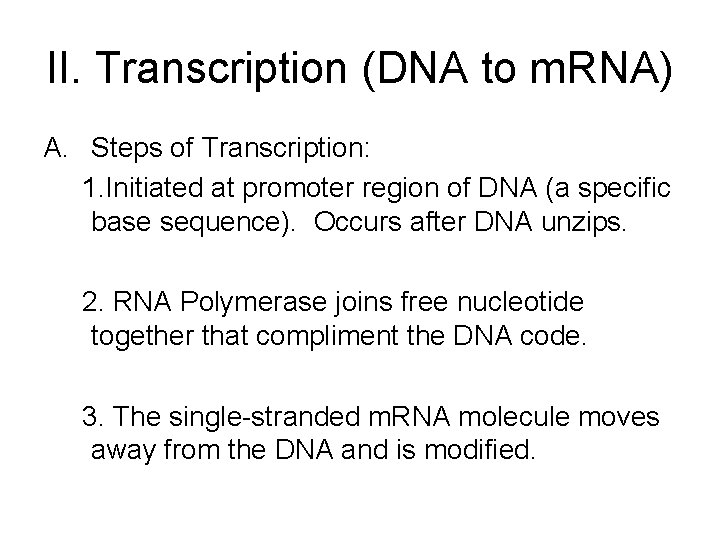
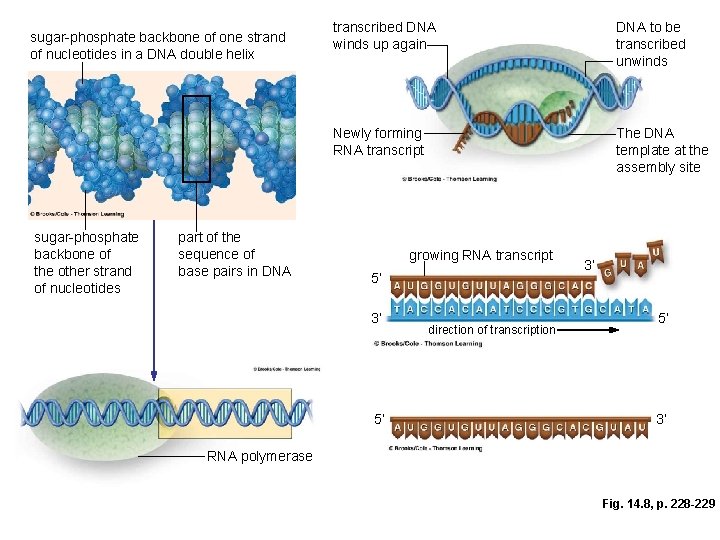
II. Transcription (DNA to m. RNA) A. Steps of Transcription: 1. Initiated at promoter region of DNA (a specific base sequence). Occurs after DNA unzips. 2. RNA Polymerase joins free nucleotide together that compliment the DNA code. 3. The single-stranded m. RNA molecule moves away from the DNA and is modified.
sugar-phosphate backbone of one strand of nucleotides in a DNA double helix sugar-phosphate backbone of the other strand of nucleotides part of the sequence of base pairs in DNA transcribed DNA winds up again DNA to be transcribed unwinds Newly forming RNA transcript The DNA template at the assembly site growing RNA transcript 5’ 3’ 5’ direction of transcription 3’ 5’ 3’ RNA polymerase Fig. 14. 8, p. 228 -229
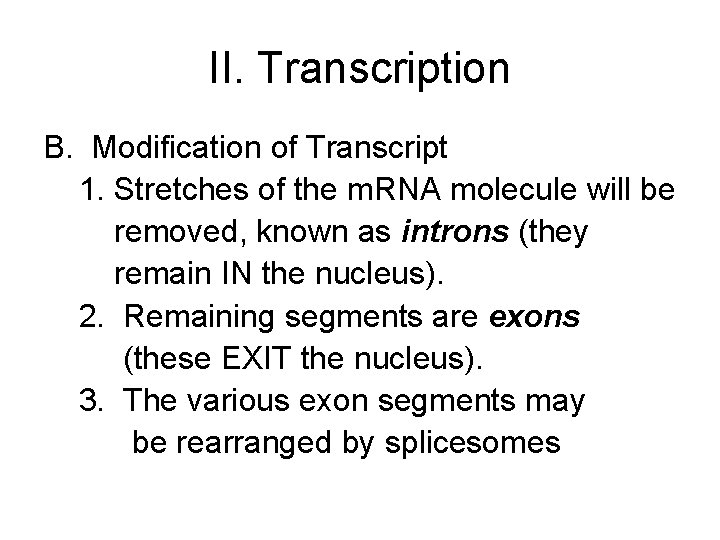
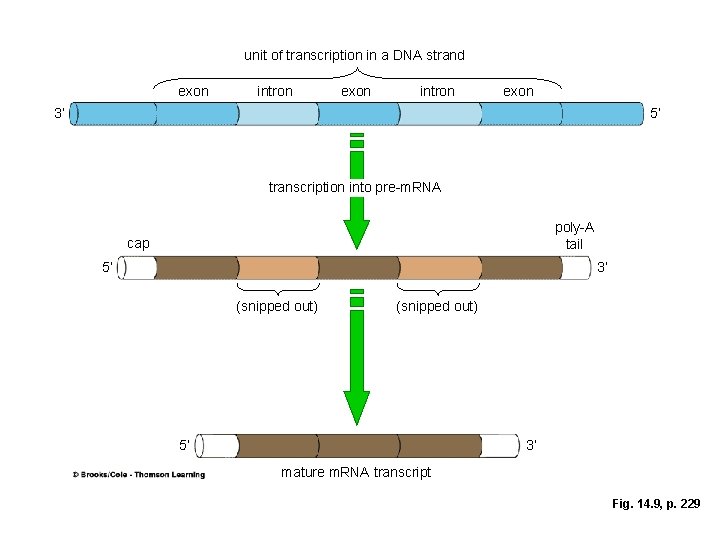
II. Transcription B. Modification of Transcript 1. Stretches of the m. RNA molecule will be removed, known as introns (they remain IN the nucleus). 2. Remaining segments are exons (these EXIT the nucleus). 3. The various exon segments may be rearranged by splicesomes
unit of transcription in a DNA strand exon intron exon 3’ 5’ transcription into pre-m. RNA poly-A tail cap 5’ 3’ (snipped out) 5’ 3’ mature m. RNA transcript Fig. 14. 9, p. 229
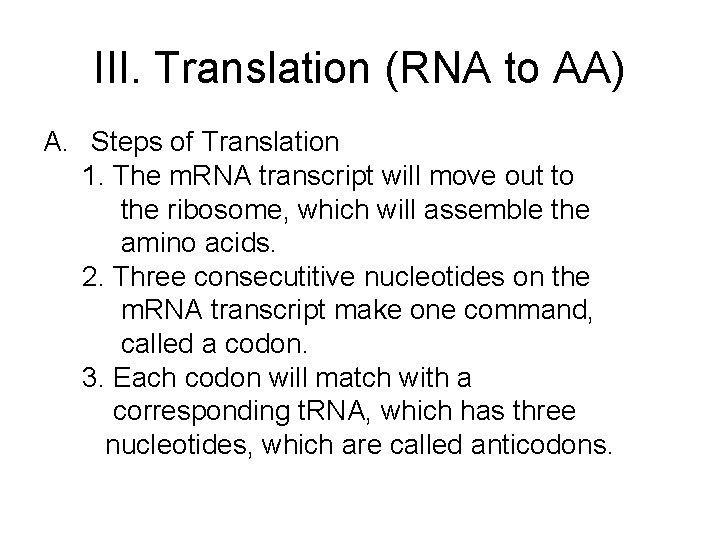
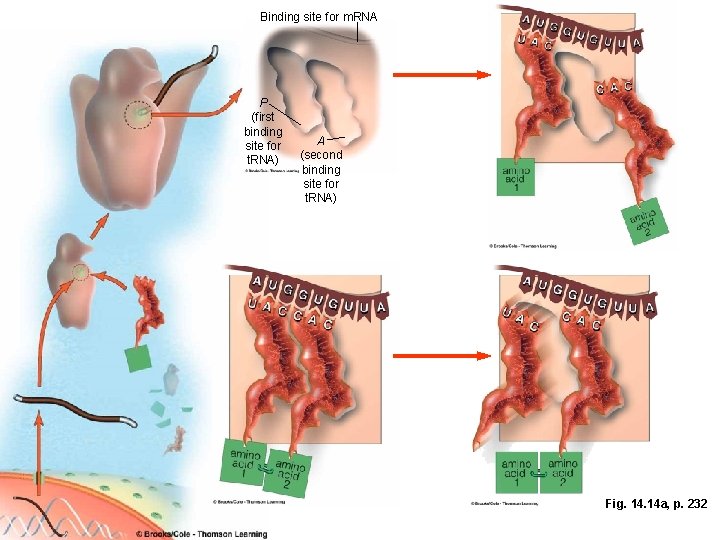
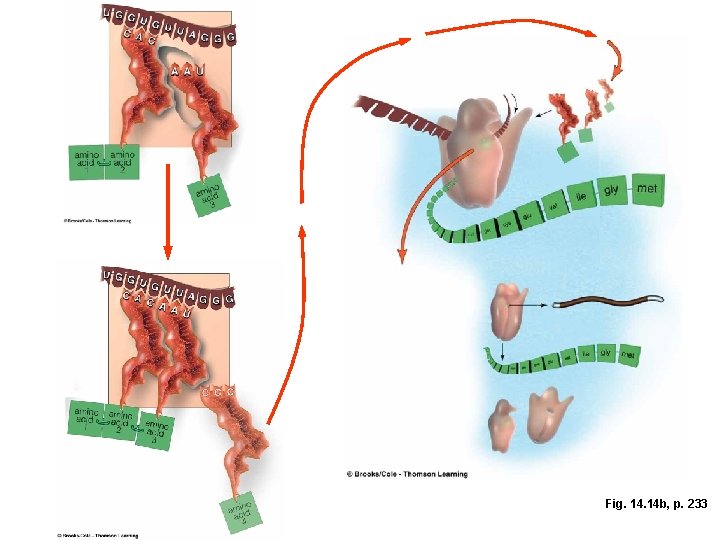
III. Translation (RNA to AA) A. Steps of Translation 1. The m. RNA transcript will move out to the ribosome, which will assemble the amino acids. 2. Three consecutitive nucleotides on the m. RNA transcript make one command, called a codon. 3. Each codon will match with a corresponding t. RNA, which has three nucleotides, which are called anticodons.
Binding site for m. RNA P (first binding site for t. RNA) A (second binding site for t. RNA) Fig. 14 a, p. 232
Fig. 14 b, p. 233
IV. Mutations A. Space holder DNA: About 97% of your DNA is noncoding, but it is hardly useless. If a mutation (error in replication or transcription) occurs, it usually occurs in this noncoding region (thus, there is no effect on phenotype.
IV. Mutations B. Types of Mutation 1. Substitution: One nucleotide incorrectly replaced with another. (One for One Switch)
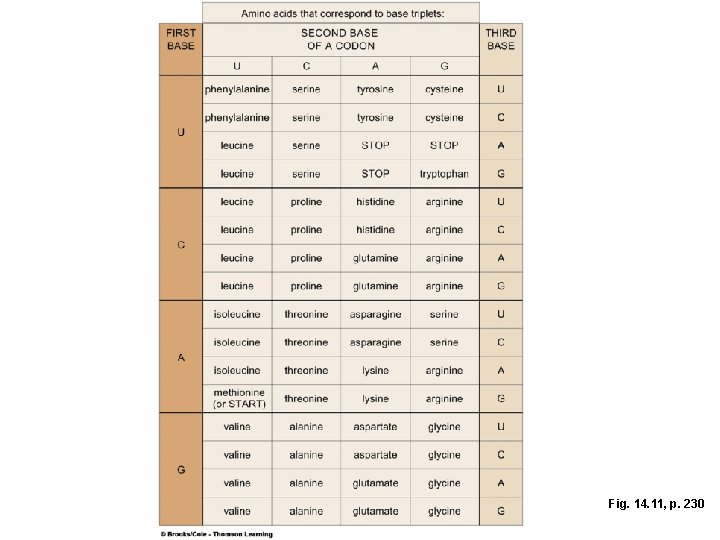
2. Wobble Effect: If you total up the number of nucleotides (A, U, C, G) and the possible arrangements of 3 letter combinations, you get a total of 64. Yet these 64 codes translate into only 20 amino acids. So small errors often don’t alter the protein/amino acid chain. Consider the codons "AUC" and "AUA. "
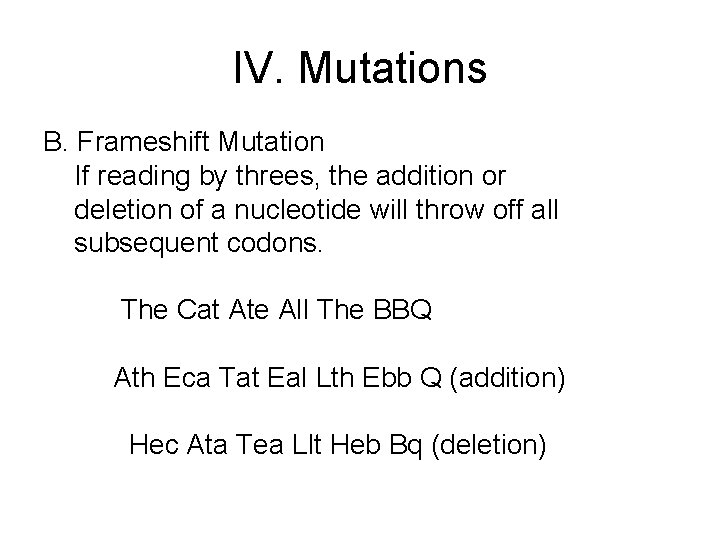
IV. Mutations B. Frameshift Mutation If reading by threes, the addition or deletion of a nucleotide will throw off all subsequent codons. The Cat Ate All The BBQ Ath Eca Tat Eal Lth Ebb Q (addition) Hec Ata Tea Llt Heb Bq (deletion)
Fig. 14. 11, p. 230
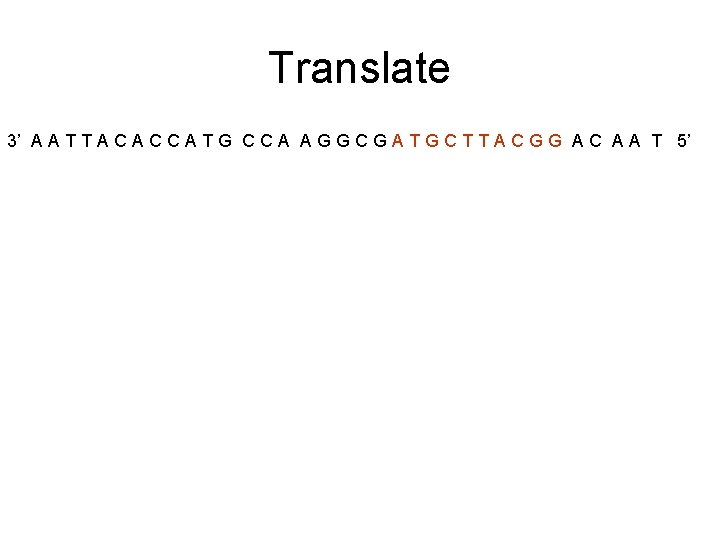
Translate 3’ A A T T A C C A T G C C A A G G C G A T G C T T A C G G A C A A T 5’