
Chapter 14 Functional Dependencies and Normalization Informal Design

- Slides: 38
Chapter 14 Functional Dependencies and Normalization • Informal Design Guidelines for Relational Databases – Semantics of the Relation Attributes – Redundant Information in Tuples and Update Anomalies – Null Values in Tuples – Spurious Tuples • Functional Dependencies (FDs) – Definition of FD – Inference Rules for FDs
(cont. ) – Equivalence of Sets of FDs – Minimal Sets of FDs • Normal Forms Based on Primary Keys – Introduction to Normalization – First Normal Form – Second Normal Form – Third Normal Form • General Normal Form Definitions(For Multiple Keys) • BCNF(Boyce-Codd Normal Form)
1. Informal Design Guidelines for Relational Databases • What is relational database design? – The grouping of attributes to form “good” relation schemas • Two levels of relation schemas: – The logical “user view” level – The storage “base relation” level • Design is concerned mainly with base relations • What are the criteria for “good” base relations? • We first discuss informally guidelines for good relational design
(cont. ) • Then we discuss formal concepts of functional dependencies and normal forms – 1 NF (First Normal Form) – 2 NF (Second Normal Form) – 3 NF (Third Normal Form) – BCNF (Boyce-Codd Normal Form) • Additional types of dependencies, further normal forms, relational design algorithms are discussed in Chapter 15
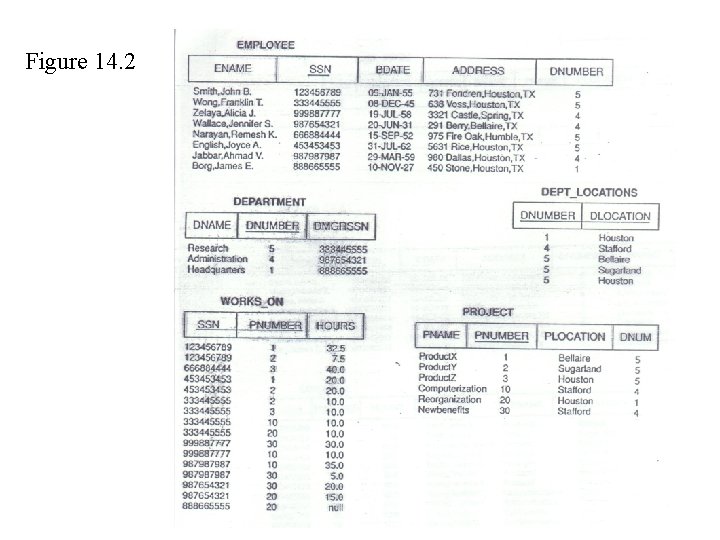
1. 1 Semantics of the Relation Attributes • Informally, each tuple should represent one entity or relationship instance • Attributes of different entities (EMPLOYEEs, DEPARTMENTs, PROJECTs) should not be mixed in the same relation • Only foreign keys should be used to refer to other entities
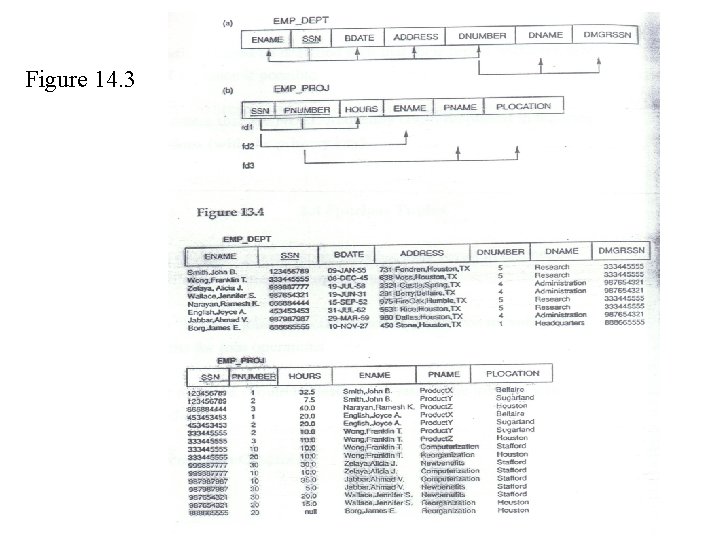
1. 2 Redundant Information in Tuples and Update Anomalies • Mixing attributes of multiple entities may cause problems • Information is stored redundantly wasting storage • Problems with update anomalies: – Insertion anomalies – Deletion anomalies – Modification anomalies
1. 3 Null Values in Tuples • Relation should be designed such that their tuples will have few NULL values if possible • Attributes that are NULL frequently could be placed in separate relations(with the primary key)
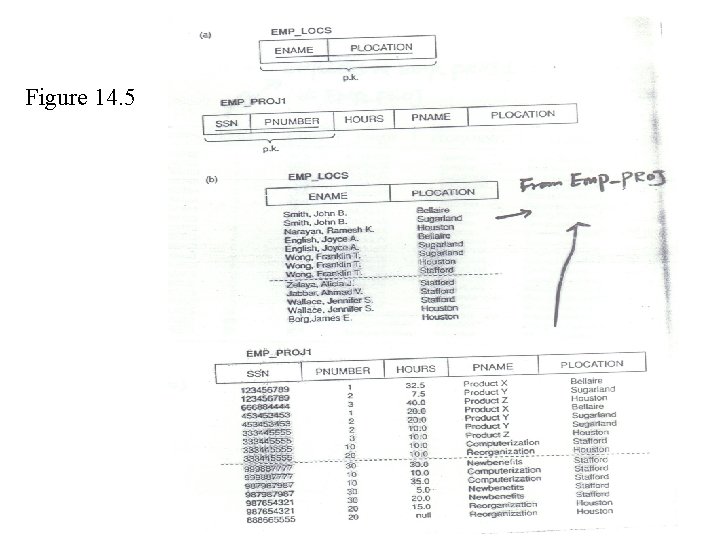
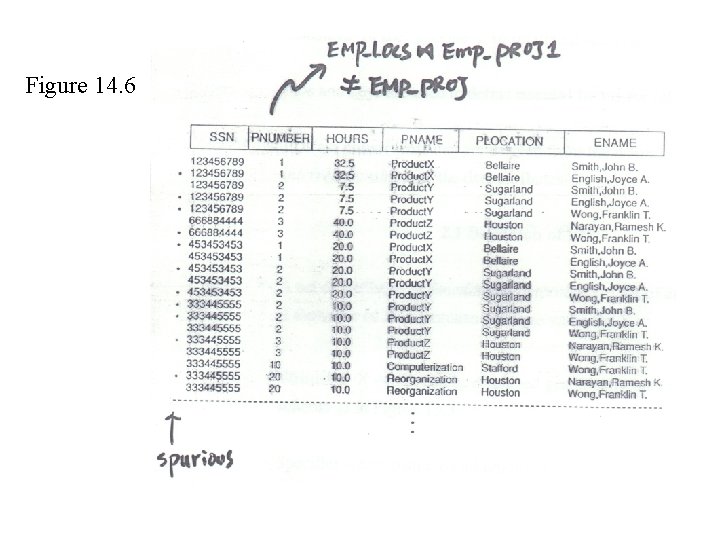
1. 4 Spurious Tuples • Bad designs for a relational database may result in erroneous results for certain JOIN operations • The “lossless join” property is used to guarantee meaningful results for join operations • The relations should be designed to satisfy the lossless join condition Discussed in Chapter 15
Figure 14. 2
Figure 14. 3
Figure 14. 5
Figure 14. 6
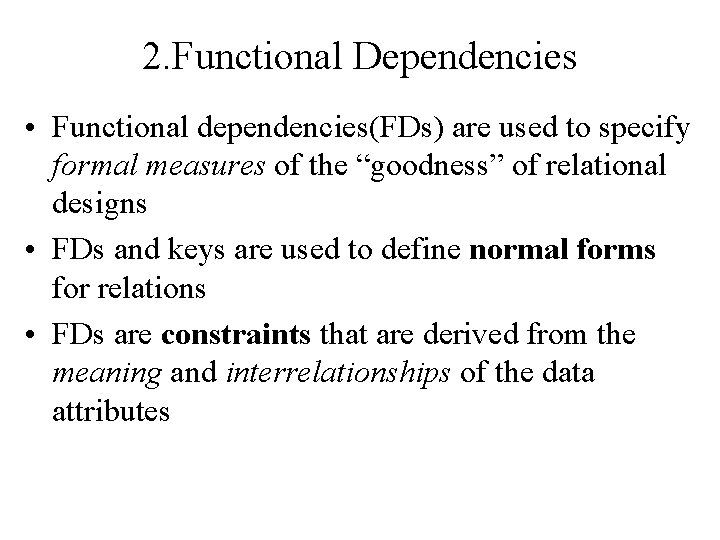
2. Functional Dependencies • Functional dependencies(FDs) are used to specify formal measures of the “goodness” of relational designs • FDs and keys are used to define normal forms for relations • FDs are constraints that are derived from the meaning and interrelationships of the data attributes
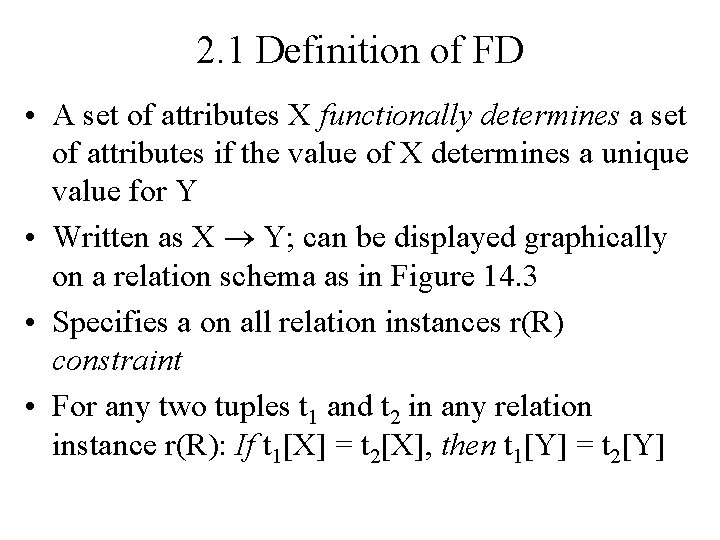
2. 1 Definition of FD • A set of attributes X functionally determines a set of attributes if the value of X determines a unique value for Y • Written as X Y; can be displayed graphically on a relation schema as in Figure 14. 3 • Specifies a on all relation instances r(R) constraint • For any two tuples t 1 and t 2 in any relation instance r(R): If t 1[X] = t 2[X], then t 1[Y] = t 2[Y]
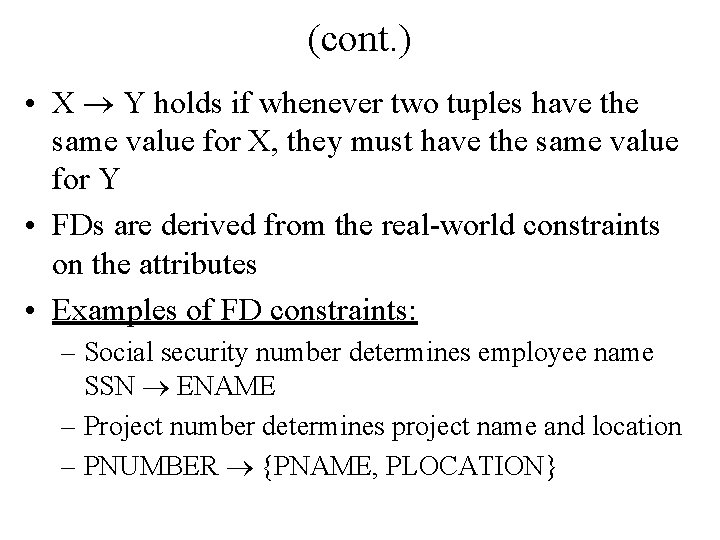
(cont. ) • X Y holds if whenever two tuples have the same value for X, they must have the same value for Y • FDs are derived from the real-world constraints on the attributes • Examples of FD constraints: – Social security number determines employee name SSN ENAME – Project number determines project name and location – PNUMBER {PNAME, PLOCATION}
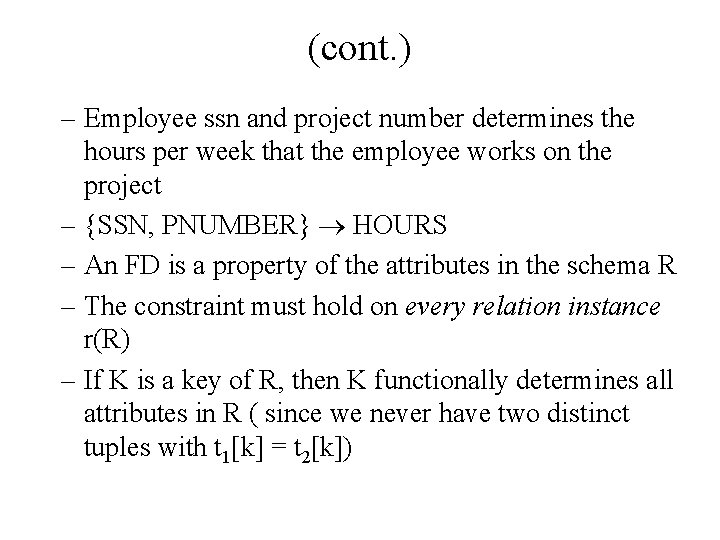
(cont. ) – Employee ssn and project number determines the hours per week that the employee works on the project – {SSN, PNUMBER} HOURS – An FD is a property of the attributes in the schema R – The constraint must hold on every relation instance r(R) – If K is a key of R, then K functionally determines all attributes in R ( since we never have two distinct tuples with t 1[k] = t 2[k])
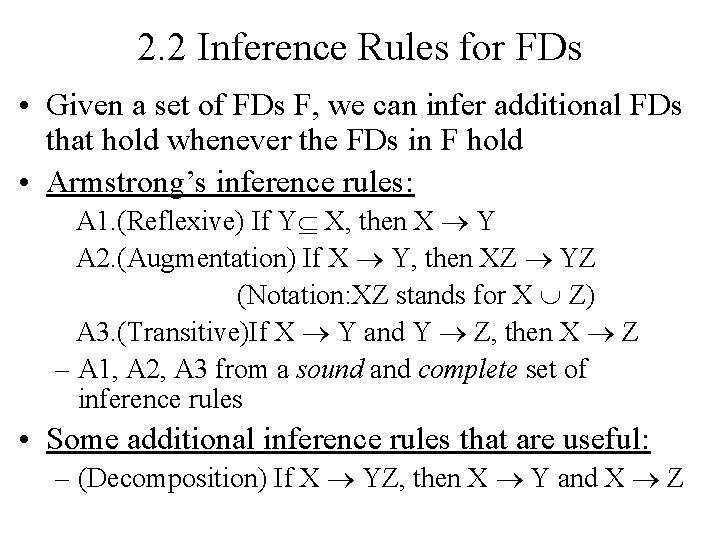
2. 2 Inference Rules for FDs • Given a set of FDs F, we can infer additional FDs that hold whenever the FDs in F hold • Armstrong’s inference rules: A 1. (Reflexive) If Y X, then X Y A 2. (Augmentation) If X Y, then XZ YZ (Notation: XZ stands for X Z) A 3. (Transitive)If X Y and Y Z, then X Z – A 1, A 2, A 3 from a sound and complete set of inference rules • Some additional inference rules that are useful: – (Decomposition) If X YZ, then X Y and X Z
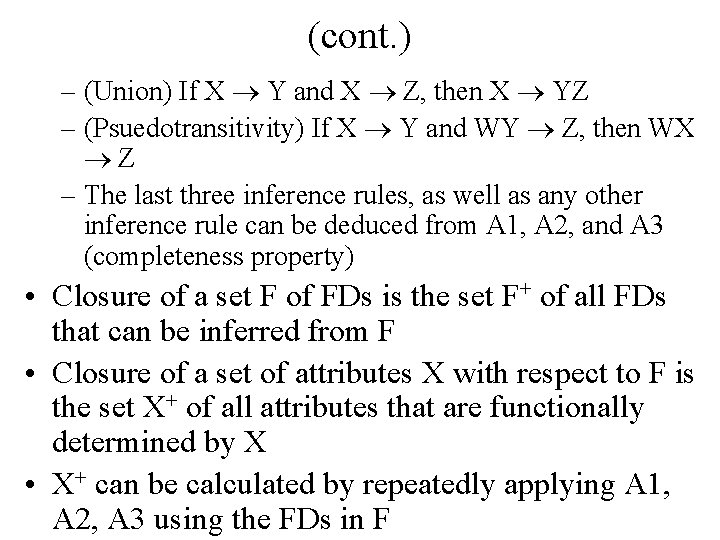
(cont. ) – (Union) If X Y and X Z, then X YZ – (Psuedotransitivity) If X Y and WY Z, then WX Z – The last three inference rules, as well as any other inference rule can be deduced from A 1, A 2, and A 3 (completeness property) • Closure of a set F of FDs is the set F+ of all FDs that can be inferred from F • Closure of a set of attributes X with respect to F is the set X+ of all attributes that are functionally determined by X • X+ can be calculated by repeatedly applying A 1, A 2, A 3 using the FDs in F
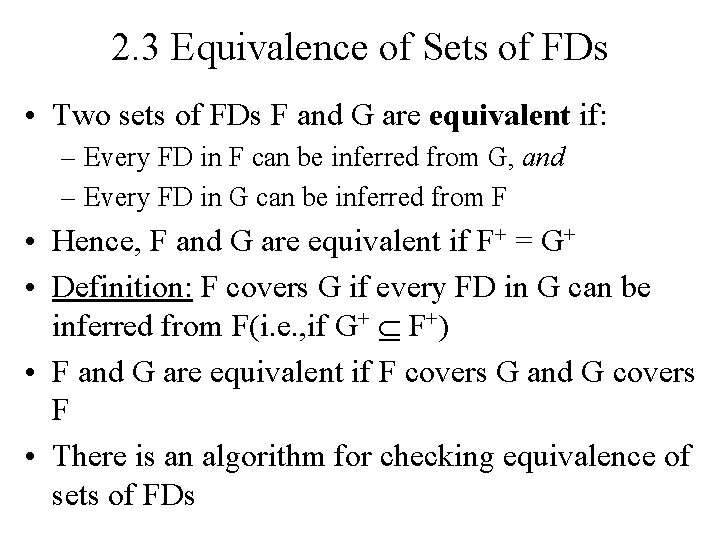
2. 3 Equivalence of Sets of FDs • Two sets of FDs F and G are equivalent if: – Every FD in F can be inferred from G, and – Every FD in G can be inferred from F • Hence, F and G are equivalent if F+ = G+ • Definition: F covers G if every FD in G can be inferred from F(i. e. , if G+ F+) • F and G are equivalent if F covers G and G covers F • There is an algorithm for checking equivalence of sets of FDs
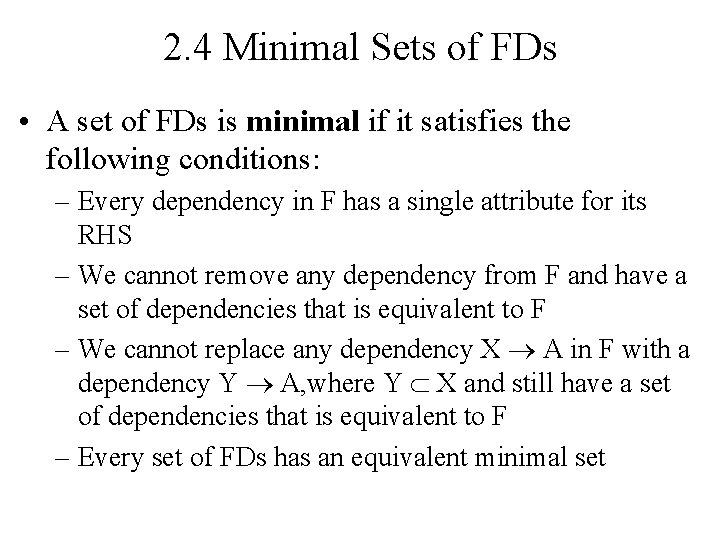
2. 4 Minimal Sets of FDs • A set of FDs is minimal if it satisfies the following conditions: – Every dependency in F has a single attribute for its RHS – We cannot remove any dependency from F and have a set of dependencies that is equivalent to F – We cannot replace any dependency X A in F with a dependency Y A, where Y X and still have a set of dependencies that is equivalent to F – Every set of FDs has an equivalent minimal set
(cont. ) – There can be several equivalent minimal sets – There is no simple algorithm for compting a minimal set of FDs that is equivalent to a set F of FDs – Having a minimal set is important for some relational design algorithms (see Chapter 15)
3 Normal Forms Based on Primary Keys • 3. 1 Introduction to Normalization – Normalization: Process of decomposing unsatisfactory “bad” relations by breaking up their attributes into smaller relations – Normal form: Condition using keys and FDs of a relation to certify whether a relation schema is in a particular normal form – 2 NF, 3 NF, BCNF based on keys and FDs of a relation schema – 4 NF based on keys, MVDs; 5 NF based on keys, JDs (Chapter 15)
(cont) • Additional properties may be needed to ensure a good relational design ( lossless join, dependency preservation; Chapter 15)
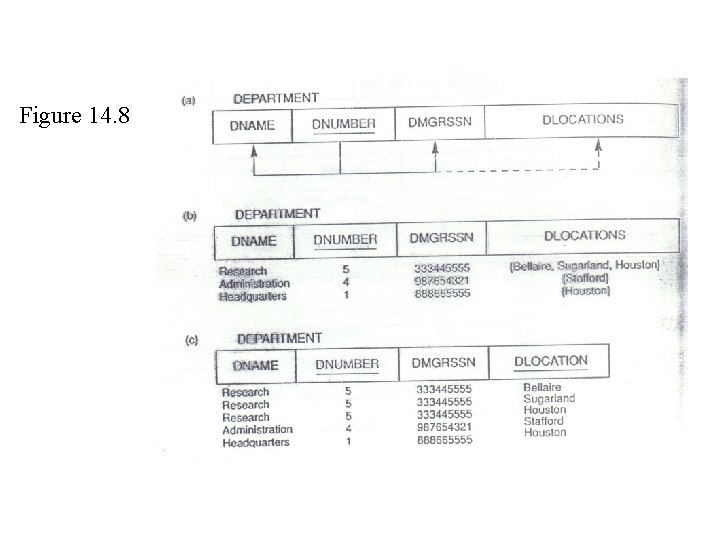
3. 2 First Normal Form • Disallows composite attributes, multivalued attributes, and nested relations; attributes whose values for an individual tuple are non-atomic • Considered to be part of the definition of relation
Figure 14. 8
Figure 14. 9
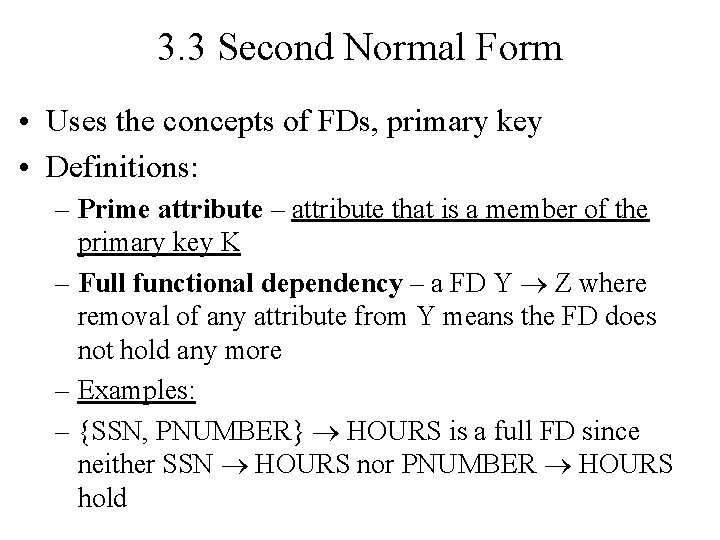
3. 3 Second Normal Form • Uses the concepts of FDs, primary key • Definitions: – Prime attribute – attribute that is a member of the primary key K – Full functional dependency – a FD Y Z where removal of any attribute from Y means the FD does not hold any more – Examples: – {SSN, PNUMBER} HOURS is a full FD since neither SSN HOURS nor PNUMBER HOURS hold
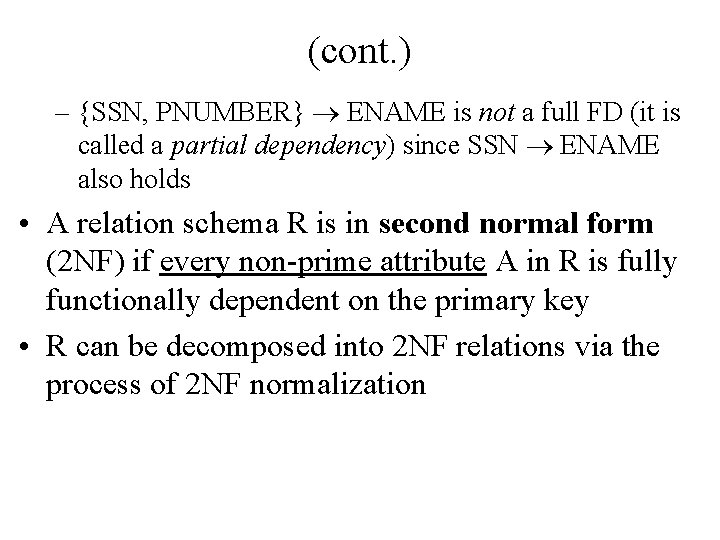
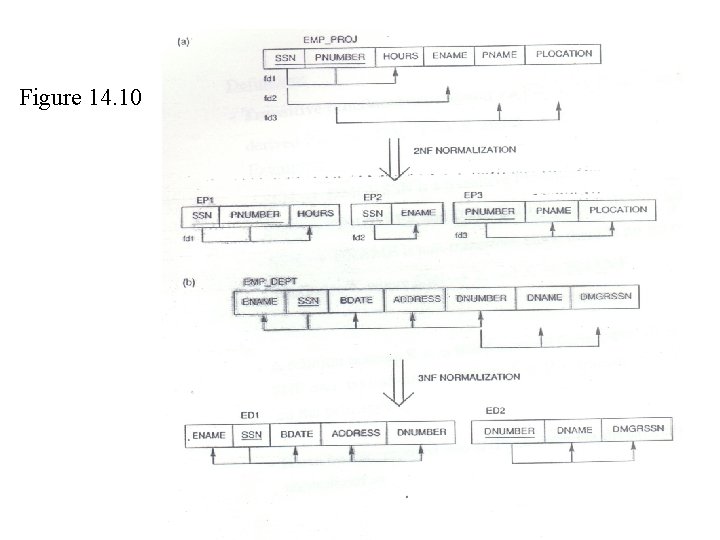
(cont. ) – {SSN, PNUMBER} ENAME is not a full FD (it is called a partial dependency) since SSN ENAME also holds • A relation schema R is in second normal form (2 NF) if every non-prime attribute A in R is fully functionally dependent on the primary key • R can be decomposed into 2 NF relations via the process of 2 NF normalization
Figure 14. 10
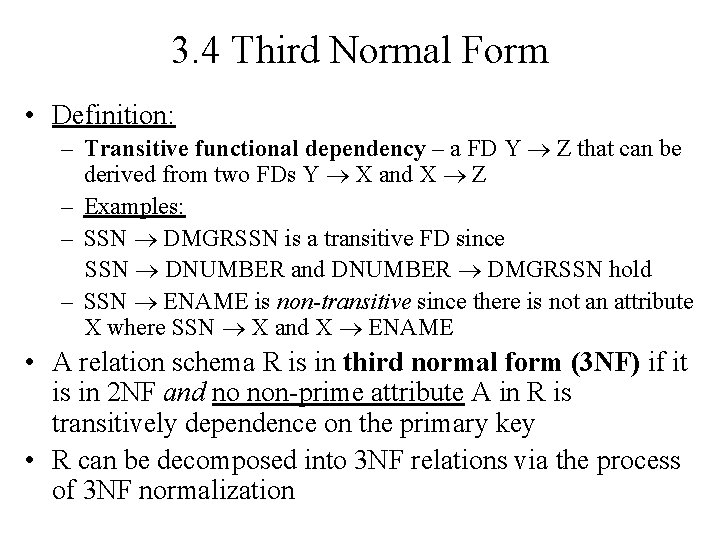
3. 4 Third Normal Form • Definition: – Transitive functional dependency – a FD Y Z that can be derived from two FDs Y X and X Z – Examples: – SSN DMGRSSN is a transitive FD since SSN DNUMBER and DNUMBER DMGRSSN hold – SSN ENAME is non-transitive since there is not an attribute X where SSN X and X ENAME • A relation schema R is in third normal form (3 NF) if it is in 2 NF and no non-prime attribute A in R is transitively dependence on the primary key • R can be decomposed into 3 NF relations via the process of 3 NF normalization
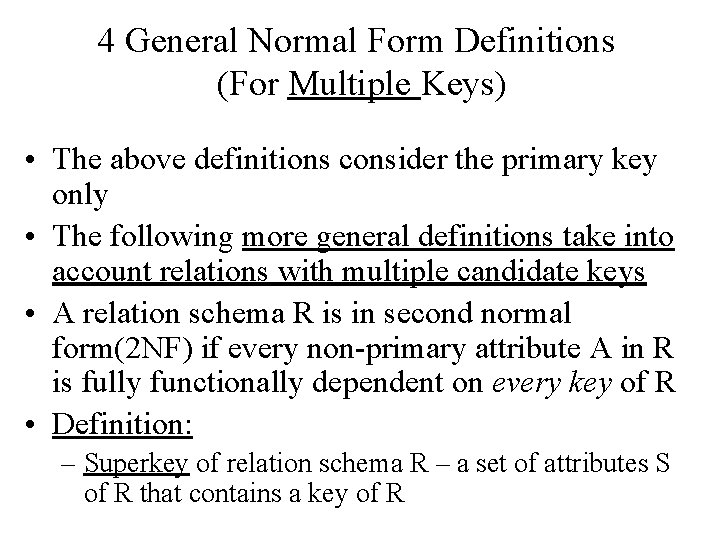
4 General Normal Form Definitions (For Multiple Keys) • The above definitions consider the primary key only • The following more general definitions take into account relations with multiple candidate keys • A relation schema R is in second normal form(2 NF) if every non-primary attribute A in R is fully functionally dependent on every key of R • Definition: – Superkey of relation schema R – a set of attributes S of R that contains a key of R
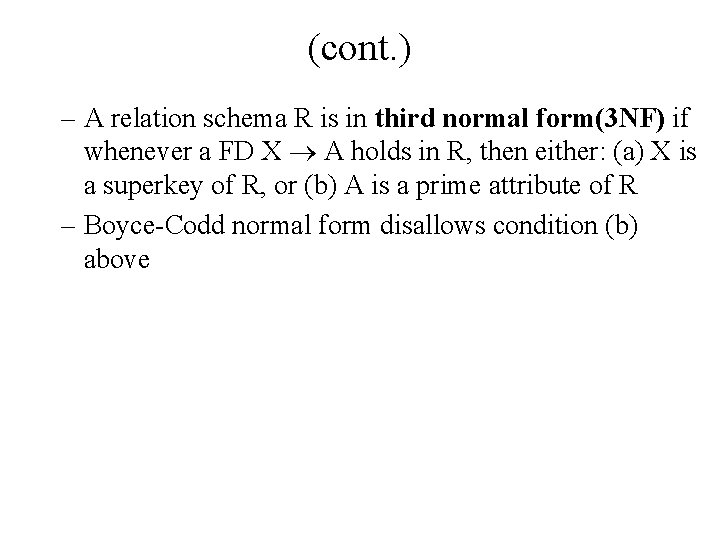
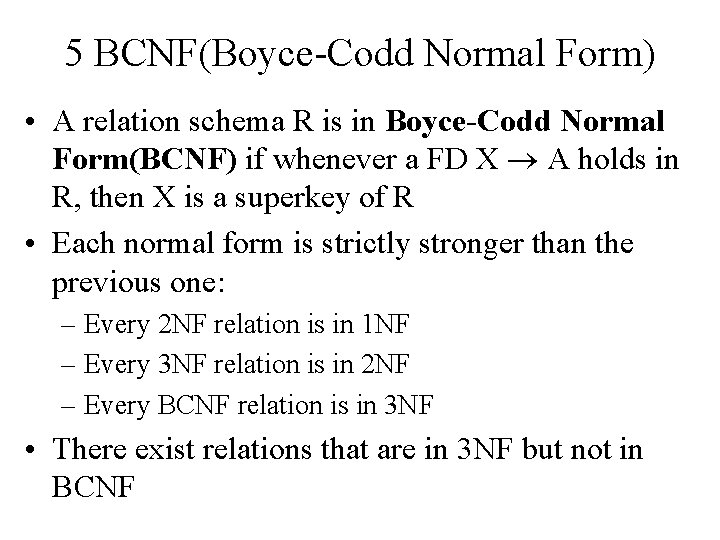
(cont. ) – A relation schema R is in third normal form(3 NF) if whenever a FD X A holds in R, then either: (a) X is a superkey of R, or (b) A is a prime attribute of R – Boyce-Codd normal form disallows condition (b) above
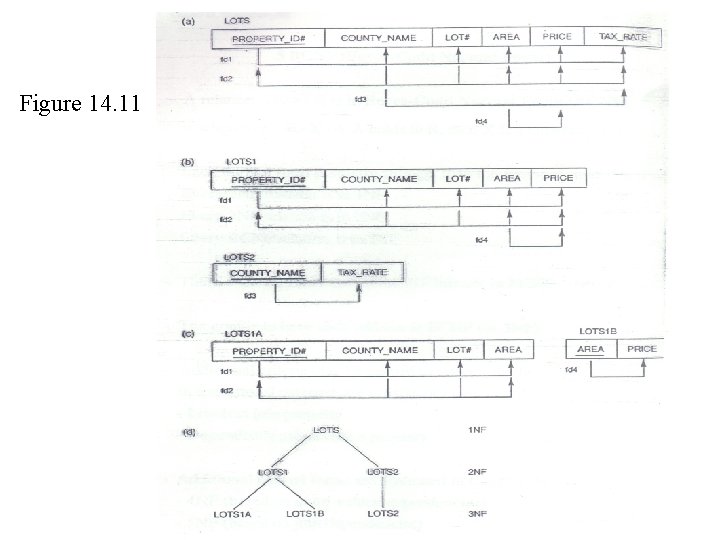
Figure 14. 11
5 BCNF(Boyce-Codd Normal Form) • A relation schema R is in Boyce-Codd Normal Form(BCNF) if whenever a FD X A holds in R, then X is a superkey of R • Each normal form is strictly stronger than the previous one: – Every 2 NF relation is in 1 NF – Every 3 NF relation is in 2 NF – Every BCNF relation is in 3 NF • There exist relations that are in 3 NF but not in BCNF
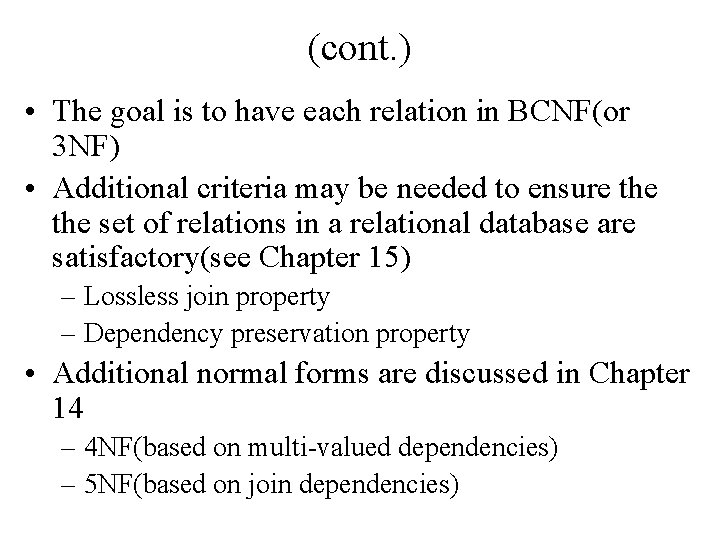
(cont. ) • The goal is to have each relation in BCNF(or 3 NF) • Additional criteria may be needed to ensure the set of relations in a relational database are satisfactory(see Chapter 15) – Lossless join property – Dependency preservation property • Additional normal forms are discussed in Chapter 14 – 4 NF(based on multi-valued dependencies) – 5 NF(based on join dependencies)
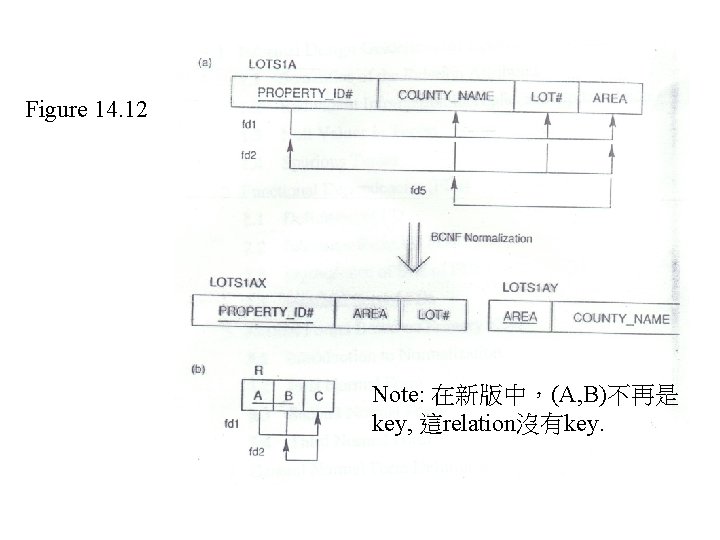
Figure 14. 12 Note: 在新版中,(A, B)不再是 key, 這relation沒有key.
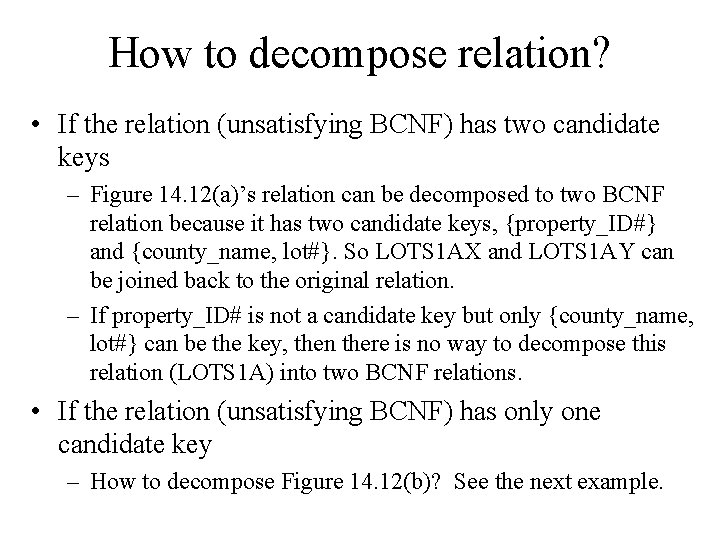
How to decompose relation? • If the relation (unsatisfying BCNF) has two candidate keys – Figure 14. 12(a)’s relation can be decomposed to two BCNF relation because it has two candidate keys, {property_ID#} and {county_name, lot#}. So LOTS 1 AX and LOTS 1 AY can be joined back to the original relation. – If property_ID# is not a candidate key but only {county_name, lot#} can be the key, then there is no way to decompose this relation (LOTS 1 A) into two BCNF relations. • If the relation (unsatisfying BCNF) has only one candidate key – How to decompose Figure 14. 12(b)? See the next example.
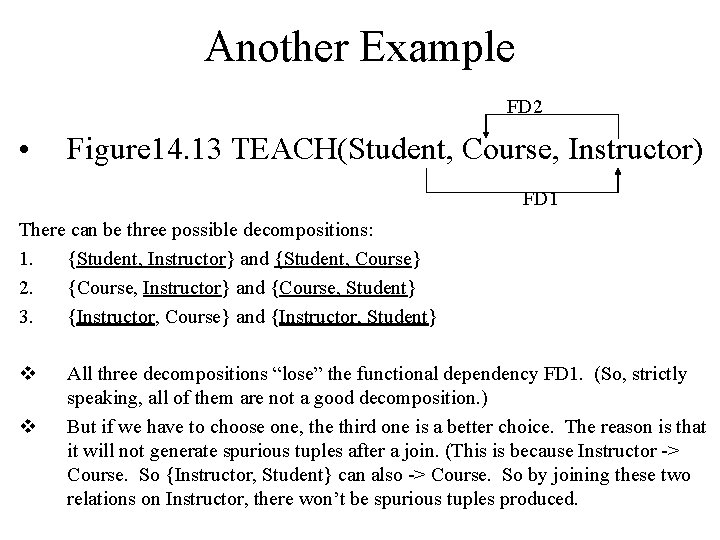
Another Example FD 2 • Figure 14. 13 TEACH(Student, Course, Instructor) FD 1 There can be three possible decompositions: 1. {Student, Instructor} and {Student, Course} 2. {Course, Instructor} and {Course, Student} 3. {Instructor, Course} and {Instructor, Student} v v All three decompositions “lose” the functional dependency FD 1. (So, strictly speaking, all of them are not a good decomposition. ) But if we have to choose one, the third one is a better choice. The reason is that it will not generate spurious tuples after a join. (This is because Instructor -> Course. So {Instructor, Student} can also -> Course. So by joining these two relations on Instructor, there won’t be spurious tuples produced.