
CHAPTER 14 Fraud Against Organizations Albrecht Fraud Examination
CHAPTER 14 Fraud Against Organizations Albrecht, Fraud Examination, 6 th Edition. © 2019 Cengage. All Rights Reserved. May not be scanned, copied or duplicated, or posted to a publicly accessible website, in whole or in part.
LEARNING OBJECTIVES After studying this chapter, you should be able to: } Understand the extent to which employees and others commit occupational fraud. } Describe the nature and various types of asset misappropriations. } Discuss the nature and various types of corruption. Albrecht, Fraud Examination, 6 th Edition. © 2019 Cengage. All Rights Reserved. May not be scanned, copied or duplicated, or posted to a publicly accessible website, in whole or in part. CHAPTER 14 2
Fraud Statistics Related to Loss* } Occupational fraud and abuse impose enormous costs on an organization. } The median loss caused by occupational frauds in the study was $150, 000. } Nearly one-quarter of the cases caused at least $1 million or more in losses. } Participants in the study estimated that organizations lose 5 percent of their annual revenues to fraud. * These statistics about occupational fraud are based on 2, 410 fraud cases reported in the ACFE’s 2016 study by Certified Fraud Examiners (CFEs). Albrecht, Fraud Examination, 6 th Edition. © 2019 Cengage. All Rights Reserved. May not be scanned, copied or duplicated, or posted to a publicly accessible website, in whole or in part. CHAPTER 14 3
Fraud Statistics Related to Detection* } Occupational fraud schemes can be very difficult to detect. } The median length of the schemes in the study was 18 months from the time the fraud began until it was detected. } Occupational frauds are more likely to be detected by a tip than by other means such as internal audits, external audits, or internal controls. } Whistle-blowers were most likely to report fraud to their direct supervisors or company executives. * These statistics about occupational fraud are based on 2, 410 fraud cases reported in the ACFE’s 2016 study by Certified Fraud Examiners (CFEs). Albrecht, Fraud Examination, 6 th Edition. © 2019 Cengage. All Rights Reserved. May not be scanned, copied or duplicated, or posted to a publicly accessible website, in whole or in part. CHAPTER 14 4
Fraud Statistics Related to Prevention* } Certain anti-fraud controls have a significant impact on an organization’s exposure to fraud. } Anti-fraud controls include internal audit departments, surprise audits, and anti-fraud training for employees and managers. } Victim organizations that had such anti-fraud controls in place had lower losses compared to organizations without antifraud controls in place. * These statistics about occupational fraud are based on 2, 410 fraud cases reported in the ACFE’s 2016 study by Certified Fraud Examiners (CFEs). Albrecht, Fraud Examination, 6 th Edition. © 2019 Cengage. All Rights Reserved. May not be scanned, copied or duplicated, or posted to a publicly accessible website, in whole or in part. CHAPTER 14 5
Fraud Statistics Related to Organization Size* } The median loss suffered by small organizations (those with fewer than 100 employees) was the same as that incurred by the largest organizations. } However, this type of loss is likely to have a much greater impact on smaller organizations. } The size of the loss caused by occupational fraud is strongly related to the position of the perpetrator. } For example, frauds committed by owners/executives were more costly when compared to frauds committed by managers. * These statistics about occupational fraud are based on 2, 410 fraud cases reported in the ACFE’s 2016 study by Certified Fraud Examiners (CFEs). Albrecht, Fraud Examination, 6 th Edition. © 2019 Cengage. All Rights Reserved. May not be scanned, copied or duplicated, or posted to a publicly accessible website, in whole or in part. CHAPTER 14 6
Asset Misappropriations } Employees, vendors, and customers of organizations have three opportunities to steal assets: } Steal receipts of cash and other assets as they are coming into an organization } Steal cash, inventory, and other assets that are on hand } Commit disbursement fraud by having the organization pay for something it shouldn’t pay for or pay too much for something it purchases } With each of these three types of fraud, the perpetrators can act alone or work in collusion with others. } Figure 14. 1 outlines the misappropriation possibilities. Albrecht, Fraud Examination, 6 th Edition. © 2019 Cengage. All Rights Reserved. May not be scanned, copied or duplicated, or posted to a publicly accessible website, in whole or in part. CHAPTER 14 7

Figure 14. 1 Types of Asset Misappropriations Albrecht, Fraud Examination, 6 th Edition. © 2019 Cengage. All Rights Reserved. May not be scanned, copied or duplicated, or posted to a publicly accessible website, in whole or in part. CHAPTER 14 8
Asset Misappropriations—Wells’s Classification Scheme } Thefts of cash } Larceny (intentionally taking away an employer’s cash without the consent and against the will of the employer) } Skimming (the removal of cash from a victim entity prior to its entry in an accounting system) } Fraudulent disbursements } Thefts of inventory and other assets } Misuse } Larceny } Figure 14. 2 illustrates the main elements of Wells’s classification scheme. Albrecht, Fraud Examination, 6 th Edition. © 2019 Cengage. All Rights Reserved. May not be scanned, copied or duplicated, or posted to a publicly accessible website, in whole or in part. CHAPTER 14 9

Figure 14. 2 Occupational Fraud Classification Scheme Albrecht, Fraud Examination, 6 th Edition. © 2019 Cengage. All Rights Reserved. May not be scanned, copied or duplicated, or posted to a publicly accessible website, in whole or in part. CHAPTER 14 10
Theft of Cash through Larceny } When larceny occurs, cash is stolen by employees or others after the cash is recorded in the company’s accounting system. } As a result, larceny schemes are easier to detect than skimming schemes and are far less common. } Cash larcenies can take place in any circumstance in which an employee has access to cash. } Common larceny schemes involve theft of cash or currency on hand (in a cash register or petty cash box, for example) or from bank deposits. } Cash larcenies are most successful when they involve relatively small amounts over extended periods of time. } With such thefts, businesses often write the small missing amounts off as “shorts” or “miscounts, ” rather than as thefts. Albrecht, Fraud Examination, 6 th Edition. © 2019 Cengage. All Rights Reserved. May not be scanned, copied or duplicated, or posted to a publicly accessible website, in whole or in part. CHAPTER 14 11
Theft of Cash through Skimming } Skimming is any scheme in which cash is stolen from an organization before it is recorded on the organization’s books and records. } Basic skimming scheme } Taking money from the sale of goods or services but making no record of the sale } More complicated skimming schemes occur when employees } Understate sales and collections by recording false or larger-than-reality sales discounts } Misappropriate customer payments and write off the receivable as “uncollectible” } Embezzle a first customer’s payment and then credit that customer’s account when a second customer pays (a delayed recognition of payment, called lapping) } Work together with customers to allow them to pay later than required or less than required Albrecht, Fraud Examination, 6 th Edition. © 2019 Cengage. All Rights Reserved. May not be scanned, copied or duplicated, or posted to a publicly accessible website, in whole or in part. CHAPTER 14 12
Cash Theft through Fraudulent Disbursements } The ACFE found that fraudulent disbursements comprised by far the highest percentage of asset misappropriations. } It identified six cash schemes involving outgoing disbursements of cash. } } } Billing schemes Check tampering Expense reimbursements schemes Payroll disbursement schemes Wire transfer schemes Register disbursement schemes } Table 14. 1 summarizes these six disbursement schemes. Albrecht, Fraud Examination, 6 th Edition. © 2019 Cengage. All Rights Reserved. May not be scanned, copied or duplicated, or posted to a publicly accessible website, in whole or in part. CHAPTER 14 13
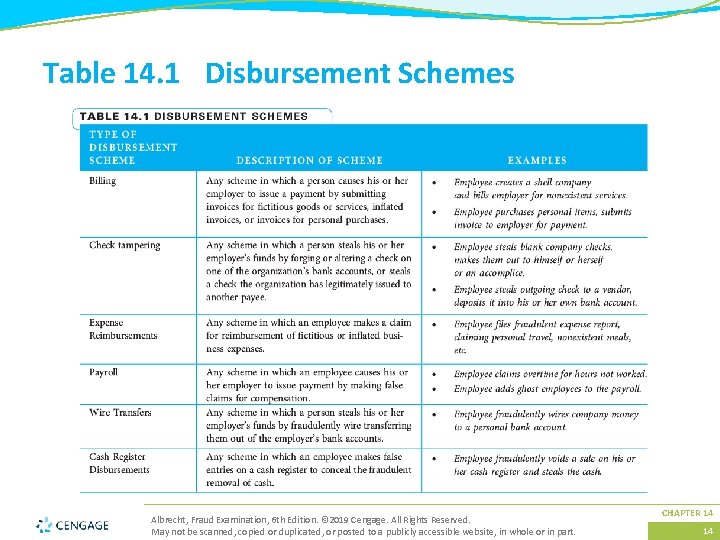
Table 14. 1 Disbursement Schemes Albrecht, Fraud Examination, 6 th Edition. © 2019 Cengage. All Rights Reserved. May not be scanned, copied or duplicated, or posted to a publicly accessible website, in whole or in part. CHAPTER 14 14
Check Tampering } Employee prepares a fraudulent check for his or her own benefit. } Employee intercepts a check intended for another person or entity and converts the check to his or her own benefit. Albrecht, Fraud Examination, 6 th Edition. © 2019 Cengage. All Rights Reserved. May not be scanned, copied or duplicated, or posted to a publicly accessible website, in whole or in part. CHAPTER 14 15
Register Disbursement Schemes } False refunds } False voids Albrecht, Fraud Examination, 6 th Edition. © 2019 Cengage. All Rights Reserved. May not be scanned, copied or duplicated, or posted to a publicly accessible website, in whole or in part. CHAPTER 14 16
Billing Schemes } Setting up dummy companies (shell companies) to submit invoices to the victim organization } Altering or double-paying a nonaccomplice vendor’s statements } Making personal purchases with company funds Albrecht, Fraud Examination, 6 th Edition. © 2019 Cengage. All Rights Reserved. May not be scanned, copied or duplicated, or posted to a publicly accessible website, in whole or in part. CHAPTER 14 17
Expense Schemes } Mischaracterizing expenses } Overstating expenses } Submitting fictitious expenses } Submitting the same expenses multiple times Albrecht, Fraud Examination, 6 th Edition. © 2019 Cengage. All Rights Reserved. May not be scanned, copied or duplicated, or posted to a publicly accessible website, in whole or in part. CHAPTER 14 18
Payroll Disbursement Schemes } Ghost employees } Falsified hours and salary } Commission schemes } False workers’ compensation claims Albrecht, Fraud Examination, 6 th Edition. © 2019 Cengage. All Rights Reserved. May not be scanned, copied or duplicated, or posted to a publicly accessible website, in whole or in part. CHAPTER 14 19
Executive Cash Frauds } Examples } Tyco scandal } Adelphia scandal Albrecht, Fraud Examination, 6 th Edition. © 2019 Cengage. All Rights Reserved. May not be scanned, copied or duplicated, or posted to a publicly accessible website, in whole or in part. CHAPTER 14 20
Misuse of Company Assets } A person can misappropriate company assets other than cash in one of two ways. } The asset can be misused (or “borrowed”), or it can be stolen. } Simple misuse is obviously the less egregious of the two types of fraud. } Assets that are misused but not stolen typically include company vehicles, company supplies, computers, and office equipment. } These assets are also used by some employees to conduct personal work on company time. Albrecht, Fraud Examination, 6 th Edition. © 2019 Cengage. All Rights Reserved. May not be scanned, copied or duplicated, or posted to a publicly accessible website, in whole or in part. CHAPTER 14 21
Theft of Inventory and Other Assets } Noncash types of frauds against organizations } Inventory } Information } Securities } Table 14. 2 describes the most common noncash types of frauds against organizations. Albrecht, Fraud Examination, 6 th Edition. © 2019 Cengage. All Rights Reserved. May not be scanned, copied or duplicated, or posted to a publicly accessible website, in whole or in part. CHAPTER 14 22
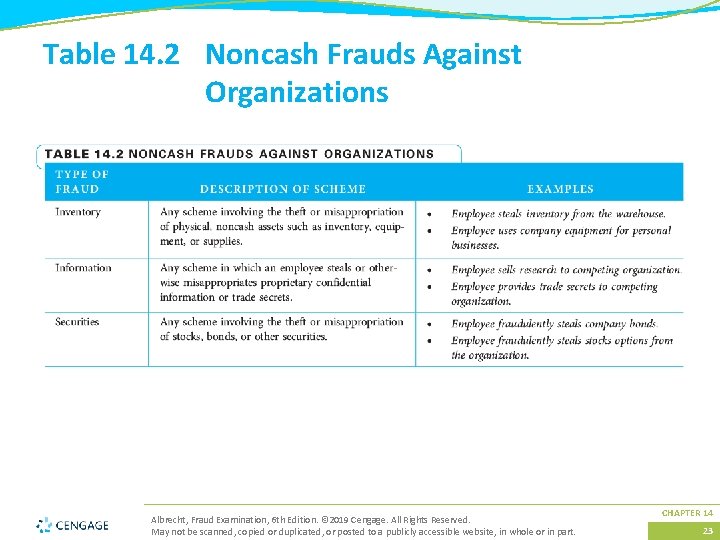
Table 14. 2 Noncash Frauds Against Organizations Albrecht, Fraud Examination, 6 th Edition. © 2019 Cengage. All Rights Reserved. May not be scanned, copied or duplicated, or posted to a publicly accessible website, in whole or in part. CHAPTER 14 23
Corruption } The tradition of “paying off” public officials or company insiders for preferential treatment is rooted in the crudest business systems developed. } Corruption can be broken down into the following four scheme types: } Bribery schemes } Conflict of interest schemes } Economic extortion schemes } Illegal gratuity schemes } Table 14. 3 from the 2012 ACFE report summarizes these types of frauds. Albrecht, Fraud Examination, 6 th Edition. © 2019 Cengage. All Rights Reserved. May not be scanned, copied or duplicated, or posted to a publicly accessible website, in whole or in part. CHAPTER 14 24
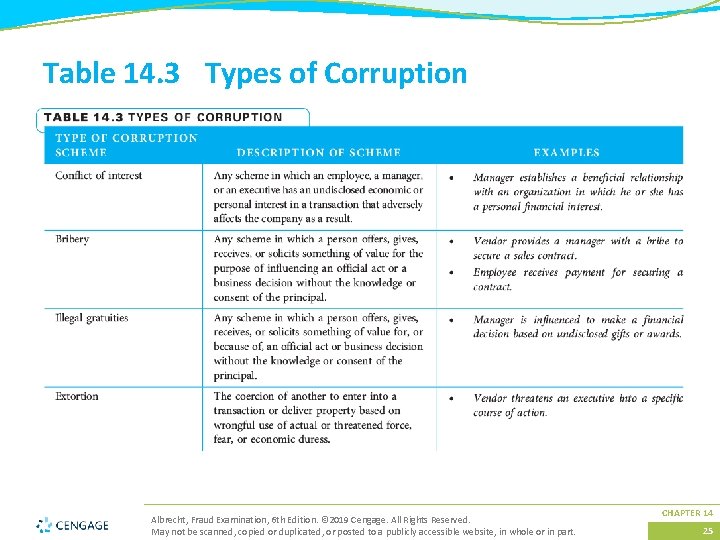
Table 14. 3 Types of Corruption Albrecht, Fraud Examination, 6 th Edition. © 2019 Cengage. All Rights Reserved. May not be scanned, copied or duplicated, or posted to a publicly accessible website, in whole or in part. CHAPTER 14 25
Bribery } Bribery involves the offering, giving, receiving, or soliciting of anything of value to influence an official act. } The term “official act” means that traditional bribery statutes only proscribe payments made to influence the decisions of government agents or employees. } Many occupational fraud schemes involve commercial bribery—something of value is offered to influence a business decision rather than an official act of government. } Bribery schemes generally fall into two broad categories: } Kickbacks } Bid-rigging schemes Albrecht, Fraud Examination, 6 th Edition. © 2019 Cengage. All Rights Reserved. May not be scanned, copied or duplicated, or posted to a publicly accessible website, in whole or in part. CHAPTER 14 26
Conflicts of Interest } A conflict of interest occurs when an employee, a manager, or an executive has an undisclosed economic or personal interest in a transaction that adversely affects the company. } Conflicts usually involve self-dealing by an employee. } In some cases, the employee’s act benefits a friend or relative, even though the employee receives no financial benefit from the transaction. } To be classified as a conflict of interest scheme, the employee’s interest in a transaction must be undisclosed. } Most conflict schemes fall into one of two categories: } Purchase schemes } Sales schemes Albrecht, Fraud Examination, 6 th Edition. © 2019 Cengage. All Rights Reserved. May not be scanned, copied or duplicated, or posted to a publicly accessible website, in whole or in part. CHAPTER 14 27
Mutual Fund Frauds } Market timing } Late trading Albrecht, Fraud Examination, 6 th Edition. © 2019 Cengage. All Rights Reserved. May not be scanned, copied or duplicated, or posted to a publicly accessible website, in whole or in part. CHAPTER 14 28
Economic Extortion } Economic extortion is basically the flip side of a bribery scheme. } Instead of a vendor offering a payment to an employee to influence a decision, the employee demands a payment from a vendor in order to make a decision in that vendor’s favor. } In any situation where an employee might accept bribes to favor a particular company or person, the situation could be reversed to a point where the employee extorts money from a potential purchaser or supplier. } Extortion always involves the use of actual or threatened force, fear, or economic duress. } Extortion is a criminal offense, which occurs when a person either obtains money, property, or services from another through coercion or intimidation or threatens one with physical or reputational harm unless he or she is paid money or property. Albrecht, Fraud Examination, 6 th Edition. © 2019 Cengage. All Rights Reserved. May not be scanned, copied or duplicated, or posted to a publicly accessible website, in whole or in part. CHAPTER 14 29
Illegal Gratuities } Illegal gratuities are similar to bribery schemes, except that there is not necessarily an intent to influence a particular business decision but rather to reward someone for making a favorable decision. } Illegal gratuities are made after deals are approved. Albrecht, Fraud Examination, 6 th Edition. © 2019 Cengage. All Rights Reserved. May not be scanned, copied or duplicated, or posted to a publicly accessible website, in whole or in part. CHAPTER 14 30
- Slides: 30