
Chapter 14 Europe the World New Encounters 1500
- Slides: 16
Chapter 14 Europe & the World: New Encounters, 1500 -1800
On the Brink of a New World 16 th cent. Atlantic seaboard became center of commercial activity – Spain & Portugal and later Dutch Republic, England & France thrived – Expansion crucial in change from agrarian to commercial capitalist system – Also led Europeans into contact w/ new non-European people Motives “God, Glory & Gold” p 380 -81 – religious zeal crusade mentality strong in Port. & Spain, desire to convert heathen to Christianity – fantastic lands The Travels of John Mandeville – Spoke of lands filled w/ precious stones, giants, cruel & evil women magical kingdom of Prester John in Africa – economic motives After reading Polo’s Travels, many sought alternative routes to Asia On conquistador wrote that he wished to “serve God and His Majesty, to give light to those in darkness and to grow rich as all men desire to do. ”
The Means – Maps medieval maps were of little use portolani – charts made by navigators & mathematicians during 13 th and 14 th proved more helpful – useful in European waters – useless for long overseas voyages by the end of 15 th cent. , Europeans possessed fairly accurate maps of the known world – Ships & Sailing new advances (axial rudder & lateen sails) could sail against the wind, large enough to carry large amts. of food & water navigational aids like compass & astrolabe allowed the sailors to explore the open seas with more confidence Lastly, increasing knowledge of Atlantic wind patterns improved the success of non-European voyages greatly
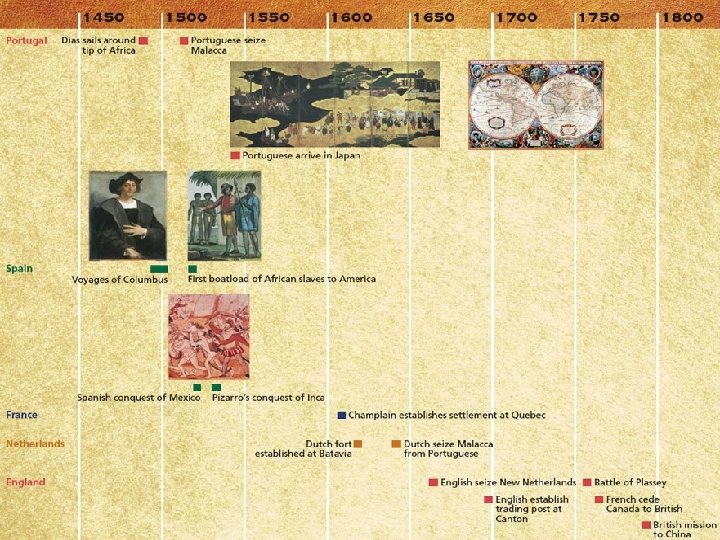
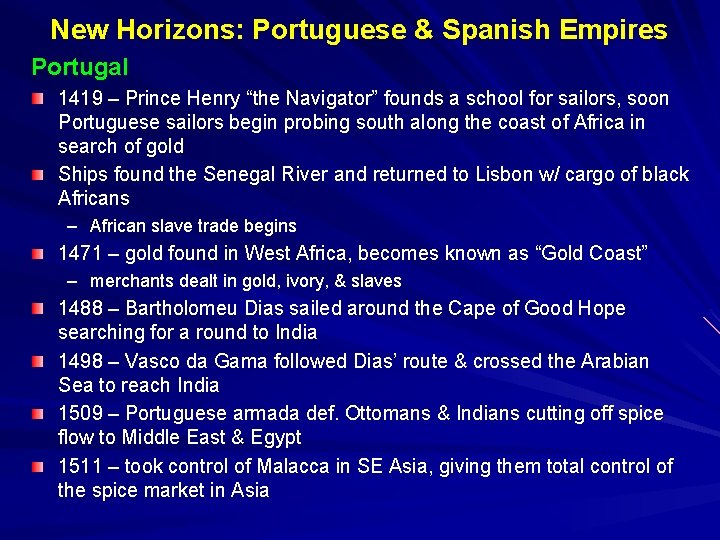
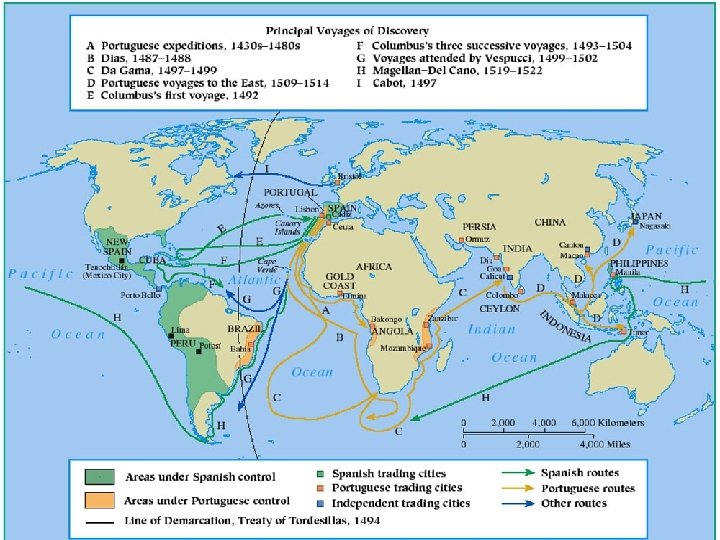
New Horizons: Portuguese & Spanish Empires Portugal 1419 – Prince Henry “the Navigator” founds a school for sailors, soon Portuguese sailors begin probing south along the coast of Africa in search of gold Ships found the Senegal River and returned to Lisbon w/ cargo of black Africans – African slave trade begins 1471 – gold found in West Africa, becomes known as “Gold Coast” – merchants dealt in gold, ivory, & slaves 1488 – Bartholomeu Dias sailed around the Cape of Good Hope searching for a round to India 1498 – Vasco da Gama followed Dias’ route & crossed the Arabian Sea to reach India 1509 – Portuguese armada def. Ottomans & Indians cutting off spice flow to Middle East & Egypt 1511 – took control of Malacca in SE Asia, giving them total control of the spice market in Asia
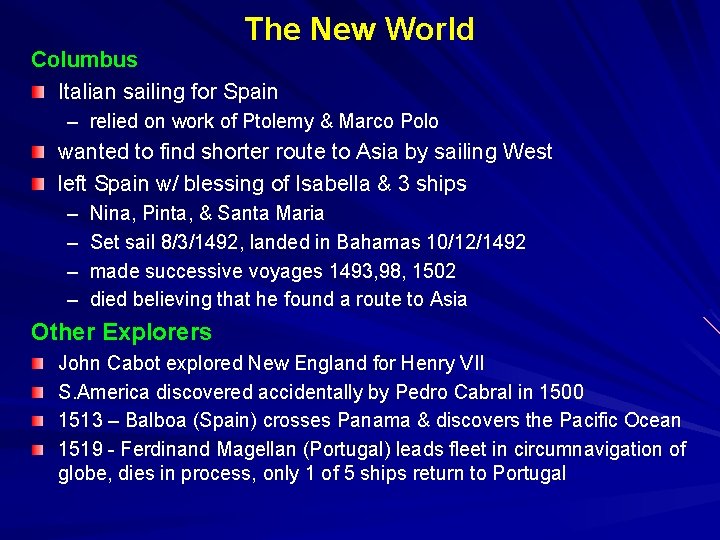
The New World Columbus Italian sailing for Spain – relied on work of Ptolemy & Marco Polo wanted to find shorter route to Asia by sailing West left Spain w/ blessing of Isabella & 3 ships – – Nina, Pinta, & Santa Maria Set sail 8/3/1492, landed in Bahamas 10/12/1492 made successive voyages 1493, 98, 1502 died believing that he found a route to Asia Other Explorers John Cabot explored New England for Henry VII S. America discovered accidentally by Pedro Cabral in 1500 1513 – Balboa (Spain) crosses Panama & discovers the Pacific Ocean 1519 - Ferdinand Magellan (Portugal) leads fleet in circumnavigation of globe, dies in process, only 1 of 5 ships return to Portugal
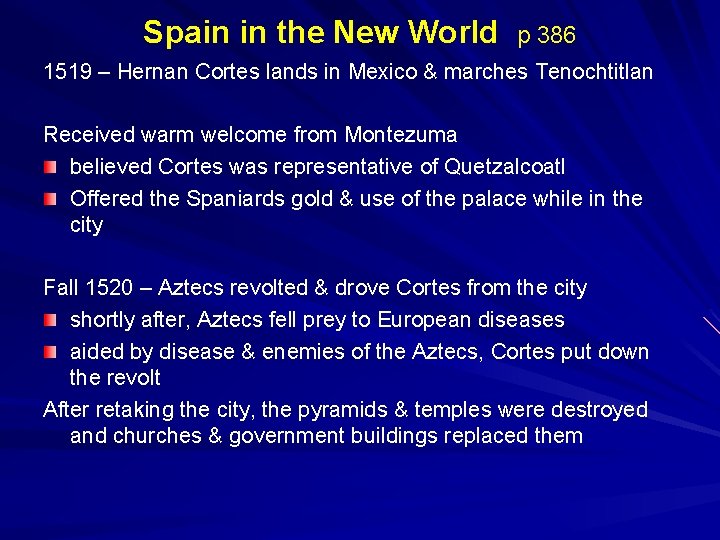
Spain in the New World p 386 1519 – Hernan Cortes lands in Mexico & marches Tenochtitlan Received warm welcome from Montezuma believed Cortes was representative of Quetzalcoatl Offered the Spaniards gold & use of the palace while in the city Fall 1520 – Aztecs revolted & drove Cortes from the city shortly after, Aztecs fell prey to European diseases aided by disease & enemies of the Aztecs, Cortes put down the revolt After retaking the city, the pyramids & temples were destroyed and churches & government buildings replaced them
Spanish Conquest of Inca Empire Dec. 1530 – Francisco Pizarro lands on Pacific coast of S. America w/ 180 men – Spanish weaponry too advanced for Incas – Smallpox had already hit Peru, killed the emperor – Two sons took the throne, caused civil war – Pizarro quickly defeated the winner of the war Administration of the Spanish Empire Combination of misguided paternalism & exploitation by Spaniards Isabella declared natives subjects of Spain – Instituted encomienda – allowed Spanish to collect taxes & use natives for labor but were responsible for protection, payment of wages, & supervision of spiritual needs Disease decimated the native population – – – smallpox, measles & typhus Pop of central Mexico: 1519 – 11 mill. , 1600 – 2. 5 million Hispaniola : 1493 – 100, 000 , 1570 - 300
New Rivals on World Stage Late 16 th cent. Spain & Portugal colonial powers 17 th cent. the Dutch, English & French began to create their own colonial empires African Slave Trade mid-17 th cent. - Dutch seized Portuguese forts on the west coast of Africa & took control of much of the trade in the Indian Ocean Dutch settled on the Cape of Good Hope and called it Cape Town – moderate climate, freedom from tropical diseases – had little affect on natives living inland As slave trade increased 16 th – 18 th cent. , millions of Africans forcibly shipped to the New World Initially market for African slaves was in Middle East – Portuguese began replacing European slaves w/ African ones – By 1470 s, about 1000 Africans were being sent to Portugal a year – discovery of New World & start of sugar cane plantations in S. America & Caribbean drastically increase need for labor 1518 – Spanish ship carries first boatload of African slaves directly to NW
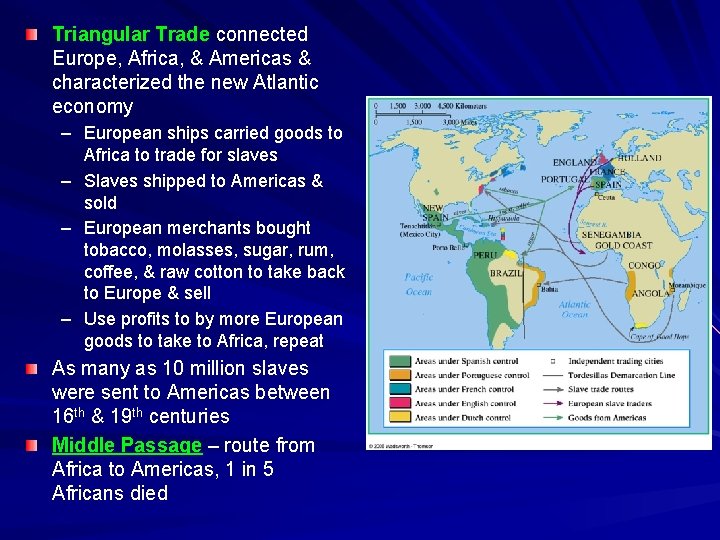
Triangular Trade connected Europe, Africa, & Americas & characterized the new Atlantic economy – European ships carried goods to Africa to trade for slaves – Slaves shipped to Americas & sold – European merchants bought tobacco, molasses, sugar, rum, coffee, & raw cotton to take back to Europe & sell – Use profits to by more European goods to take to Africa, repeat As many as 10 million slaves were sent to Americas between 16 th & 19 th centuries Middle Passage – route from Africa to Americas, 1 in 5 Africans died
Slaves packed tight into the ships (350 -400) – chained below deck to their bunks roughly had anywhere from 2 -2 -4 to 3 -3 -5 ft space – given just enough food to stay alive – if you had to go, you went where you were – groups rinsed off above deck occasionally – slaves not encouraged to have children Many African rulers viewed slavery as a source of income – Prisoners from neighboring villages or kingdoms sold into slavery Effects – Economic - cheap European labor hurt home businesses – Social – depopulation robbed African communities of their youngest & strongest men and women – Political – demand for slaves caused wars between African communities
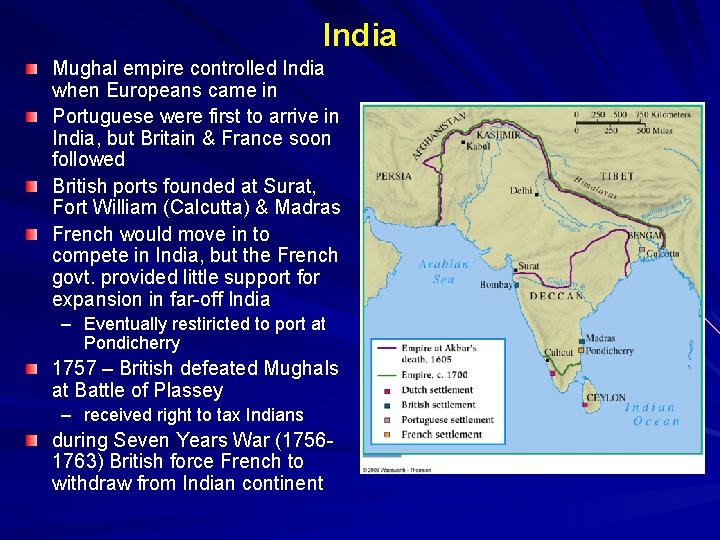
India Mughal empire controlled India when Europeans came in Portuguese were first to arrive in India, but Britain & France soon followed British ports founded at Surat, Fort William (Calcutta) & Madras French would move in to compete in India, but the French govt. provided little support for expansion in far-off India – Eventually restiricted to port at Pondicherry 1757 – British defeated Mughals at Battle of Plassey – received right to tax Indians during Seven Years War (17561763) British force French to withdraw from Indian continent
Toward A World Economy Inflation very bad as population increase & influx of new bullion drive price increases – Annual inflation was low (2 -3%) but prices were very stable in Europe before the price revolution Capitalism was growing thanks to new commercial organizations like the joint-stock company – Individuals bought shares in the company & received dividends based on their investment and a board of directors made important decisions – ex. Dutch East India Company Enormous profits made in shipbuilding, metallurgy, & mining – Jacob Fugger amassed a fortune with a mining monopoly in Central Europe, only to lose it by making bad loans to the Habsburgs
By 17 th century, family banks could not supply the numerous services needed for a capitalist economy – Amsterdam created a city bank & stock exchange Even though the European economy was growing, most saw no improvement in quality of life – – – 80% of pop. farmed many owed feudal dues faced increased rents and fees & taxes Mercantilism – economic trend that came to dominate the practices of 17 th cent. – – – total volume of trade is unchangeable a country’s power based on amt. of bullion supported tariffs one state can only increase it’s trade at the expense of competitors to mercantilists – economic activity was ‘war by peaceful means” colonies deemed good as sources of raw material & markets for finished goods – govt. involvement often seen as desirable for nat’l good
Impact of Expansion Native American population ravaged by European diseases Social structures destroyed & replaced by European models Asian cultures affected gradually by contact w/ westerners Developed a new society in Central & South America, referred to as Latin America – mixture of Spanish, Portuguese, Native American, & African – very multicultural, less rigid attitudes about race Europeans brought the Catholic faith to the New World where it thrived in Central America brought new agricultural products to Europe changed Europeans view of the world literally & figuratively