
Chapter 14 ECommerce Strategy and Global EC Jason
Chapter 14 E-Commerce Strategy and Global EC Jason Chou-Hong Chen, Ph. D. Professor of MIS Graduate School of Business, Gonzaga University Spokane, WA 99223 USA chen@jepson. gonzaga. edu ã Pearson/Prentice Hall & Dr. Chen, Electronic Commerce
Learning Objectives 1. 2. 3. 4. 5. 6. 7. Describe the strategic planning process. Describe the purpose and content of a business plan. Understand how e-commerce impacts the strategic planning process. Understand how to formulate, justify, and prioritize EC applications. Describe strategy implementation and assessment, including the use of metrics. Evaluate the issues involved in global EC. Analyze the impact of EC on small and medium-sized businesses. ã Pearson/Prentice Hall & Dr. Chen, Electronic Commerce
14. 1 Organizational Strategy: Concepts and Overview • Strategy: A broad-based formula for how a business is going to compete, what its goals should be, and what plans and policies will be needed to carry out those goals • Strategy is also about making tough decisions about what not to do ã Pearson/Prentice Hall & Dr. Chen, Electronic Commerce
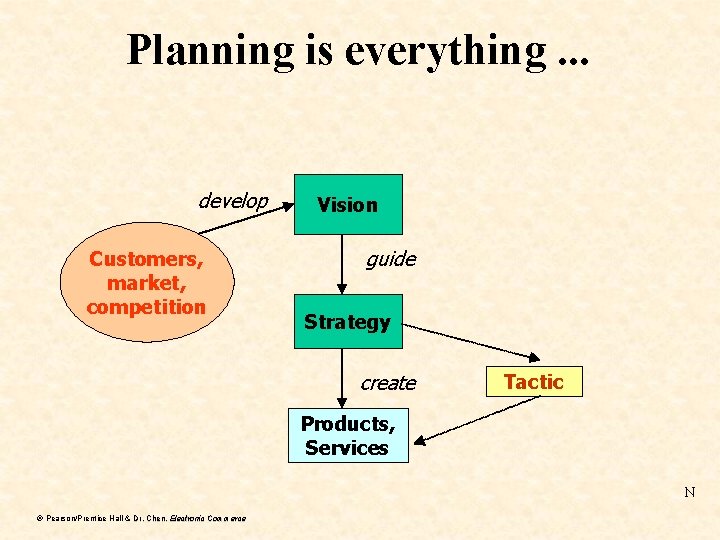
Planning is everything. . . develop Customers, market, competition Vision guide Strategy create Tactic Products, Services N ã Pearson/Prentice Hall & Dr. Chen, Electronic Commerce
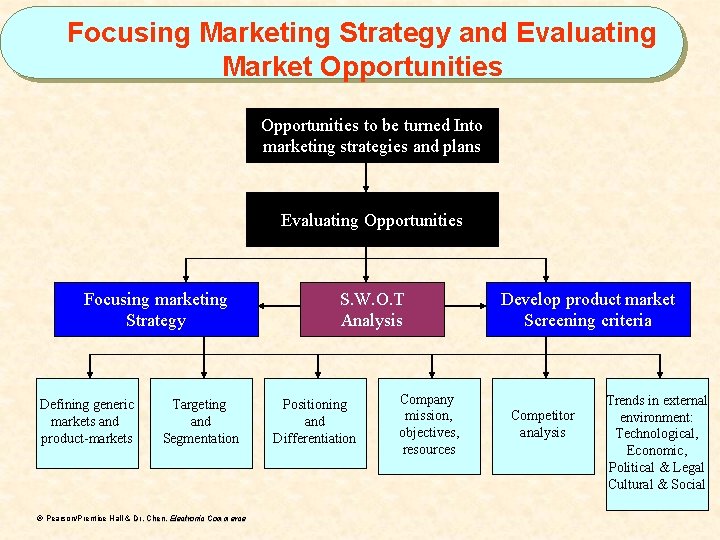
Focusing Marketing Strategy and Evaluating Market Opportunities to be turned Into marketing strategies and plans Evaluating Opportunities Focusing marketing Strategy Defining generic markets and product-markets Targeting and Segmentation ã Pearson/Prentice Hall & Dr. Chen, Electronic Commerce S. W. O. T Analysis Positioning and Differentiation Company mission, objectives, resources Develop product market Screening criteria Competitor analysis Trends in external environment: Technological, Economic, Political & Legal Cultural & Social
Organizational Strategy (cont. ) • Profitability and economic value is determined by establishing a unique value proposition • Strategy is focused on questions about: – organizational fit – trade-offs – profitability – value ã Pearson/Prentice Hall & Dr. Chen, Electronic Commerce
Organizational Strategy: Concepts and Overview • Strategy and the Web Environment – e-commerce strategy (e-strategy) The formulation and execution of a vision of how a new or existing company intends to do business electronically ã Pearson/Prentice Hall & Dr. Chen, Electronic Commerce
Organizational Strategy: Concepts and Overview • Strategy and the Web Environment – strategic information systems planning (SISP) A process for developing a strategy and plans for aligning information systems (including ecommerce applications) with the business strategies of an organization ã Pearson/Prentice Hall & Dr. Chen, Electronic Commerce
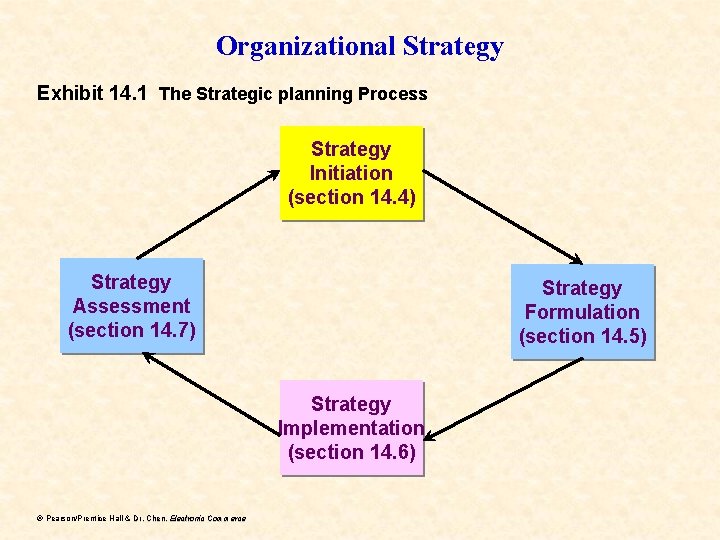
Organizational Strategy Exhibit 14. 1 The Strategic planning Process Strategy Initiation (section 14. 4) Strategy Assessment (section 14. 7) Strategy Formulation (section 14. 5) Strategy Implementation (section 14. 6) ã Pearson/Prentice Hall & Dr. Chen, Electronic Commerce
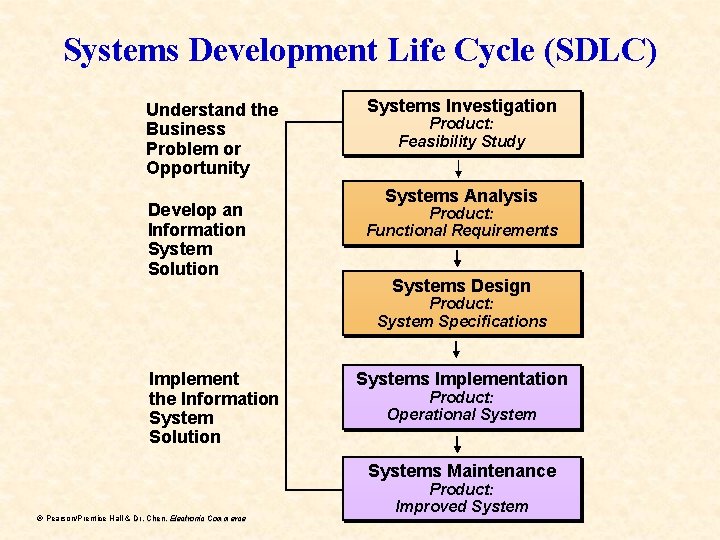
Systems Development Life Cycle (SDLC) Understand the Business Problem or Opportunity Develop an Information System Solution Systems Investigation Product: Feasibility Study Systems Analysis Product: Functional Requirements Systems Design Product: System Specifications Implement the Information System Solution Systems Implementation Product: Operational Systems Maintenance ã Pearson/Prentice Hall & Dr. Chen, Electronic Commerce Product: Improved System
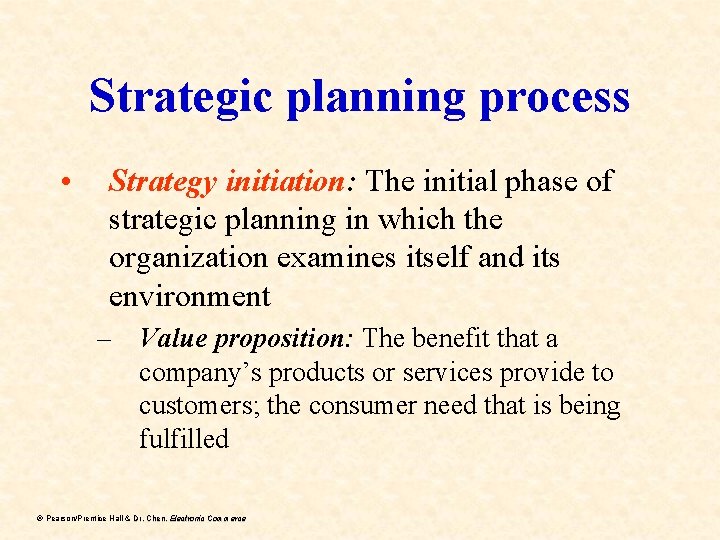
Strategic planning process • Strategy initiation: The initial phase of strategic planning in which the organization examines itself and its environment – Value proposition: The benefit that a company’s products or services provide to customers; the consumer need that is being fulfilled ã Pearson/Prentice Hall & Dr. Chen, Electronic Commerce
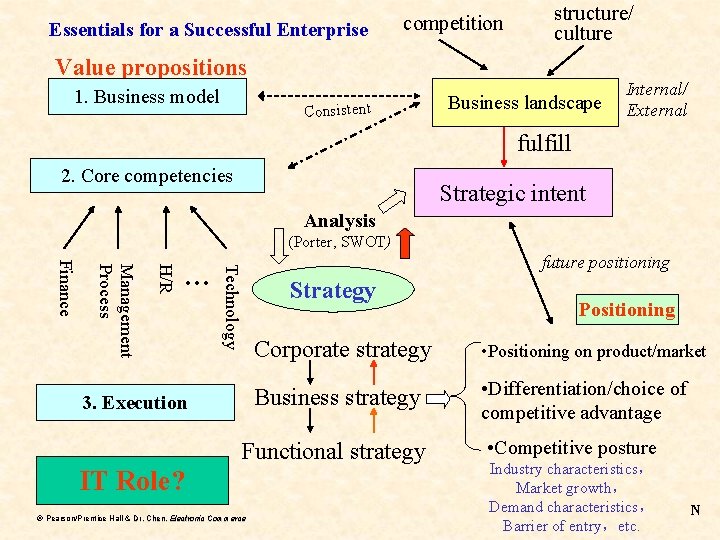
Essentials for a Successful Enterprise competition structure/ culture Value propositions 1. Business model Consistent Business landscape Internal/ External fulfill 2. Core competencies Strategic intent Analysis (Porter, SWOT) Technology H/R Management Process Finance … 3. Execution future positioning Strategy Corporate strategy • Positioning on product/market Business strategy • Differentiation/choice of competitive advantage Functional strategy IT Role? ã Pearson/Prentice Hall & Dr. Chen, Electronic Commerce Positioning • Competitive posture Industry characteristics, Market growth, Demand characteristics, Barrier of entry,etc. N
Strategic planning process (cont. ) • Outcomes from strategy initiation phase – Company analysis (including value proposition) – Core competencies – Forecasts – Competitor (industry) analysis ã Pearson/Prentice Hall & Dr. Chen, Electronic Commerce
Strategic planning process (cont. ) • Strategy formulation: The development of strategies to exploit opportunities and manage threats in the business environment in light of corporate strengths and weaknesses • Specific activities and outcomes from strategy formulation phase: – Business opportunities – Cost-benefit analysis – Risk analysis, assessment, and management ã Pearson/Prentice Hall & Dr. Chen, Electronic Commerce
Strategic planning process (cont. ) • Strategy implementation: The development of detailed, short-term plans for carrying out the projects agreed on in strategy formulation • Specific activities and outcomes from strategy implementation phase: – Business planning – Resource allocation – Project management ã Pearson/Prentice Hall & Dr. Chen, Electronic Commerce
Strategic planning process (cont. ) • Strategy assessment: The continuous evaluation of progress toward the organization’s strategic goals, resulting in corrective action and, if necessary, strategy reformulation Specific measures called metrics are used to assess the progress of the strategy ã Pearson/Prentice Hall & Dr. Chen, Electronic Commerce
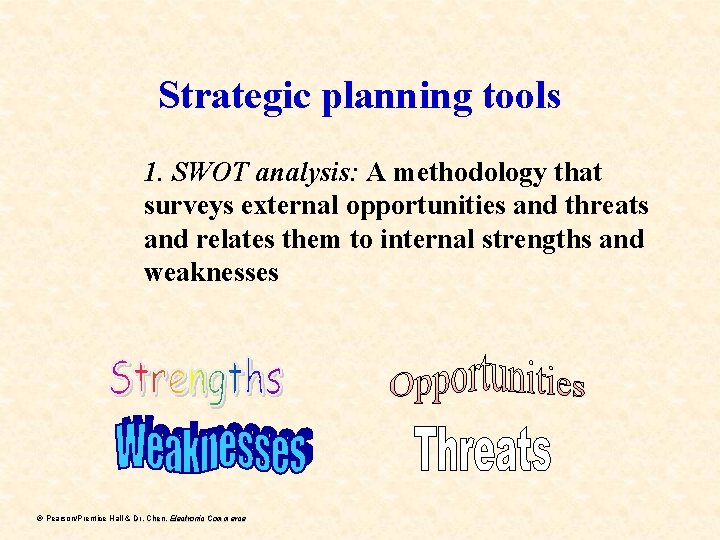
Strategic planning tools 1. SWOT analysis: A methodology that surveys external opportunities and threats and relates them to internal strengths and weaknesses ã Pearson/Prentice Hall & Dr. Chen, Electronic Commerce
Strategic planning tools (cont. ) • 2. Competitor analysis grid: A strategic planning tool that highlights points of differentiation between competitors and the target firm • 3. Scenario planning: A strategic planning methodology that generates plausible alternative futures to help decision makers identify actions that can be taken today to ensure success in the future ã Pearson/Prentice Hall & Dr. Chen, Electronic Commerce
Strategic planning tools (cont. ) • 4. Balanced scorecard: An adaptive tool that assesses organizational progress toward strategic goals by measuring performance in a number of different areas • 5. (extra) Return on investment (ROI): A ratio of required costs and perceived benefits of a project or an application ã Pearson/Prentice Hall & Dr. Chen, Electronic Commerce
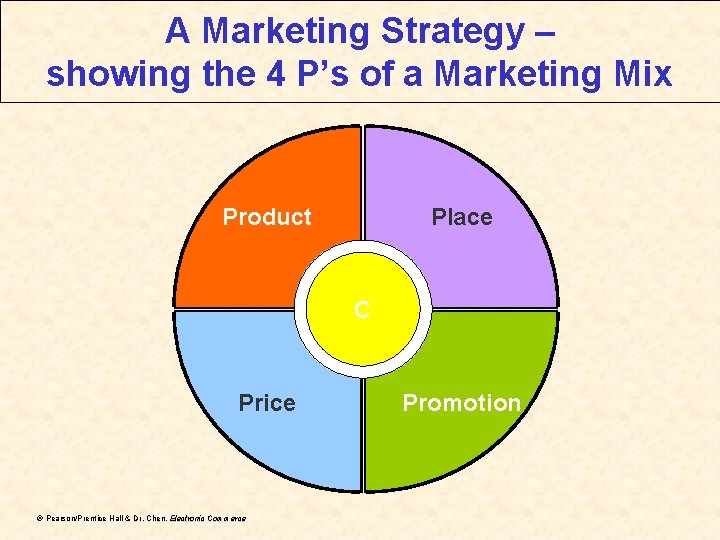
A Marketing Strategy – showing the 4 P’s of a Marketing Mix Product Place C Price ã Pearson/Prentice Hall & Dr. Chen, Electronic Commerce Promotion
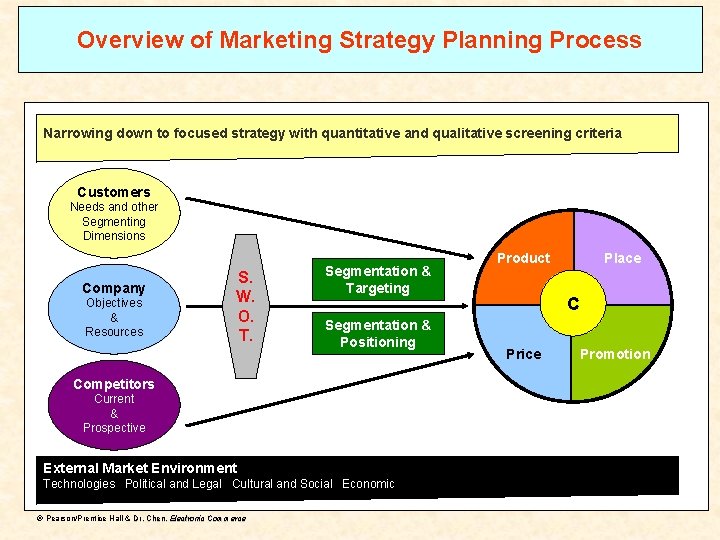
Overview of Marketing Strategy Planning Process Narrowing down to focused strategy with quantitative and qualitative screening criteria Customers Needs and other Segmenting Dimensions Company Objectives & Resources S. W. O. T. Segmentation & Targeting Segmentation & Positioning Competitors Current & Prospective External Market Environment Technologies Political and Legal Cultural and Social Economic ã Pearson/Prentice Hall & Dr. Chen, Electronic Commerce Product Place C Price Promotion
14. 2 Business Planning in ECommerce • business plan A written document that identifies the company’s goals and outlines how the company intends to achieve those goals ã Pearson/Prentice Hall & Dr. Chen, Electronic Commerce
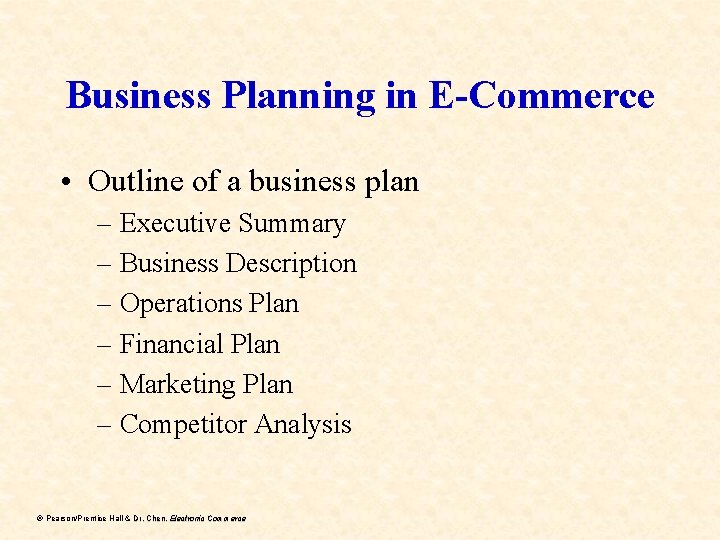
Business Planning in E-Commerce • Outline of a business plan – Executive Summary – Business Description – Operations Plan – Financial Plan – Marketing Plan – Competitor Analysis ã Pearson/Prentice Hall & Dr. Chen, Electronic Commerce
Business Planning in E-Commerce • Business Plan Fundamentals – Purposes for business plan • To acquire funding • To acquire nonfinancial resources • To obtain a realistic approach to the business • business case A business plan for a new initiative or large, new project inside an existing organization ã Pearson/Prentice Hall & Dr. Chen, Electronic Commerce
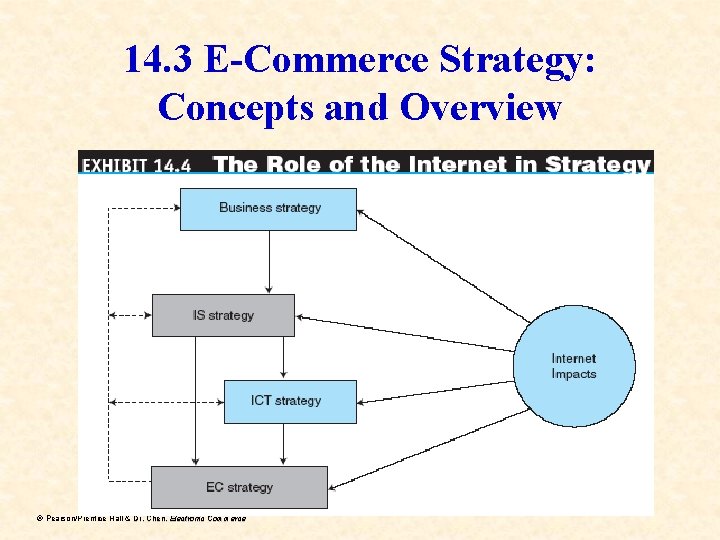
14. 3 E-Commerce Strategy: Concepts and Overview ã Pearson/Prentice Hall & Dr. Chen, Electronic Commerce
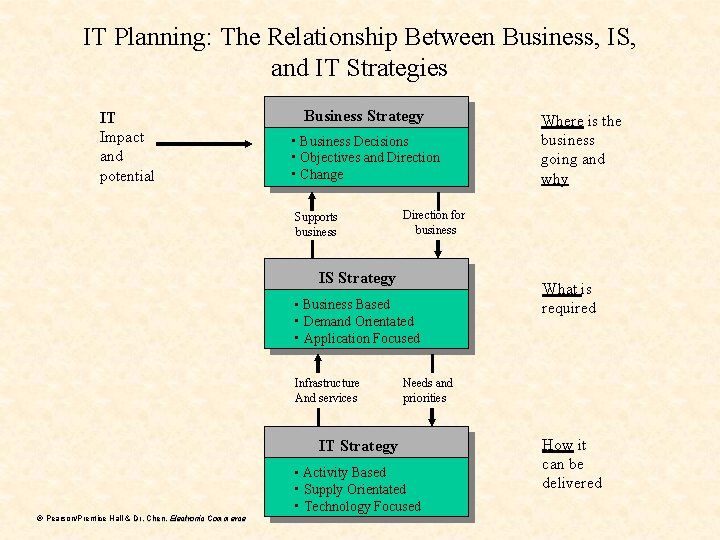
IT Planning: The Relationship Between Business, IS, and IT Strategies IT Impact and potential Business Strategy • Business Decisions • Objectives and Direction • Change Supports business Direction for business IS Strategy • Business Based • Demand Orientated • Application Focused Infrastructure And services What is required Needs and priorities IT Strategy • Activity Based ã Pearson/Prentice Hall & Dr. Chen, Electronic Commerce Where is the business going and why • Supply Orientated • Technology Focused How it can be delivered
BREAK • Application Case 14. 1: Strategic Planning at Internet. NZ (p. 644) ã Pearson/Prentice Hall & Dr. Chen, Electronic Commerce
14. 4 E-Strategy Initiation • Issues in E-Strategy Initiation – Be a First Mover or a Follower? – Born-on-the-Net or Move-to-the-Net? – Determining Scope – Have a Separate Online Company? – Have a Separate Online Brand? ã Pearson/Prentice Hall & Dr. Chen, Electronic Commerce
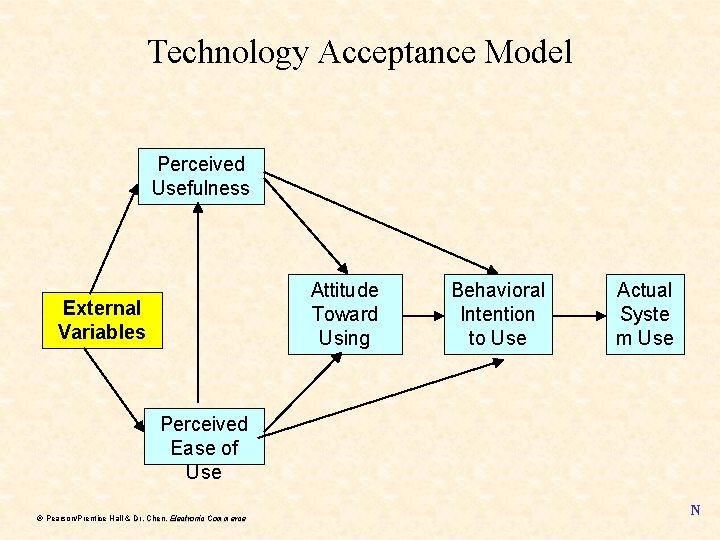
Technology Acceptance Model Perceived Usefulness Attitude Toward Using External Variables Behavioral Intention to Use Actual Syste m Use Perceived Ease of Use ã Pearson/Prentice Hall & Dr. Chen, Electronic Commerce N
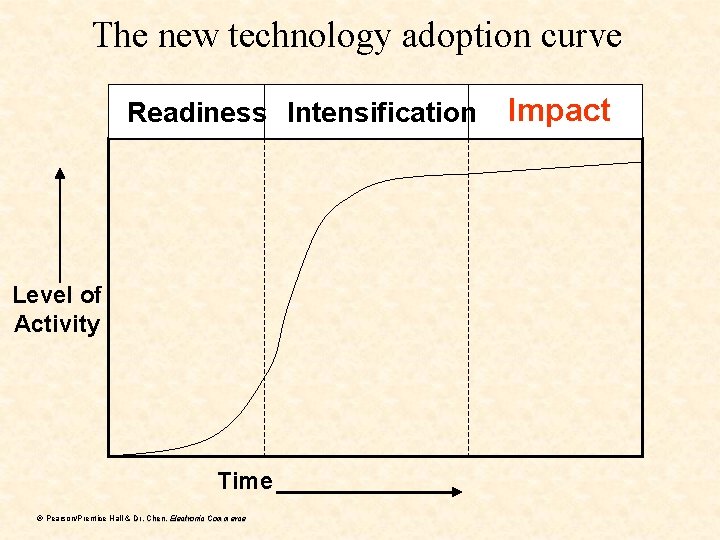
The new technology adoption curve Readiness Intensification Level of Activity Time ã Pearson/Prentice Hall & Dr. Chen, Electronic Commerce Impact
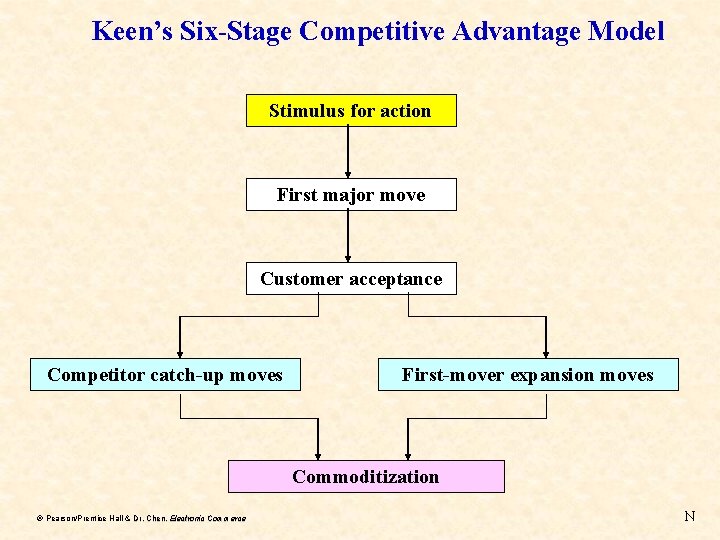
Keen’s Six-Stage Competitive Advantage Model Stimulus for action First major move Customer acceptance Competitor catch-up moves First-mover expansion moves Commoditization ã Pearson/Prentice Hall & Dr. Chen, Electronic Commerce N
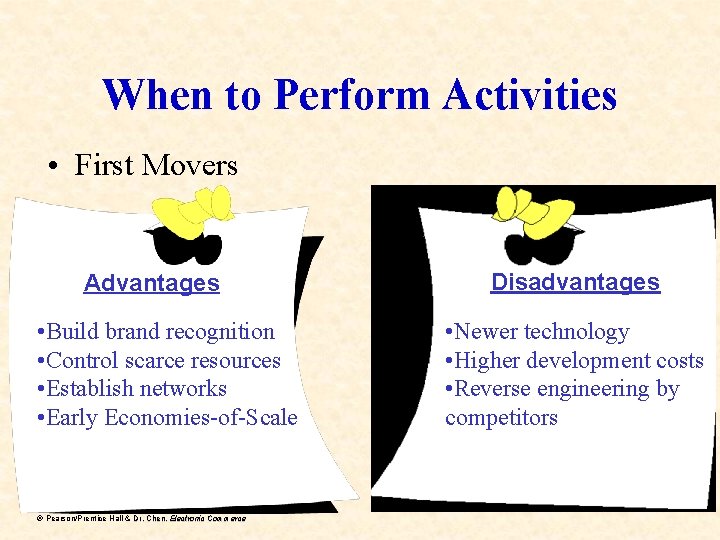
When to Perform Activities • First Movers Advantages • Build brand recognition • Control scarce resources • Establish networks • Early Economies-of-Scale ã Pearson/Prentice Hall & Dr. Chen, Electronic Commerce Disadvantages • Newer technology • Higher development costs • Reverse engineering by competitors
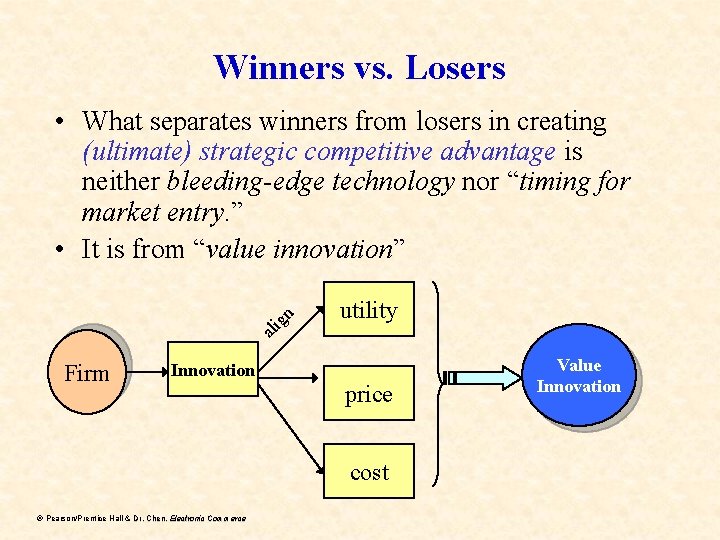
Winners vs. Losers utility al ig n • What separates winners from losers in creating (ultimate) strategic competitive advantage is neither bleeding-edge technology nor “timing for market entry. ” • It is from “value innovation” Firm Innovation price cost ã Pearson/Prentice Hall & Dr. Chen, Electronic Commerce Value Innovation
14. 5 E-Strategy Formulation • Selecting EC Opportunities – Incorrect approaches to EC strategy selection: 1. 2. 3. – Indiscriminately funding many projects and hoping for a few winners Betting it all in a single, high-stakes initiative “Trend-surfing” Productive approaches to EC strategy selection 1. 2. 3. 4. Problem-driven strategy Technology-driven strategy Market-driven strategy E-business maturity model ã Pearson/Prentice Hall & Dr. Chen, Electronic Commerce
E-Strategy Formulation • Determining an Appropriate EC Application Portfolio Mix – The BCG model – An Internet portfolio map for selecting applications ã Pearson/Prentice Hall & Dr. Chen, Electronic Commerce
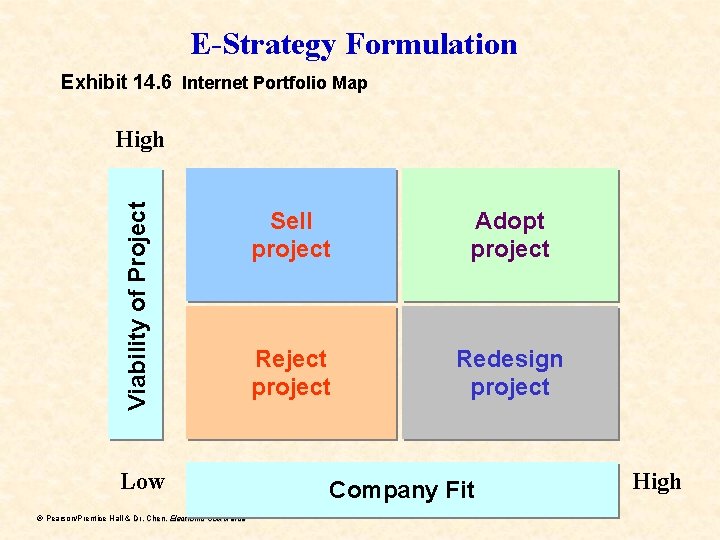
E-Strategy Formulation Exhibit 14. 6 Internet Portfolio Map Viability of Project High Low ã Pearson/Prentice Hall & Dr. Chen, Electronic Commerce Sell project Adopt project Reject project Redesign project Company Fit High
E-Strategy Formulation • Risk Analysis and Management – e-commerce (EC) risk The likelihood that a negative outcome will occur in the course of developing and operating an electronic commerce strategy – Security issues ã Pearson/Prentice Hall & Dr. Chen, Electronic Commerce
E-Strategy Formulation • Issues in Strategy Formulation – How to handle channel conflict – How to handle conflict between the off-line and online businesses – Pricing strategy • • Price comparison is easier Buyers sometimes set the price Online and off-line goods are priced differently Differentiated pricing can be a pricing strategy – versioning Selling the same good, but with different selection and delivery characteristics ã Pearson/Prentice Hall & Dr. Chen, Electronic Commerce
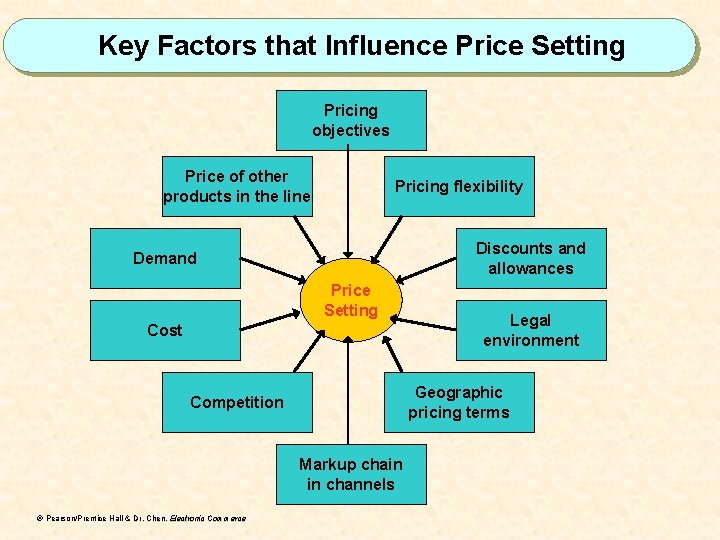
Key Factors that Influence Price Setting Pricing objectives Price of other products in the line Pricing flexibility Discounts and allowances Demand Price Setting Cost Geographic pricing terms Competition Markup chain in channels ã Pearson/Prentice Hall & Dr. Chen, Electronic Commerce Legal environment
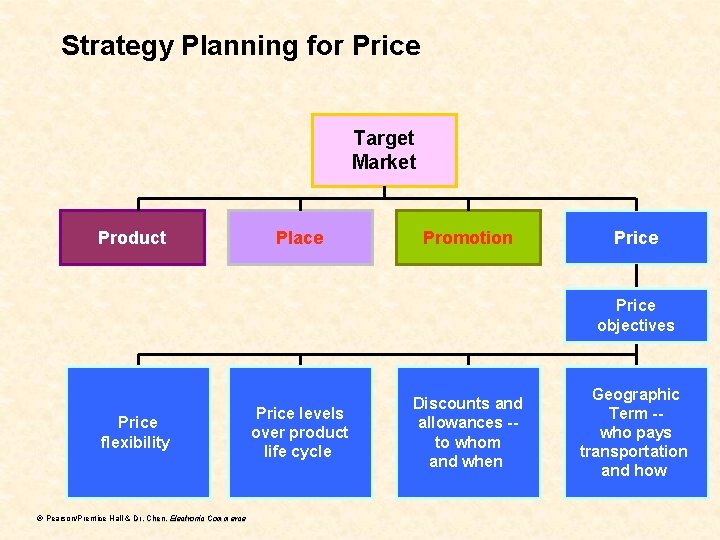
Strategy Planning for Price Target Market Product Place Promotion Price objectives Price flexibility ã Pearson/Prentice Hall & Dr. Chen, Electronic Commerce Price levels over product life cycle Discounts and allowances -to whom and when Geographic Term -who pays transportation and how
14. 6 E-Strategy Implementation • Create a Web Team – project champion The person who ensures the EC project gets the time, attention, and resources required and defends the project from detractors at all times • Start with a Pilot Project • Allocate Resources • Manage the Project ã Pearson/Prentice Hall & Dr. Chen, Electronic Commerce
14. 6 E-Strategy Implementation • Strategy Implementation Issues – Application development – Partners’ strategy • outsourcing The use of an external vendor to provide all or part of the products and services that could be provided internally ã Pearson/Prentice Hall & Dr. Chen, Electronic Commerce
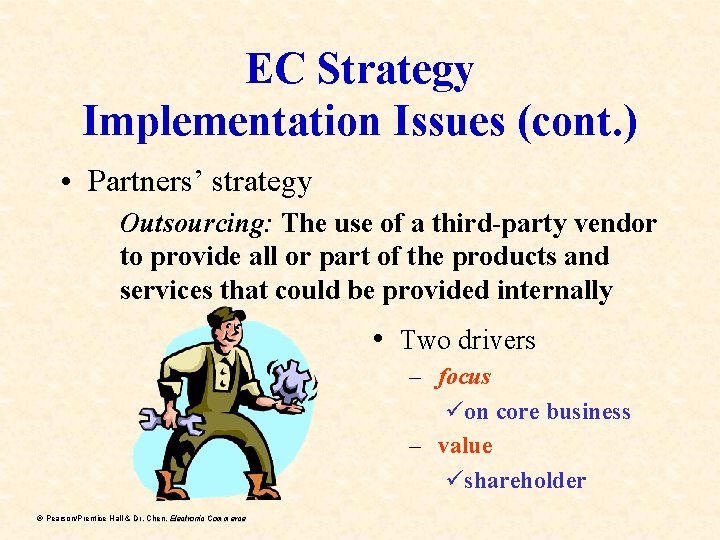
EC Strategy Implementation Issues (cont. ) • Partners’ strategy Outsourcing: The use of a third-party vendor to provide all or part of the products and services that could be provided internally • Two drivers – focus üon core business – value üshareholder ã Pearson/Prentice Hall & Dr. Chen, Electronic Commerce
When to Outsourcing? • Which IS activities are strategic to our company's business? • Will outsourcing save us at least 15 percent? • Does our firm have access to the needed technology and expertise? – If not, outsourcing may be the answer to acquiring these resources. • Does outsourcing increase our firm's flexibility? ã Pearson/Prentice Hall & Dr. Chen, Electronic Commerce Dr. Chen, Managing IT Reos. Thru Strategic Partnerships; A Portoflio Approach to IT Development TM -44
Going Offshore for IS Development • When the MIS organization uses contractor services, or even builds its own data center in a distant land, it is engaged in offshoring, which is short for outsourcing offshore. • The types of tasks that are outsourced are usually those that can be well-specified; however, nowdays, the functions sent offshore range from routine IT transactions to increasingly higher end, knowledge-based processes. • Countries such as India, the Philippines, etc, offer “offshoring”, an alternative to in-house systems development • It raises the issue of what to send offshore, and what to keep within your enterprise MIS organization. ã Pearson/Prentice Hall & Dr. Chen, Electronic Commerce
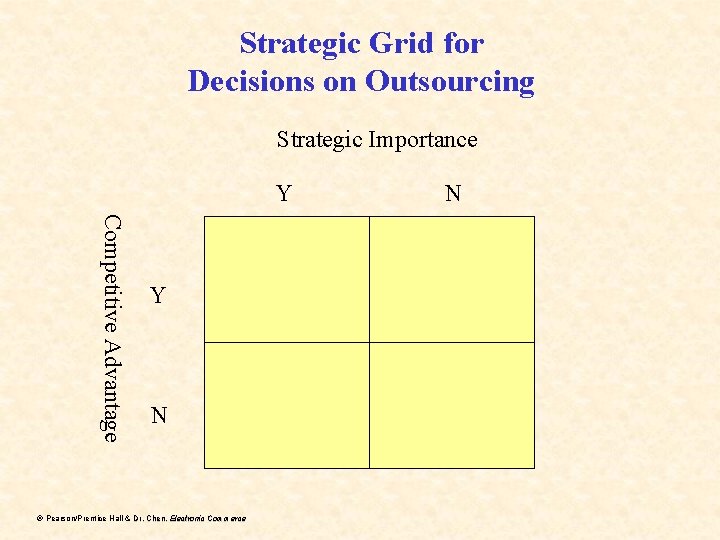
Strategic Grid for Decisions on Outsourcing Strategic Importance Y Competitive Advantage Y N ã Pearson/Prentice Hall & Dr. Chen, Electronic Commerce N
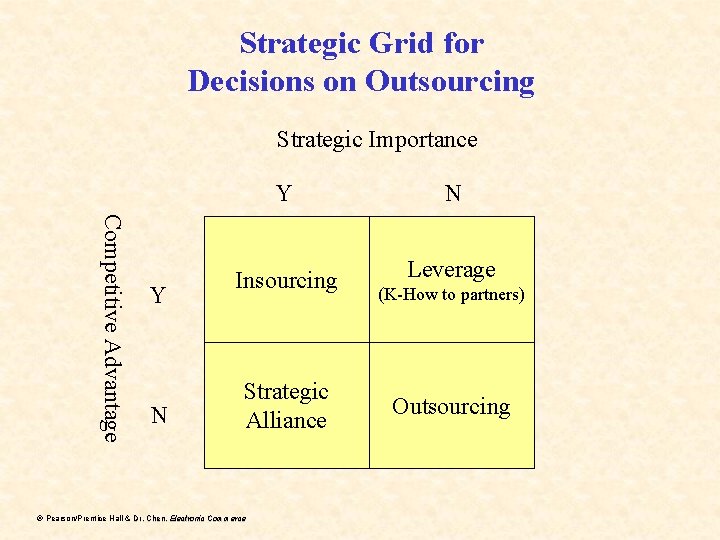
Strategic Grid for Decisions on Outsourcing Strategic Importance Competitive Advantage Y N Insourcing Leverage Strategic Alliance ã Pearson/Prentice Hall & Dr. Chen, Electronic Commerce (K-How to partners) Outsourcing
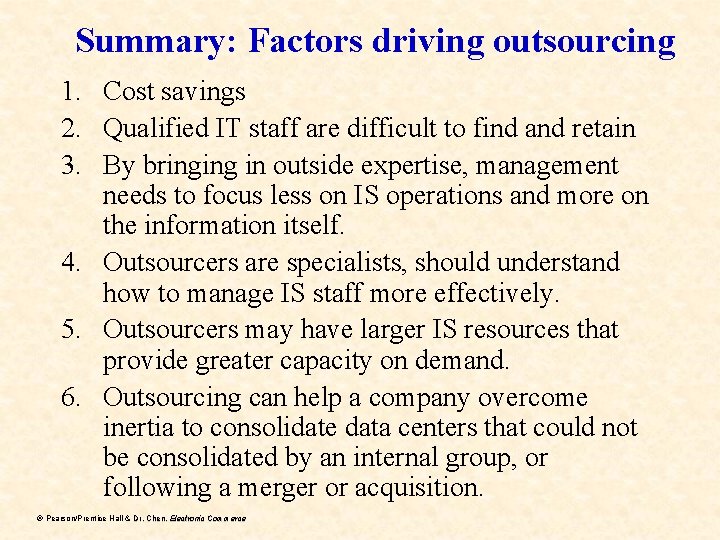
Summary: Factors driving outsourcing 1. Cost savings 2. Qualified IT staff are difficult to find and retain 3. By bringing in outside expertise, management needs to focus less on IS operations and more on the information itself. 4. Outsourcers are specialists, should understand how to manage IS staff more effectively. 5. Outsourcers may have larger IS resources that provide greater capacity on demand. 6. Outsourcing can help a company overcome inertia to consolidate data centers that could not be consolidated by an internal group, or following a merger or acquisition. ã Pearson/Prentice Hall & Dr. Chen, Electronic Commerce
E-Strategy Implementation • Business alliances and virtual corporations virtual corporation (VC) – An organization composed of several business partners sharing costs and resources for the production or utilization of a product or service – co-opetition Two or more companies cooperate together on some activities for their mutual benefit, even while competing against each other in the marketplace ã Pearson/Prentice Hall & Dr. Chen, Electronic Commerce
EC Strategy Implementation Issues (cont. ) A Virtual Corporation (VC) is an Organization Composed of several Business Partners that Uses Information Technology to Link/Share People, Assets, Ideas, Costs, and Resources for the purpose of producing a product or service. Virtual Companies are Adaptable and Opportunity. Exploiting Organizations Providing World-Class Excellence in Their Competencies and Technologies. ã Pearson/Prentice Hall & Dr. Chen, Electronic Commerce
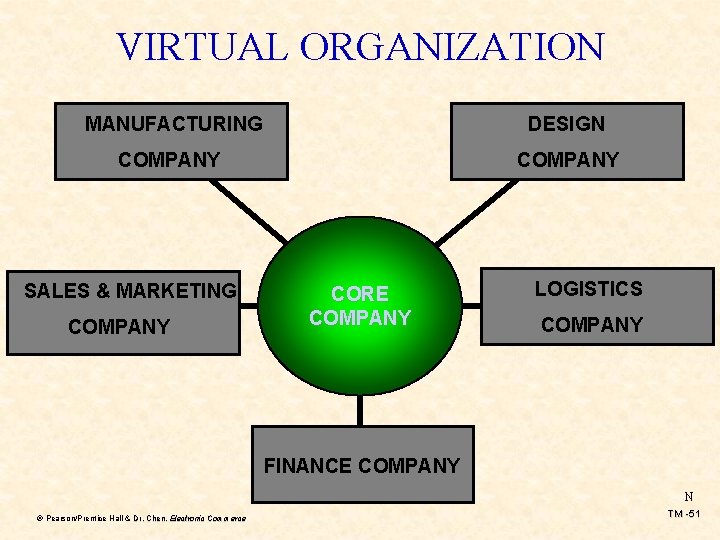
VIRTUAL ORGANIZATION MANUFACTURING DESIGN COMPANY SALES & MARKETING COMPANY CORE COMPANY LOGISTICS COMPANY FINANCE COMPANY N ã Pearson/Prentice Hall & Dr. Chen, Electronic Commerce TM -51
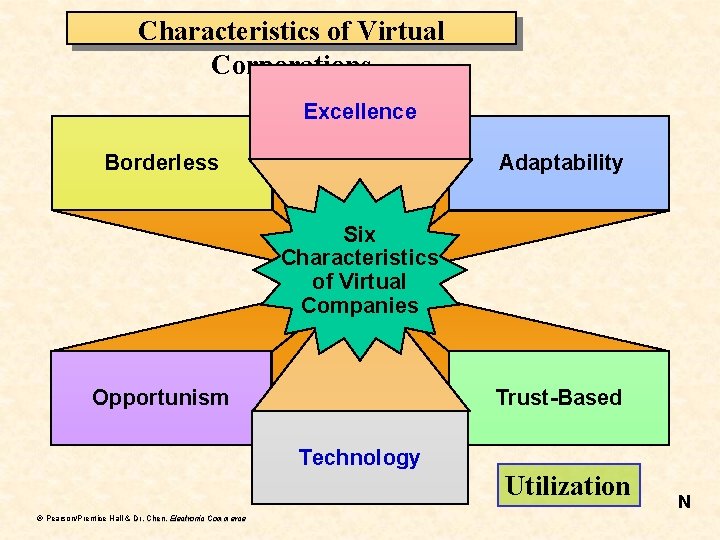
Characteristics of Virtual Corporations Excellence Borderless Adaptability Six Characteristics of Virtual Companies Opportunism Trust-Based Technology Utilization ã Pearson/Prentice Hall & Dr. Chen, Electronic Commerce N
E-Strategy Implementation – Redesigning business processes • business process reengineering (BPR) A methodology for conducting a comprehensive redesign of an enterprise’s processes ã Pearson/Prentice Hall & Dr. Chen, Electronic Commerce
E-Strategy Implementation – business process management (BPM) Method for business restructuring that combines workflow systems and redesign methods; covers three process categories— people-to-people, systems-to-systems, and systems-to-people interactions ã Pearson/Prentice Hall & Dr. Chen, Electronic Commerce
14. 7 E-Strategy and Project Assessment • The Objectives of Assessment – Measure the extent to which the EC strategy and ensuing projects are delivering what they were supposed to deliver – Determine if the EC strategy and projects are still viable in the current environment – Reassess the initial strategy in order to learn from mistakes and improve future planning – Identify failing projects as soon as possible and determine why they failed ã Pearson/Prentice Hall & Dr. Chen, Electronic Commerce
E-Strategy and Project Assessment • Measuring Results and Using Metrics – metric A specific, measurable standard against which actual performance is compared – corporate (business) performance management (CPM, BPM) Advanced performance measuring and analysis approach that embraces planning and strategy ã Pearson/Prentice Hall & Dr. Chen, Electronic Commerce
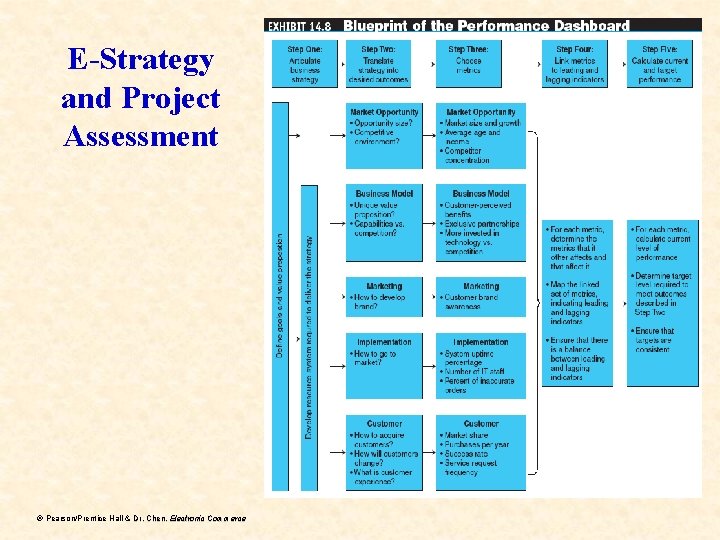
E-Strategy and Project Assessment ã Pearson/Prentice Hall & Dr. Chen, Electronic Commerce
E-Strategy and Project Assessment • Web analytics The analysis of clickstream data to understand visitor behavior on a Web site ã Pearson/Prentice Hall & Dr. Chen, Electronic Commerce
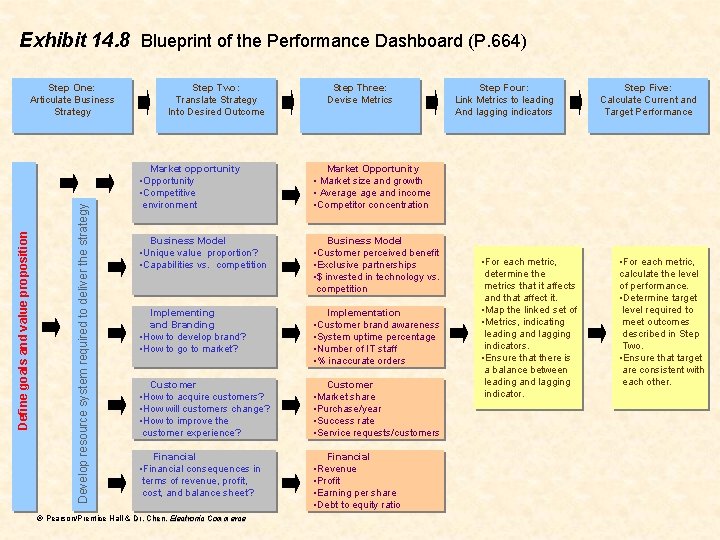
Exhibit 14. 8 Blueprint of the Performance Dashboard (P. 664) Develop resource system required to deliver the strategy Define goals and value proposition Step One: Articulate Business Strategy Step Two: Translate Strategy Into Desired Outcome Step Three: Devise Metrics Market opportunity • Opportunity • Competitive environment Market Opportunity • Market size and growth • Average and income • Competitor concentration Business Model • Unique value proportion? • Capabilities vs. competition Business Model • Customer perceived benefit • Exclusive partnerships • $ invested in technology vs. competition Implementing and Branding • How to develop brand? • How to go to market? Implementation • Customer brand awareness • System uptime percentage • Number of IT staff • % inaccurate orders Customer • How to acquire customers? • How will customers change? • How to improve the customer experience? Customer • Market share • Purchase/year • Success rate • Service requests/customers Financial • Financial consequences in terms of revenue, profit, cost, and balance sheet? Financial • Revenue • Profit • Earning per share • Debt to equity ratio ã Pearson/Prentice Hall & Dr. Chen, Electronic Commerce Step Four: Link Metrics to leading And lagging indicators • For each metric, determine the metrics that it affects and that affect it. • Map the linked set of • Metrics, indicating leading and lagging indicators. • Ensure that there is a balance between leading and lagging indicator. Step Five: Calculate Current and Target Performance • For each metric, calculate the level of performance. • Determine target level required to meet outcomes described in Step Two. • Ensure that target are consistent with each other.
14. 8 Global E-Commerce • Benefits and Extent of Operations – The major advantage of EC is the ability to do business at any time, from anywhere, and at a reasonable cost ã Pearson/Prentice Hall & Dr. Chen, Electronic Commerce
Global E-Commerce • Barriers to Global EC – Cultural issues – Culture and language translation – Administrative issues – Geographic issues and localization – Economic issues ã Pearson/Prentice Hall & Dr. Chen, Electronic Commerce
Global E-Commerce • Breaking Down the Barriers to Global EC – Be strategic – Know your audience – Localize – Think globally, act consistently – Value the human touch – Clarify, document, explain – Offer services that reduce barriers ã Pearson/Prentice Hall & Dr. Chen, Electronic Commerce
E-Commerce in Small and Medium. Sized Enterprises • Advantages and Benefits of EC to Small and Medium-Sized Enterprises – Inexpensive sources of information – Inexpensive ways of advertising and conducting market research – Competitor analysis is easier – Inexpensive ways to build storefronts – Less locked into legacy technologies – Image and public recognition can be generated quickly – An opportunity to reach worldwide customers ã Pearson/Prentice Hall & Dr. Chen, Electronic Commerce
14. 9 E-Commerce in Small and Medium-Sized Enterprises • Disadvantages and Risks of EC to Small and Medium-Sized Enterprises – Lack of financial resources to fully exploit the Web – Lack of technical staff or insufficient expertise in legal issues, advertising, etc. – Less risk tolerance than a large company. – Products not suitable for online sales – Reduced personal contact with customers – Inability to afford the advantages of digital exchanges ã Pearson/Prentice Hall & Dr. Chen, Electronic Commerce
E-Commerce in Small and Medium. Sized Enterprises • Critical Success Factors for SMES – Product is critical – Payment methods must be flexible – Electronic payments must be secure – Capital investment should be kept to a minimum – Inventory control is crucial – Logistics services must be quick and reliable ã Pearson/Prentice Hall & Dr. Chen, Electronic Commerce
E-Commerce in Small and Medium. Sized Enterprises • Critical Success Factors for SMES – Owner support – High visibility on the Internet – Join an online community – A Web site should provide all the services needed by consumers • Supporting SMES – Government agencies – Vendor service centers ã Pearson/Prentice Hall & Dr. Chen, Electronic Commerce
The Key to successful business on the Internet. . . • The key to successful business on the Internet is not the formulation of a conceptual strategy but the execution of that strategy – the content owners must buy into the strategy and have the confidence of senior executives, – often the decisions the content owners make may have serious consequences to the organization and its strategy – Buy-in and open discussions are keys to success Robert Plant, e. Commerce: Formulation of Strategy, pp. 67, 1999, Prentice Hall ã Pearson/Prentice Hall & Dr. Chen, Electronic Commerce
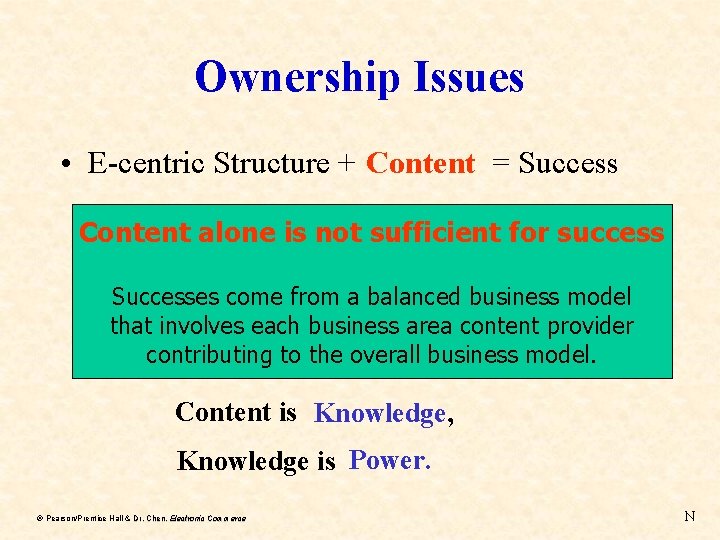
Ownership Issues • E-centric Structure + Content = Success Content alone is not sufficient for success Successes come from a balanced business model that involves each business area content provider contributing to the overall business model. Content is Knowledge, Knowledge is Power. ã Pearson/Prentice Hall & Dr. Chen, Electronic Commerce N
BREAK • Application Case 14. 3: Web Page Translation at the Denver Metro Convention and Visitors Bureau (p. 667) ã Pearson/Prentice Hall & Dr. Chen, Electronic Commerce
Managerial Issues 1. What is the strategic value of EC to the organization? 2. Who determines EC strategy? 3. What are the benefits and risks of EC? 4. Why do we need a plan? 5. What metrics should we use? ã Pearson/Prentice Hall & Dr. Chen, Electronic Commerce
Managerial Issues 6. What staffing is required? 7. How can we go global? 8. Should the dot-com activities be spun off as a separate company? 9. Can we learn to love smallness? 10. Is e-business always beneficial? ã Pearson/Prentice Hall & Dr. Chen, Electronic Commerce

ã Pearson/Prentice Hall & Dr. Chen, Electronic Commerce
- Slides: 72