
Chapter 14 Density Matrix State of a system
- Slides: 53
Chapter 14
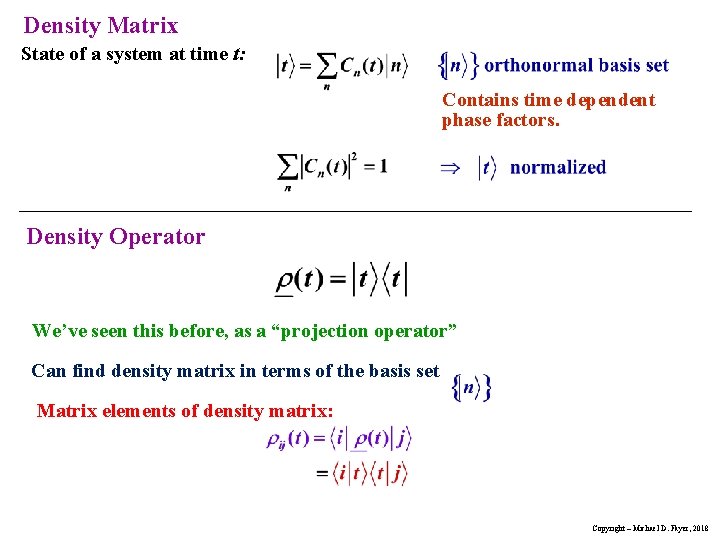
Density Matrix State of a system at time t: Contains time dependent phase factors. Density Operator We’ve seen this before, as a “projection operator” Can find density matrix in terms of the basis set Matrix elements of density matrix: Copyright – Michael D. Fayer, 2018
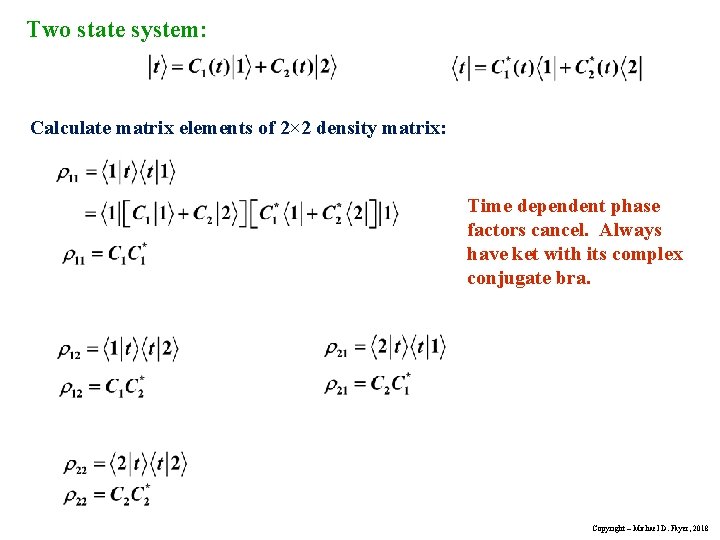
Two state system: Calculate matrix elements of 2× 2 density matrix: Time dependent phase factors cancel. Always have ket with its complex conjugate bra. Copyright – Michael D. Fayer, 2018
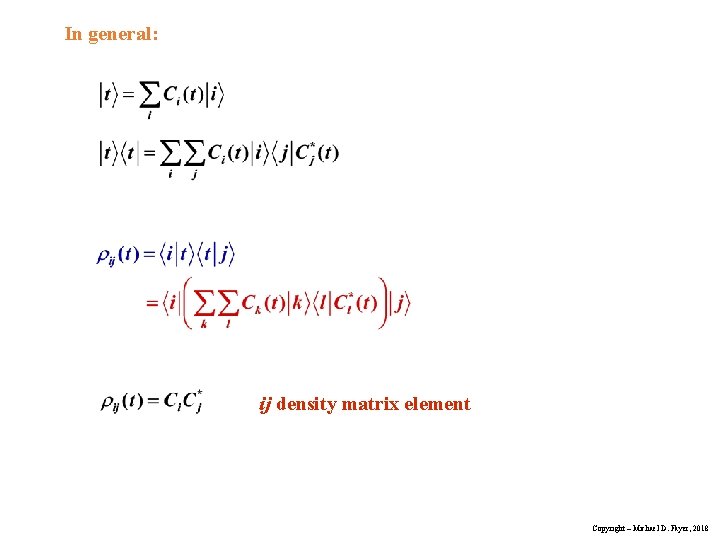
In general: ij density matrix element Copyright – Michael D. Fayer, 2018
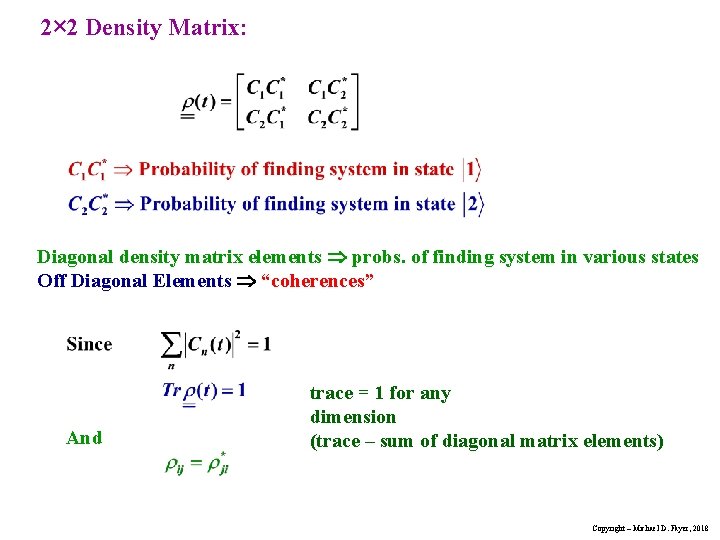
2× 2 Density Matrix: Diagonal density matrix elements probs. of finding system in various states Off Diagonal Elements “coherences” And trace = 1 for any dimension (trace – sum of diagonal matrix elements) Copyright – Michael D. Fayer, 2018
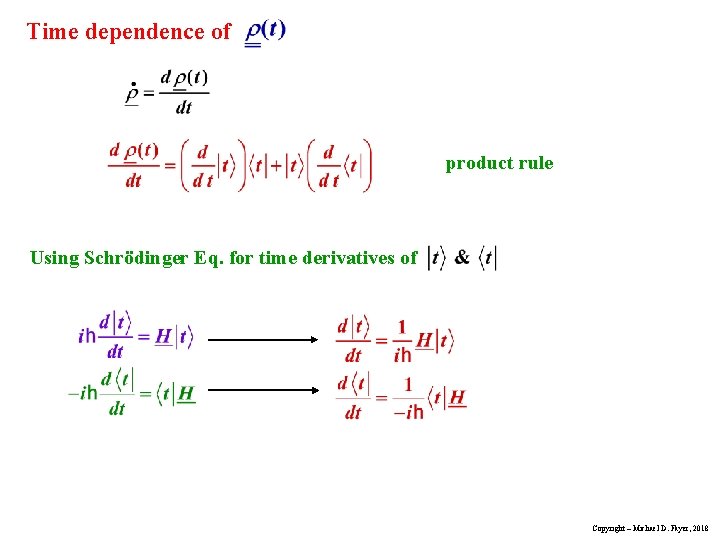
Time dependence of product rule Using Schrödinger Eq. for time derivatives of Copyright – Michael D. Fayer, 2018
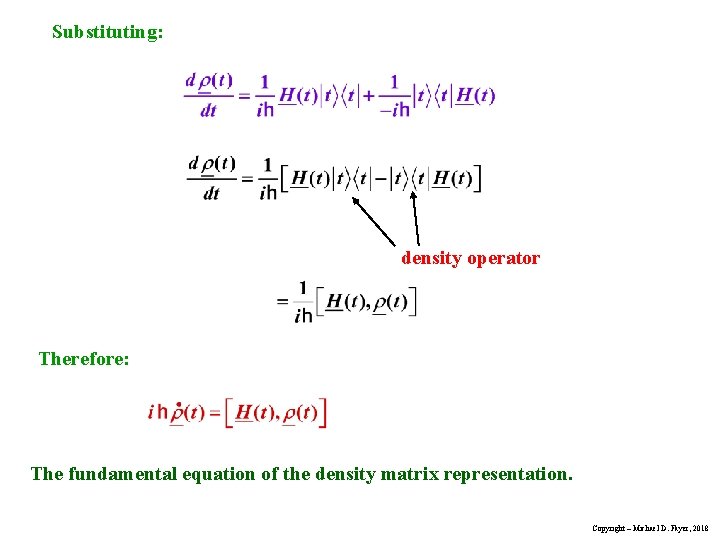
Substituting: density operator Therefore: The fundamental equation of the density matrix representation. Copyright – Michael D. Fayer, 2018
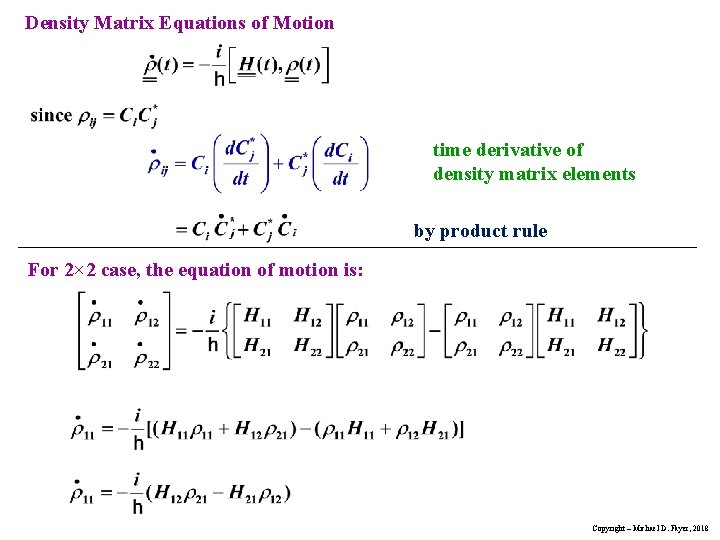
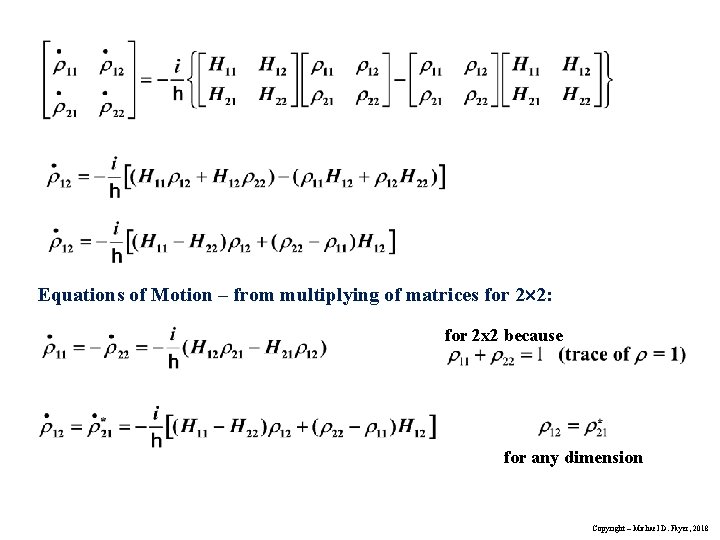
Density Matrix Equations of Motion time derivative of density matrix elements by product rule For 2× 2 case, the equation of motion is: Copyright – Michael D. Fayer, 2018
Equations of Motion – from multiplying of matrices for 2 2: for 2 x 2 because for any dimension Copyright – Michael D. Fayer, 2018
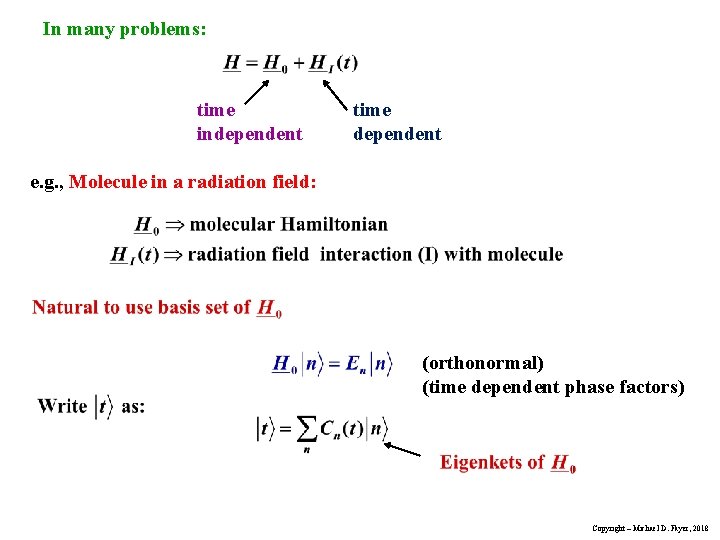
In many problems: time independent time dependent e. g. , Molecule in a radiation field: (orthonormal) (time dependent phase factors) Copyright – Michael D. Fayer, 2018
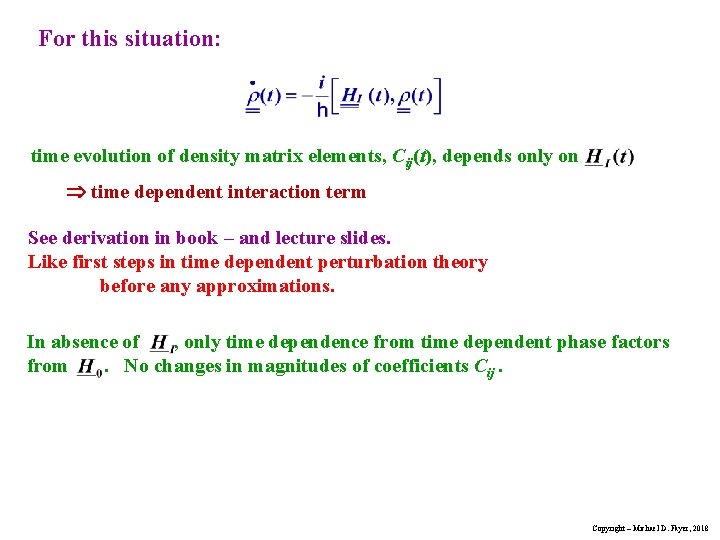
For this situation: time evolution of density matrix elements, Cij(t), depends only on time dependent interaction term See derivation in book – and lecture slides. Like first steps in time dependent perturbation theory before any approximations. In absence of , only time dependence from time dependent phase factors from. No changes in magnitudes of coefficients Cij. Copyright – Michael D. Fayer, 2018
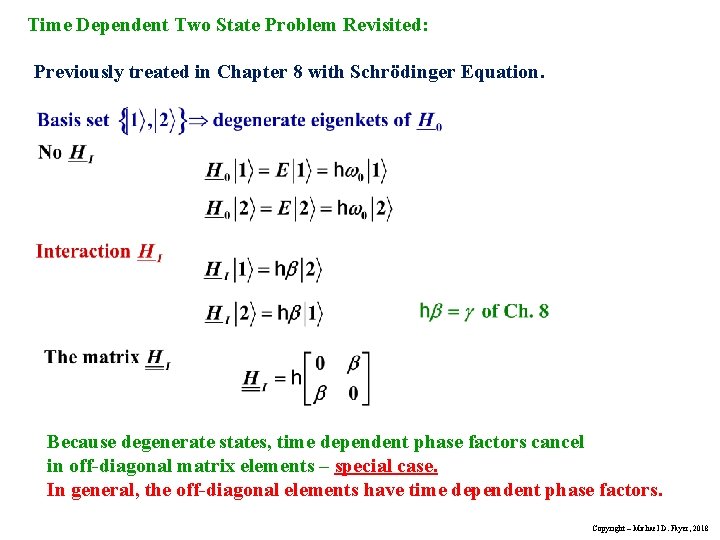
Time Dependent Two State Problem Revisited: Previously treated in Chapter 8 with Schrödinger Equation. Because degenerate states, time dependent phase factors cancel in off-diagonal matrix elements – special case. In general, the off-diagonal elements have time dependent phase factors. Copyright – Michael D. Fayer, 2018
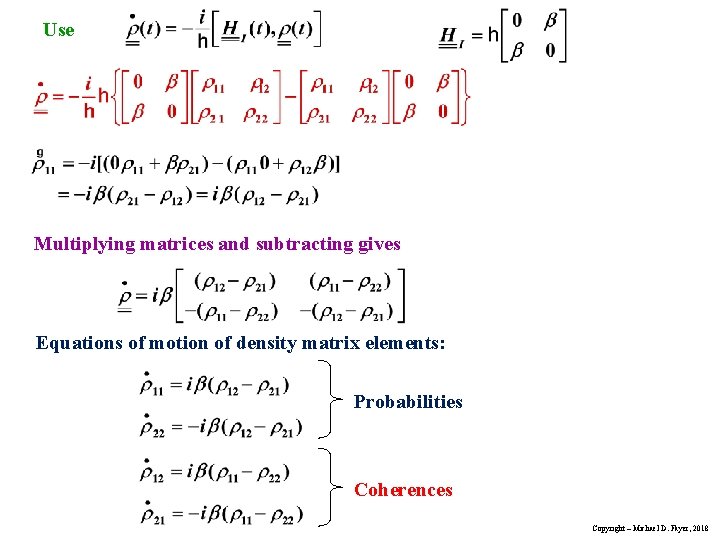
Use Multiplying matrices and subtracting gives Equations of motion of density matrix elements: Probabilities Coherences Copyright – Michael D. Fayer, 2018
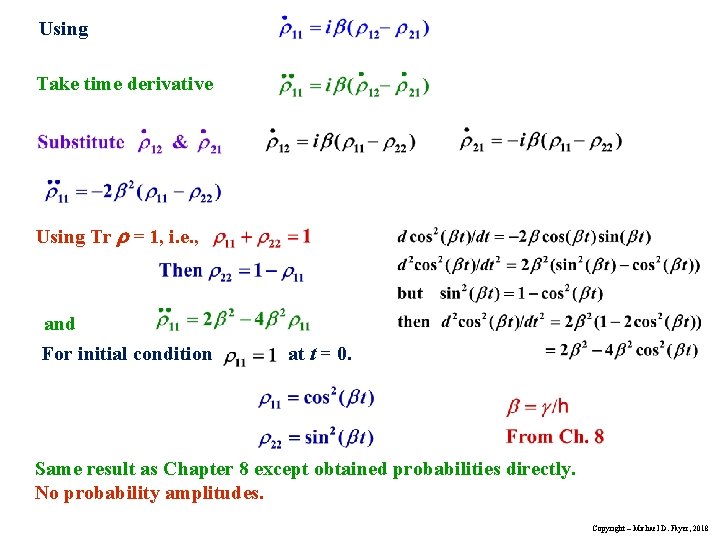
Using Take time derivative Using Tr = 1, i. e. , and For initial condition at t = 0. Same result as Chapter 8 except obtained probabilities directly. No probability amplitudes. Copyright – Michael D. Fayer, 2018
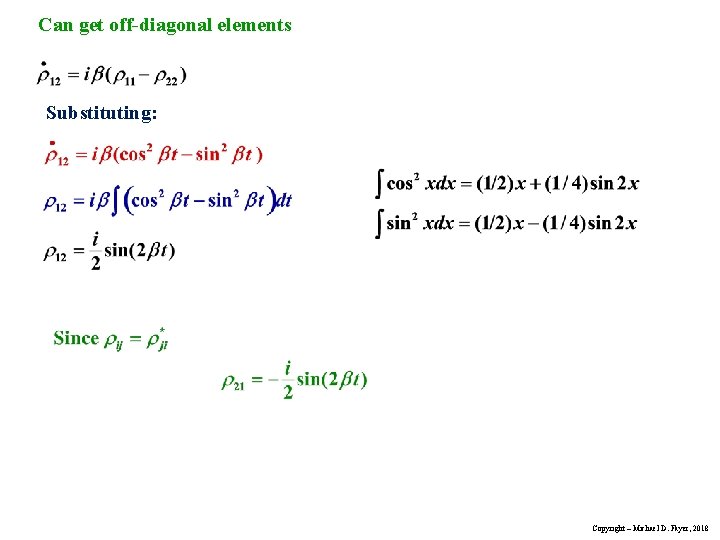
Can get off-diagonal elements Substituting: Copyright – Michael D. Fayer, 2018
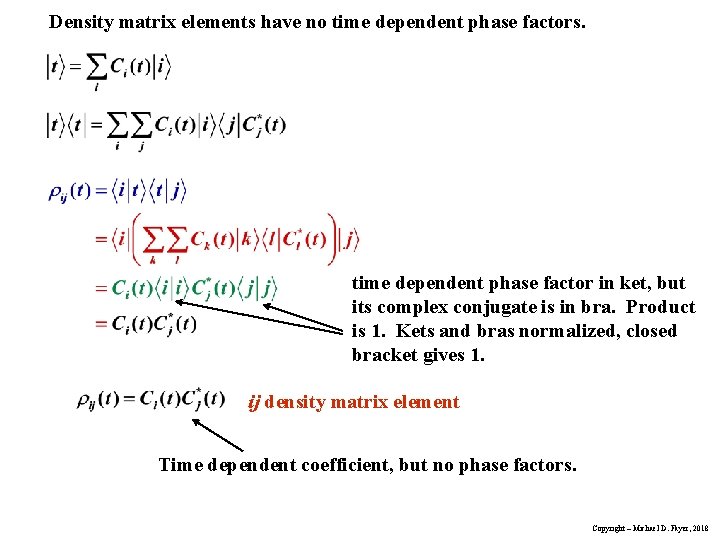
Density matrix elements have no time dependent phase factors. time dependent phase factor in ket, but its complex conjugate is in bra. Product is 1. Kets and bras normalized, closed bracket gives 1. ij density matrix element Time dependent coefficient, but no phase factors. Copyright – Michael D. Fayer, 2018
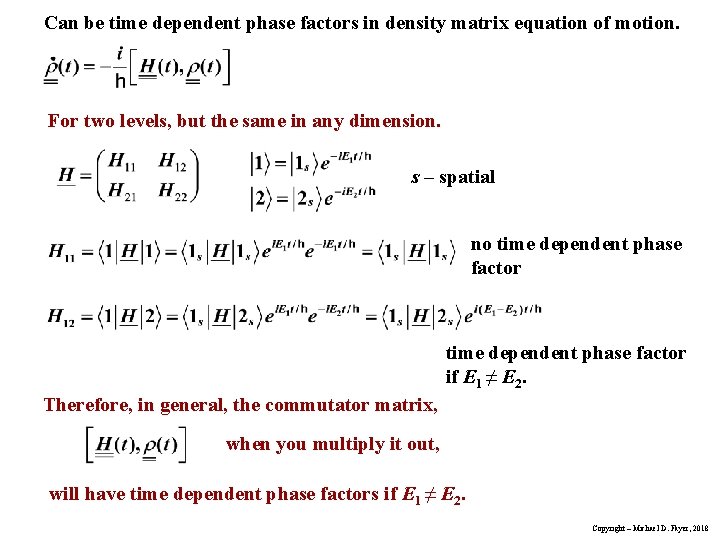
Can be time dependent phase factors in density matrix equation of motion. For two levels, but the same in any dimension. s – spatial no time dependent phase factor if E 1 ≠ E 2. Therefore, in general, the commutator matrix, when you multiply it out, will have time dependent phase factors if E 1 ≠ E 2. Copyright – Michael D. Fayer, 2018
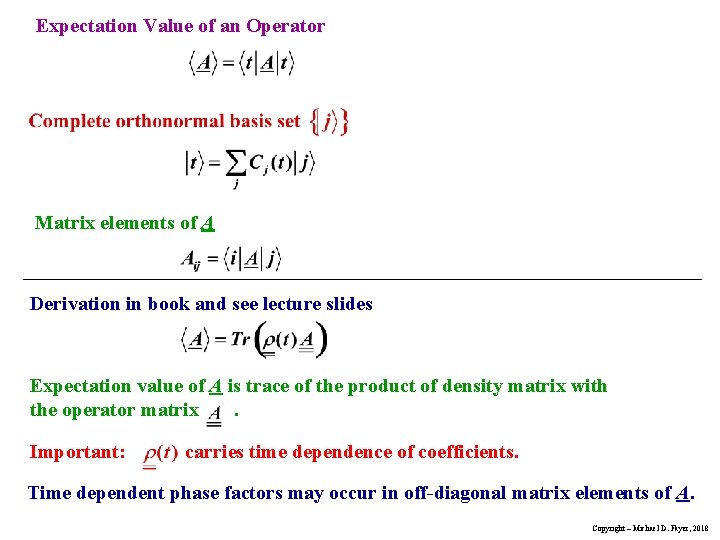
Expectation Value of an Operator Matrix elements of A Derivation in book and see lecture slides Expectation value of A is trace of the product of density matrix with the operator matrix. Important: carries time dependence of coefficients. Time dependent phase factors may occur in off-diagonal matrix elements of A. Copyright – Michael D. Fayer, 2018
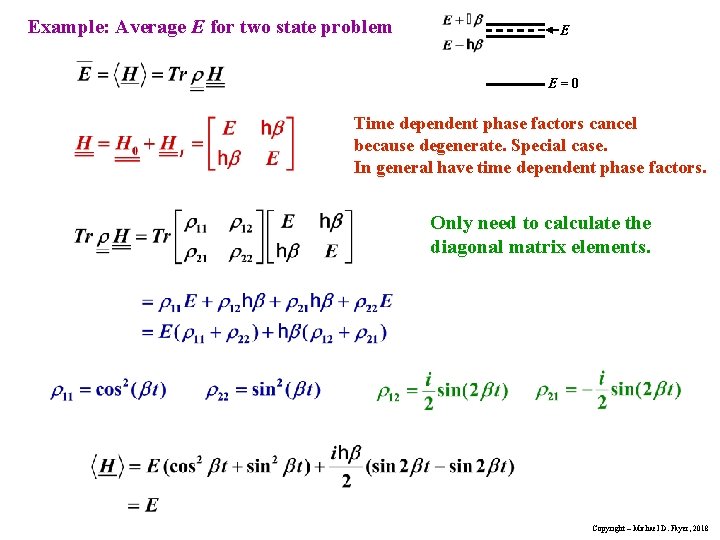
Example: Average E for two state problem E E=0 Time dependent phase factors cancel because degenerate. Special case. In general have time dependent phase factors. Only need to calculate the diagonal matrix elements. Copyright – Michael D. Fayer, 2018
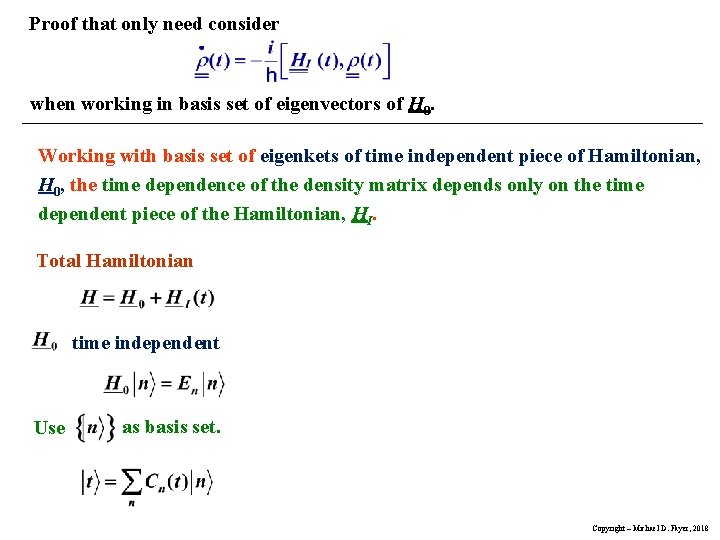
Proof that only need consider when working in basis set of eigenvectors of H 0. Working with basis set of eigenkets of time independent piece of Hamiltonian, H 0, the time dependence of the density matrix depends only on the time dependent piece of the Hamiltonian, HI. Total Hamiltonian time independent Use as basis set. Copyright – Michael D. Fayer, 2018
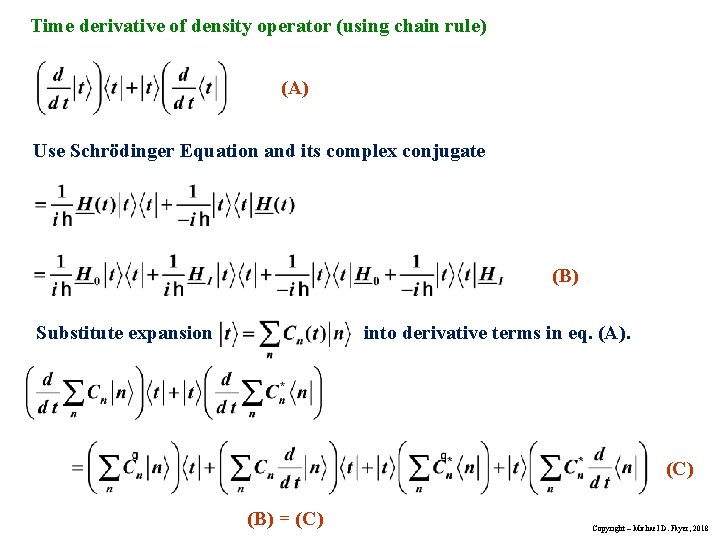
Time derivative of density operator (using chain rule) (A) Use Schrödinger Equation and its complex conjugate (B) Substitute expansion into derivative terms in eq. (A). (C) (B) = (C) Copyright – Michael D. Fayer, 2018
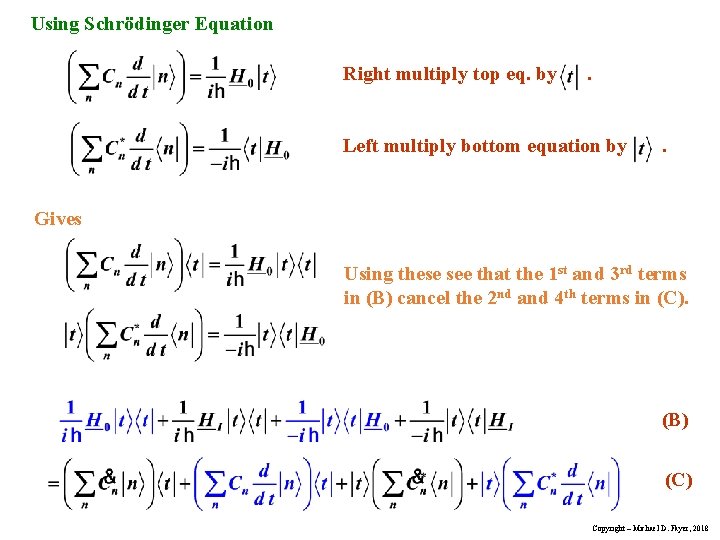
Using Schrödinger Equation Right multiply top eq. by . Left multiply bottom equation by . Gives Using these see that the 1 st and 3 rd terms in (B) cancel the 2 nd and 4 th terms in (C). (B) (C) Copyright – Michael D. Fayer, 2018
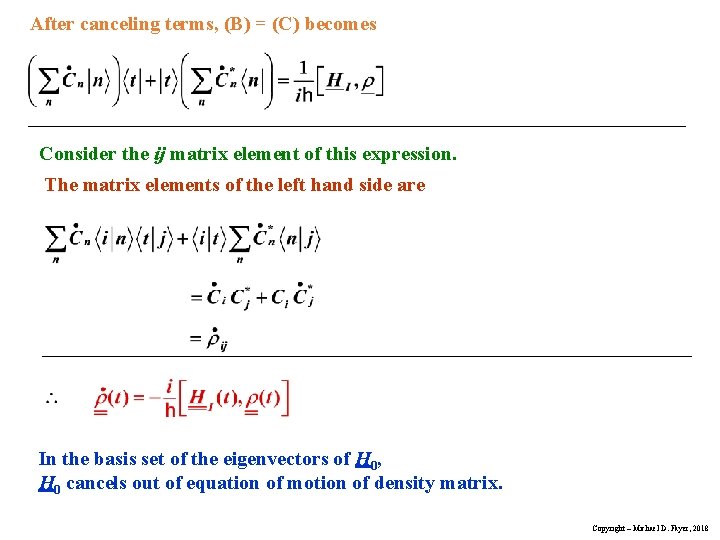
After canceling terms, (B) = (C) becomes Consider the ij matrix element of this expression. The matrix elements of the left hand side are In the basis set of the eigenvectors of H 0, H 0 cancels out of equation of motion of density matrix. Copyright – Michael D. Fayer, 2018
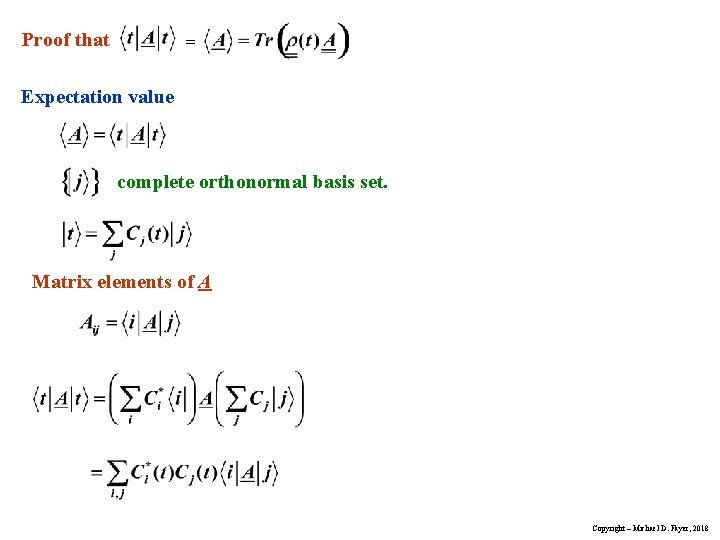
Proof that = Expectation value complete orthonormal basis set. Matrix elements of A Copyright – Michael D. Fayer, 2018
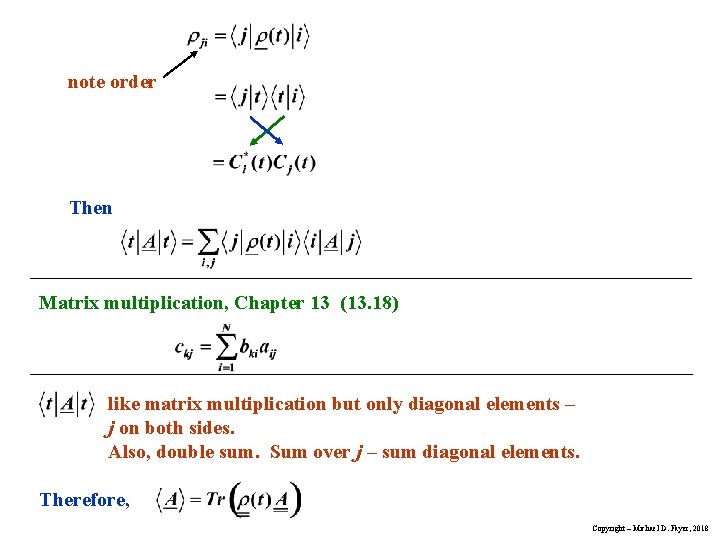
note order Then Matrix multiplication, Chapter 13 (13. 18) like matrix multiplication but only diagonal elements – j on both sides. Also, double sum. Sum over j – sum diagonal elements. Therefore, Copyright – Michael D. Fayer, 2018
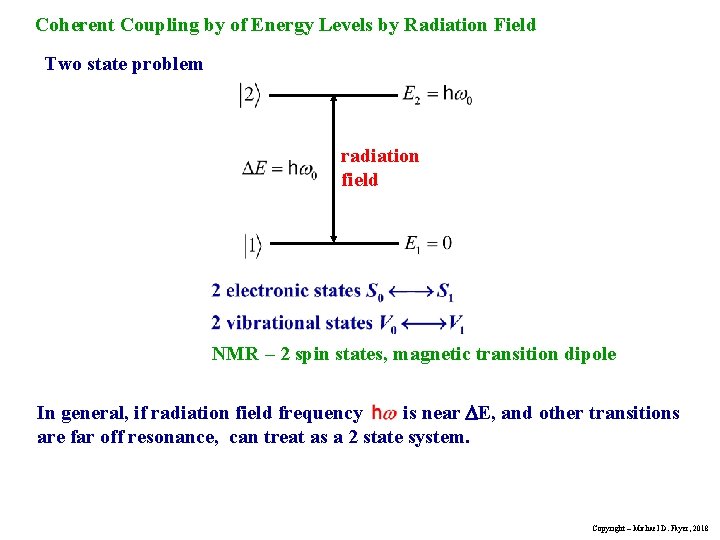
Coherent Coupling by of Energy Levels by Radiation Field Two state problem radiation field NMR – 2 spin states, magnetic transition dipole In general, if radiation field frequency is near E, and other transitions are far off resonance, can treat as a 2 state system. Copyright – Michael D. Fayer, 2018
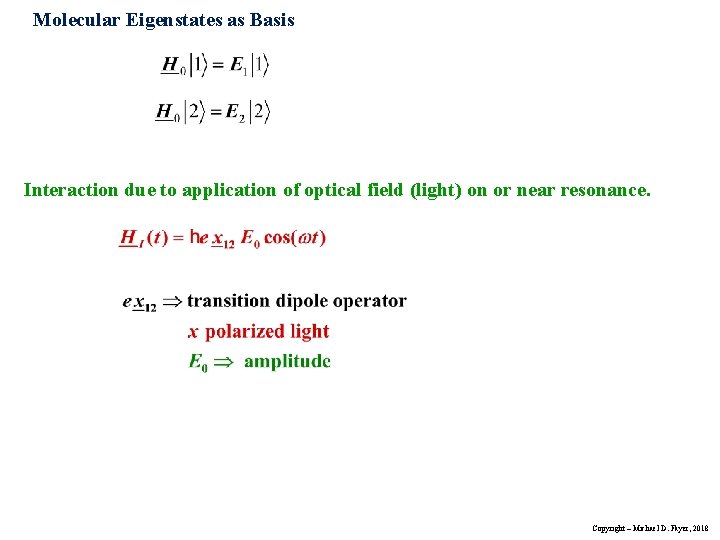
Molecular Eigenstates as Basis Interaction due to application of optical field (light) on or near resonance. Copyright – Michael D. Fayer, 2018
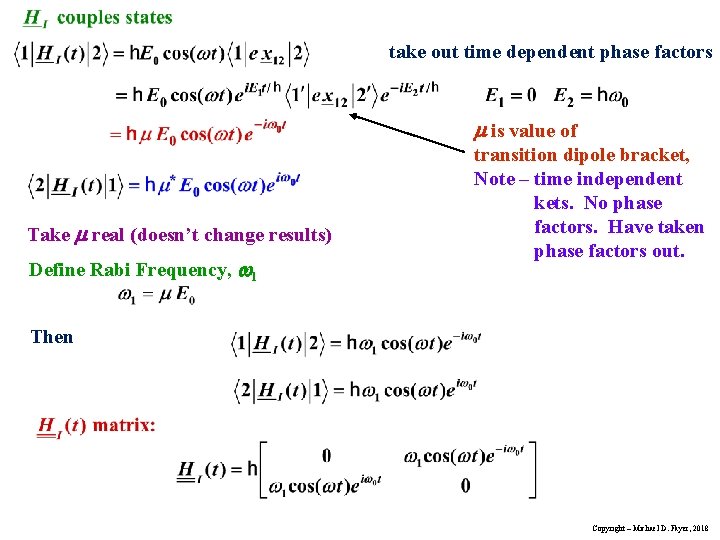
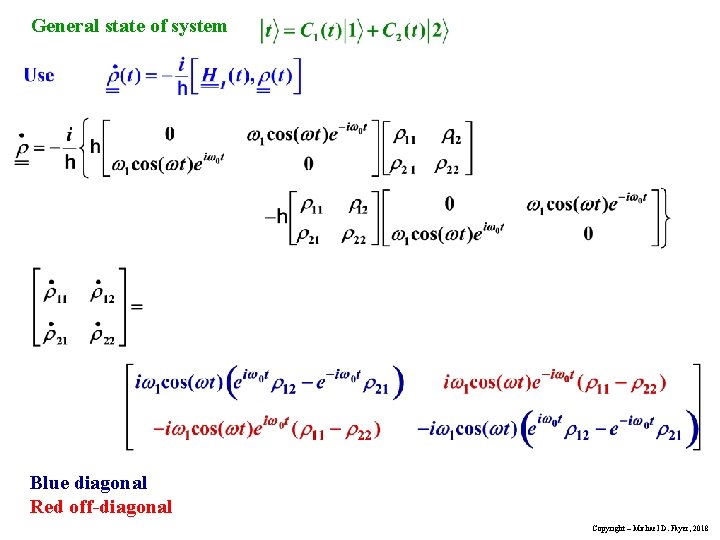
take out time dependent phase factors is value of Take real (doesn’t change results) Define Rabi Frequency, 1 transition dipole bracket, Note – time independent kets. No phase factors. Have taken phase factors out. Then Copyright – Michael D. Fayer, 2018
General state of system Blue diagonal Red off-diagonal Copyright – Michael D. Fayer, 2018
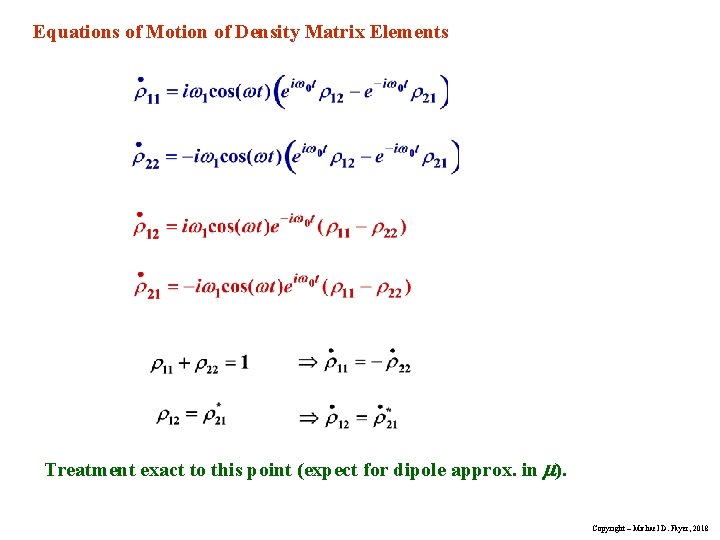
Equations of Motion of Density Matrix Elements Treatment exact to this point (expect for dipole approx. in ). Copyright – Michael D. Fayer, 2018
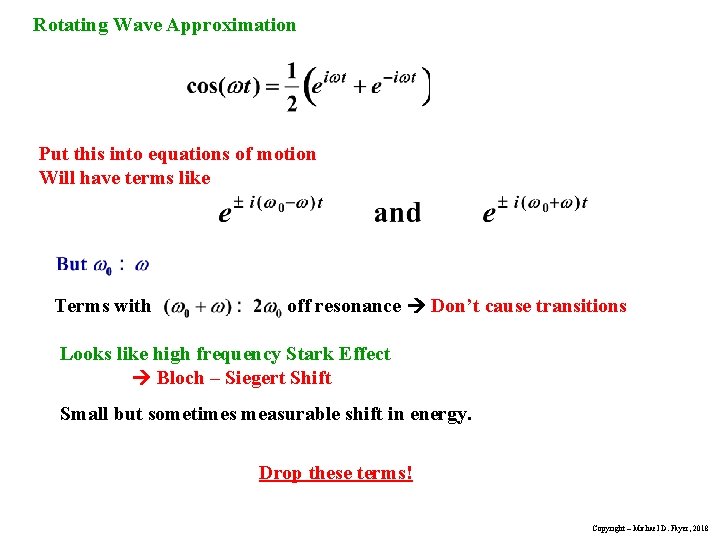
Rotating Wave Approximation Put this into equations of motion Will have terms like Terms with off resonance Don’t cause transitions Looks like high frequency Stark Effect Bloch – Siegert Shift Small but sometimes measurable shift in energy. Drop these terms! Copyright – Michael D. Fayer, 2018
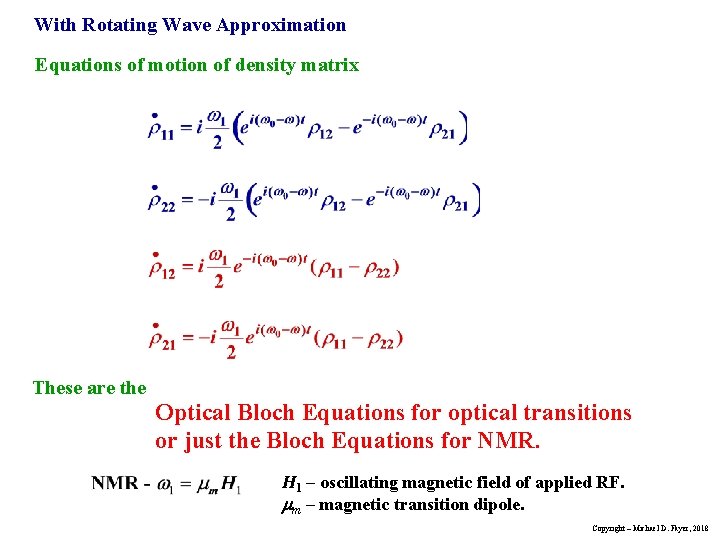
With Rotating Wave Approximation Equations of motion of density matrix These are the Optical Bloch Equations for optical transitions or just the Bloch Equations for NMR. H 1 – oscillating magnetic field of applied RF. m – magnetic transition dipole. Copyright – Michael D. Fayer, 2018
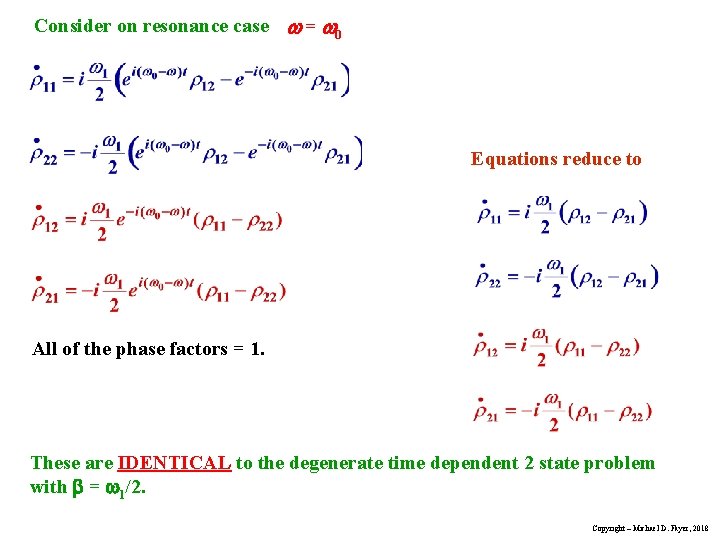
Consider on resonance case = 0 Equations reduce to All of the phase factors = 1. These are IDENTICAL to the degenerate time dependent 2 state problem with = 1/2. Copyright – Michael D. Fayer, 2018
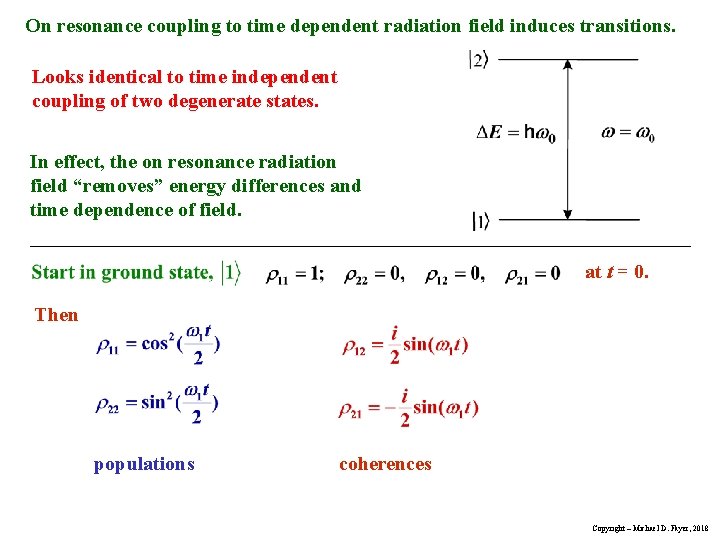
On resonance coupling to time dependent radiation field induces transitions. Looks identical to time independent coupling of two degenerate states. In effect, the on resonance radiation field “removes” energy differences and time dependence of field. at t = 0. Then populations coherences Copyright – Michael D. Fayer, 2018
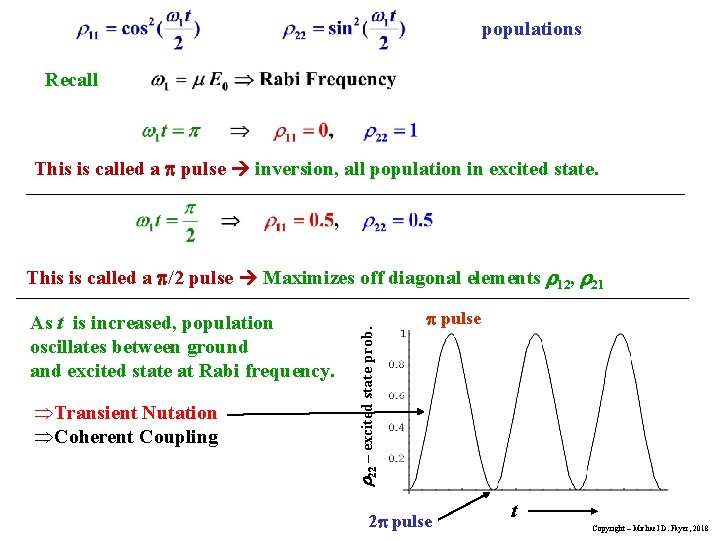
populations Recall This is called a pulse inversion, all population in excited state. As t is increased, population oscillates between ground and excited state at Rabi frequency. ÞTransient Nutation ÞCoherent Coupling 22 – excited state prob. This is called a /2 pulse Maximizes off diagonal elements 12, 21 pulse 2 pulse t Copyright – Michael D. Fayer, 2018
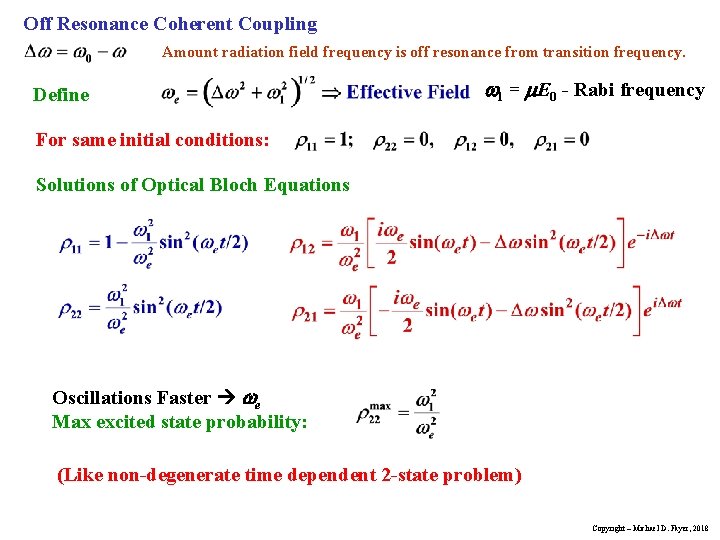
Off Resonance Coherent Coupling Amount radiation field frequency is off resonance from transition frequency. Define 1 = E 0 - Rabi frequency For same initial conditions: Solutions of Optical Bloch Equations Oscillations Faster e Max excited state probability: (Like non-degenerate time dependent 2 -state problem) Copyright – Michael D. Fayer, 2018
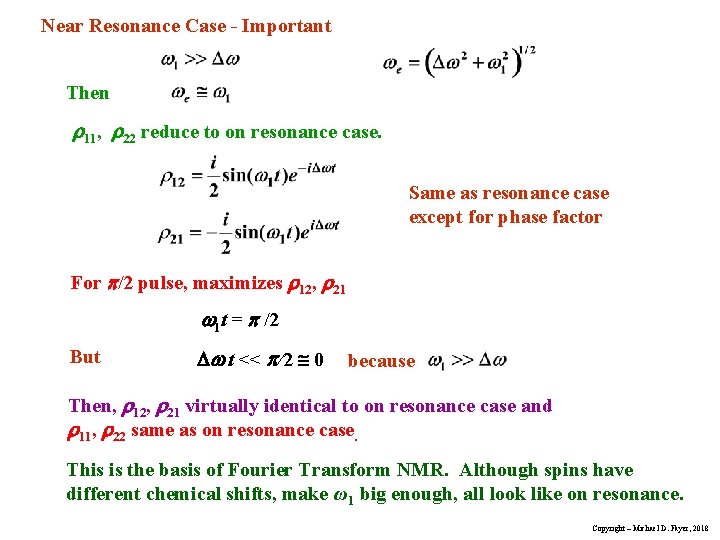
Near Resonance Case - Important Then 11, 22 reduce to on resonance case. Same as resonance case except for phase factor For /2 pulse, maximizes 12, 21 1 t = /2 But t << /2 0 because Then, 12, 21 virtually identical to on resonance case and 11, 22 same as on resonance case. This is the basis of Fourier Transform NMR. Although spins have different chemical shifts, make ω1 big enough, all look like on resonance. Copyright – Michael D. Fayer, 2018
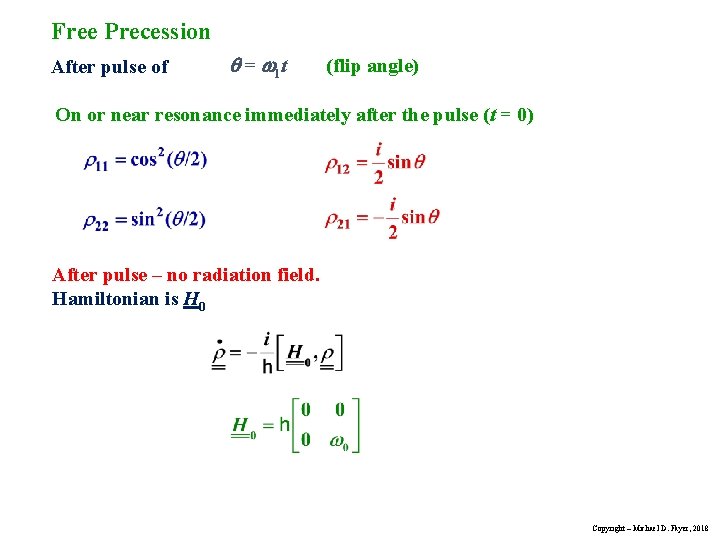
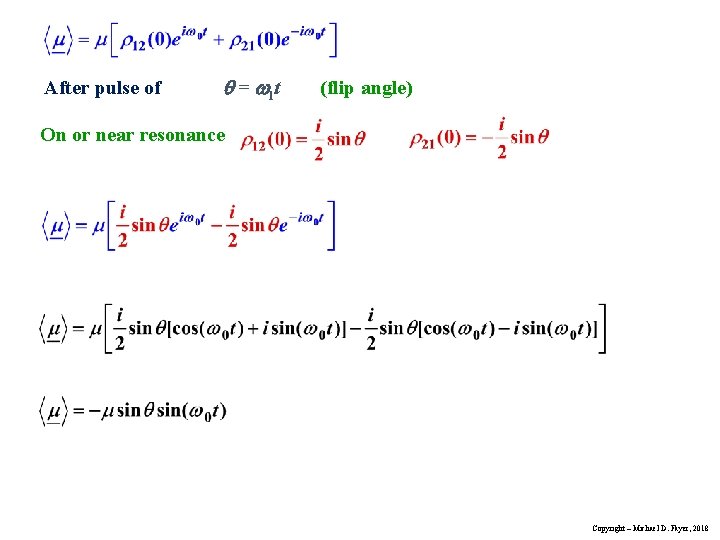
Free Precession After pulse of = 1 t (flip angle) On or near resonance immediately after the pulse (t = 0) After pulse – no radiation field. Hamiltonian is H 0 Copyright – Michael D. Fayer, 2018
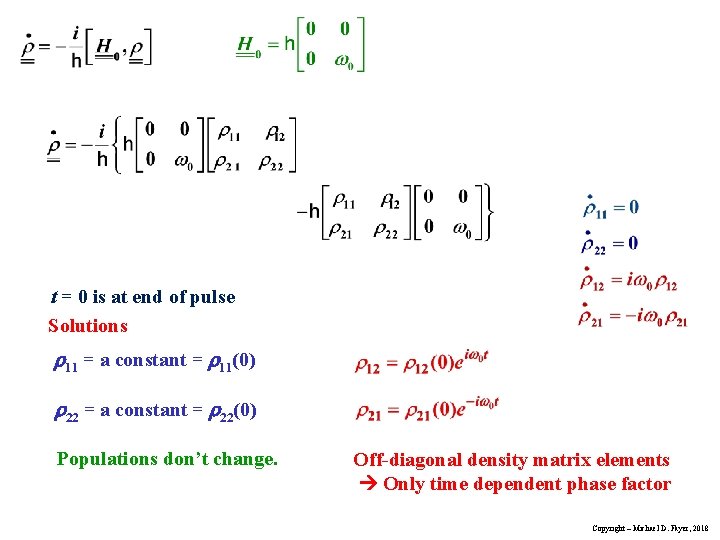
t = 0 is at end of pulse Solutions 11 = a constant = 11(0) 22 = a constant = 22(0) Populations don’t change. Off-diagonal density matrix elements Only time dependent phase factor Copyright – Michael D. Fayer, 2018
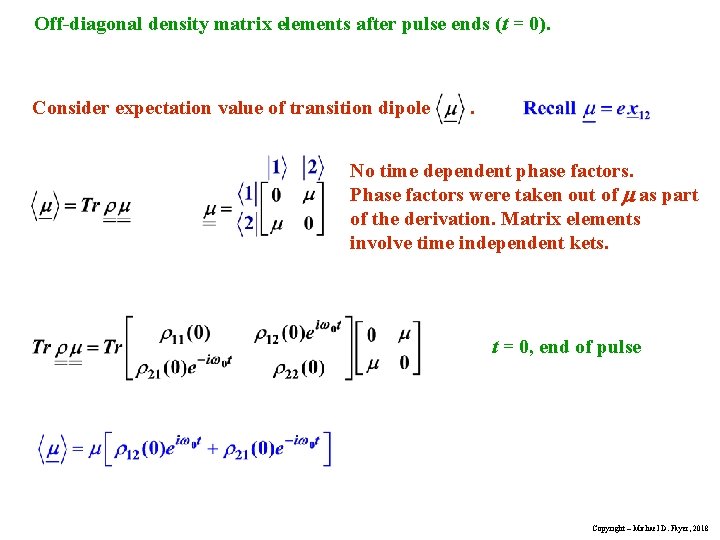
Off-diagonal density matrix elements after pulse ends (t = 0). Consider expectation value of transition dipole . No time dependent phase factors. Phase factors were taken out of as part of the derivation. Matrix elements involve time independent kets. t = 0, end of pulse Copyright – Michael D. Fayer, 2018
After pulse of = 1 t (flip angle) On or near resonance Copyright – Michael D. Fayer, 2018
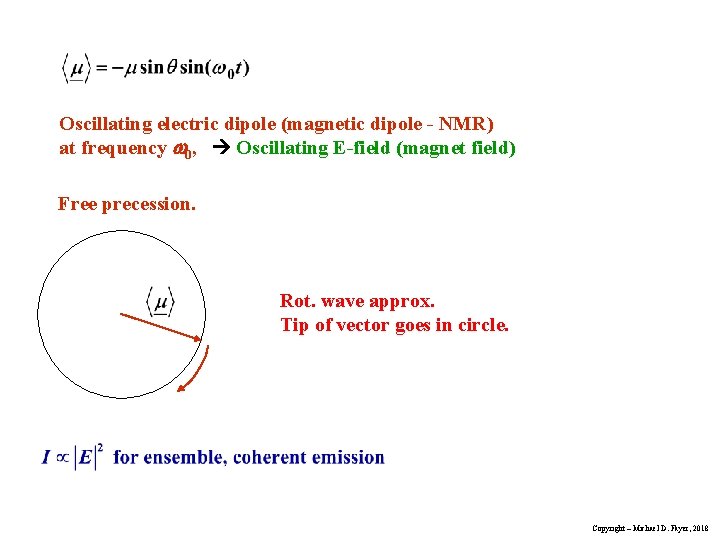
Oscillating electric dipole (magnetic dipole - NMR) at frequency 0, Oscillating E-field (magnet field) Free precession. Rot. wave approx. Tip of vector goes in circle. Copyright – Michael D. Fayer, 2018
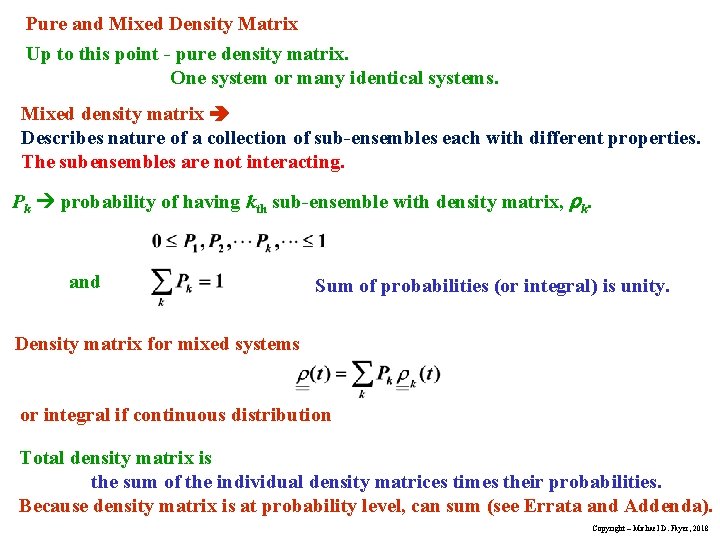
Pure and Mixed Density Matrix Up to this point - pure density matrix. One system or many identical systems. Mixed density matrix Describes nature of a collection of sub-ensembles each with different properties. The subensembles are not interacting. Pk probability of having kth sub-ensemble with density matrix, k. and Sum of probabilities (or integral) is unity. Density matrix for mixed systems or integral if continuous distribution Total density matrix is the sum of the individual density matrices times their probabilities. Because density matrix is at probability level, can sum (see Errata and Addenda). Copyright – Michael D. Fayer, 2018
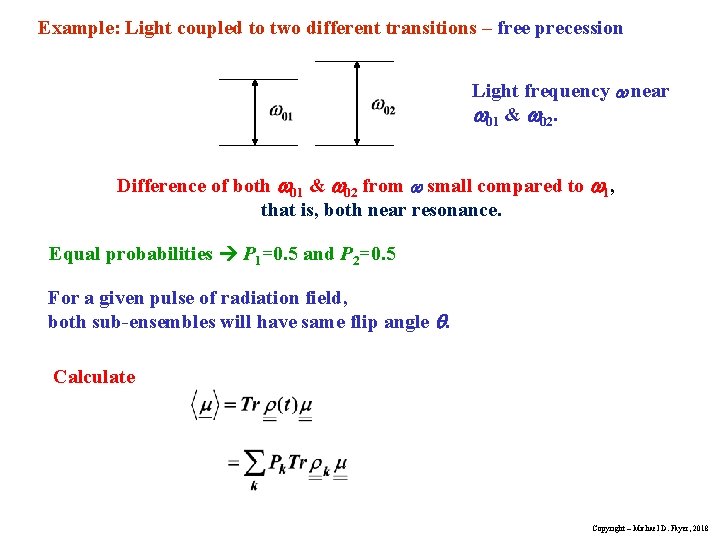
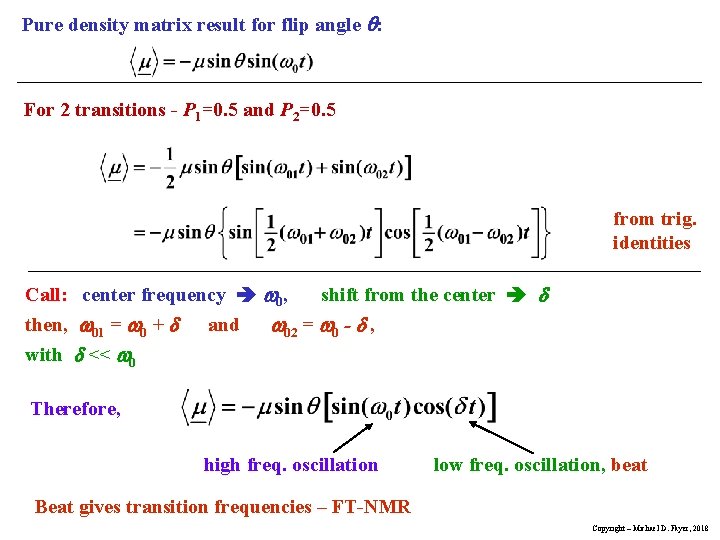
Example: Light coupled to two different transitions – free precession Light frequency near 01 & 02. Difference of both 01 & 02 from small compared to 1, that is, both near resonance. Equal probabilities P 1=0. 5 and P 2=0. 5 For a given pulse of radiation field, both sub-ensembles will have same flip angle . Calculate Copyright – Michael D. Fayer, 2018
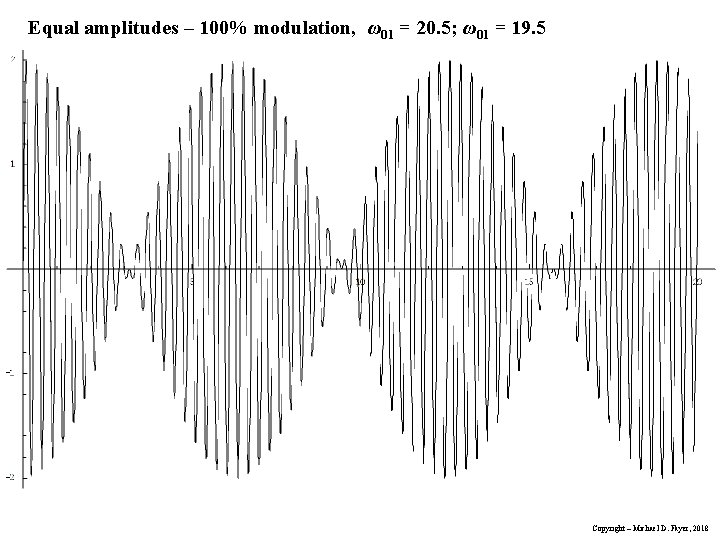
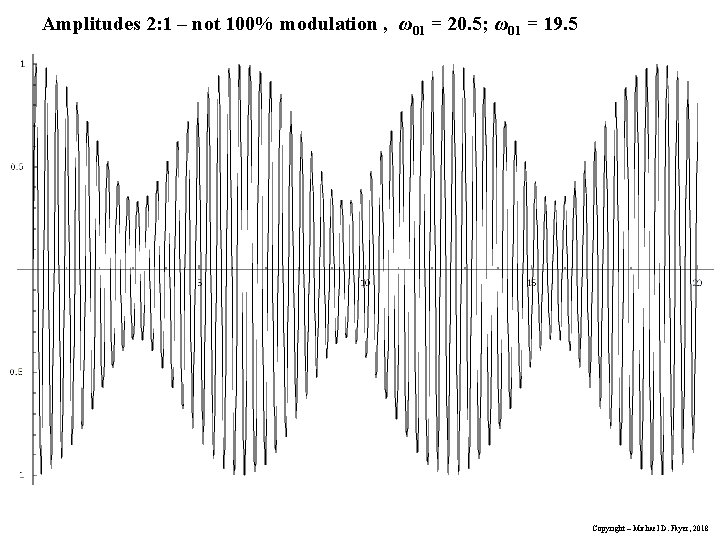
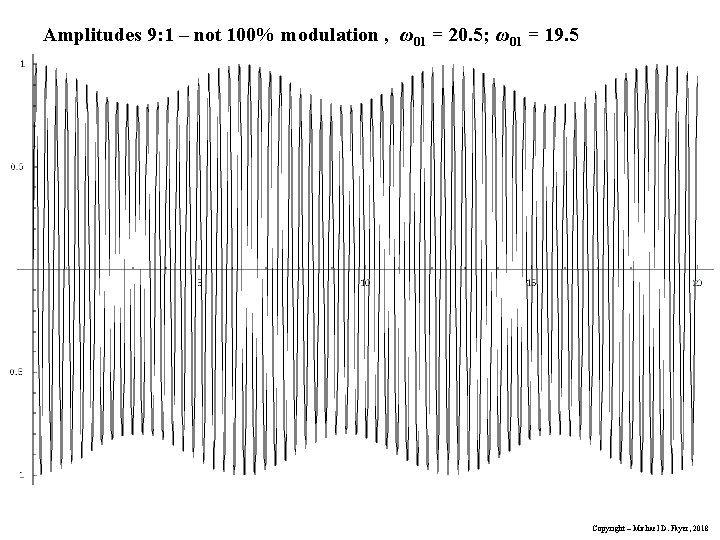
Pure density matrix result for flip angle : For 2 transitions - P 1=0. 5 and P 2=0. 5 from trig. identities Call: center frequency 0, shift from the center then, 01 = 0 + and 02 = 0 - , with << 0 Therefore, high freq. oscillation low freq. oscillation, beat Beat gives transition frequencies – FT-NMR Copyright – Michael D. Fayer, 2018
Equal amplitudes – 100% modulation, ω01 = 20. 5; ω01 = 19. 5 Copyright – Michael D. Fayer, 2018
Amplitudes 2: 1 – not 100% modulation , ω01 = 20. 5; ω01 = 19. 5 Copyright – Michael D. Fayer, 2018
Amplitudes 9: 1 – not 100% modulation , ω01 = 20. 5; ω01 = 19. 5 Copyright – Michael D. Fayer, 2018
Equal amplitudes – 100% modulation, ω01 = 21; ω01 = 19 Copyright – Michael D. Fayer, 2018
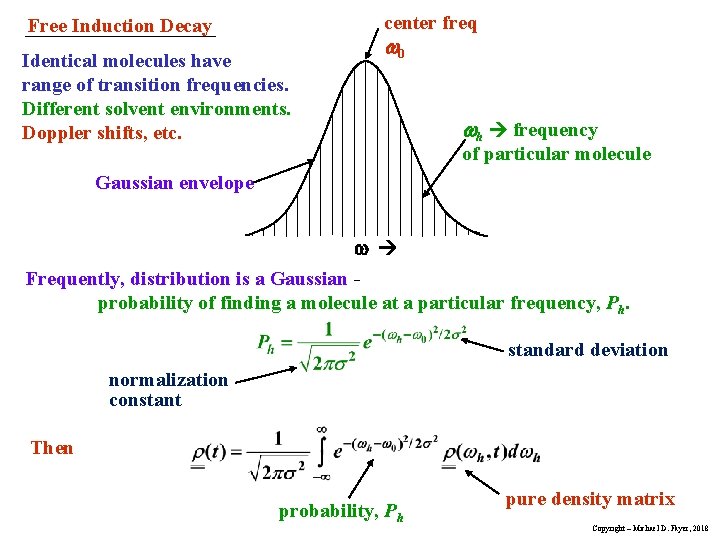
center freq Free Induction Decay Identical molecules have range of transition frequencies. Different solvent environments. Doppler shifts, etc. 0 h frequency of particular molecule Gaussian envelope Frequently, distribution is a Gaussian probability of finding a molecule at a particular frequency, Ph. standard deviation normalization constant Then probability, Ph pure density matrix Copyright – Michael D. Fayer, 2018
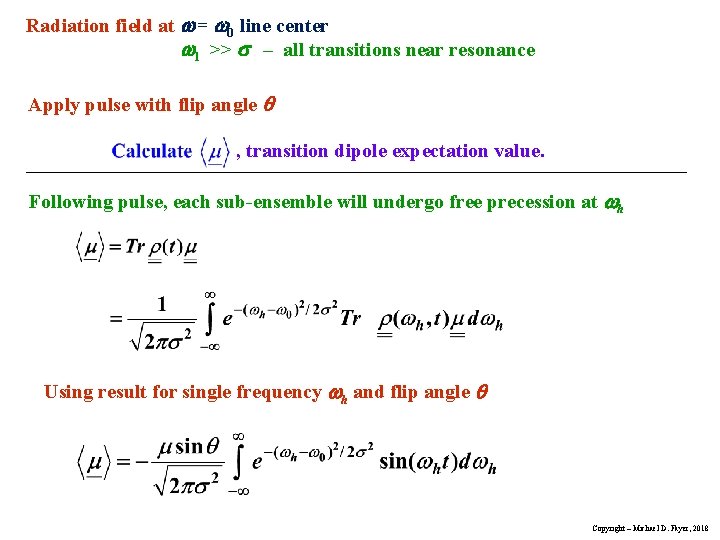
Radiation field at = 0 line center 1 >> – all transitions near resonance Apply pulse with flip angle , transition dipole expectation value. Following pulse, each sub-ensemble will undergo free precession at h Using result for single frequency h and flip angle Copyright – Michael D. Fayer, 2018
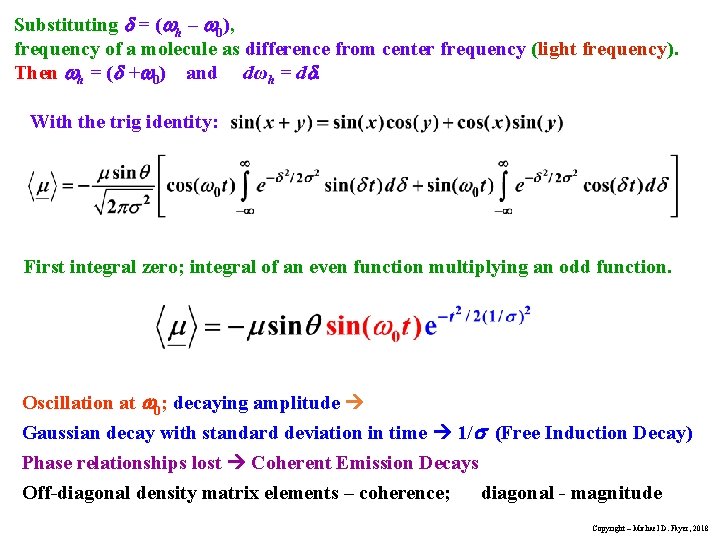
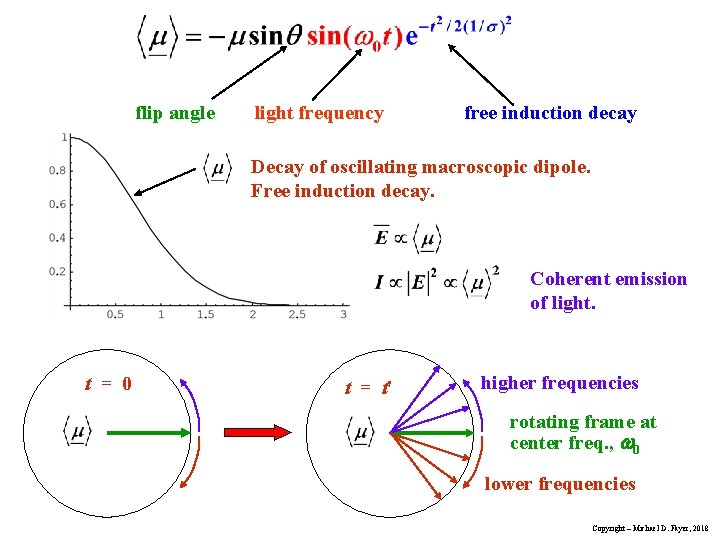
Substituting = ( h – 0), frequency of a molecule as difference from center frequency (light frequency). Then h = ( + 0) and dωh = d. With the trig identity: First integral zero; integral of an even function multiplying an odd function. Oscillation at 0; decaying amplitude Gaussian decay with standard deviation in time 1/ (Free Induction Decay) Phase relationships lost Coherent Emission Decays Off-diagonal density matrix elements – coherence; diagonal - magnitude Copyright – Michael D. Fayer, 2018
flip angle light frequency free induction decay Decay of oscillating macroscopic dipole. Free induction decay. Coherent emission of light. t = 0 t = t' higher frequencies rotating frame at center freq. , 0 lower frequencies Copyright – Michael D. Fayer, 2018