
Chapter 14 Cost of Capital 14 1 Mc



- Slides: 79
Chapter 14 Cost of Capital 14 -1 Mc. Graw-Hill/Irwin Copyright © 2013 by The Mc. Graw-Hill Companies, Inc. All rights reserved.
Chapter Outline • The Cost of Capital – Overview • The Cost of Equity • The Cost of Debt • The Cost of Preferred Stock • The Weighted Average Cost of Capital (WACC) • Divisional and Project Costs of Capital • Floatation Costs relative to WACC 14 -2
Chapter Outline • The Cost of Capital – Overview • The Cost of Equity • The Cost of Debt • The Cost of Preferred Stock • The Weighted Average Cost of Capital (WACC) • Divisional and Project Costs of Capital • Floatation Costs relative to WACC 14 -3
Why the Cost of Capital Is Important 1. We know that the return earned on assets depends on the risk of those assets 2. The return to an investor is the same as the cost to the company 14 -4
Why the Cost of Capital Is Important 3. Our cost of capital provides us with an indication of how the market views the risk of our assets 4. Knowing our cost of capital can also help us determine our required return for capital budgeting projects 14 -5
Chapter Outline • The Cost of Capital – Overview • The Cost of Equity • The Cost of Debt • The Cost of Preferred Stock • The Weighted Average Cost of Capital (WACC) • Divisional and Project Costs of Capital • Floatation Costs relative to WACC 14 -6
The Cost of Equity The cost of equity is the return required by equity investors given the risk of the cash flows from the firm: • Business risk • Financial risk 14 -7
The Cost of Equity There are two major methods for determining the cost of equity: 1. Dividend growth model (aka: the Gordon Model) 14 -8 2. SML, or the CAPM
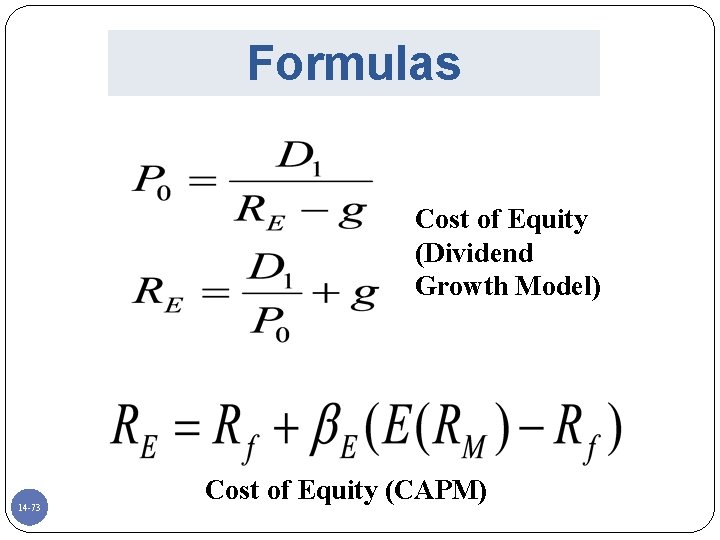
The Dividend Growth Model (The Gordon Model) Start with the dividend growth model formula and rearrange to solve for RE 14 -9
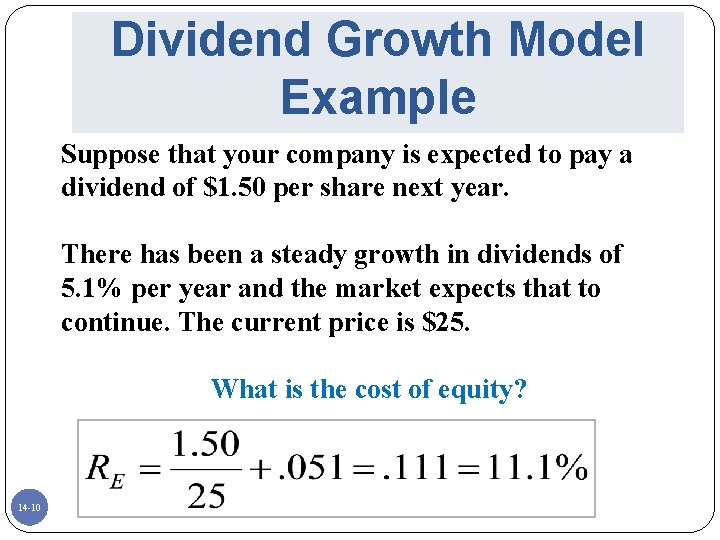
Dividend Growth Model Example Suppose that your company is expected to pay a dividend of $1. 50 per share next year. There has been a steady growth in dividends of 5. 1% per year and the market expects that to continue. The current price is $25. What is the cost of equity? 14 -10
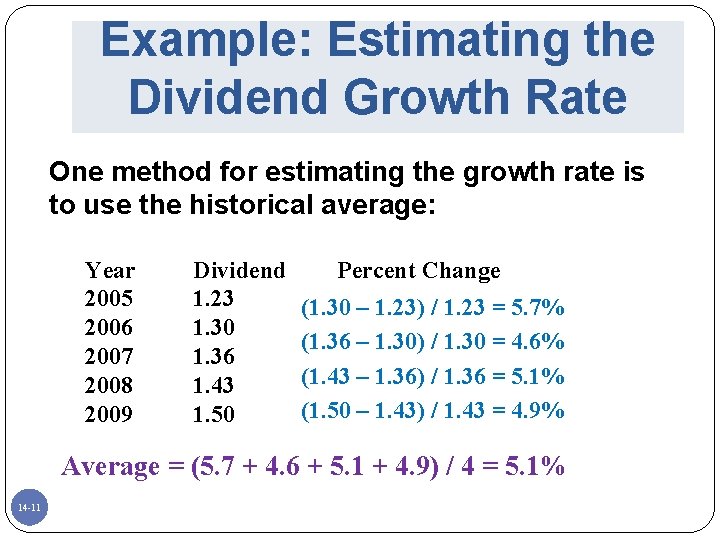
Example: Estimating the Dividend Growth Rate One method for estimating the growth rate is to use the historical average: Year 2005 2006 2007 2008 2009 Dividend 1. 23 1. 30 1. 36 1. 43 1. 50 Percent Change (1. 30 – 1. 23) / 1. 23 = 5. 7% (1. 36 – 1. 30) / 1. 30 = 4. 6% (1. 43 – 1. 36) / 1. 36 = 5. 1% (1. 50 – 1. 43) / 1. 43 = 4. 9% Average = (5. 7 + 4. 6 + 5. 1 + 4. 9) / 4 = 5. 1% 14 -11
Advantages and Disadvantages of the Dividend Growth Model Advantage: Easy to understand use 14 -12
Advantages and Disadvantages of the Dividend Growth Model • Disadvantages: • Only applicable to companies currently paying dividends • Not applicable if dividends aren’t growing at a reasonably constant rate 14 -13
Advantages and Disadvantages of the Dividend Growth Model • Disadvantages : • Extremely sensitive to the estimated growth rate – an increase in g of 1% increases the cost of equity by 1% • Does not explicitly consider risk 14 -14
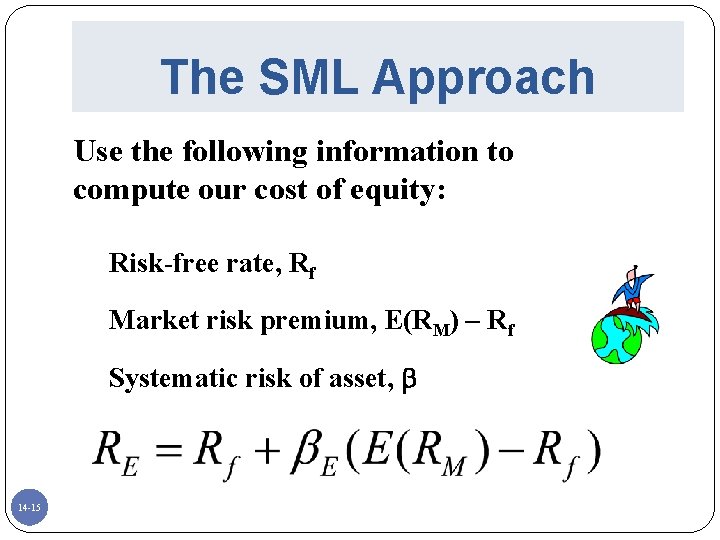
The SML Approach Use the following information to compute our cost of equity: Risk-free rate, Rf Market risk premium, E(RM) – Rf Systematic risk of asset, 14 -15
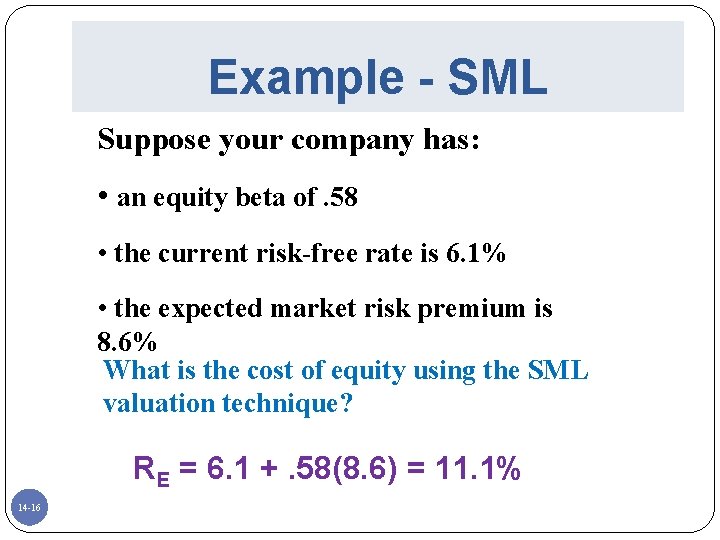
Example - SML Suppose your company has: • an equity beta of. 58 • the current risk-free rate is 6. 1% • the expected market risk premium is 8. 6% What is the cost of equity using the SML valuation technique? RE = 6. 1 +. 58(8. 6) = 11. 1% 14 -16
How Did We Do? Since we came up with similar numbers using both the dividend growth model (11. 1%) and the SML approach (11. 1%), we should feel good about our estimate! 14 -17
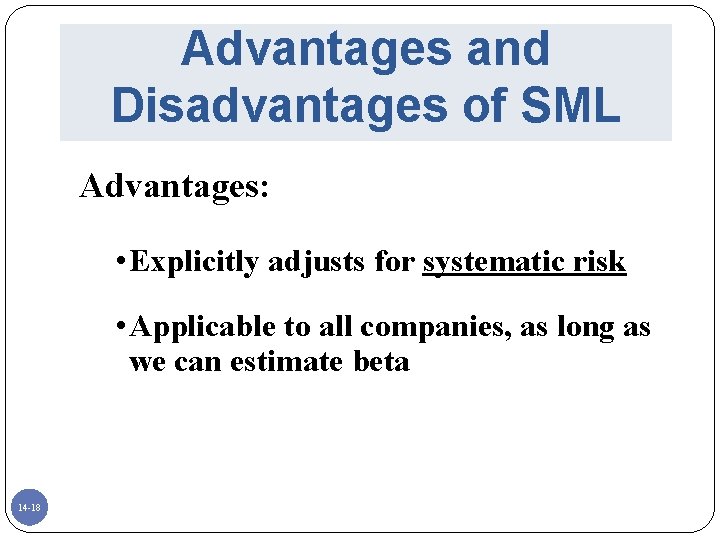
Advantages and Disadvantages of SML Advantages: • Explicitly adjusts for systematic risk • Applicable to all companies, as long as we can estimate beta 14 -18
Advantages and Disadvantages of SML Disadvantages: • Have to estimate the expected market risk premium, which does vary over time • Have to estimate beta, which also varies over time • We are using the past to predict the future, which is not always reliable 14 -19
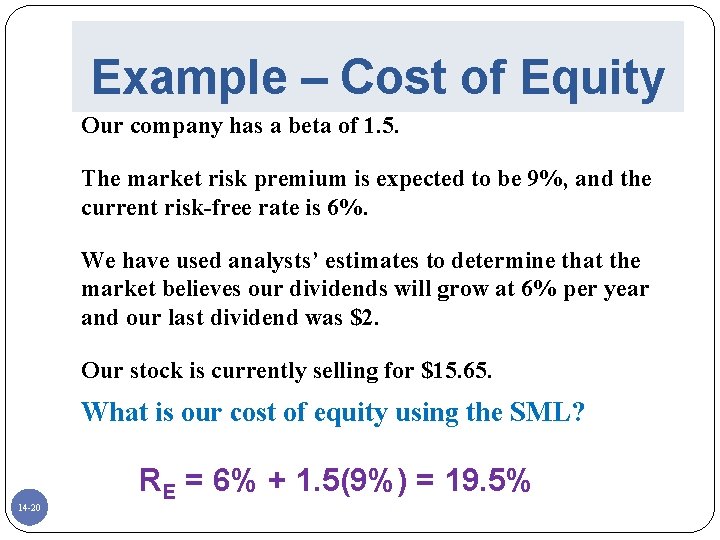
Example – Cost of Equity Our company has a beta of 1. 5. The market risk premium is expected to be 9%, and the current risk-free rate is 6%. We have used analysts’ estimates to determine that the market believes our dividends will grow at 6% per year and our last dividend was $2. Our stock is currently selling for $15. 65. What is our cost of equity using the SML? 14 -20 RE = 6% + 1. 5(9%) = 19. 5%
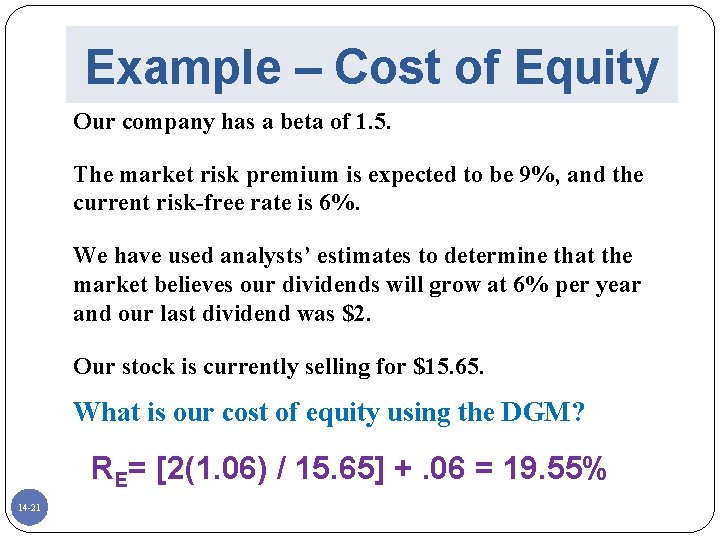
Example – Cost of Equity Our company has a beta of 1. 5. The market risk premium is expected to be 9%, and the current risk-free rate is 6%. We have used analysts’ estimates to determine that the market believes our dividends will grow at 6% per year and our last dividend was $2. Our stock is currently selling for $15. 65. What is our cost of equity using the DGM? RE= [2(1. 06) / 15. 65] +. 06 = 19. 55% 14 -21
Chapter Outline • The Cost of Capital – Overview • The Cost of Equity • The Cost of Debt • The Cost of Preferred Stock • The Weighted Average Cost of Capital (WACC) • Divisional and Project Costs of Capital • Floatation Costs relative to WACC 14 -22
Cost of Debt The cost of debt is the required return on our company’s debt We usually focus on the cost of longterm debt or bonds (as opposed to short-term debt like notes payable) 14 -23
Cost of Debt The required return is best estimated by computing the yield-to-maturity on the existing long-term debt (the YTM). The computation of the YTM was presented in the chapter on Bond Valuation 14 -24
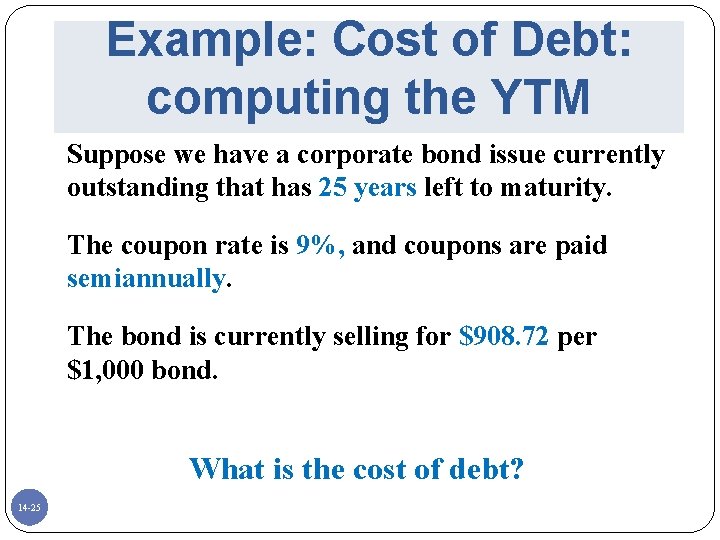
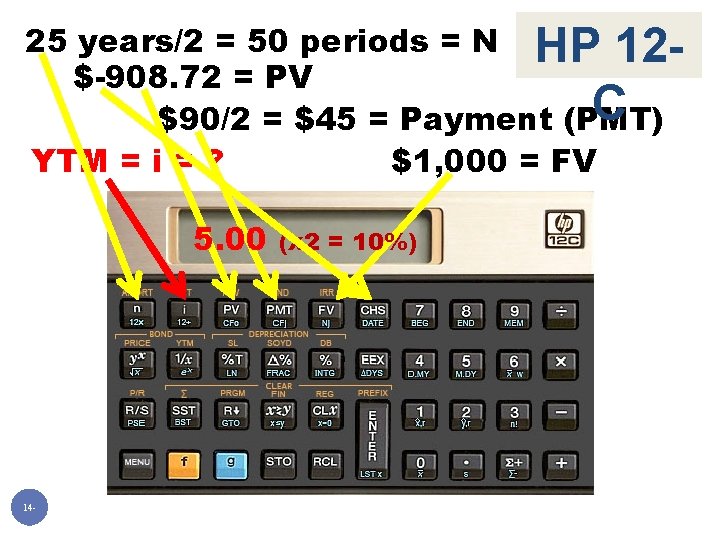
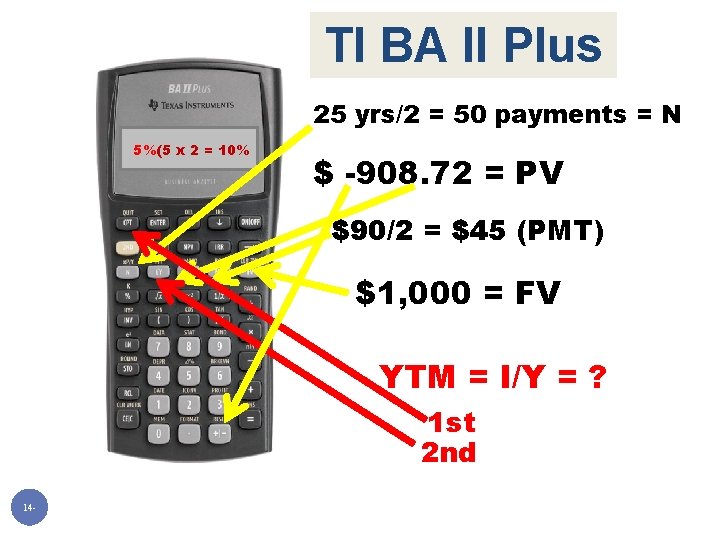
Example: Cost of Debt: computing the YTM Suppose we have a corporate bond issue currently outstanding that has 25 years left to maturity. The coupon rate is 9%, and coupons are paid semiannually. The bond is currently selling for $908. 72 per $1, 000 bond. What is the cost of debt? 14 -25
25 years/2 = 50 periods = N HP 12$-908. 72 = PV C $90/2 = $45 = Payment (PMT) YTM = i = ? $1, 000 = FV 5. 00 14 - (x 2 = 10%)
TI BA II Plus 25 yrs/2 = 50 payments = N 5%(5 x 2 = 10% $ -908. 72 = PV $90/2 = $45 (PMT) $1, 000 = FV YTM = I/Y = ? 1 st 2 nd 14 -
Chapter Outline • The Cost of Capital – Overview • The Cost of Equity • The Cost of Debt • The Cost of Preferred Stock • The Weighted Average Cost of Capital (WACC) • Divisional and Project Costs of Capital • Floatation Costs relative to WACC 14 -28
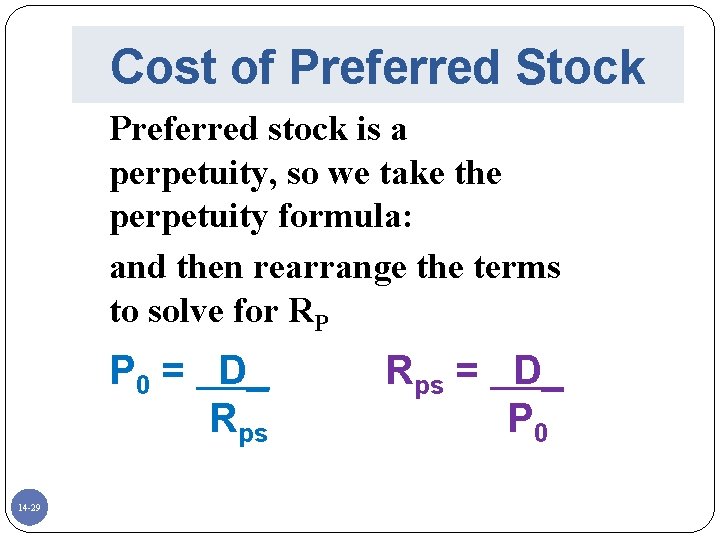
Cost of Preferred Stock Preferred stock is a perpetuity, so we take the perpetuity formula: and then rearrange the terms to solve for RP P 0 = D_ Rps 14 -29 Rps = D_ P 0
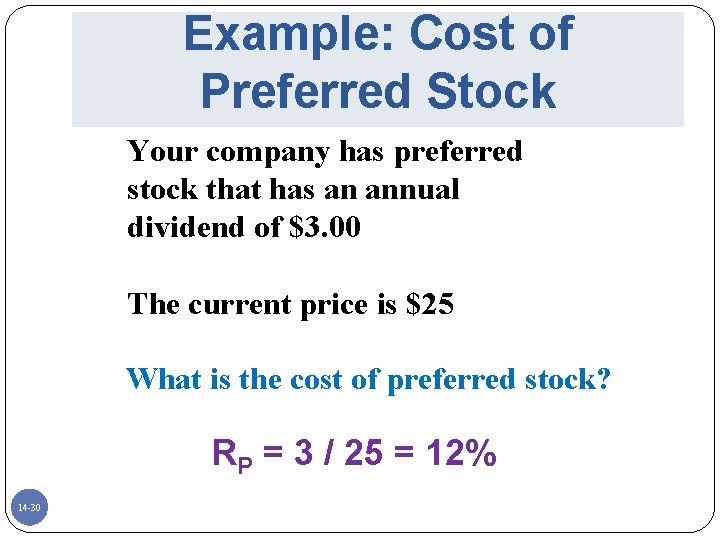
Example: Cost of Preferred Stock Your company has preferred stock that has an annual dividend of $3. 00 The current price is $25 What is the cost of preferred stock? RP = 3 / 25 = 12% 14 -30
Chapter Outline • The Cost of Capital – Overview • The Cost of Equity • The Cost of Debt • The Cost of Preferred Stock • The Weighted Average Cost of Capital (WACC) • Divisional and Project Costs of Capital • Floatation Costs relative to WACC 14 -31
Capital Structure Weights To compute the WACC, we first need the weights of each source of funds: namely debt, preferred stock and equity 14 -32
Capital Structure Weights Let’s simplify with an example of just debt and equity. We often use the market value of both debt and equity 14 -33
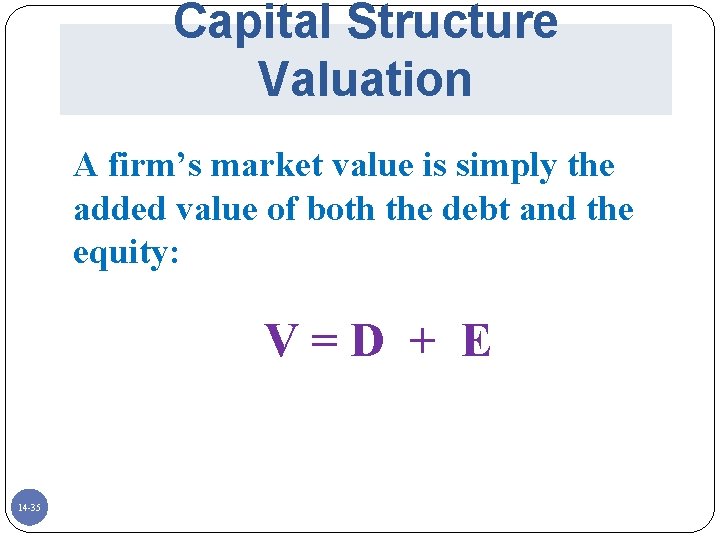
Capital Structure Valuation Debt’s Market Value = (# of outstanding bonds ) x (the market price of one bond) Equity’s Market Value = (# shares of outstanding common stock) x (the market price of one share of common stock) 14 -34
Capital Structure Valuation A firm’s market value is simply the added value of both the debt and the equity: V=D + E 14 -35
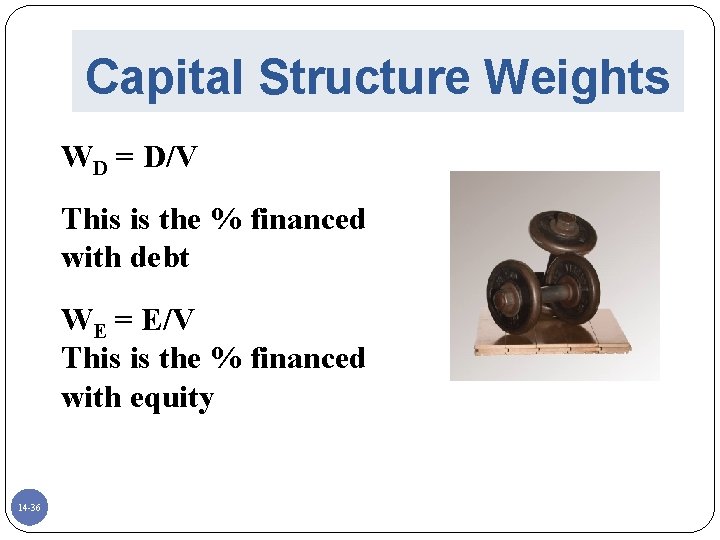
Capital Structure Weights WD = D/V This is the % financed with debt WE = E/V This is the % financed with equity 14 -36
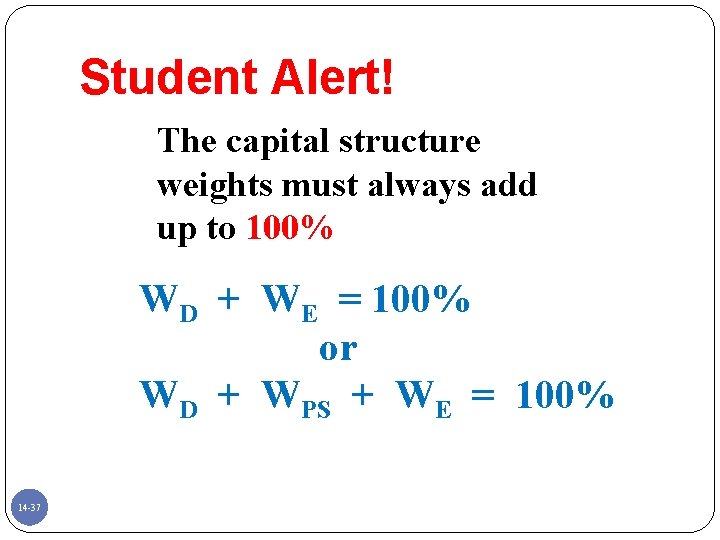
Student Alert! The capital structure weights must always add up to 100% WD + WE = 100% or WD + WPS + WE = 100% 14 -37
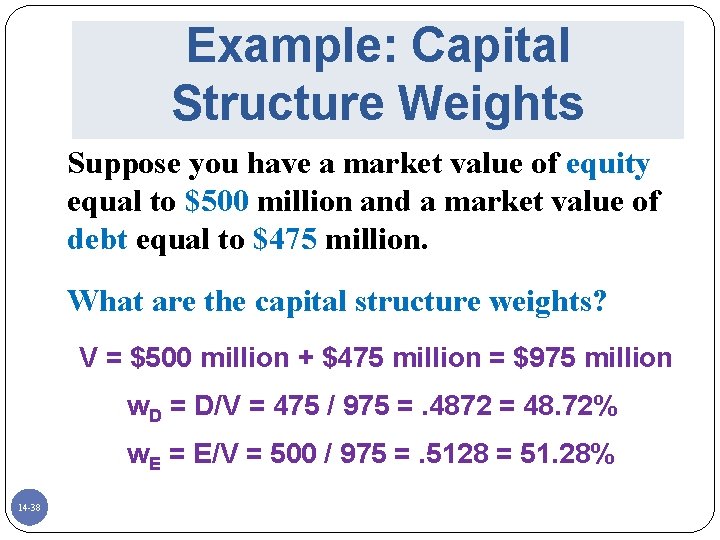
Example: Capital Structure Weights Suppose you have a market value of equity equal to $500 million and a market value of debt equal to $475 million. What are the capital structure weights? V = $500 million + $475 million = $975 million w. D = D/V = 475 / 975 =. 4872 = 48. 72% w. E = E/V = 500 / 975 =. 5128 = 51. 28% 14 -38
Taxes and the WACC Wait a minute! Debt and Equity are not equal in the eyes of the firm. Debt gets a tax advantage and Equity does not. 14 -39
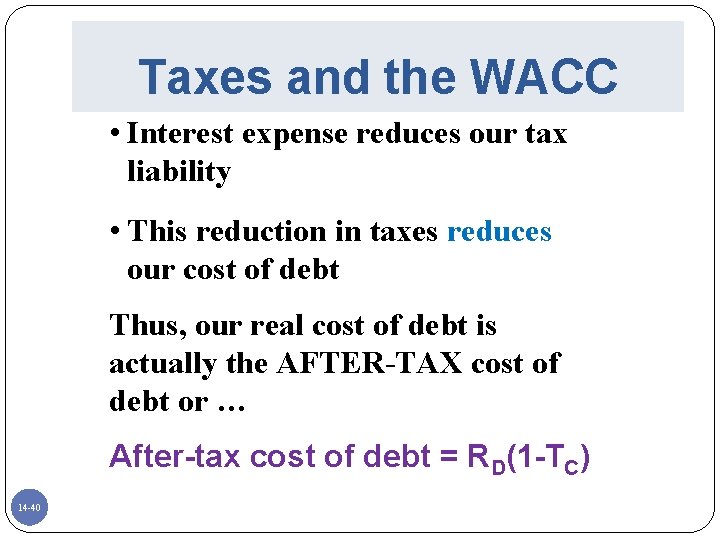
Taxes and the WACC • Interest expense reduces our tax liability • This reduction in taxes reduces our cost of debt Thus, our real cost of debt is actually the AFTER-TAX cost of debt or … After-tax cost of debt = RD(1 -TC) 14 -40
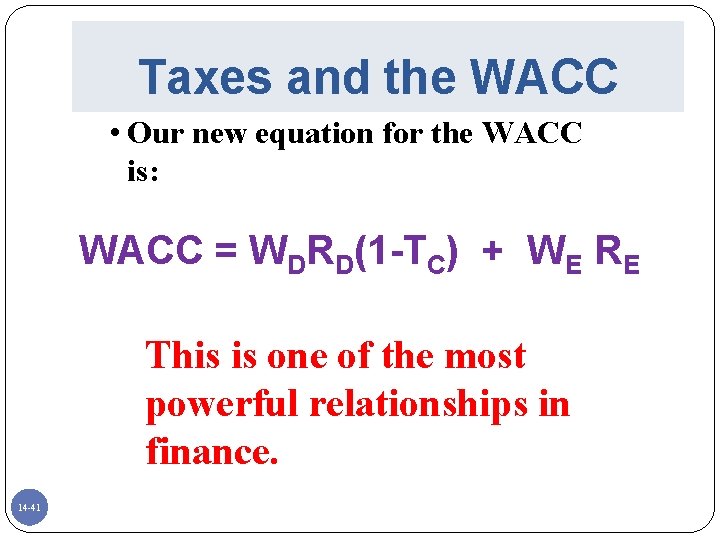
Taxes and the WACC • Our new equation for the WACC is: WACC = WDRD(1 -TC) + WE RE This is one of the most powerful relationships in finance. 14 -41
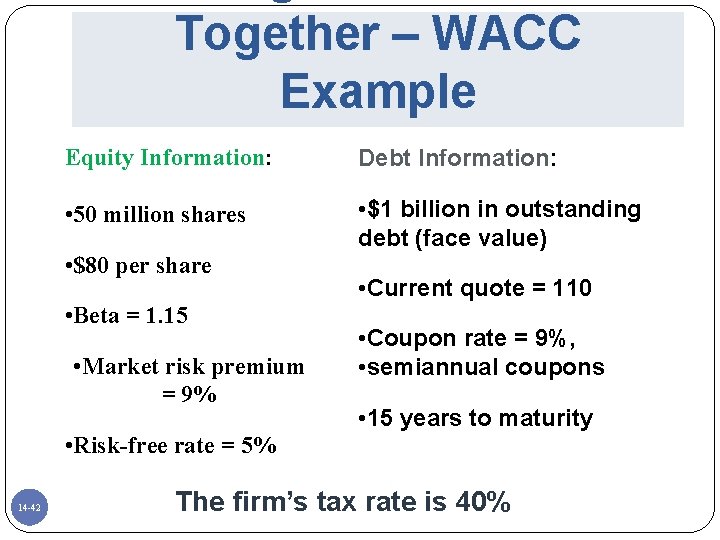
Together – WACC Example Equity Information: Debt Information: • 50 million shares • $1 billion in outstanding debt (face value) • $80 per share • Beta = 1. 15 • Market risk premium = 9% • Risk-free rate = 5% 14 -42 • Current quote = 110 • Coupon rate = 9%, • semiannual coupons • 15 years to maturity The firm’s tax rate is 40%
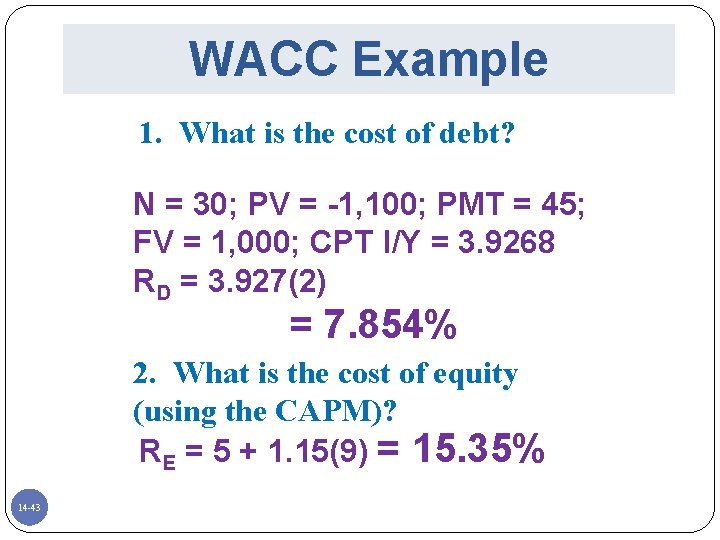
WACC Example 1. What is the cost of debt? N = 30; PV = -1, 100; PMT = 45; FV = 1, 000; CPT I/Y = 3. 9268 RD = 3. 927(2) = 7. 854% 2. What is the cost of equity (using the CAPM)? RE = 5 + 1. 15(9) = 15. 35% 14 -43
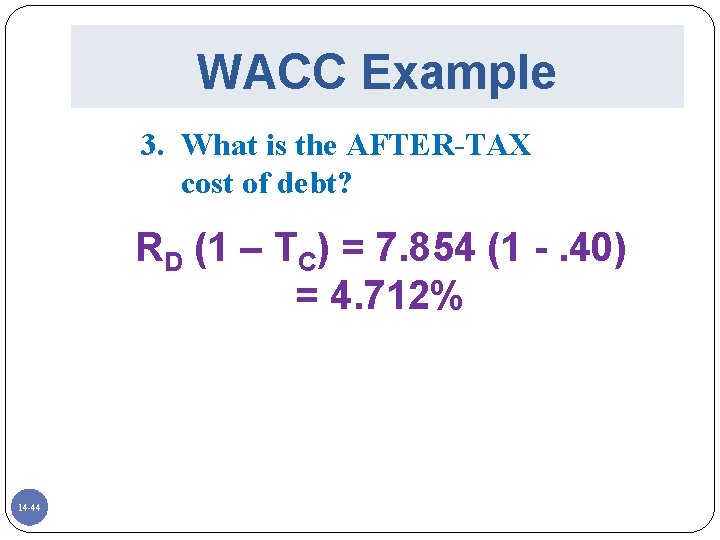
WACC Example 3. What is the AFTER-TAX cost of debt? RD (1 – TC) = 7. 854 (1 -. 40) = 4. 712% 14 -44
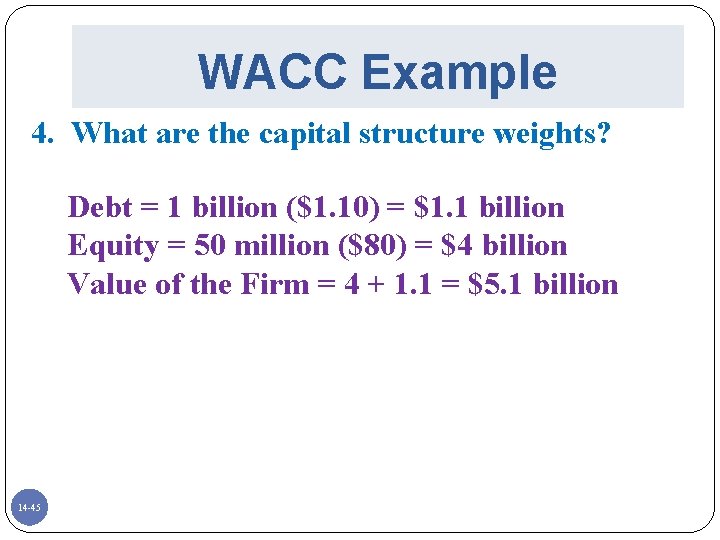
WACC Example 4. What are the capital structure weights? Debt = 1 billion ($1. 10) = $1. 1 billion Equity = 50 million ($80) = $4 billion Value of the Firm = 4 + 1. 1 = $5. 1 billion 14 -45
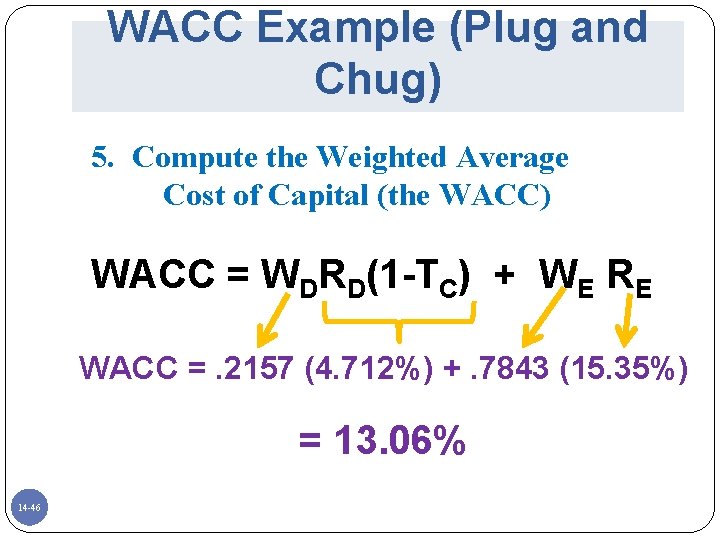
WACC Example (Plug and Chug) 5. Compute the Weighted Average Cost of Capital (the WACC) WACC = WDRD(1 -TC) + WE RE WACC =. 2157 (4. 712%) +. 7843 (15. 35%) = 13. 06% 14 -46
Eastman Chemical I Click on the web surfer to go to Yahoo Finance to get information on Eastman Chemical (EMN) Under Profile and Key Statistics, you can find the following information: • # of shares outstanding • Book value per share • Price per share • Beta 14 -47
Eastman Chemical IV Find the weighted average cost of the debt • Use market values if you were able to get the information • Use the book values if market information was not available • They are often very close Compute the WACC 14 -48 Use market value weights if available
Work the Web Find estimates of WACC at www. valuepro. net How do the assumptions impact the estimate of WACC? 14 -49
Chapter Outline • The Cost of Capital – Overview • The Cost of Equity • The Cost of Debt • The Cost of Preferred Stock • The Weighted Average Cost of Capital (WACC) • Divisional and Project Costs of Capital • Floatation Costs relative to WACC 14 -50
Divisional and Project Costs of Capital Using the WACC as our discount rate is only appropriate for projects that have the same risk as the firm’s current operations If we are looking at a project that does NOT have the same risk as the firm, then we need to determine the appropriate discount rate for that project 14 -51
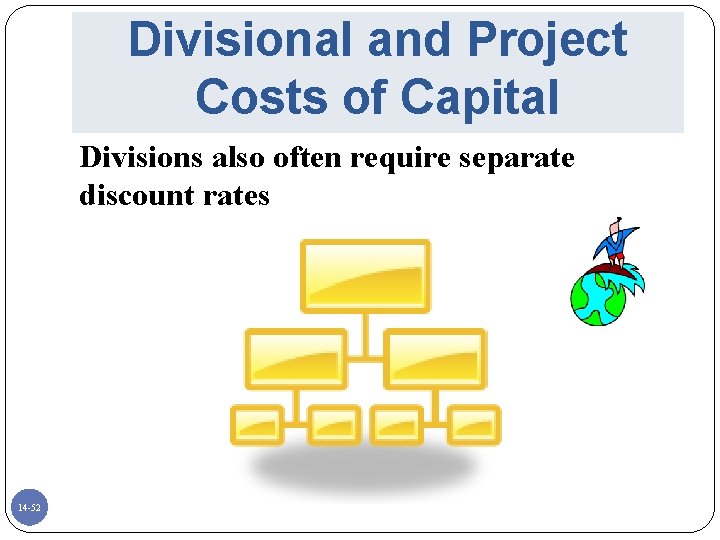
Divisional and Project Costs of Capital Divisions also often require separate discount rates 14 -52
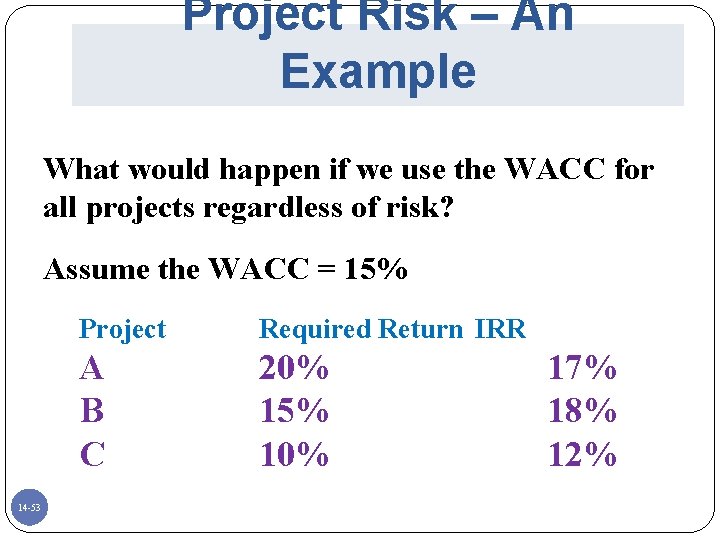
Project Risk – An Example What would happen if we use the WACC for all projects regardless of risk? Assume the WACC = 15% 14 -53 Project Required Return IRR A B C 20% 15% 10% 17% 18% 12%
Project Risk Differentiation We have two tools in finance to help us here: 1. The Pure Play Approach 2. The Subjective Approach 14 -54
Project Risk Differentiation We have two tools in finance to help us here: 1. The Pure Play Approach 2. The Subjective Approach 14 -55
The Pure Play Approach 1. Find one or more companies that specialize in the product or service that we are considering 2. Compute (or research) the beta for each company 3. Take an average of the betas 14 -56
The Pure Play Approach 4. Use that beta along with the CAPM to find the appropriate return for a project of that identical risk 5. Use this computed cost of capital for capital budgeting computations 14 -57
Project Risk Differentiation We have two tools in finance to help us here: 1. The Pure Play Approach 2. The Subjective Approach 14 -58
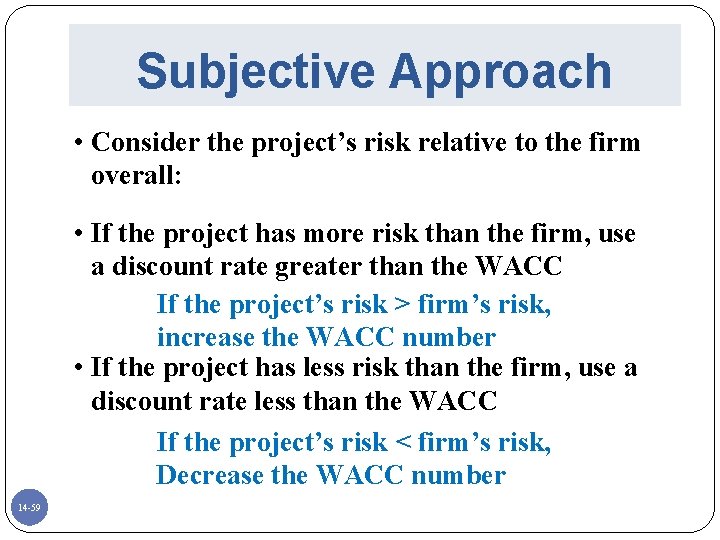
Subjective Approach • Consider the project’s risk relative to the firm overall: • If the project has more risk than the firm, use a discount rate greater than the WACC If the project’s risk > firm’s risk, increase the WACC number • If the project has less risk than the firm, use a discount rate less than the WACC If the project’s risk < firm’s risk, Decrease the WACC number 14 -59
Subjective Approach You may still accept projects that you shouldn’t and reject projects you should accept, but your error rate should be lower than not considering differential risk at all. 14 -60
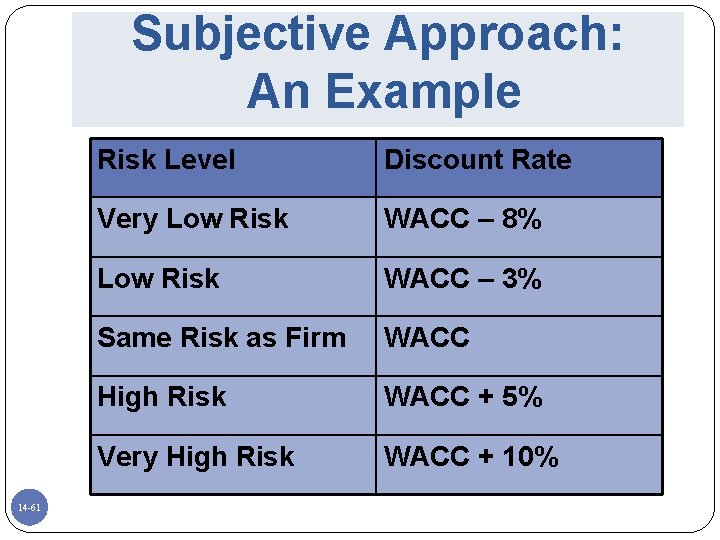
Subjective Approach: An Example 14 -61 Risk Level Discount Rate Very Low Risk WACC – 8% Low Risk WACC – 3% Same Risk as Firm WACC High Risk WACC + 5% Very High Risk WACC + 10%
Chapter Outline • The Cost of Capital – Overview • The Cost of Equity • The Cost of Debt • The Cost of Preferred Stock • The Weighted Average Cost of Capital (WACC) • Divisional and Project Costs of Capital • Floatation Costs relative to WACC 14 -62
Flotation Costs • Flotation costs are the fees paid to issue stocks or bonds • While the required return for a project depends on the risk, it should not depend upon how the money is raised 14 -63 • However, the cost of issuing new securities should not just be ignored either
Flotation Costs • However, the cost of issuing new securities should not just be ignored either. The Basic Approach: 1. Compute the weighted average flotation cost 2. Use the target weights because the firm will issue securities in these percentages over the long term 14 -64
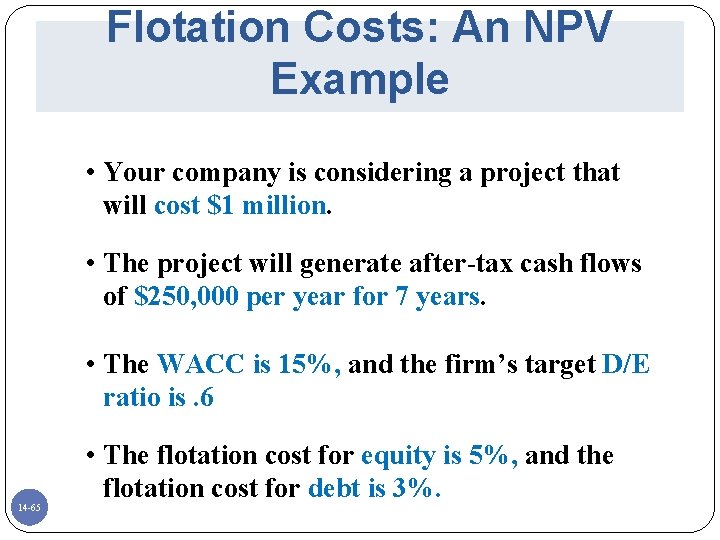
Flotation Costs: An NPV Example • Your company is considering a project that will cost $1 million. • The project will generate after-tax cash flows of $250, 000 per year for 7 years. • The WACC is 15%, and the firm’s target D/E ratio is. 6 14 -65 • The flotation cost for equity is 5%, and the flotation cost for debt is 3%.
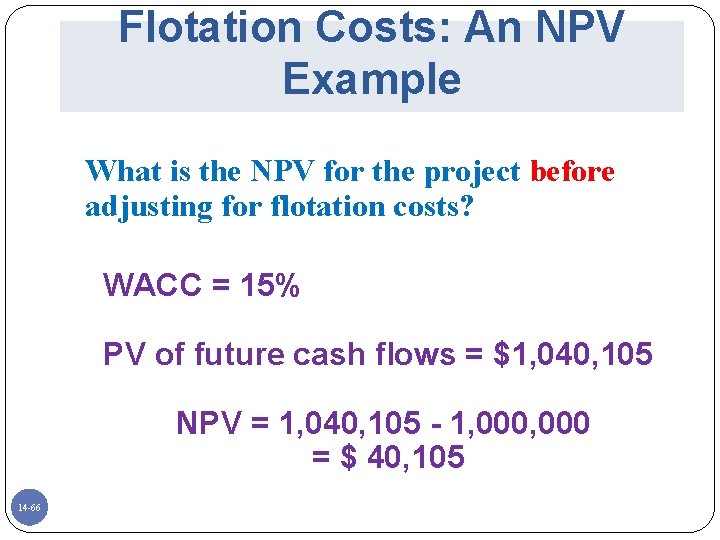
Flotation Costs: An NPV Example What is the NPV for the project before adjusting for flotation costs? WACC = 15% PV of future cash flows = $1, 040, 105 NPV = 1, 040, 105 - 1, 000 = $ 40, 105 14 -66
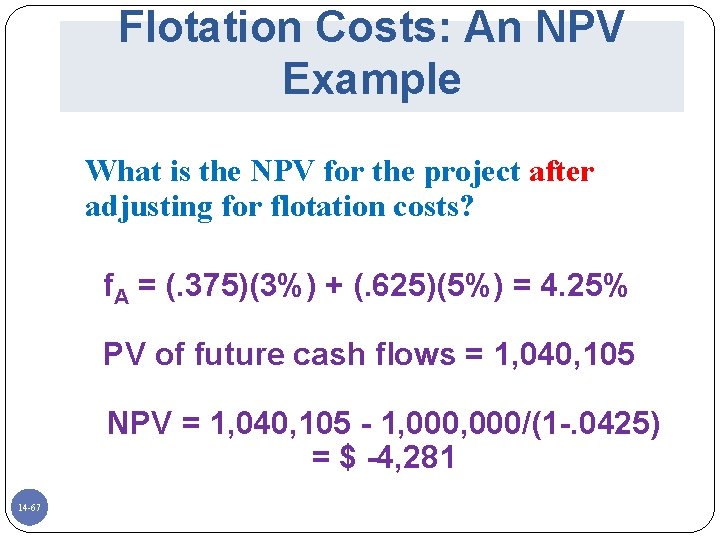
Flotation Costs: An NPV Example What is the NPV for the project after adjusting for flotation costs? f. A = (. 375)(3%) + (. 625)(5%) = 4. 25% PV of future cash flows = 1, 040, 105 NPV = 1, 040, 105 - 1, 000/(1 -. 0425) = $ -4, 281 14 -67
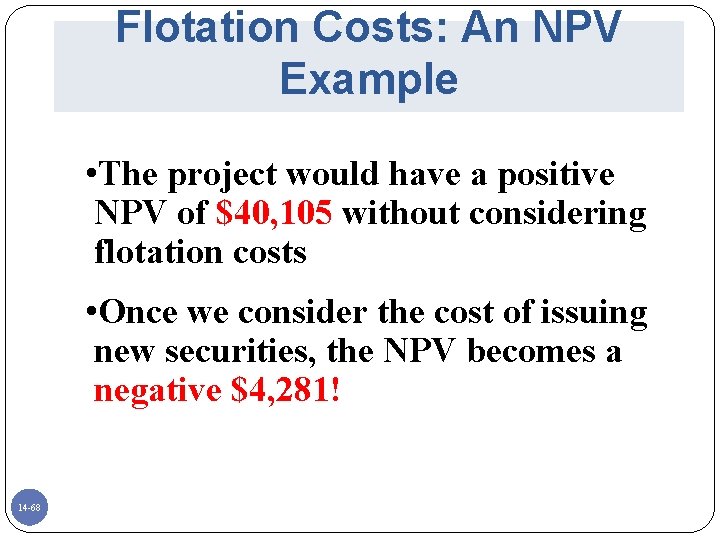
Flotation Costs: An NPV Example • The project would have a positive NPV of $40, 105 without considering flotation costs • Once we consider the cost of issuing new securities, the NPV becomes a negative $4, 281! 14 -68
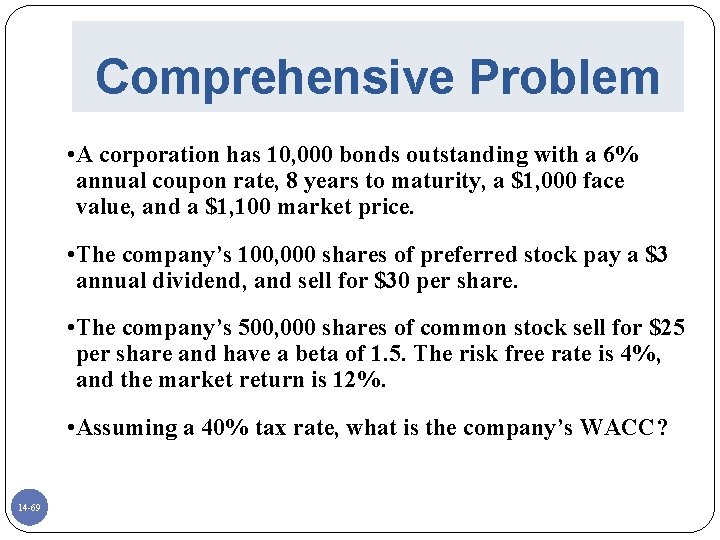
Comprehensive Problem • A corporation has 10, 000 bonds outstanding with a 6% annual coupon rate, 8 years to maturity, a $1, 000 face value, and a $1, 100 market price. • The company’s 100, 000 shares of preferred stock pay a $3 annual dividend, and sell for $30 per share. • The company’s 500, 000 shares of common stock sell for $25 per share and have a beta of 1. 5. The risk free rate is 4%, and the market return is 12%. • Assuming a 40% tax rate, what is the company’s WACC? 14 -69
Ethics Issues How could a project manager adjust the cost of capital (i. e. , appropriate discount rate) to increase the likelihood of having his/her project accepted? Is this ethical or financially sound? 14 -70
Terminology • Security Market Line (SML) • Capital Asset Pricing Model (CAPM) • Yield or Yield to Maturity (YTM) • Cost of Capital • Weighted Average Cost of Capital (WACC) • Pure Play risk • Subjective Risk 14 -71
Terminology (ctd) • Capital Structure • Cost of Equity • Cost of Debt • Cost of Capital • Capital Budgeting (NPV, IRR) • Floatation Costs 14 -72
Formulas Cost of Equity (Dividend Growth Model) 14 -73 Cost of Equity (CAPM)
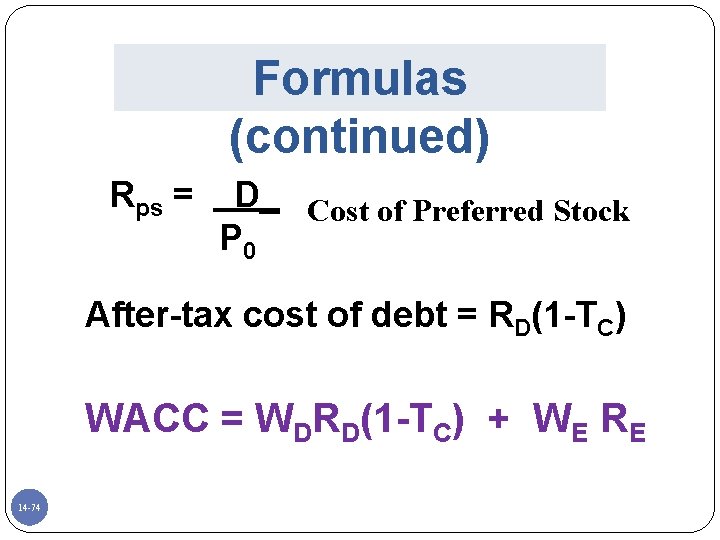
Formulas (continued) Rps = D_ Cost of Preferred Stock P 0 After-tax cost of debt = RD(1 -TC) WACC = WDRD(1 -TC) + WE RE 14 -74
Key Concepts and Skills • Be able to compute a firm’s cost of equity using the CAPM and the Dividend Growth model • Be able to compute a firm’s after -tax cost of debt 14 -75
Key Concepts and Skills • Know how to compute the WACC of a firm • Identify the consequences to the WACC of considering floatation costs 14 -76
What are the most important topics of this chapter? 1. There are two ways to compute the cost of equity: DGM and CAPM. 2. The relevant cost of debt to a firm is the after-tax cost. 14 -77 3. Capital structure determines the weights of debt, preferred stock and equity used by the firm.
What are the most important topics of this chapter? 4. The WACC determines the discount rate to be used for capital budgeting purposes for NPV, IRR and MIRR. 5. All projects may not have the identical risk classification and we may need to adjust the WACC accordingly. 14 -78
Questions? 14 -79