
Chapter 14 Cost Management Systems and ActivityBased Costing
Chapter 14 Cost Management Systems and Activity-Based Costing © 2002 Prentice Hall Business Publishing, Introduction to Management Accounting 12/e, Horngren/Sundem/Stratton 4 -1
Learning Objective 1 Describe the purposes of cost management systems. © 2002 Prentice Hall Business Publishing, Introduction to Management Accounting 12/e, Horngren/Sundem/Stratton 4 -2
Cost Management System A cost-management system (CMS) is a collection of tools and techniques that identifies how management’s decisions affect costs. © 2002 Prentice Hall Business Publishing, Introduction to Management Accounting 12/e, Horngren/Sundem/Stratton 4 -3
What is Cost Accounting? Cost accounting is that part of the accounting system that measures costs for the purposes of management decision making and financial reporting. © 2002 Prentice Hall Business Publishing, Introduction to Management Accounting 12/e, Horngren/Sundem/Stratton 4 -4
Learning Objective 2 Explain the relationships among cost, cost objective, cost accumulation, and cost allocation. © 2002 Prentice Hall Business Publishing, Introduction to Management Accounting 12/e, Horngren/Sundem/Stratton 4 -5
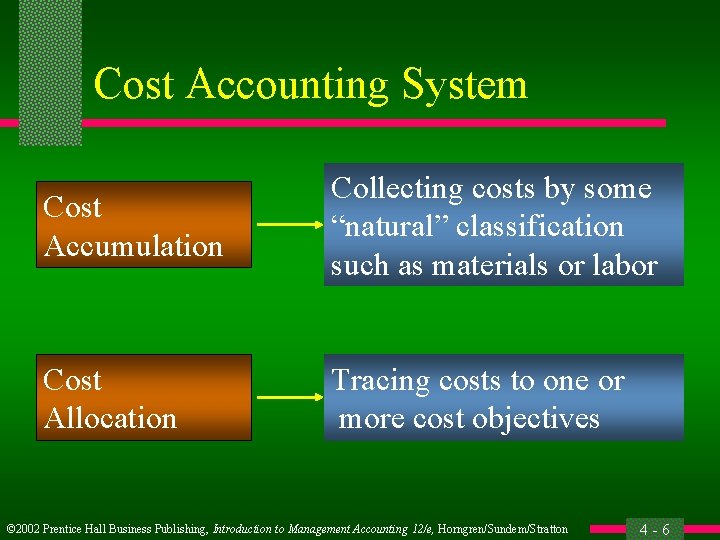
Cost Accounting System Cost Accumulation Collecting costs by some “natural” classification such as materials or labor Cost Allocation Tracing costs to one or more cost objectives © 2002 Prentice Hall Business Publishing, Introduction to Management Accounting 12/e, Horngren/Sundem/Stratton 4 -6
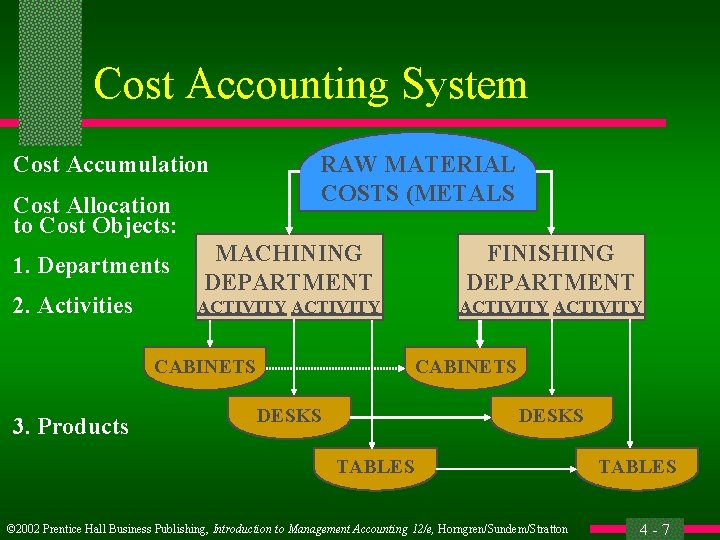
Cost Accounting System Cost Accumulation Cost Allocation to Cost Objects: 1. Departments 2. Activities RAW MATERIAL COSTS (METALS MACHINING DEPARTMENT FINISHING DEPARTMENT ACTIVITY CABINETS 3. Products DESKS TABLES © 2002 Prentice Hall Business Publishing, Introduction to Management Accounting 12/e, Horngren/Sundem/Stratton TABLES 4 -7
Cost A cost may be defined as a sacrifice or giving up of resources for a particular purpose. l Costs are frequently measured by the monetary units that must be paid for goods and services. l © 2002 Prentice Hall Business Publishing, Introduction to Management Accounting 12/e, Horngren/Sundem/Stratton 4 -8
Cost Objective What is a cost object or cost objective? It is anything for which a separate measurement of costs is desired. © 2002 Prentice Hall Business Publishing, Introduction to Management Accounting 12/e, Horngren/Sundem/Stratton 4 -9
Learning Objective 3 Distinguish among direct, indirect, and unallocated costs. © 2002 Prentice Hall Business Publishing, Introduction to Management Accounting 12/e, Horngren/Sundem/Stratton 4 - 10
Direct Costs What are direct costs? Direct costs can be identified specifically and exclusively with a given cost objective in an economically feasible way. © 2002 Prentice Hall Business Publishing, Introduction to Management Accounting 12/e, Horngren/Sundem/Stratton 4 - 11
Indirect Costs What are indirect costs? Indirect costs cannot be identified specifically and exclusively with a given cost objective in an economically feasible way. © 2002 Prentice Hall Business Publishing, Introduction to Management Accounting 12/e, Horngren/Sundem/Stratton 4 - 12
What Distinguishes Direct and Indirect Costs? Managers prefer to classify costs as direct rather than indirect whenever it is “economically feasible” or “cost effective. ” l Other factors also influence whether a cost is considered direct or indirect. l The key is the particular cost objective. l © 2002 Prentice Hall Business Publishing, Introduction to Management Accounting 12/e, Horngren/Sundem/Stratton 4 - 13
Categories of Manufacturing Costs Any raw material, labor, or other input used by any organization could, in theory, be identified as a direct or indirect cost depending on the cost objective. © 2002 Prentice Hall Business Publishing, Introduction to Management Accounting 12/e, Horngren/Sundem/Stratton 4 - 14
Categories of Manufacturing Costs l 1 2 3 All costs which are eventually allocated to products are classified as either… direct materials, direct labor, or indirect manufacturing. © 2002 Prentice Hall Business Publishing, Introduction to Management Accounting 12/e, Horngren/Sundem/Stratton 4 - 15
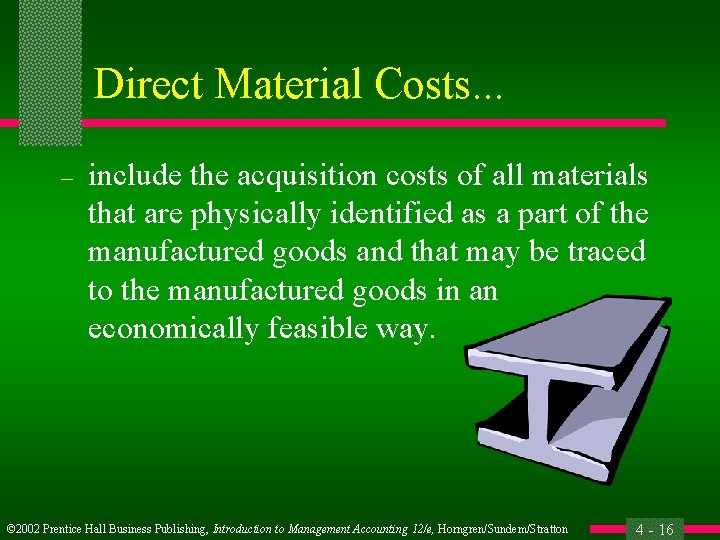
Direct Material Costs. . . – include the acquisition costs of all materials that are physically identified as a part of the manufactured goods and that may be traced to the manufactured goods in an economically feasible way. © 2002 Prentice Hall Business Publishing, Introduction to Management Accounting 12/e, Horngren/Sundem/Stratton 4 - 16
Direct Labor Costs. . . – include the wages of all labor that can be traced specifically and exclusively to the manufactured goods in an economically feasible way. © 2002 Prentice Hall Business Publishing, Introduction to Management Accounting 12/e, Horngren/Sundem/Stratton 4 - 17
Indirect Manufacturing Costs. . . – or factory overhead, include all costs associated with the manufacturing process that cannot be traced to the manufactured goods in an economically feasible way. © 2002 Prentice Hall Business Publishing, Introduction to Management Accounting 12/e, Horngren/Sundem/Stratton 4 - 18
Product Costs. . . are costs identified with goods produced or purchased for resale. l Product costs are initially identified as part of the inventory on hand. l These costs, inventoriable costs, become expenses (in the form of cost of goods sold) only when the inventory is sold. – © 2002 Prentice Hall Business Publishing, Introduction to Management Accounting 12/e, Horngren/Sundem/Stratton 4 - 19
Period Costs. . . – are costs that are deducted as expenses during the current period without going through an inventory stage. © 2002 Prentice Hall Business Publishing, Introduction to Management Accounting 12/e, Horngren/Sundem/Stratton 4 - 20
Period or Product Costs In merchandising accounting, insurance, depreciation, and wages are period costs (expenses of the current period). l In manufacturing accounting, many of these items are related to production activities and thus, as indirect manufacturing, are product costs. l © 2002 Prentice Hall Business Publishing, Introduction to Management Accounting 12/e, Horngren/Sundem/Stratton 4 - 21
Period Costs – Merchandising and Manufacturing l In both merchandising and manufacturing accounting, selling and general administrative costs are period costs. © 2002 Prentice Hall Business Publishing, Introduction to Management Accounting 12/e, Horngren/Sundem/Stratton 4 - 22
Learning Objective 4 Explain how the financial statements of merchandisers and manufacturers differ because of the types of goods they sell. © 2002 Prentice Hall Business Publishing, Introduction to Management Accounting 12/e, Horngren/Sundem/Stratton 4 - 23
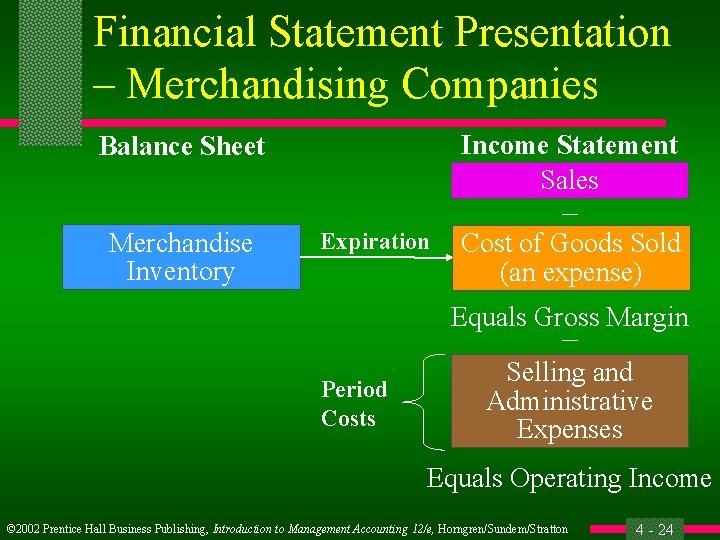
Financial Statement Presentation – Merchandising Companies Income Statement Sales Balance Sheet Merchandise Inventory Expiration – Cost of Goods Sold (an expense) Equals Gross Margin – Period Costs Selling and Administrative Expenses Equals Operating Income © 2002 Prentice Hall Business Publishing, Introduction to Management Accounting 12/e, Horngren/Sundem/Stratton 4 - 24
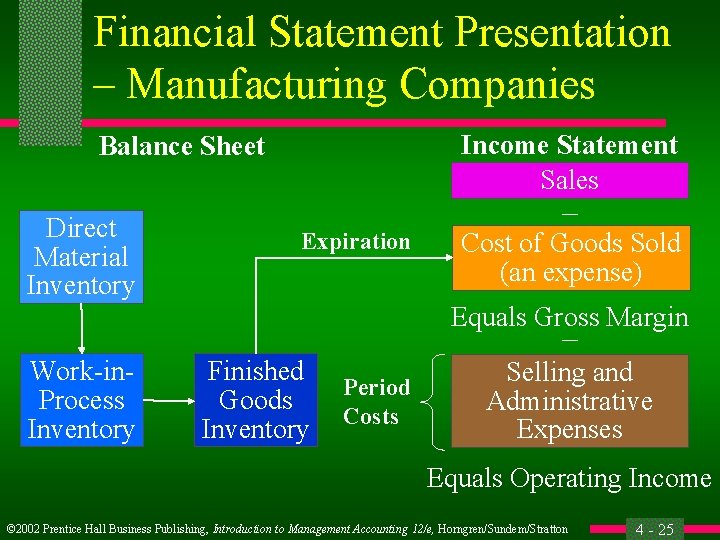
Financial Statement Presentation – Manufacturing Companies Income Statement Sales Balance Sheet Direct Material Inventory Expiration – Cost of Goods Sold (an expense) Equals Gross Margin – Work-in. Process Inventory Finished Goods Inventory Period Costs Selling and Administrative Expenses Equals Operating Income © 2002 Prentice Hall Business Publishing, Introduction to Management Accounting 12/e, Horngren/Sundem/Stratton 4 - 25
Costs and Income Statements l On income statements, the detailed reporting of selling and administrative expenses is typically the same for manufacturing and merchandising organizations, but the cost of goods sold is different. © 2002 Prentice Hall Business Publishing, Introduction to Management Accounting 12/e, Horngren/Sundem/Stratton 4 - 26
Cost of Goods Sold for a Manufacturer l 1 2 3 The manufacturer’s cost of goods produced and then sold is usually composed of the three major categories of cost: Direct materials Direct labor Indirect manufacturing © 2002 Prentice Hall Business Publishing, Introduction to Management Accounting 12/e, Horngren/Sundem/Stratton 4 - 27
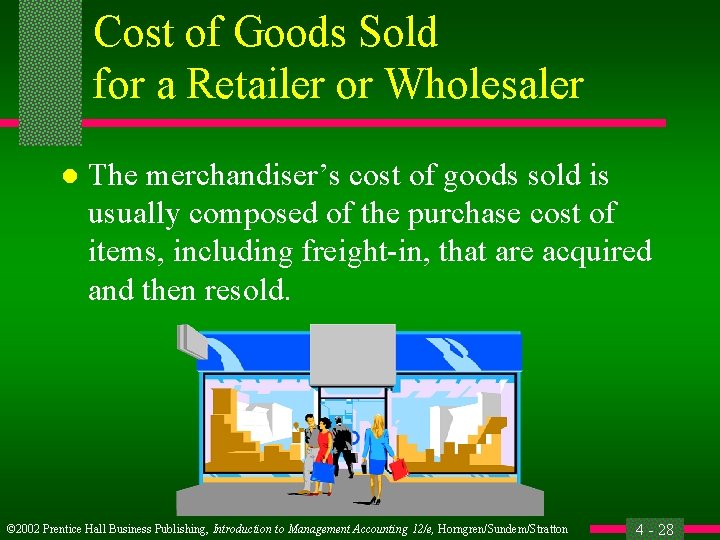
Cost of Goods Sold for a Retailer or Wholesaler l The merchandiser’s cost of goods sold is usually composed of the purchase cost of items, including freight-in, that are acquired and then resold. © 2002 Prentice Hall Business Publishing, Introduction to Management Accounting 12/e, Horngren/Sundem/Stratton 4 - 28
Learning Objective 5 Understand the main differences between traditional and activity-based costing systems and why ABC systems provide value to managers. © 2002 Prentice Hall Business Publishing, Introduction to Management Accounting 12/e, Horngren/Sundem/Stratton 4 - 29
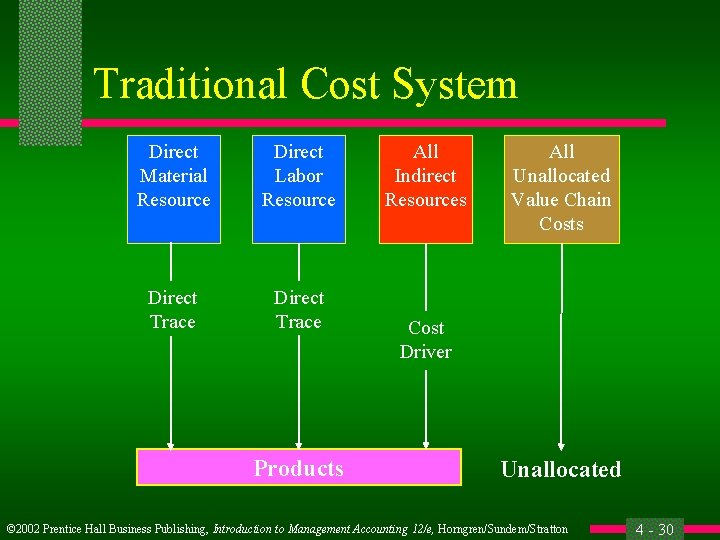
Traditional Cost System Direct Material Resource Direct Labor Resource Direct Trace Products All Indirect Resources All Unallocated Value Chain Costs Cost Driver Unallocated © 2002 Prentice Hall Business Publishing, Introduction to Management Accounting 12/e, Horngren/Sundem/Stratton 4 - 30
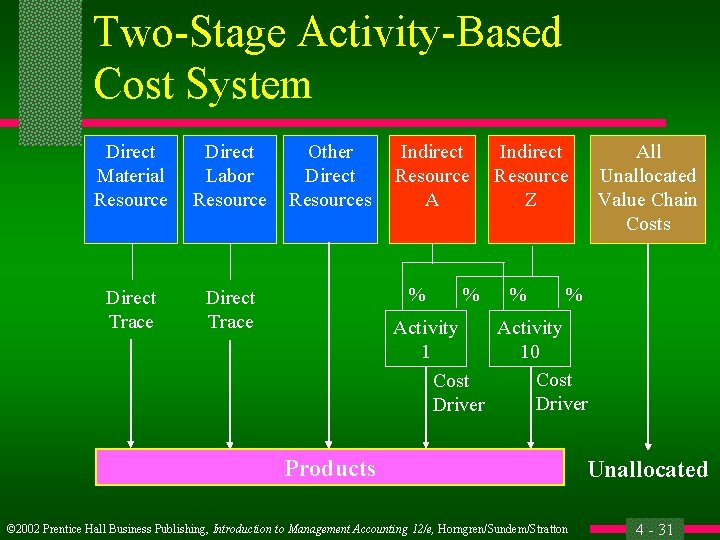
Two-Stage Activity-Based Cost System Direct Material Resource Direct Labor Resource Direct Trace Other Direct Resources Indirect Resource A % % Indirect Resource Z % All Unallocated Value Chain Costs % Activity 1 10 Cost Driver Products © 2002 Prentice Hall Business Publishing, Introduction to Management Accounting 12/e, Horngren/Sundem/Stratton Unallocated 4 - 31
Activity-Based Costing Understanding the relationships among activities, resources, costs, and cost drivers is the key to understanding ABC and how ABC facilitates managers’ understanding of operations. © 2002 Prentice Hall Business Publishing, Introduction to Management Accounting 12/e, Horngren/Sundem/Stratton 4 - 32
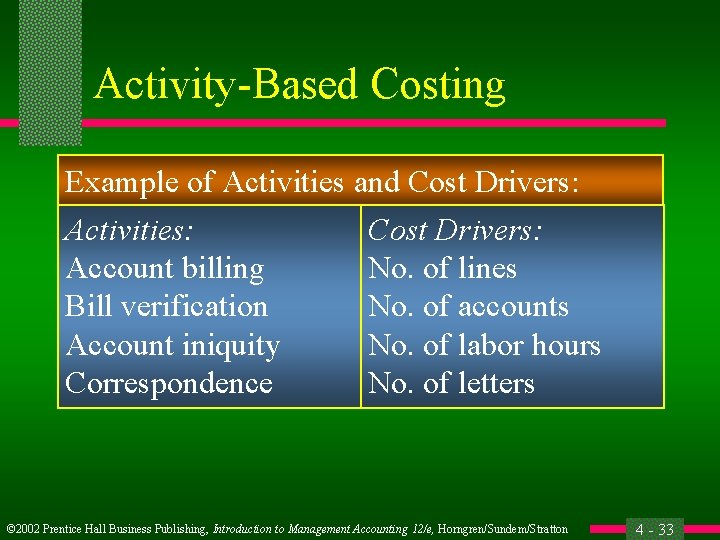
Activity-Based Costing Example of Activities and Cost Drivers: Activities: Cost Drivers: Account billing No. of lines Bill verification No. of accounts Account iniquity No. of labor hours Correspondence No. of letters © 2002 Prentice Hall Business Publishing, Introduction to Management Accounting 12/e, Horngren/Sundem/Stratton 4 - 33
Learning Objective 6 Identify the steps involved in the design and implementation of an activity-based costing system. © 2002 Prentice Hall Business Publishing, Introduction to Management Accounting 12/e, Horngren/Sundem/Stratton 4 - 34
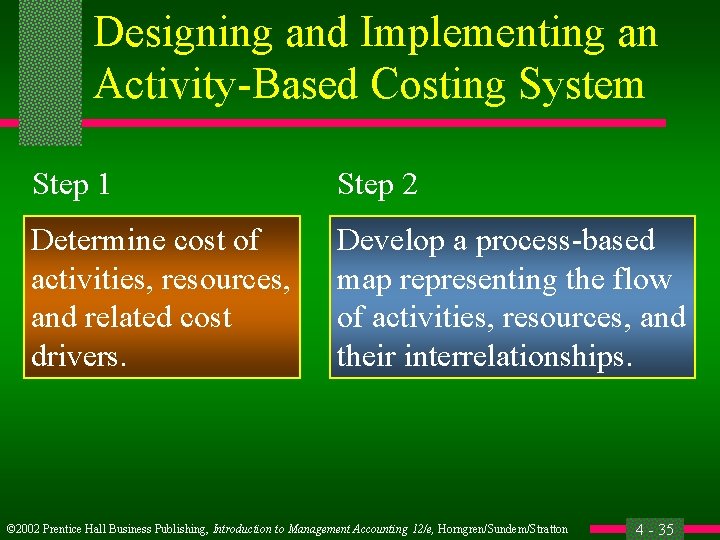
Designing and Implementing an Activity-Based Costing System Step 1 Step 2 Determine cost of activities, resources, and related cost drivers. Develop a process-based map representing the flow of activities, resources, and their interrelationships. © 2002 Prentice Hall Business Publishing, Introduction to Management Accounting 12/e, Horngren/Sundem/Stratton 4 - 35
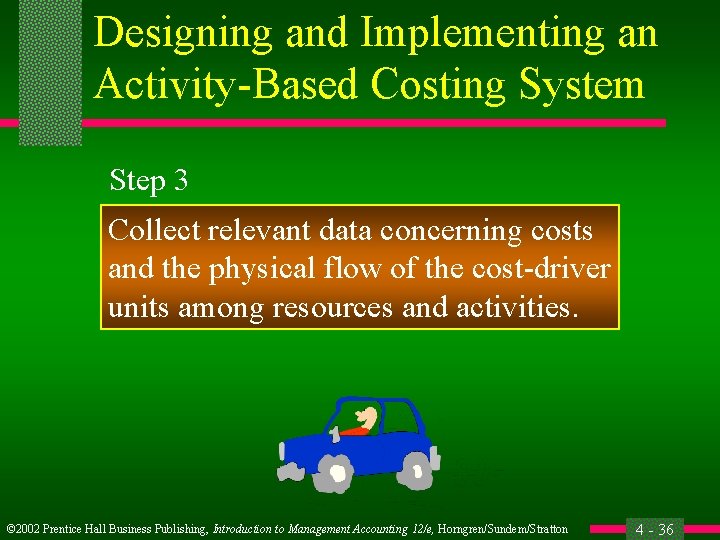
Designing and Implementing an Activity-Based Costing System Step 3 Collect relevant data concerning costs and the physical flow of the cost-driver units among resources and activities. © 2002 Prentice Hall Business Publishing, Introduction to Management Accounting 12/e, Horngren/Sundem/Stratton 4 - 36
Designing and Implementing an Activity-Based Costing System Step 4 Calculate and interpret the new activity-based information. Using an activity-based costing system to improve the operations of an organization is activity-based management (ABM). © 2002 Prentice Hall Business Publishing, Introduction to Management Accounting 12/e, Horngren/Sundem/Stratton 4 - 37
Activity-Based Management Activity-based management aims to improve the value received by customers and to improve profits by identifying opportunities for improvements in strategy and operations. © 2002 Prentice Hall Business Publishing, Introduction to Management Accounting 12/e, Horngren/Sundem/Stratton 4 - 38
Activity-Based Management A value-added cost is the cost of an activity that cannot be eliminated without affecting a product’s value to the customer. l In contrast, non-value-added costs are costs that can be eliminated without affecting a product’s value to the customer. l © 2002 Prentice Hall Business Publishing, Introduction to Management Accounting 12/e, Horngren/Sundem/Stratton 4 - 39
Learning Objective 7 Use activity-based cost information to improve the operations of an organization. © 2002 Prentice Hall Business Publishing, Introduction to Management Accounting 12/e, Horngren/Sundem/Stratton 4 - 40
Using ABC Information Activity-based management… provides costs of value-added and non-value-added activities. improves managers’ understanding of operations. © 2002 Prentice Hall Business Publishing, Introduction to Management Accounting 12/e, Horngren/Sundem/Stratton 4 - 41
Learning Objective 8 Understand cost accounting’s role in a company’s improvement efforts across the value chain. © 2002 Prentice Hall Business Publishing, Introduction to Management Accounting 12/e, Horngren/Sundem/Stratton 4 - 42
Cost Accounting and the Value Chain A good cost accounting system is critical to all value-chain functions from research and development through customer service. © 2002 Prentice Hall Business Publishing, Introduction to Management Accounting 12/e, Horngren/Sundem/Stratton 4 - 43
End of Chapter 4 © 2002 Prentice Hall Business Publishing, Introduction to Management Accounting 12/e, Horngren/Sundem/Stratton 4 - 44
- Slides: 44