
Chapter 14 Corporate Social Responsibility Corporate social responsibility
Chapter 14 Corporate Social Responsibility
Corporate social responsibility z Recent developments and contexts yglobalization y“green” agenda ystakeholder theory ysocial responsibility z Financial reporting responding z “Attitude not techniques” y. Seeks qualitative as well as quantitative expression y. Addresses issues such as environmental impact z Some pioneer companies, e. g. , Prudential, BT Chapter 14 © Philip O’Regan 2016 2
CSR ctd. z Broader responsibilities of reporting function ye. g. wider range of users (Shareholder/Stakeholder) xinvestors xemployees xcommunity xcustomers, etc. z Takes emphasis off numbers and puts it onto “qualitative” information z Companies as “corporate citizens” z Regulatory environment is critical ynational/international (UN Global Compact) Chapter 14 © Philip O’Regan 2016 3
CSR ctd. z Potent force for positive action ye. g. oil companies / political action y. Role of “citizen power” z Resistance from some, e. g. , some MNEs z Power struggle between business and others? z Part of broader social agenda z Narrative disclosures likely to increase y. Range of reports will expand Chapter 14 © Philip O’Regan 2016 4
Triple bottom line (TBL) z TBL is one response to information demands of CSR z Measures performance under: yfinancial; ysocial; and yenvironmental z Reflects limitations of traditional model Chapter 14 © Philip O’Regan 2016 5
Sustainability & environmental accounting z Sub-set of CSR y. Area of most significant impact on accounting z Response to “green agenda” z Environmental Reports now produced by many large companies ye. g. , Shell ygenuine or propaganda? z Increased disclosures: ycontingent liabilities for environmental damage ycarbon emissions Chapter 14 © Philip O’Regan 2016 6
“Sustainability” z Sustainability: “capacity to sustain service without diminishing critical capital” z Central and key concept z One accounting response distinguishes between: y. Capital: Man-made / Natural y. Natural: Critical / Non-critical z This imposes notion of “social costs” on business y. Businesses “charged” for use of critical resources y. Most businesses would be making losses if charged Chapter 14 © Philip O’Regan 2016 7
Supply chain management z Area of considerable focus z One point at which interests of developed and developing world may converge y. Significant political pressure for change y. Results in largest MNEs becoming proactive z Political roles: y. UN/ILO yregulatory bodies yaccountants Chapter 14 © Philip O’Regan 2016 8
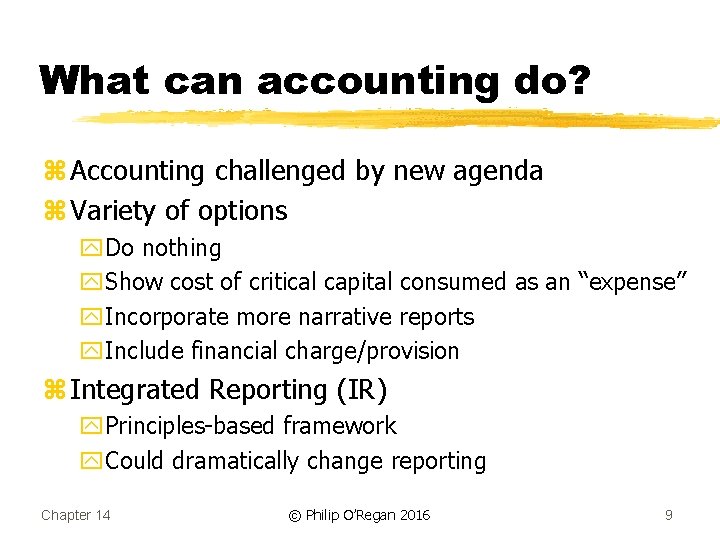
What can accounting do? z Accounting challenged by new agenda z Variety of options y. Do nothing y. Show cost of critical capital consumed as an “expense” y. Incorporate more narrative reports y. Include financial charge/provision z Integrated Reporting (IR) y. Principles-based framework y. Could dramatically change reporting Chapter 14 © Philip O’Regan 2016 9
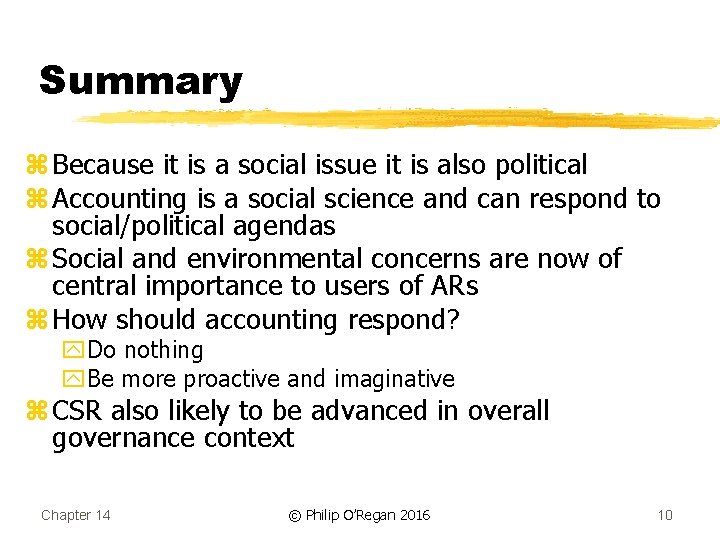
Summary z Because it is a social issue it is also political z Accounting is a social science and can respond to social/political agendas z Social and environmental concerns are now of central importance to users of ARs z How should accounting respond? y. Do nothing y. Be more proactive and imaginative z CSR also likely to be advanced in overall governance context Chapter 14 © Philip O’Regan 2016 10
- Slides: 10