
Chapter 14 Consumer Decision Making I The Process
- Slides: 28
Chapter 14 Consumer Decision Making I: The Process Consumer Behaviour Canadian Edition Schiffman/Kanuk/Das
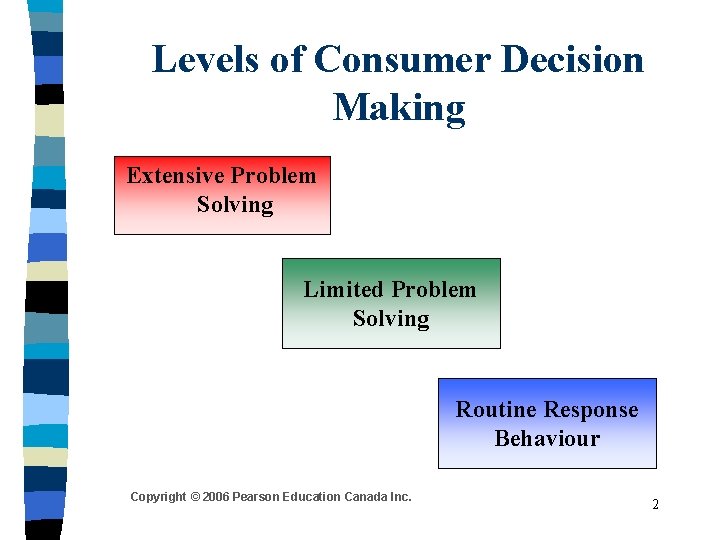
Levels of Consumer Decision Making Extensive Problem Solving Limited Problem Solving Routine Response Behaviour Copyright © 2006 Pearson Education Canada Inc. 2
Factors That Affect the Type of Decision Making Process Used n Importance of the decision n Extent of previous experience n Existence of well-established decision criteria n Amount of information at hand about each alternative n The number of alternatives available n Model of consumption being followed Copyright © 2006 Pearson Education Canada Inc. 3
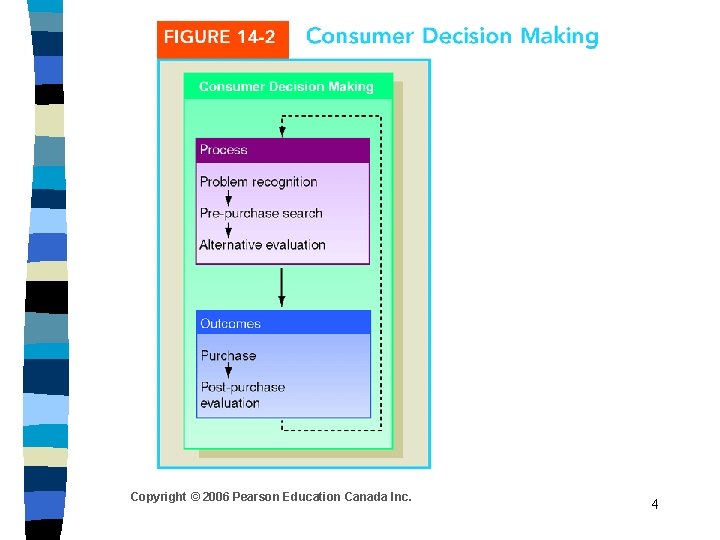
Copyright © 2006 Pearson Education Canada Inc. 4
Consumer Decision Making – The Process n Need Recognition n Pre-purchase Search n Evaluation of Alternatives Copyright © 2006 Pearson Education Canada Inc. 5
Need or Problem Recognition n The realization that there is a difference between actual and desired states – The higher the gap, the stronger the need (or bigger the problem) Copyright © 2006 Pearson Education Canada Inc. 6
Types of Problems n Active Versus Inactive problems – Active: those you are aware of – Inactive: those that you are not yet aware of (but exist) n Those that require immediate solutions and those that do not require immediate solutions Copyright © 2006 Pearson Education Canada Inc. 7
Problem Recognition and Marketing Strategy n n n Identify existing consumer problems and find solutions for these Lower the actual state Increase the desired state Increase the importance of the gap between actual and desired states Convert inactive problems to active problems Convert problems into ones requiring an immediate solution Copyright © 2006 Pearson Education Canada Inc. 8
Pre-Purchase Search n Types of Information Sources n Types of Information Sought n Factors Affecting Extent of Information Search Copyright © 2006 Pearson Education Canada Inc. 9
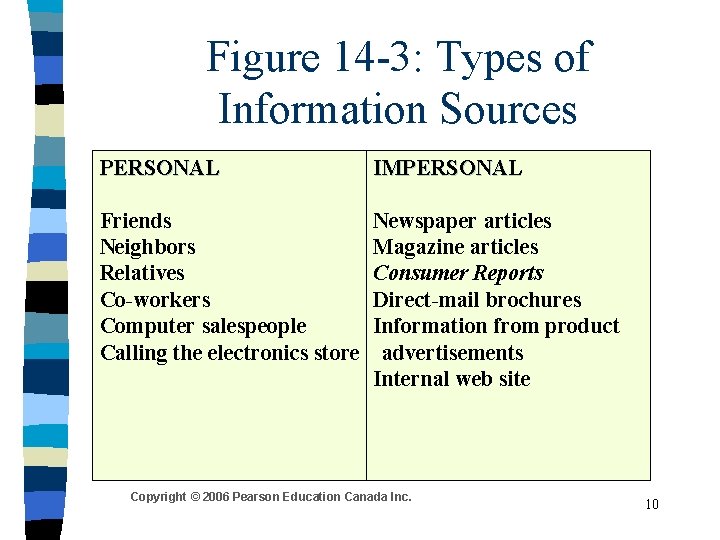
Figure 14 -3: Types of Information Sources PERSONAL IMPERSONAL Friends Neighbors Relatives Co-workers Computer salespeople Calling the electronics store Newspaper articles Magazine articles Consumer Reports Direct-mail brochures Information from product advertisements Internal web site Copyright © 2006 Pearson Education Canada Inc. 10
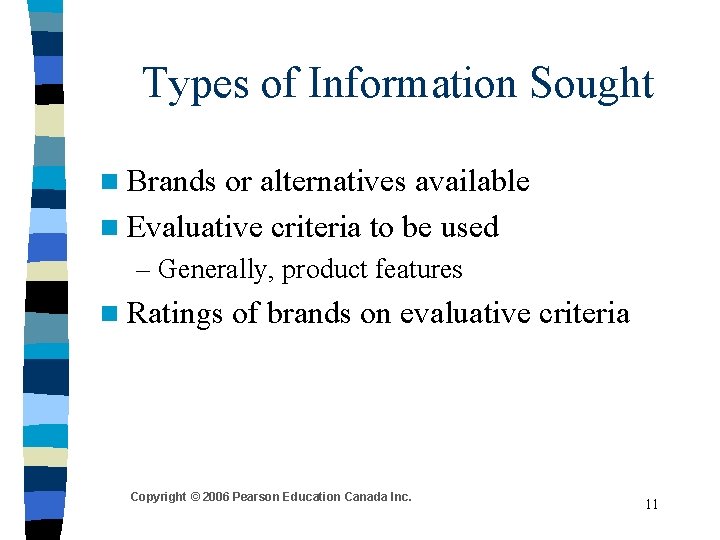
Types of Information Sought n Brands or alternatives available n Evaluative criteria to be used – Generally, product features n Ratings of brands on evaluative criteria Copyright © 2006 Pearson Education Canada Inc. 11
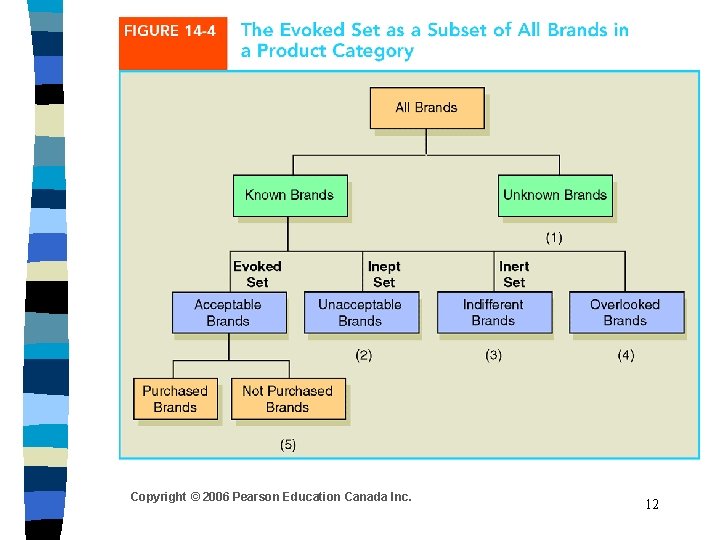
Copyright © 2006 Pearson Education Canada Inc. 12
Factors that Increase the Level of Pre -purchase Search n Product Factors: Higher search when – It is a long-lasting or infrequently used product – There are frequent changes in product styling – Large volume is purchased – The price is high – There are many alternative brands – There is much variation in features » continued Copyright © 2006 Pearson Education Canada Inc. 13
Factors that Increase the Level of Pre -purchase Search n Situational Factors: Higher search when: – Experience is lower – Previous experience was unsatisfactory n Social Acceptability: Higher search when: – Purchase is a gift – Product is socially visible in use » continued Copyright © 2006 Pearson Education Canada Inc. 14
Factors that Increase the Level of Pre -purchase Search n Value-Related Factors: Higher search when: – Purchase is discretionary – All alternatives have both positive and negative qualities – No agreement among users exists – Conflicting information is available – Other considerations exist » continued Copyright © 2006 Pearson Education Canada Inc. 15
Factors that Increase the Level of Pre -purchase Search n Consumer Factors: Higher search when: – Consumers are well-educated, have higher income levels and are younger – Consumers are low in dogmatism and risk perception – Level of involvement is high – Shopping is seen as an enjoyable activity » continued Copyright © 2006 Pearson Education Canada Inc. 16
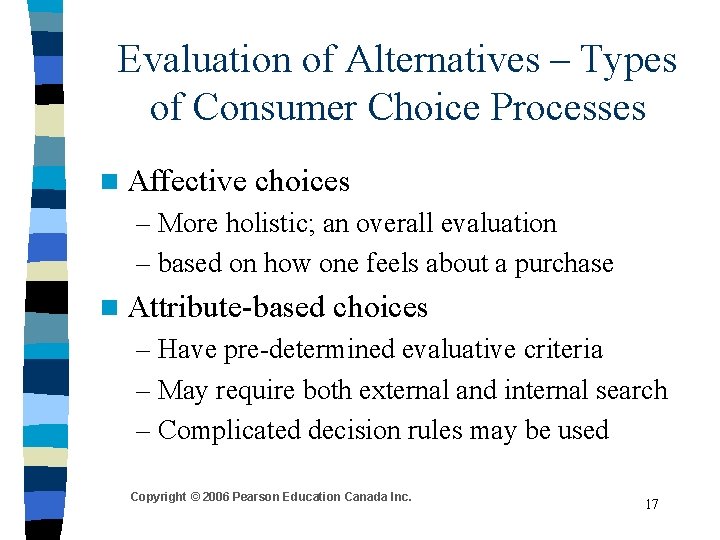
Evaluation of Alternatives – Types of Consumer Choice Processes n Affective choices – More holistic; an overall evaluation – based on how one feels about a purchase n Attribute-based choices – Have pre-determined evaluative criteria – May require both external and internal search – Complicated decision rules may be used Copyright © 2006 Pearson Education Canada Inc. 17
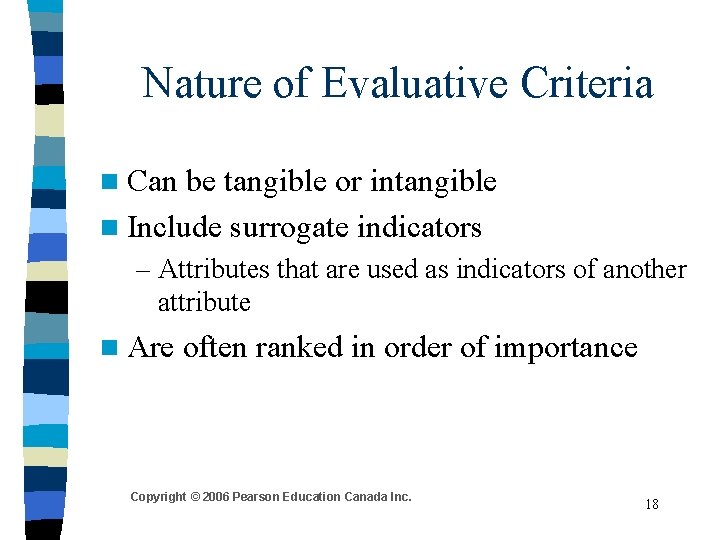
Nature of Evaluative Criteria n Can be tangible or intangible n Include surrogate indicators – Attributes that are used as indicators of another attribute n Are often ranked in order of importance Copyright © 2006 Pearson Education Canada Inc. 18
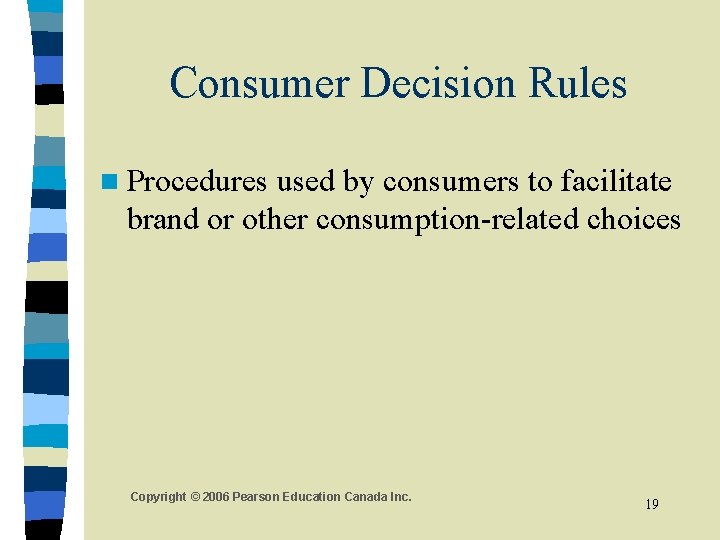
Consumer Decision Rules n Procedures used by consumers to facilitate brand or other consumption-related choices Copyright © 2006 Pearson Education Canada Inc. 19
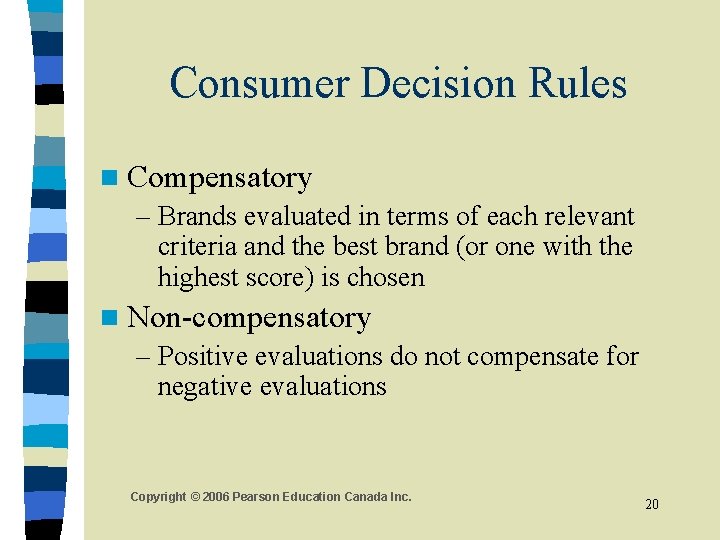
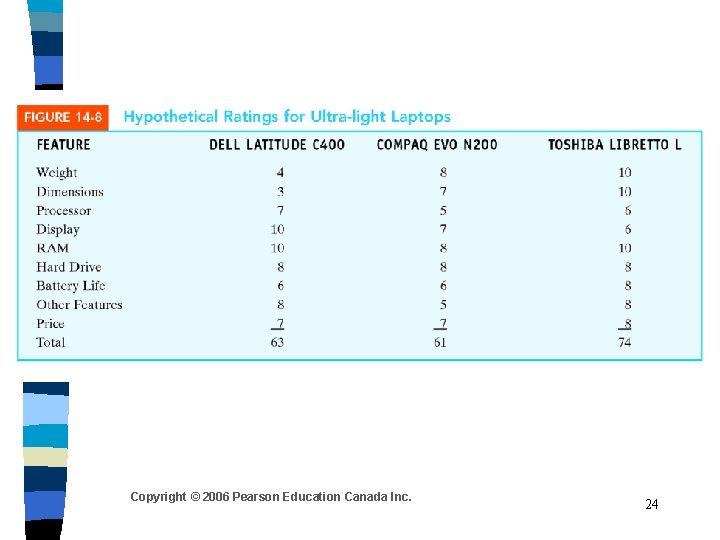
Consumer Decision Rules n Compensatory – Brands evaluated in terms of each relevant criteria and the best brand (or one with the highest score) is chosen n Non-compensatory – Positive evaluations do not compensate for negative evaluations Copyright © 2006 Pearson Education Canada Inc. 20
Non-Compensatory Consumer Decision Rules n Conjunctive Decision Rule – Product attributes are identified – a minimally acceptable cutoff point is established for each attribute – brands that fall below the cutoff point on any one attribute are eliminated from further consideration. » continued Copyright © 2006 Pearson Education Canada Inc. 21
Non-Compensatory Consumer Decision Rules n Disjunctive Decision Rule – consumers identify product attributes – establish a minimally acceptable cutoff point for each attribute – accept the brand that meets or exceeds the cutoff for any one attribute » continued Copyright © 2006 Pearson Education Canada Inc. 22
Non-Compensatory Consumer Decision Rules n Lexicographic Decision Rule – Product attributes are identified – Product attributes are ranked in terms of importance – brands are compared in terms of the attribute considered most important – Brand that scores highest on the first attribute is chosen – If there is a tie, the scores on the next attribute are considered Copyright © 2006 Pearson Education Canada Inc. 23
Copyright © 2006 Pearson Education Canada Inc. 24
Issues in Alternative Evaluation n Lifestyles as a Consumer Decision Strategy n Incomplete Information n Non-comparable Alternatives n Series of Decisions n Consumption Vision – Mental picture of the consequences of using a particular product Copyright © 2006 Pearson Education Canada Inc. 25
Coping with Missing Information n Delay decision until missing information is obtained n Ignore missing information and use available information n Change the decision strategy to one that better accommodates for the missing information n Infer the missing information Copyright © 2006 Pearson Education Canada Inc. 26
Information Search and Marketing Strategy n Get products into consumers’ evoked set n Limit information search if your brand is the preferred brand n Increase information search if your alternative is not the preferred brand n Use point-of-purchase advertising effectively Copyright © 2006 Pearson Education Canada Inc. 27
Alternative Evaluation and Marketing Strategy n n n Identify decision rule used by target market and use suitable promotional messages Influence the choice of evaluative criteria Influence the rating of your product on evaluative criteria used Use surrogate indicators effectively Use ‘consumption vision’ Copyright © 2006 Pearson Education Canada Inc. 28