
Chapter 14 Classification of Organisms How do we
- Slides: 19
Chapter 14 Classification of Organisms
• How do we tell the difference between related individuals? – Different first name – Same last name • Science is slightly different
Section 14. 1 Categories of Biological Classification
Taxonomy • Taxonomy – The science of naming and classifying organisms • Created to make it easier to tell the difference between all organisms on Earth • Taxonomy uses Latin language
A Simpler System • Binomial Nomenclature – Two-word system for naming organisms • Invented by Swedish scientist, Carl Linnaeus • First word = genus • Second word = species
Scientific Names • Binomial nomenclature = scientific name • Genus – A taxonomic category containing similar species • Helps describe the difference between organisms with the same name • p. 301 – Table 1
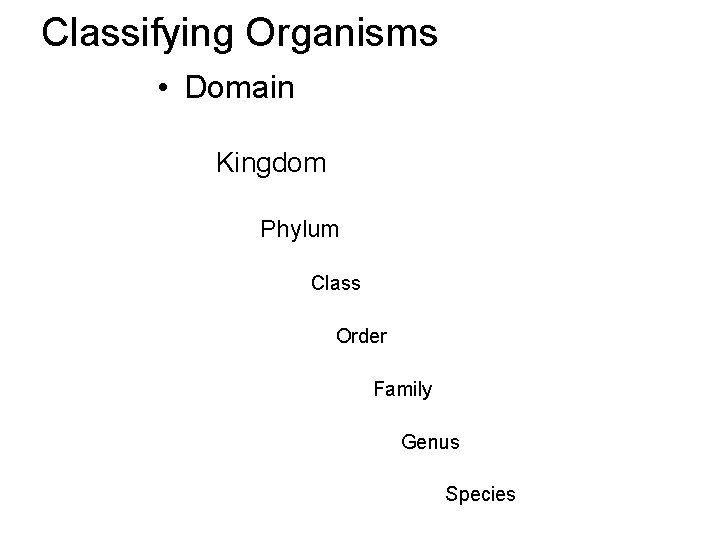
Classifying Organisms • Consists of 8 levels – p. 302 – fig. 2 • Starts with the most broad and ends with most specific descriptive
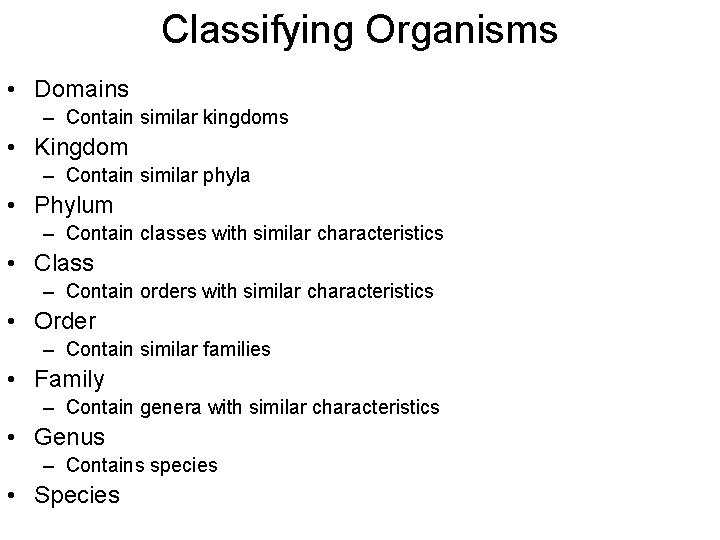
Classifying Organisms • Domains – Contain similar kingdoms • Kingdom – Contain similar phyla • Phylum – Contain classes with similar characteristics • Class – Contain orders with similar characteristics • Order – Contain similar families • Family – Contain genera with similar characteristics • Genus – Contains species • Species
Classifying Organisms • Domain Kingdom Phylum Class Order Family Genus Species
Create a Mnemonic • Create a mnemonic to remember the organization of the levels of classification in the correct order. • Ex: Do Kids Post Crap On Facebook? Generally So • Create your own and share with your table partner.
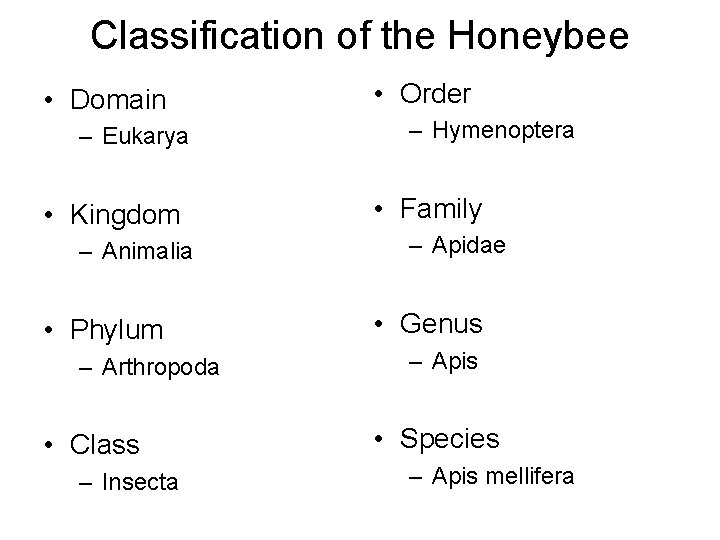
Classification of the Honeybee • Domain – Eukarya • Kingdom – Animalia • Phylum – Arthropoda • Class – Insecta • Order – Hymenoptera • Family – Apidae • Genus – Apis • Species – Apis mellifera
Section 14. 2 How Biologists Classify Organisms
• With a partner, describe how you would organize a closet full of clothes so things seemed to be in a logical order. – – – – Color Long-sleeve Short-sleeve Fabric Buttons No buttons Hoods No hoods
What is a Species? • Biological Species – A group of natural populations that are interbreeding or could interbreed, and that are reproductively isolated from other similar groups. • Reproductive Isolation – Occurs when a barrier separates two or more groups of organisms and prevents them from interbreeding • Hybrid – Occurs if individuals of different species interbreed
Number of Species • Many more species exist than are described • New species are being discovered • There are currently around 1. 5 million species • Scientists believe there are 5 to 10 million species (in the tropics alone) that have not yet been described • The earth is more diverse than we think
Evolutionary History • Phylogeny – Evolutionary history of an organism • Convergent evolution – Organisms may have similar characteristics due to developing in similar habitats • Analogous characters – Similarities that occur due to convergent evolution • Wings of birds and insects
Cladistics • Cladistics – Method of analysis that reconstructs phylogenies by inferring relationships based on shared characteristics • Ancestral character – Occurs when the characteristic is found in common ancestors • Backbone of birds and mammals
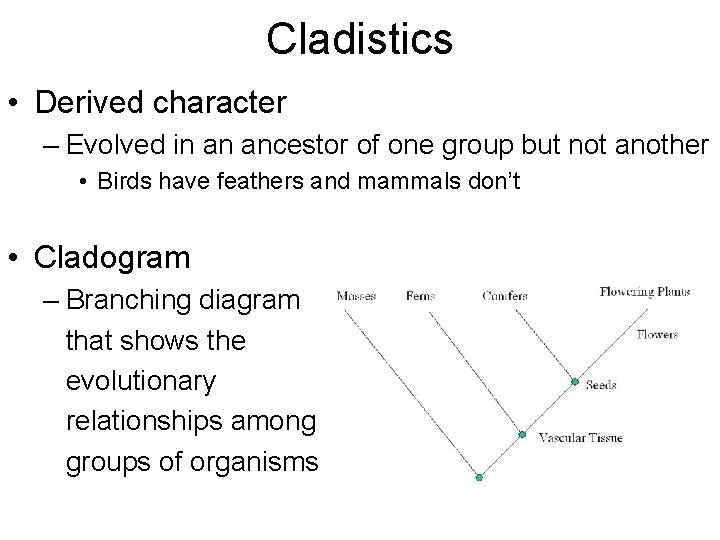
Cladistics • Derived character – Evolved in an ancestor of one group but not another • Birds have feathers and mammals don’t • Cladogram – Branching diagram that shows the evolutionary relationships among groups of organisms
Data Lab – p. 309 • Materials (per group): – Whiteboard – 1 marker – Eraser • Task – Create a cladogram for the 3 plants. – Answer the 3 Analysis Questions on your whiteboard