
Chapter 14 Chemical Kinetics 14 1 Reaction Rates





- Slides: 87
Chapter 14 Chemical Kinetics
14. 1 Reaction Rates • Kinetics: the study of how fast reactions take place • Some reactions are fast (photosynthesis) • Some reactions are slow (conversion of diamond to graphite) Copyright Mc. Graw-Hill 2009
Importance of Studying Reaction Rates • Speed up desirable reactions • Minimize damage by undesirable reactions • Useful in drug design, pollution control, and food processing Copyright Mc. Graw-Hill 2009
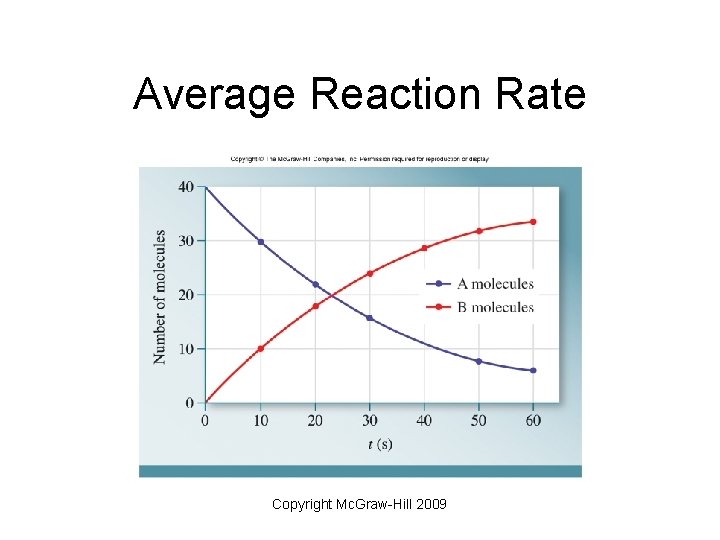
Rate of Reaction • Expressed as either: – Rate of disappearance of reactants (decrease or negative) OR – Rate of appearance of products (increase or positive) Copyright Mc. Graw-Hill 2009
Average Reaction Rate Copyright Mc. Graw-Hill 2009
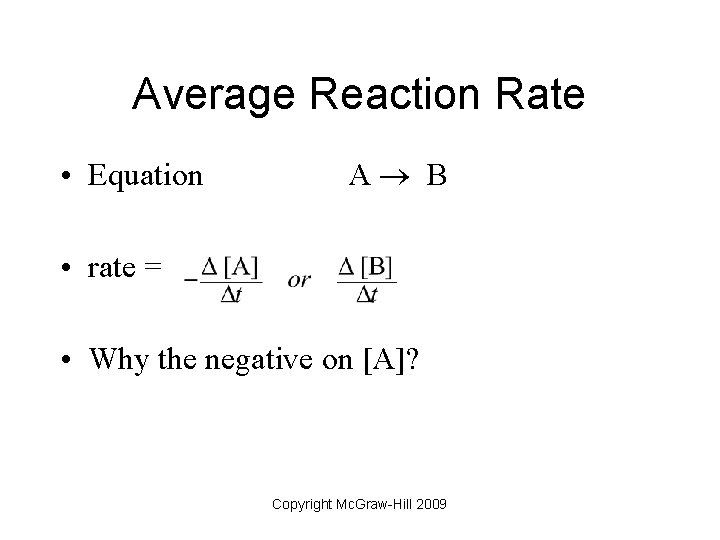
Average Reaction Rate • Equation A B • rate = • Why the negative on [A]? Copyright Mc. Graw-Hill 2009
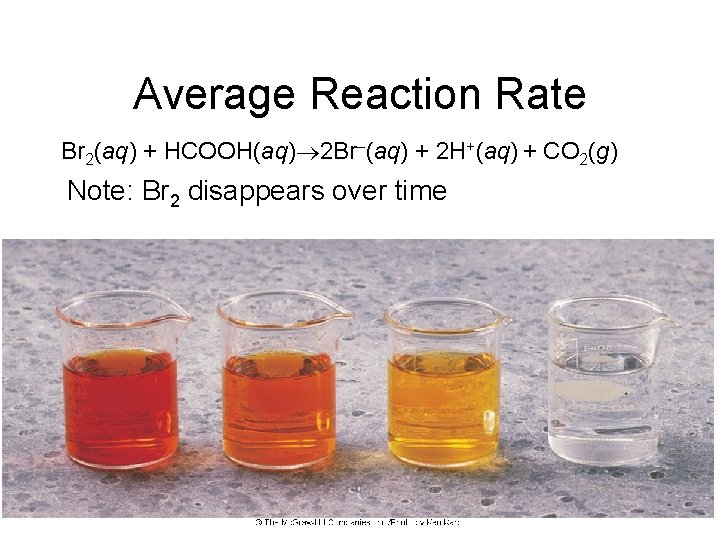
Average Reaction Rate Br 2(aq) + HCOOH(aq) 2 Br (aq) + 2 H+(aq) + CO 2(g) Note: Br 2 disappears over time Copyright Mc. Graw-Hill 2009
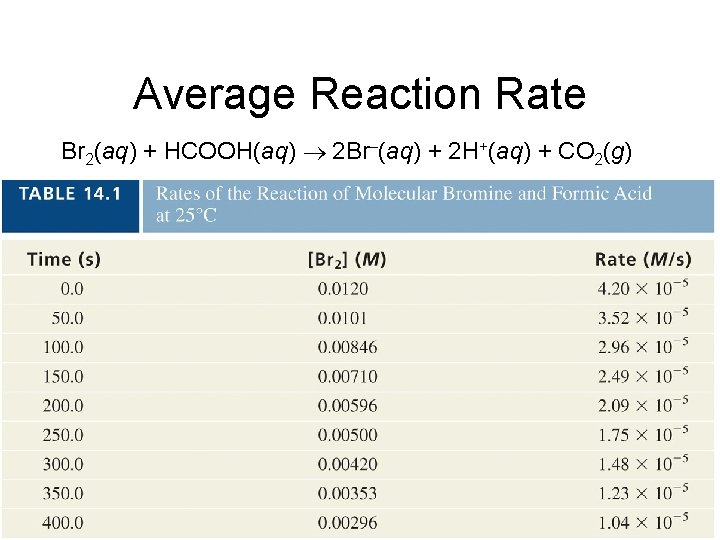
Average Reaction Rate Br 2(aq) + HCOOH(aq) 2 Br (aq) + 2 H+(aq) + CO 2(g) Copyright Mc. Graw-Hill 2009
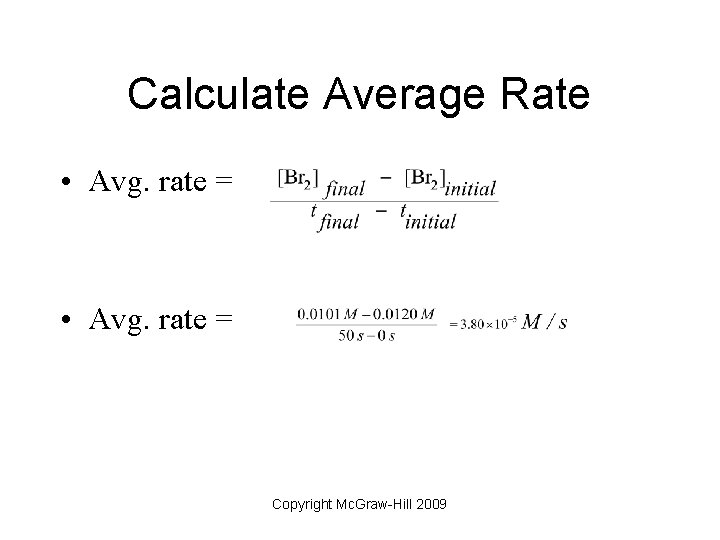
Calculate Average Rate • Avg. rate = Copyright Mc. Graw-Hill 2009
Average Rate • Average rate depends on time interval • Plot of [Br 2] vs time = curve • Plot of Rate vs [Br 2] = straight line Copyright Mc. Graw-Hill 2009
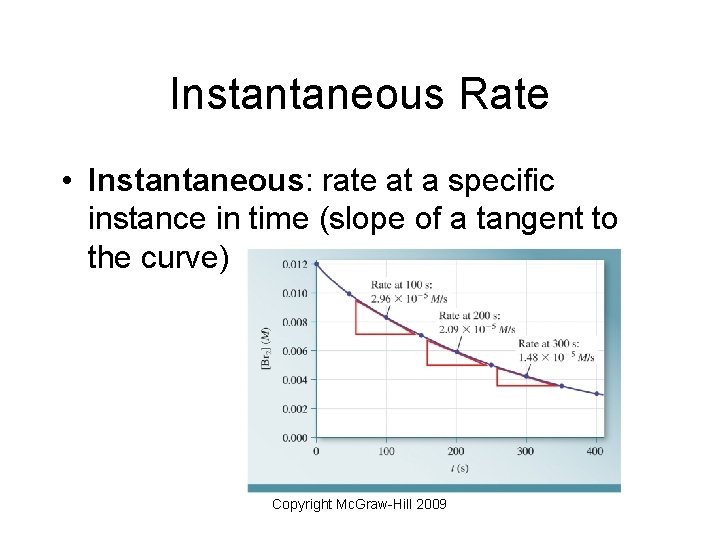
Instantaneous Rate • Instantaneous: rate at a specific instance in time (slope of a tangent to the curve) Copyright Mc. Graw-Hill 2009
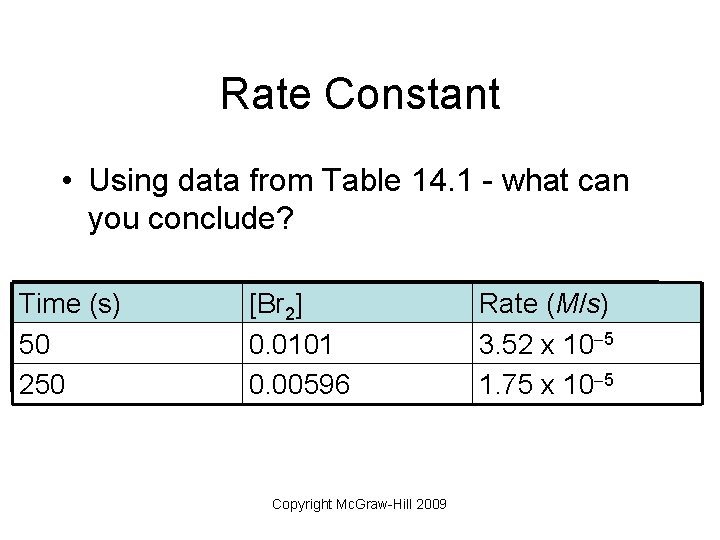
Rate Constant • Using data from Table 14. 1 - what can you conclude? Time (s) 50 250 [Br 2] 0. 0101 0. 00596 Copyright Mc. Graw-Hill 2009 Rate (M/s) 3. 52 x 10 5 1. 75 x 10 5
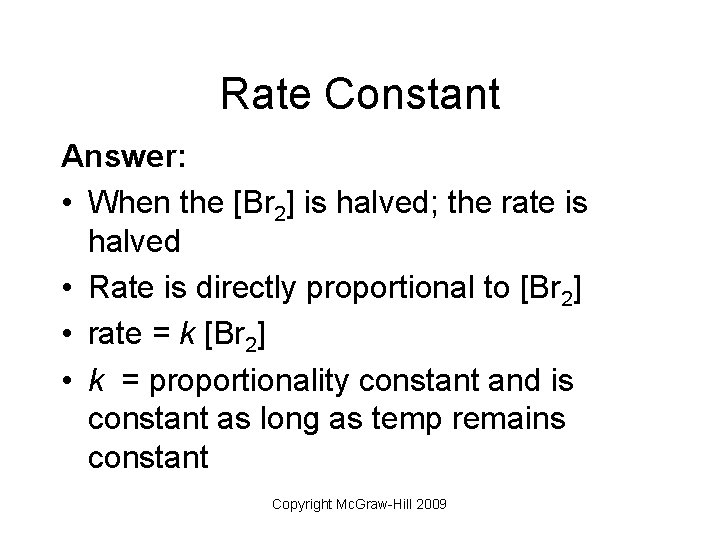
Rate Constant Answer: • When the [Br 2] is halved; the rate is halved • Rate is directly proportional to [Br 2] • rate = k [Br 2] • k = proportionality constant and is constant as long as temp remains constant Copyright Mc. Graw-Hill 2009
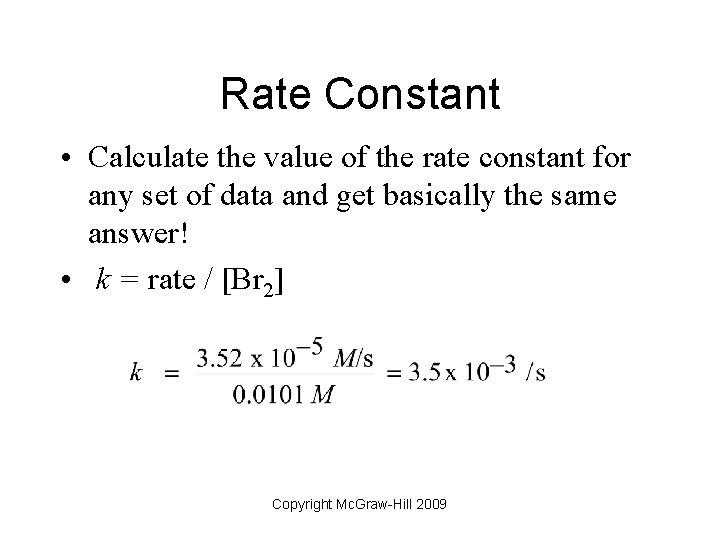
Rate Constant • Calculate the value of the rate constant for any set of data and get basically the same answer! • k = rate / [Br 2] Copyright Mc. Graw-Hill 2009
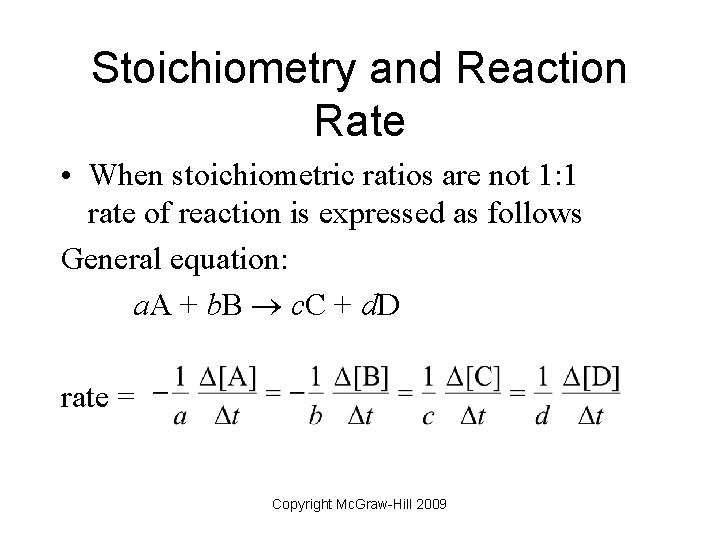
Stoichiometry and Reaction Rate • When stoichiometric ratios are not 1: 1 rate of reaction is expressed as follows General equation: a. A + b. B c. C + d. D rate = Copyright Mc. Graw-Hill 2009
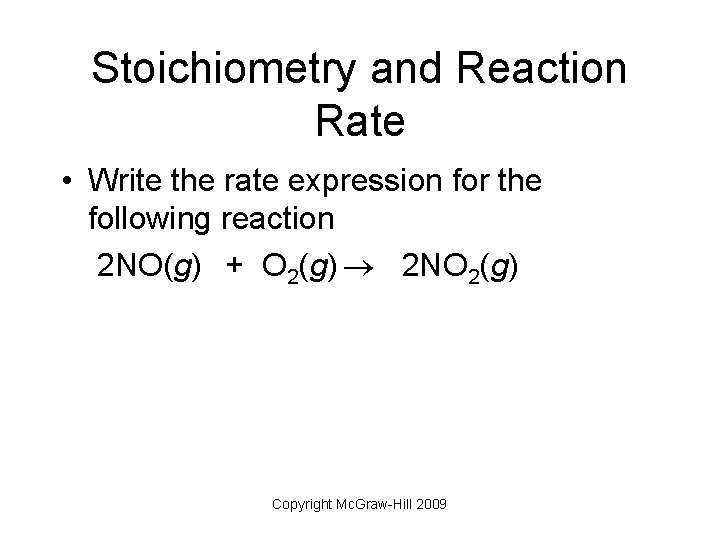
Stoichiometry and Reaction Rate • Write the rate expression for the following reaction 2 NO(g) + O 2(g) 2 NO 2(g) Copyright Mc. Graw-Hill 2009
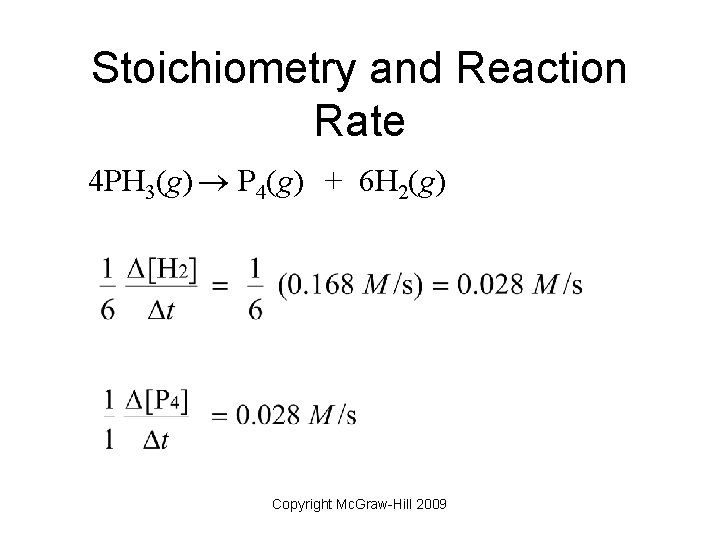
Stoichiometry and Reaction Rate 4 PH 3(g) P 4(g) + 6 H 2(g) If molecular hydrogen is formed at a rate of 0. 168 M/s, at what rate is P 4 being produced? Copyright Mc. Graw-Hill 2009
Stoichiometry and Reaction Rate 4 PH 3(g) P 4(g) + 6 H 2(g) Copyright Mc. Graw-Hill 2009
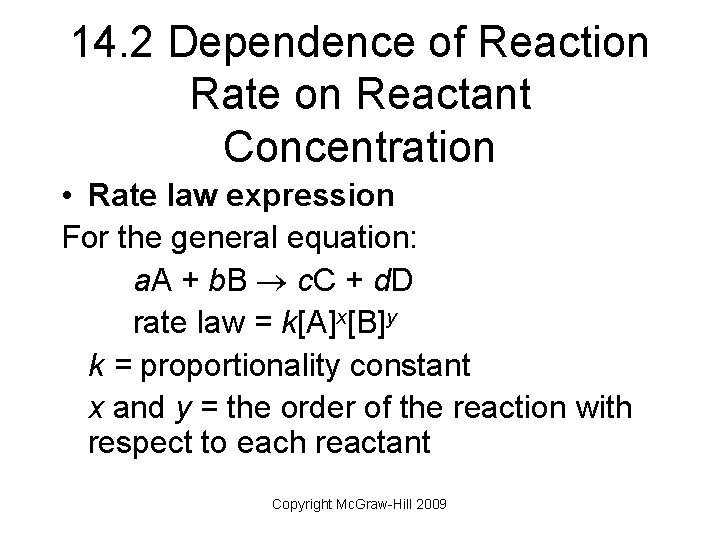
14. 2 Dependence of Reaction Rate on Reactant Concentration • Rate law expression For the general equation: a. A + b. B c. C + d. D rate law = k[A]x[B]y k = proportionality constant x and y = the order of the reaction with respect to each reactant Copyright Mc. Graw-Hill 2009
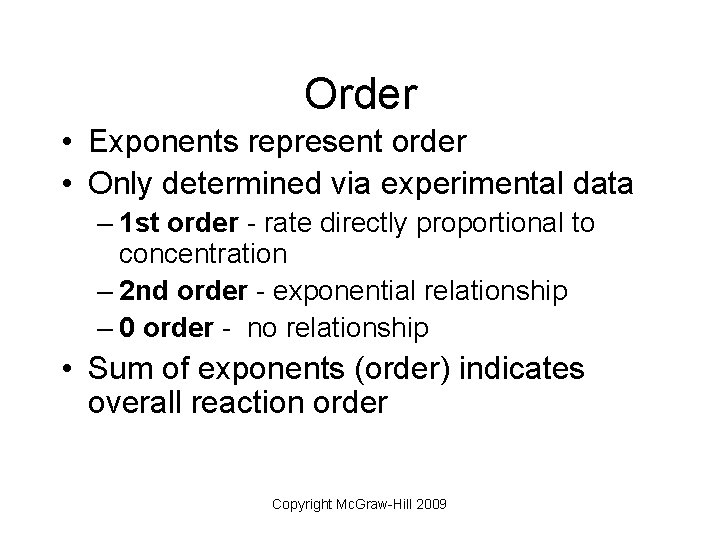
Order • Exponents represent order • Only determined via experimental data – 1 st order - rate directly proportional to concentration – 2 nd order - exponential relationship – 0 order - no relationship • Sum of exponents (order) indicates overall reaction order Copyright Mc. Graw-Hill 2009
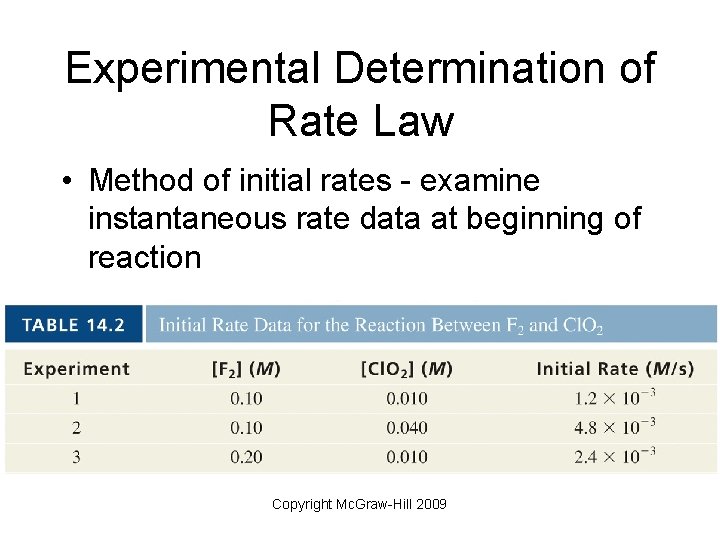
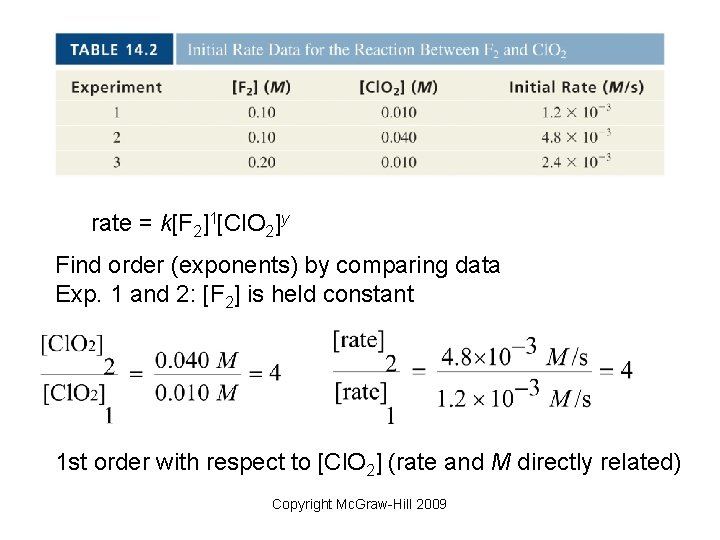
Experimental Determination of Rate Law • Method of initial rates - examine instantaneous rate data at beginning of reaction Copyright Mc. Graw-Hill 2009
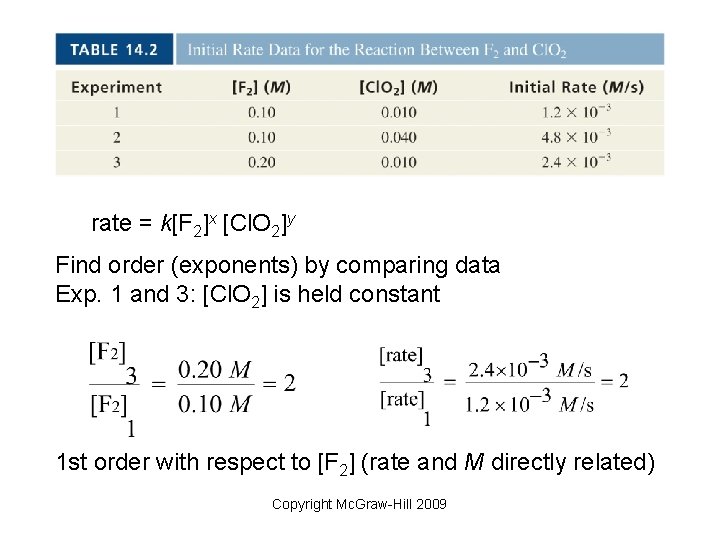
rate = k[F 2]x [Cl. O 2]y Find order (exponents) by comparing data Exp. 1 and 3: [Cl. O 2] is held constant 1 st order with respect to [F 2] (rate and M directly related) Copyright Mc. Graw-Hill 2009
rate = k[F 2]1[Cl. O 2]y Find order (exponents) by comparing data Exp. 1 and 2: [F 2] is held constant 1 st order with respect to [Cl. O 2] (rate and M directly related) Copyright Mc. Graw-Hill 2009
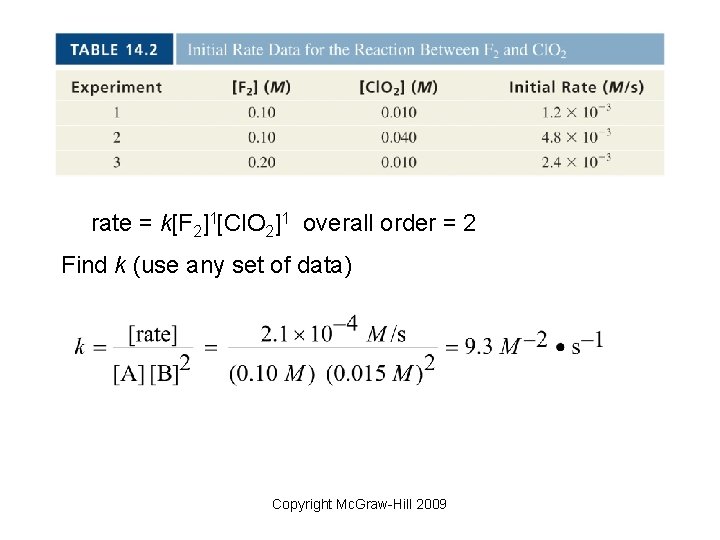
rate = k[F 2]1[Cl. O 2]1 overall order = 2 Find k (use any set of data) Copyright Mc. Graw-Hill 2009
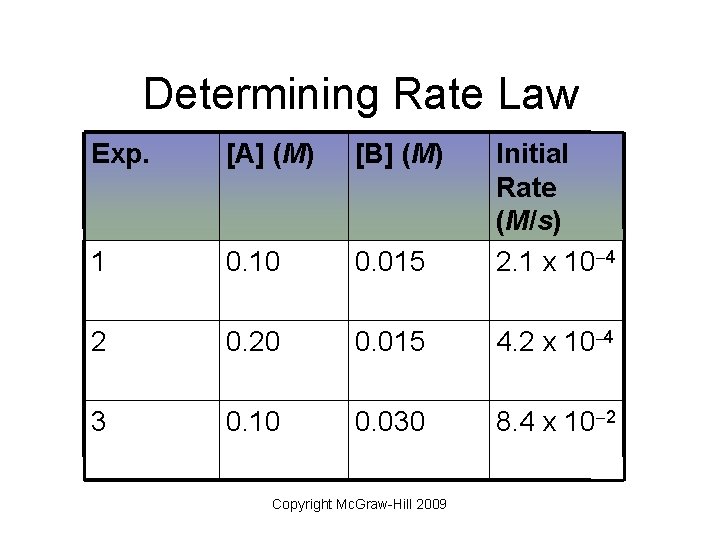
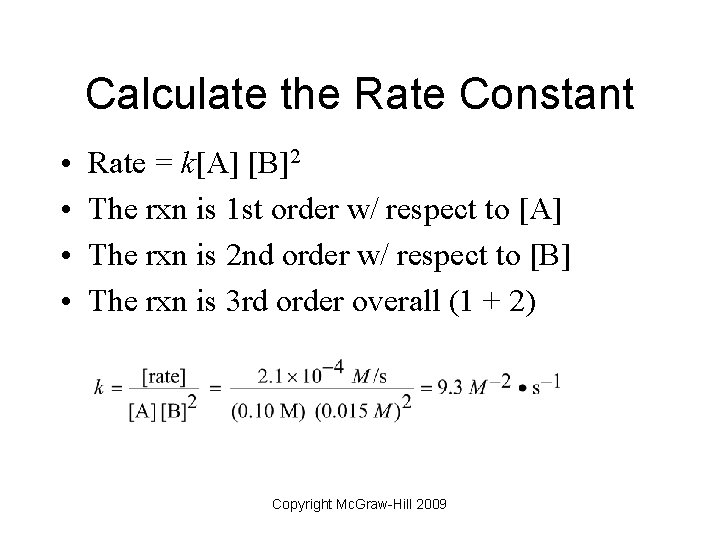
Determining Rate Law Exp. [A] (M) [B] (M) 1 0. 10 0. 015 Initial Rate (M/s) 2. 1 x 10 4 2 0. 20 0. 015 4. 2 x 10 4 3 0. 10 0. 030 8. 4 x 10 2 Copyright Mc. Graw-Hill 2009
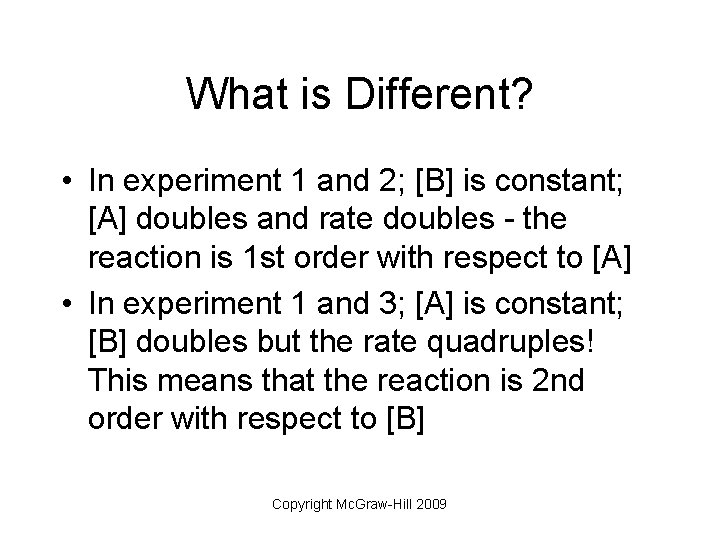
What is Different? • In experiment 1 and 2; [B] is constant; [A] doubles and rate doubles - the reaction is 1 st order with respect to [A] • In experiment 1 and 3; [A] is constant; [B] doubles but the rate quadruples! This means that the reaction is 2 nd order with respect to [B] Copyright Mc. Graw-Hill 2009
Calculate the Rate Constant • • Rate = k[A] [B]2 The rxn is 1 st order w/ respect to [A] The rxn is 2 nd order w/ respect to [B] The rxn is 3 rd order overall (1 + 2) Copyright Mc. Graw-Hill 2009
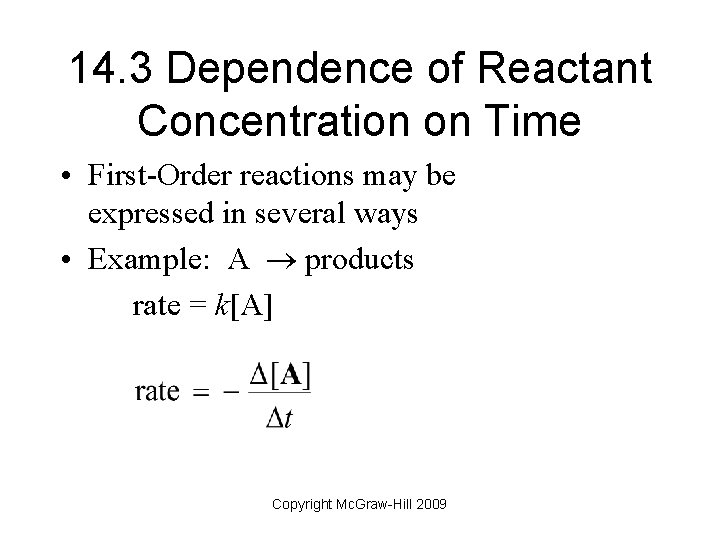
14. 3 Dependence of Reactant Concentration on Time • First-Order reactions may be expressed in several ways • Example: A products rate = k[A] Copyright Mc. Graw-Hill 2009
Integrated Rate Law (First order) When the two expressions are set equal to each other, we get an expression that can be rearranged in the form of a straight line. y = mx + Copyright Mc. Graw-Hill 2009 b
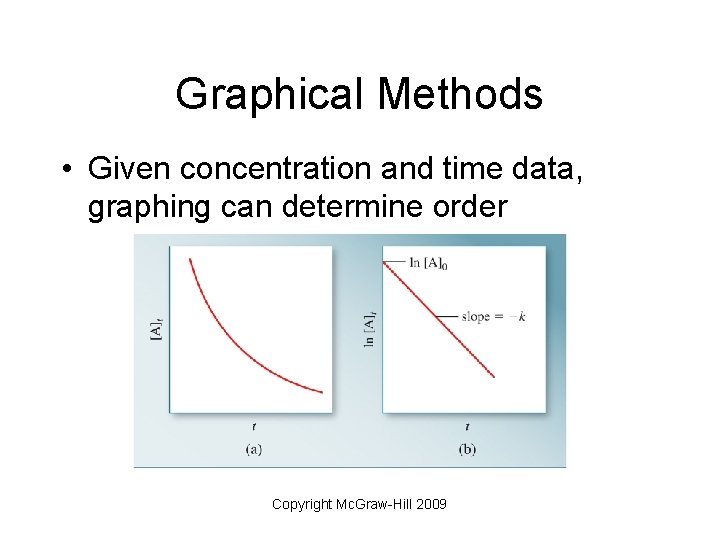
Graphical Methods • Given concentration and time data, graphing can determine order Copyright Mc. Graw-Hill 2009
Integrated Rate Law (First order) • For a 1 st order reaction, a plot of ln [A] vs time yields a straight line • The slope = k (the rate constant) Copyright Mc. Graw-Hill 2009
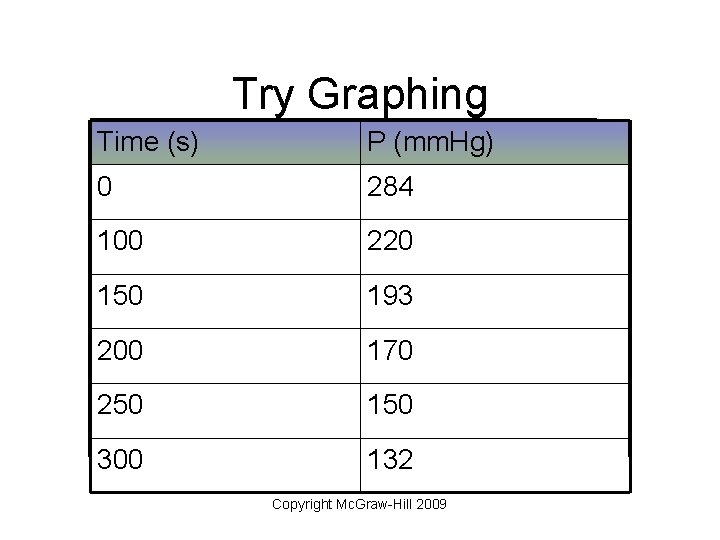
Try Graphing Time (s) P (mm. Hg) 0 284 100 220 150 193 200 170 250 150 300 132 Copyright Mc. Graw-Hill 2009
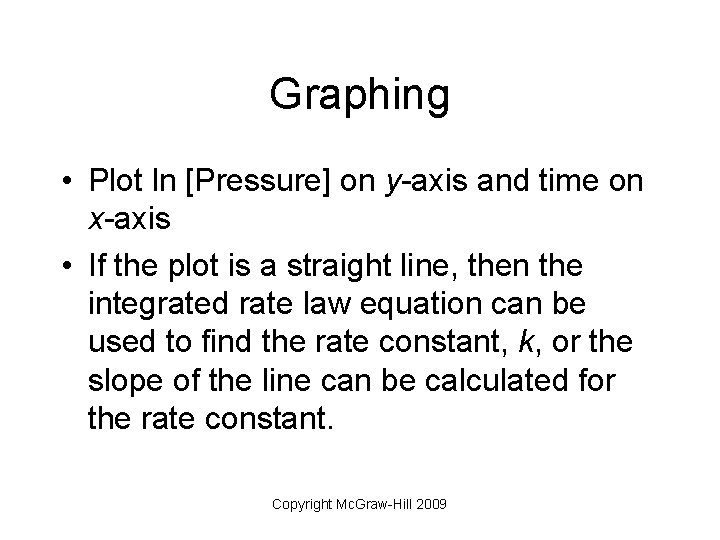
Graphing • Plot ln [Pressure] on y-axis and time on x-axis • If the plot is a straight line, then the integrated rate law equation can be used to find the rate constant, k, or the slope of the line can be calculated for the rate constant. Copyright Mc. Graw-Hill 2009
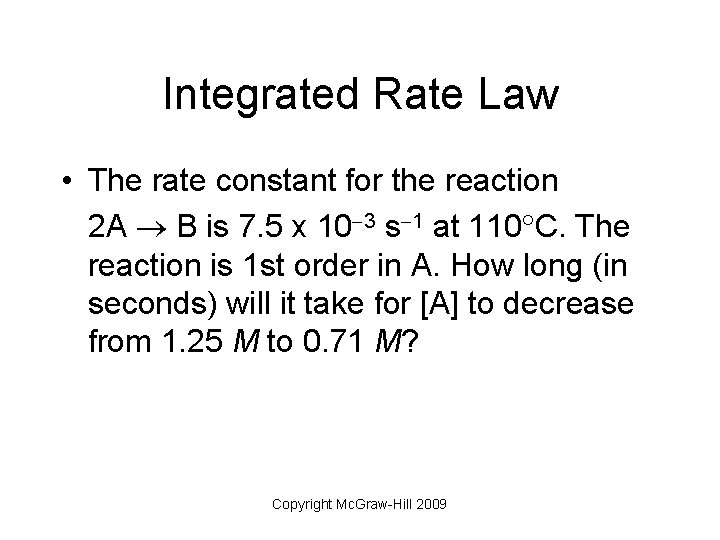
Integrated Rate Law • The rate constant for the reaction 2 A B is 7. 5 x 10 3 s 1 at 110 C. The reaction is 1 st order in A. How long (in seconds) will it take for [A] to decrease from 1. 25 M to 0. 71 M? Copyright Mc. Graw-Hill 2009
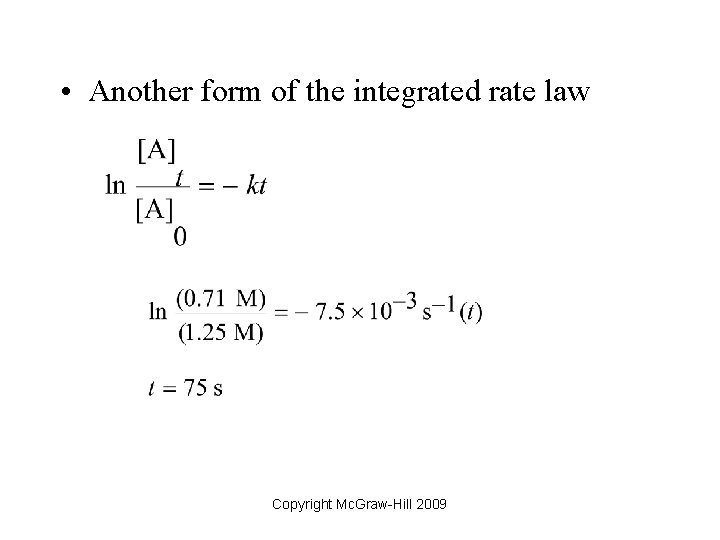
• Another form of the integrated rate law Copyright Mc. Graw-Hill 2009
Your Turn! • Consider the same first order reaction 2 A B, for which k = 7. 5 x 10 3 s 1 at 110 C. With a starting concentration of [A] = 2. 25 M, what will [A] be after 2. 0 minutes? Copyright Mc. Graw-Hill 2009
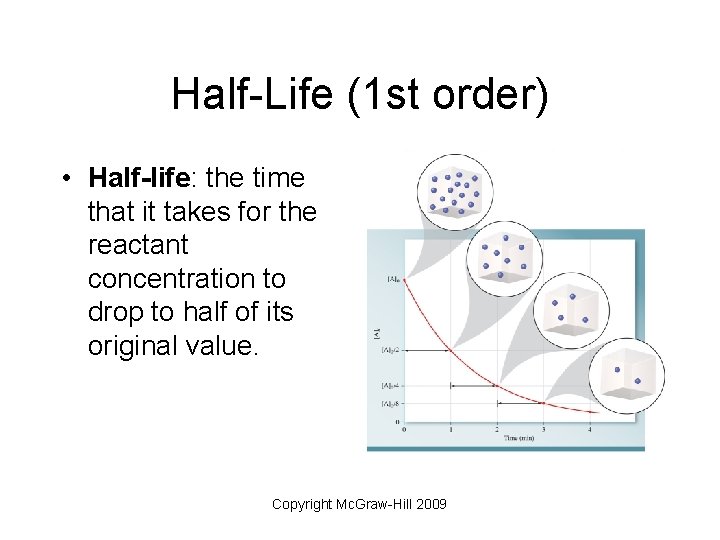
Half-Life (1 st order) • Half-life: the time that it takes for the reactant concentration to drop to half of its original value. Copyright Mc. Graw-Hill 2009
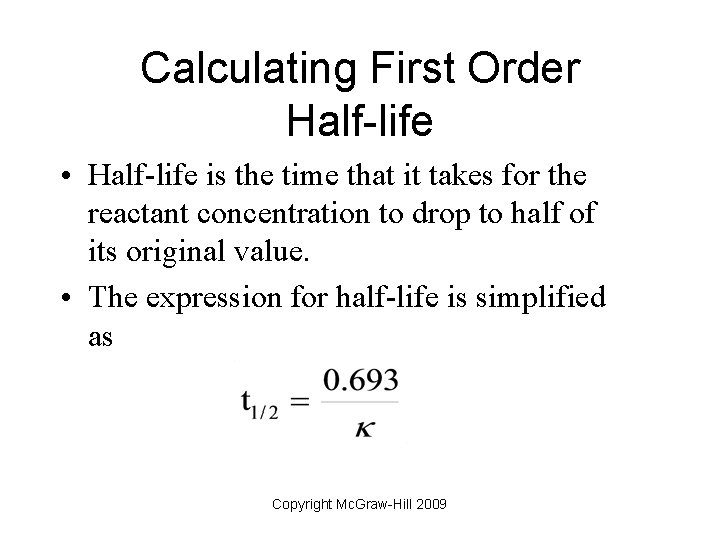
Calculating First Order Half-life • Half-life is the time that it takes for the reactant concentration to drop to half of its original value. • The expression for half-life is simplified as Copyright Mc. Graw-Hill 2009
Half-Life • The decomposition of ethane (C 2 H 6) to methyl radicals ( CH 3) is a first order reaction with a rate constant of 5. 36 x 10 4 s 1 at 700 C. C 2 H 6 2 CH 3 Calculate the half-life in minutes. Copyright Mc. Graw-Hill 2009
Half-Life Copyright Mc. Graw-Hill 2009
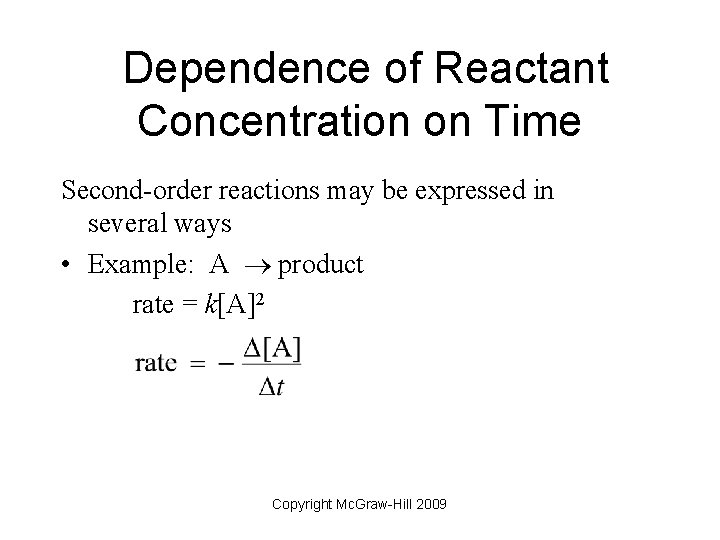
Dependence of Reactant Concentration on Time Second-order reactions may be expressed in several ways • Example: A product rate = k[A]2 Copyright Mc. Graw-Hill 2009
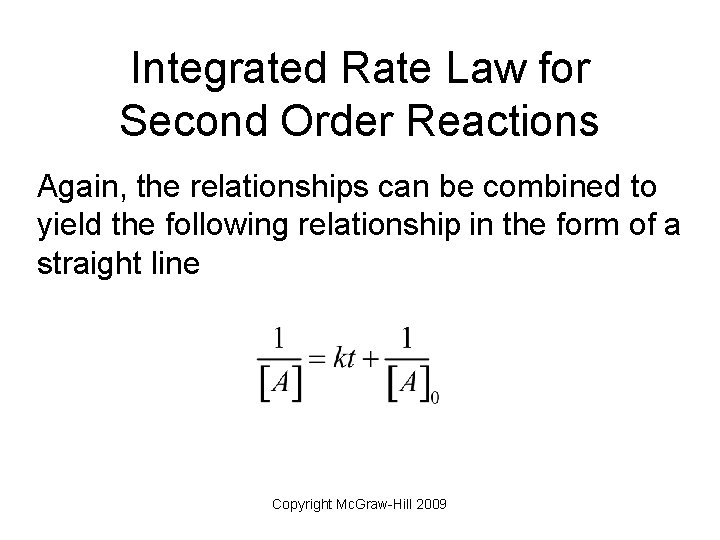
Integrated Rate Law for Second Order Reactions Again, the relationships can be combined to yield the following relationship in the form of a straight line Copyright Mc. Graw-Hill 2009
Integrated Rate Law for Second Order Reactions • For a 2 nd order reaction, a plot of 1/[A] vs time yields a straight line • The slope = k (the rate constant) Copyright Mc. Graw-Hill 2009
Calculating Second-Order Half-life The expression for half-life is simplified as Note: half-life for 2 nd order is inversely proportional to the initial reaction concentration Copyright Mc. Graw-Hill 2009
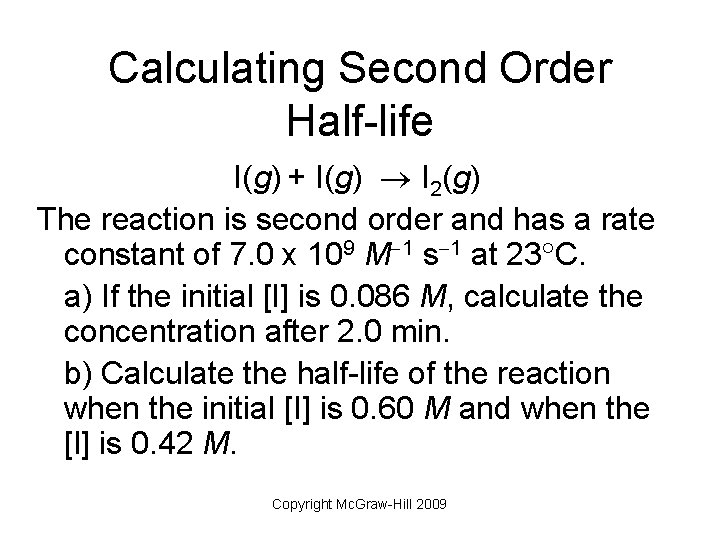
Calculating Second Order Half-life I(g) + I(g) I 2(g) The reaction is second order and has a rate constant of 7. 0 x 109 M 1 s 1 at 23 C. a) If the initial [I] is 0. 086 M, calculate the concentration after 2. 0 min. b) Calculate the half-life of the reaction when the initial [I] is 0. 60 M and when the [I] is 0. 42 M. Copyright Mc. Graw-Hill 2009
a) Use integrated rate equation for 2 nd order Copyright Mc. Graw-Hill 2009
b) Use the half-life formula for 2 nd order (note: half-life does not remain constant for a 2 nd-order reaction!) Copyright Mc. Graw-Hill 2009
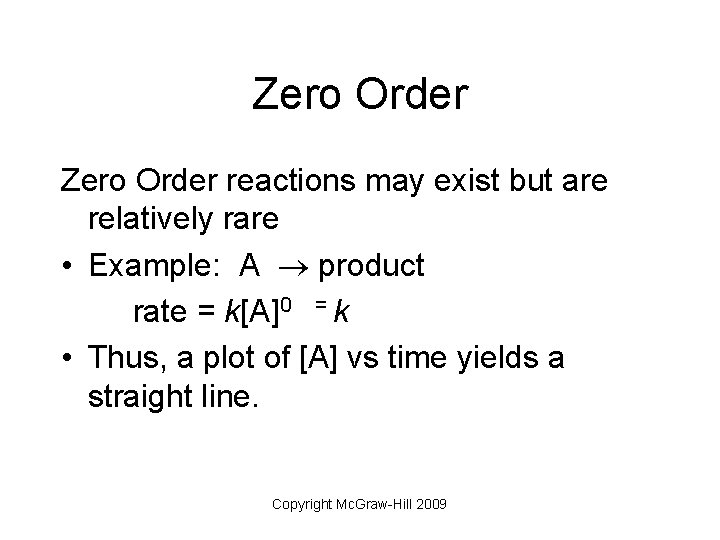
Zero Order reactions may exist but are relatively rare • Example: A product rate = k[A]0 = k • Thus, a plot of [A] vs time yields a straight line. Copyright Mc. Graw-Hill 2009
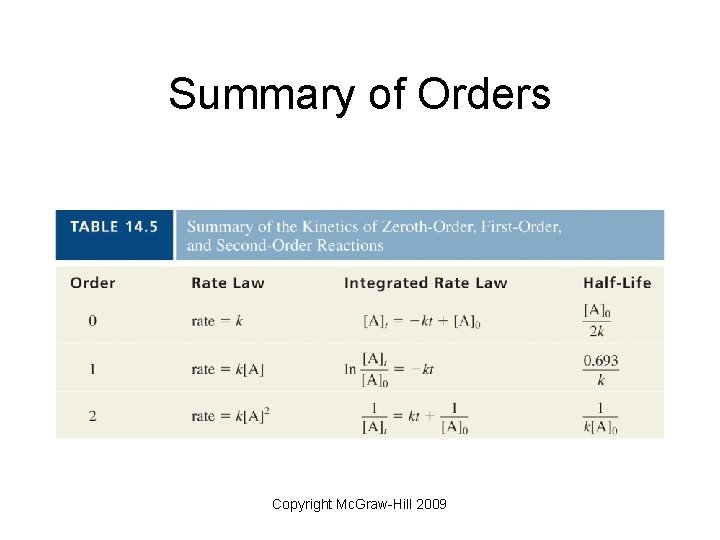
Summary of Orders Copyright Mc. Graw-Hill 2009
14. 4 Dependence of Reaction Rate on Temperature • Most reactions occur faster at a higher temperature. • How does temperature alter rate? Copyright Mc. Graw-Hill 2009
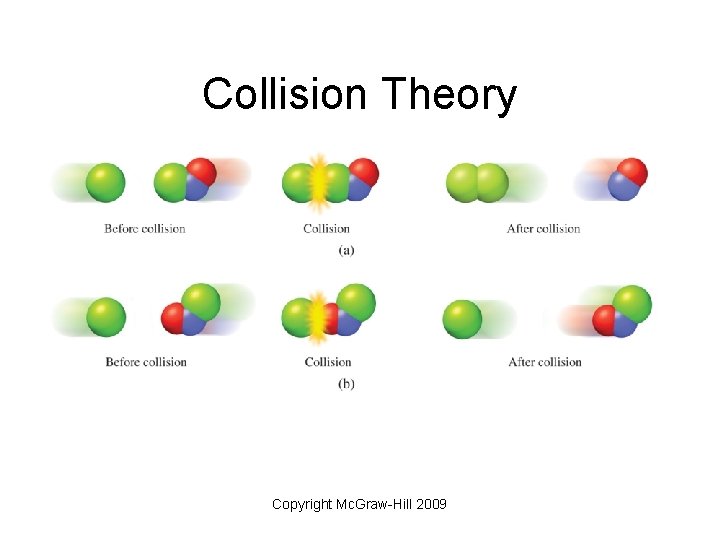
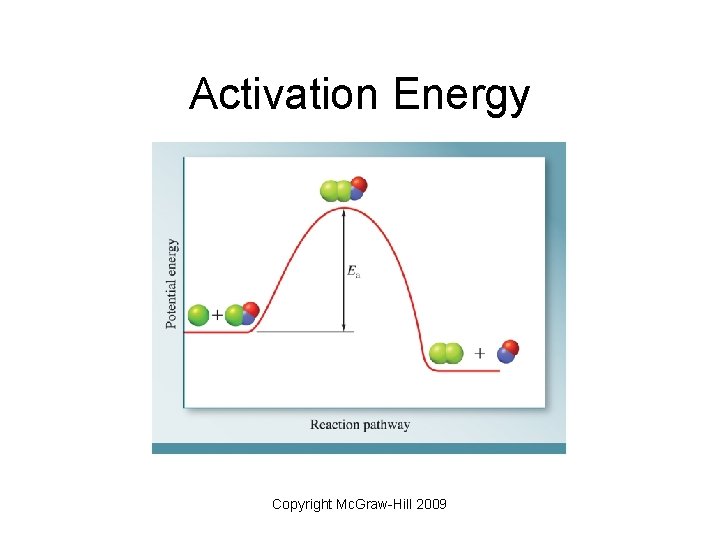
Collision Theory • Particles must collide in order to react • The greater frequency of collisions, the higher the reaction rate • Only two particles may react at one time • Many factors must be met: – Orientation – Energy needed to break bonds (activation energy) Copyright Mc. Graw-Hill 2009
Collision Theory Copyright Mc. Graw-Hill 2009
Collision Theory • Though it seems simple, not all collisions are effective collisions • Effective collisions: a collision that does result in a reaction • An activated complex (transition state) forms in an effective collision Copyright Mc. Graw-Hill 2009
Activation Energy Copyright Mc. Graw-Hill 2009
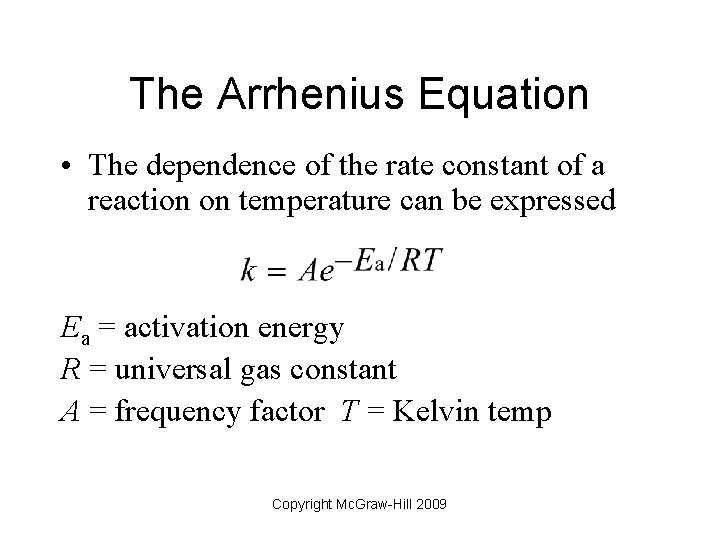
The Arrhenius Equation • The dependence of the rate constant of a reaction on temperature can be expressed Ea = activation energy R = universal gas constant A = frequency factor T = Kelvin temp Copyright Mc. Graw-Hill 2009
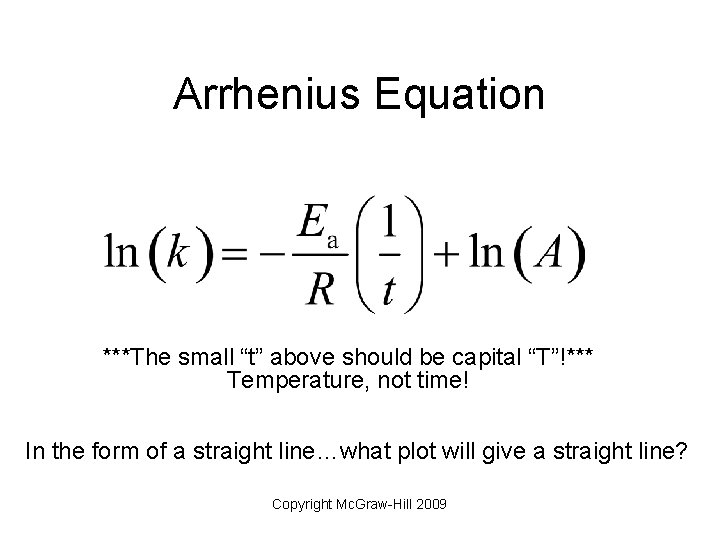
Arrhenius Equation ***The small “t” above should be capital “T”!*** Temperature, not time! In the form of a straight line…what plot will give a straight line? Copyright Mc. Graw-Hill 2009
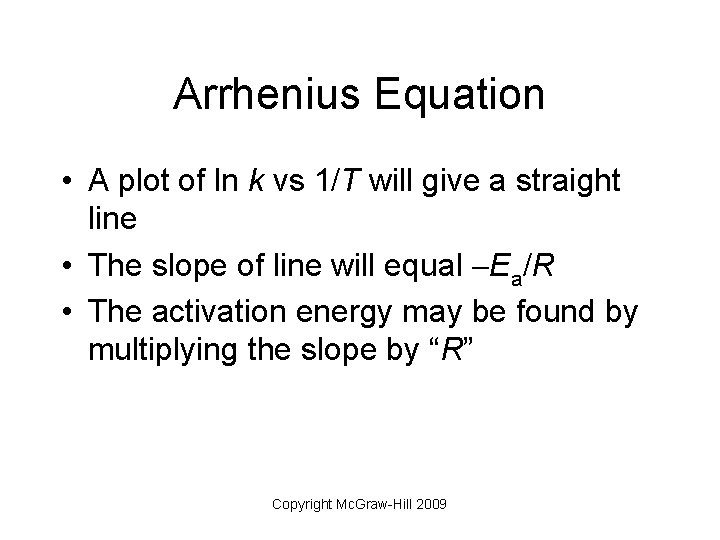
Arrhenius Equation • A plot of ln k vs 1/T will give a straight line • The slope of line will equal Ea/R • The activation energy may be found by multiplying the slope by “R” Copyright Mc. Graw-Hill 2009
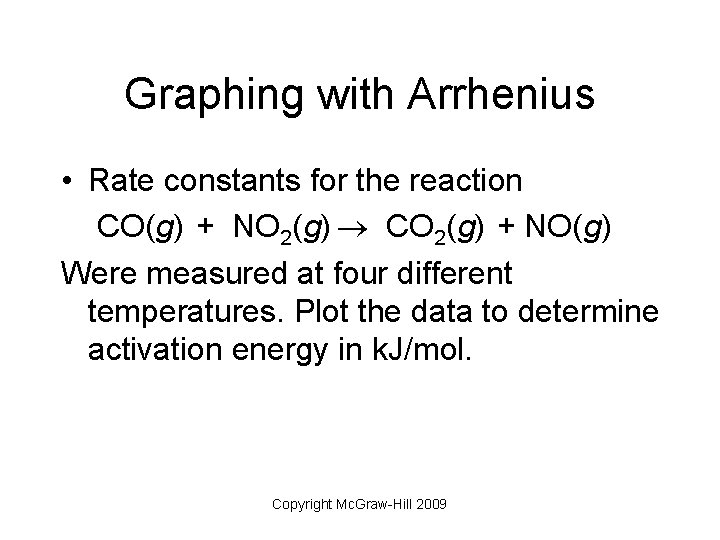
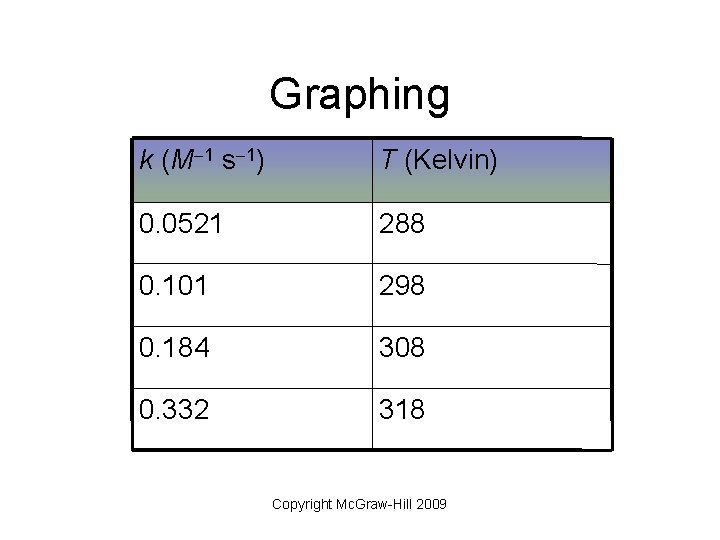
Graphing with Arrhenius • Rate constants for the reaction CO(g) + NO 2(g) CO 2(g) + NO(g) Were measured at four different temperatures. Plot the data to determine activation energy in k. J/mol. Copyright Mc. Graw-Hill 2009
Graphing k (M 1 s 1) T (Kelvin) 0. 0521 288 0. 101 298 0. 184 308 0. 332 318 Copyright Mc. Graw-Hill 2009
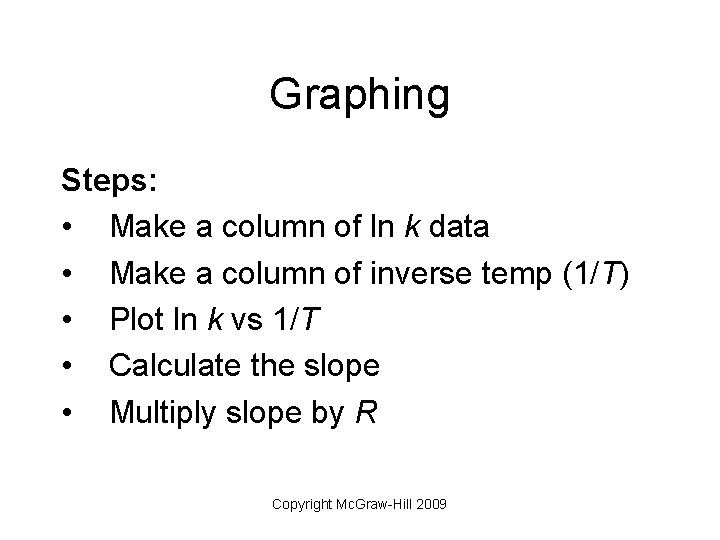
Graphing Steps: • Make a column of ln k data • Make a column of inverse temp (1/T) • Plot ln k vs 1/T • Calculate the slope • Multiply slope by R Copyright Mc. Graw-Hill 2009
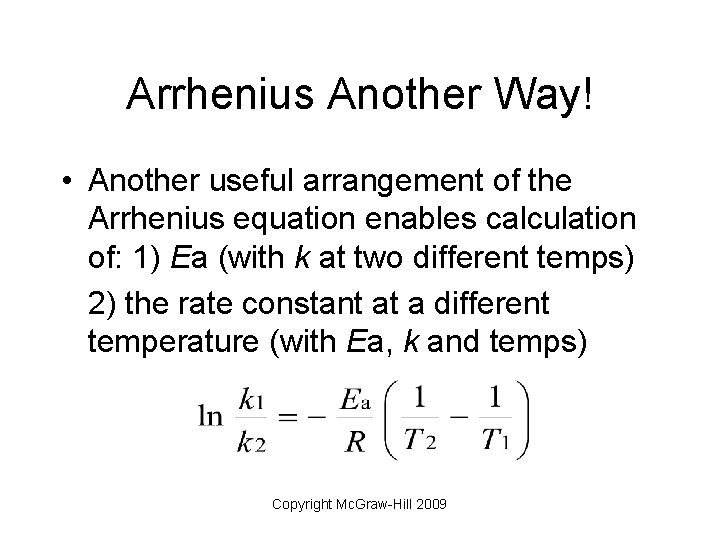
Arrhenius Another Way! • Another useful arrangement of the Arrhenius equation enables calculation of: 1) Ea (with k at two different temps) 2) the rate constant at a different temperature (with Ea, k and temps) Copyright Mc. Graw-Hill 2009
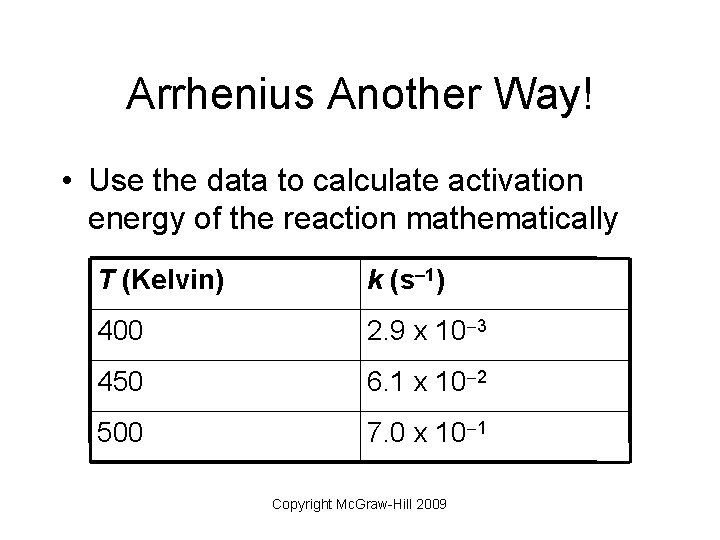
Arrhenius Another Way! • Use the data to calculate activation energy of the reaction mathematically T (Kelvin) k (s 1) 400 2. 9 x 10 3 450 6. 1 x 10 2 500 7. 0 x 10 1 Copyright Mc. Graw-Hill 2009
Arrhenius Copyright Mc. Graw-Hill 2009
14. 5 Reaction Mechanisms • Most reactions occur in a series of steps • The balanced equation does not tell us how the reaction occurs! • There are often a series of steps which add together to give the overall reaction • The series of steps is the reaction mechanism Copyright Mc. Graw-Hill 2009
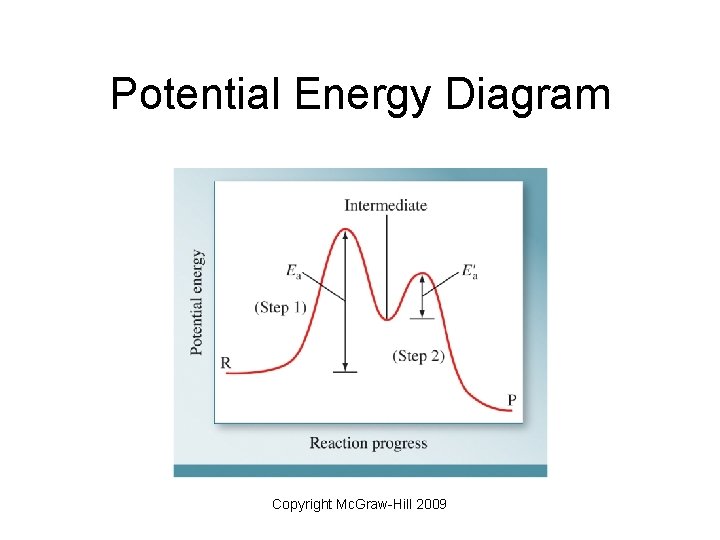
Reaction Mechanisms • Most chemical reactions occur in a series of steps • Energy of activation must be overcome to form intermediates Copyright Mc. Graw-Hill 2009
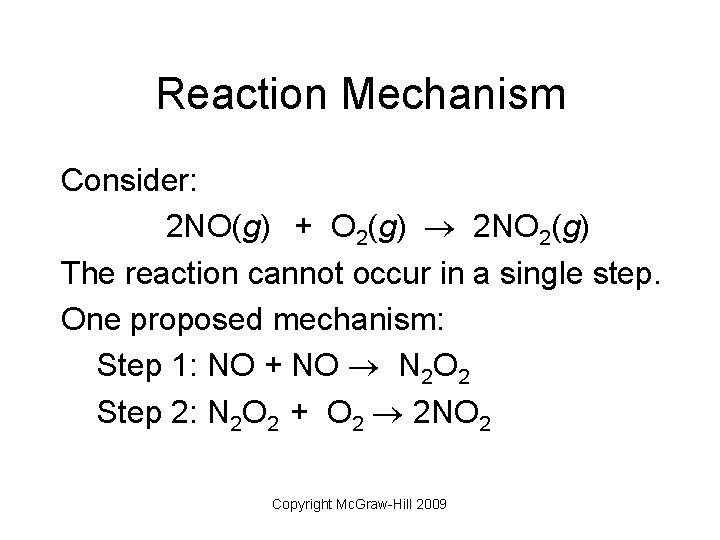
Reaction Mechanism Consider: 2 NO(g) + O 2(g) 2 NO 2(g) The reaction cannot occur in a single step. One proposed mechanism: Step 1: NO + NO N 2 O 2 Step 2: N 2 O 2 + O 2 2 NO 2 Copyright Mc. Graw-Hill 2009
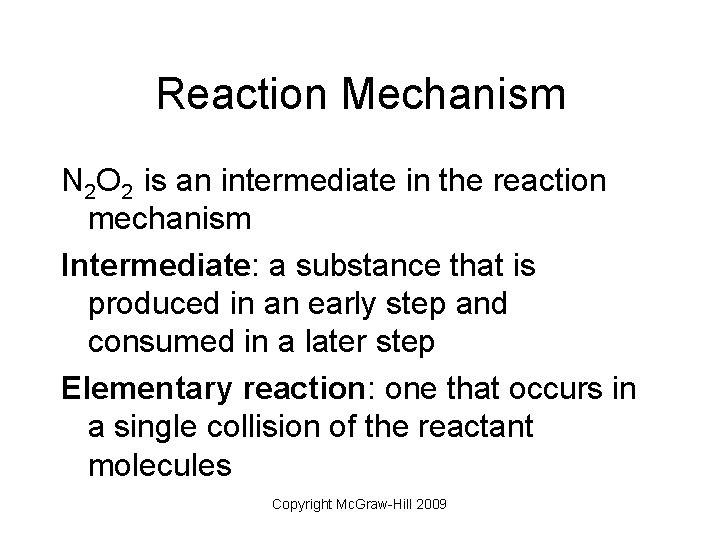
Reaction Mechanism N 2 O 2 is an intermediate in the reaction mechanism Intermediate: a substance that is produced in an early step and consumed in a later step Elementary reaction: one that occurs in a single collision of the reactant molecules Copyright Mc. Graw-Hill 2009
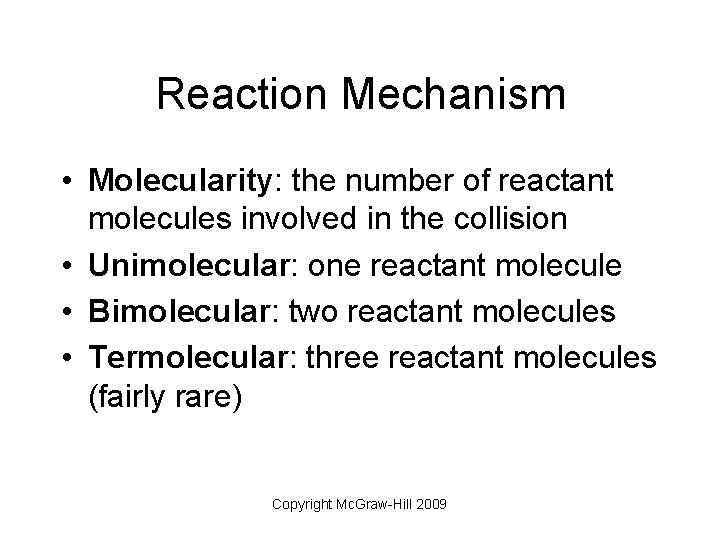
Reaction Mechanism • Molecularity: the number of reactant molecules involved in the collision • Unimolecular: one reactant molecule • Bimolecular: two reactant molecules • Termolecular: three reactant molecules (fairly rare) Copyright Mc. Graw-Hill 2009
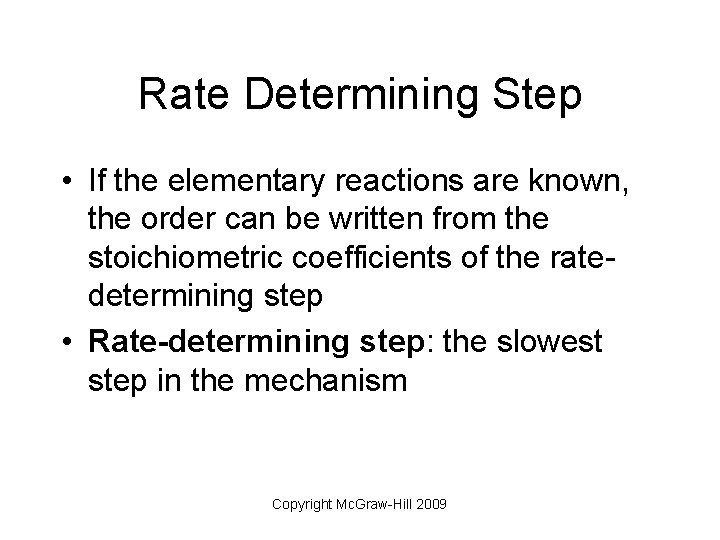
Rate Determining Step • If the elementary reactions are known, the order can be written from the stoichiometric coefficients of the ratedetermining step • Rate-determining step: the slowest step in the mechanism Copyright Mc. Graw-Hill 2009
Rate-Determining Step • Steps of a mechanism must satisfy two requirements – Sum of elementary steps must equal the overall balanced equation – The rate law must have same rate law as determined from experimental data Copyright Mc. Graw-Hill 2009
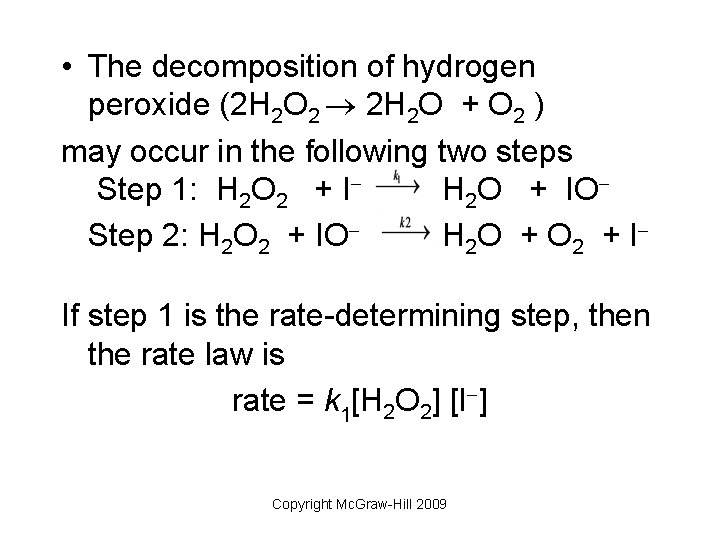
• The decomposition of hydrogen peroxide (2 H 2 O 2 2 H 2 O + O 2 ) may occur in the following two steps Step 1: H 2 O 2 + I H 2 O + IO Step 2: H 2 O 2 + IO H 2 O + O 2 + I If step 1 is the rate-determining step, then the rate law is rate = k 1[H 2 O 2] [I ] Copyright Mc. Graw-Hill 2009
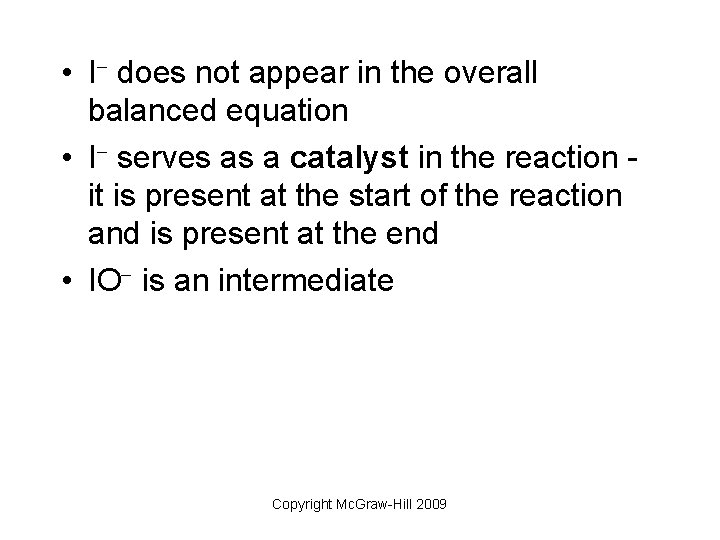
• I does not appear in the overall balanced equation • I serves as a catalyst in the reaction it is present at the start of the reaction and is present at the end • IO is an intermediate Copyright Mc. Graw-Hill 2009
Potential Energy Diagram Copyright Mc. Graw-Hill 2009
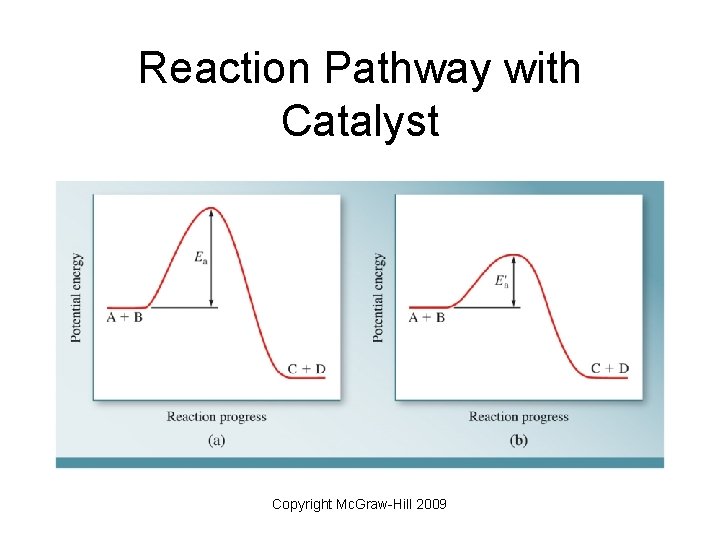
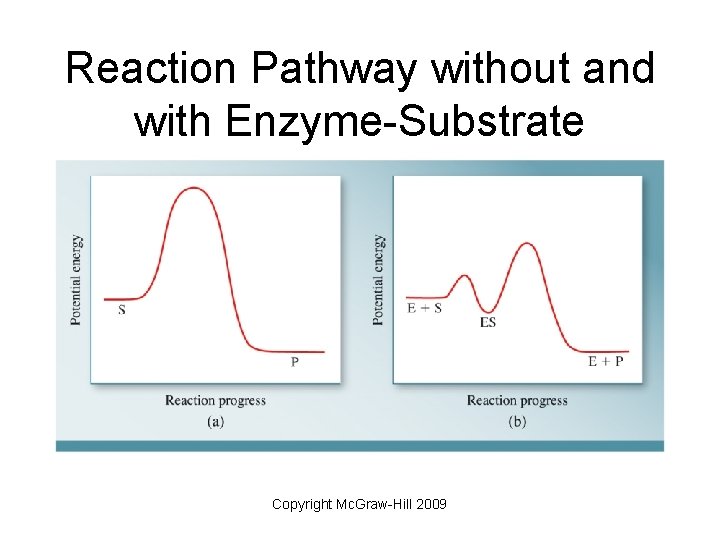
14. 6 Catalysis • Catalyst - a substance that increases the rate of a chemical reaction without being used up itself • Provides a set of elementary steps with more favorable kinetics than those that exist in its absence • Many times a catalyst lowers the activation energy Copyright Mc. Graw-Hill 2009
Reaction Pathway with Catalyst Copyright Mc. Graw-Hill 2009
Types of Catalysts • Heterogeneous catalysts - reactants and catalyst are in different phases • Homogeneous catalysts - reactants and catalysts are dispersed in single phase • Enzyme catalysts - biological catalysts Copyright Mc. Graw-Hill 2009
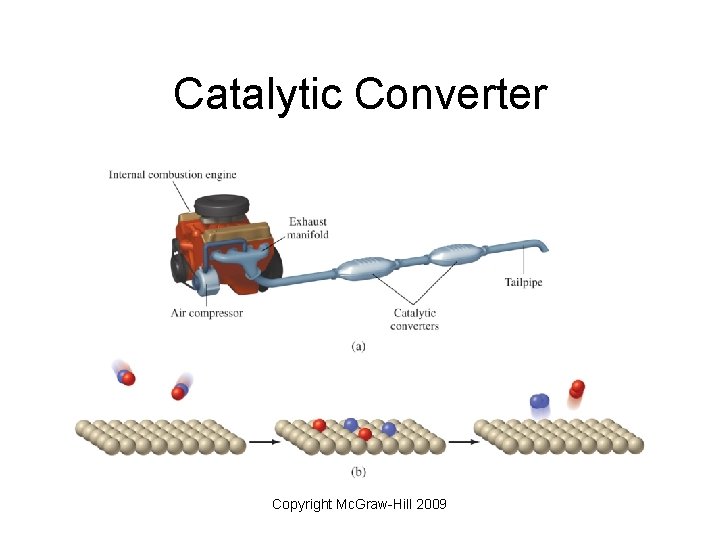
Heterogeneous Catalysts • Most important in industrial chemistry • Used in catalytic converters in automobiles – Efficient catalytic converter serves two purposes; oxidizes CO and unburned hydrocarbons into CO 2 and H 2 O; converts NO and NO 2 into N 2 and O 2 Copyright Mc. Graw-Hill 2009
Catalytic Converter Copyright Mc. Graw-Hill 2009
Homogeneous Catalysts • Usually dispersed in liquid phase • Acid and base catalyses are the most important types of homogeneous catalysis in liquid solution Copyright Mc. Graw-Hill 2009
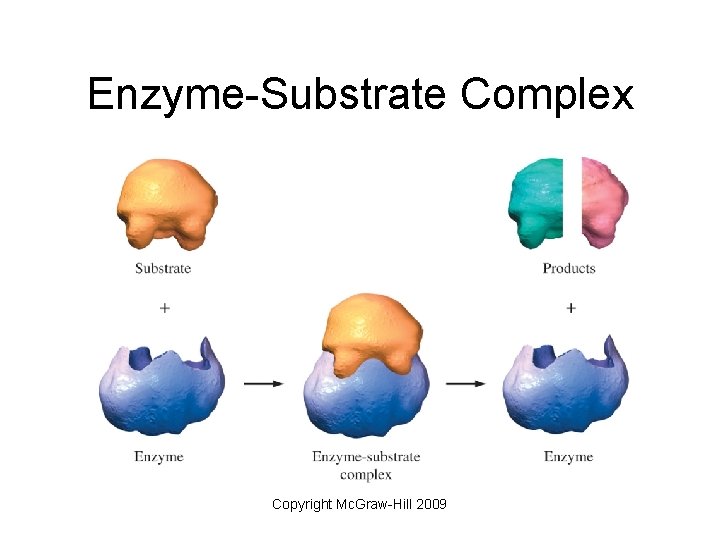
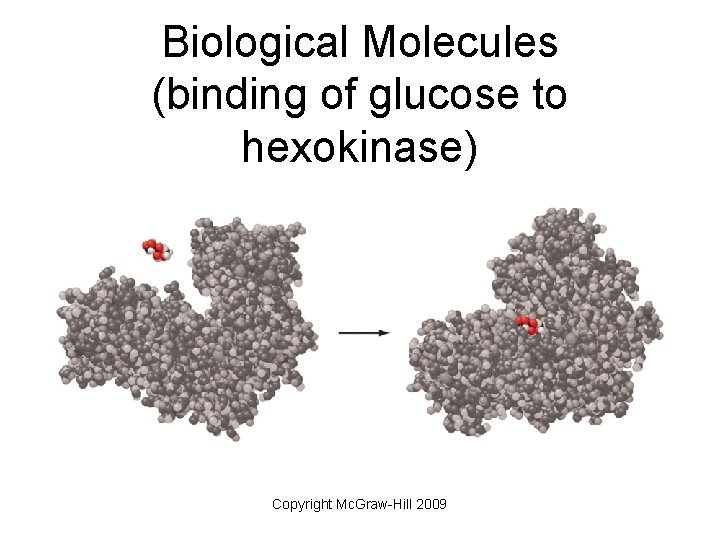
Biological Catalysts • Enzymes: large protein molecule that contains one or more active sites where interactions with substrates occur • Enzymes are highly specific (lock and key) Copyright Mc. Graw-Hill 2009
Reaction Pathway without and with Enzyme-Substrate Copyright Mc. Graw-Hill 2009
Enzyme-Substrate Complex Copyright Mc. Graw-Hill 2009
Biological Molecules (binding of glucose to hexokinase) Copyright Mc. Graw-Hill 2009
Key Points • Rate of reaction can be determined in several ways – Instantaneous rate – Average rate – Graphing using integrated rate laws – Mechanisms Copyright Mc. Graw-Hill 2009
Key Points • • • Write rate law expressions Calculate rate constant with proper units Distinguish orders: 1 st, 2 nd, 0 order Calculate half-life Collision theory and relationship to Arrhenius equation Copyright Mc. Graw-Hill 2009
Key Points • Calculate activation energy graphically and mathematically • Reaction mechanisms – Elementary reactions – Molecularity – Rate law from slow step – Intermediates and catalysts Copyright Mc. Graw-Hill 2009
Key Points • Catalysis – Heterogeneous – Homogeneous – Enzymes Copyright Mc. Graw-Hill 2009