
CHAPTER 14 CHEMICAL EQUILIBRIUM THE CONCEPT OF EQUILIBRIUM

CHAPTER 14 CHEMICAL EQUILIBRIUM
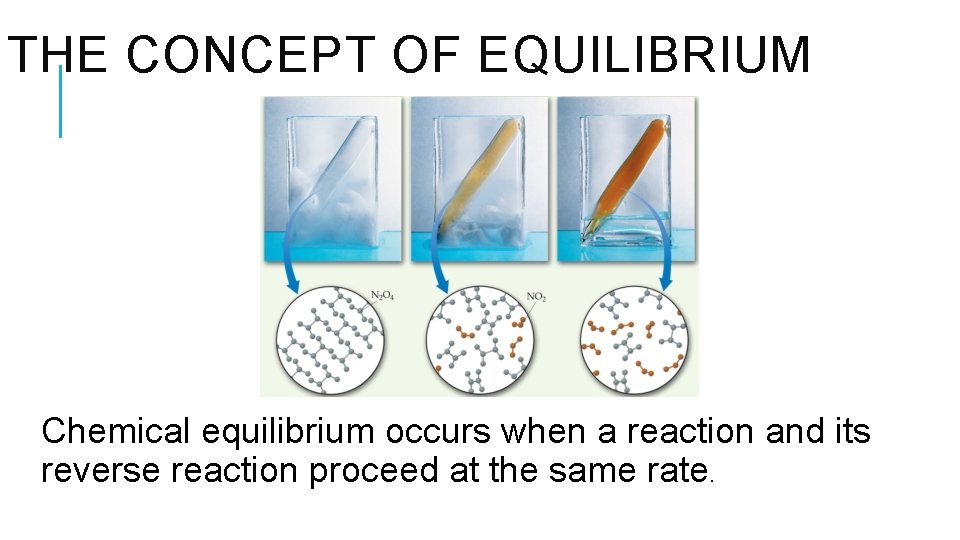
THE CONCEPT OF EQUILIBRIUM Chemical equilibrium occurs when a reaction and its reverse reaction proceed at the same rate.
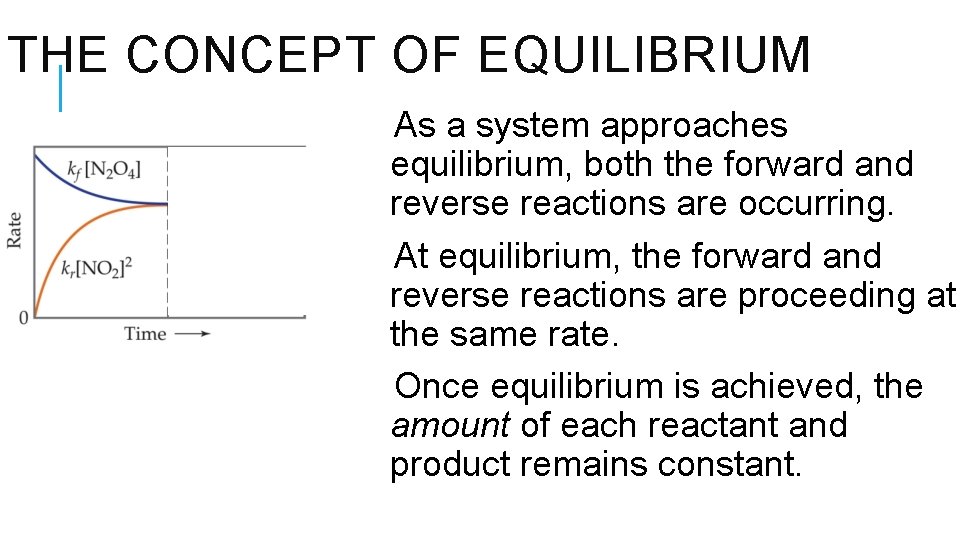
THE CONCEPT OF EQUILIBRIUM As a system approaches equilibrium, both the forward and reverse reactions are occurring. At equilibrium, the forward and reverse reactions are proceeding at the same rate. Once equilibrium is achieved, the amount of each reactant and product remains constant.
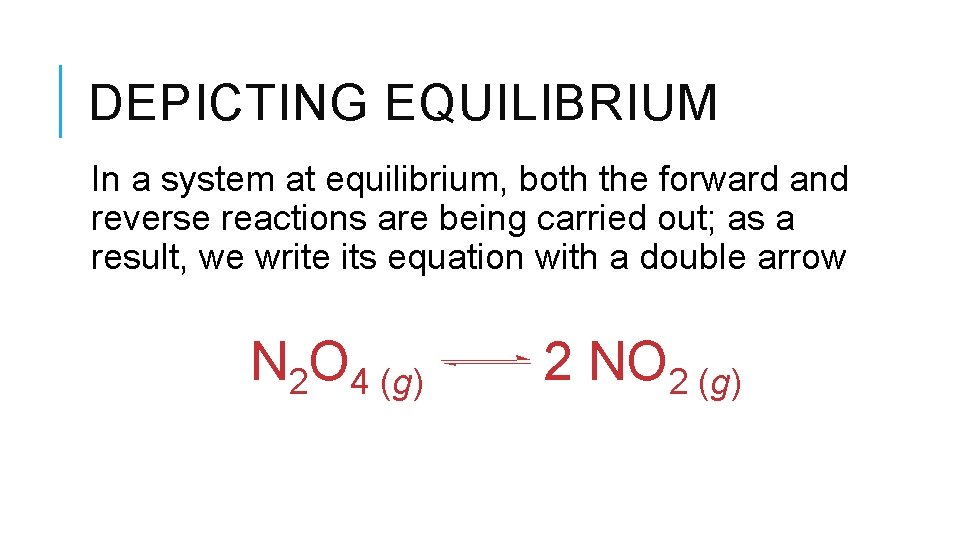
DEPICTING EQUILIBRIUM In a system at equilibrium, both the forward and reverse reactions are being carried out; as a result, we write its equation with a double arrow N 2 O 4 (g) 2 NO 2 (g)
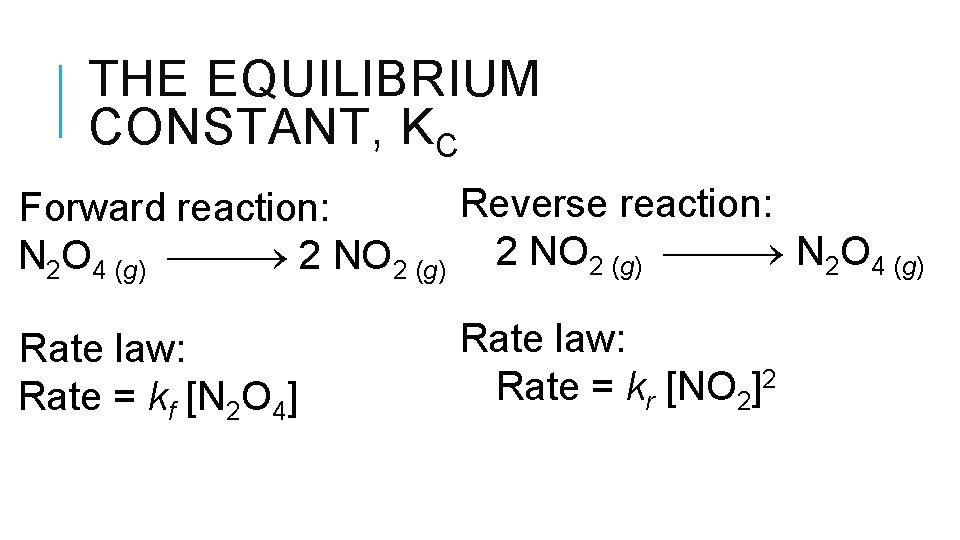
THE EQUILIBRIUM CONSTANT, KC Reverse reaction: Forward reaction: N 2 O 4 (g) 2 NO 2 (g) N 2 O 4 (g) Rate law: Rate = kf [N 2 O 4] Rate law: Rate = kr [NO 2]2
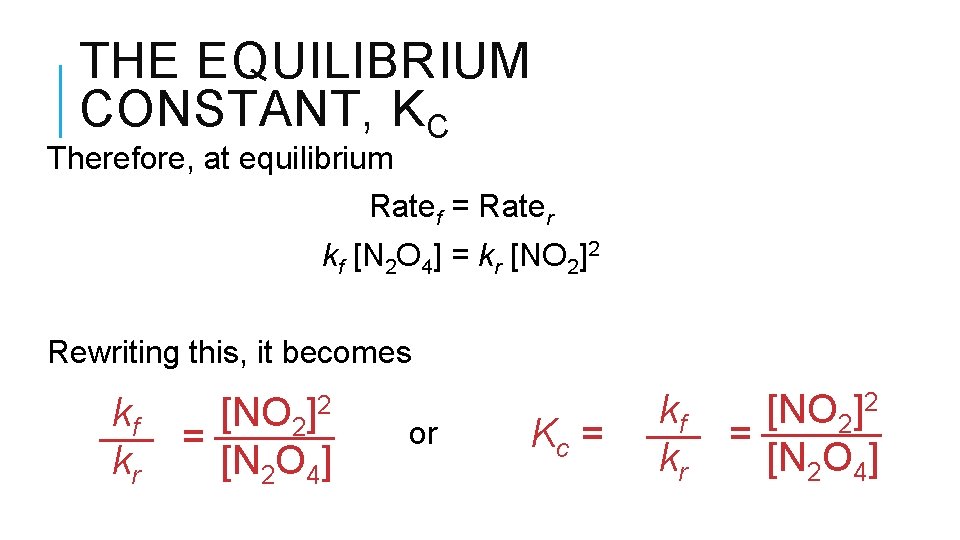
THE EQUILIBRIUM CONSTANT, KC Therefore, at equilibrium Ratef = Rater kf [N 2 O 4] = kr [NO 2]2 Rewriting this, it becomes kf kr ]2 [NO 2 = [N 2 O 4] or Kc = kf kr [NO 2]2 = [N 2 O 4]
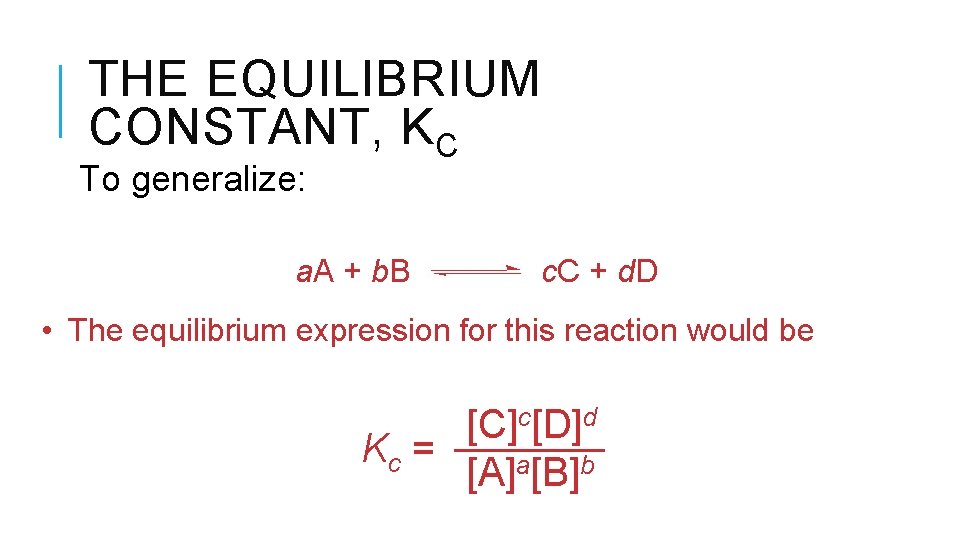
THE EQUILIBRIUM CONSTANT, KC To generalize: a. A + b. B c. C + d. D • The equilibrium expression for this reaction would be [C]c[D]d Kc = [A]a[B]b
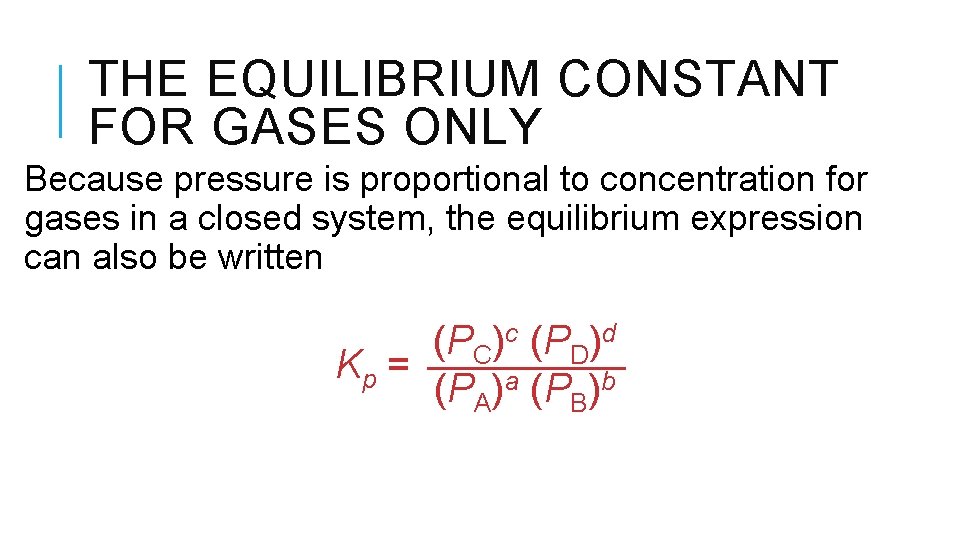
THE EQUILIBRIUM CONSTANT FOR GASES ONLY Because pressure is proportional to concentration for gases in a closed system, the equilibrium expression can also be written (PC)c (PD)d Kp = (PA)a (PB)b
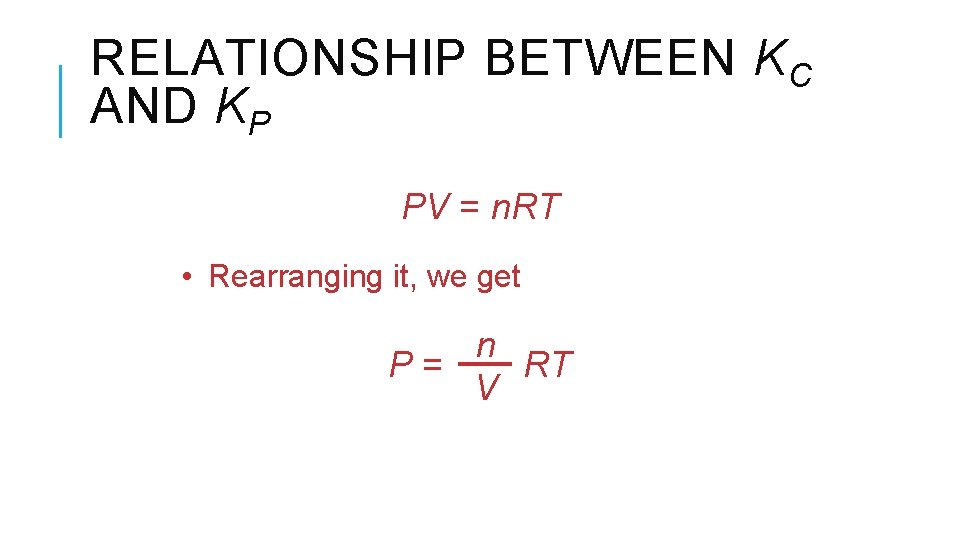
RELATIONSHIP BETWEEN KC AND KP PV = n. RT • Rearranging it, we get n P= RT V
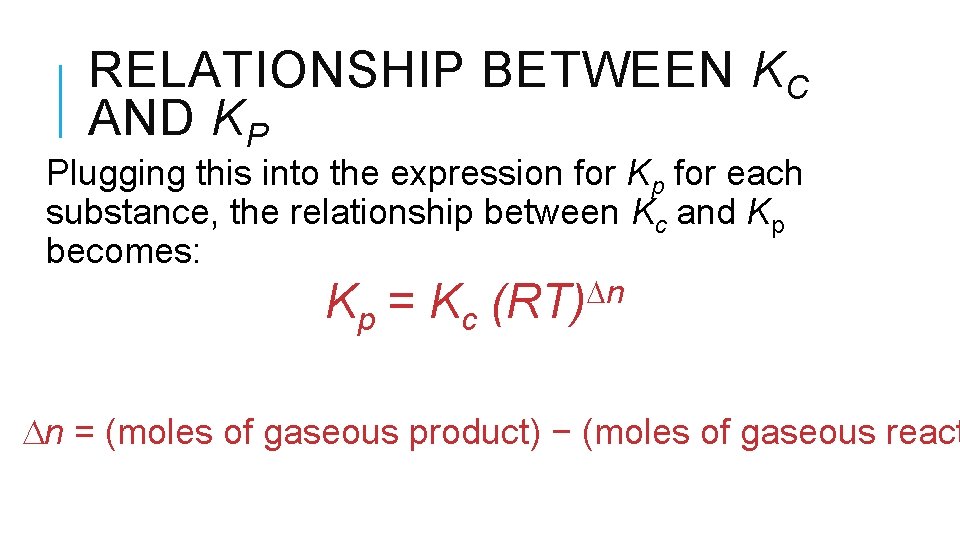
RELATIONSHIP BETWEEN KC AND KP Plugging this into the expression for Kp for each substance, the relationship between Kc and Kp becomes: Kp = Kc n (RT) n = (moles of gaseous product) − (moles of gaseous react
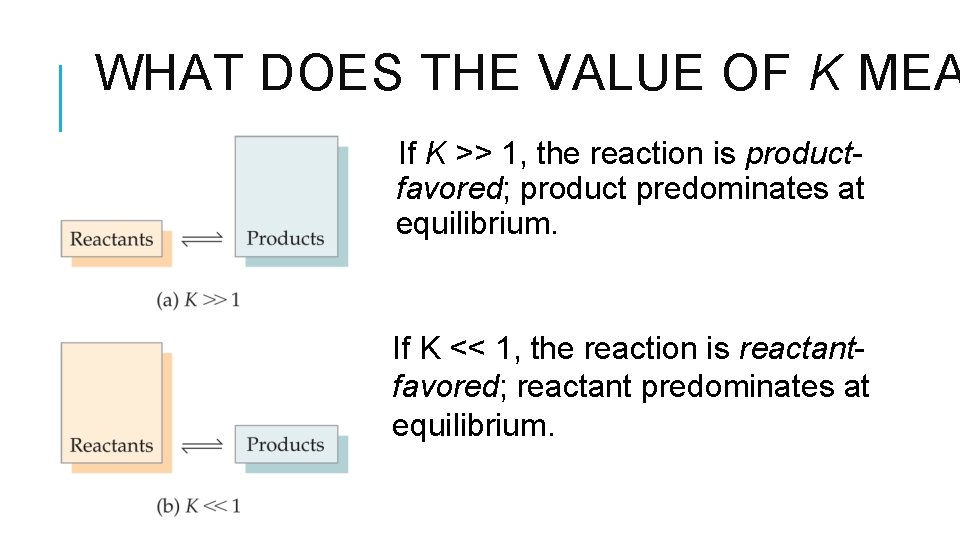
WHAT DOES THE VALUE OF K MEA If K >> 1, the reaction is productfavored; product predominates at equilibrium. If K << 1, the reaction is reactantfavored; reactant predominates at equilibrium.
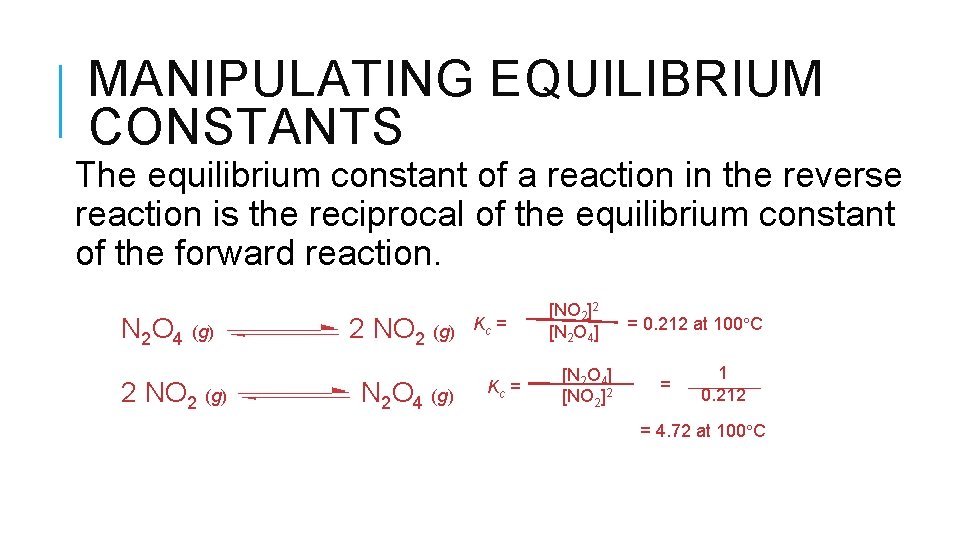
MANIPULATING EQUILIBRIUM CONSTANTS The equilibrium constant of a reaction in the reverse reaction is the reciprocal of the equilibrium constant of the forward reaction. N 2 O 4 (g) 2 NO 2 (g) N 2 O 4 (g) Kc = [NO 2]2 [N 2 O 4] [NO 2]2 = 0. 212 at 100 C = 1 0. 212 = 4. 72 at 100 C
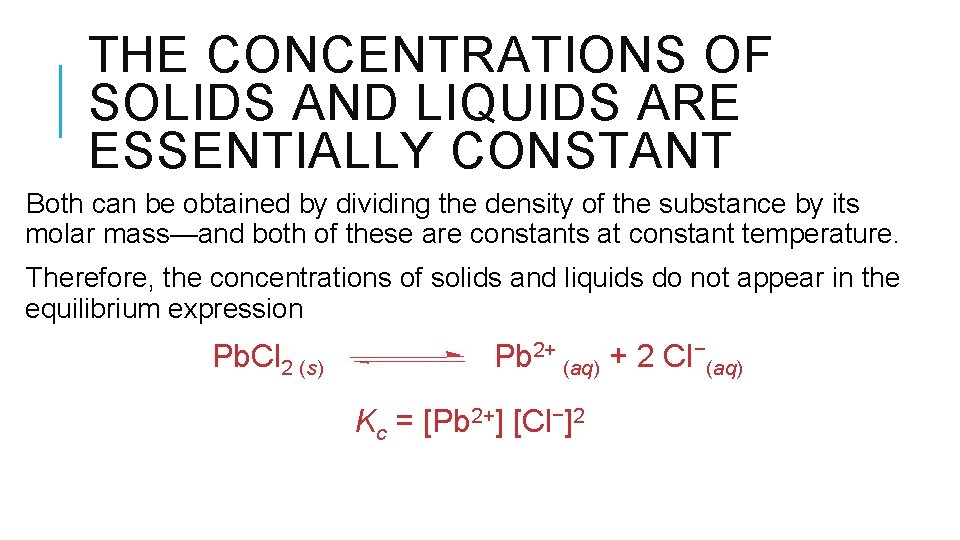
THE CONCENTRATIONS OF SOLIDS AND LIQUIDS ARE ESSENTIALLY CONSTANT Both can be obtained by dividing the density of the substance by its molar mass—and both of these are constants at constant temperature. Therefore, the concentrations of solids and liquids do not appear in the equilibrium expression Pb. Cl 2 (s) Pb 2+ (aq) + 2 Cl−(aq) Kc = [Pb 2+] [Cl−]2
EQUILIBRIUM CALCULATIONS A closed system initially containing 1. 000 x 10− 3 M H 2 and 2. 000 x 10− 3 M I 2 At 448 C is allowed to reach equilibrium. Analysis of the equilibrium mixture shows that the concentration of HI is 1. 87 x 10− 3 M. Calculate Kc at 448 C for the reaction taking place, which is H 2 (g) + I 2 (g) 2 HI (g)
![WHAT DO WE KNOW? [H 2], M Initially [I 2], M 1. 000 x](http://slidetodoc.com/presentation_image_h2/d689a75b29939068be3f2139c02d80a1/image-15.jpg "WHAT DO WE KNOW? [H 2], M Initially [I 2], M 1. 000 x")
WHAT DO WE KNOW? [H 2], M Initially [I 2], M 1. 000 x 10 -3 2. 000 x 10 -3 [HI], M 0 Change At equilibrium 1. 87 x 10 -3
![[HI] INCREASES BY 1. 87 X 10 -3 M [H 2], M Initially [I](http://slidetodoc.com/presentation_image_h2/d689a75b29939068be3f2139c02d80a1/image-16.jpg "[HI] INCREASES BY 1. 87 X 10 -3 M [H 2], M Initially [I")
[HI] INCREASES BY 1. 87 X 10 -3 M [H 2], M Initially [I 2], M 1. 000 x 10 -3 2. 000 x 10 -3 [HI], M 0 Change +1. 87 x 10 -3 At equilibrium 1. 87 x 10 -3
![STOICHIOMETRY TELLS US [H 2] AND [I 2] DECREASE BY HALF AS MUCH [H](http://slidetodoc.com/presentation_image_h2/d689a75b29939068be3f2139c02d80a1/image-17.jpg "STOICHIOMETRY TELLS US [H 2] AND [I 2] DECREASE BY HALF AS MUCH [H")
STOICHIOMETRY TELLS US [H 2] AND [I 2] DECREASE BY HALF AS MUCH [H 2], M [I 2], M [HI], M Initially 1. 000 x 10 -3 2. 000 x 10 -3 Change -9. 35 x 10 -4 +1. 87 x 10 -3 At equilibrium 0 1. 87 x 10 -3
![WE CAN NOW CALCULATE THE EQUILIBRIUM CONCENTRATIONS OF ALL THREE COMPOUNDS… [H 2], M](http://slidetodoc.com/presentation_image_h2/d689a75b29939068be3f2139c02d80a1/image-18.jpg "WE CAN NOW CALCULATE THE EQUILIBRIUM CONCENTRATIONS OF ALL THREE COMPOUNDS… [H 2], M")
WE CAN NOW CALCULATE THE EQUILIBRIUM CONCENTRATIONS OF ALL THREE COMPOUNDS… [H 2], M [I 2], M [HI], M Initially 1. 000 x 10 -3 2. 000 x 10 -3 Change -9. 35 x 10 -4 +1. 87 x 10 -3 At equilibrium 6. 5 x 10 -5 1. 065 x 10 -3 0 1. 87 x 10 -3
![…AND, THEREFORE, THE EQUILIBRIUM CONSTANT [HI]2 Kc = [H 2] [I 2] = (1.](http://slidetodoc.com/presentation_image_h2/d689a75b29939068be3f2139c02d80a1/image-19.jpg "…AND, THEREFORE, THE EQUILIBRIUM CONSTANT [HI]2 Kc = [H 2] [I 2] = (1.")
…AND, THEREFORE, THE EQUILIBRIUM CONSTANT [HI]2 Kc = [H 2] [I 2] = (1. 87 x 10 -3)2 (6. 5 x 10 -5)(1. 065 x 10 -3) = 51
THE REACTION QUOTIENT (Q) • To calculate Q, one substitutes the initial concentrations on reactants and products into the equilibrium expression. • Q gives the same ratio the equilibrium expression gives, but for a system that is not at equilibrium.
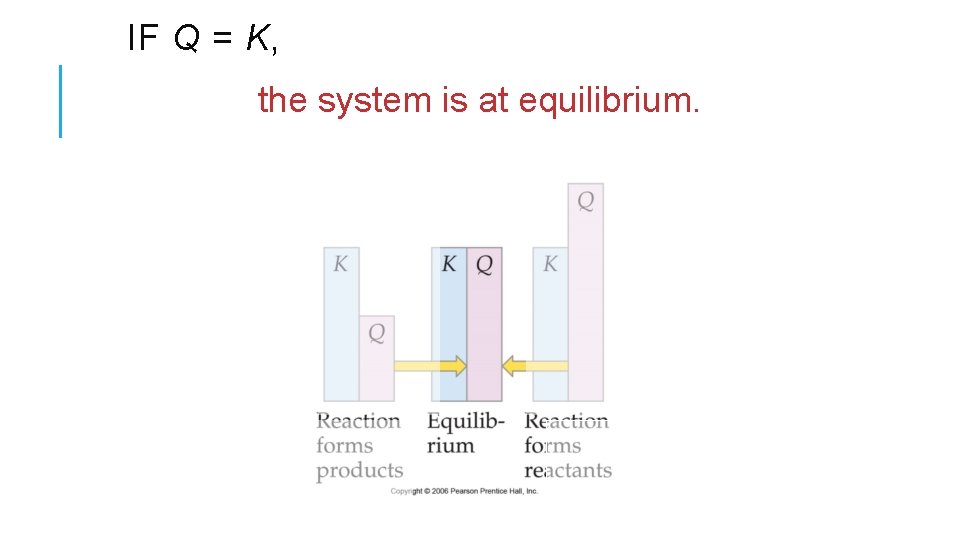
IF Q = K, the system is at equilibrium.
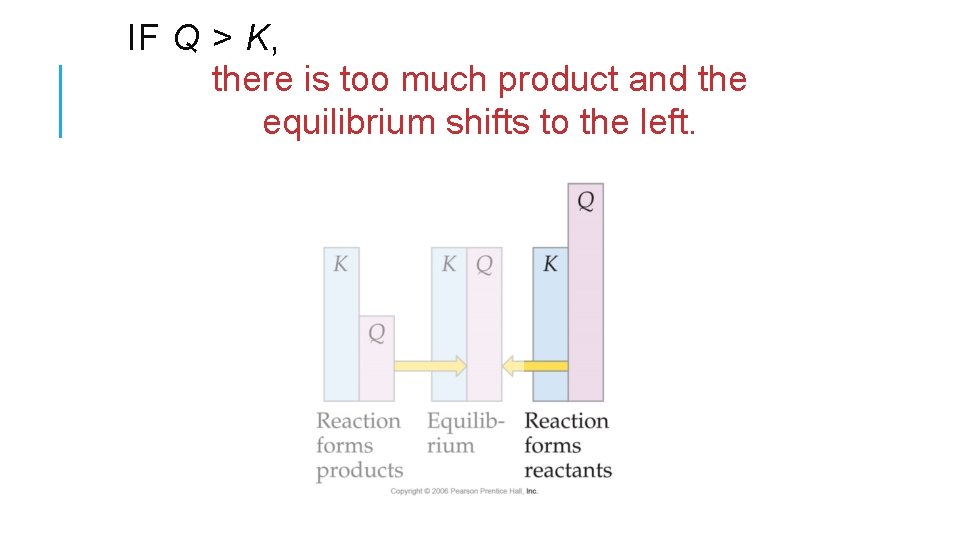
IF Q > K, there is too much product and the equilibrium shifts to the left.
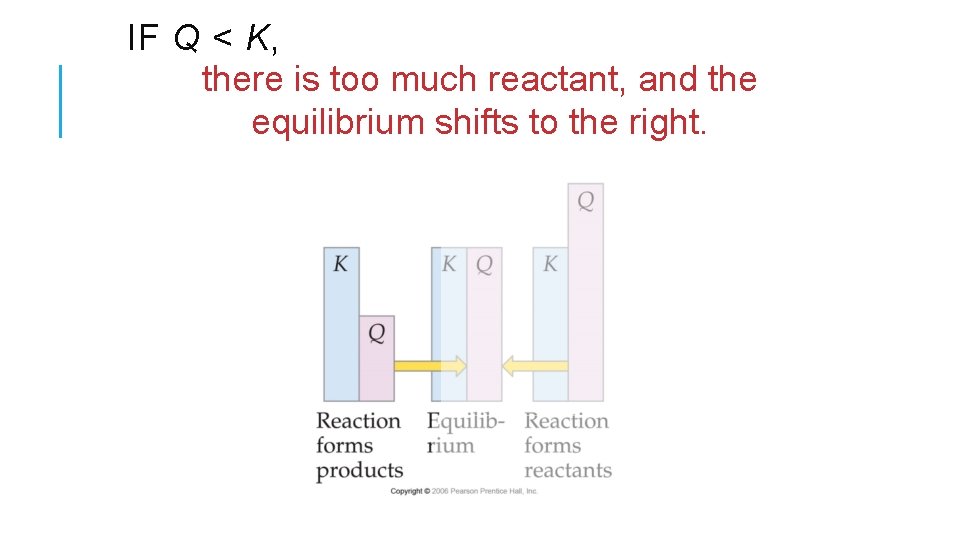
IF Q < K, there is too much reactant, and the equilibrium shifts to the right.

LE CH TELIER’S
LE CH TELIER’S PRINCIPLE “If a system at equilibrium is disturbed by a change in temperature, pressure, or the concentration of one of the components, the system will shift its equilibrium position so as to counteract the effect of the disturbance. ”
LECHATELIER TRANSLATED: When you take something away from a system at equilibrium, the system shifts in such a way as to replace what you’ve taken away. When you add something to a system at equilibrium, the system shifts in such a way as to use up what you’ve added.
EFFECT OF CONCENTRATION OF REACTANTS Adding reactant shifts the reaction toward the products. Why? Stress: Increasing reactants Relief: Decreasing reactants Shift: to the right (products)
EFFECT OF CONCENTRATION OF PRODUCTS Adding products shifts the reaction toward the reactants. Why? Stress: Increasing products Relief: Decreasing products Shift: to the left (reactants)
EFFECT OF TEMPERATURE Increasing the temperature causes the equilibrium to shift in the direction that absorbs heat. Why? Stress: Increase in Temp Relief: Decrease in Temp Shift: Towards the left
EFFECT OF PRESSURE • Affects gases only • For unequal number of moles of reactants and products, if pressure is increased, the equilibrium will shift to reduce the number of particles • For equal number of moles of reactants and products, no shift occurs.
EX: EFFECT OF PRESSURE 2 NO 2 (g) N 2 O 4 (g) Stress: increasing the pressure Relief: decreasing the pressure Shift: to the right (side of less molecules…lower coefficient side)
ADDITION OF A CATALYST • This does not affect an equilibrium • A catalyst speeds both forward and reverse reactions (by lowering the activation energy) • It allows us to get to equilibrium faster, but it does not alter equilibrium concentrations
- Slides: 32