
Chapter 14 Chapter 15 Chapter 16 Chapter 17





- Slides: 112
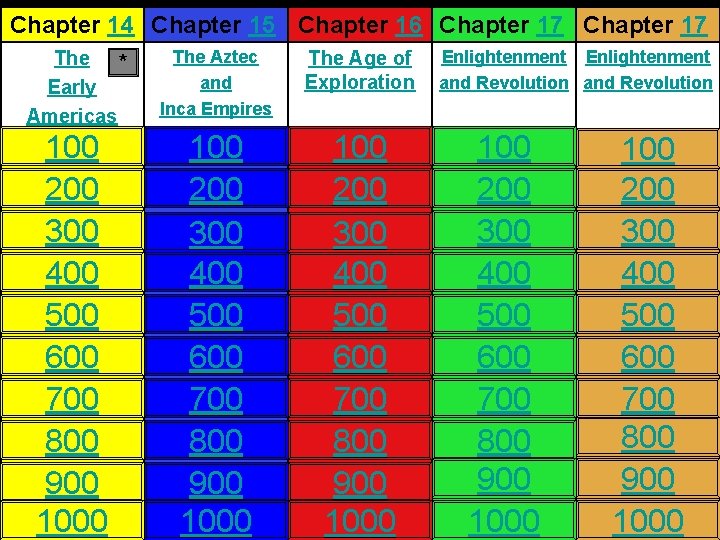
Chapter 14 Chapter 15 Chapter 16 Chapter 17 The * Early Americas The Aztec and Inca Empires The Age of Exploration 100 200 300 400 500 600 700 800 900 1000 Enlightenment and Revolution 100 200 300 400 500 600 700 800 900 1000
G 7 Chapter 14 The Early Americas (12, 000 BC - AD 1000)
G 7 C 14 Key Terms and People 1. 2. 3. 4. 5. 6. Mesoamerica maize obsidian Pacal observatories Popol Vuh
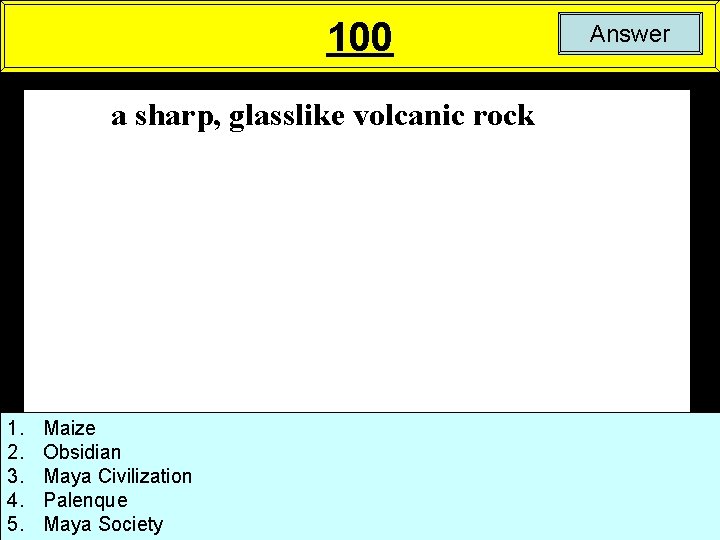
100 a sharp, glasslike volcanic rock 1. 2. 3. 4. 5. Maize Obsidian Maya Civilization Palenque Maya Society Answer
200 Answer It reached its height between about AD 250 and 900 centered around the Yucatan Penninsula in Mesoamerica (present day Mexico). 1. 2. 3. 4. 5. Maize Obsidian Maya Civilization Palenque Maya Society
300 corn; staple crop of the Americas 1. 2. 3. 4. 5. Maize Obsidian Maya Civilization Palenque Maya Society Answer
400 Answer Upper Class - king, priests, professional Warriors and merchants Lower Class - farmers and slaves 1. 2. 3. 4. 5. Maize Obsidian Maya Civilization Palenque Maya Society
500 Answer The ancient Maya city of ______ was a major power on the border between the Maya highlands and lowlands. Its great temples and plazas were typical of the Classic Age of Maya civilization. 1. 2. 3. 4. 5. Maize Obsidian Maya Civilization Palenque Maya Society
600 corn; staple crop of the Americas 1. 2. 3. 4. 5. Maize Obsidian Maya Civilization Palenque Maya Society Answer
700 Answer Upper Class - king, priests, professional Warriors and merchants Lower Class - farmers and slaves 1. 2. 3. 4. 5. Maize Obsidian Maya Civilization Palenque Maya Society
800 Answer It reached its height between about AD 250 and 900 centered around the Yucatan Penninsula in Mesoamerica (present day Mexico). 1. 2. 3. 4. 5. Maize Obsidian Maya Civilization Palenque Maya Society
900 a sharp, glasslike volcanic rock 1. 2. 3. 4. 5. Maize Obsidian Maya Civilization Palenque Maya Society Answer
1000 Answer The ancient Maya city of ______ was a major power on the border between the Maya highlands and lowlands. Its great temples and plazas were typical of the Classic Age of Maya civilization. 1. 2. 3. 4. 5. Maize Obsidian Maya Civilization Palenque Maya Society
G 7 Chapter 15 The Aztec and Inca Empires (1325 -1537)
G 7 C 15 Key Terms and People 1. 2. 3. 4. 5. 6. 7. 8. 9. 10. 11. causeways conquistadors Hernan Cortes Moxtezuma II Codex Pachacuti Quechua llamas Atahualpa Francisco Pizarro masonry
100 Answer It covered half the territory of present day Mexico. 1. 2. 3. 4. 5. The Aztec Empire Tenochtitlan Conquistadors Hernan Cortes Moctezuma 6. Aztec Society 7. The Inca Empire 8. Atahualpa 9. Francisco Pizarro 10. Inca Society
200 Answer It covered the South American western coast from the north to the south along the Andes mountain ranges. 1. 2. 3. 4. 5. The Aztec Empire Tenochtitlan Conquistadors Hernan Cortes Moctezuma 6. Aztec Society 7. The Inca Empire 8. Atahualpa 9. Francisco Pizarro 10. Inca Society
300 Answer 1485– 1547 - After arriving on the coast of Mexico, he burned his ships so his men couldn’t return home. They had no choice but to stay and fight with him. In the end they conquered the Aztecs, partly due to his leadership and determination to find gold. Also, the Spanish had a huge advantage by having guns and the Aztecs only having arrows. 1. 2. 3. 4. 5. The Aztec Empire Tenochtitlan Conquistadors Hernan Cortes Moctezuma 6. Aztec Society 7. The Inca Empire 8. Atahualpa 9. Francisco Pizarro 10. Inca Society
400 Answer Kings ruled the empire and lived in luxury. Nobles served as important officials, such as tax collectors and judges. Priests performed many important duties, such as keeping calendars. Warriors fought to conquer other peoples and capture victims for sacrifice. Merchants traded goods like food, clothing, and tools. At the bottom of society, farmers and slaves were left. Slaves who disobeyed orders were sacrificed to the gods. 1. 2. 3. 4. 5. The Aztec Empire Tenochtitlan Conquistadors Hernan Cortes Moctezuma 6. Aztec Society 7. The Inca Empire 8. Atahualpa 9. Francisco Pizarro 10. Inca Society
500 Answer This was the capital of the Aztec Empire. To build this amazing city, the Aztecs had to overcome many geographical challenges. The city’s island location made travel and trade difficult. To make it easier to get to and from their city, the Aztecs built three wide causeways—raised roads across water or wet ground—to connect the island to the shore. The causeways were made of rocks covered with dirt. It was surrounded by water, but the water was undrinkable. As a result, the Aztecs built a stone aqueduct, or channel, to bring fresh water to the city. 1. 2. 3. 4. 5. The Aztec Empire Tenochtitlan Conquistadors Hernan Cortes Moctezuma 6. Aztec Society 7. The Inca Empire 8. Atahualpa 9. Francisco Pizarro 10. Inca Society
600 Answer Spanish soldiers in the Americas who explored new lands, searched for gold and silver, and tried to spread Christianity. 1. 2. 3. 4. 5. The Aztec Empire Tenochtitlan Conquistadors Hernan Cortes Moctezuma 6. Aztec Society 7. The Inca Empire 8. Atahualpa 9. Francisco Pizarro 10. Inca Society
700 Answer The king, priests, and government officials made up the upper class. For the lower class, most were farmers, artisans, or servants. There were no slaves in Inca society. Lower-class men and women farmed on government lands, served in the army, worked in mines, and built roads. Parents taught their children how to work, so most children didn’t go to school. But some carefully chosen young girls did go to school to learn weaving, cooking, and religion. Then they were sent to serve the king or work in the temple in Cuzco. Lower-class Incas lived outside Cuzco in small houses. By law they had to wear plain clothes. Also, they couldn’t own more goods than they needed. 1. 2. 3. 4. 5. The Aztec Empire Tenochtitlan Conquistadors Hernan Cortes Moctezuma 6. Aztec Society 7. The Inca Empire 8. Atahualpa 9. Francisco Pizarro 10. Inca Society
800 Answer 1466– 1520 - He ruled the Aztec Empire at its height, but he also contributed to its downfall. The tribute he demanded from neighboring tribes made the Aztecs unpopular. In addition, his belief that Cortés was Quetzalcoatl allowed Cortés to capture him and eventually conquer the empire. 1. 2. 3. 4. 5. The Aztec Empire Tenochtitlan Conquistadors Hernan Cortes Moctezuma 6. Aztec Society 7. The Inca Empire 8. Atahualpa 9. Francisco Pizarro 10. Inca Society
900 Answer 1502– 1533 - He was the last Inca king. He was brave and popular with the Inca army, but he didn’t rule for long. A Spanish friar offered him a religious book to convince him he should accept Christianity. He held the book to his ear and listened to it. When the book didn’t speak, he threw it on the ground. The Spaniards used this as a reason to attacks. 1. 2. 3. 4. 5. The Aztec Empire Tenochtitlan Conquistadors Hernan Cortes Moctezuma 6. Aztec Society 7. The Inca Empire 8. Atahualpa 9. Francisco Pizarro 10. Inca Society
1000 Answer 1475– 1541 - He organized expeditions to explore the west coast of South America. His first two trips were mostly unsuccessful. But on his third trip, his luck changed. With only about 180 men, he conquered the Inca Empire, which had been weakened by disease and civil war. In 1535 he founded Lima, the capital of modern Peru. 1. 2. 3. 4. 5. The Aztec Empire Tenochtitlan Conquistadors Hernan Cortes Moctezuma 6. Aztec Society 7. The Inca Empire 8. Atahualpa 9. Francisco Pizarro 10. Inca Society
G 7 Chapter 16 The Age of Exploration (1400 -1650)
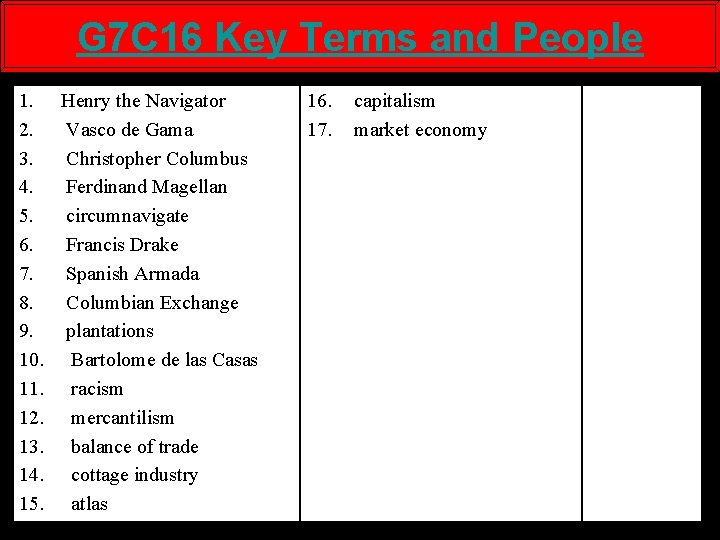
G 7 C 16 Key Terms and People 1. Henry the Navigator 2. Vasco de Gama 3. Christopher Columbus 4. Ferdinand Magellan 5. circumnavigate 6. Francis Drake 7. Spanish Armada 8. Columbian Exchange 9. plantations 10. Bartolome de las Casas 11. racism 12. mercantilism 13. balance of trade 14. cottage industry 15. atlas 16. 17. capitalism market economy
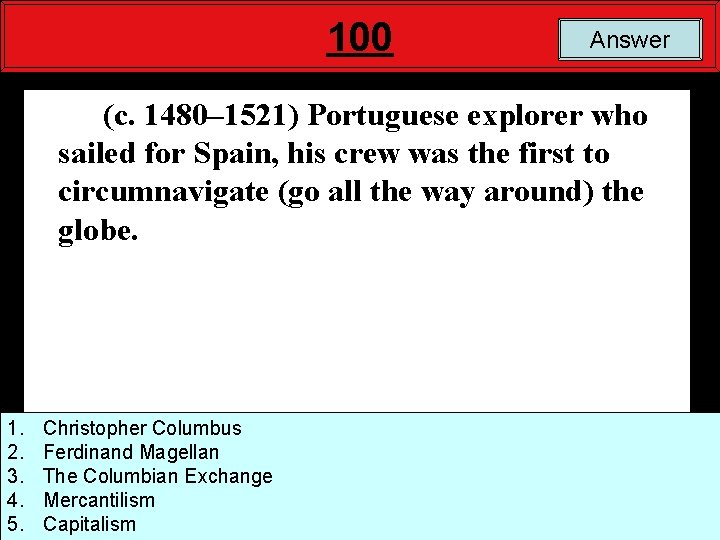
100 Answer (c. 1480– 1521) Portuguese explorer who sailed for Spain, his crew was the first to circumnavigate (go all the way around) the globe. 1. 2. 3. 4. 5. Christopher Columbus Ferdinand Magellan The Columbian Exchange Mercantilism Capitalism
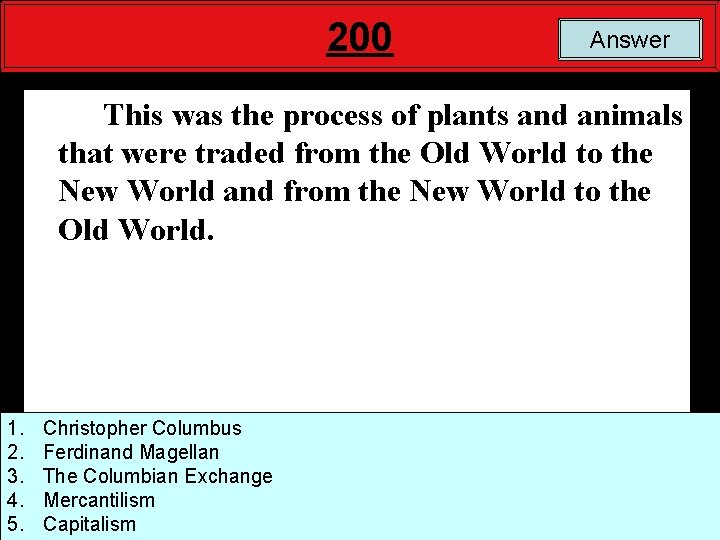
200 Answer This was the process of plants and animals that were traded from the Old World to the New World and from the New World to the Old World. 1. 2. 3. 4. 5. Christopher Columbus Ferdinand Magellan The Columbian Exchange Mercantilism Capitalism
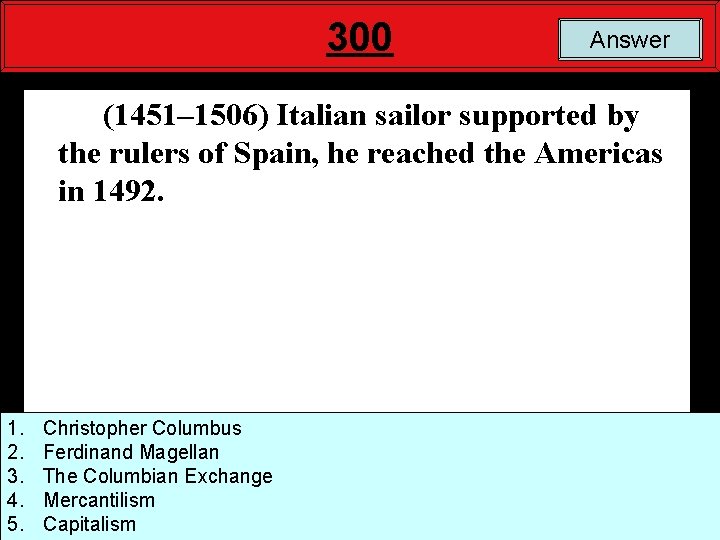
300 Answer (1451– 1506) Italian sailor supported by the rulers of Spain, he reached the Americas in 1492. 1. 2. 3. 4. 5. Christopher Columbus Ferdinand Magellan The Columbian Exchange Mercantilism Capitalism
400 Answer an economic system in which individuals and private businesses run most industries 1. 2. 3. 4. 5. Christopher Columbus Ferdinand Magellan The Columbian Exchange Mercantilism Capitalism
500 Answer a system in which a government controls all economic activity in a country and its colonies to make the government stronger and richer 1. 2. 3. 4. 5. Christopher Columbus Ferdinand Magellan The Columbian Exchange Mercantilism Capitalism
600 Answer (1451– 1506) Italian sailor supported by the rulers of Spain, he reached the Americas in 1492. 1. 2. 3. 4. 5. Christopher Columbus Ferdinand Magellan The Columbian Exchange Mercantilism Capitalism
700 Answer (c. 1480– 1521) Portuguese explorer who sailed for Spain, his crew was the first to circumnavigate (go all the way around) the globe. 1. 2. 3. 4. 5. Christopher Columbus Ferdinand Magellan The Columbian Exchange Mercantilism Capitalism
800 Answer an economic system in which individuals and private businesses run most industries 1. 2. 3. 4. 5. Christopher Columbus Ferdinand Magellan The Columbian Exchange Mercantilism Capitalism
900 Answer a system in which a government controls all economic activity in a country and its colonies to make the government stronger and richer 1. 2. 3. 4. 5. Christopher Columbus Ferdinand Magellan The Columbian Exchange Mercantilism Capitalism
1000 Answer This was the process of plants and animals that were traded from the Old World to the New World and from the New World to the Old World. 1. 2. 3. 4. 5. Christopher Columbus Ferdinand Magellan The Columbian Exchange Mercantilism Capitalism
G 7 Chapter 17 Enlightenment and Revolution (1642 -1800)
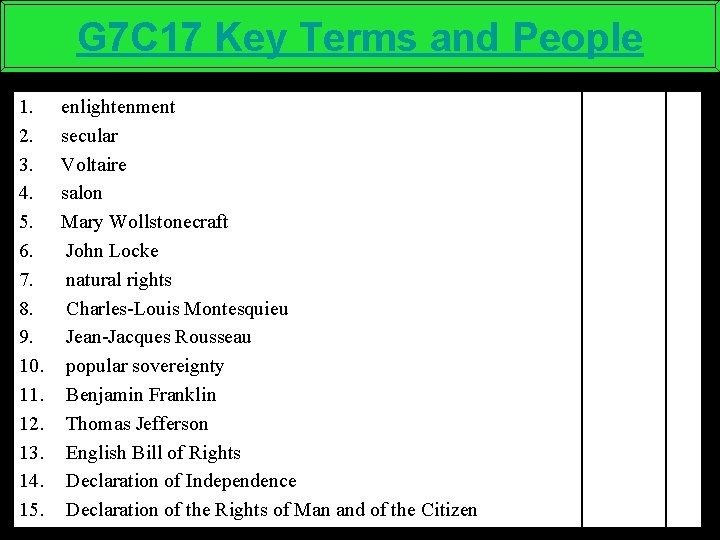
G 7 C 17 Key Terms and People 1. 2. 3. 4. 5. 6. 7. 8. 9. 10. 11. 12. 13. 14. 15. enlightenment secular Voltaire salon Mary Wollstonecraft John Locke natural rights Charles-Louis Montesquieu Jean-Jacques Rousseau popular sovereignty Benjamin Franklin Thomas Jefferson English Bill of Rights Declaration of Independence Declaration of the Rights of Man and of the Citizen
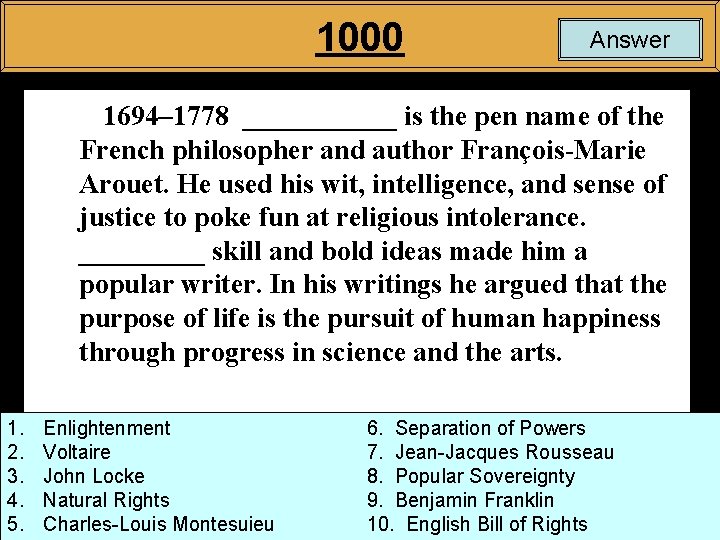
100 Answer 1694– 1778 ______ is the pen name of the French philosopher and author François-Marie Arouet. He used his wit, intelligence, and sense of justice to poke fun at religious intolerance. _____ skill and bold ideas made him a popular writer. In his writings he argued that the purpose of life is the pursuit of human happiness through progress in science and the arts. 1. 2. 3. 4. 5. Enlightenment Voltaire John Locke Natural Rights Charles-Louis Montesuieu 6. Separation of Powers 7. Jean-Jacques Rousseau 8. Popular Sovereignty 9. Benjamin Franklin 10. English Bill of Rights
200 Answer the idea that every man should have the right to be able to think and to worship as they please 1. 2. 3. 4. 5. Enlightenment Voltaire John Locke Natural Rights Charles-Louis Montesuieu 6. Separation of Powers 7. Jean-Jacques Rousseau 8. Popular Sovereignty 9. Benjamin Franklin 10. English Bill of Rights
300 Answer (1706– 1790) American colonial leader, he argued that the British government had no right to tax the colonists because they had no representation in Parliament. He is the $100 bill man! 1. 2. 3. 4. 5. Enlightenment Voltaire John Locke Natural Rights Charles-Louis Montesuieu 6. Separation of Powers 7. Jean-Jacques Rousseau 8. Popular Sovereignty 9. Benjamin Franklin 10. English Bill of Rights
400 Answer When did he live? 1632– 1704 Where did he live? England the Netherlands What did he do? He worked as a professor, physician, and government official. He wrote about the human mind, science, government, religion, and other topics. Why is he important? He believed in the right of common people to think and worship as they pleased and to own property. He also had great faith in science and people’s basic goodness. Not everyone liked his ideas. At one point he fled to Holland to avoid arrest by political enemies. His ideas have inspired political reforms in the West for some 300 years. 1. 2. 3. 4. 5. Enlightenment Voltaire John Locke Natural Rights Charles-Louis Montesuieu 6. Separation of Powers 7. Jean-Jacques Rousseau 8. Popular Sovereignty 9. Benjamin Franklin 10. English Bill of Rights
500 Answer (1712– 1778) French philosopher, he believed in popular sovereignty and the social contract between citizens and their governments. 1. 2. 3. 4. 5. Enlightenment Voltaire John Locke Natural RIghts Charles-Louis Montesuieu 6. Separation of Powers 7. Jean-Jacques Rousseau 8. Popular Sovereignty 9. Benjamin Franklin 10. English Bill of Rights
600 Answer The idea that governments should express the will of the people. 1. 2. 3. 4. 5. Enlightenment Voltaire John Locke Natural Rights Charles-Louis Montesuieu 6. Separation of Powers 7. Jean-Jacques Rousseau 8. Popular Sovereignty 9. Benjamin Franklin 10. English Bill of Rights
700 Answer This was a period during the 1600 s and 1700 s when reason was used to guide people’s thoughts about society, politics, and philosophy. 1. 2. 3. 4. 5. Enlightenment Voltaire John Locke Natural Rights Charles-Louis Montesuieu 6. Separation of Powers 7. Jean-Jacques Rousseau 8. Popular Sovereignty 9. Benjamin Franklin 10. English Bill of Rights
800 Answer A document approved in 1689 that listed rights for Parliament and the English people and drew on the principles of the Magna Carta. 1. 2. 3. 4. 5. Enlightenment Voltaire John Locke Natural Rights Charles-Louis Montesuieu 6. Separation of Powers 7. Jean-Jacques Rousseau 8. Popular Sovereignty 9. Benjamin Franklin 10. English Bill of Rights
900 Answer (1689– 1755) French Enlightenment thinker, he believed that government should be divided into separate branches to protect people’s freedom. 1. 2. 3. 4. 5. Enlightenment Voltaire John Locke Natural Rights Charles-Louis Montesuieu 6. Separation of Powers 7. Jean-Jacques Rousseau 8. Popular Sovereignty 9. Benjamin Franklin 10. English Bill of Rights
1000 Answer Government is separated into branches to balance authority. 1. 2. 3. 4. 5. Enlightenment Voltaire John Locke Natural Rights Charles-Louis Montesuieu 6. Separation of Powers 7. Jean-Jacques Rousseau 8. Popular Sovereignty 9. Benjamin Franklin 10. English Bill of Rights
G 7 Chapter 17 Enlightenment and Revolution (1642 -1800)
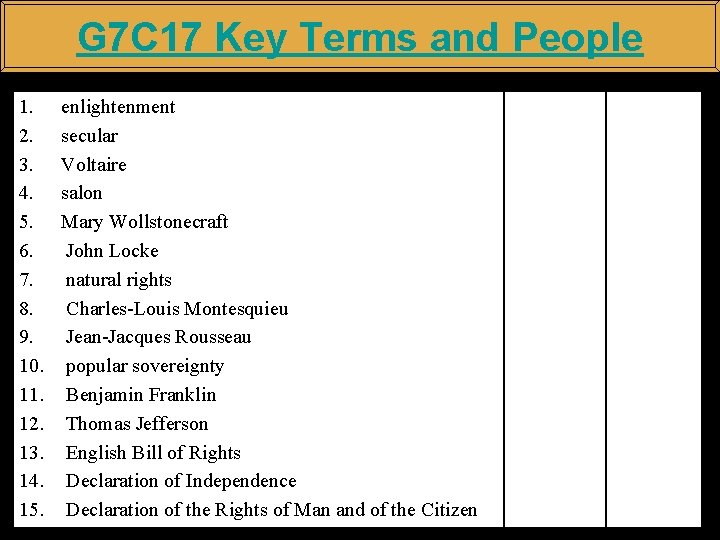
G 7 C 17 Key Terms and People 1. 2. 3. 4. 5. 6. 7. 8. 9. 10. 11. 12. 13. 14. 15. enlightenment secular Voltaire salon Mary Wollstonecraft John Locke natural rights Charles-Louis Montesquieu Jean-Jacques Rousseau popular sovereignty Benjamin Franklin Thomas Jefferson English Bill of Rights Declaration of Independence Declaration of the Rights of Man and of the Citizen
100 Answer (1689– 1755) French Enlightenment thinker, he believed that government should be divided into separate branches to protect people’s freedom. 1. 2. 3. 4. 5. Enlightenment Voltaire John Locke Natural Rights Charles-Louis Montesuieu 6. Separation of Powers 7. Jean-Jacques Rousseau 8. Popular Sovereignty 9. Benjamin Franklin 10. English Bill of Rights
200 Answer Government is separated into branches to balance authority. 1. 2. 3. 4. 5. Enlightenment Voltaire John Locke Natural Rights Charles-Louis Montesuieu 6. Separation of Powers 7. Jean-Jacques Rousseau 8. Popular Sovereignty 9. Benjamin Franklin 10. English Bill of Rights
300 Answer This was a period during the 1600 s and 1700 s when reason was used to guide people’s thoughts about society, politics, and philosophy. 1. 2. 3. 4. 5. Enlightenment Voltaire John Locke Natural Rights Charles-Louis Montesuieu 6. Separation of Powers 7. Jean-Jacques Rousseau 8. Popular Sovereignty 9. Benjamin Franklin 10. English Bill of Rights
400 Answer The idea that governments should express the will of the people. 1. 2. 3. 4. 5. Enlightenment Voltaire John Locke Natural Rights Charles-Louis Montesuieu 6. Separation of Powers 7. Jean-Jacques Rousseau 8. Popular Sovereignty 9. Benjamin Franklin 10. English Bill of Rights
500 Answer (1712– 1778) French philosopher, he believed in popular sovereignty and the social contract between citizens and their governments. 1. 2. 3. 4. 5. Enlightenment Voltaire John Locke Natural Rights Charles-Louis Montesuieu 6. Separation of Powers 7. Jean-Jacques Rousseau 8. Popular Sovereignty 9. Benjamin Franklin 10. English Bill of Rights
600 Answer When did he live? 1632– 1704 Where did he live? England the Netherlands What did he do? He worked as a professor, physician, and government official. He wrote about the human mind, science, government, religion, and other topics. Why is he important? He believed in the right of common people to think and worship as they pleased and to own property. He also had great faith in science and people’s basic goodness. Not everyone liked his ideas. At one point he fled to Holland to avoid arrest by political enemies. His ideas have inspired political reforms in the West for some 300 years. 1. 2. 3. 4. 5. Enlightenment Voltaire John Locke Natural Rights Charles-Louis Montesuieu 6. Separation of Powers 7. Jean-Jacques Rousseau 8. Popular Sovereignty 9. Benjamin Franklin 10. English Bill of Rights
700 Answer (1706– 1790) American colonial leader, he argued that the British government had no right to tax the colonists because they had no representation in Parliament. He is the $100 bill man! 1. 2. 3. 4. 5. Enlightenment Voltaire John Locke Natural Rights Charles-Louis Montesuieu 6. Separation of Powers 7. Jean-Jacques Rousseau 8. Popular Sovereignty 9. Benjamin Franklin 10. English Bill of Rights
800 Answer the idea that every man should have the right to be able to think and to worship as they please 1. 2. 3. 4. 5. Enlightenment Voltaire John Locke Natural Rights Charles-Louis Montesuieu 6. Separation of Powers 7. Jean-Jacques Rousseau 8. Popular Sovereignty 9. Benjamin Franklin 10. English Bill of Rights
900 Answer the idea that every man should have the right to be able to think and to worship as they please 1. 2. 3. 4. 5. Enlightenment Voltaire John Locke Natural Rights Charles-Louis Montesuieu 6. Separation of Powers 7. Jean-Jacques Rousseau 8. Popular Sovereignty 9. Benjamin Franklin 10. English Bill of Rights
1000 Answer 1694– 1778 ______ is the pen name of the French philosopher and author François-Marie Arouet. He used his wit, intelligence, and sense of justice to poke fun at religious intolerance. _____ skill and bold ideas made him a popular writer. In his writings he argued that the purpose of life is the pursuit of human happiness through progress in science and the arts. 1. 2. 3. 4. 5. Enlightenment Voltaire John Locke Natural Rights Charles-Louis Montesuieu 6. Separation of Powers 7. Jean-Jacques Rousseau 8. Popular Sovereignty 9. Benjamin Franklin 10. English Bill of Rights
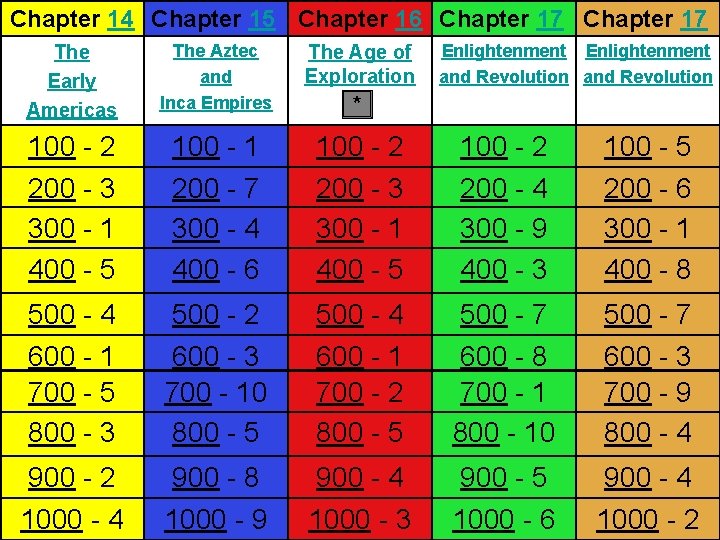
Chapter 14 Chapter 15 Chapter 16 Chapter 17 The Early Americas The Aztec and Inca Empires The Age of Exploration Enlightenment and Revolution 100 - 2 200 - 3 300 - 1 400 - 5 100 - 1 200 - 7 300 - 4 400 - 6 100 - 2 200 - 3 300 - 1 400 - 5 100 - 2 200 - 4 300 - 9 400 - 3 100 - 5 200 - 6 300 - 1 400 - 8 500 - 4 600 - 1 700 - 5 800 - 3 500 - 2 600 - 3 700 - 10 800 - 5 500 - 4 600 - 1 700 - 2 800 - 5 500 - 7 600 - 8 700 - 1 800 - 10 500 - 7 600 - 3 700 - 9 800 - 4 900 - 2 1000 - 4 900 - 8 1000 - 9 900 - 4 1000 - 3 900 - 5 1000 - 6 900 - 4 1000 - 2 *
100 2. Obsidian
200 3. Maya civilization
300 1. Maize
400 5. Maya Society
500 4. Palenque
600 1. Maize
700 5. Maya Society
800 3. Maya Civilization
900 2. Obsidian
1000 4. Palenque
100 1. The Aztec Empire
200 7. The Inca Empire
300 4. Hernan Cortes
400 6. Aztec Society
500 2. Tenochititlan
600 3. Conquistadores
700 10. Inca Society
800 5. Moctezuma II
900 8. Atahualpa
1000 9. Francisco Pizarro
100 2. Ferdinand Magellan
200 3. The Columbian Exchange
300 1. Christopher Columbus
400 5. Capitalism
500 4. Mercantilism
600 1. Christopher Columbus
700 2. Ferdinand Magellan
800 5. Capitalism
900 4. Mercantilism
1000 3. The Columbian Exchange
100 2. Voltaire
200 4. Natural Rights
300 9. Benjamin Franklin
400 3. John Locke
500 7. Jean-Jacques Rousseau
600 8. Popular Sovereignty
700 1. Enlightenment
800 10. English Bill of Rights
900 5. Charles-Louis Montesuieu
1000 6. Separation of Powers
100 5. Charles-Louis Montesuieu
200 6. Separation of Powers
300 1. Enlightenment
400 8. Popular Sovereignty
500 7. Jean-Jacques Rousseau
600 3. John Locke
700 9. Benjamin Franklin
800 4. Natural Rights
900 4. Natural Rights
1000 2. Voltaire