
CHAPTER 14 CHANGING PHYSICAL ACTIVITY BEHAVIOUR THE SOCIALECOLOGICAL

CHAPTER 14 CHANGING PHYSICAL ACTIVITY BEHAVIOUR: THE SOCIAL-ECOLOGICAL MODEL AND THE YOUTH PHYSICAL ACTIVITY FRAMEWORK
KEY KNOWLEDGE v Components of the social-ecological model (individual, social environment, physical environment and policy) and/or the Youth Physical Activity Promotion Model. © Victorian Curriculum & Assessment Authority
THEORETICAL MODELS OF PHYSICAL ACTIVITY BEHAVIOUR (1) Several theories and models are used to explain health behaviour. These can be used to predict which factors will lead to a change in certain health behaviours (e. g. physical activity, alcohol consumption or smoking). They: v explain influences or determinants of physical activity v explain the relationship between these factors (e. g. beliefs, barriers) and physical activity v explain the conditions under which relationships with physical activity do and do not occur (e. g. the time, place and circumstances that lead to physical activity).
THEORETICAL MODELS OF PHYSICAL ACTIVITY BEHAVIOUR (2) Here, determinants mean factors that influence how active a person is. They can be enablers or barriers. These factors do not usually influence behaviour in isolation; there might be a combination of factors. Theoretical models of behavioural change can incorporate several of these factors, in an attempt to better understand physical activity behaviour. Two theoretical models provide a framework for physical activity promotion: v individual (intrapersonal) and v interpersonal models of adult physical activity. These models are made up of multiple theories (see Table 14. 6).
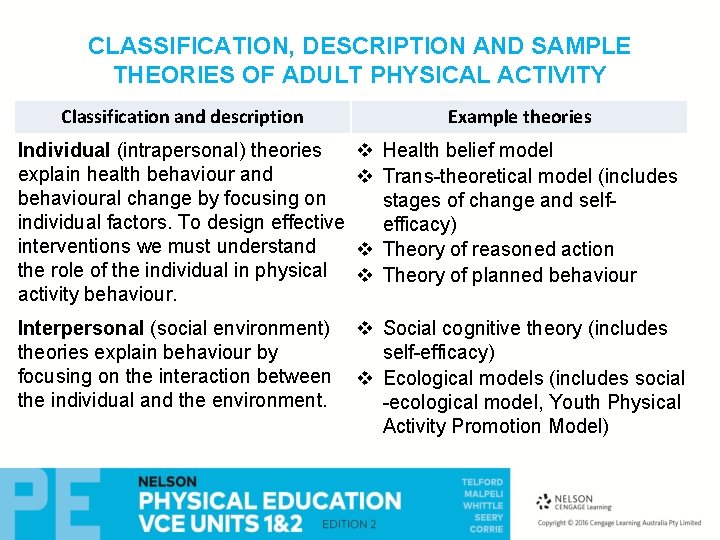
CLASSIFICATION, DESCRIPTION AND SAMPLE THEORIES OF ADULT PHYSICAL ACTIVITY Classification and description Example theories Individual (intrapersonal) theories explain health behaviour and behavioural change by focusing on individual factors. To design effective interventions we must understand the role of the individual in physical activity behaviour. v Health belief model v Trans-theoretical model (includes stages of change and selfefficacy) v Theory of reasoned action v Theory of planned behaviour Interpersonal (social environment) theories explain behaviour by focusing on the interaction between the individual and the environment. v Social cognitive theory (includes self-efficacy) v Ecological models (includes social -ecological model, Youth Physical Activity Promotion Model)
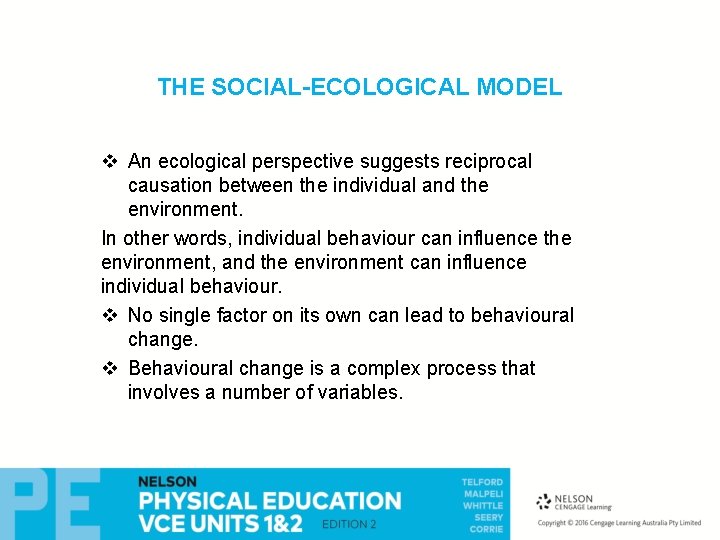
THE SOCIAL-ECOLOGICAL MODEL v An ecological perspective suggests reciprocal causation between the individual and the environment. In other words, individual behaviour can influence the environment, and the environment can influence individual behaviour. v No single factor on its own can lead to behavioural change. v Behavioural change is a complex process that involves a number of variables.
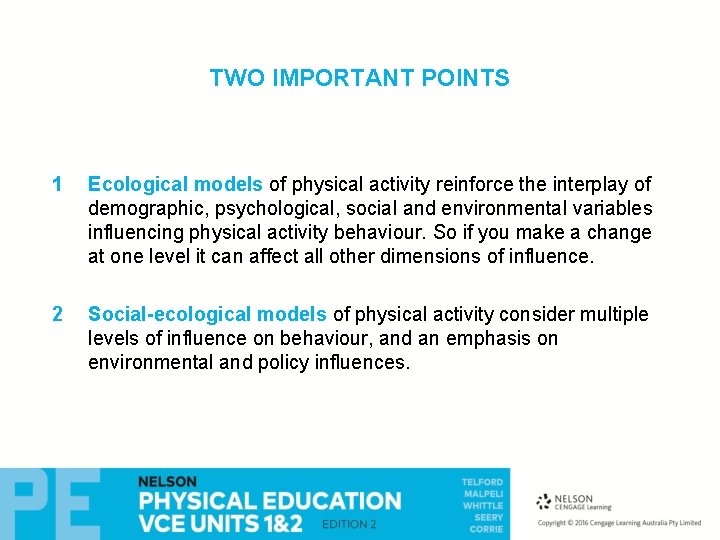
TWO IMPORTANT POINTS 1 Ecological models of physical activity reinforce the interplay of demographic, psychological, social and environmental variables influencing physical activity behaviour. So if you make a change at one level it can affect all other dimensions of influence. 2 Social-ecological models of physical activity consider multiple levels of influence on behaviour, and an emphasis on environmental and policy influences.
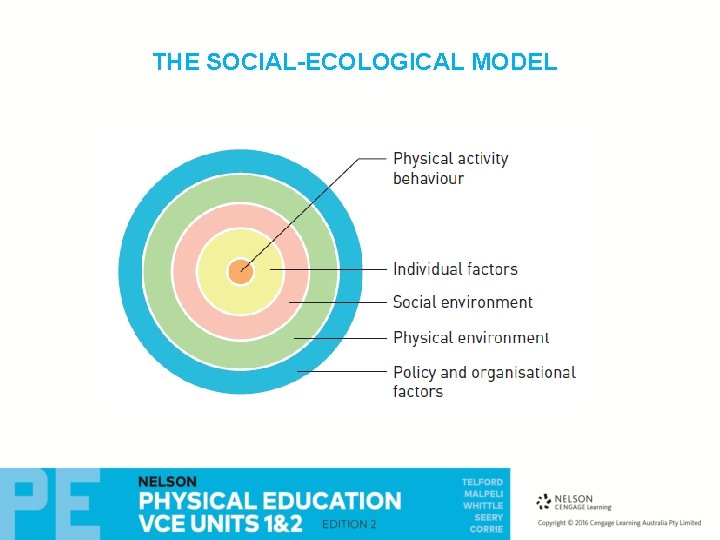
THE SOCIAL-ECOLOGICAL MODEL
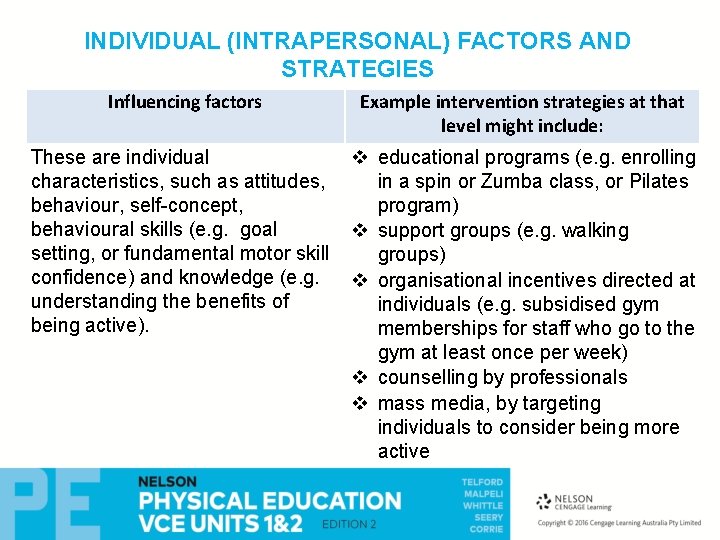
INDIVIDUAL (INTRAPERSONAL) FACTORS AND STRATEGIES Influencing factors Example intervention strategies at that level might include: These are individual characteristics, such as attitudes, behaviour, self-concept, behavioural skills (e. g. goal setting, or fundamental motor skill confidence) and knowledge (e. g. understanding the benefits of being active). v educational programs (e. g. enrolling in a spin or Zumba class, or Pilates program) v support groups (e. g. walking groups) v organisational incentives directed at individuals (e. g. subsidised gym memberships for staff who go to the gym at least once per week) v counselling by professionals v mass media, by targeting individuals to consider being more active
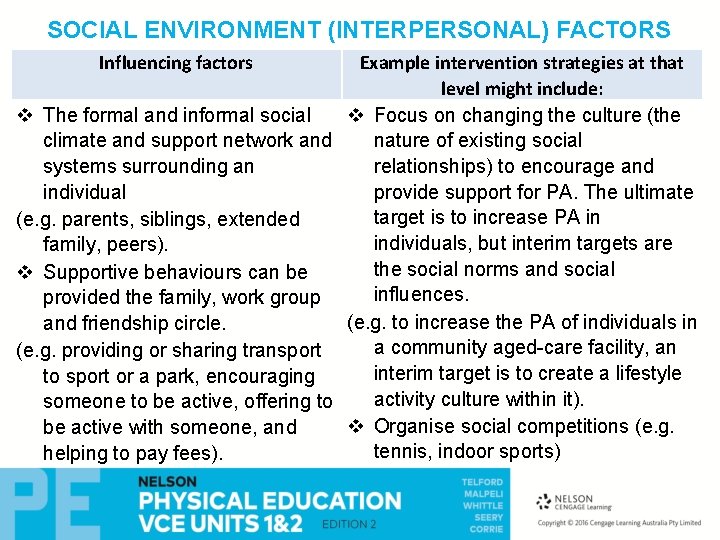
SOCIAL ENVIRONMENT (INTERPERSONAL) FACTORS Influencing factors Example intervention strategies at that level might include: v The formal and informal social v Focus on changing the culture (the climate and support network and nature of existing social systems surrounding an relationships) to encourage and individual provide support for PA. The ultimate target is to increase PA in (e. g. parents, siblings, extended individuals, but interim targets are family, peers). the social norms and social v Supportive behaviours can be influences. provided the family, work group (e. g. to increase the PA of individuals in and friendship circle. a community aged-care facility, an (e. g. providing or sharing transport interim target is to create a lifestyle to sport or a park, encouraging activity culture within it). someone to be active, offering to v Organise social competitions (e. g. be active with someone, and tennis, indoor sports) helping to pay fees).
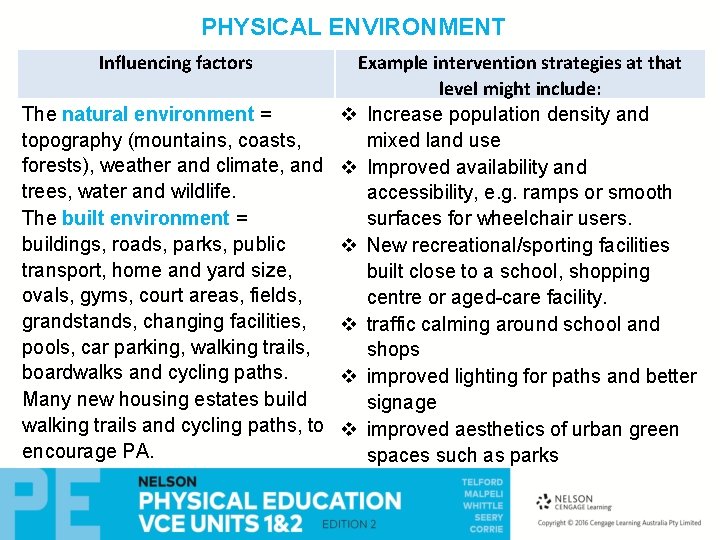
PHYSICAL ENVIRONMENT Influencing factors Example intervention strategies at that level might include: The natural environment = v Increase population density and topography (mountains, coasts, mixed land use forests), weather and climate, and v Improved availability and trees, water and wildlife. accessibility, e. g. ramps or smooth The built environment = surfaces for wheelchair users. buildings, roads, parks, public v New recreational/sporting facilities transport, home and yard size, built close to a school, shopping ovals, gyms, court areas, fields, centre or aged-care facility. grandstands, changing facilities, v traffic calming around school and pools, car parking, walking trails, shops boardwalks and cycling paths. v improved lighting for paths and better Many new housing estates build signage walking trails and cycling paths, to v improved aesthetics of urban green encourage PA. spaces such as parks
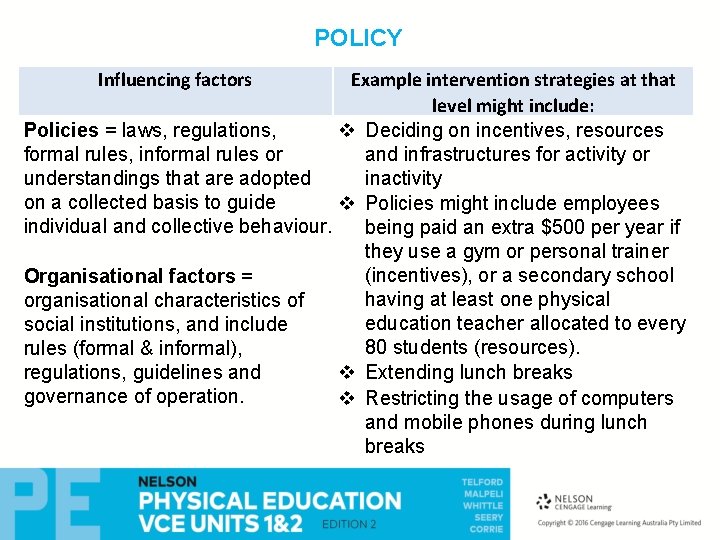
POLICY Influencing factors Example intervention strategies at that level might include: Policies = laws, regulations, v Deciding on incentives, resources formal rules, informal rules or and infrastructures for activity or understandings that are adopted inactivity on a collected basis to guide v Policies might include employees individual and collective behaviour. being paid an extra $500 per year if they use a gym or personal trainer (incentives), or a secondary school Organisational factors = having at least one physical organisational characteristics of education teacher allocated to every social institutions, and include 80 students (resources). rules (formal & informal), regulations, guidelines and v Extending lunch breaks governance of operation. v Restricting the usage of computers and mobile phones during lunch breaks
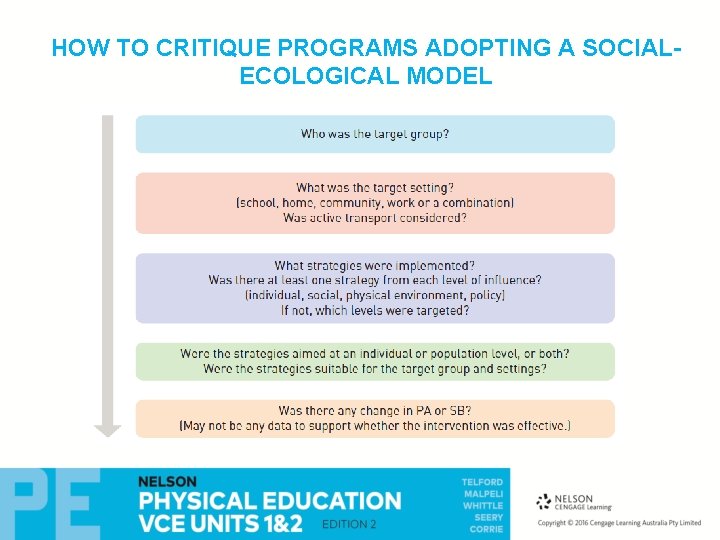
HOW TO CRITIQUE PROGRAMS ADOPTING A SOCIALECOLOGICAL MODEL
THE YOUTH PHYSICAL ACTIVITY PROMOTION MODEL (YPAP) (1) v YPAP integrates a range of individual and environmental variables with a systematic socio-ecological framework. v It is a conceptual model of physical activity promotion based on unique developmental, psychological and behavioural characteristics of children. v The YPAP model considers individual, social and environmental influences on children’s physical activity. v It also incorporates ideas from other theoretical frameworks. Ecological models can incorporate factors in multiple domains that influence physical activity in youth.
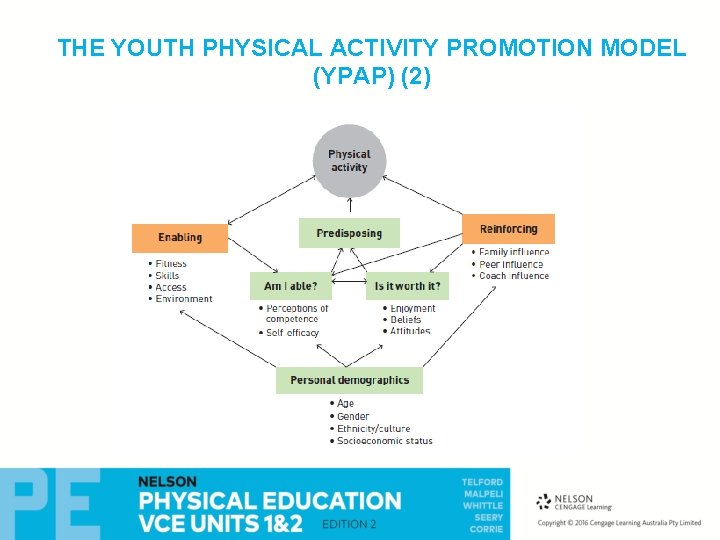
THE YOUTH PHYSICAL ACTIVITY PROMOTION MODEL (YPAP) (2)
YPAP MAJOR COMPONENTS The YPAP model categorises factors affecting physical activity among youth into three major components: 1 Predisposing factors 2 Enabling factors 3 Reinforcing factors
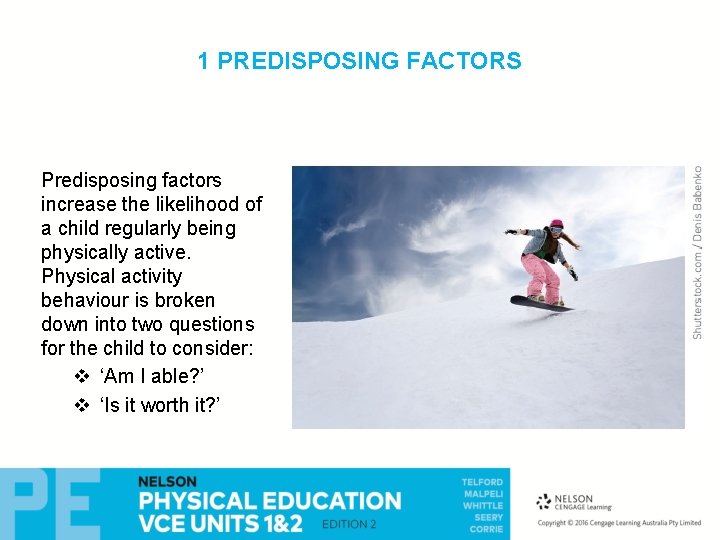
1 PREDISPOSING FACTORS Predisposing factors increase the likelihood of a child regularly being physically active. Physical activity behaviour is broken down into two questions for the child to consider: v ‘Am I able? ’ v ‘Is it worth it? ’
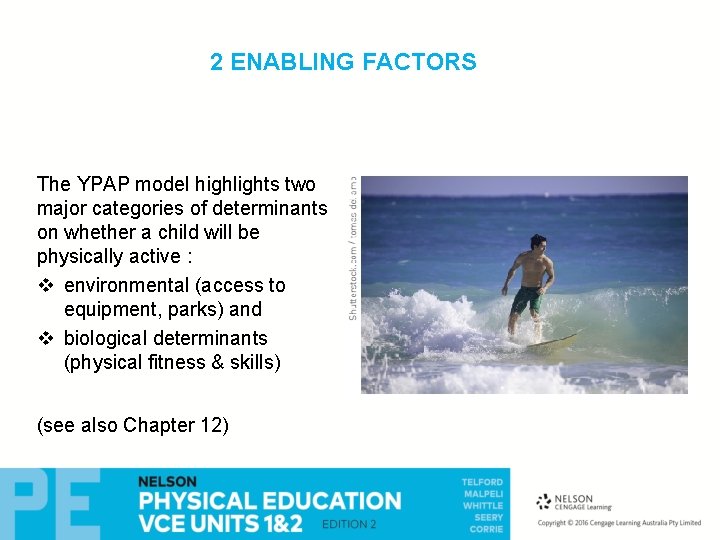
2 ENABLING FACTORS The YPAP model highlights two major categories of determinants on whether a child will be physically active : v environmental (access to equipment, parks) and v biological determinants (physical fitness & skills) (see also Chapter 12)
3 REINFORCING FACTORS Reinforcing factors = support from significant others which encourages a child to be physically active. They could be family, teachers, peers or even a coach. Examples of reinforcing factors include: v parental encouragement v friend and family social support v social influences v parental barriers v parental social support (e. g. take child to the park, drive child to training/park, pay fees for programs) v parental belief systems v PE teacher providing active opportunities.
DEMOGRAPHIC VARIABLES The YPAP model incorporates different demographic variables, recognising that these variables can influence each major component. Personal demographics refer to: v age v gender v ethnicity/culture v socioeconomic status.
- Slides: 21