
Chapter 14 Cardiac and Respiratory Emergencies Limmer First

- Slides: 40
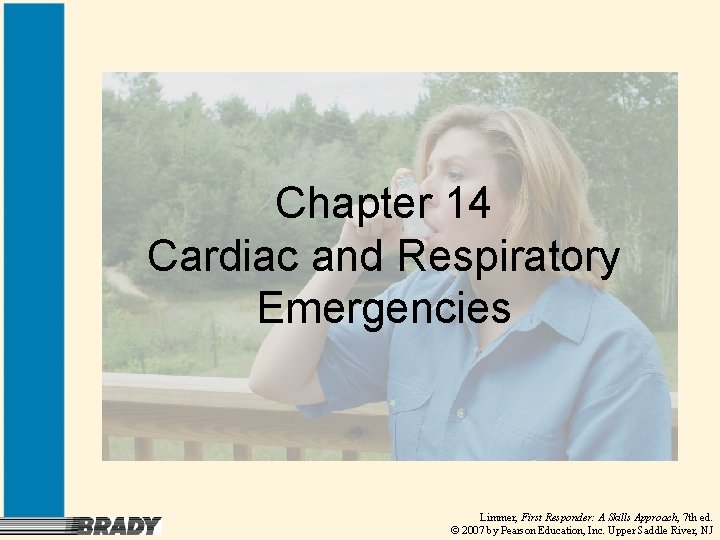
Chapter 14 Cardiac and Respiratory Emergencies Limmer, First Responder: A Skills Approach, 7 th ed. © 2007 by Pearson Education, Inc. Upper Saddle River, NJ
Topics Cardiac Emergencies Respiratory Emergencies Limmer, First Responder: A Skills Approach, 7 th ed. © 2007 by Pearson Education, Inc. Upper Saddle River, NJ
Cardiac Emergencies Limmer, First Responder: A Skills Approach, 7 th ed. © 2007 by Pearson Education, Inc. Upper Saddle River, NJ
Cardiac Emergencies Patient assessment First responder care Specific cardiac conditions Limmer, First Responder: A Skills Approach, 7 th ed. © 2007 by Pearson Education, Inc. Upper Saddle River, NJ
Cardiac Emergencies Occur from abnormal heart rhythms Interruption of oxygen to the heart – Coronary artery disease Limmer, First Responder: A Skills Approach, 7 th ed. © 2007 by Pearson Education, Inc. Upper Saddle River, NJ
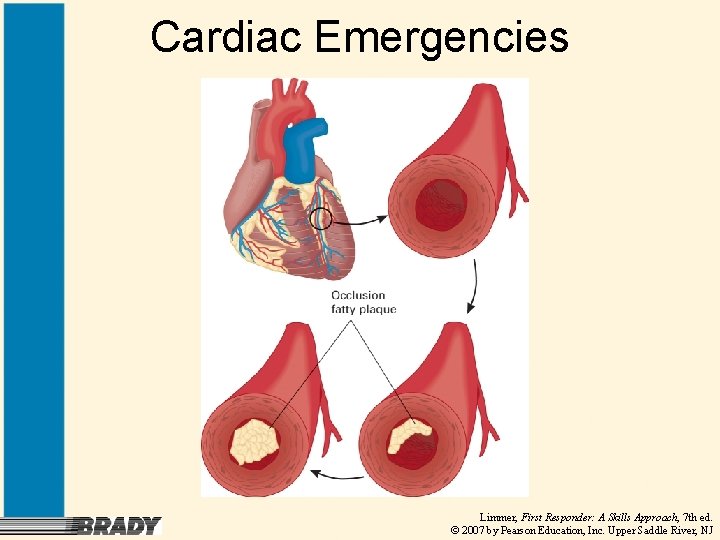
Cardiac Emergencies Coronary artery disease – Blood vessels feeding the heart are narrowed – Artery continues to narrow, reducing oxygen supply – Complete blockage results in a heart attack – Lack of oxygen causes chest pain Limmer, First Responder: A Skills Approach, 7 th ed. © 2007 by Pearson Education, Inc. Upper Saddle River, NJ
Cardiac Emergencies Limmer, First Responder: A Skills Approach, 7 th ed. © 2007 by Pearson Education, Inc. Upper Saddle River, NJ
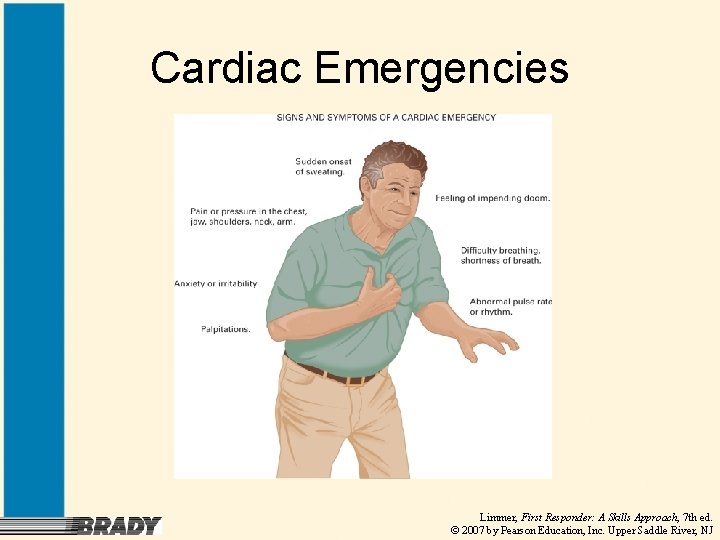
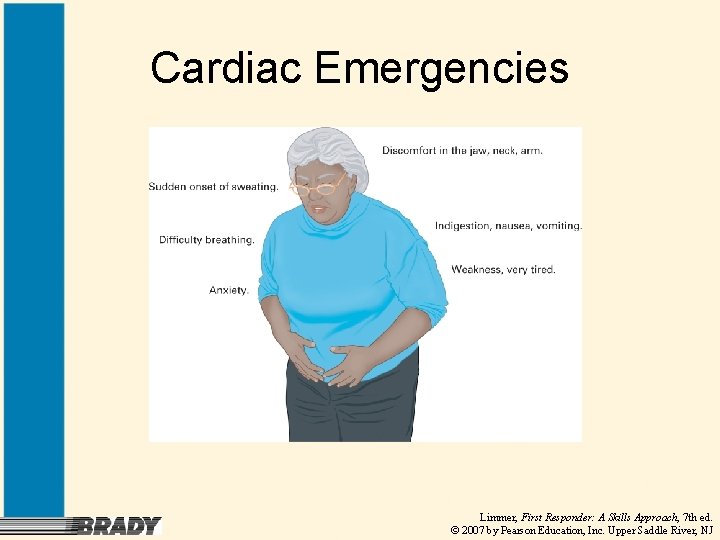
Cardiac Emergencies Patient assessment – Chest pain or discomfort that may radiate – Difficulty breathing – Unusual heart beat – Sweating – Feeling of impending doom Limmer, First Responder: A Skills Approach, 7 th ed. © 2007 by Pearson Education, Inc. Upper Saddle River, NJ
Cardiac Emergencies Limmer, First Responder: A Skills Approach, 7 th ed. © 2007 by Pearson Education, Inc. Upper Saddle River, NJ
Cardiac Emergencies Limmer, First Responder: A Skills Approach, 7 th ed. © 2007 by Pearson Education, Inc. Upper Saddle River, NJ
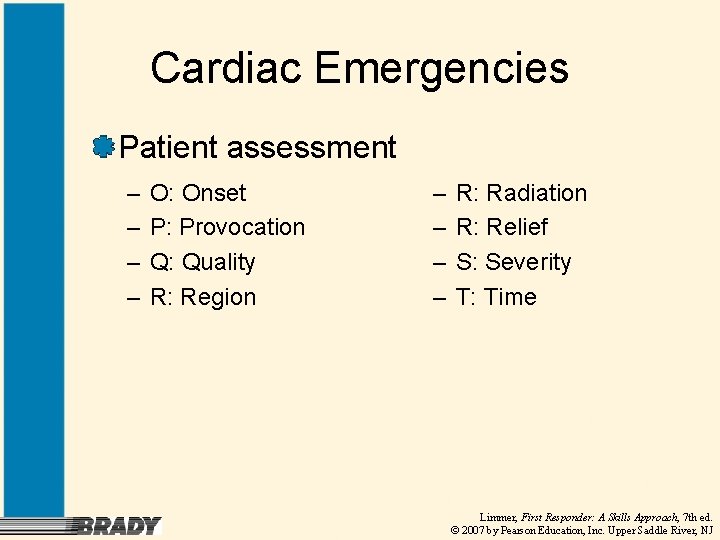
Cardiac Emergencies Patient assessment – – O: Onset P: Provocation Q: Quality R: Region – – R: Radiation R: Relief S: Severity T: Time Limmer, First Responder: A Skills Approach, 7 th ed. © 2007 by Pearson Education, Inc. Upper Saddle River, NJ
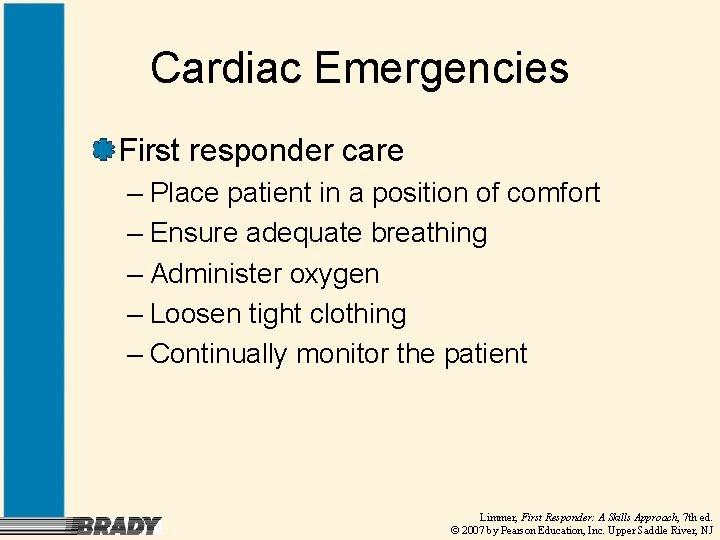
Cardiac Emergencies First responder care – Place patient in a position of comfort – Ensure adequate breathing – Administer oxygen – Loosen tight clothing – Continually monitor the patient Limmer, First Responder: A Skills Approach, 7 th ed. © 2007 by Pearson Education, Inc. Upper Saddle River, NJ
Cardiac Emergencies Specific cardiac conditions – Angina pectoris – Acute myocardial infarction Treatment is the same Limmer, First Responder: A Skills Approach, 7 th ed. © 2007 by Pearson Education, Inc. Upper Saddle River, NJ
Cardiac Emergencies Specific cardiac conditions – Angina pectoris Chest pain or discomfort when the heart does not get enough oxygen Usually associated with physical exertion Palpitations Skin changes Difficulty breathing Limmer, First Responder: A Skills Approach, 7 th ed. © 2007 by Pearson Education, Inc. Upper Saddle River, NJ
Cardiac Emergencies Specific cardiac conditions – Angina pectoris Reversible Generally relieved with rest Patient may take nitroglycerin May result in heart attack if untreated Limmer, First Responder: A Skills Approach, 7 th ed. © 2007 by Pearson Education, Inc. Upper Saddle River, NJ
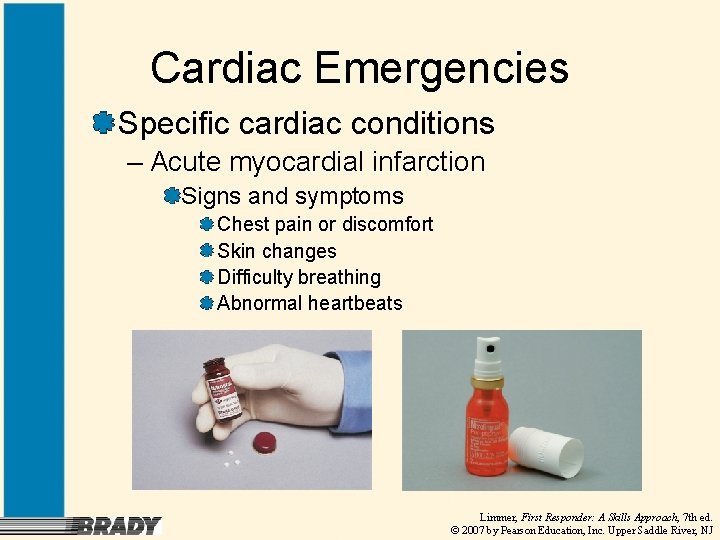
Cardiac Emergencies Specific cardiac conditions – Nitroglycerin Can lower blood pressure Should not take with systolic blood pressure < 100 mm. Hg Can be taken up to 3 times in 5 -minute intervals Do not administer without approval of medical director Limmer, First Responder: A Skills Approach, 7 th ed. © 2007 by Pearson Education, Inc. Upper Saddle River, NJ
Cardiac Emergencies Specific cardiac conditions – Acute myocardial infarction Results in death of heart tissue Four serious consequences Sudden death Shock Congestive heart failure Cardiac dysrhythmias Limmer, First Responder: A Skills Approach, 7 th ed. © 2007 by Pearson Education, Inc. Upper Saddle River, NJ
Cardiac Emergencies Specific cardiac conditions – Acute myocardial infarction Signs and symptoms Chest pain or discomfort Skin changes Difficulty breathing Abnormal heartbeats Limmer, First Responder: A Skills Approach, 7 th ed. © 2007 by Pearson Education, Inc. Upper Saddle River, NJ
Cardiac Emergencies Specific cardiac conditions – Acute myocardial infarction Aspirin Dose is 2– 4 chewable baby aspirin Confirm that patient is not allergic Do not administer if patient is on blood thinners Only administer if patient is conscious Only administer with approval of medical director Limmer, First Responder: A Skills Approach, 7 th ed. © 2007 by Pearson Education, Inc. Upper Saddle River, NJ
Respiratory Emergencies Limmer, First Responder: A Skills Approach, 7 th ed. © 2007 by Pearson Education, Inc. Upper Saddle River, NJ
Respiratory Emergencies Patient assessment First Responder care Specific respiratory conditions Limmer, First Responder: A Skills Approach, 7 th ed. © 2007 by Pearson Education, Inc. Upper Saddle River, NJ
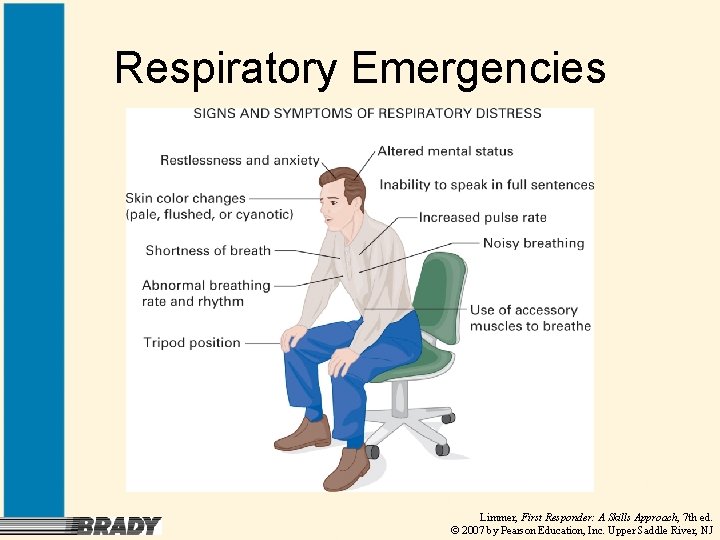
Respiratory Emergencies Patient assessment – Signs and symptoms Inability to speak full sentences Abnormal respirations Accessory muscle usage Tripod position Skin changes Altered mental status Limmer, First Responder: A Skills Approach, 7 th ed. © 2007 by Pearson Education, Inc. Upper Saddle River, NJ
Respiratory Emergencies Limmer, First Responder: A Skills Approach, 7 th ed. © 2007 by Pearson Education, Inc. Upper Saddle River, NJ
Respiratory Emergencies First Responder care – Ensure adequate breathing – Apply oxygen – Place patient in position of comfort – Comfort and reassure the patient Limmer, First Responder: A Skills Approach, 7 th ed. © 2007 by Pearson Education, Inc. Upper Saddle River, NJ
Respiratory Emergencies Specific respiratory conditions – COPD – Asthma – Pneumonia – Acute pulmonary edema – Hyperventilation Limmer, First Responder: A Skills Approach, 7 th ed. © 2007 by Pearson Education, Inc. Upper Saddle River, NJ
Respiratory Emergencies Specific respiratory conditions – Chronic obstructive pulmonary disease (COPD) Emphysema Alveoli loose elasticity Chronic bronchitis Inflammation, edema, and excessive mucus Productive cough for 3 months, for 2 consecutive years May have a hypoxic drive Limmer, First Responder: A Skills Approach, 7 th ed. © 2007 by Pearson Education, Inc. Upper Saddle River, NJ
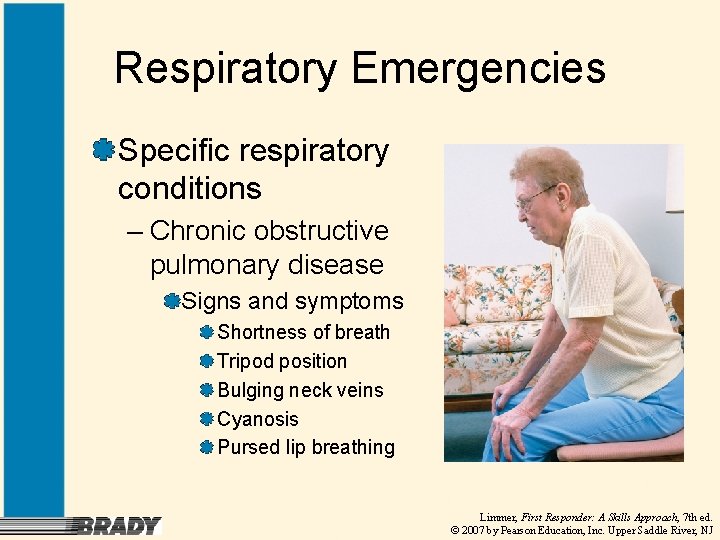
Respiratory Emergencies Specific respiratory conditions – Chronic obstructive pulmonary disease Signs and symptoms Shortness of breath Tripod position Bulging neck veins Cyanosis Pursed lip breathing Limmer, First Responder: A Skills Approach, 7 th ed. © 2007 by Pearson Education, Inc. Upper Saddle River, NJ
Respiratory Emergencies Specific respiratory conditions – Asthma Attacks vary in duration, intensity, and frequency Airway obstruction caused by: Bronchospasm Swelling of bronchial walls Plugging of bronchi by thick mucus Limmer, First Responder: A Skills Approach, 7 th ed. © 2007 by Pearson Education, Inc. Upper Saddle River, NJ
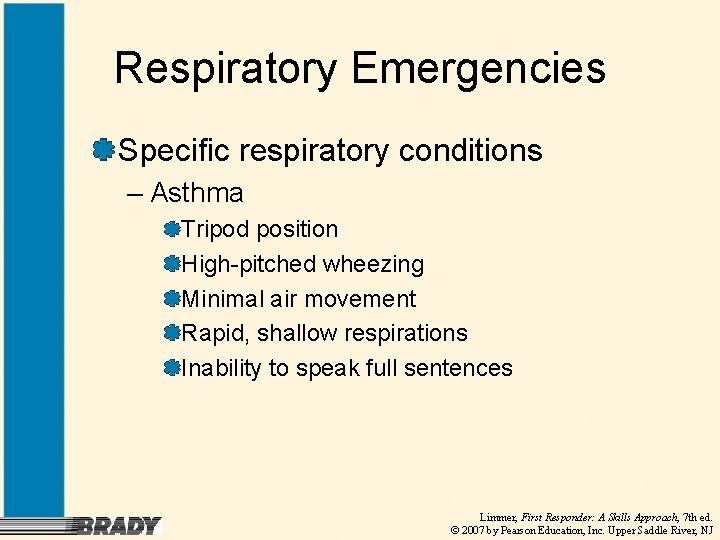
Respiratory Emergencies Specific respiratory conditions – Asthma Tripod position High-pitched wheezing Minimal air movement Rapid, shallow respirations Inability to speak full sentences Limmer, First Responder: A Skills Approach, 7 th ed. © 2007 by Pearson Education, Inc. Upper Saddle River, NJ
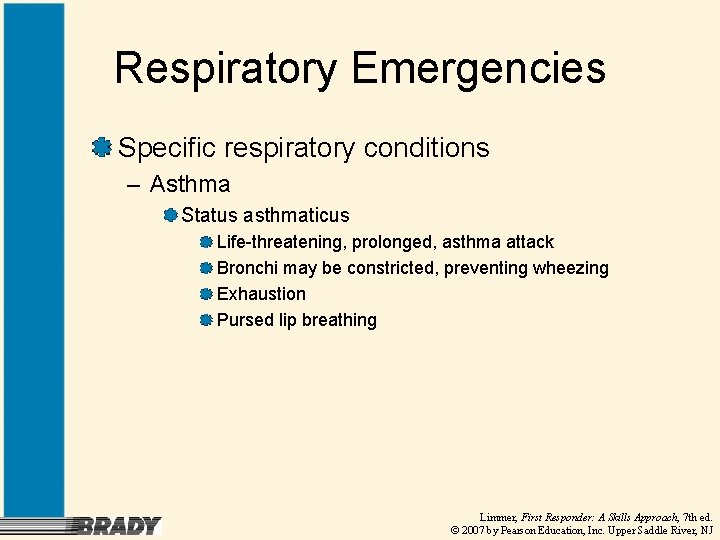
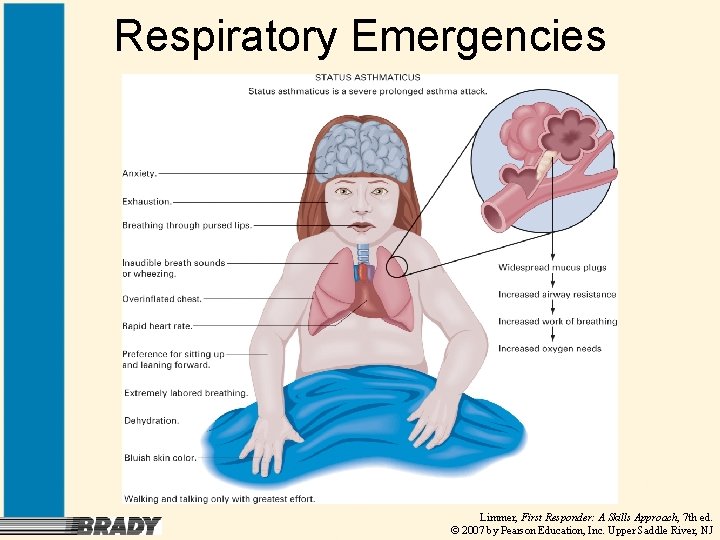
Respiratory Emergencies Specific respiratory conditions – Asthma Status asthmaticus Life-threatening, prolonged, asthma attack Bronchi may be constricted, preventing wheezing Exhaustion Pursed lip breathing Limmer, First Responder: A Skills Approach, 7 th ed. © 2007 by Pearson Education, Inc. Upper Saddle River, NJ
Respiratory Emergencies Limmer, First Responder: A Skills Approach, 7 th ed. © 2007 by Pearson Education, Inc. Upper Saddle River, NJ
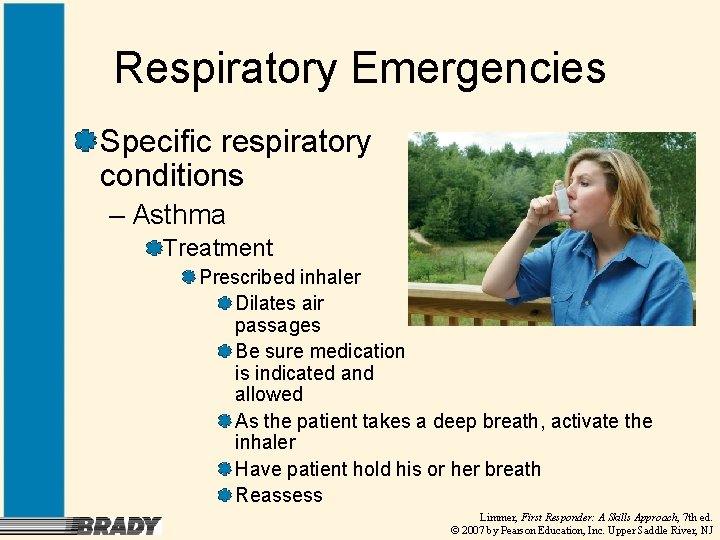
Respiratory Emergencies Specific respiratory conditions – Asthma Treatment Prescribed inhaler Dilates air passages Be sure medication is indicated and allowed As the patient takes a deep breath, activate the inhaler Have patient hold his or her breath Reassess Limmer, First Responder: A Skills Approach, 7 th ed. © 2007 by Pearson Education, Inc. Upper Saddle River, NJ
Respiratory Emergencies Specific respiratory conditions – Pneumonia Lung infection with fluid- or pus-filled alveoli Caused by bacteria, virus, or aspirated materials Limmer, First Responder: A Skills Approach, 7 th ed. © 2007 by Pearson Education, Inc. Upper Saddle River, NJ
Respiratory Emergencies Specific respiratory conditions – Pneumonia Signs and symptoms Chest pain made worse with breathing Respiratory distress Productive cough, possibly discolored Fever, chills, and hot, dry skin Limmer, First Responder: A Skills Approach, 7 th ed. © 2007 by Pearson Education, Inc. Upper Saddle River, NJ
Respiratory Emergencies Specific respiratory conditions – Acute pulmonary edema Caused by damage to the heart or lungs Fluid builds up in the alveoli Limmer, First Responder: A Skills Approach, 7 th ed. © 2007 by Pearson Education, Inc. Upper Saddle River, NJ
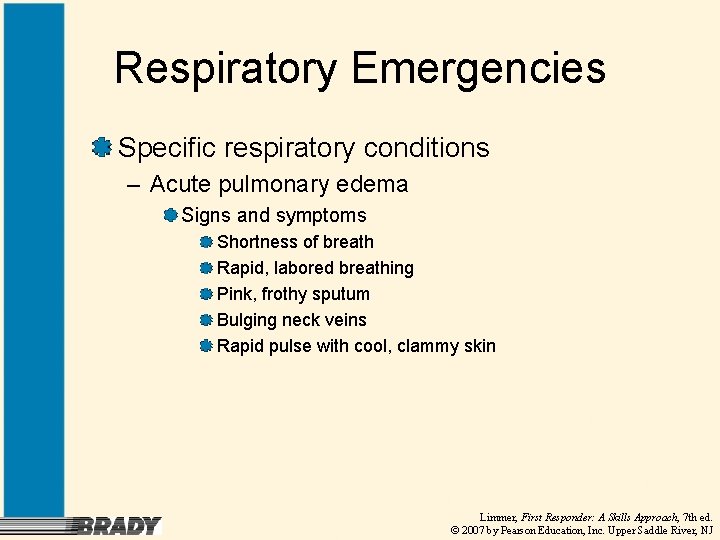
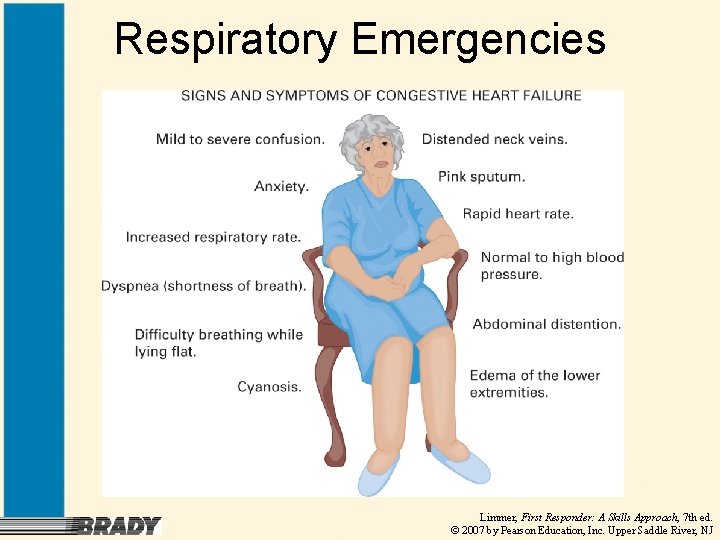
Respiratory Emergencies Specific respiratory conditions – Acute pulmonary edema Signs and symptoms Shortness of breath Rapid, labored breathing Pink, frothy sputum Bulging neck veins Rapid pulse with cool, clammy skin Limmer, First Responder: A Skills Approach, 7 th ed. © 2007 by Pearson Education, Inc. Upper Saddle River, NJ
Respiratory Emergencies Limmer, First Responder: A Skills Approach, 7 th ed. © 2007 by Pearson Education, Inc. Upper Saddle River, NJ
Respiratory Emergencies Specific respiratory conditions – Hyperventilation Breathing too fast Usually associated with anxiety Exhales too much carbon dioxide Limmer, First Responder: A Skills Approach, 7 th ed. © 2007 by Pearson Education, Inc. Upper Saddle River, NJ
Respiratory Emergencies Specific respiratory conditions – Hyperventilation Signs and symptoms Carpal pedal spasms Blurred vision Chest pain Syncope Numbness and tingling Limmer, First Responder: A Skills Approach, 7 th ed. © 2007 by Pearson Education, Inc. Upper Saddle River, NJ
Summary Regardless of the cause, treat all patients with chest pain the same Be prepared for the patient experiencing chest pain to become unresponsive Never withhold oxygen from a patient complaining of difficulty breathing Only administer medications with the prior approval of your medical director Limmer, First Responder: A Skills Approach, 7 th ed. © 2007 by Pearson Education, Inc. Upper Saddle River, NJ