
Chapter 14 Artificial Intelligence Invitation to Computer Science
- Slides: 36
Chapter 14: Artificial Intelligence Invitation to Computer Science, C++ Version, Third Edition
Objectives In this chapter, you will learn about: n Division of labor n Knowledge representation n Recognition tasks n Reasoning tasks Invitation to Computer Science, C++ Version, Third Edition 2
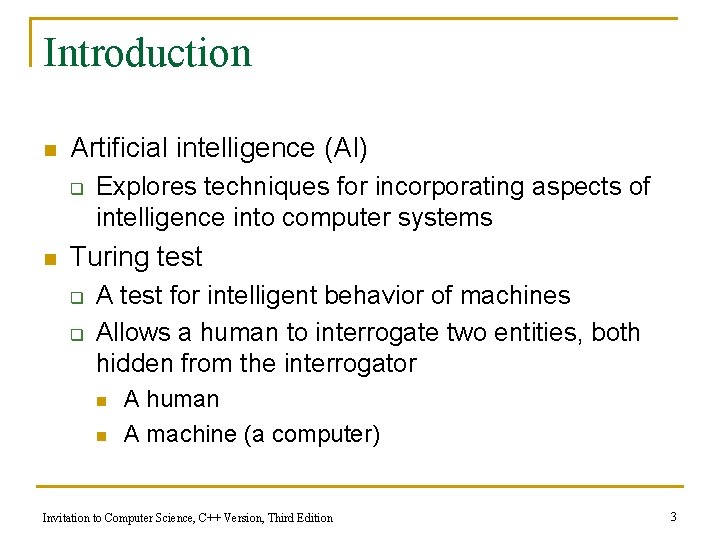
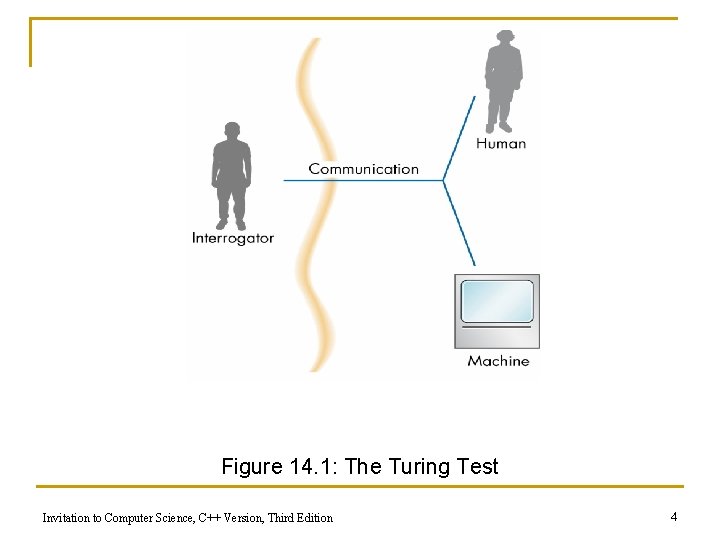
Introduction n Artificial intelligence (AI) q n Explores techniques for incorporating aspects of intelligence into computer systems Turing test q q A test for intelligent behavior of machines Allows a human to interrogate two entities, both hidden from the interrogator n n A human A machine (a computer) Invitation to Computer Science, C++ Version, Third Edition 3
Figure 14. 1: The Turing Test Invitation to Computer Science, C++ Version, Third Edition 4
Introduction (continued) n Turing test (continued) q n If the interrogator is unable to determine which entity is the human and which the computer, the computer has passed the test Artificial intelligence can be thought of as constructing computer models of human intelligence Invitation to Computer Science, C++ Version, Third Edition 5
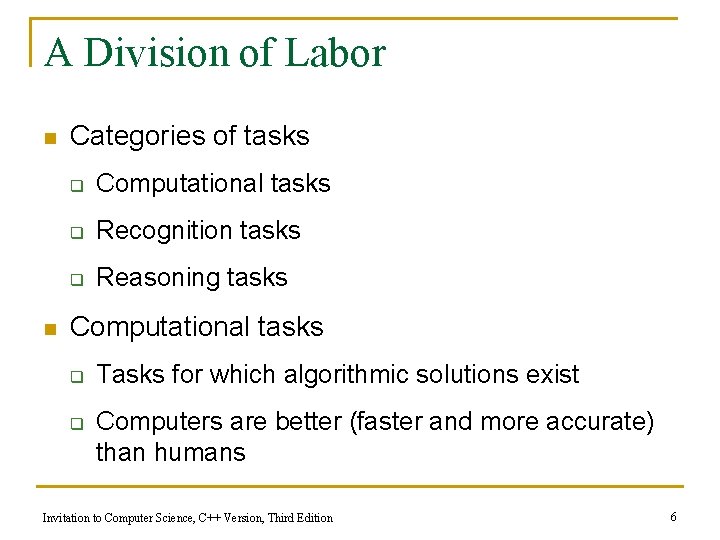
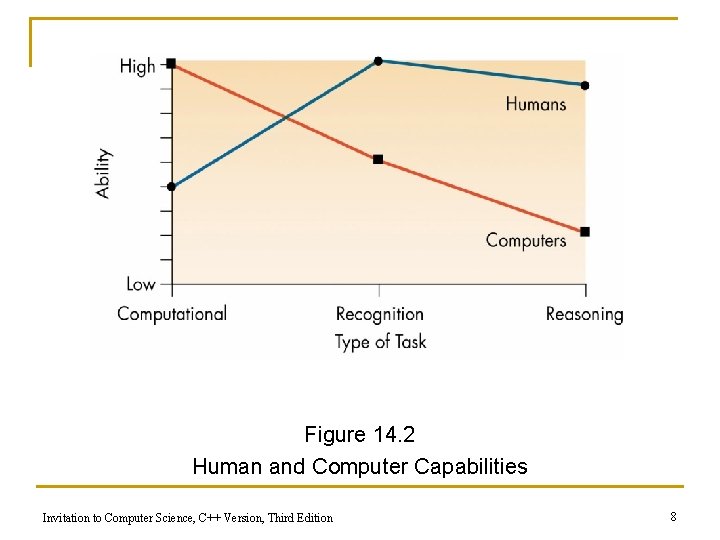
A Division of Labor n n Categories of tasks q Computational tasks q Recognition tasks q Reasoning tasks Computational tasks q q Tasks for which algorithmic solutions exist Computers are better (faster and more accurate) than humans Invitation to Computer Science, C++ Version, Third Edition 6
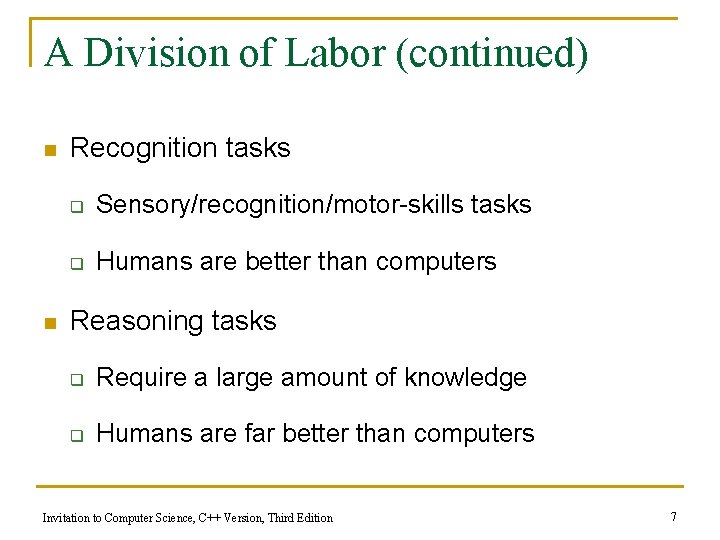
A Division of Labor (continued) n n Recognition tasks q Sensory/recognition/motor-skills tasks q Humans are better than computers Reasoning tasks q Require a large amount of knowledge q Humans are far better than computers Invitation to Computer Science, C++ Version, Third Edition 7
Figure 14. 2 Human and Computer Capabilities Invitation to Computer Science, C++ Version, Third Edition 8
Knowledge Representation n Knowledge: a body of facts or truths n For a computer to make use of knowledge, it must be stored within the computer in some form Invitation to Computer Science, C++ Version, Third Edition 9
Knowledge Representation (continued) n Knowledge representation schemes q Natural language q Formal language q Pictorial q Graphical Invitation to Computer Science, C++ Version, Third Edition 10
Knowledge Representation (continued) n Required characteristics of a knowledge representation scheme q Adequacy q Efficiency q Extendability q Appropriateness Invitation to Computer Science, C++ Version, Third Edition 11
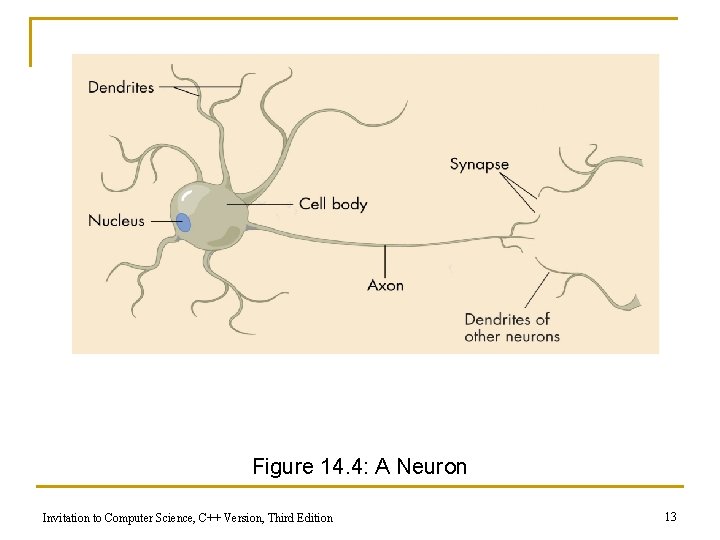
Recognition Tasks n A neuron is a cell in the human brain, capable of: q q Receiving stimuli from other neurons through its dendrites Sending stimuli to other neurons through its axon Invitation to Computer Science, C++ Version, Third Edition 12
Figure 14. 4: A Neuron Invitation to Computer Science, C++ Version, Third Edition 13
Recognition Tasks (continued) n If the sum of activating and inhibiting stimuli received by a neuron equals or exceeds its “threshold” value, the neuron sends out its own signal n Each neuron can be thought of as an extremely simple computational device with a single on/off output Invitation to Computer Science, C++ Version, Third Edition 14
Recognition Tasks (continued) n Human brain: a connectionist architecture q n A large number of simple “processors” with multiple interconnections Von Neumann architecture q A small number (maybe only one) of very powerful processors with a limited number of interconnections between them Invitation to Computer Science, C++ Version, Third Edition 15
Recognition Tasks (continued) n Artificial neural networks (neural networks) q q n Simulate individual neurons in hardware Connect them in a massively parallel network of simple devices that act somewhat like biological neurons The effect of a neural network may be simulated in software on a sequential-processing computer Invitation to Computer Science, C++ Version, Third Edition 16
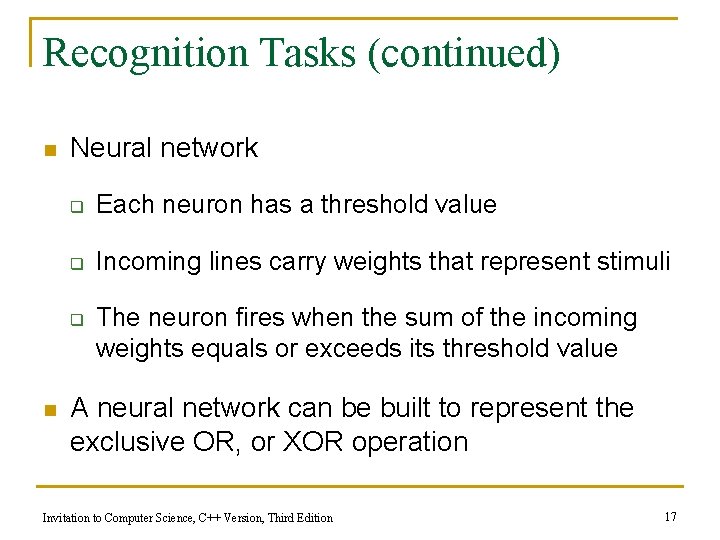
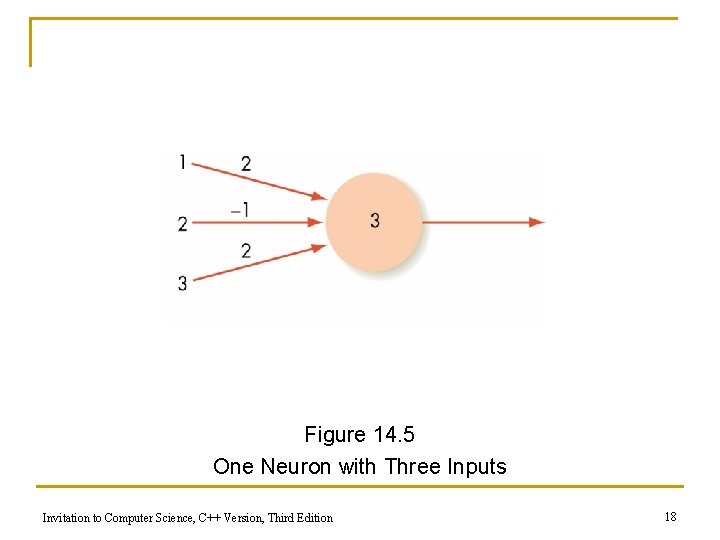
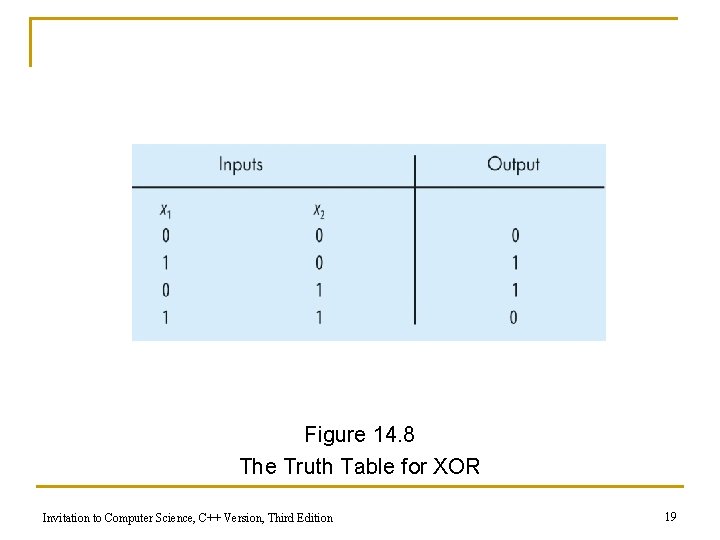
Recognition Tasks (continued) n Neural network q Each neuron has a threshold value q Incoming lines carry weights that represent stimuli q n The neuron fires when the sum of the incoming weights equals or exceeds its threshold value A neural network can be built to represent the exclusive OR, or XOR operation Invitation to Computer Science, C++ Version, Third Edition 17
Figure 14. 5 One Neuron with Three Inputs Invitation to Computer Science, C++ Version, Third Edition 18
Figure 14. 8 The Truth Table for XOR Invitation to Computer Science, C++ Version, Third Edition 19
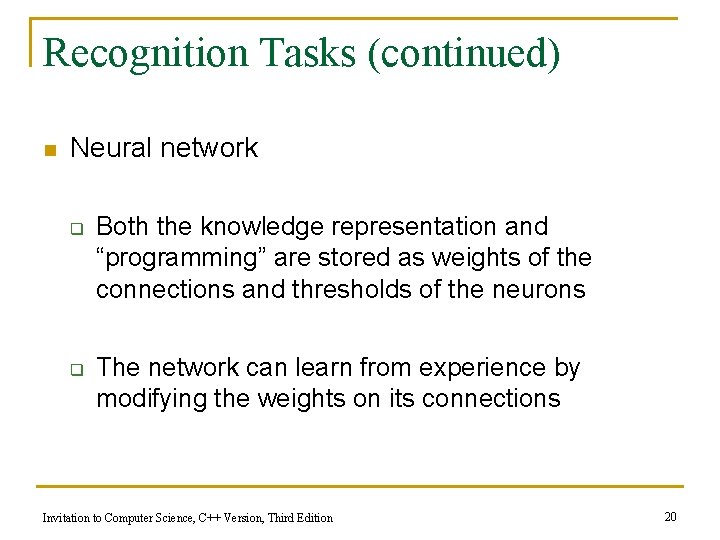
Recognition Tasks (continued) n Neural network q q Both the knowledge representation and “programming” are stored as weights of the connections and thresholds of the neurons The network can learn from experience by modifying the weights on its connections Invitation to Computer Science, C++ Version, Third Edition 20
Reasoning Tasks n Human reasoning requires the ability to draw on a large body of facts and past experience to come to a conclusion n Artificial intelligence specialists try to get computers to emulate this characteristic Invitation to Computer Science, C++ Version, Third Edition 21
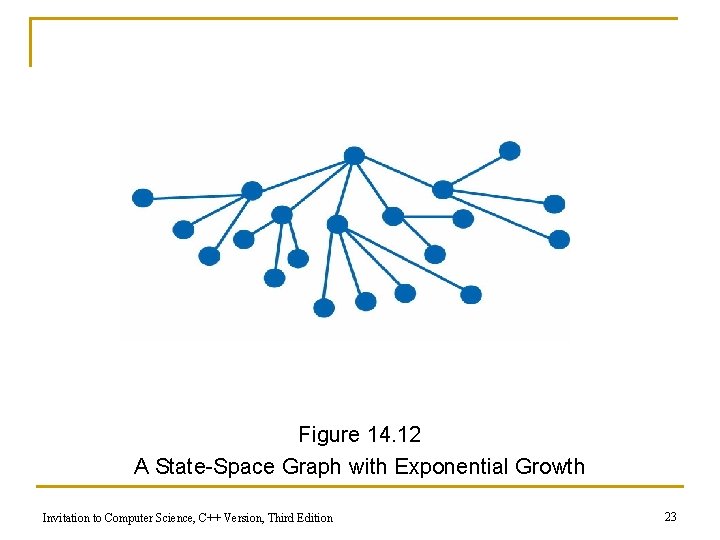
Intelligent Searching n State-space graph: q q n After any one node has been searched, there a huge number of next choices to try There is no algorithm to dictate the next choice State-space search q Finds a solution path through a state-space graph Invitation to Computer Science, C++ Version, Third Edition 22
Figure 14. 12 A State-Space Graph with Exponential Growth Invitation to Computer Science, C++ Version, Third Edition 23
Intelligent Searching (continued) n Each node represents a problem state n Goal state: the state we are trying to reach n Intelligent searching applies some heuristic (or an educated guess) to: q q Evaluate the differences between the present state and the goal state Move to a new state that minimizes those differences Invitation to Computer Science, C++ Version, Third Edition 24
Swarm Intelligence n Swarm intelligence q n Models the behavior of a colony of ants Swarm intelligence model q Uses simple agents that: n Operate independently n Can sense certain aspects of their environment n Can change their environment n May “evolve” and acquire additional capabilities over time Invitation to Computer Science, C++ Version, Third Edition 25
Intelligent Agents n An intelligent agent: software that interacts collaboratively with a user n Initially an intelligent agent simply follows user commands Invitation to Computer Science, C++ Version, Third Edition 26
Intelligent Agents (continued) n Over time q Agent initiates communication, takes action, and performs tasks on its own using its knowledge of the user’s needs and preferences Invitation to Computer Science, C++ Version, Third Edition 27
Expert Systems n Rule-based systems q q Also called expert systems or knowledge-based systems Attempt to mimic the human ability to engage pertinent facts and combine them in a logical way to reach some conclusion Invitation to Computer Science, C++ Version, Third Edition 28
Expert Systems (continued) n A rule-based system must contain q q n A knowledge base: set of facts about subject matter An inference engine: mechanism for selecting relevant facts and for reasoning from them in a logical way Many rule-based systems also contain q An explanation facility: allows user to see assertions and rules used in arriving at a conclusion Invitation to Computer Science, C++ Version, Third Edition 29
Expert Systems (continued) n n A fact can be q A simple assertion q A rule: a statement of the form if. . . then. . . Modus ponens (method of assertion) q The reasoning process used by the inference engine Invitation to Computer Science, C++ Version, Third Edition 30
Expert Systems (continued) n n Inference engines can proceed through q Forward chaining q Backward chaining Forward chaining q Begins with assertions and tries to match those assertions to “if” clauses of rules, thereby generating new assertions Invitation to Computer Science, C++ Version, Third Edition 31
Expert Systems (continued) n Backward chaining q Begins with a proposed conclusion n q Tries to match it with the “then” clauses of rules Then looks at the corresponding “if” clauses n Tries to match those with assertions, or with the “then” clauses of other rules Invitation to Computer Science, C++ Version, Third Edition 32
Expert Systems (continued) n A rule-based system is built through a process called knowledge engineering q Builder of system acquires information for knowledge base from experts in the domain Invitation to Computer Science, C++ Version, Third Edition 33
Summary of Level 5 n Level 5: Applications q Simulation and modeling q New business applications q Artificial intelligence Invitation to Computer Science, C++ Version, Third Edition 34
Summary n Artificial intelligence explores techniques for incorporating aspects of intelligence into computer systems n Categories of tasks: computational tasks, recognition tasks, reasoning tasks n Neural networks simulate individual neurons in hardware and connect them in a massively parallel network Invitation to Computer Science, C++ Version, Third Edition 35
Summary n Swarm intelligence models the behavior of a colony of ants n An intelligent agent interacts collaboratively with a user n Rule-based systems attempt to mimic the human ability to engage pertinent facts and combine them in a logical way to reach some conclusion Invitation to Computer Science, C++ Version, Third Edition 36